
Life, 1888-07-12 · page 10 of 14
Life — July 12, 1888 — page 10: what you’re looking at
What you’re looking at
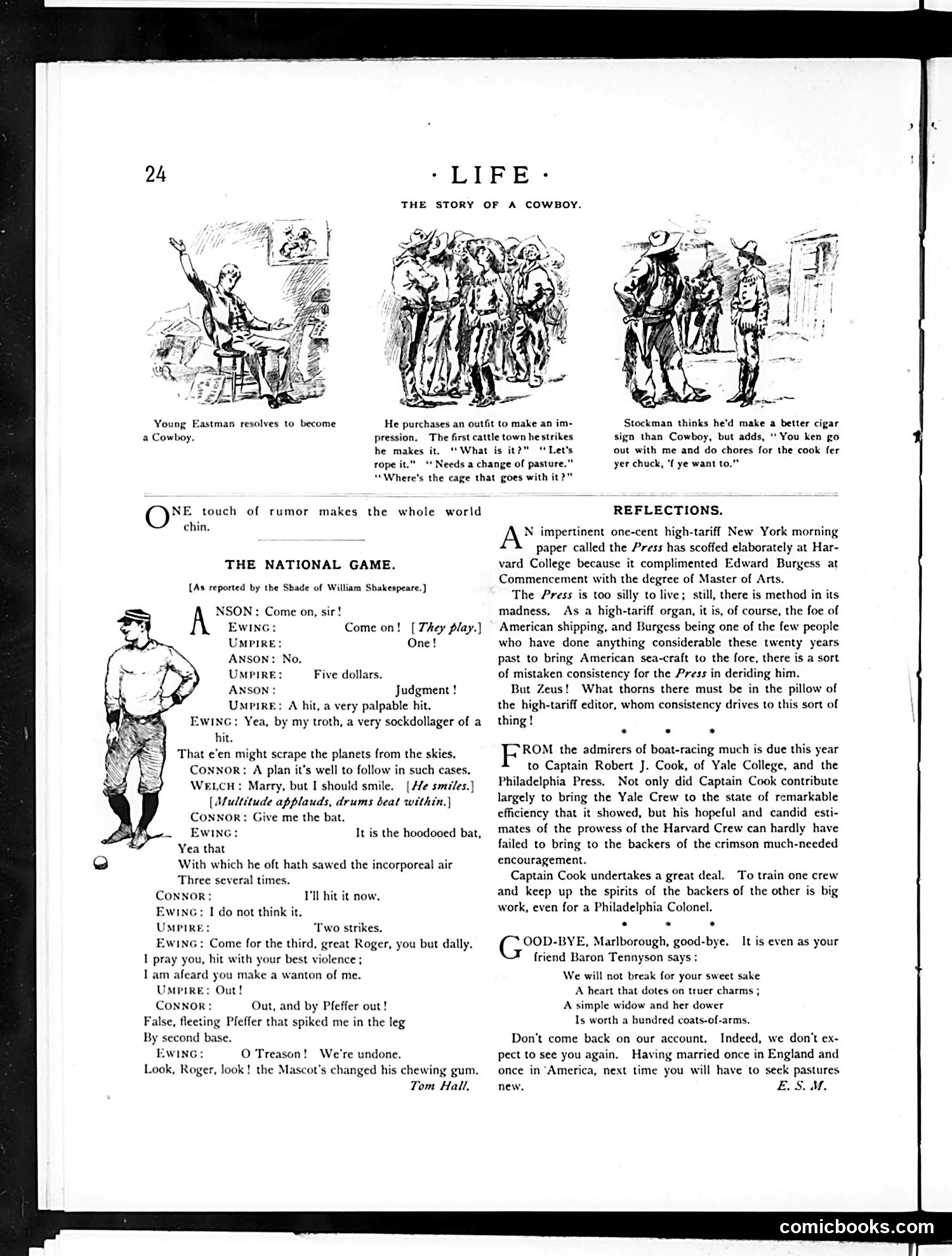
**Top Section - "The Story of a Cowboy":** Three illustrated panels humorously depict an Easterner's failed attempt to become a cowboy. He buys outfit and cattle, but makes poor decisions (keeping a cage with the cattle, suggesting incompetence). A stockman mocks his efforts, offering him domestic chores instead—satirizing naive city people attempting to adopt frontier life without actual skill or experience. **"The National Game":** A baseball dialogue between an umpire and player named Connor and Ewing parodies Shakespeare's language to describe a baseball argument. The humor relies on applying elaborate, formal theatrical speech to a mundane sports dispute—typical of Life's wordplay-based satire. The page emphasizes American humor through incompetence and linguistic incongruity rather than political commentary.
📄 Transcribed text from this page (OCR, searchable)
Machine-transcribed from the original scan — historical spelling and the odd misread are preserved.
‘LIFE: THE STORY OF A COWBOY. Young Eastman resolves to become a Cowboy. pression. he makes it. rope it.” He purchases an outfit to make an im- The first cattle town he strikes “What is it?” Needs a change of pasture.” Stockman thinks he'd make a better cigar sign than Cowboy, but adds, “You ken go out with me and do chores for the cook fer yer chuck, ‘f ye want to." “Let's “Where's the cage that goes with it?” NE touch chin, of rumor makes the whole world THE NATIONAL GAME. [As reported by the Shade of William Shakespeare.] NSON : Come on, sir! Gs Come on! [ They play.) One! Five dollars. ANSON Judgment ! Umpire: A hit, a very palpable hit. EwinG: Yea, by my troth, a very sockdollager of a hit. That e’en might scrape the planets from the skies, Connor: A plan it's well to follow in such cases. WELCH: Marry, but I should smile. [/e suts/es.] (Atudtitude applauds, drums beat within.) Connor: Give me the bat. EWING: Yea that With which he oft hath sawed the incorporeal air Three several times. CONNOR: Ew1nG: I do not think it. UMPIRE: Two strikes. EwinG: Come for the third, great Roger, you but dally. I pray you, hit with your best violence ; 1am afeard you make a wanton of me. UMprRe: Out! CONNOR: Out, and by Pfeffer out! False, fleeting Pfeffer that spiked me in the leg By second base. EWING: O Treason! Look, Roger, look! the 3 It is the hoodooed bat, T'll hit it now, We're undone. cot’s changed his chewing gum. Tom Hall. REFLECTIONS. N impertinent one-cent high-tariff New York morning paper called the Press has scoffed elaborately at Har- vard College because it complimented Edward Burgess at Commencement with the degree of Master of Arts. The Press is too silly to live; still, there is method in its madness. As a high-tariff organ, it is, of course, the foe of American shipping, and Burgess being one of the few people who have done anything considerable these twenty years past to bring American sea-craft to the fore, there is a sort of mistaken consistency for the Press in deriding him. But Zeus! What thorns there must be in the pillow of the high-tariff editor, whom consistency drives to this sort of thing! + . . ROM the admirers of boat-racing much is due this year to Captain Robert J. Cook, of Yale College, and the Philadelphia Press. Not only did Captain Cook contribute largely to bring the Yale Crew to the state of remarkable efficiency that it showed, but his hopeful and candid esti- mates of the prowess of the Harvard Crew can hardly have failed to bring to the backers of the crimson much-needed encouragement. Captain Cook undertakes a great deal. To train one crew and keep up the spirits of the backers of the other is big work, even for a Philadelphia Colonel. . . . OOD-BYE, Marlborough, good-bye. friend Baron Tennyson says : We will not break for your sweet sake A heart that dotes on truer charms ; A simple widow and her dower Is worth a hundred coats-of-arms. Don’t come back on our account. Indeed, we don’t ex- pect to see you again. Having married once in England and once in ‘America, next time you will have to seek pastures new, ELS. M. It is even as your comicbooks.com