
Life, 1888-07-12 · page 6 of 14
Life — July 12, 1888 — page 6: what you’re looking at
What you’re looking at
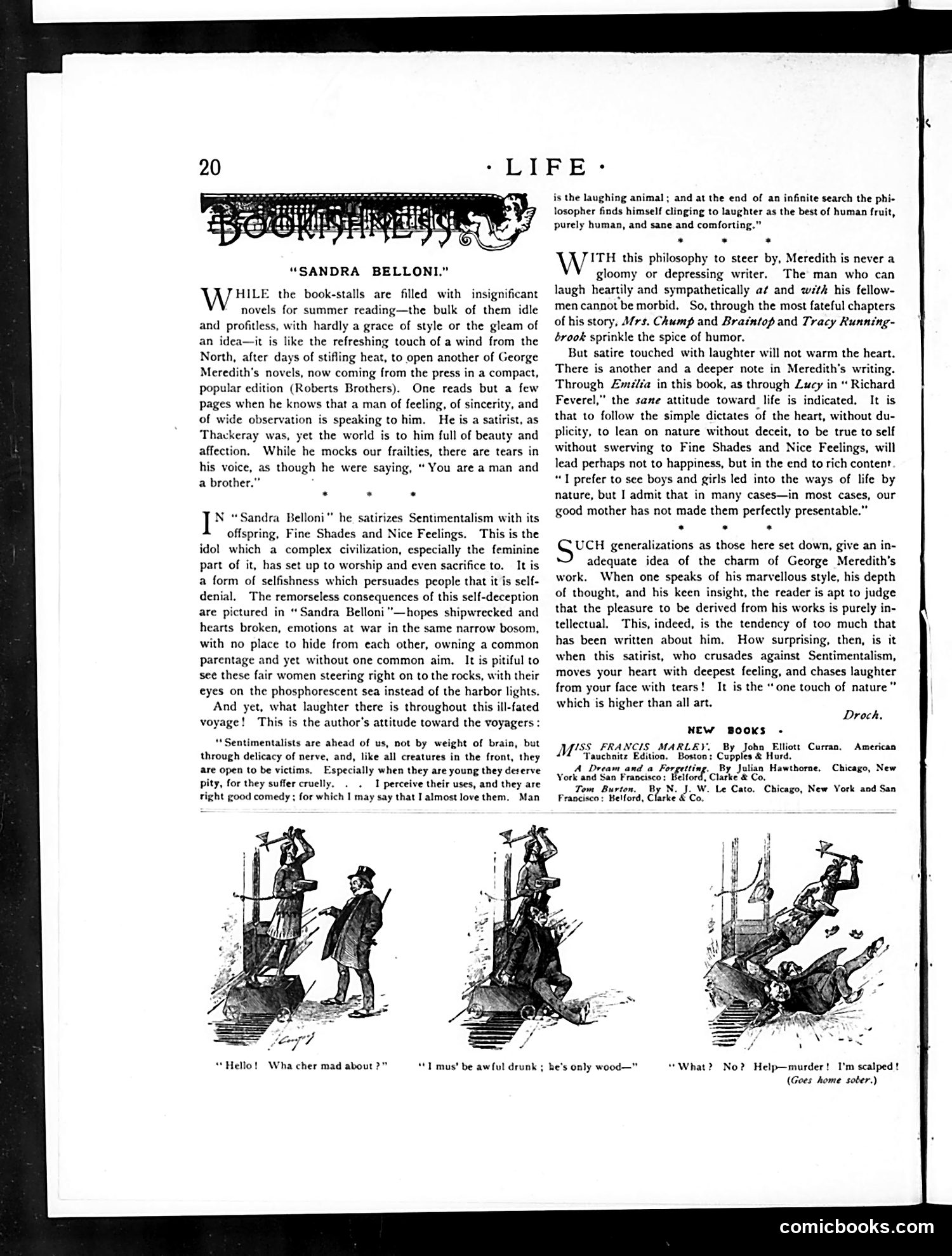
This page reviews George Meredith's novels, particularly "Sandra Belloni." The text praises Meredith as a satirist who uses humor to expose sentimentality and "Fine Shades and Nice Feelings"—likely Victorian affectations about emotion and morality. The three cartoons below illustrate this satire through slapstick comedy: a man encounters what appears to be a woman (or figure in feminine dress) near a pole, leading to escalating physical mishaps—drunkenness, then violence and injury. The captions emphasize the absurdity ("I mus' be awful drunk; he's only wood"). The cartoons mock the exaggerated emotional responses and social pretense Meredith critiques. The page essentially argues that Meredith's satirical approach—deflating pretense through comedy—is more honest and humanizing than sentimental literature of the era.
📄 Transcribed text from this page (OCR, searchable)
Machine-transcribed from the original scan — historical spelling and the odd misread are preserved.
- LI “SANDRA BELLONI.” HILE the book-stalls are filled with insignificant novels for summer reading—the bulk of them idle and profitless, with hardly a grace of style or the gleam of an idea—it is like the refreshing touch of a wind from the North, after days of stifling heat, to open another of George Meredith's novels, now coming from the press in a compact, popular edition (Roberts Brothers). One reads but a few pages when he knows that a man of feeling, of sincerity, and of wide observation is speaking to him. He is a satirist, as Thackeray was, yet the world is to him full of beauty and affection. While he mocks our frailties, there are tears in his voice, as though he were saying, “ You are a man and a brother.” J “Sandra Belloni” he satirizes Sentimentalism with its offspring, Fine Shades and Nice Feelings. This is the idol which a complex civilization, especially the feminine part of it, has set up to worship and even sacrifice to. It is a form of selfishness which persuades people that it is self- denial. The remorseless consequences of this self-deception are pictured in “Sandra Belloni "—hopes shipwrecked and hearts broken, emotions at war in the same narrow bosom, with no place to hide from each other, owning a common parentage and yet without one common aim. It is pitiful to see these fair women steering right on to the rocks, with their eyes on the phosphorescent sea instead of the harbor lights. And yet, what laughter there is throughout this ill-fated voyage! This is the author's attitude toward the voyagers : “Sentimentalists are ahead of us, not by weight of brain, but through delicacy of nerve, and, like all creatures in the front, they are open to be victims. Especially when they are young they deserve pity, for they suffer cruelly. . . I perceive their uses, and they are right good comedy ; for which I may say that I almost love them. Man “Hello! Wha cher mad about?” “1 mus’ be awful drunk ; FE: is the laughing animal; and at the end of an infinite search the phi- losopher finds himself clinging to laughter as the best of human fruit, purely human, and sane and comforting.” . . . ITH this philosophy to steer by, Meredith is never a gloomy or depressing writer. The man who can laugh heartily and sympathetically a¢ and with his fellow- men cannot be morbid. So, through the most fateful chapters of his story, Mfrs. Chump and Braintop and Tracy Running- brook sprinkle the spice of humor. But satire touched with laughter will not warm the heart. There is another and a deeper note in Meredith's writing. Through Eméira in this book, as through Lucy in “ Richard Feverel,” the sane attitude toward life is indicated. It is that to follow the simple dictates of the heart, without du- plicity, to lean on nature without deceit, to be true to self without swerving to Fine Shades and Nice Feelings, will lead perhaps not to happiness, but in the end to rich content “I prefer to see boys and girls led into the ways of life by nature, but I admit that in many cases—in most cases, our good mother has not made them perfectly presentable.” . . . UCH generalizations as those here set down, give an in- adequate idea of the charm of George Meredith’s work. When one speaks of his marvellous style, his depth of thought, and his keen insight, the reader is apt to judge that the pleasure to be derived from his works is purely in- tellectual. This, indeed, is the tendency of too much that has been written about him. How surprising, then, is it when this satirist, who crusades against Sentimentalism, moves your heart with deepest feeling, and chases laughter from your face with tears! It is the “one touch of nature” which is higher than all art. Droch. NEW Books - MISS. FRANCIS MARLEY. By Joba Elliott Curran. American 411° Tauchaitz Edition, Boston: Cupples & Hurd. A Dream and a Forgetting. By Julian Hawthorne, Chicago, New York and San Francisco: Belford, Clarke & Co. Tom Burton. By N. J. W. Le Cato. Chicago, New Vork and San Francisco: Belford, Clarke & Co, he's only wood—" “What? No? Help—murder! I'm scalped! (Goes home sober.) comicbooks.com