
A complete issue · 21 pages · 1888
Life — June 28, 1888
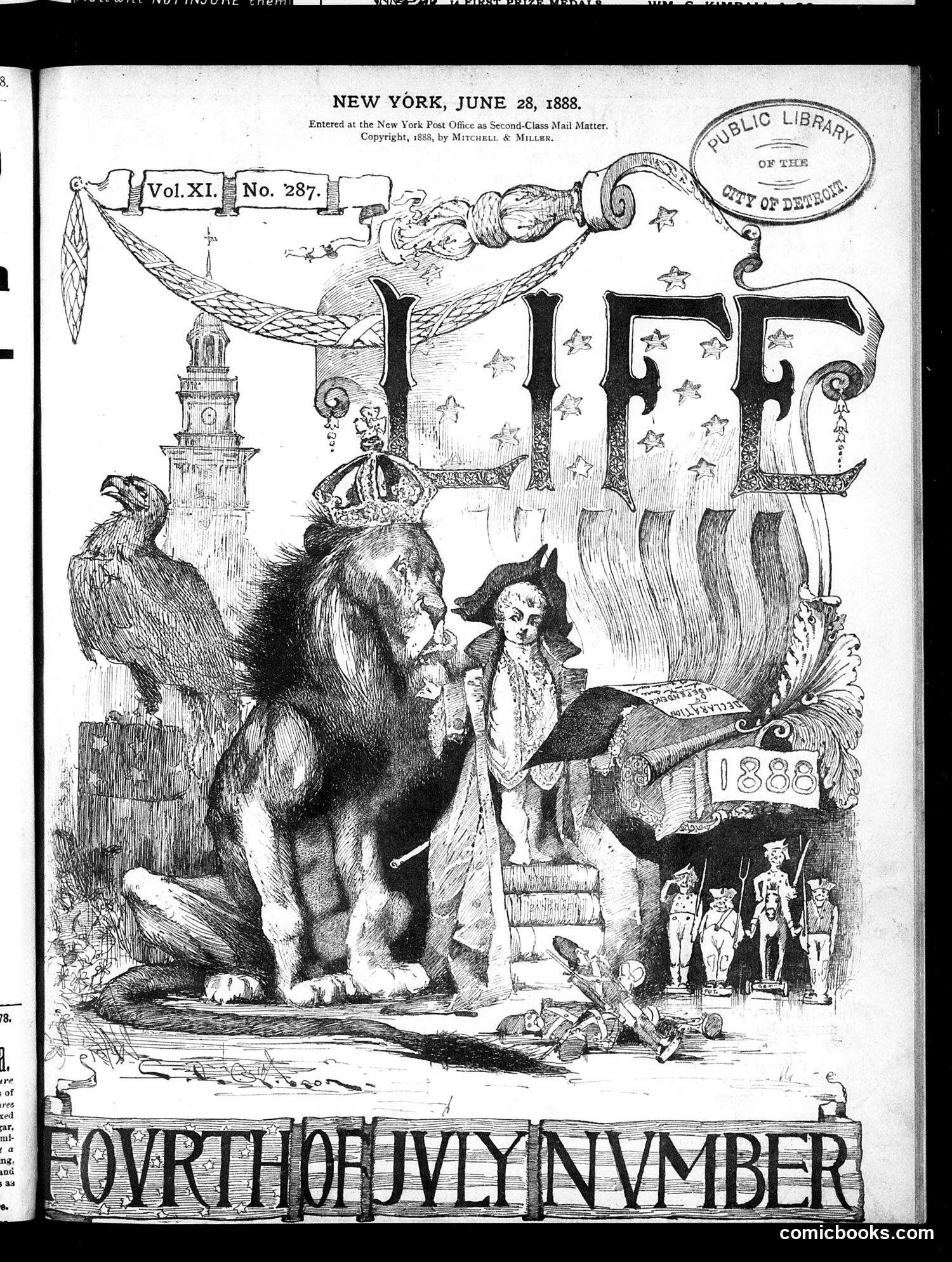
This cover celebrates America's Fourth of July independence with allegorical imagery. The large bear wearing a crown appears to represent Russia, depicted as a threatening foreign power. A small demonic or devilish figure confronts the bear, while a lighthouse (symbolizing American guidance/stability) stands nearby. The scattered figures at bottom appear to be American citizens or soldiers. Stars float throughout the composition, emphasizing patriotic themes. The title "FOURTH OF JULY NUMBER" indicates this is a holiday-themed issue. The satire likely comments on American strength versus European imperial powers (particularly Russia), a common theme in 1880s American political cartoons during periods of tension between the nations. The exact political event being referenced remains somewhat unclear without additional context.
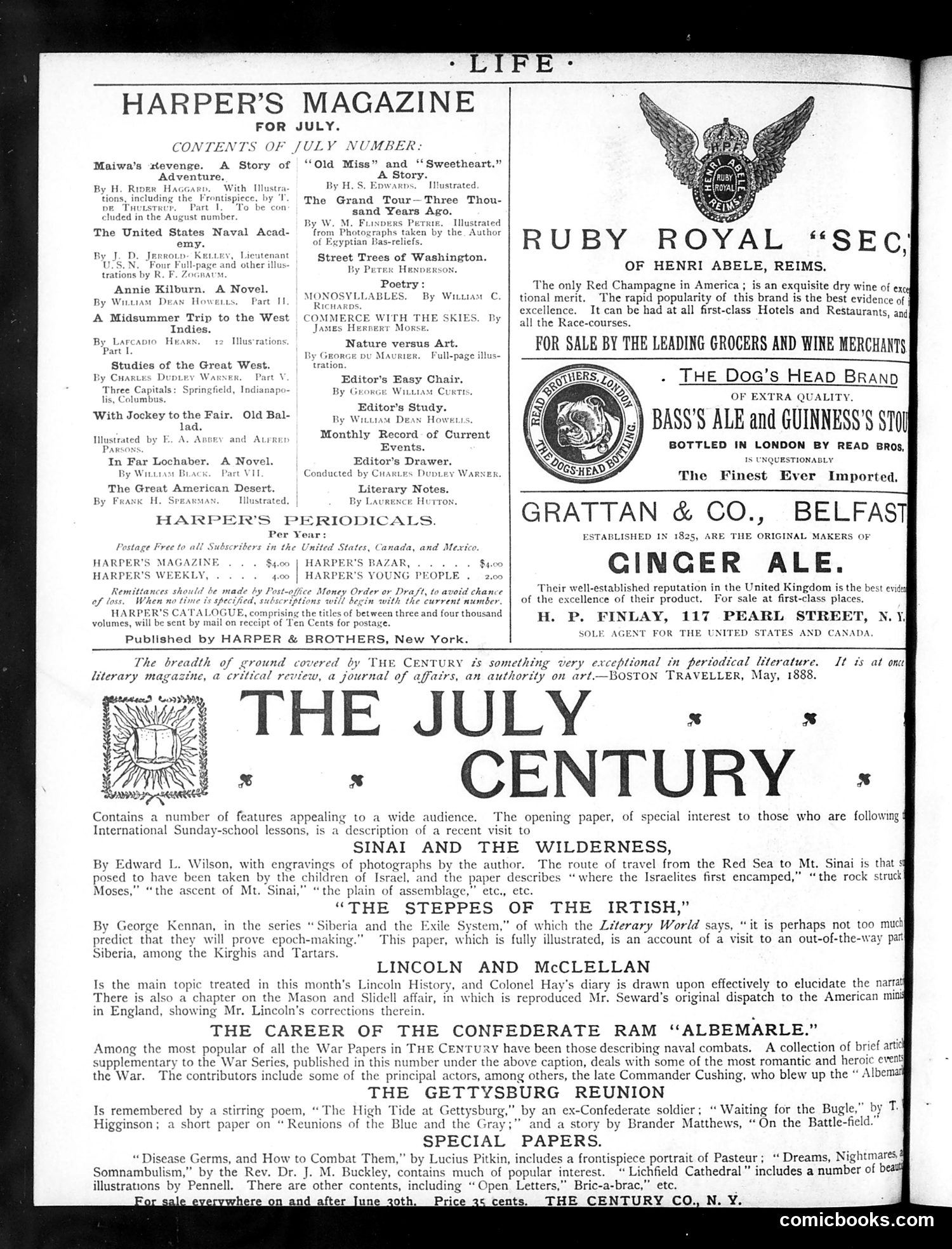
This page is primarily **advertising and magazine promotion**, not political satire. The upper half contains ads for luxury goods (Ruby Royal champagne, Bass's Ale, Grattan & Co.'s ginger ale) targeting wealthy readers. The lower half promotes **The Century magazine's July issue**. Article titles listed include "Sinai and the Wilderness," "The Steppes of the Irish," and "Lincoln and McClellan"—historical and geographical pieces rather than satire. One heading mentions "The Career of the Confederate Ram 'Albemarle'" and "The Gettysburg Reunion," indicating Civil War content, likely nostalgic rather than satirical given the post-war period. **No political cartoons or caricatures are visible on this page.** It's a historical document showing late 19th-century magazine marketing to an educated, affluent audience.
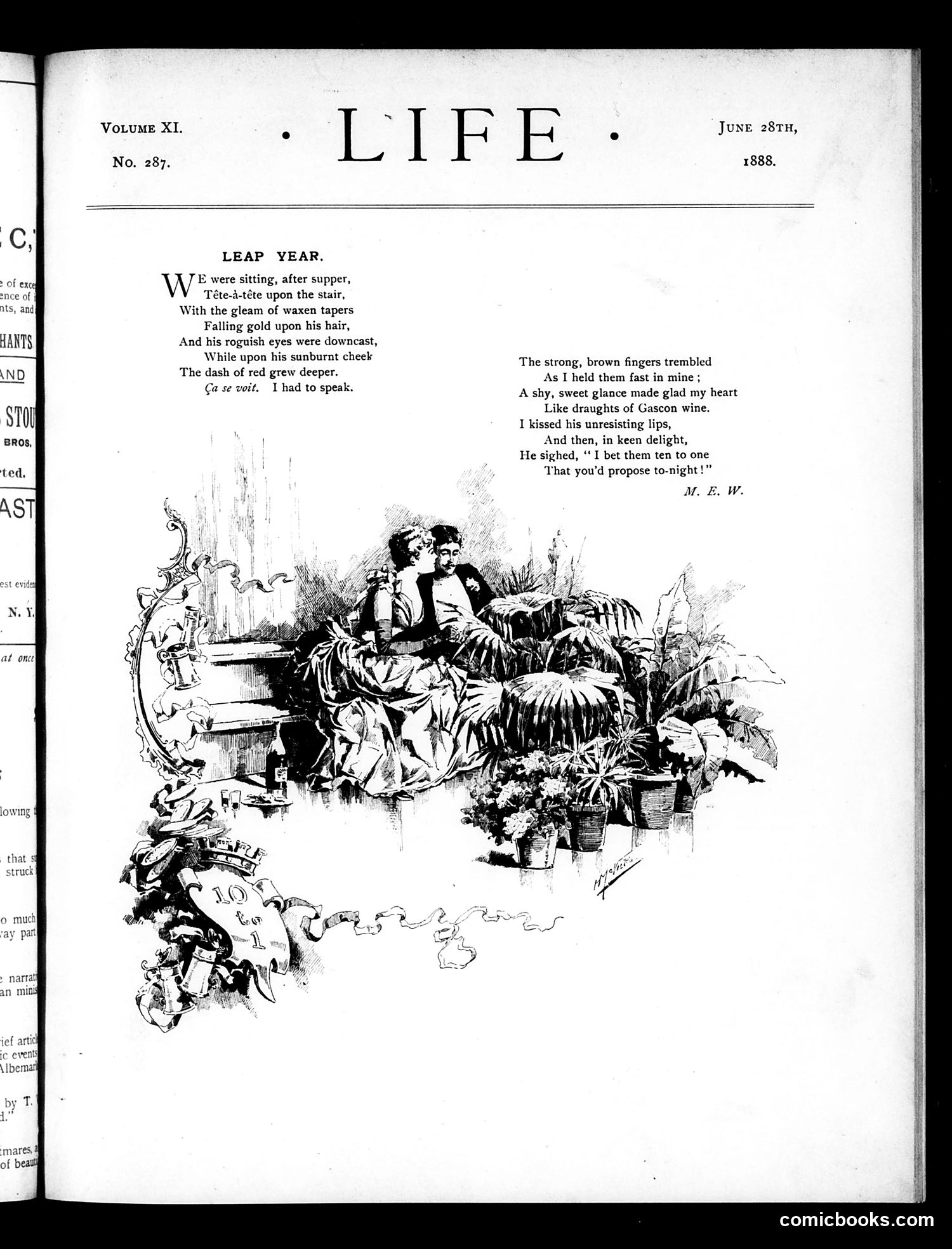
This poem celebrates the tradition of **Leap Year**, when women could conventionally propose to men—reversing normal gender roles. The illustrated couple depicts a woman boldly declaring her romantic intentions during this socially-sanctioned reversal. The poem's narrative describes a woman making an advance to a reluctant man ("his rougish eyes were downcast"), emphasizing the unusual scenario where female agency in courtship was temporarily acceptable. The accompanying illustration shows an intimate moment in a conservatory setting, romanticizing this brief female empowerment. The satire gently mocks both Victorian courtship conventions and the absurdity of restricting women's romantic agency to a single leap year occurrence. The initials "M.E.W." credit the author. This reflects 1880s attitudes toward gender roles and marriage customs.
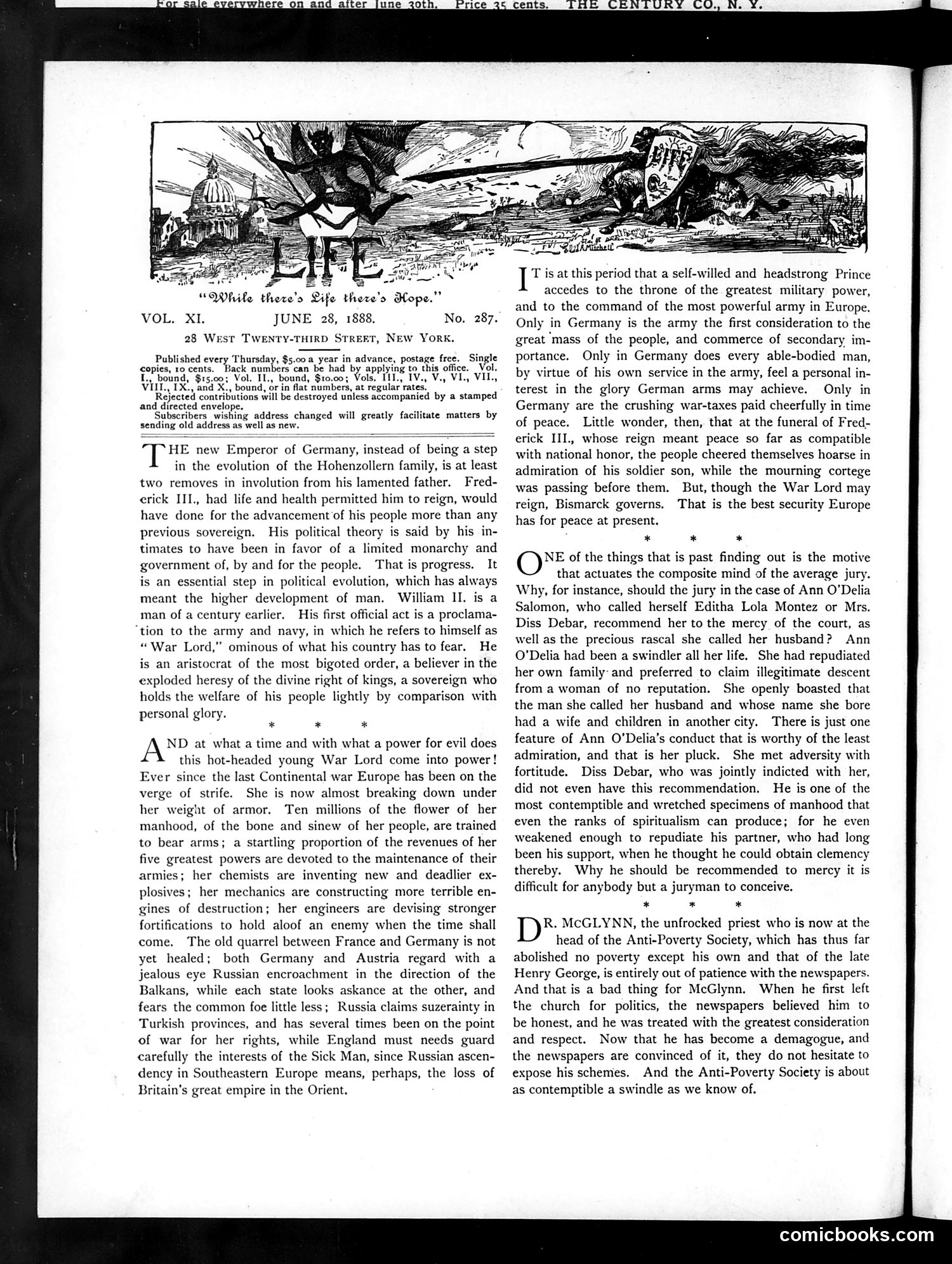
The masthead cartoon depicts a large tree uprooted amid European landscape and architectural ruins, likely symbolizing political upheaval in Germany following Emperor Frederick III's death and his son Wilhelm II's accession to the throne. The article's text discusses Wilhelm II as a militaristic "War Lord" whose aggressive policies threaten European stability. It criticizes his absolute power and compares him unfavorably to his father Frederick III, praising the latter's progressive politics and constitutional monarchy ideals. The satirical angle warns American readers that Wilhelm II represents dangerous autocratic militarism—his "hot-headed" nature and vast military resources pose threats to European peace and Britain's interests. The cartoon's destruction imagery reinforces this warning about the consequences of his warlike leadership.
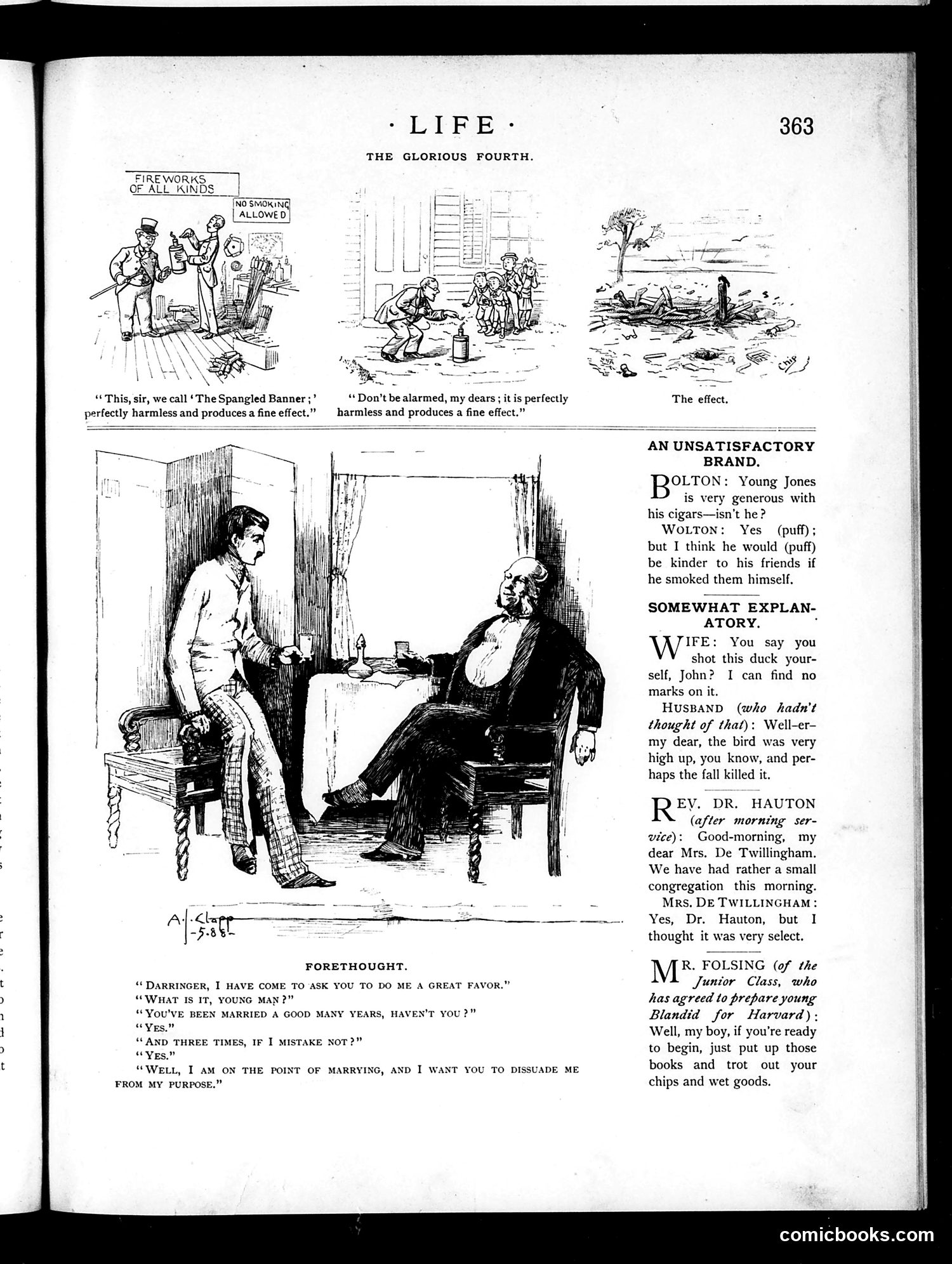
**Top Section - "The Glorious Fourth":** These cartoons satirize Fourth of July fireworks safety. The left panel mocks "The Spangled Banner" fireworks as "perfectly harmless" while showing chaos. The middle and right panels show the dangerous results—injuries and destruction. This criticizes the casual attitude toward fireworks hazards during Independence Day celebrations. **Middle Section - "Forethought":** A dialogue cartoon where a man asks another to help him disguise his purpose before marriage, claiming he needs three trial periods first. It's a bachelor's anxiety joke about matrimonial commitment and deception. **Right Section - Short humor pieces:** Includes brief jokes about cigars, duck hunting, and other minor social observations typical of the era's magazine humor. The page reflects early 20th-century American domestic humor and safety concerns.
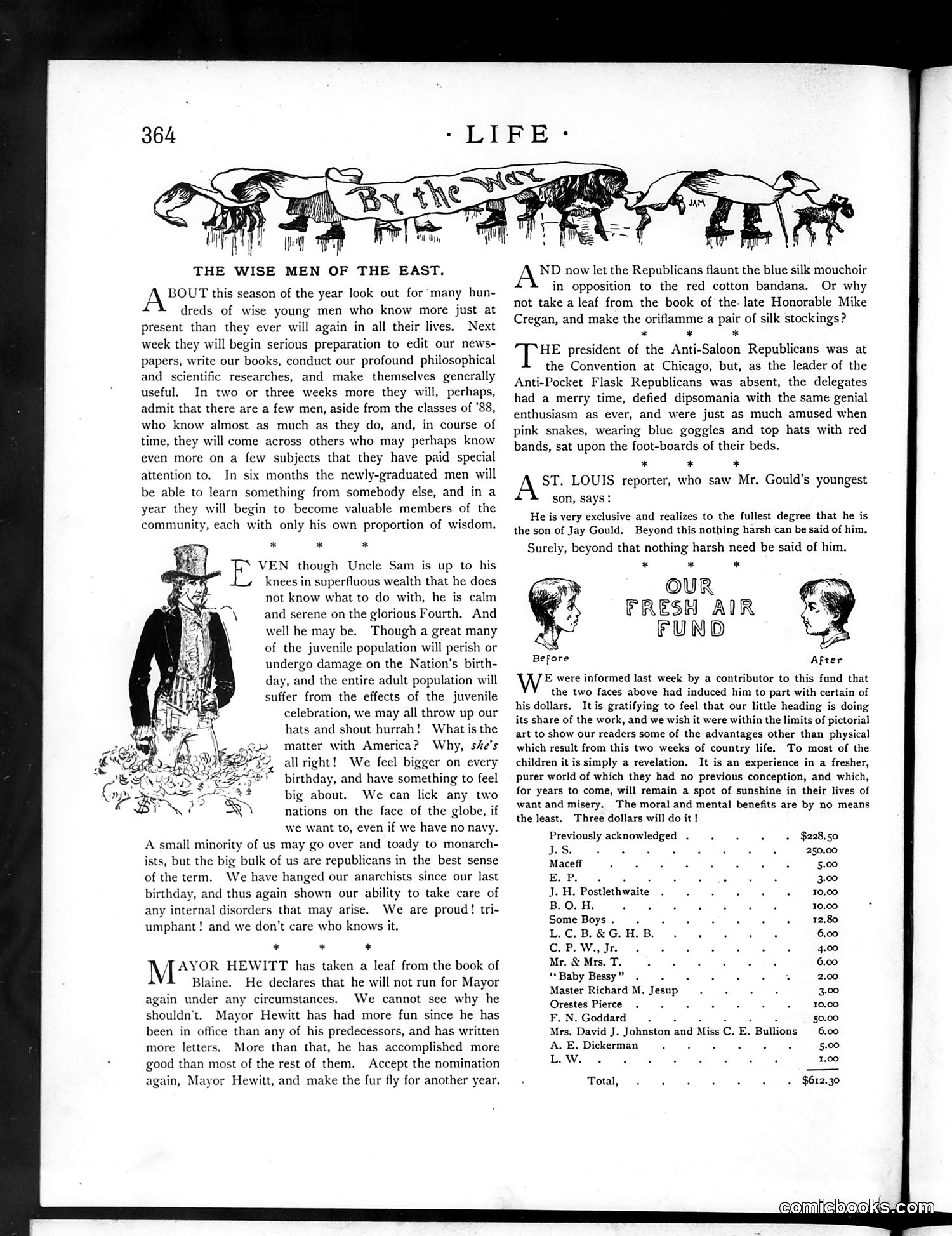
This satirical page mocks Republican political figures and conventions of the Gilded Age era. "The Wise Men of the East" section ridicules young Republican journalists and politicians preparing for the upcoming election season, suggesting they're self-important despite limited knowledge. The cartoon features **Uncle Sam** (identifiable by his characteristic top hat and stars-and-stripes clothing), depicted amid chaos, commenting on the Fourth of July and juvenile celebrations—likely satirizing concerns about rowdy holiday behavior. The text also mocks the "Anti-Saloon Republicans" convention at Chicago, describing delegates wearing absurd attire (blue goggles, red-banded hats) engaged in undignified behavior. This appears to ridicule prohibitionist Republicans as eccentric and hypocritical. The "Our Fresh Air Fund" section shifts to charitable fundraising, listing small donations.
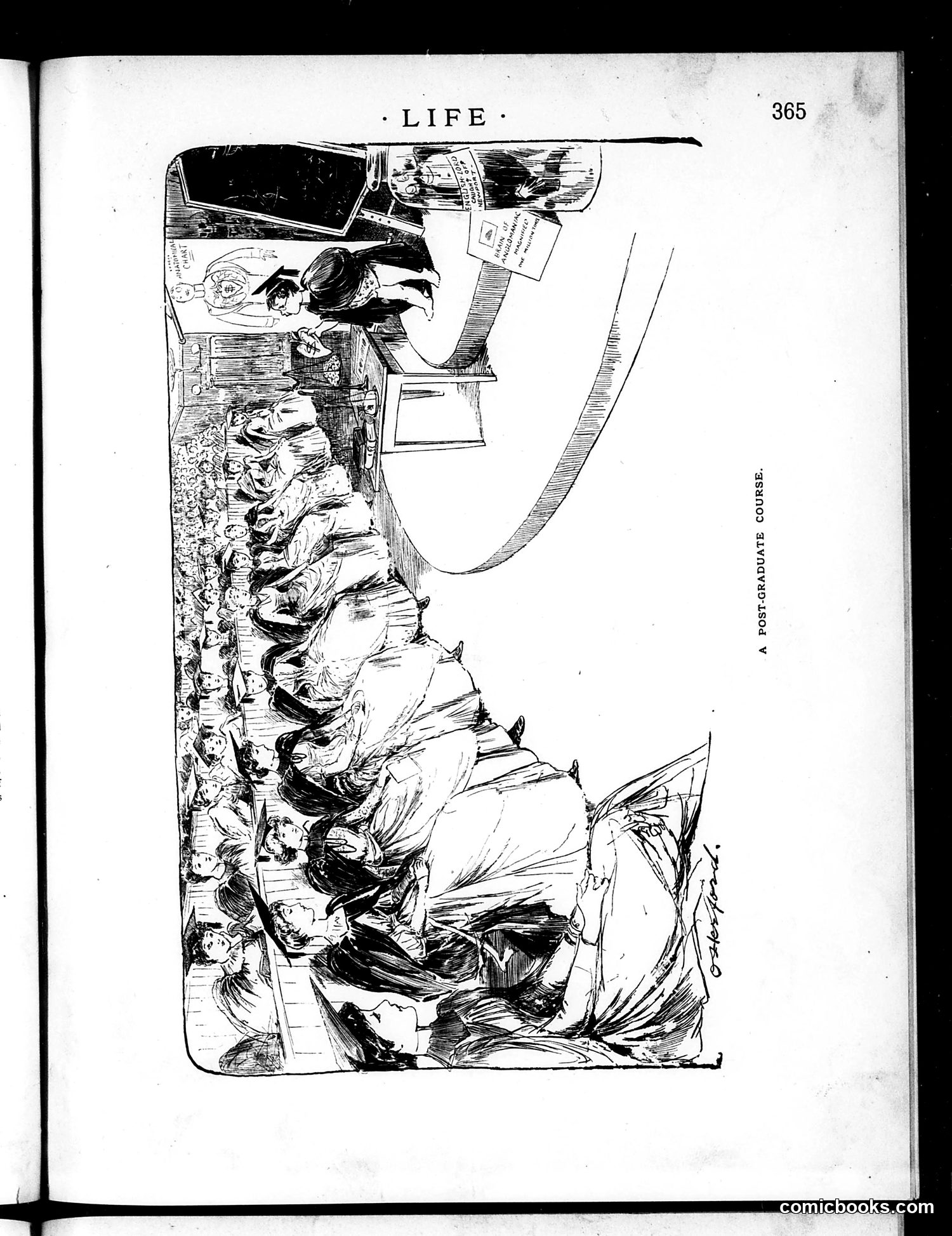
This satirical cartoon depicts a classroom scene titled "A Post-Graduate Course," showing what appears to be a graduation or advanced education setting. The image is rotated 90 degrees, displaying multiple figures arranged vertically—likely representing students or graduates in formal attire. The specific political or social reference is unclear from the visible text and image alone. The cartoon's meaning depends on context from the original Life magazine issue (page 365), which isn't provided. The satire likely comments on higher education, professional advancement, or social climbing of the era, but without identifying the specific figures or accompanying article text, I cannot definitively explain the targeted subject or intended joke to a modern reader.
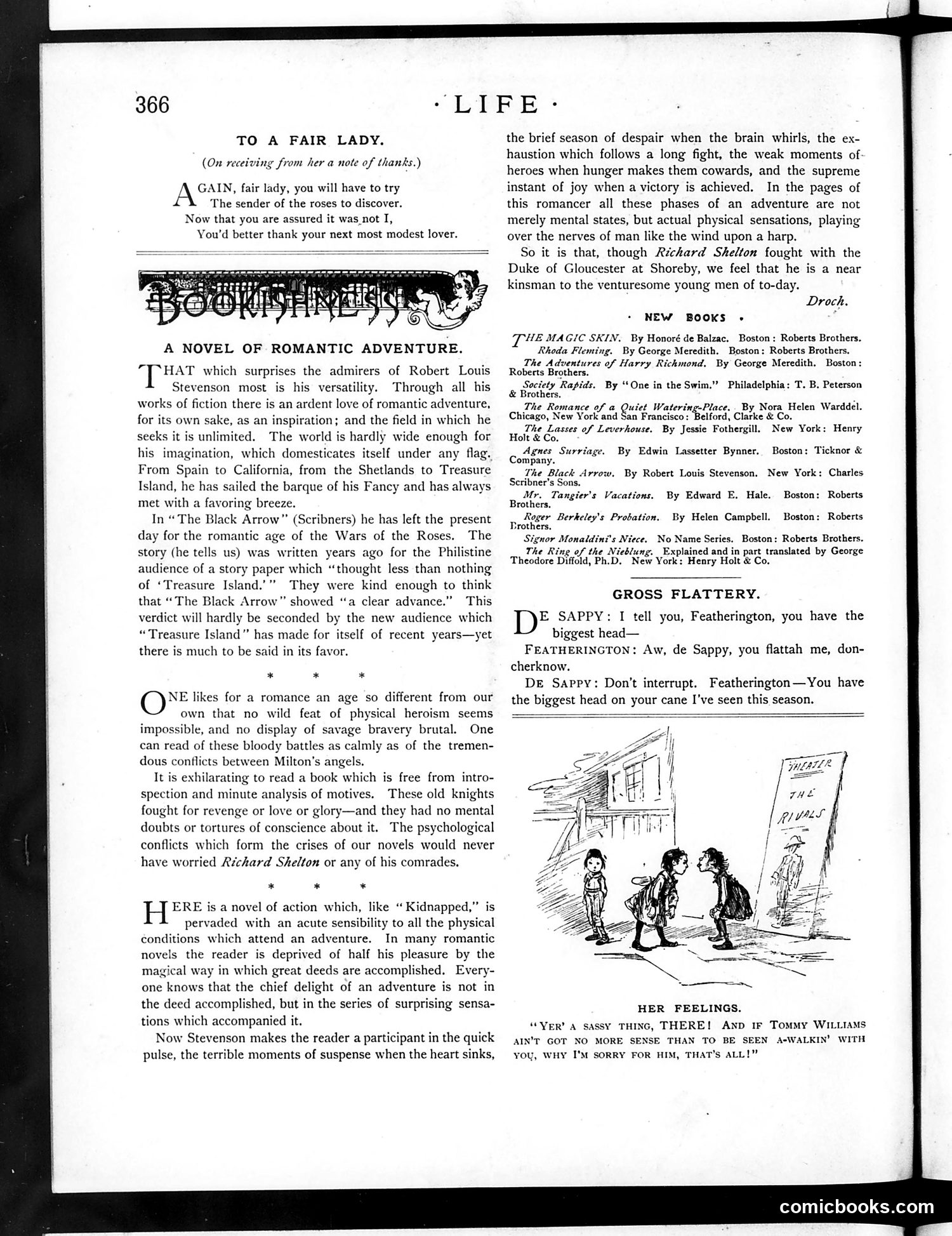
This page combines literary criticism with a humorous sketch titled "Her Feelings." The main text reviews romantic adventure novels, particularly praising Robert Louis Stevenson's work and contrasting old-fashioned adventure stories (featuring knights fighting "for revenge or love or glory") with modern psychological novels. The cartoon below shows three street urchins discussing a boy named Tommy Williams. One character (de Sappy) mocks another (Featherington) for having "the biggest head" on his cane. The punchline, printed in capitals, suggests Tommy has been seen "a-walkin'" with someone and lost his common sense—implying romantic infatuation has made him foolish. The joke satirizes how love makes people act irrationally, tying thematically to the page's discussion of romantic adventure narratives.
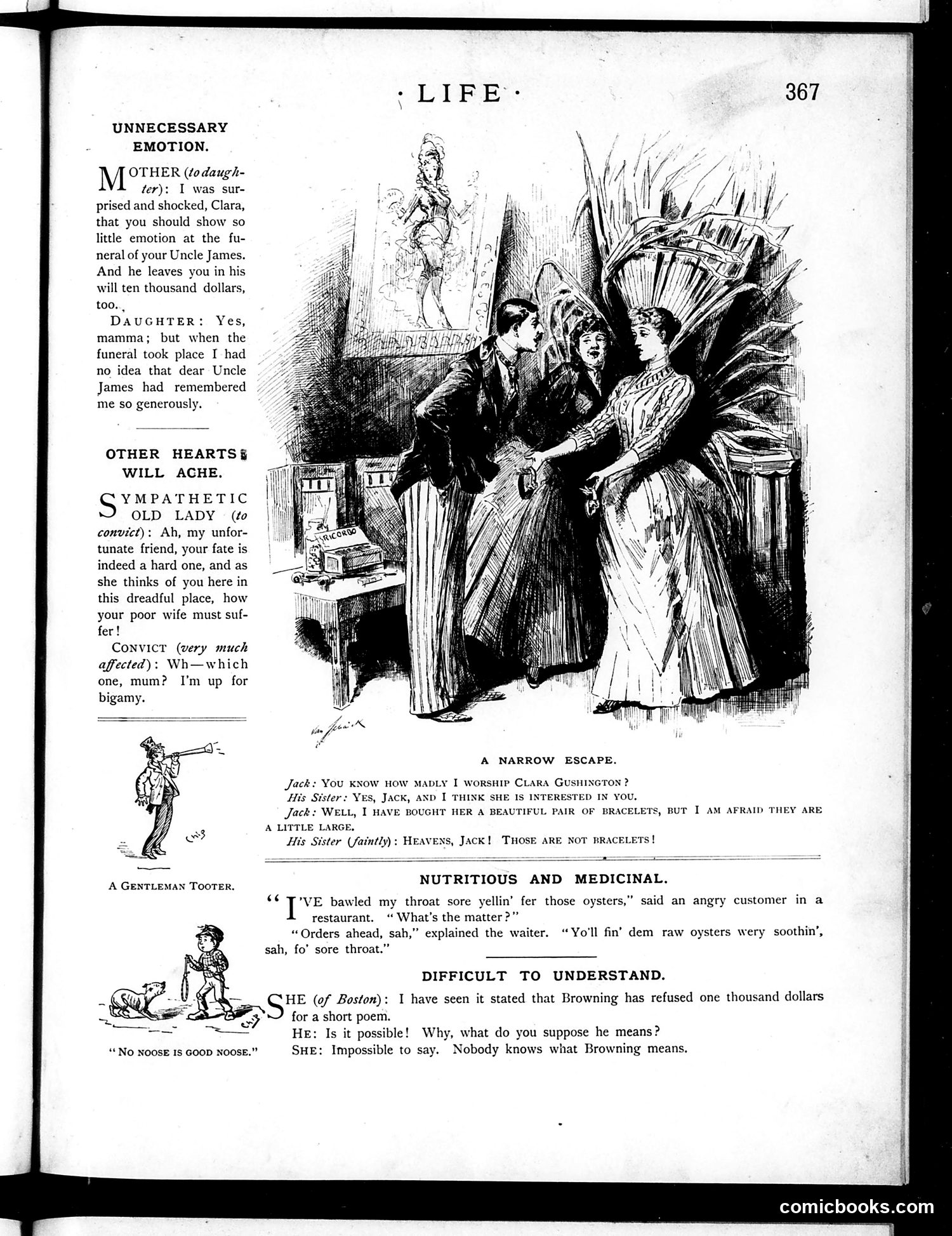
This page contains several satirical sketches typical of early Life magazine's humor: **"Unnecessary Emotion"** satirizes a daughter's restrained grief over an uncle's death—she's unmoved by his generosity ($10,000 inheritance) but shocked by his lack of remembrance toward her. **"Other Hearts Will Ache"** mocks excessive sympathy, with a "Sympathetic Old Lady" expressing melodramatic concern about a friend's wife, only to reveal she's primarily worried about the friend's bigamy charge. **"A Narrow Escape"** depicts a man buying bracelets for a woman named Clara Gushington, nearly exposed as a scoundrel when his sister intervenes. **"A Gentleman Tooter"** and the oyster/throat anecdote are brief joke vignettes about social absurdities and miscommunication—typical of the magazine's light, observational humor format.
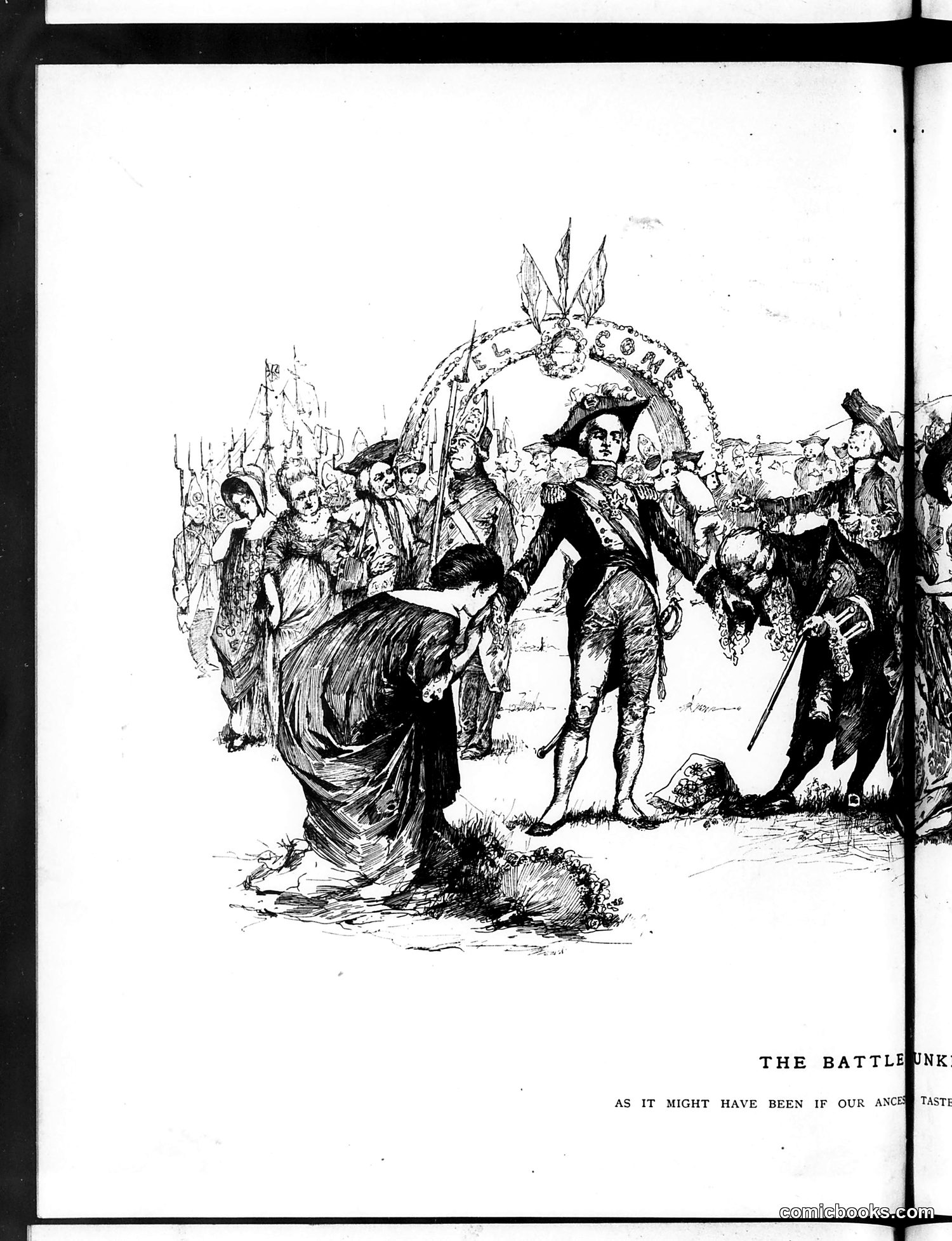
This satirical illustration depicts a military procession with ornate, elaborate pageantry. A figure in military dress stands centrally, surrounded by uniformed officers and what appears to be ceremonial attendants bearing decorative standards or insignia. The caption reads: "THE BATTLEJUNK: AS IT MIGHT HAVE BEEN IF OUR ANCESTORS..." The satire appears to critique military pomp and ceremony, suggesting that if history had unfolded differently, warfare might have involved even more extravagant, ornamental displays. The densely detailed line work emphasizes the excessive decoration and formality of the scene, mocking the spectacle surrounding military authority and conflict. The incomplete caption suggests this compares past or potential practices to contemporary military customs, likely critiquing the gap between martial pageantry and actual combat necessity.
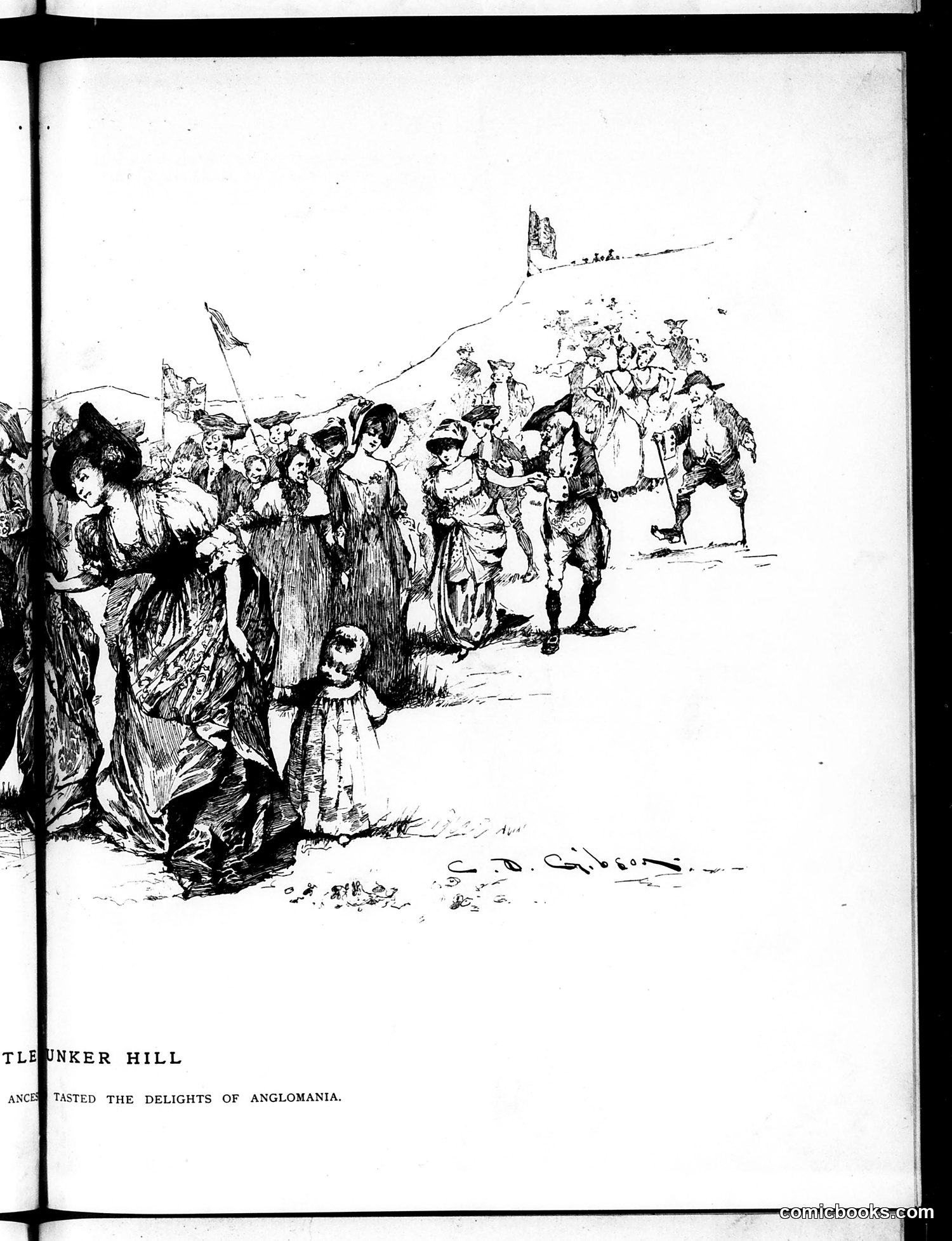
This illustration depicts **Bunker Hill** (a famous American Revolutionary War battle site) personified as a figure experiencing "Anglomania"—an obsessive admiration for English customs and culture. The sketch shows a large crowd of elaborately dressed figures in what appears to be a fashionable social gathering, likely mocking upper-class Americans who slavishly imitated British styles and manners. The satire suggests that even this historically significant American location—symbol of independence from Britain—has succumbed to anglophilia. The "delights" referenced are sarcastically presented as the frivolous fashions and affected behaviors of those aping English society, contrasting sharply with Bunker Hill's revolutionary significance. This reflects early American anxieties about cultural independence from Britain.
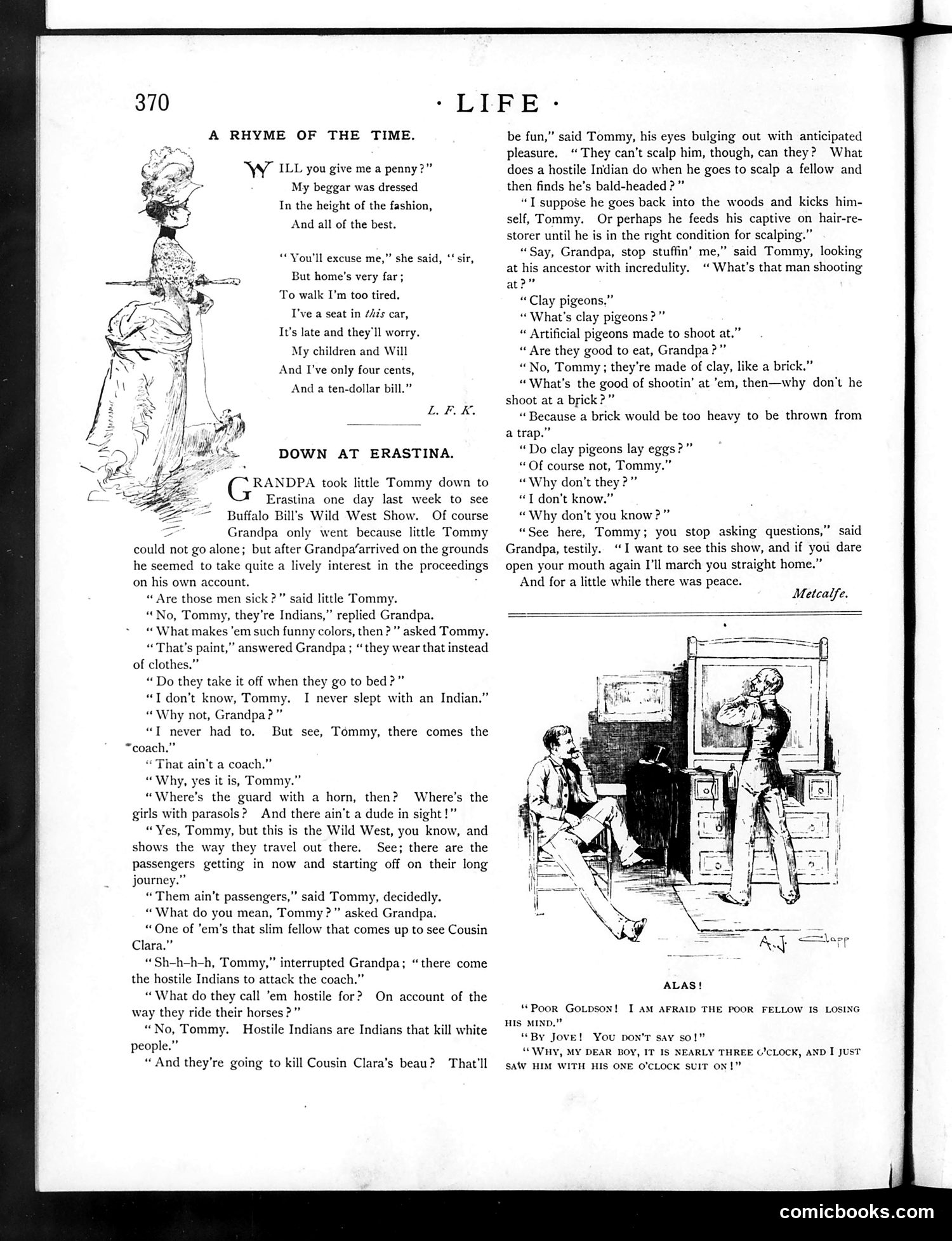
**"A Rhyme of the Time"** satirizes wealth inequality: a fashionably-dressed beggar paradoxically claims poverty while mentioning a "ten-dollar bill" and a car—mocking the contradiction of wealthy appearance masking financial desperation, or perhaps critiquing conspicuous consumption during economic hardship. **"Down at Erastina"** depicts a grandfather and grandson at Buffalo Bill's Wild West Show. Tommy's naive questions expose the artificiality of the performance: he questions whether Indians are sick, challenges the coach authenticity, and asks practical questions about clay pigeons. The humor lies in adult pretense versus childhood logic—Tommy sees through the show's theatrical conventions that adults accept. **"Alas!"** jokes about a man's mental decline through fashion obsession: he's seen wearing his "one o'clock suit" at three o'clock, suggesting he's lost his mind by breaking rigid Victorian dress codes (different suits for different times of day). This satirizes rigid class conventions and their absurdity.
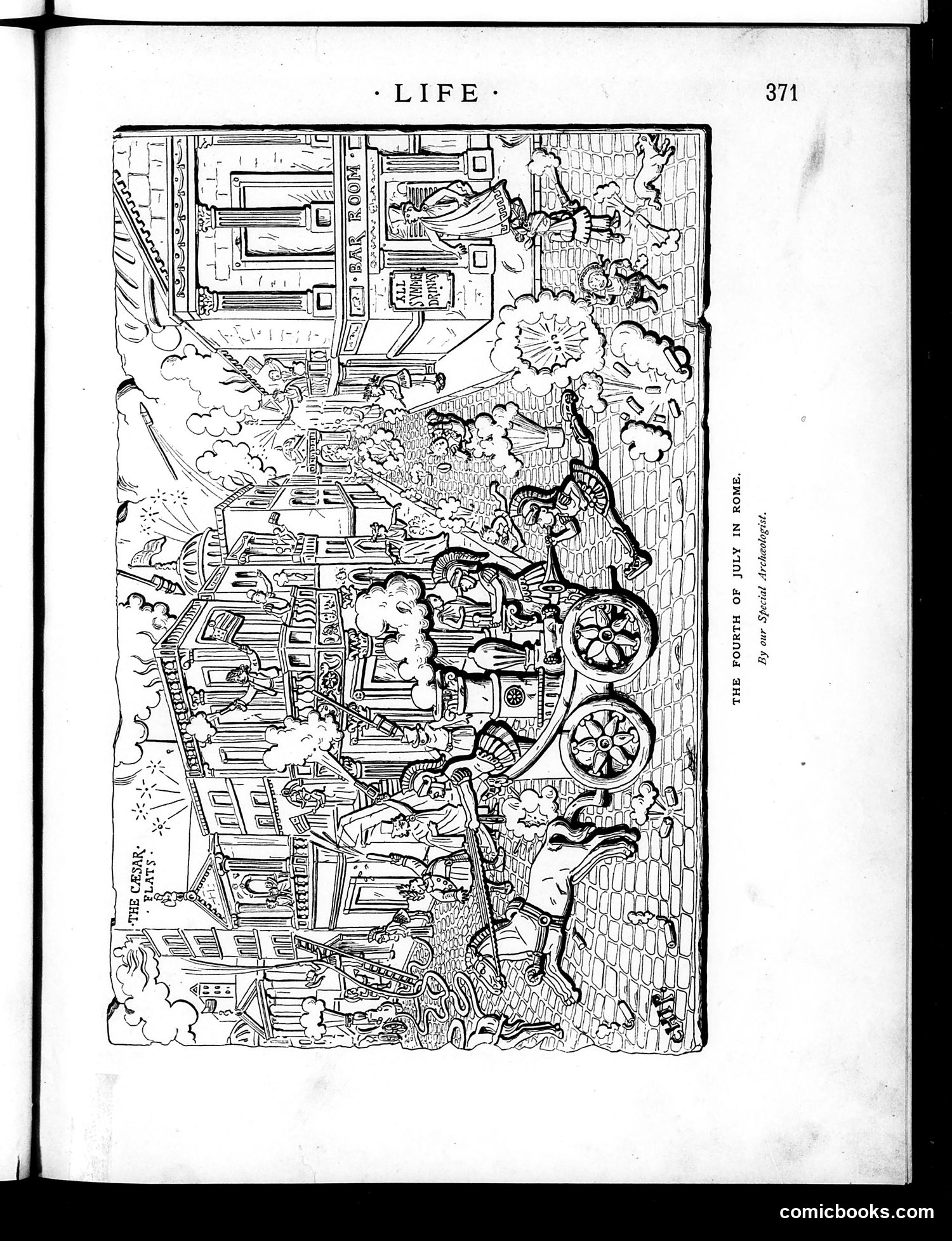
This is a satirical illustration depicting an imagined Roman celebration of American Independence Day under Caesar's rule. The cartoon creates humor through anachronism—transplanting an American holiday into ancient Rome. The scene shows classical Roman architecture, toga-wearing figures, and a chariot, all rendered in detailed line work typical of early Life magazine. The satire appears to mock either: 1. American imperialism (suggesting America under its leaders resembles Rome under Caesar), or 2. The incongruity of democratic ideals in an authoritarian empire The "Special Archeologist" credit suggests the cartoonist is presenting this as a historical "discovery"—a witty frame implying that future generations might find such an absurd mixing of cultures in ancient records. Without seeing the complete text or knowing the publication date, the precise political target remains unclear, but the joke centers on the incompatibility of July Fourth's freedom celebration with autocratic rule.
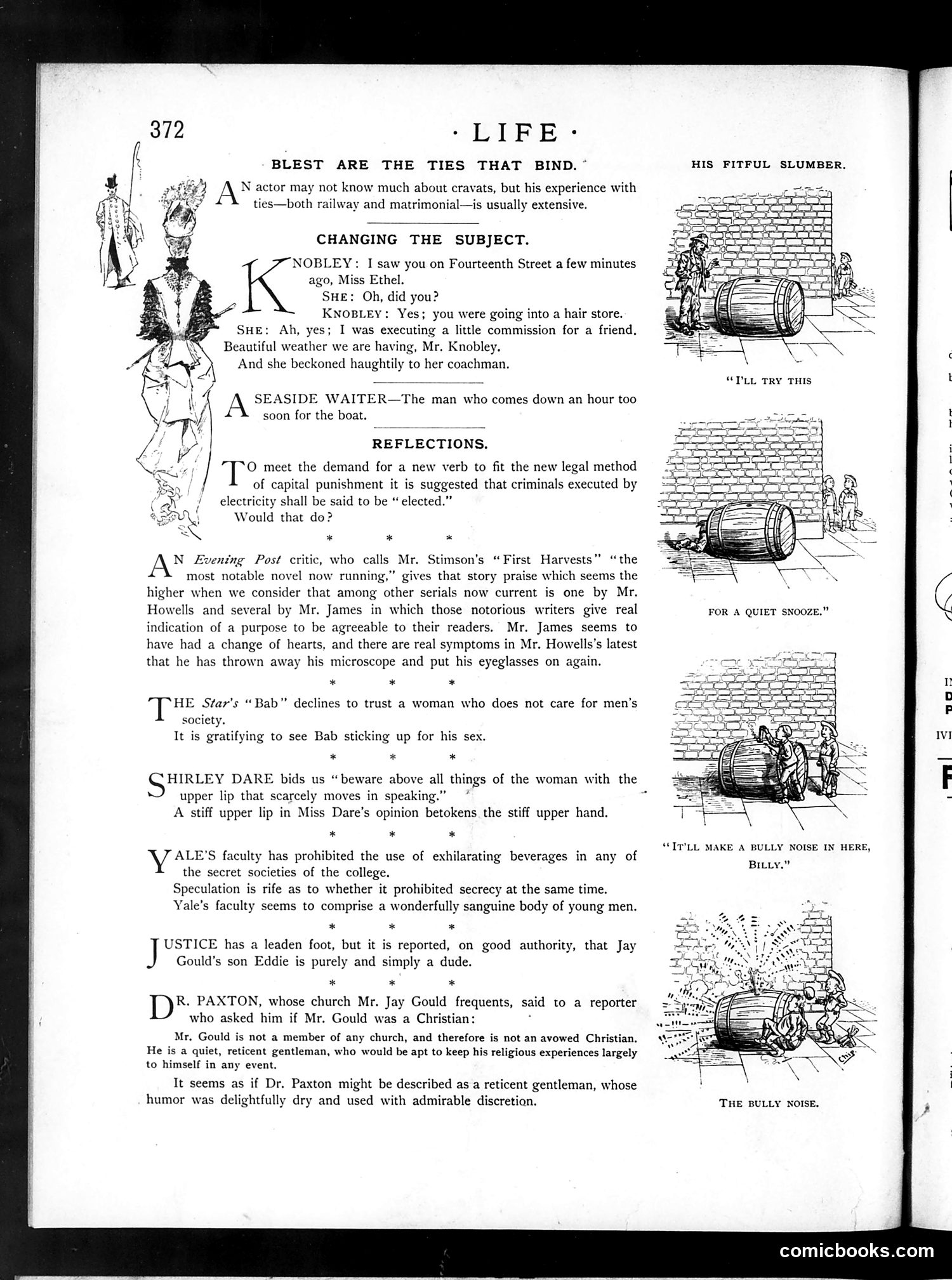
This page contains multiple short satirical pieces typical of Life magazine's format. The main items mock contemporary social figures and issues: **Top section**: A conversation joke where a woman caught entering a hair salon deflects by praising the weather and dismissing her acquaintance—satirizing social pretense and evasion. **"Reflections" section**: Sharp one-liners on current topics, including a pun about executions by electricity being called "elected," and commentary on popular novelists (Howells, Henry James, and Stimson) suggesting established writers are finally trying to please readers rather than challenge them. **Right-side cartoon**: "His Fitful Slumber" and "The Bully Noise"—appears to show someone attempting to use a large barrel or log as a bed or hiding place, with crude humor about creating noise. The reference to "Billy" and "bully" suggests rough, masculine roughhousing. The page exemplifies Life's approach: brief, witty social commentary targeting manners, literary taste, and public figures' hypocrisies.
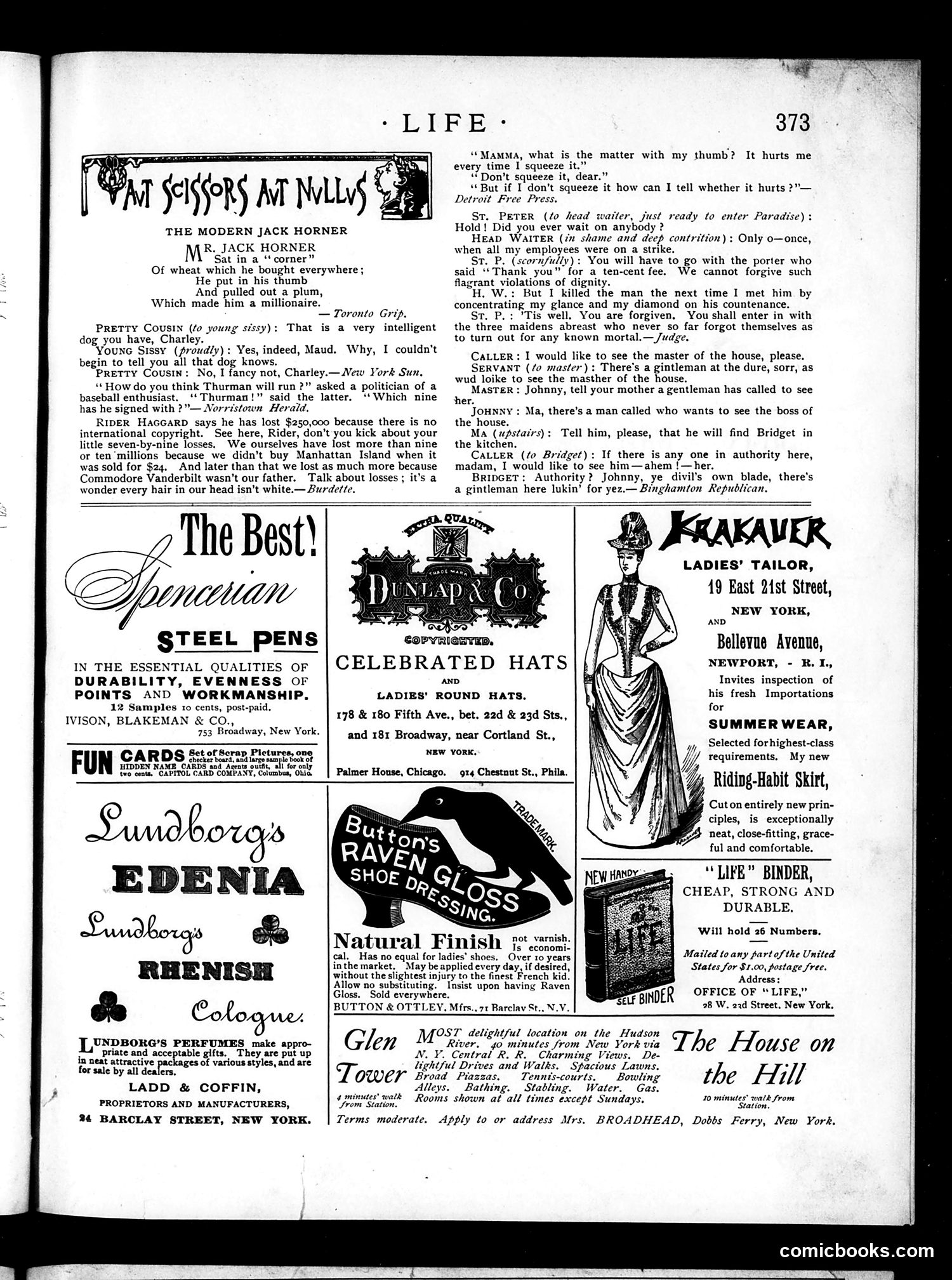
This page contains several brief satirical jokes typical of 1880s-90s American humor magazines: **"The Modern Jack Horner"** parodies the nursery rhyme, applying it to wheat speculation—likely referencing the Grange movement and farmers' concerns about grain monopolies. A man who corners the wheat market becomes a millionaire, satirizing financial manipulation. **Subsidiary jokes** mock: - A young woman's chatty dog (playing on "intelligent" dogs as status symbols) - A politician confusing politician Thurman with a baseball player—mocking political ignorance - Rider Haggard's copyright complaints as trivial compared to America's lost financial opportunities (Manhattan's original purchase) **The "St. Peter" and servant jokes** satirize workplace hierarchies and the Irish immigrant servant stereotype ("gintleman," "dure," "masther")—common ethnic humor of the era. The page is primarily **advertisements** (Spencerian pens, Dunlap hats, perfumes, shoe polish). The cartoons are incidental filler typical of Life's format—brief, topical quips rather than sustained visual satire.
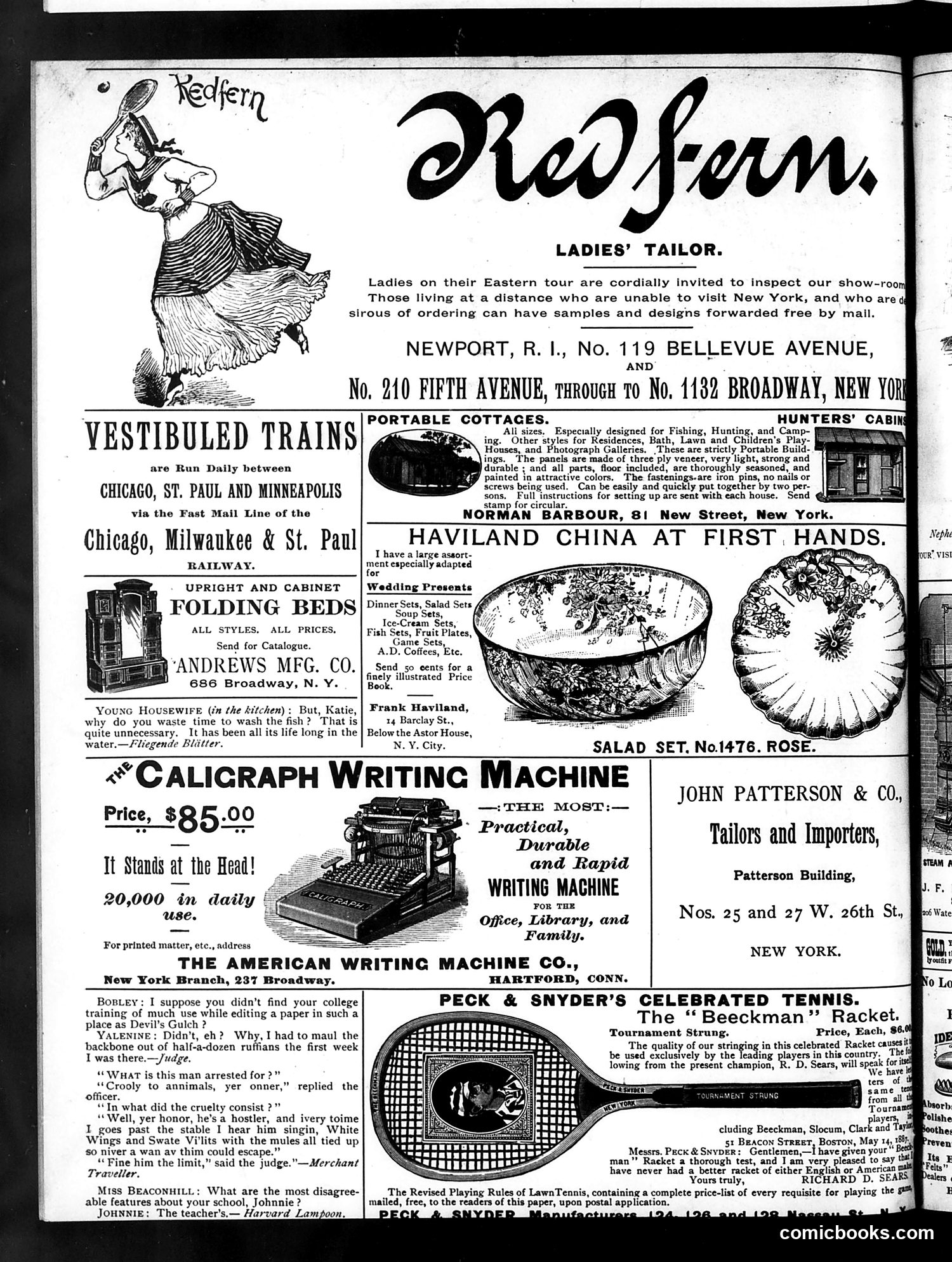
This is primarily a **advertising page** from Life magazine, not a political cartoon. The page contains multiple commercial advertisements typical of the era, including: - **Red Fern Ladies' Tailor** (Newport and New York locations) - **Chicago, Milwaukee & St. Paul Railway** (vestibuled trains) - **Caligraph Writing Machine** ($85) - **Haviland China** (wedding presents) - **Folding Beds** and other household goods The page includes **three brief humorous anecdotes** at bottom—typical of Life's satirical content: 1. A domestic joke about washing fish 2. A college editor's violent experience in "Devil's Gulch" 3. An Irish hostler's cruelty (singing while mules are tied up) These are generic humor pieces, not political satire. The advertisements target wealthy, educated readers—those taking "Eastern tours," purchasing fine china, and attending college. The page reflects **Gilded Age consumerism** and the magazine's affluent audience, rather than offering social commentary.
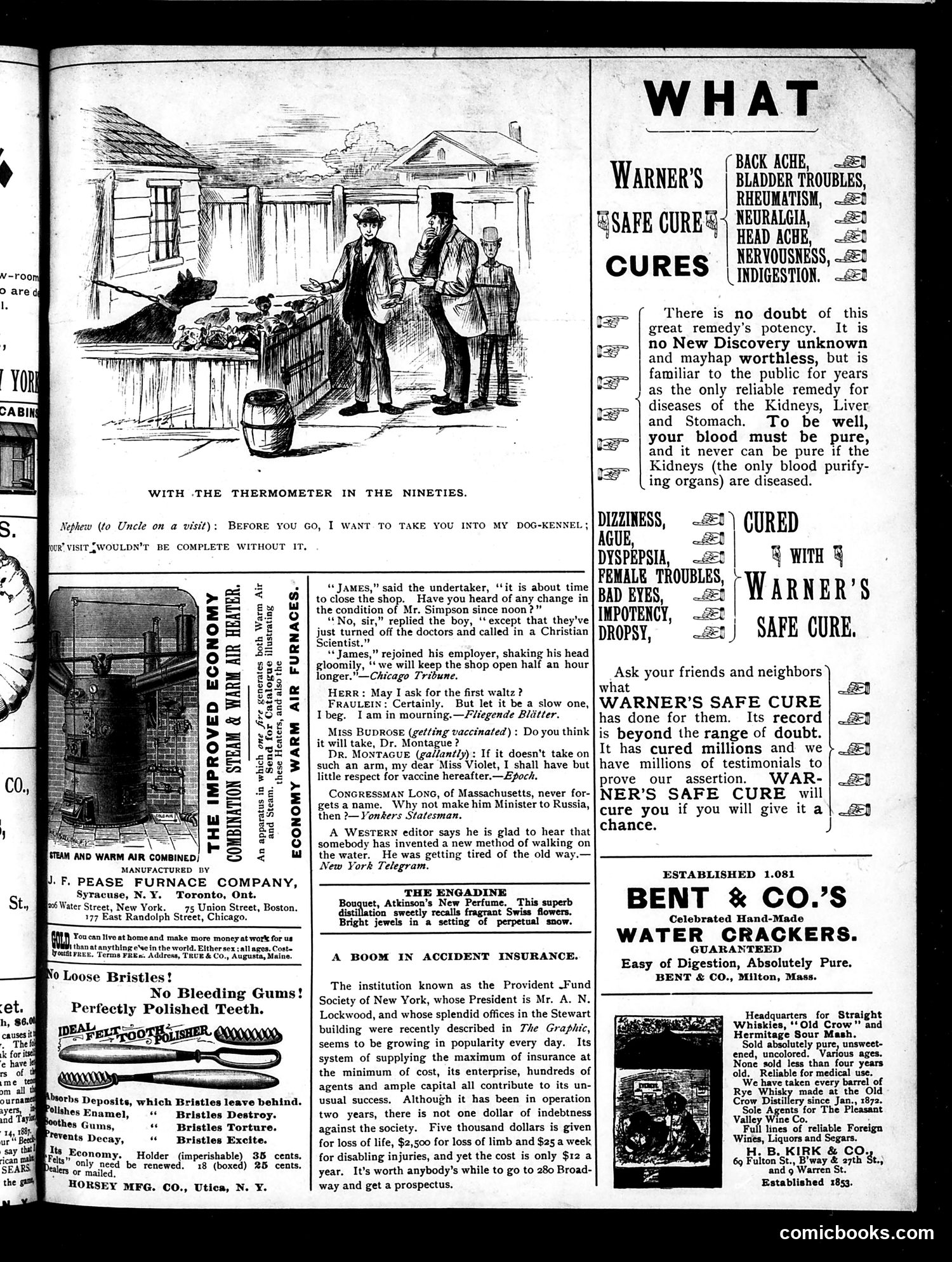
This page, dated around the 1880s-1890s based on advertising styles, contains primarily **advertisements and filler humor** rather than political satire. ## Main Cartoon The top illustration depicts a nephew asking his uncle to visit the dog-kennel, with the caption "WITH THE THERMOMETER IN THE NINETIES." This is a joke about extreme heat—the nephew wants to show his uncle where it's cooler (with the dogs) during a sweltering summer day. ## Content Overview The page is dominated by **patent medicine ads**, particularly Warner's Safe Cure, promising to treat kidneys, liver, bladder troubles, and rheumatism—typical quack remedies of the era. Other ads include furnaces, toothbrushes, and accident insurance. The scattered humor pieces are mild jokes from other publications (Chicago Tribune, etc.) about undertakers, dancing, and vaccination—nothing satirically pointed. **This is primarily a commercial page** using modest humor to fill advertising space rather than social commentary or political satire.
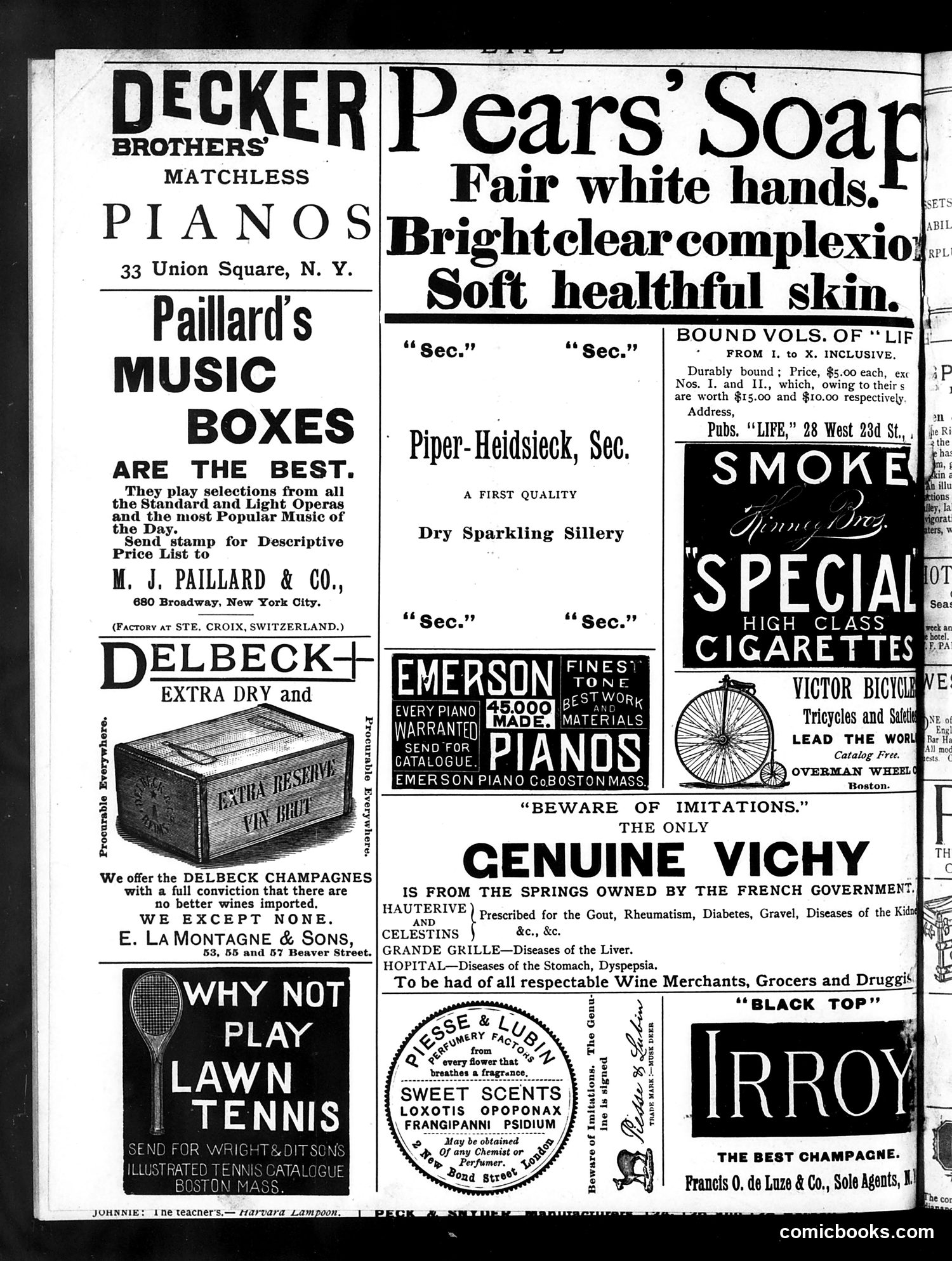
This page is **primarily advertising**, not satire or political commentary. It's a collection of late 19th-century product advertisements typical of Life magazine's revenue model. The lone cartoon reference appears at the bottom: "JOHNNIE: The teacher's.— Harvard Lampoon," suggesting a small reprinted joke (source credited to Harvard's humor magazine), though the actual cartoon is not visible on this page. The advertisements themselves reveal period concerns and products: champagnes and wines marketed for medicinal purposes (Vichy water prescribed for gout, rheumatism, diabetes), luxury goods (pianos, music boxes), grooming products (Pears' Soap promising "fair white hands" and "bright clear complexion"), and cigarettes advertised as "high class." The page documents Gilded Age consumer culture and the era's medical and beauty claims—many of which modern readers would recognize as dubious or potentially harmful by today's standards.
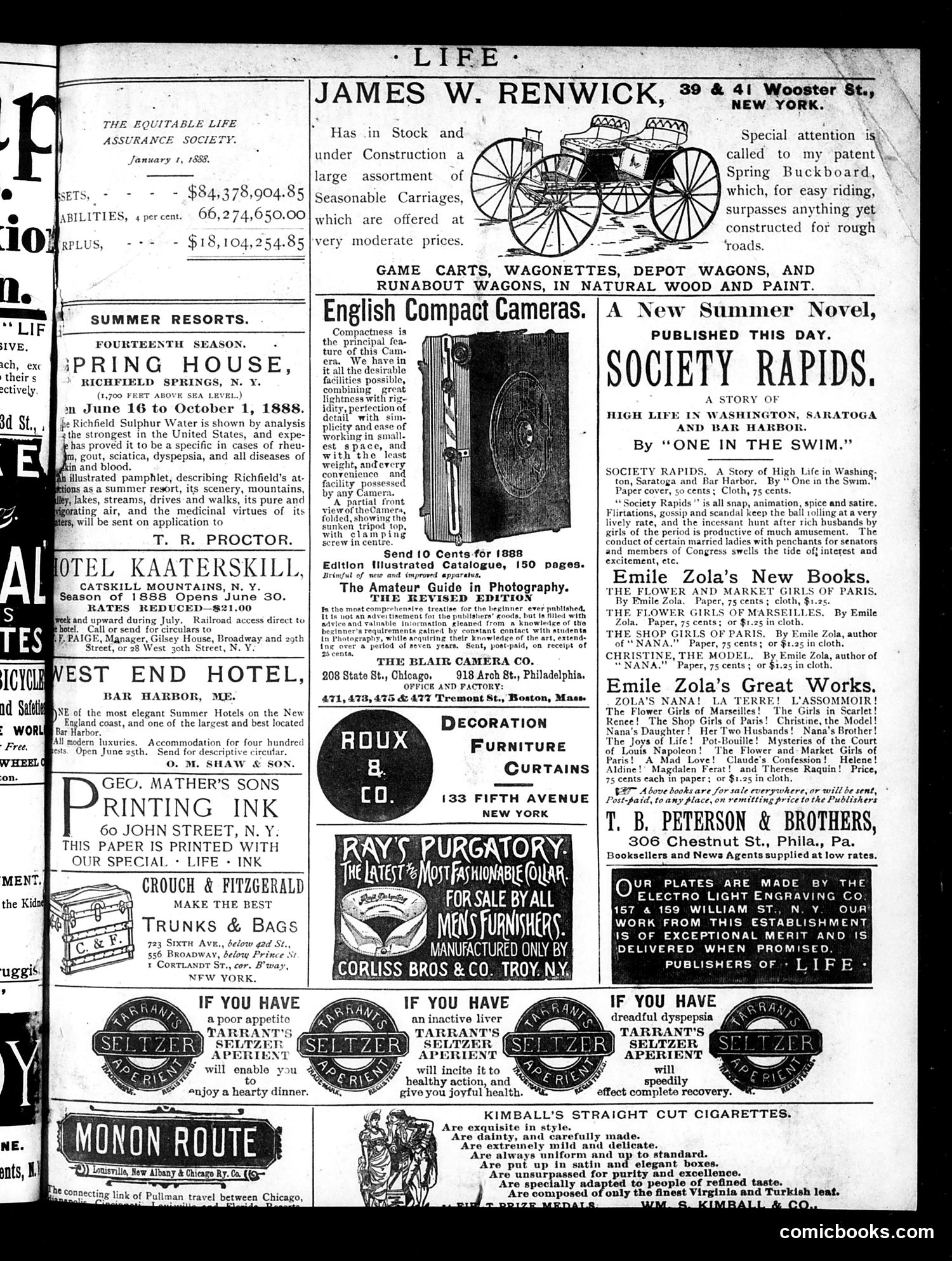
This is primarily an **advertising page** from Life magazine (January 1, 1888), not a political cartoon page. The content consists of commercial advertisements for summer resorts (Richfield Springs, Catskill Mountains hotels), carriages, printing ink, camera equipment, and furniture. There is one book advertisement for *Society Rapids*, a satirical novel about wealthy social climbers in Washington, Saratoga, and Bar Harbor—described as containing "snap, animation, spice and satire" about women hunting for rich husbands and the scandalous behavior of married women pursuing senators and congressmen. The page also advertises Emile Zola's novels, including *Nana*, which was controversial at the time for its frank depiction of a courtesan's life. **No clear political cartoons or caricatures are visible.** The page is typical commercial content from a satirical magazine that relied heavily on advertising revenue.
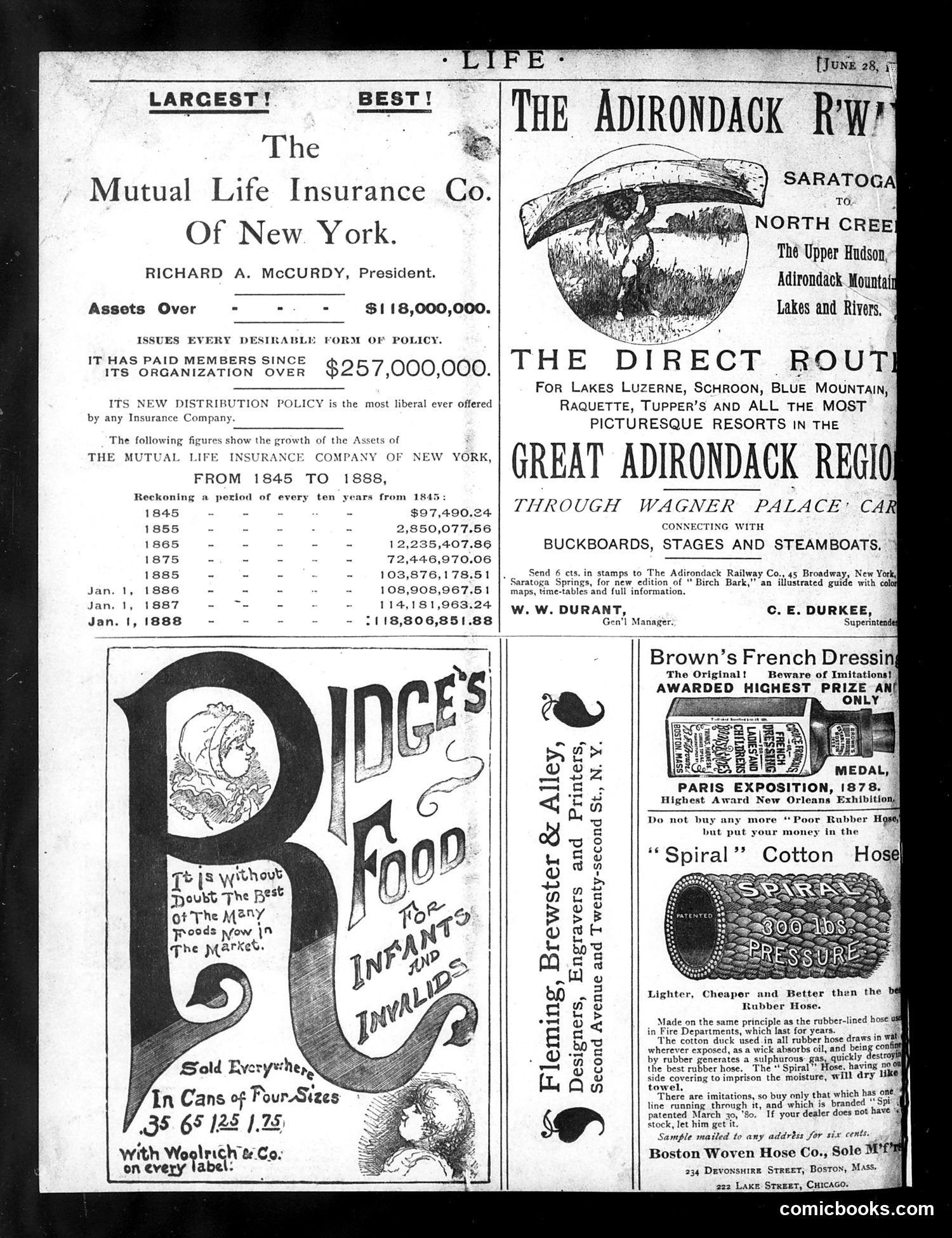
This page is primarily **advertising**, not satire or political commentary. It contains four distinct advertisements: 1. **Mutual Life Insurance Co.** — emphasizes the company's massive assets ($118M+) and growth since 1845, positioning it as America's largest insurer. 2. **Adirondack Railway** — promotes tourist travel to upstate New York mountain resorts via luxury "Wagner Palace" rail cars, appealing to wealthy leisure travelers. 3. **Ridge's Food** — a Victorian-era patent medicine/food product advertised in cans as "the best of many foods now in the market." 4. **Brown's French Dressing & Spiral Cotton Hose** — two separate product advertisements highlighting durability claims and Paris Exposition awards. The page reflects **late-19th-century consumer culture**: insurance as status symbol, tourism as leisure activity for the wealthy, and heavily marketed proprietary products with nationalist/international award claims. The ornate typography and illustrated logos were typical advertising design of the period.
I can see this is a page from Life magazine, but the image is almost entirely black with only fragments of text visible on the left margin and the "comicbooks.com" watermark at the bottom. The OCR text provided contains only that watermark. Without being able to see the actual cartoon content, layout, or readable text on the page, I cannot identify specific figures, caricatures, political references, or explain the satirical point. The image quality and contrast make it impossible to discern the content that would allow me to provide historical context or analysis. To properly analyze this Life magazine page, a clearer or higher-contrast image would be needed.