
Life, 1888-06-28 · page 8 of 21
Life — June 28, 1888 — page 8: what you’re looking at
What you’re looking at
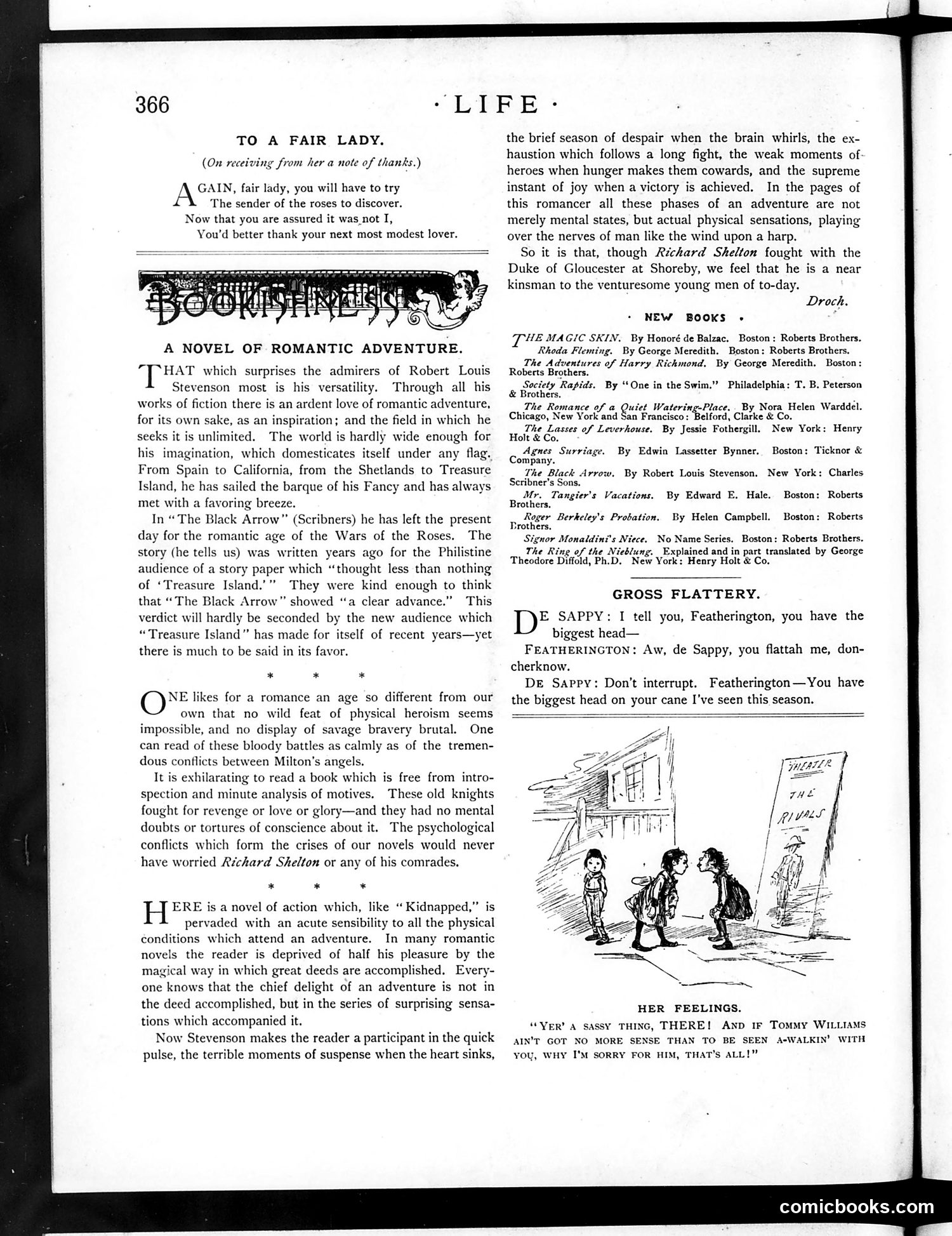
This page combines literary criticism with a humorous sketch titled "Her Feelings." The main text reviews romantic adventure novels, particularly praising Robert Louis Stevenson's work and contrasting old-fashioned adventure stories (featuring knights fighting "for revenge or love or glory") with modern psychological novels. The cartoon below shows three street urchins discussing a boy named Tommy Williams. One character (de Sappy) mocks another (Featherington) for having "the biggest head" on his cane. The punchline, printed in capitals, suggests Tommy has been seen "a-walkin'" with someone and lost his common sense—implying romantic infatuation has made him foolish. The joke satirizes how love makes people act irrationally, tying thematically to the page's discussion of romantic adventure narratives.
📄 Transcribed text from this page (OCR, searchable)
Machine-transcribed from the original scan — historical spelling and the odd misread are preserved.
“LIFE: TO A FAIR LADY. (On receiving from her a note of thanks.) GAIN, fair lady, you will have to try he sender of the roses to discover. Now that you are assured it was not I, You'd better thank your next most modest lover. A NOVEL OF ROMANTIC ADVENTURE. *T°HAT which surprises the admirers of Robert Louis Stevenson most is his versatility. Through all his works of fiction there is an ardent love of romantic adventure, for its own sake, as an inspiration; and the field in which he seeks it is unlimited. The world is hardly wide enough for his imagination, which domesticates itself under any flag. From Spain to California, from the Shetlands to Treasure Island, he has sailed the barque of his Fancy and has always met with a favoring breeze. In “ The Black Arrow” (Scribners) he has left the present day for the romantic age of the Wars of the Roses. The story (he tells us) was written years ago for the Philistine audience of a story paper which “thought less than nothing of ‘Treasure Island.’ They were kind enough to think that “The Black Arrow” showed “a clear advance.” This verdict will hardly be seconded by the new audience which “Treasure Island” has made for itself of recent years—yet there is much to be said in its favor. O E likes for a romance an age so different from our own that no wild feat of physical heroism seems impossible, and no display of savage bravery brutal. One can read of these bloody battles as calmly as of the tremen- dous conflicts between Milton's angels. It is exhilarating to read a book which is free from intro- spection and minute analysis of motives. These old knights fought for revenge or love or glory—and they had no mental doubts or tortures of conscience about it. The psychological conflicts which form the crises of our novels would never have worried Richard Shelton or any of his comrades. * * * * * * ERE is a novel of action which, like “ Kidnapped,” is pervaded with an acute sensibility to all the physical conditions which attend an adventure. In many romantic novels the reader is deprived of half his pleasure by the magical way in which great deeds are accomplished. Every- one knows that the chief delight of an adventure is not in the deed accomplished, but in the series of surprising sensa- tions which accompanied it. Now Stevenson makes the reader a participant in the quick pulse, the terrible moments of suspense when the heart sinks, the brief season of despair when the brain whirls, the ex- haustion which follows a long fight, the weak moments of. heroes when hunger makes them cowards, and the supreme instant of joy when a victory is achieved. In the pages of this romancer all these phases of an adventure are not merely mental states, but actual physical sensations, playing over the nerves of man like the wind upon a harp. So it is that, though Rechard Shelton fought with the Duke of Gloucester at Shoreby, we feel that he is a near kinsman to the venturesome young men of to-day. Droch. + NEW BOOKS - : THE MAGIC SKIN. By Honoré de Balzac, Boston : Roberts Brothers. Rhoda Fleming, By George Meredith. Boston: Roberts Brothers. The Adventures of Harry Richmond, By George Meredith. Boston : Roberts Brothers. Society Rapids. & Brothers. : The Romance of a Quiet Watering-Place, By Nora Helen Warddel. Chicago, New York and San Francisco: Belford, Clarke & Co. The Lasses of Leverhouse. By Jessie Fothergill. New York: Henry Holt & Co. Agnes Surriage. Company. The Black Arrow, Scribner's Sons. Mr. Tangier’s Vacations. Brothers. Roger Berkeley's Probation. Drothers. Signor Monaldini's Niece. No Name Series. Boston: Roberts Brothers. The Ring of the Nieblung. Explained and in part translated by George Theodore Diffold, Ph.D. New York: Henry Holt & Co. By ‘One in the Swim.” Philadelphia: T. B. Peterson By Edwin Lassetter Bynner. Boston: Ticknor & By Robert Louis Stevenson. New York: Charles By Edward E, Hale. Boston: Roberts By Helen Campbell. Boston: Roberts GROSS FLATTERY. E SAPPY: I tell you, Featherington, you have the biggest head— FEATHERINGTON: Aw, de Sappy, you flattah me, don- cherknow. DE Sappy: Don’t interrupt. Featherington—You have the biggest head on your cane I've seen this season. Flare THE RLV HER FEELINGS. ‘YER’ A SASSY THING, THERE! AnD IF Tommy WILLIAMS AIN'T GOT NO MORE SENSE THAN TO BE SEEN A-WALKIN’ WITH you, WHY I'M SORRY FOR HIM, THAT'S ALL!” comicbooks.com