
Life, 1888-06-28 · page 4 of 21
Life — June 28, 1888 — page 4: what you’re looking at
What you’re looking at
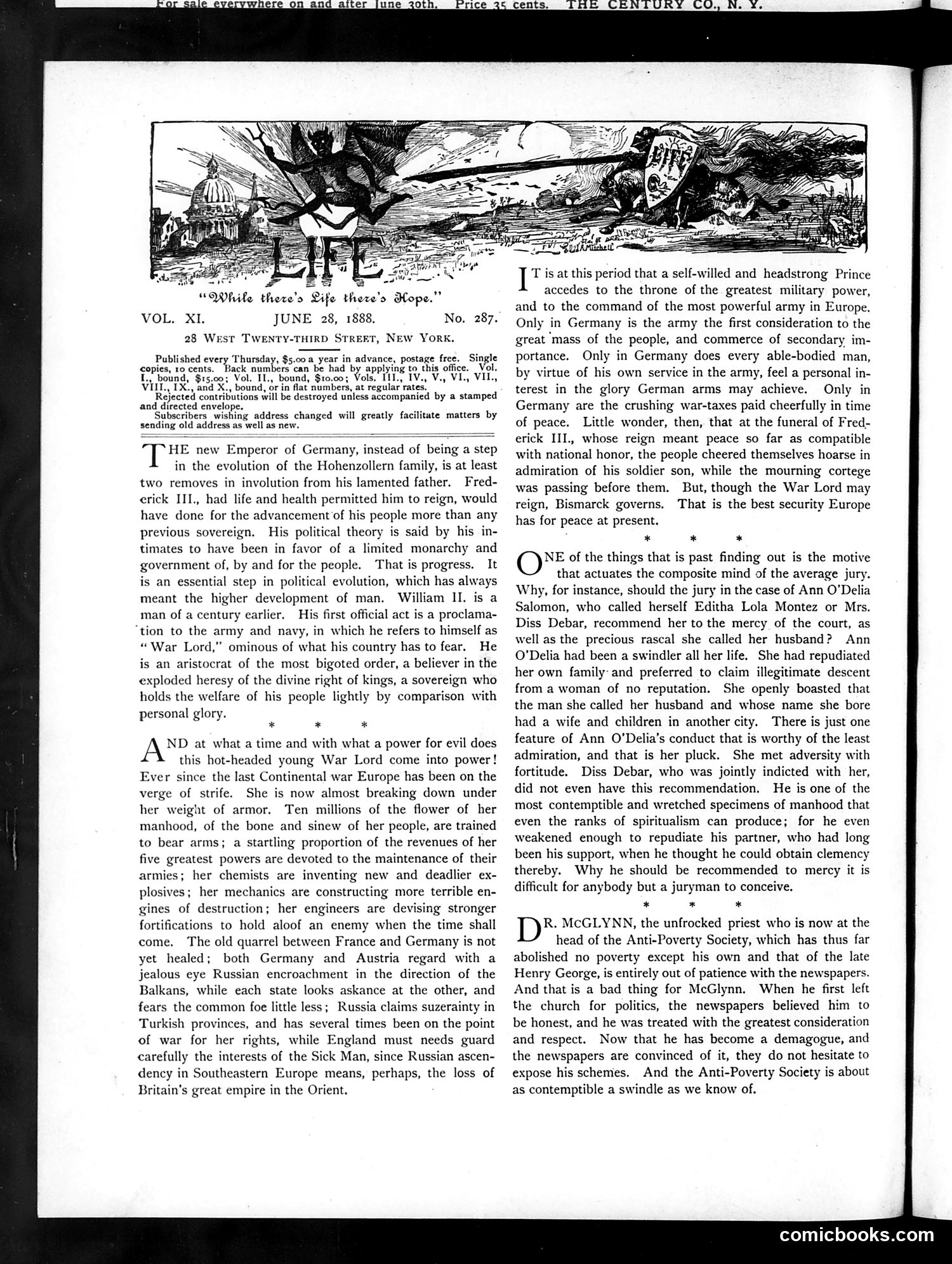
The masthead cartoon depicts a large tree uprooted amid European landscape and architectural ruins, likely symbolizing political upheaval in Germany following Emperor Frederick III's death and his son Wilhelm II's accession to the throne. The article's text discusses Wilhelm II as a militaristic "War Lord" whose aggressive policies threaten European stability. It criticizes his absolute power and compares him unfavorably to his father Frederick III, praising the latter's progressive politics and constitutional monarchy ideals. The satirical angle warns American readers that Wilhelm II represents dangerous autocratic militarism—his "hot-headed" nature and vast military resources pose threats to European peace and Britain's interests. The cartoon's destruction imagery reinforces this warning about the consequences of his warlike leadership.
📄 Transcribed text from this page (OCR, searchable)
Machine-transcribed from the original scan — historical spelling and the odd misread are preserved.
“While there's Life there's d VOL. XI. JUNE 28, 1888. No. 287. 28 West TWENTY-THIRD STREET, NEW YORK. Published every Thursday, $5.00 a year in advance, postage free. Single copies, ro cents. Back numbers can be had by applying to this office. Vol. I, bound, $15.00; Vol. II., bound, $10.00; Vols. Il VL, VIL, VIII. IX., and X., bound, or in flat numbers, at regular rat Rejected contributions will be destroyed unless accompanied by a stamped and directed envelope. Subscribers wishing address changed will greatly facilitate matters by sending old address as well as new. HE new Emperor of Germany, instead of being a step in the evolution of the Hohenzollern family, is at least two removes in involution from his lamented father. Fred- erick III., had life and health permitted him to reign, would have done for the advancement of his people more than any previous sovereign. His political theory is said by his in- timates to have been in favor of a limited monarchy and government of, by and for the people. That is progress. It is an essential step in political evolution, which has always meant the higher development of man. William II. is a man of a century earlier. His first official act is a proclama- “tion to the army and navy, in which he refers to himself as “War Lord,” ominous of what his country has to fear. He is an aristocrat of the most bigoted order, a believer in the exploded heresy of the divine right of kings, a sovereign who holds the welfare of his people lightly by comparison with personal glory. * * * ND at what a time and with what a power for evil does this hot-headed young War Lord come into power! Ever since the last Continental war Europe has been on the verge of strife. She is now almost breaking down under her weight of armor. Ten millions of the flower of her manhood, of the bone and sinew of her people, are trained to bear arms; a startling proportion of the revenues of her five greatest powers are devoted to the maintenance of their armies; her chemists are inventing new and deadlier ex- plosives; her mechanics are constructing more terrible en- gines of destruction; her engineers are devising stronger fortifications to hold aloof an enemy when the time shall come. The old quarrel between France and Germany is not yet healed; both Germany and Austria regard with a jealous eye Russian encroachment in the direction of the Balkans, while each state looks askance at the other, and fears the common foe little less; Russia claims suzerainty in Turkish provinces, and has several times been on the point of war for her rights, while England must needs guard carefully the interests of the Sick Man, since Russian ascen- dency in Southeastern Europe means, perhaps, the loss of Britain's great empire in the Orient. T is at this period that a self-willed and headstrong Prince accedes to the throne of the greatest military power, and to the command of the most powerful army in Europe. Only in Germany is the army the first consideration to the great mass of the people, and commerce of secondary im- portance. Only in Germany does every able-bodied man, by virtue of his own service in the army, feel a personal in- terest in the glory German arms may achieve. Only in Germany are the crushing war-taxes paid cheerfully in time of peace. Little wonder, then, that at the funeral of Fred- erick III., whose reign meant peace so far as compatible with national honor, the people cheered themselves hoarse in admiration of his soldier son, while the mourning cortege was passing before them. But, though the War Lord may reign, Bismarck governs. That is the best security Europe has for peace at present. * * * NE of the things that is past finding out is the motive that actuates the composite mind of the average jury. Why, for instance, should the jury in the case of Ann O’Delia Salomon, who called herself Editha Lola Montez or Mrs. Diss Debar, recommend her to the mercy of the court, as well as the precious rascal she called her husband? Ann O'Delia had been a swindler all her life. She had repudiated her own family: and preferred to claim illegitimate descent from a woman of no reputation. She openly boasted that the man she called her husband and whose name she bore had a wife and children in another city. There is just one feature of Ann O’Delia’s conduct that is worthy of the least admiration, and that is her pluck. She met adversity with fortitude. Diss Debar, who was jointly indicted with her, did not even have this recommendation. He is one of the most contemptible and wretched specimens of manhood that even the ranks of spiritualism can produce; for he even weakened enough to repudiate his partner, who had long been his support, when he thought he could obtain clemency thereby. Why he should be recommended to mercy it is difficult for anybody but a juryman to conceive. * * * R. McGLYNN, the unfrocked priest who is now at the head of the Anti-Poverty Society, which has thus far abolished no poverty except his own and that of the late Henry George, is entirely out of patience with the newspapers. And that is a bad thing for McGlynn. When he first left the church for politics, the newspapers believed him to be honest, and he was treated with the greatest consideration and respect. Now that he has become a demagogue, and the newspapers are convinced of it, they do not hesitate to expose his schemes. And the Anti-Poverty Society is about as contemptible a swindle as we know of. comicbooks.com