
A complete issue · 20 pages · 1888
Life — May 31, 1888
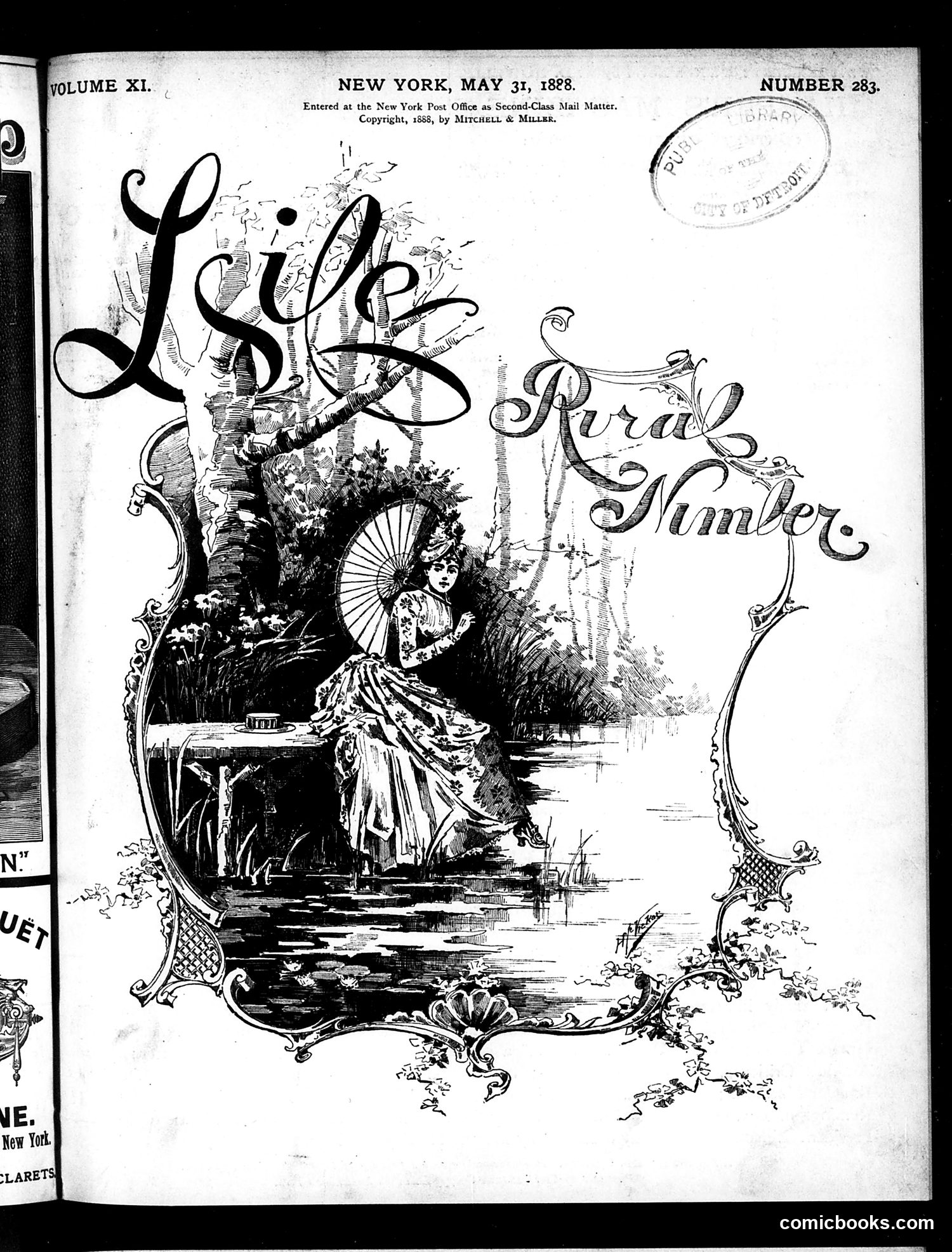
This is a cover illustration for Life's "Rural Number" issue. The image depicts an elegantly dressed woman seated outdoors by a tree near water, holding a parasol and writing tablet. She appears to be a figure of leisure and refinement. The satire likely mocks the romanticized, pastoral fantasy that urban audiences held about rural life. The woman's ornate dress, delicate fan, and civilized posture contrast sharply with actual rural conditions, suggesting Life is poking fun at how city dwellers idealized countryside living as a realm of gentle beauty and relaxation, disconnected from the actual labor and hardship of farming communities. The decorative Art Nouveau border frames this as a special thematic issue.
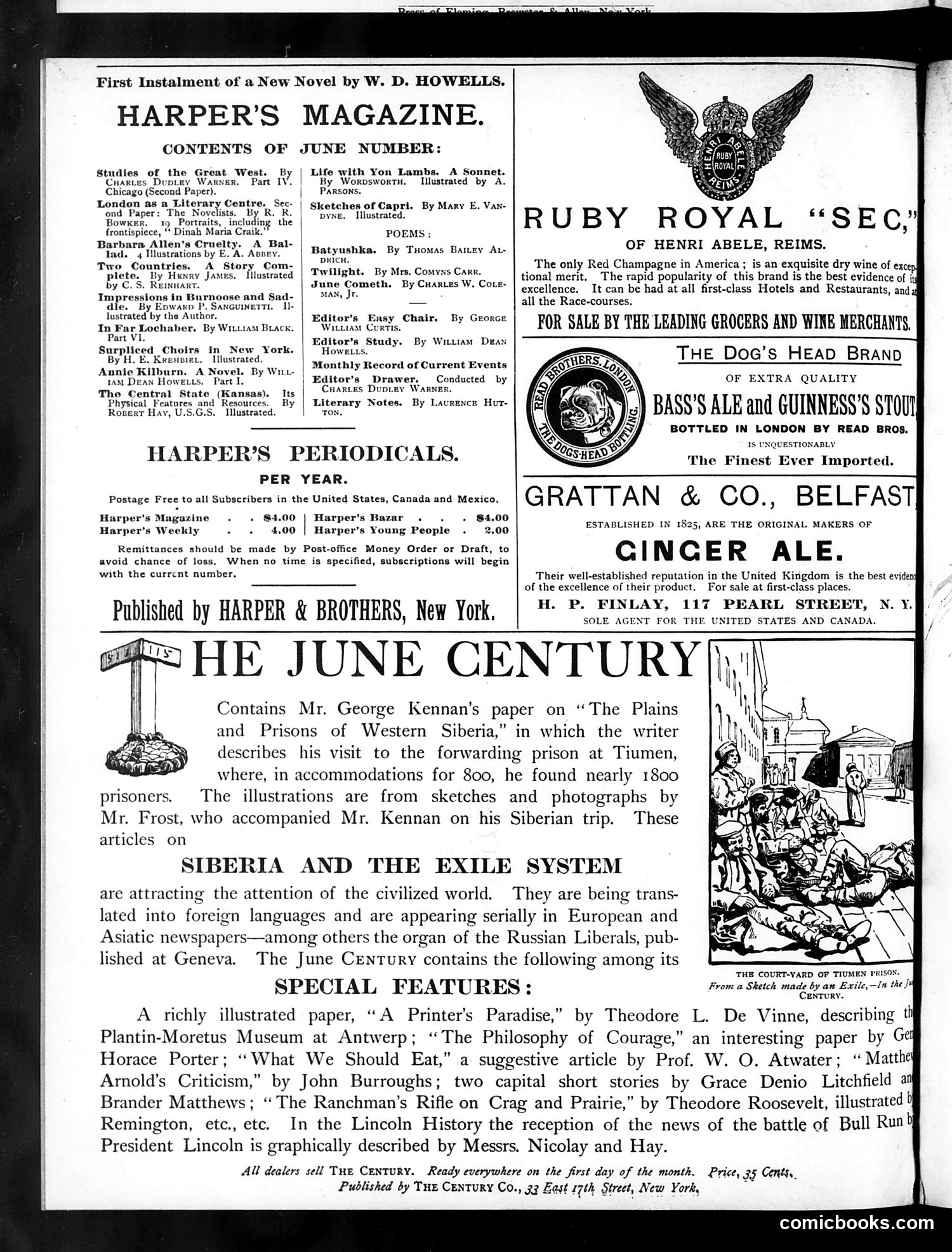
This page is primarily **advertising and editorial content**, not political satire. The top section lists Harper's Magazine contents and subscription rates. The right side features product advertisements for luxury goods: Ruby Royal champagne, Bass's ale and Guinness stout, and Grattan & Co.'s ginger ale—typical high-end consumer goods marketed to wealthy readers. The lower section promotes *The Century* magazine's June issue, highlighting an article by George Kennan on "The Plains and Prisons of Western Siberia," illustrated with sketches about the Russian exile system. This appears designed to attract readers interested in international affairs and social commentary rather than to satirize specific political figures or events.
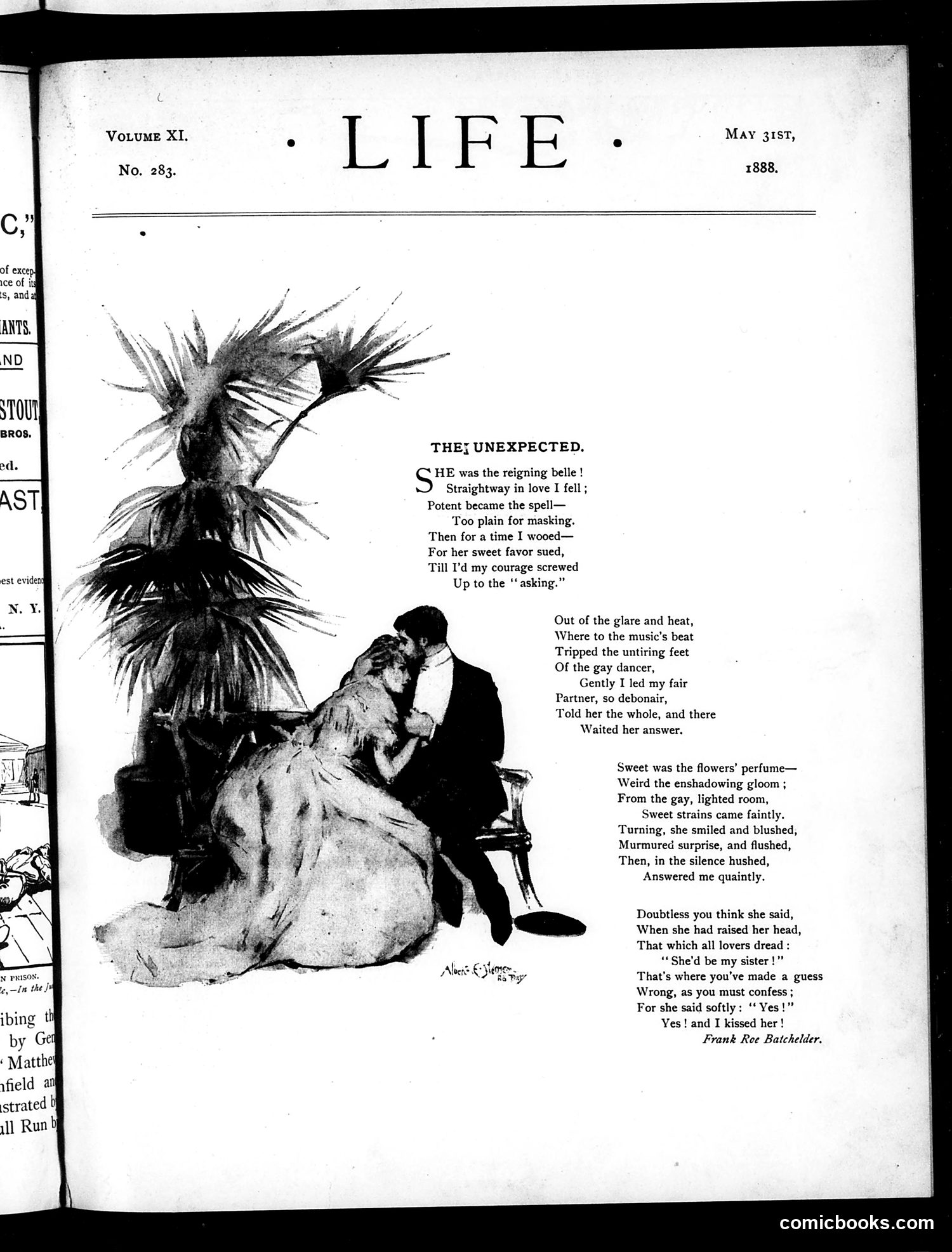
This page features a romantic poem titled "The Unexpected" by Frank Roe Batchelder, illustrated with a courtship scene beneath a flowering plant. The poem narrates a man's confession of love to a woman at a social gathering—he leads her away from the dance floor and declares his feelings. The humor lies in the poem's twist ending: the man expects rejection or requires courage to speak, but the woman simply answers "Yes!" and allows him to kiss her. The "unexpected" element is her immediate acceptance, subverting the narrator's anxious anticipation. The illustration depicts the romantic moment—the couple seated intimately under decorative foliage—capturing the sentimental Victorian courtship narrative that Life's audience would have recognized and found amusing for its earnest romanticism.
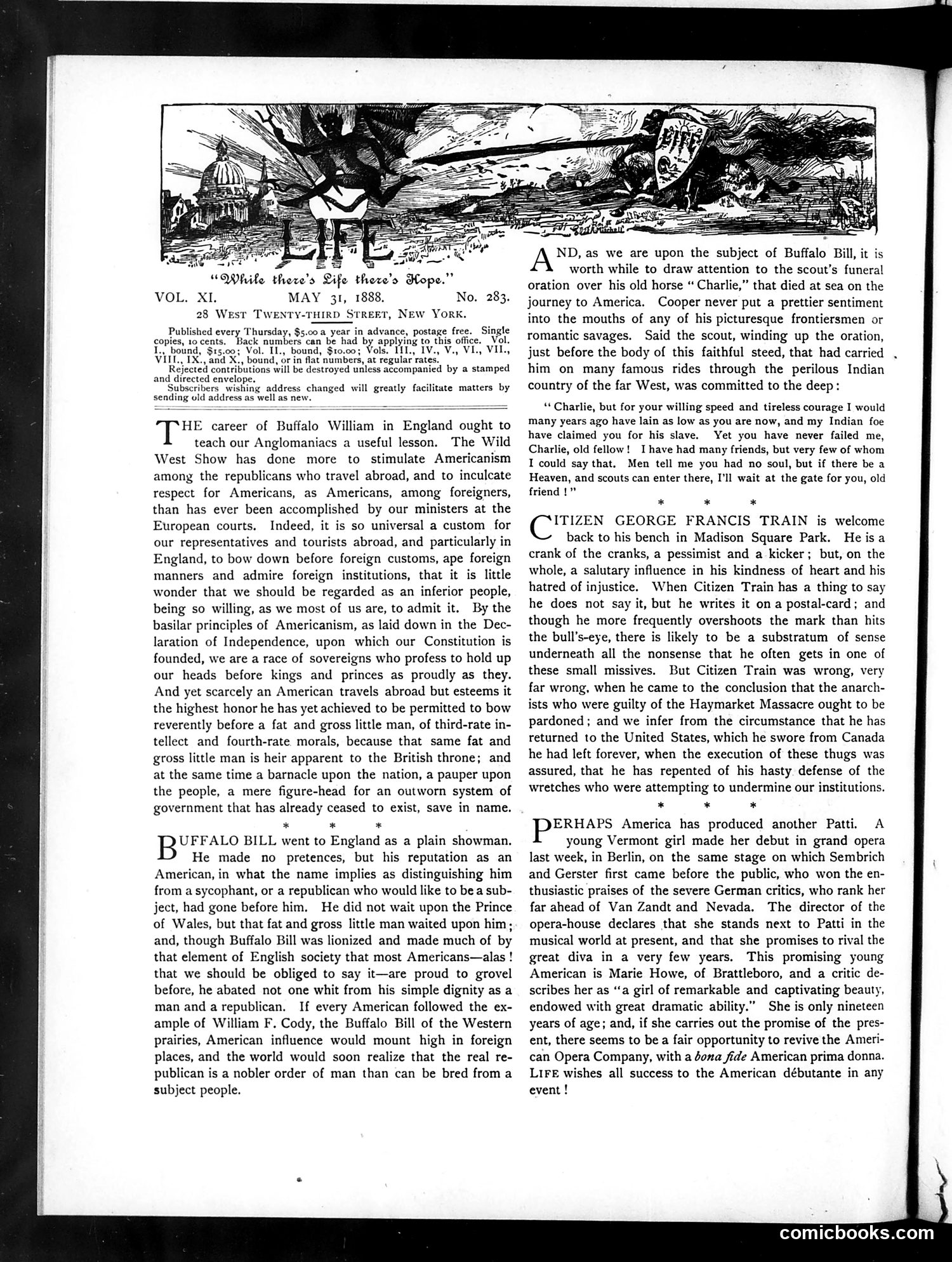
The page contains three satirical articles rather than cartoons. The lead piece criticizes **Buffalo Bill** (William F. Cody) for his deferential behavior during his Wild West Show tour in England, arguing he compromised American republican dignity by bowing to British aristocracy. The satire mocks what the writer sees as improper deference to foreign custom. A second article attacks **Citizen George Francis Train**, a political activist and eccentric, for wrongly defending anarchists involved in the Haymarket Massacre—a violent 1886 labor protest in Chicago where several were executed. The final brief item celebrates an American opera singer's (Marie Howe) European debut, wishing success for American cultural achievement abroad. The page satirizes American dignity, anarchism, and celebrates cultural nationalism.
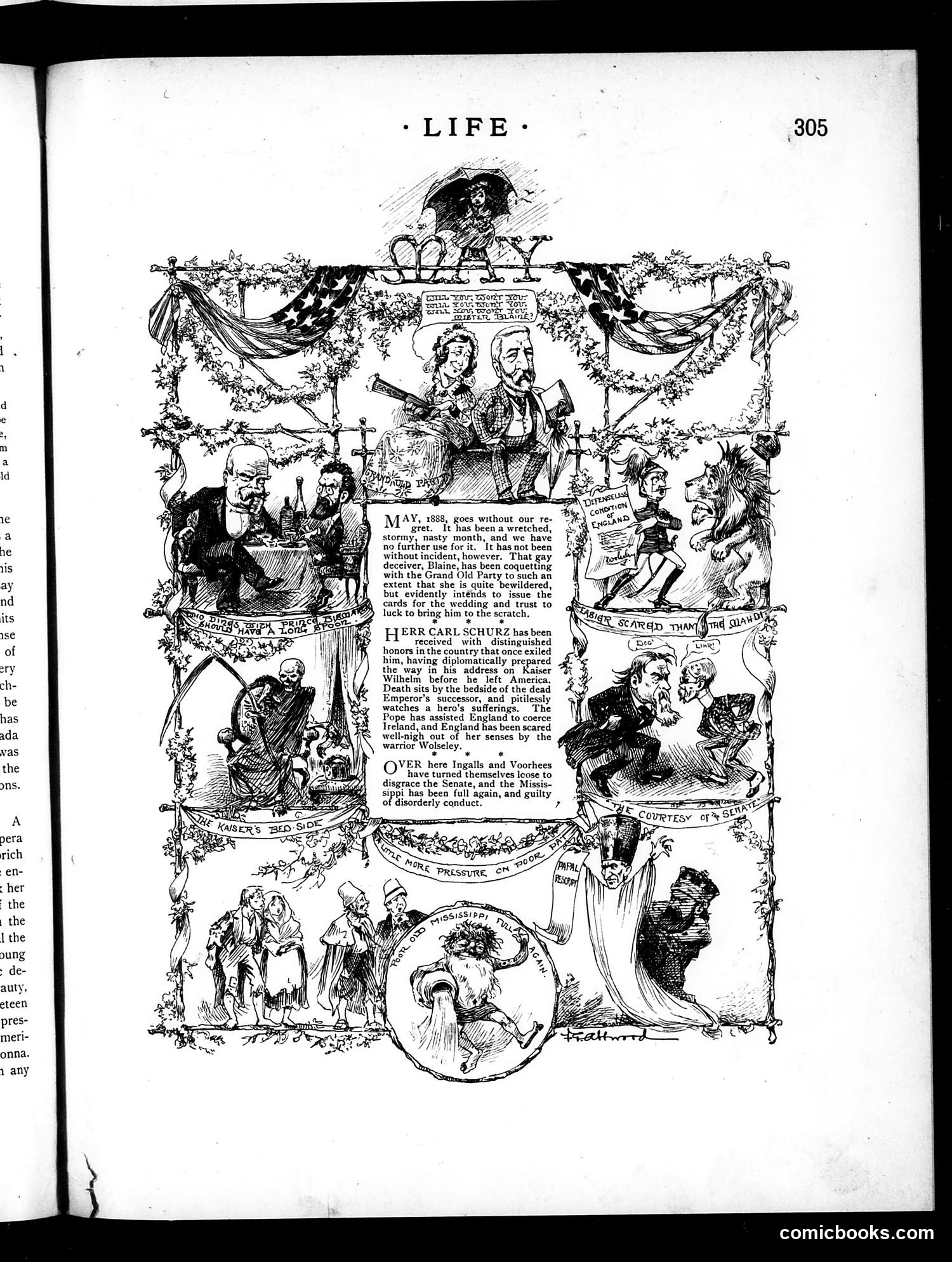
This ornately decorated page satirizes European political crises of May 1888. The text references: **Bismarck's schemes**: German Chancellor Otto von Bismarck is accused of "coquetting with the Grand Old Party" (likely British Conservatives) regarding wedding cards and trust arrangements—apparently plotting diplomatic maneuvering. **Schurz's honors**: Carl Schurz, a German-American diplomat, receives recognition from European powers, suggesting diplomatic shuffling. **Colonial tensions**: References to "Ingalls and Voorhees" and conflicts in the Muscat region indicate disputes over colonial influence and territorial disputes. The elaborate border illustrations depict various European political figures and symbolic imagery commenting on these international tensions. The satire mocks the complexity and duplicity of late 19th-century European diplomacy and power struggles.
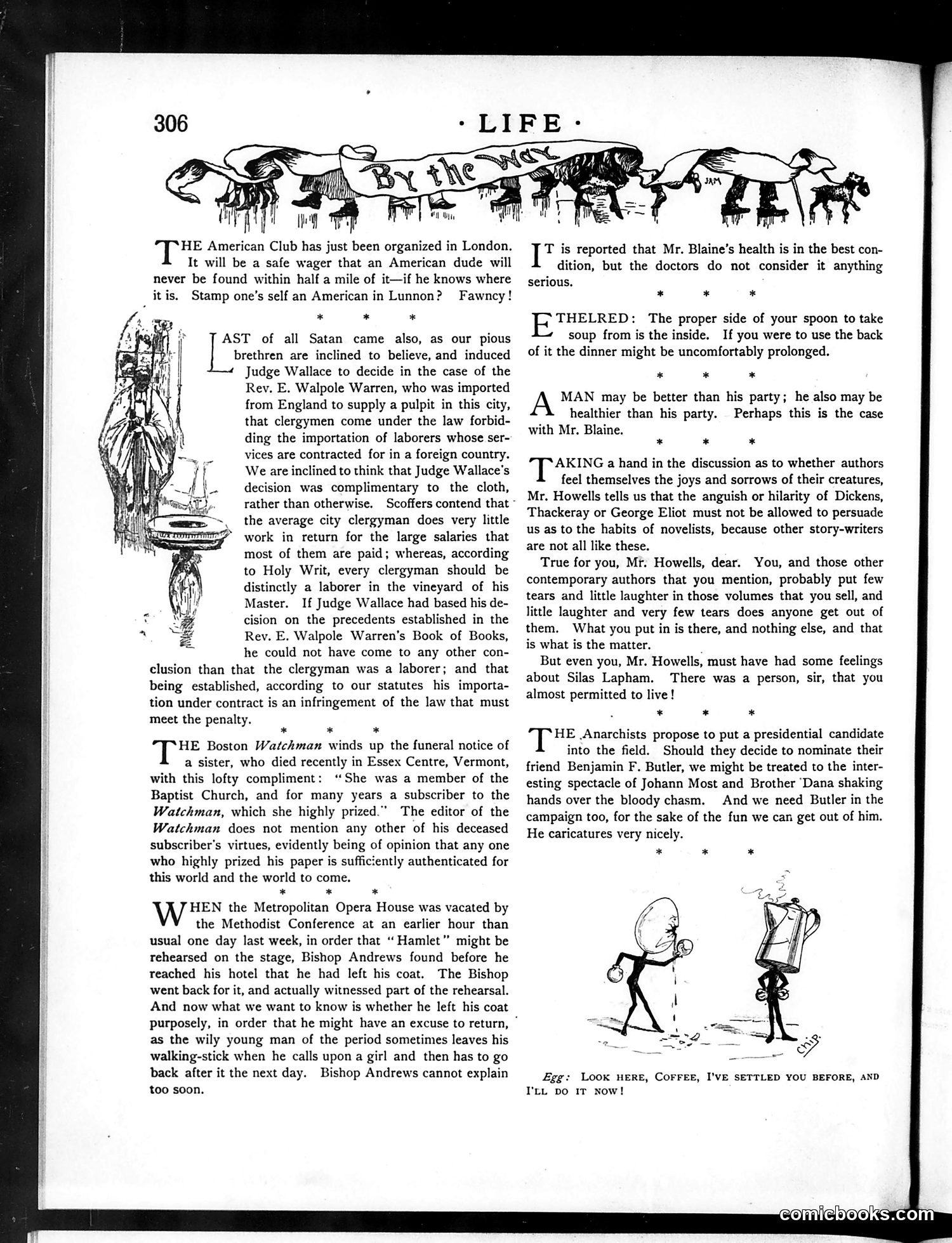
This page contains social commentary and gossip rather than political cartoons. The items mock: 1. **American expatriates in London** — satirizing American "dudes" abroad and an exclusive American Club's pretensions. 2. **Clergy labor debates** — discussing whether clergymen importing foreign laborers violates religious principles (referencing Judge Wallace's court case). 3. **Authors' emotional attachment to characters** — critiquing Dickens, Thackeray, and George Eliot for becoming too invested in their fictional creations, contrasting with contemporary authors like Howells. 4. **Anarchist politics** — joking about nominating Benjamin F. Butler as a presidential candidate as anarchist spectacle. The bottom cartoon shows two figures debating coffee, with minimal political significance—a domestic humor piece.
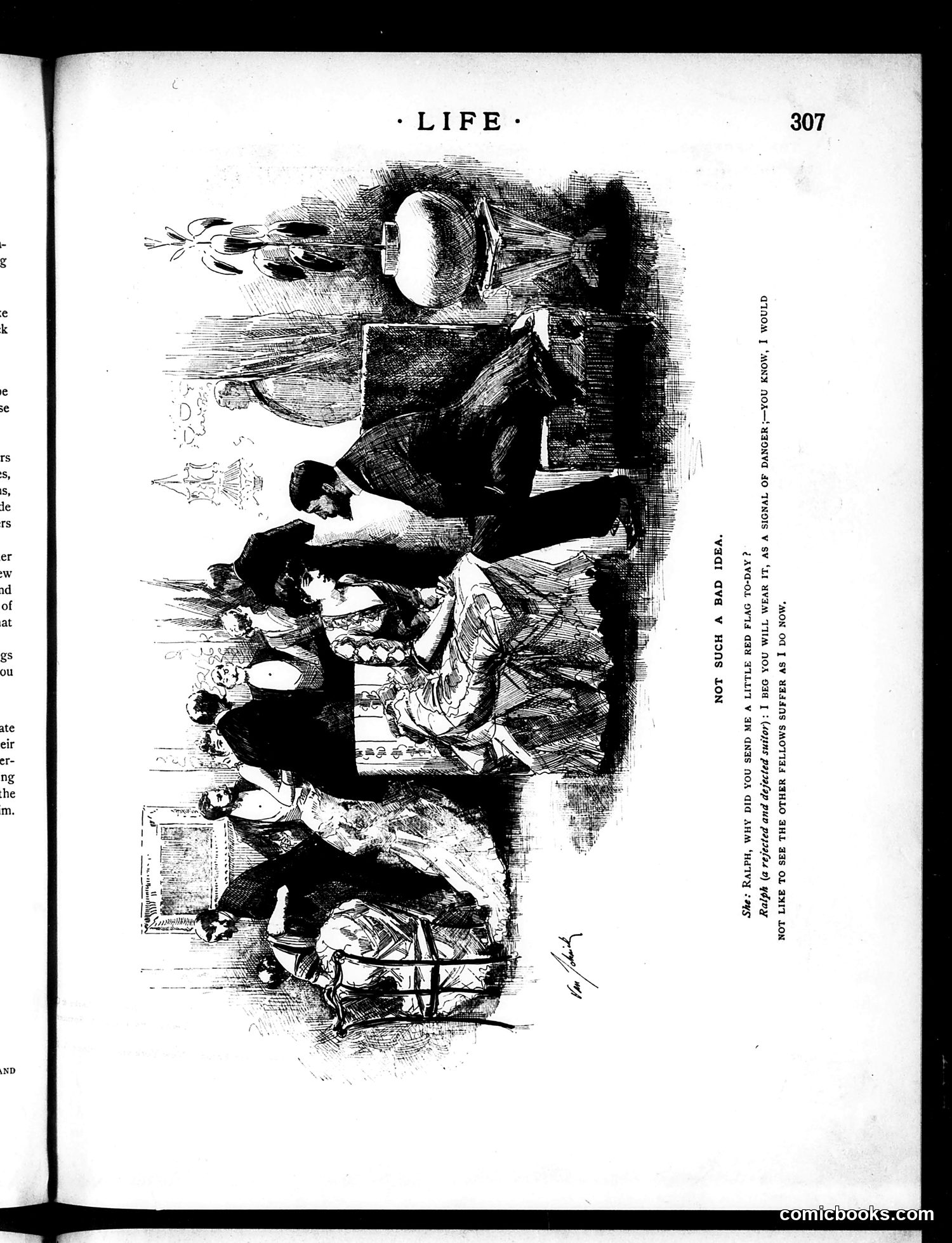
This page contains a satirical illustration titled "NOT SUCH A BAD IDEA," appearing to depict a domestic or social scene viewed upside-down. The caption reads: "SIR RALPH WHY DO YOU SEEM SO HAPPY? / 'AHEM' BECAUSE I NOTICE EVERY TIME I LOOK AT IT, A VISION OF SANDBANKS YOU WOULD NOT LIKE TO SEE THE FLIES EITHER IF I AM." The satire appears to mock social pretension or hypocrisy—specifically, someone (Sir Ralph) claiming contentment with an unappealing situation by reframing it humorously. The upside-down perspective reinforces the joke: one's viewpoint determines whether something seems acceptable or ridiculous. Without additional context about which historical figure "Sir Ralph" references, the exact target remains unclear, though the satire likely critiques aristocratic self-deception or social climbing.
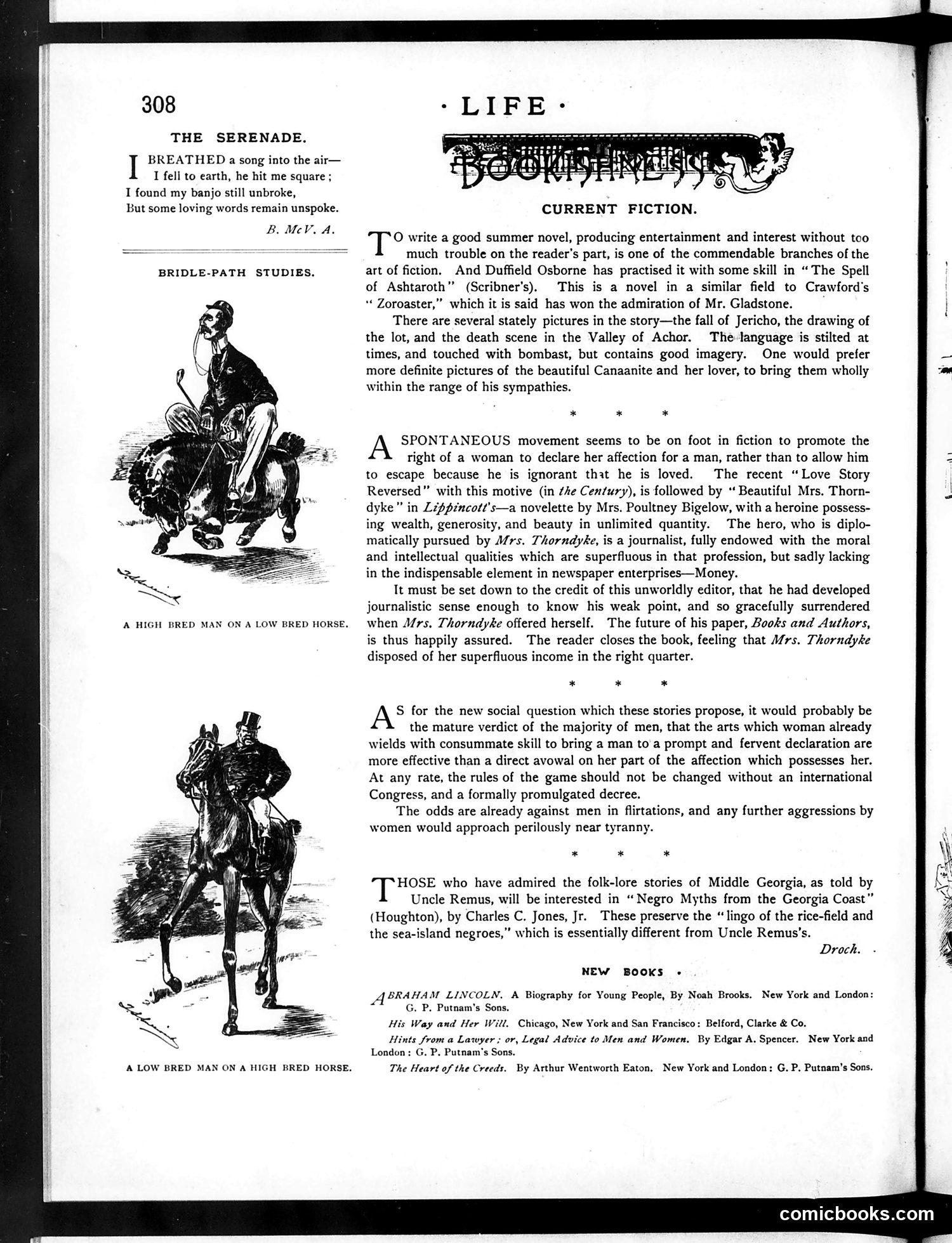
This page contains literary criticism rather than political satire. The two illustrations labeled "A HIGH BRED MAN ON A LOW BRED HORSE" and "A LOW BRED MAN ON A HIGH BRED HORSE" are generic social-class commentary in visual form—not specific political cartoons. They illustrate the essay's discussion of contemporary fiction. The text reviews summer novels, particularly praising Duffield Osborne's "The Spell of Ashtaroth" and discussing Mrs. Poutney Bigelow's "Lipincott's" novelette. The review critiques characterization and explores emerging social questions about women's agency in romantic relationships—a genuine debate of the era. The page concludes with book announcements, making this primarily a literary review section rather than political satire.
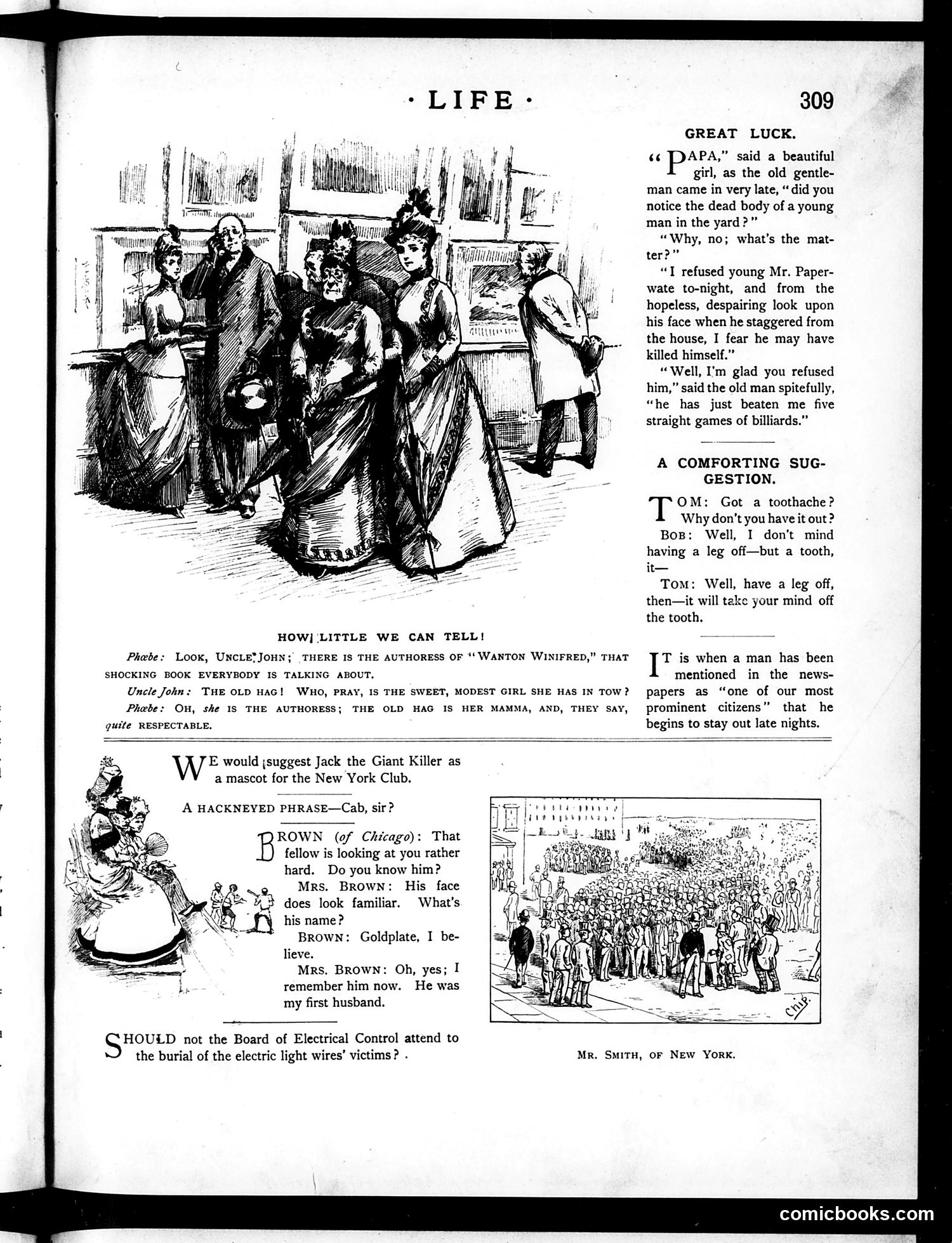
This page contains several unrelated satirical pieces typical of Life's format: **"Great Luck"** (top right): A social comedy where a father is relieved his daughter refused a suitor, Mr. Paperwate, who abandoned her after being rejected—until he learns the man subsequently won five consecutive billiards games, making him suddenly "respectable" again. The satire targets how arbitrary social status can be. **"A Comforting Suggestion"**: A brief joke about dental pain—toothache sufferers should have a leg amputated instead, as the distraction will ease the tooth pain. **Other content** includes references to "Warton Winifred" (likely a popular novel), commentary on New York society figures, and what appears to be a crowd scene cartoon. The overall tone is light social satire typical of early 20th-century American humor magazines.
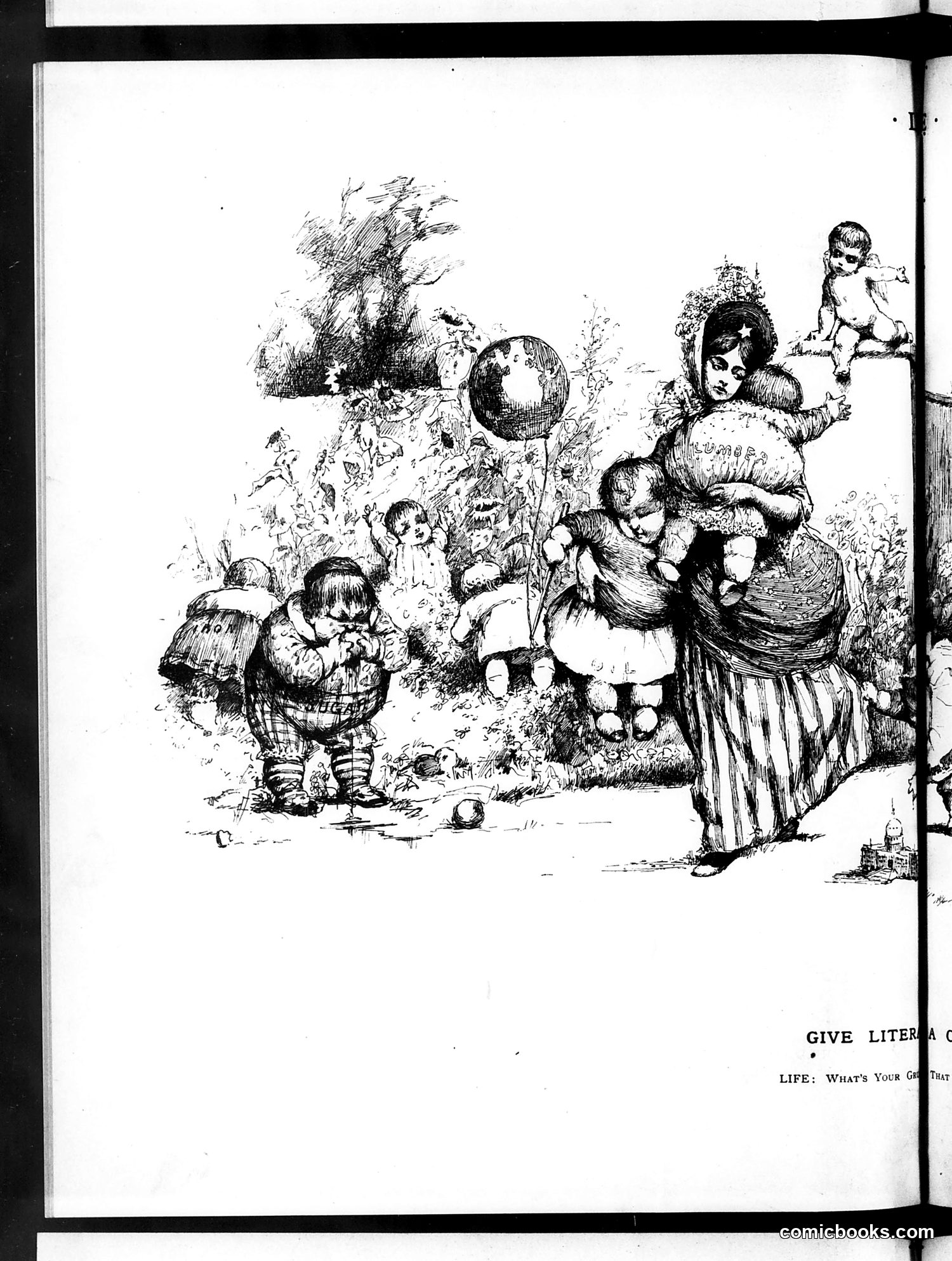
This is an illustrated page from *Life* magazine depicting a domestic scene with a woman and several children in a garden setting. The visible text fragment reads "GIVE LITERA..." and "LIFE: What's Your Gr... That," suggesting this is part of a larger article or feature. The illustration shows a mother figure surrounded by young children of varying ages, engaged in what appears to be outdoor play or gardening activity. The artistic style—detailed pen-and-ink work—is characteristic of early 20th-century magazine illustration. Without the complete text visible, the specific satirical point remains unclear, though the domestic focus suggests commentary on family life, children's upbringing, or maternal responsibilities. The tone appears genteel rather than sharply satirical based on the sentimental illustration style.
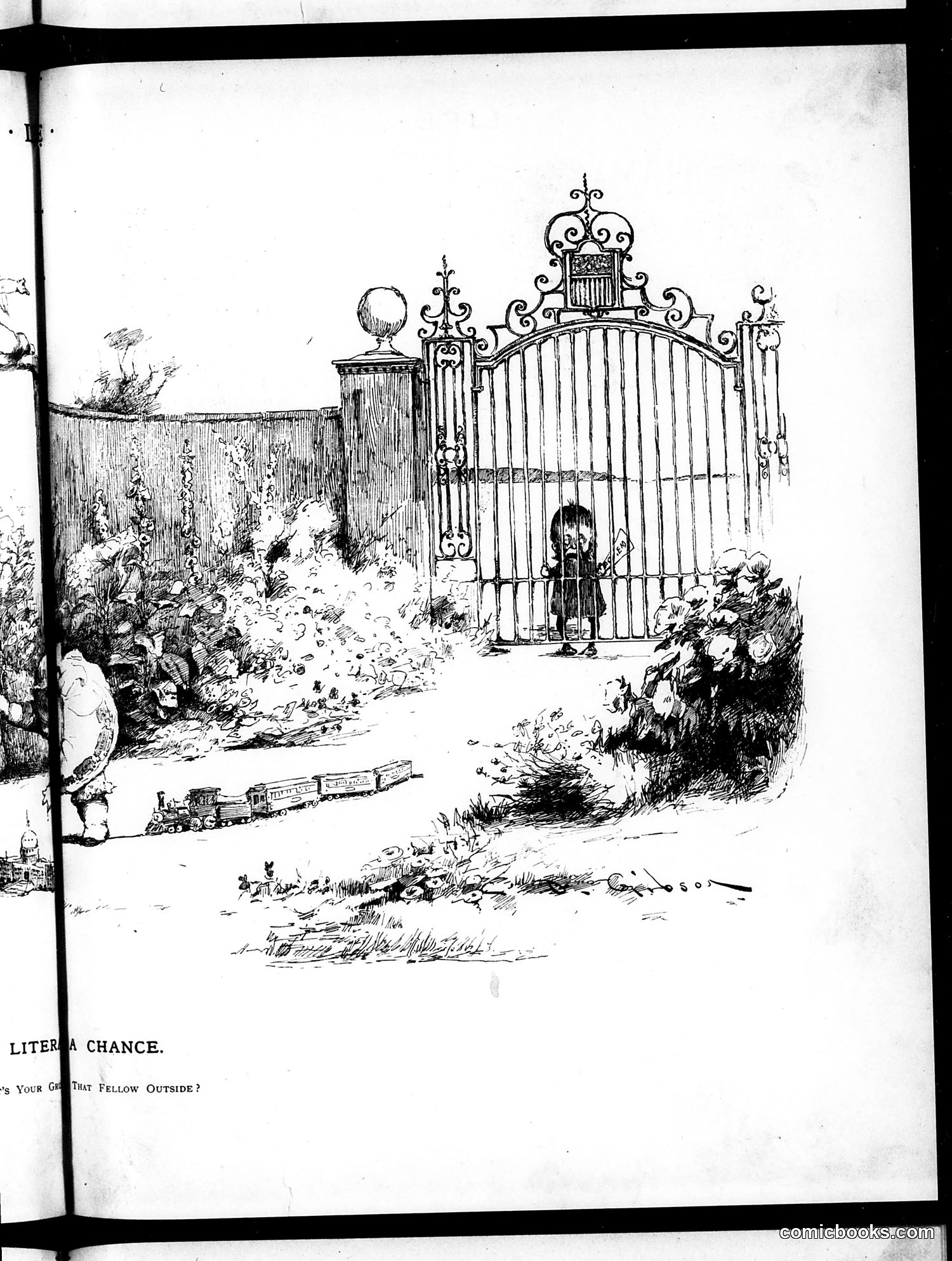
This cartoon depicts a child peering through an ornate garden gate at a toy train on the path outside. The title "Litera Chance" (likely "Literature Chance") and caption "Is Your Gentleman Fellow Outside?" suggest social satire about class boundaries. The elaborate, decorative gate symbolizes the barriers separating privileged children from common experiences. The toy train represents accessible pleasures or opportunities that exist just beyond the gate. The contrast between the ornate enclosure and the simple toy outside implies criticism of overprotective upper-class parenting or artificial social constraints that limit children's experiences. The satire appears to mock the pretentiousness of gated privilege while suggesting that genuine childhood pleasures lie in simpler, unrestricted access to the world.
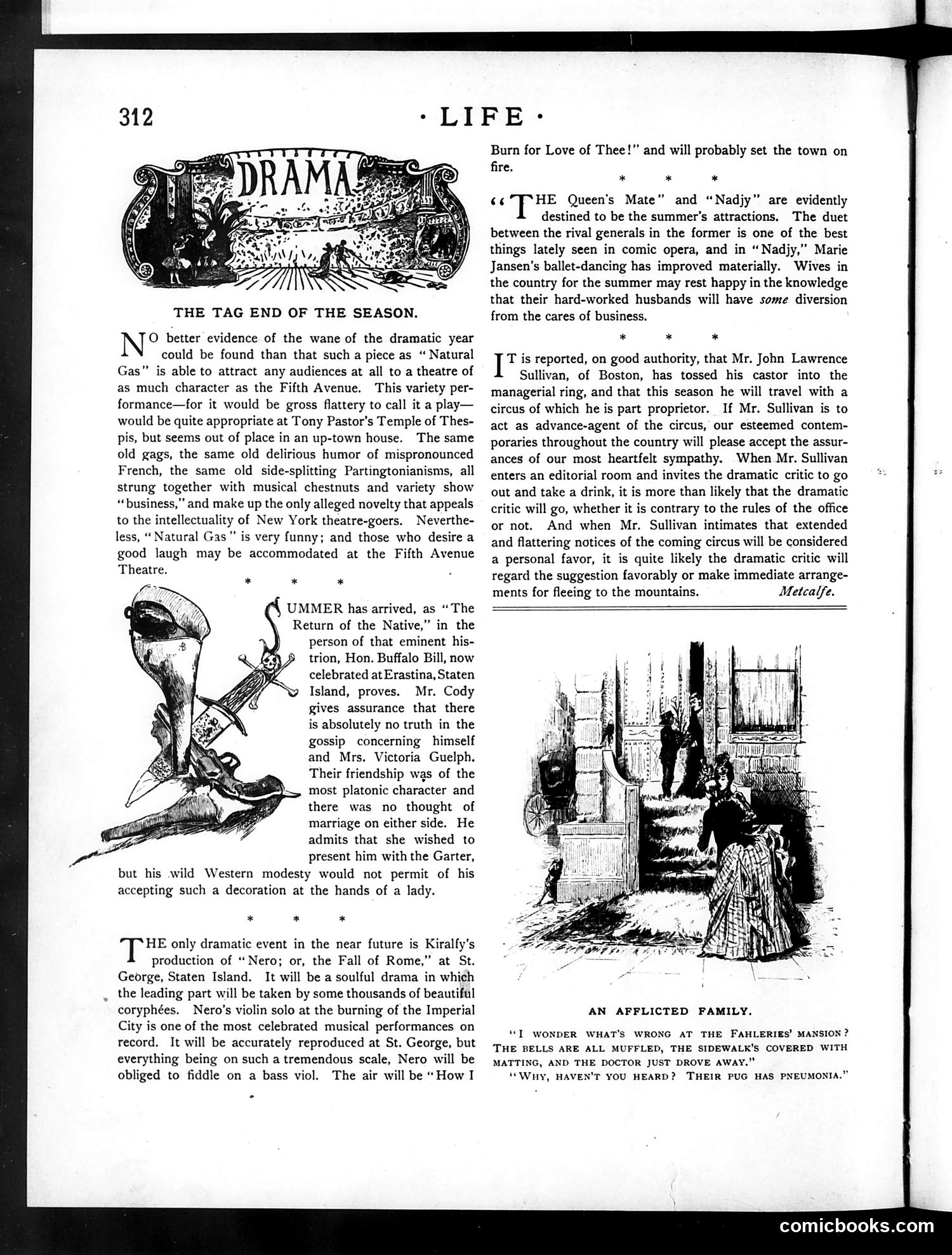
This page satirizes the theatrical season's decline through reviews of mediocre productions. The critic mocks "Natural Gas" at the Fifth Avenue Theatre as tired vaudeville—recycled jokes, bad French puns, and music-hall routines unworthy of an upscale venue. The piece also ridicules Buffalo Bill (Hon. Buffalo Bill Cody), then performing at Erastina, Staten Island. Life sarcastically denies gossip about his relationship with "Mrs. Victoria Guelph" (likely Queen Victoria), claiming their friendship was merely platonic, though she allegedly offered him the Garter—a jab at the absurdity of such rumors. The Kiralfy opera "Nero" receives mocking praise for its massive scale—so enormous that Nero must use a bass viol instead of violin for his famous solo. Finally, boxer John Lawrence Sullivan's venture into circus management prompts warnings: dramatic critics should flee when Sullivan requests favorable notices, as his persuasive methods (offering drinks) may compromise their professional integrity.
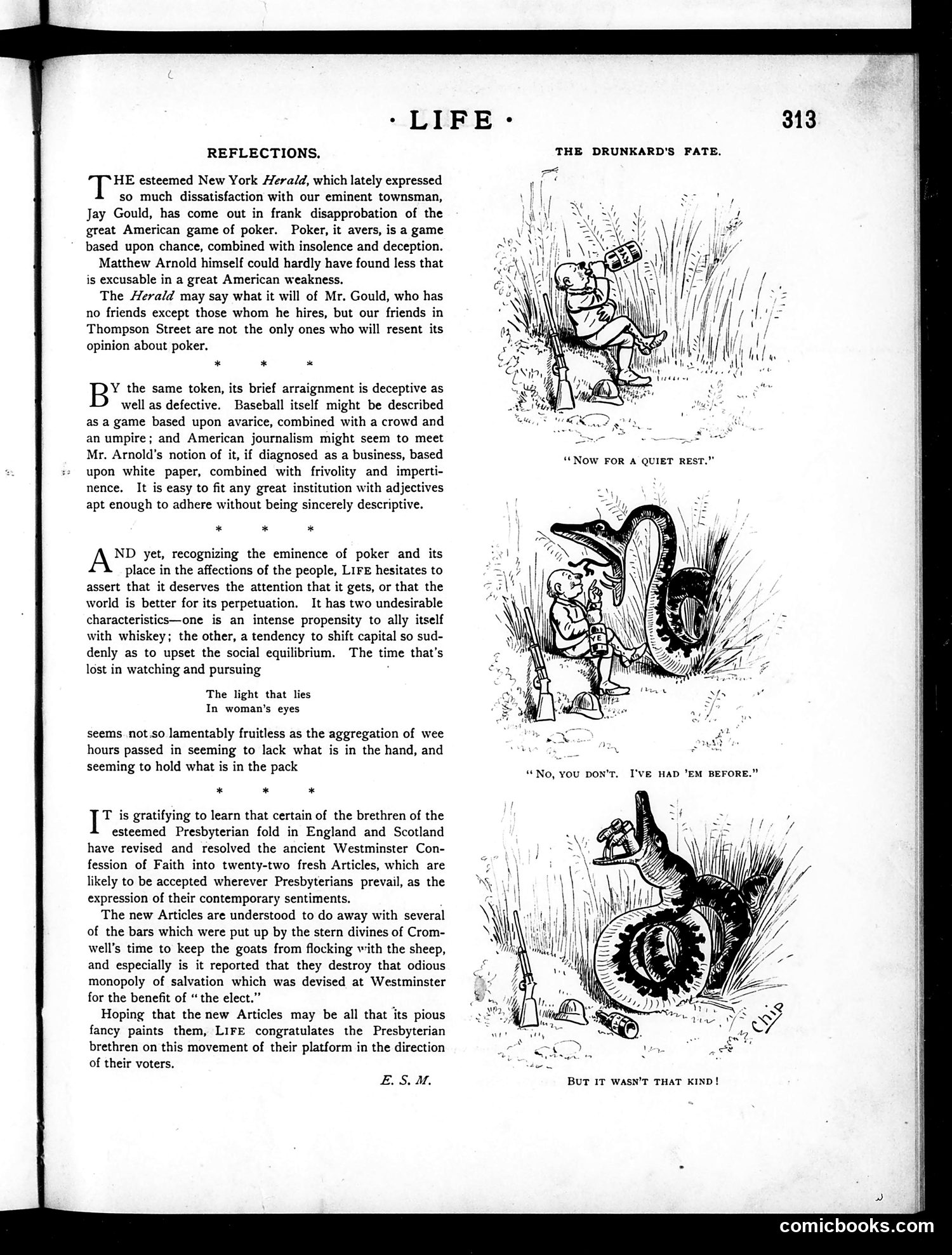
This page contains three satirical cartoons illustrating the dangers of alcoholism. The illustrations show a figure progressing through stages of drunkenness in a natural setting—first resting peacefully in tall grass, then collapsed against a large wheel or machinery, and finally sprawled on the ground in apparent distress or death. The captions ("Now for a Quiet Rest," "No, You Don't. I've Had 'Em Before," "But It Wasn't That Kind!") suggest ironic commentary on the drunkard's self-deception and inevitable downfall. This reflects Victorian-era temperance messaging common in satirical magazines like *Life*. The accompanying "Reflections" section critiques poker and other American pastimes, using similar moral logic—these activities lead people astray, waste time, and corrupt society. The drunkard cartoons visually reinforce this cautionary theme about vice and moral decline.
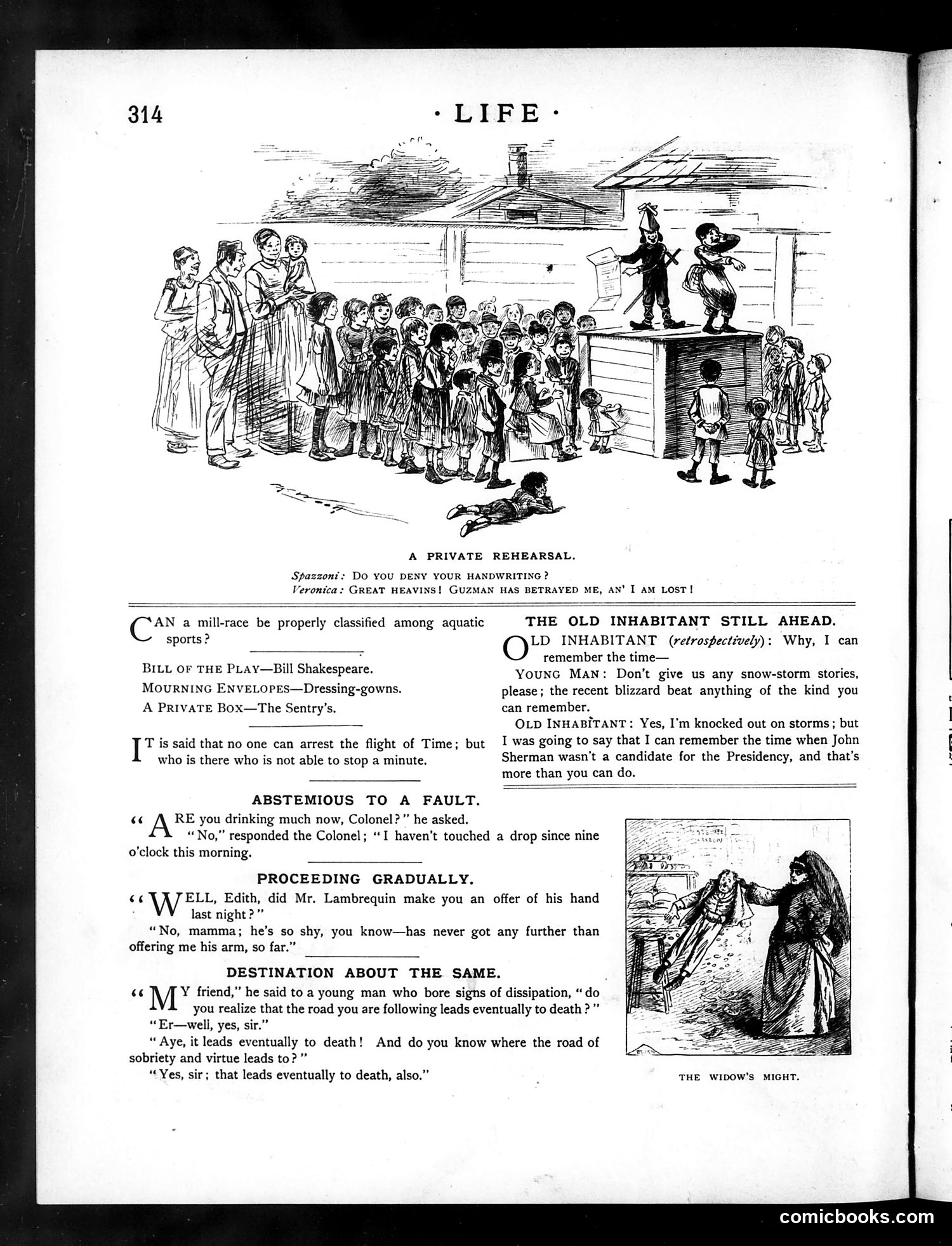
This page contains multiple short humorous sketches typical of Life's satirical style: **"A Private Rehearsal"** (top): A theatrical scene showing actors rehearsing dramatic lines about betrayal and handwriting denial—likely satirizing melodramatic stage performances of the era. **"The Old Inhabitant Still Ahead"**: Jokes about an elderly man who claims to remember impossibly distant events (like before John Sherman was a presidential candidate), mocking the "old timer" trope of exaggerating past experiences. **Brief jokes** on drinking abstinence, courtship progress, and mortality play on common social situations and human nature rather than specific political figures. **"The Widow's Might"** (illustration): Depicts two women in dark clothing, likely widows, though the specific reference is unclear from visible text. The page represents Life's editorial approach: mixing theatrical satire, generational humor, and domestic comedy without targeting particular politicians or events—focusing instead on universal human foibles and social pretension.
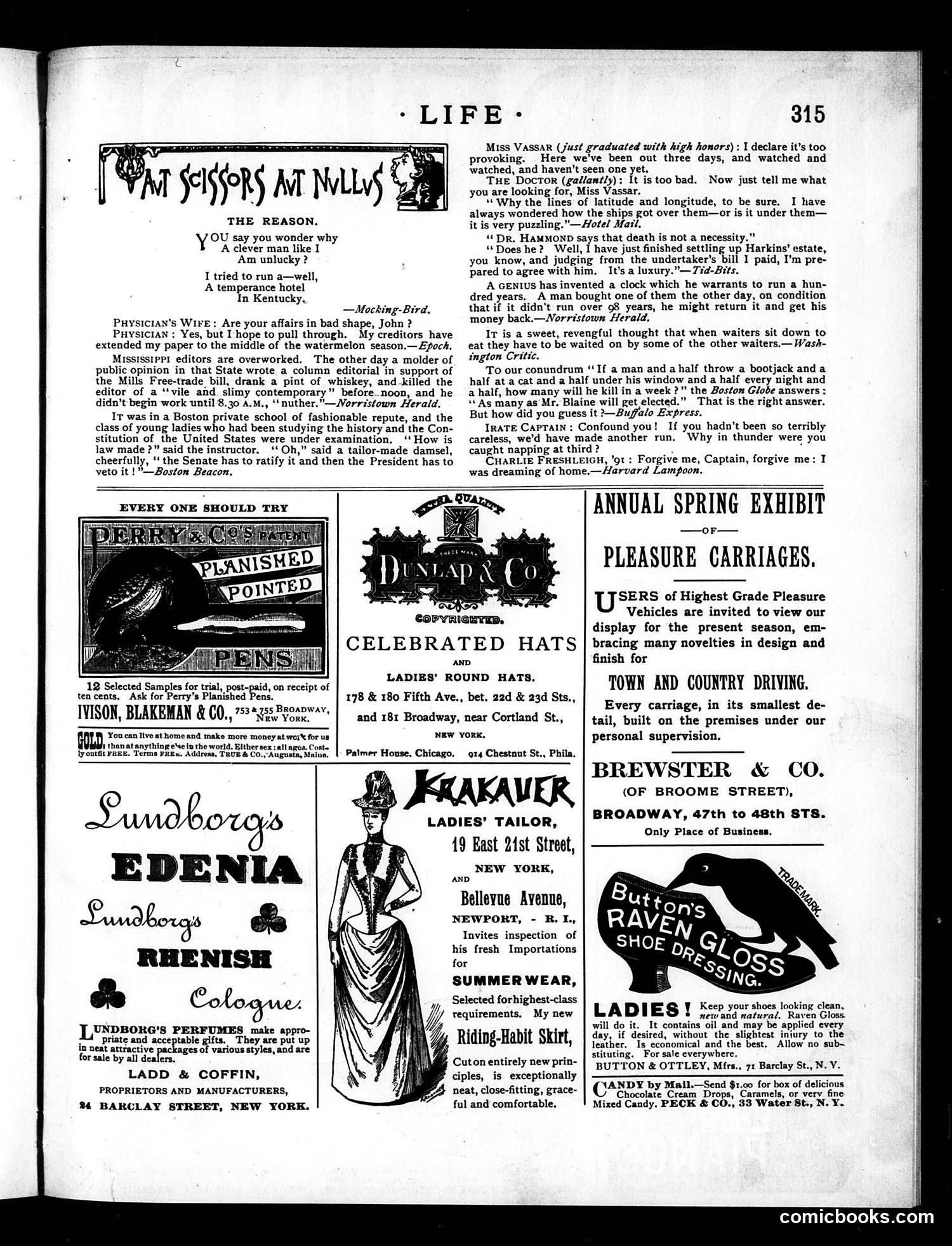
This page contains several brief humorous anecdotes rather than a political cartoon. The jokes target American social types and contemporary absurdities: **Notable sketches:** - A Vassar graduate (representing educated but impractical women) searches for latitude/longitude lines, literally misunderstanding geography - A Mississippi editor's violent temperament: he writes a pro-free-trade editorial, drinks whiskey, and kills a rival editor before 8:30 AM - A Boston schoolgirl hilariously misdefines lawmaking: "the Senate ratifies it and then the President vetoes it" - A reference to James G. Blaine (likely the 1884 presidential candidate), implying he'll never get elected The humor relies on period stereotypes: incompetent women, violent Southern editors, and Irish/working-class characteristics. These reflect late 19th-century American satirical conventions mocking regional differences, class pretension, and gender roles. The page is otherwise dominated by advertisements for hats, pens, and carriages.
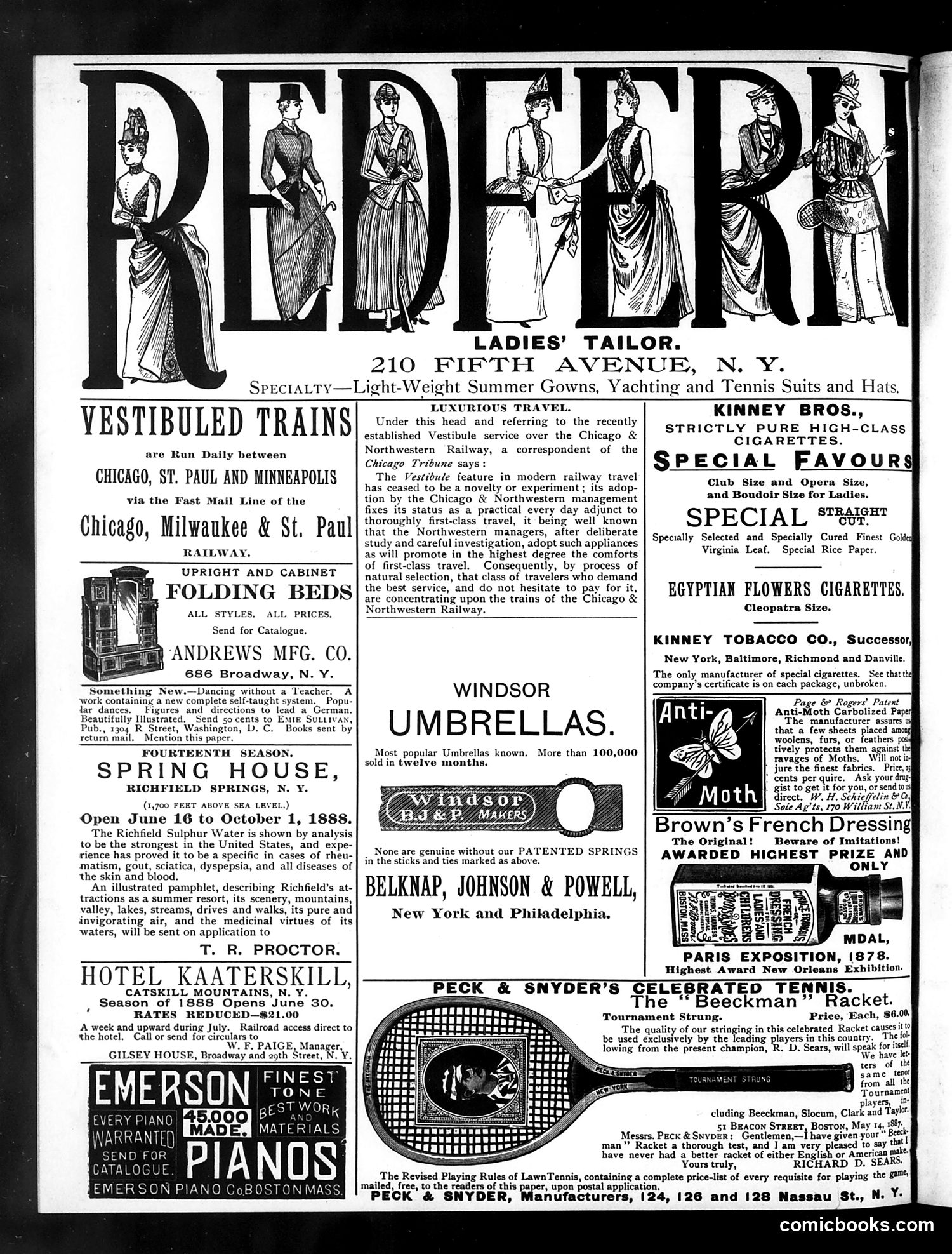
This page is primarily a **advertisements section** rather than satirical cartoon content. It displays various commercial ads typical of late 19th-century American magazines, including: - Ladies' tailoring services - Railroad "Vestibuled Trains" (new luxury railway cars with enclosed passages between compartments) - Folding beds, pianos, and hotels - Consumer goods like Windsor umbrellas, cigarettes, and moth-prevention products The one illustration—a tennis racket by Peck & Snyder—is a product advertisement, not satire. The page reflects the commercial focus of *Life* magazine during this era, when advertising subsidized publication. No political figures, caricatures, or satirical commentary are present. This appears to be a standard advertising page from the 1888 publication.
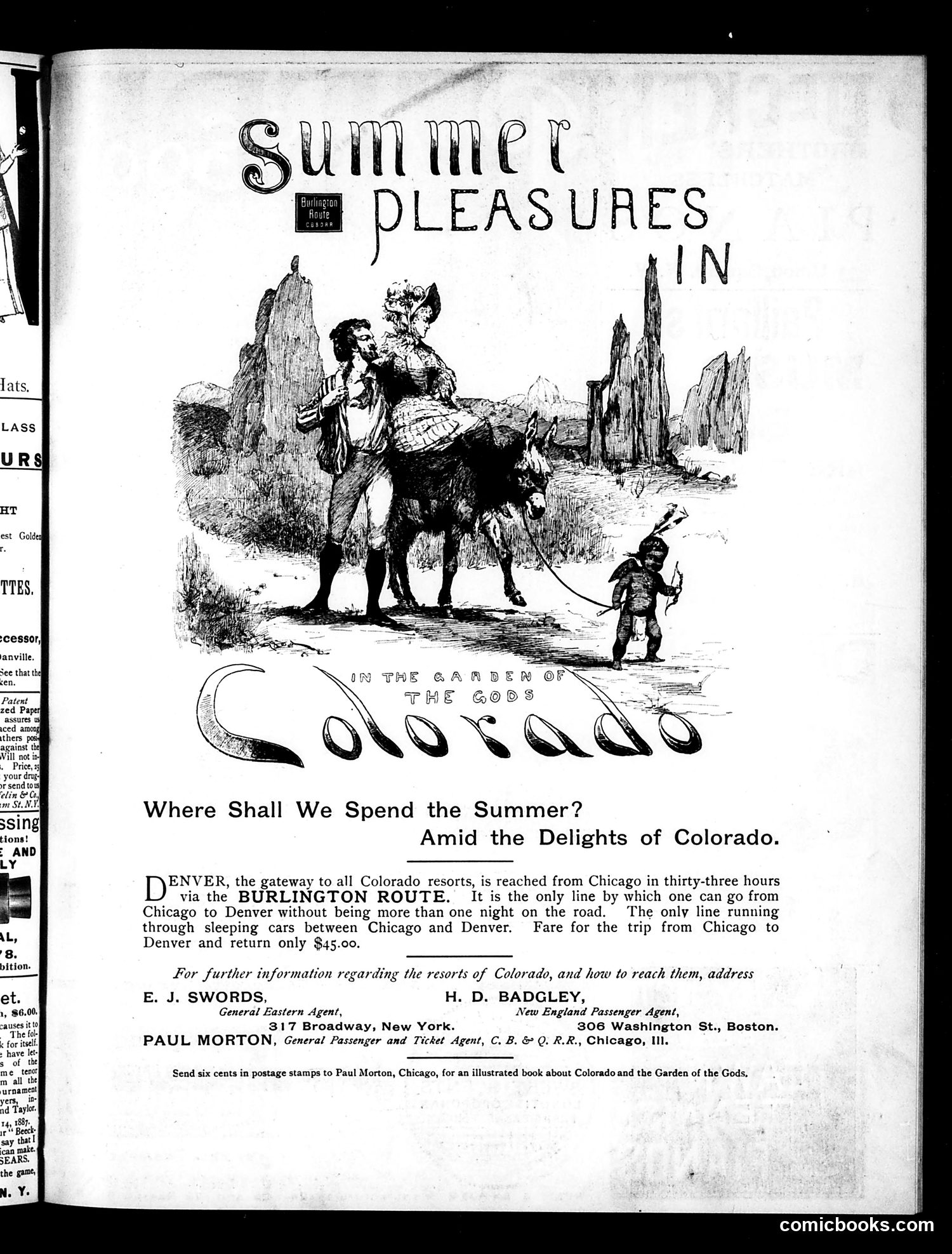
This is primarily a **travel advertisement** rather than political satire. The illustration depicts a romantic pastoral scene: a well-dressed couple on horseback being led by a small figure (possibly a guide or servant) through a mountainous landscape labeled "Garden of the Gods"—a real Colorado attraction. The text promotes Denver as a vacation destination accessible via the Burlington Route railroad, emphasizing the convenience of sleeping cars and a reasonable fare ($45 round-trip from Chicago). The satirical element, if present, is subtle: the idealized romantic imagery may gently mock the aspirations of middle-class travelers seeking leisure and sophistication. The "Garden of the Gods" reference invokes classical mythology, suggesting Colorado resorts offer an escape to paradise—likely an exaggeration meant to be slightly tongue-in-cheek. The page functions primarily as commercial promotion rather than social commentary.
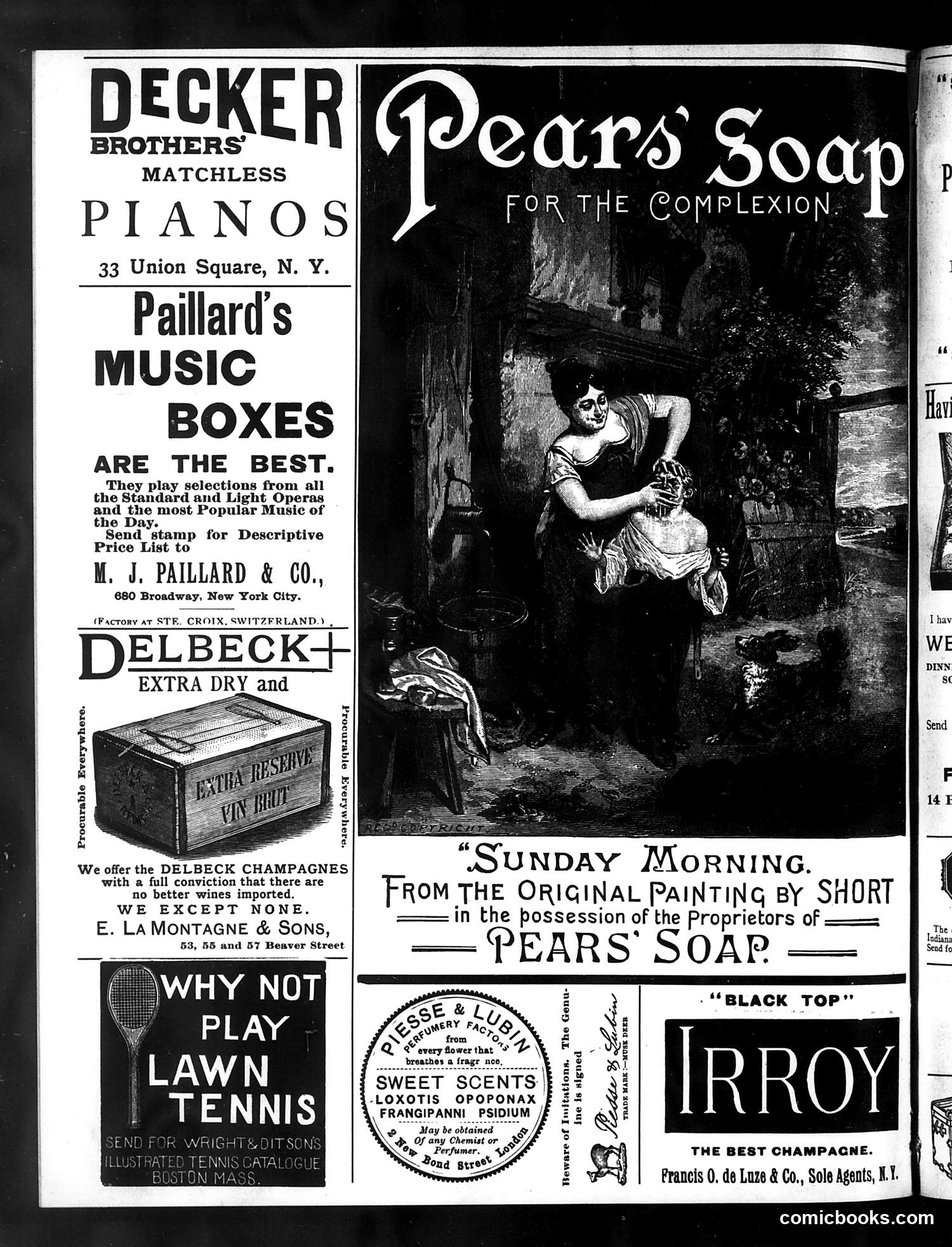
This page is primarily **advertising**, not editorial content or satire. It features multiple product advertisements typical of a late 19th-century American magazine: The dominant image—"Sunday Morning" by artist Short—advertises **Pears' Soap**, depicting a woman at her toilette. This represents Victorian-era beauty culture and the era's racial attitudes embedded in complexion products (the advertisement explicitly markets soap "for the complexion"). Other ads promote luxury goods: **Decker Brothers pianos**, **Paillard's music boxes**, **Delbeck champagne**, and **lawn tennis equipment**. These target wealthy consumers—the magazine's affluent readership. The "Black Top" champagne advertisement appears at bottom right. There is **no political cartoon or satire visible** on this page. Rather, it illustrates how Life magazine monetized its audience through high-end product endorsements, reflecting Gilded Age consumer culture and the aspirational lifestyle marketed to the urban middle and upper classes.
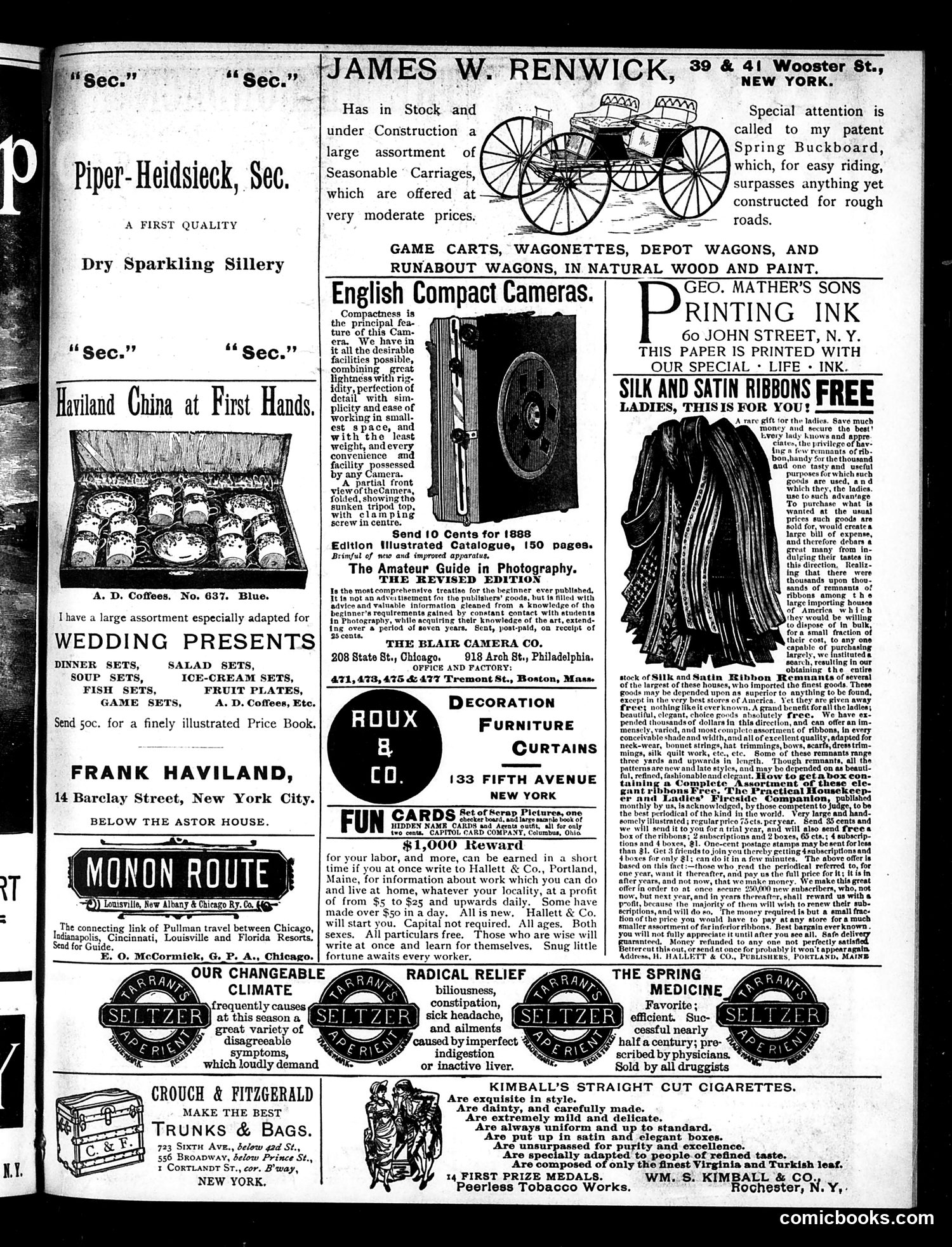
This page is **primarily advertisements**, not satirical content. It features turn-of-the-century commercial promotions for luxury goods and services aimed at affluent Americans. Notable ads include carriages and buckboards from James W. Renwick, fine china and dinnerware from Frank Haviland (wedding presents), English compact cameras from Blair Camera Co., and luggage from Crouch & Fitzgerald. A "Monon Route" railroad ad advertises Pullman travel between major cities. The only tangentially humorous content is a small "Fun Cards" advertisement promising $1,000 rewards for home labor, and a Seltzer medicine ad claiming relief for various ailments caused by the season's "changeable climate." The page reflects **Gilded Age consumer culture**—targeting wealthy urbanites seeking imported goods, travel, and photography equipment. There is no political satire or cartoon present.
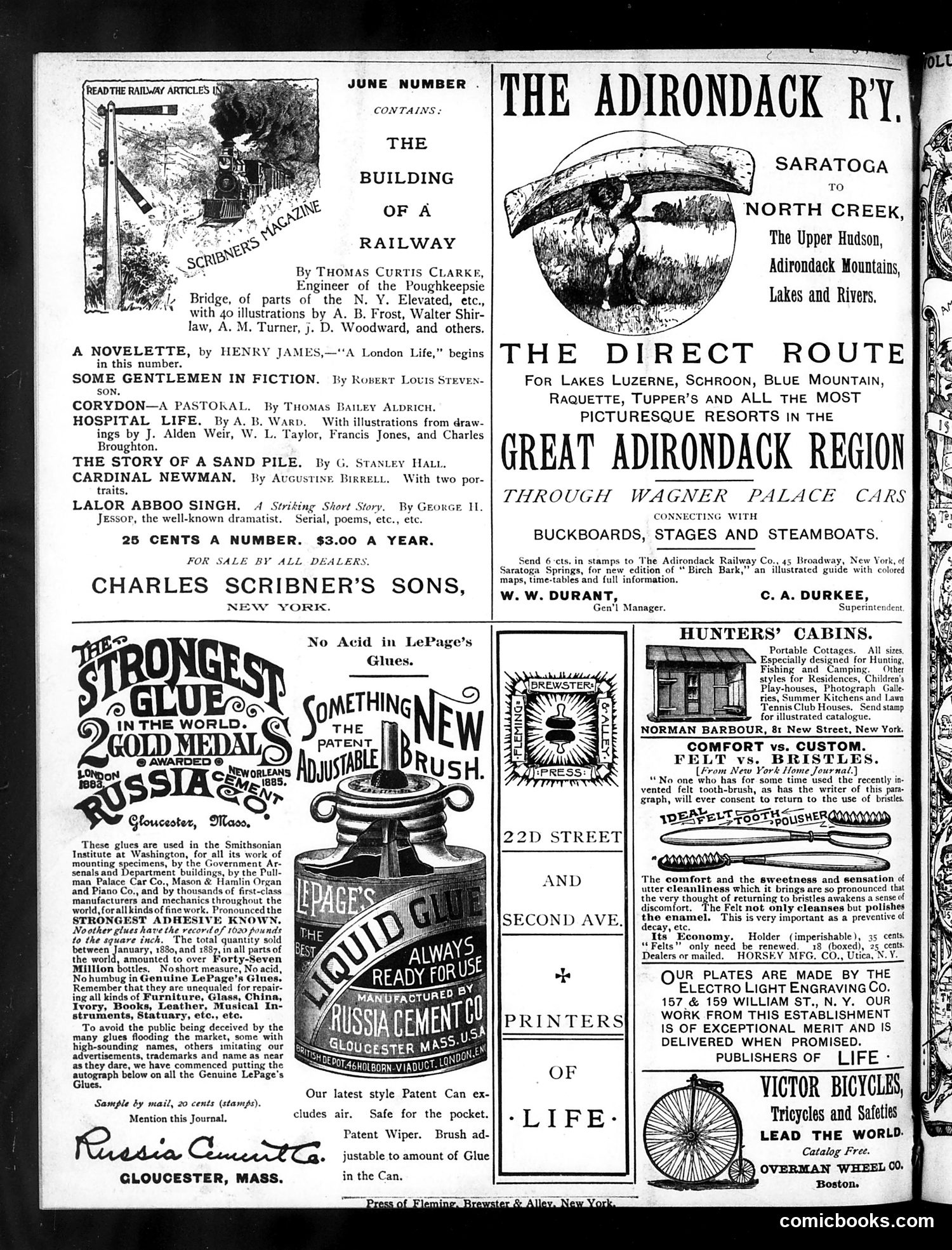
This is primarily an **advertising and contents page** for Life magazine's June issue, not a political cartoon page. The actual editorial content listed includes literary pieces by Henry James and Robert Louis Stevenson, articles on railway engineering, and fiction stories. The advertisements dominate visually. Most notable is **LePage's Glue**, which boasts of being "the strongest adhesive known" with claims of 1,620 pounds per square inch strength—used by the Smithsonian Institution and major manufacturers. The ad explicitly warns against counterfeits flooding the market with similar names and trademarks. Other ads promote the Adirondack Railway, hunters' cabins, Victor bicycles, and a felt toothbrush claiming superiority over bristles for comfort and cleanliness. There are **no political cartoons** on this page—it's a commercial publication page typical of late 19th-century magazines where advertising revenue subsidized editorial content.