
Life, 1888-05-31 · page 6 of 20
Life — May 31, 1888 — page 6: what you’re looking at
What you’re looking at
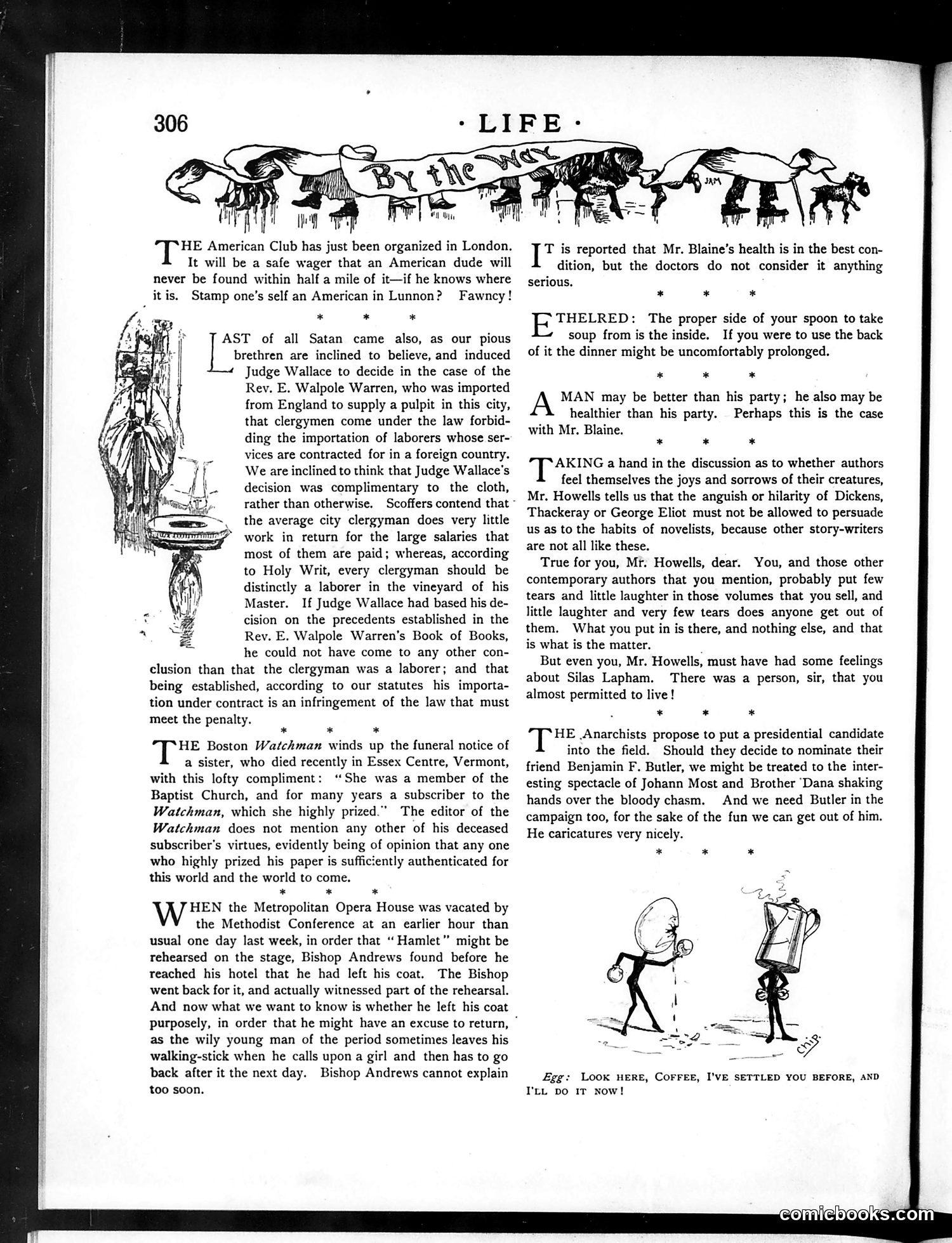
This page contains social commentary and gossip rather than political cartoons. The items mock: 1. **American expatriates in London** — satirizing American "dudes" abroad and an exclusive American Club's pretensions. 2. **Clergy labor debates** — discussing whether clergymen importing foreign laborers violates religious principles (referencing Judge Wallace's court case). 3. **Authors' emotional attachment to characters** — critiquing Dickens, Thackeray, and George Eliot for becoming too invested in their fictional creations, contrasting with contemporary authors like Howells. 4. **Anarchist politics** — joking about nominating Benjamin F. Butler as a presidential candidate as anarchist spectacle. The bottom cartoon shows two figures debating coffee, with minimal political significance—a domestic humor piece.
📄 Transcribed text from this page (OCR, searchable)
Machine-transcribed from the original scan — historical spelling and the odd misread are preserved.
HE American Club has just been organized in London. It will be a safe wager that an American dude will never be found within half a mile of it—if he knows where it is. Stamp one’s self an American in Lunnon? = Fawncy! * * * AST of all Satan came also, as our pious [Sore are inclined to believe, and induced Judge Wallace to decide in the case of the Rev. E. Walpole Warren, who was imported from England to supply a pulpit in this city, that clergymen come under the law forbid- ding the importation of laborers whose ser- vices are contracted for in a foreign country. We are inclined to think that Judge Wallace's decision was complimentary to the cloth, rather than otherwise. Scoffers contend that the average city clergyman does very little work in return for the large salaries that most of them are paid; whereas, according to Holy Writ, every clergyman should be distinctly a laborer in the vineyard of his Master. If Judge Wallace had based his de- cision on the precedents established in the Rev. E. Walpole Warren's Book of Books, he could not have come to any other con- clusion than that the clergyman was a laborer; and that being established, according to our statutes his importa- tion under contract is an infringement of the law that must meet the penalty. * * HE Boston Watchman winds up the funeral notice of a sister, who died recently in Essex Centre, Vermont, with this lofty compliment: “She was a member of the Baptist Church, and for many years a subscriber to the Watchman, which she highly prized.’ The editor of the Watchman does not mention any other of his deceased subscriber's virtues, evidently being of opinion that any one who highly prized his paper is sufficiently authenticated for this world and the world to come. * * * Ween the Metropolitan Opera House was vacated by the Methodist Conference at an earlier hour than usual one day last week, in order that “Hamlet” might be rehearsed on the stage, Bishop Andrews found before he reached his hotel that he had left his coat. The Bishop went back for it, and actually witnessed part of the rehearsal. And now what we want to know is whether he left his coat purposely, in order that he might have an excuse to return, * as the wily young man of the period sometimes leaves his walking-stick when he calls upon a girl and then has to go back after it the next day. Bishop Andrews cannot explain too soon, T is reported that Mr. Blaine’s health is in the best con- dition, but the doctors do not consider it anything serious. * * * THELRED: The proper side of your spoon to take soup from is the inside. If you were to use the back of it the dinner might be uncomfortably prolonged. * * * A MAN may be better than his party; he also may be healthier than his party. Perhaps this is the case with Mr. Blaine. * * * AKING a hand in the discussion as to whether authors feel themselves the joys and sorrows of their creatures, Mr. Howells tells us that the anguish or hilarity of Dickens, Thackeray or George Eliot must not be allowed to persuade us as to the habits of novelists, because other story-writers are not all like these. True for you, Mr. Howells, dear. You, and those other contemporary authors that you mention, probably put few tears and little laughter in those volumes that you sell, and little laughter and very few tears does anyone get out of them. What you put in is there, and nothing else, and that is what is the matter. But even you, Mr. Howells, must have had some feelings about Silas Lapham. There was a person, sir, that you almost permitted to live! * * * HE Anarchists propose to put a presidential candidate into the field. Should they decide to nominate their friend Benjamin F. Butler, we might be treated to the inter- esting spectacle of Johann Most and Brother ‘Dana shaking hands over the bloody chasm. And we need Butler in the campaign too, for the sake of the fun we can get out of him. He caricatures very nicely. Z£gg: Loox HERE, COFFEE, I'VE SETTLED YOU BEFORE, AND I'LL po IT vow!