
Life, 1888-05-31 · page 4 of 20
Life — May 31, 1888 — page 4: what you’re looking at
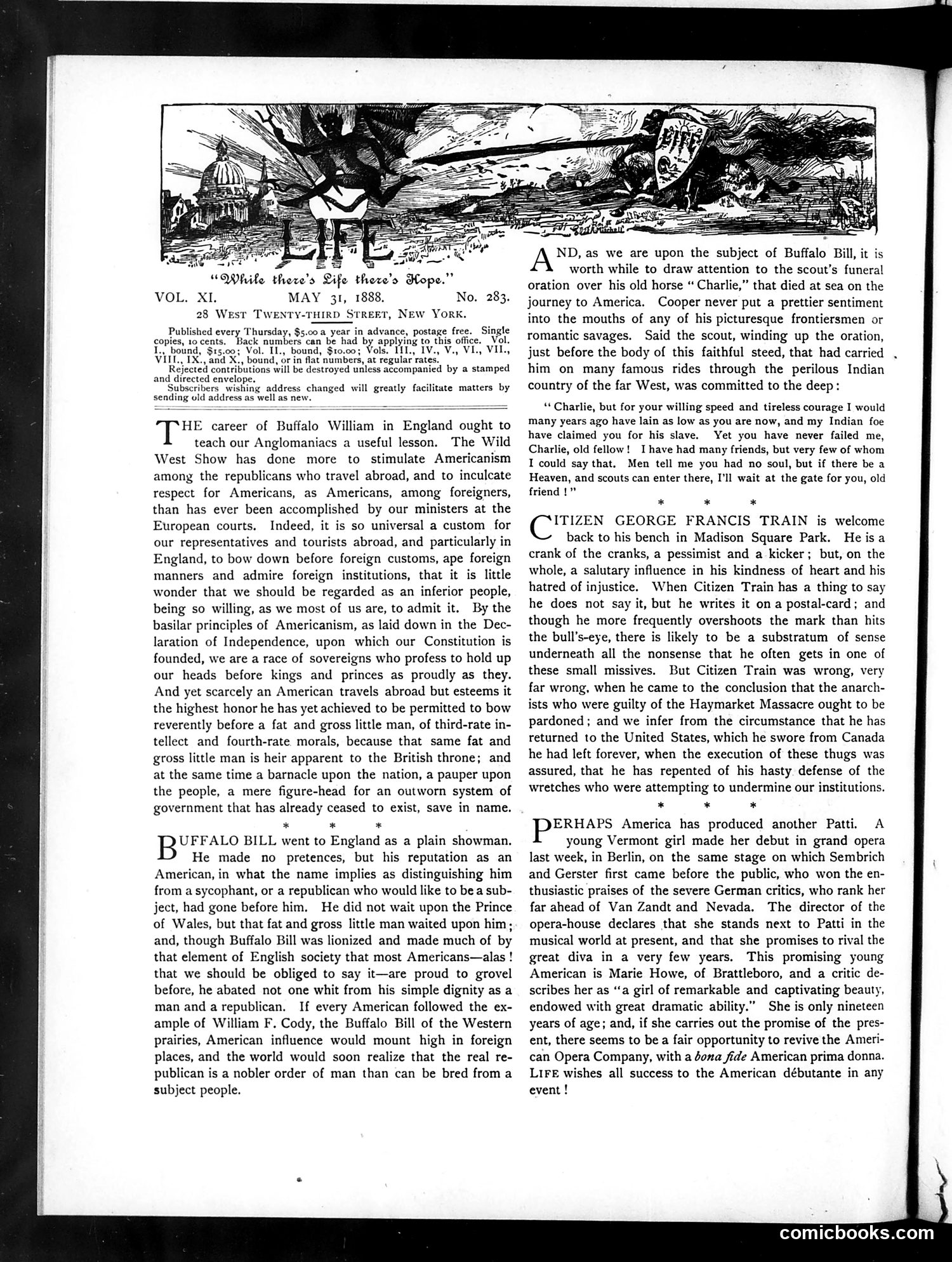
What you’re looking at
The page contains three satirical articles rather than cartoons. The lead piece criticizes **Buffalo Bill** (William F. Cody) for his deferential behavior during his Wild West Show tour in England, arguing he compromised American republican dignity by bowing to British aristocracy. The satire mocks what the writer sees as improper deference to foreign custom. A second article attacks **Citizen George Francis Train**, a political activist and eccentric, for wrongly defending anarchists involved in the Haymarket Massacre—a violent 1886 labor protest in Chicago where several were executed. The final brief item celebrates an American opera singer's (Marie Howe) European debut, wishing success for American cultural achievement abroad. The page satirizes American dignity, anarchism, and celebrates cultural nationalism.
📄 Transcribed text from this page (OCR, searchable)
Machine-transcribed from the original scan — historical spelling and the odd misread are preserved.
“While there's Life there’s Hope.” VOL. XI. MAY 31, 1888. No. 283. 28 West TWENTY-THIRD STREET, New YorK. Published every Thursday, $5.00 a year in advance, postage free. Single copies, 10 cents. Back numbers can be had by applying to this office. Vol. $15,00; Vol. IL., bound, $10.00; Vols. III., IV., V., VI, VIL, , IX! and X:, bound, or in flat’ numbers, at regular rates. Rejected contributions will be destroyed unless accompanied by a stamped and directed envelope. Subscribers wishing address changed will greatly facilitate matters by sending old address as well as new. Te career of Buffalo William in England ought to teach our Anglomaniacs a useful lesson. The Wild West Show has done more to stimulate Americanism among the republicans who travel abroad, and to inculcate respect for Americans, as Americans, among foreigners, than has ever been accomplished by our ministers at the European courts. Indeed, it is so universal a custom for our representatives and tourists abroad, and particularly in England, to bow down before foreign customs, ape foreign manners and admire foreign institutions, that it is little wonder that we should be regarded as an inferior people, being so willing, as we most of us are, to admit it. By the basilar principles of Americanism, as laid down in the Dec- laration of Independence, upon which our Constitution is founded, we are a race of sovereigns who profess to hold up our heads before kings and princes as proudly as they. And yet scarcely an American travels abroad but esteems it the highest honor he has yet achieved to be permitted to bow reverently before a fat and gross little man, of third-rate in- tellect and fourth-rate. morals, because that same fat and gross little man is heir apparent to the British throne; and at the same time a barnacle upon the nation, a pauper upon the people, a mere figure-head for an outworn system of government that has already ceased to exist, save in name. * * * UFFALO BILL went to England as a plain showman. He made no pretences, but his reputation as an American, in what the name implies as distinguishing him from a sycophant, or a republican who would like to be a sub- ject, had gone before him. He did not wait upon the Prince of Wales, but that fat and gross little man waited upon him; and, though Buffalo Bill was lionized and made much of by that element of English society that most Americans—alas ! that we should be obliged to say it—are proud to grovel before, he abated not one whit from his simple dignity as a man and a republican. If every American followed the ex- ample of William F. Cody, the Buffalo Bill of the Western prairies, American influence would mount high in foreign places, and the world would soon realize that the real re- publican is a nobler order of man than can be bred from a subject people. ND, as we are upon the subject of Buffalo Bill, it is worth while to draw attention to the scout’s funeral oration over his old horse “ Charlie,” that died at sea on the journey to America. Cooper never put a prettier sentiment into the mouths of any of his picturesque frontiersmen or romantic savages. Said the scout, winding up the oration, just before the body of this faithful steed, that had carried him on many famous rides through the perilous Indian country of the far West, was committed to the deep: “ Charlie, but for your willing speed and tireless courage I would many years ago have lain as low as you are now, and my Indian foe have claimed you for his slave. Yet you have never failed me, Charlie, old fellow! I have had many friends, but very few of whom I could say that. Men tell me you had no soul, but if there be a Heaven, and scouts can enter there, I'll wait at the gate for you, old friend |” * * * ITIZEN GEORGE FRANCIS TRAIN is welcome back to his bench in Madison Square Park. He isa crank of the cranks, a pessimist and a kicker; but, on the whole, a salutary influence in his kindness of heart and his hatred of injustice. When Citizen Train has a thing to say he does not say it, but he writes it ona postal-card; and though he more frequently overshoots the mark than hits the bull’s-eye, there is likely to be a substratum of sense underneath all the nonsense that he often gets in one of these small missives. But Citizen Train was wrong, very far wrong, when he came to the conclusion that the anarch- ists who were guilty of the Haymarket Massacre ought to be pardoned ; and we infer from the circumstance that he has returned to the United States, which he swore from Canada he had left forever, when the execution of these thugs was assured, that he has repented of his hasty defense of the wretches who were attempting to undermine our institutions. * * * ERHAPS America has produced another Patti. A young Vermont girl made her debut in grand opera last week, in Berlin, on the same stage on which Sembrich and Gerster first came before the public, who won the en- thusiastic praises of the severe German critics, who rank her far ahead of Van Zandt and Nevada. The director of the opera-house declares that she stands next to Patti in the musical world at present, and that she promises to rival the great diva in a very few years. This promising young American is Marie Howe, of Brattleboro, and a critic de- scribes her as ‘“‘a girl of remarkable and captivating beauty, endowed with great dramatic ability.” She is only nineteen years of age; and, if she carries out the promise of the pres- ent, there seems to be a fair opportunity to revive the Ameri- can Opera Company, with a dona fide American prima donna. LIFE wishes all success to the American débutante in any event! comicbooks.com