
A complete issue · 18 pages · 1888
Life — May 24, 1888
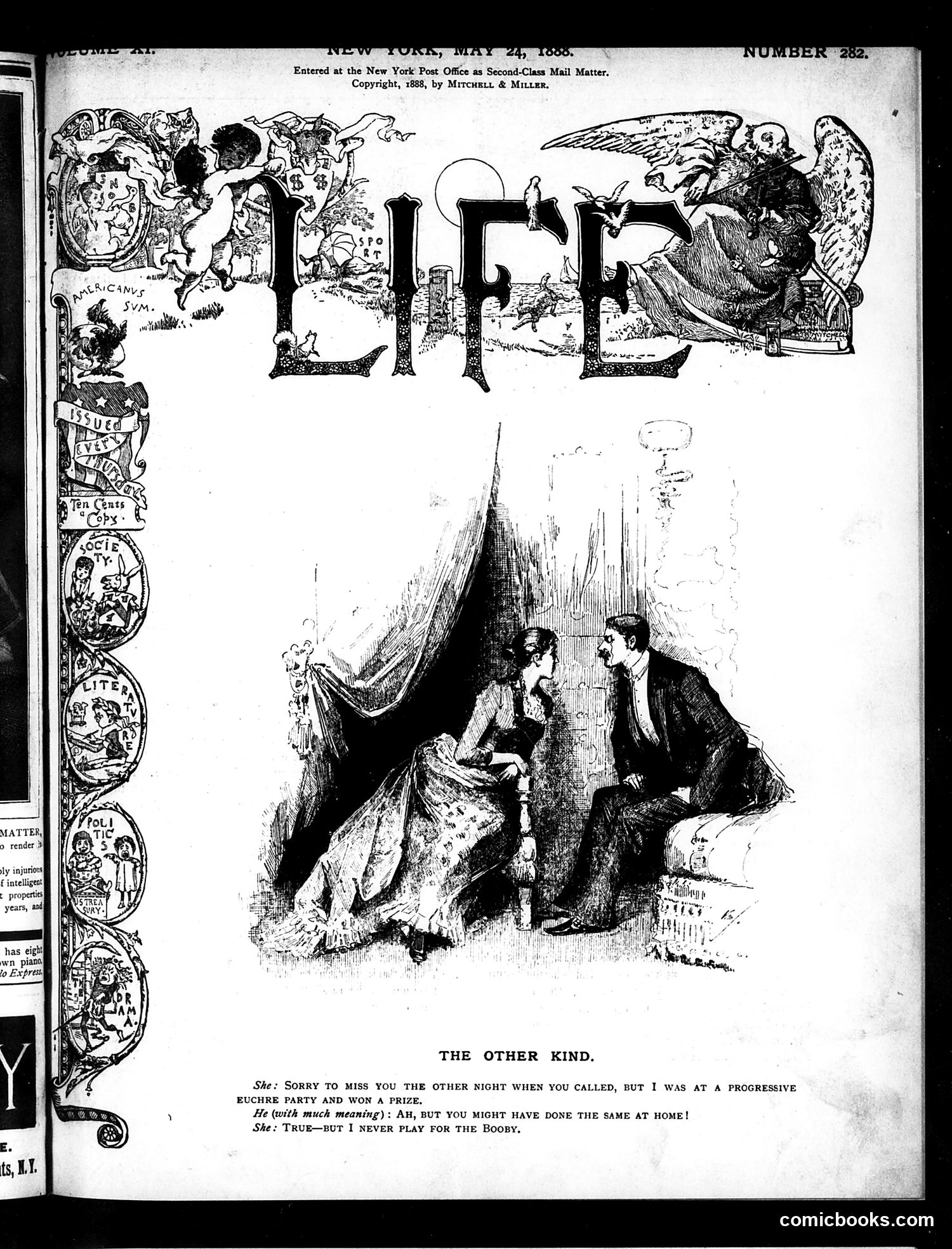
This page features a satirical cartoon titled "The Other Kind" from Life magazine (May 24, 1888). The illustration depicts a domestic scene where a woman explains to a man why she missed his visit: she was attending a "progressive euchre party" and won a prize. The man responds sarcastically that she might have done the same at home, but the woman insists she "never play[s] for the booby"—meaning she doesn't gamble for foolish stakes at home. The cartoon satirizes the social trend of progressive euchre parties (card games played in competitive tournament fashion), which were fashionable among wealthy Americans in the 1880s. The humor targets women's leisure activities and the domestic tensions created by wives' social engagements outside the home.
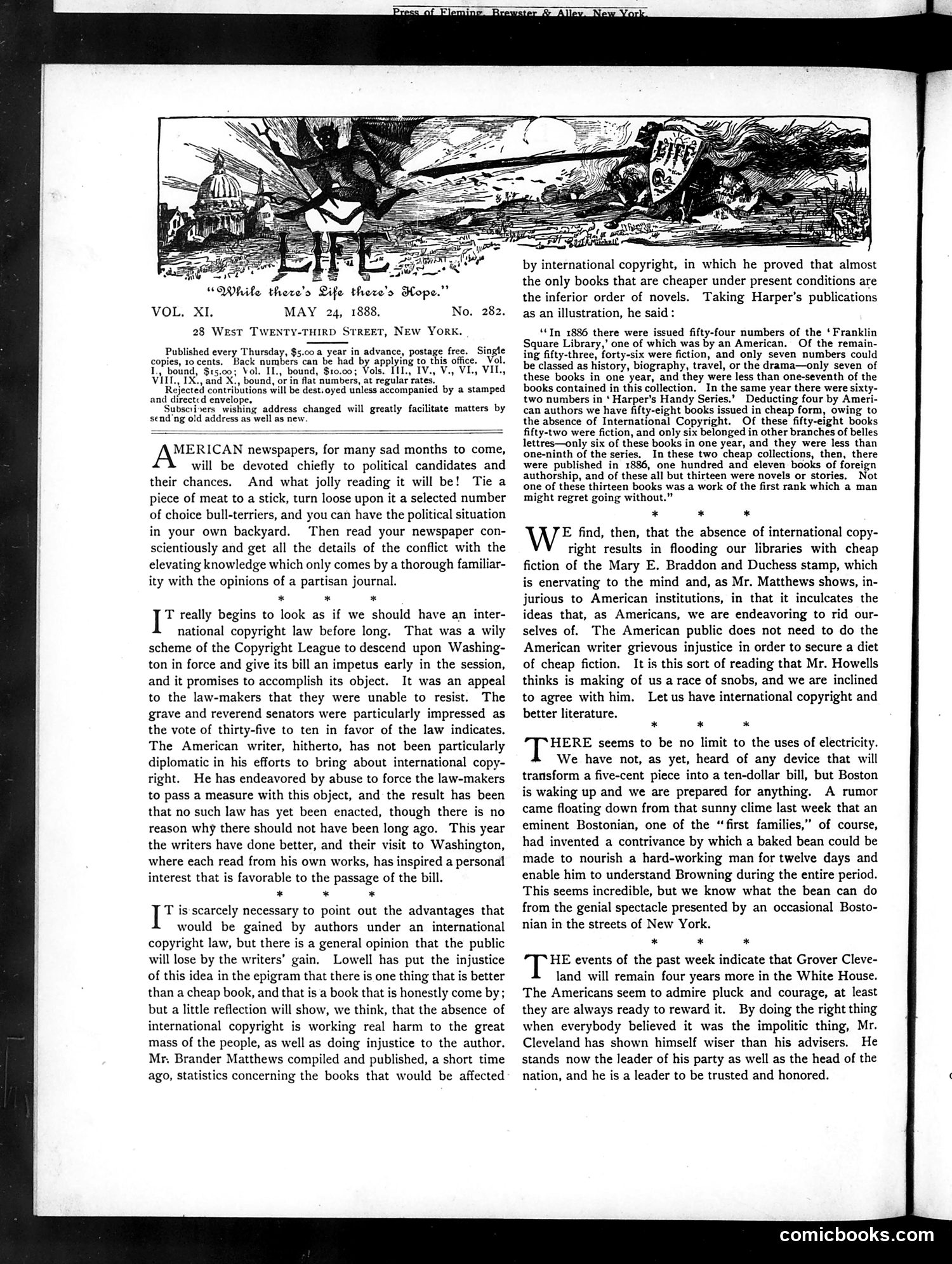
The masthead cartoon depicts a landscape with a bare tree, buildings, and a flag labeled "LIFE," illustrating the magazine's title "While there's Life there's Hope." The page is primarily text discussing **international copyright law**—a major political issue in 1888. The article argues that American publishers benefit from the *absence* of international copyright protection, allowing them to cheaply reprint foreign works without paying authors. The text criticizes this practice as unjust to foreign writers and advocates for stronger copyright laws. It references efforts by the "Copyright League" to lobby Congress and mentions President **Grover Cleveland** approvingly for supporting the measure. The piece also includes a humorous anecdote about a Boston inventor creating a device to power a baked bean to nourish a laborer—satirizing impractical technological solutions.
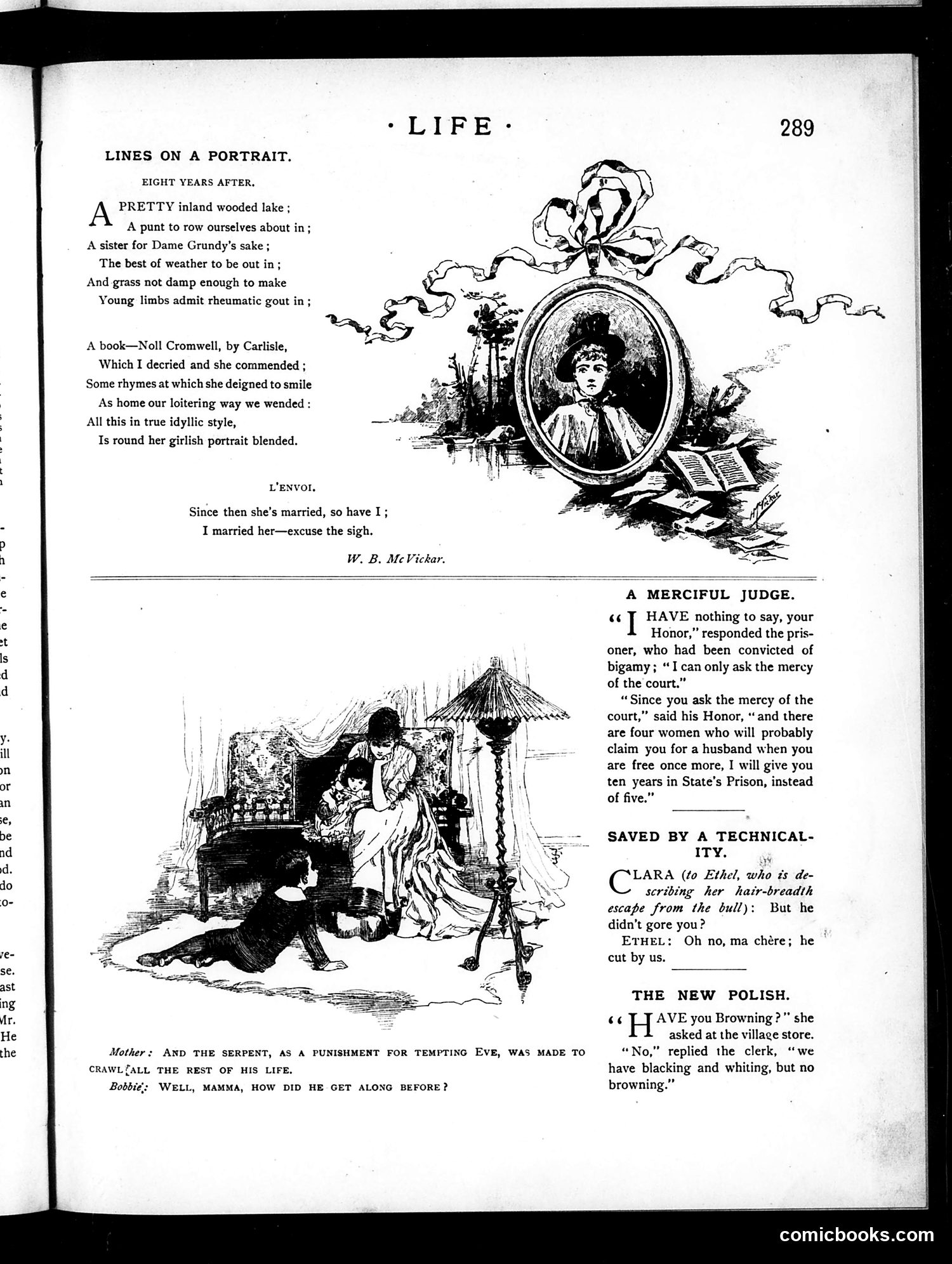
This page contains three separate humor pieces: 1. **"Lines on a Portrait"** (top): A poem by W.B. McVickar describing an inland lake scene and a book by Noll Cromwell. The final couplet reveals the joke: the author married the woman whose portrait he'd admired eight years earlier. 2. **"A Merciful Judge"** (middle): A courtroom anecdote where a judge, asked for mercy by a bigamy convict, responds by sentencing him to ten years instead of five—because four women will claim him once he's released, making his imprisonment merciful to him. 3. **"Saved by a Technicality"** and **"The New Polish"** (bottom): Brief joke snippets about escape from prison and a store clerk's exchange about "browning" (unclear reference). The humor relies on wordplay and unexpected logical twists typical of early 20th-century satirical magazines.
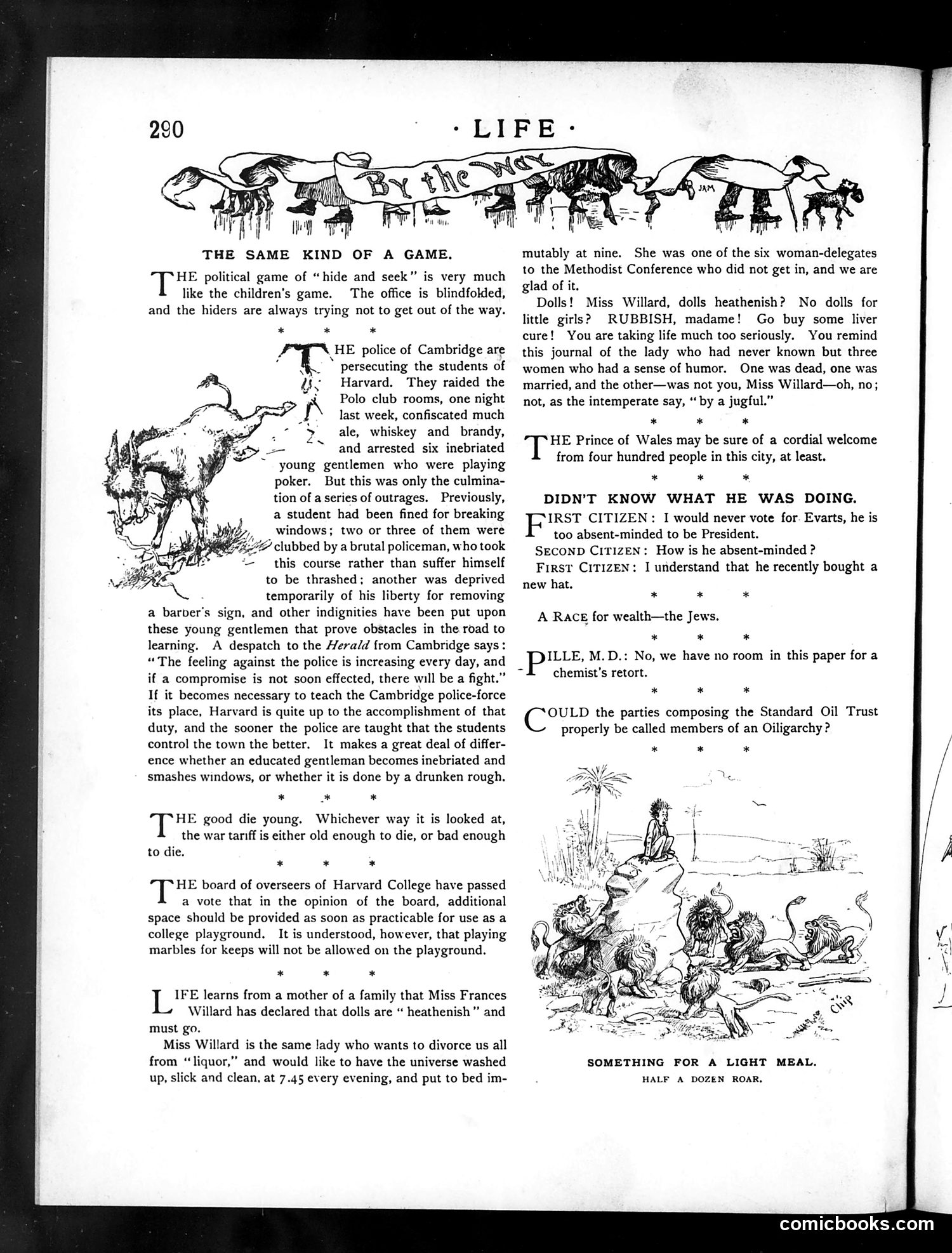
This page contains brief satirical commentary rather than political cartoons. The main items mock: 1. **Harvard student police problems**: Cambridge police arrested students playing poker, prompting debate about whether educated gentlemen or "drunken roughs" better control campus behavior. 2. **Miss Willard's social crusade**: A woman advocating for playground space and opposing "heathenish" dolls is ridiculed for her rigid moralism—the writer notes she also wants to eliminate alcohol and impose early bedtimes, suggesting her reforms are excessively puritanical. 3. **Various satirical quips**: Including jabs at absent-minded politicians, the Standard Oil Trust, and Jewish wealth. The humor targets progressive reform movements and their advocates as overly earnest killjoys trying to impose their values on society.
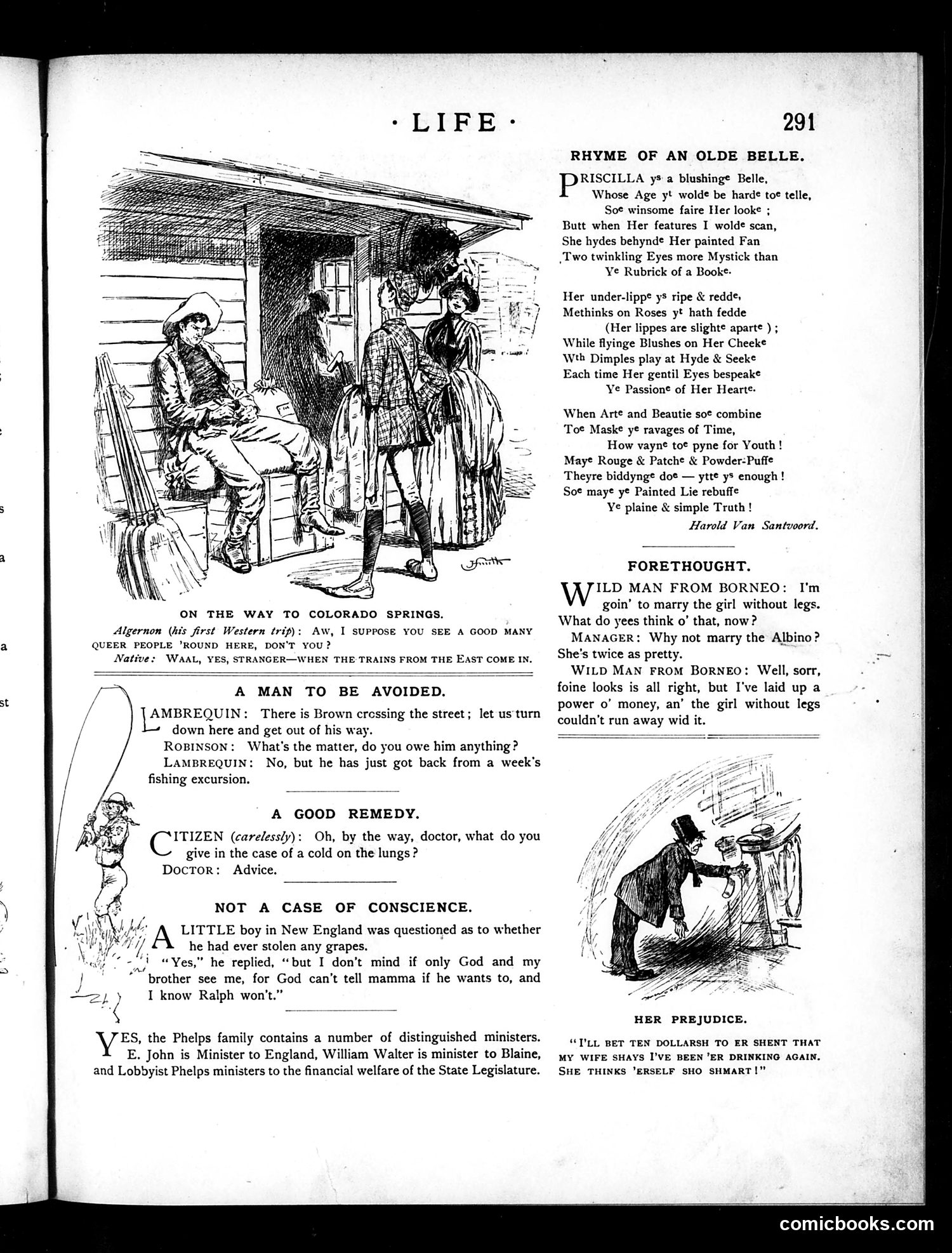
This page contains humorous short pieces and sketches typical of Life's satirical format. The main illustrated items are: **"On the Way to Colorado Springs"**: A sketch showing two men on a street, with accompanying dialogue about avoiding someone named Brown. **"A Man to Be Avoided"**: A brief dialogue between Lambrequin and Robinson about Brown returning from fishing. **"A Good Remedy"**: A joke about a doctor advising a citizen to give cold medicine to his lungs. **"Not a Case of Conscience"**: A story about a New England boy questioned about stealing grapes, claiming God won't tell his mother. **"Her Prejudice"**: A caption-only sketch about a man offering money to prove his wife stopped drinking. The page represents typical turn-of-the-century American humor—domestic situations, mild social commentary, and gentle satire with no apparent major political figures or events referenced.
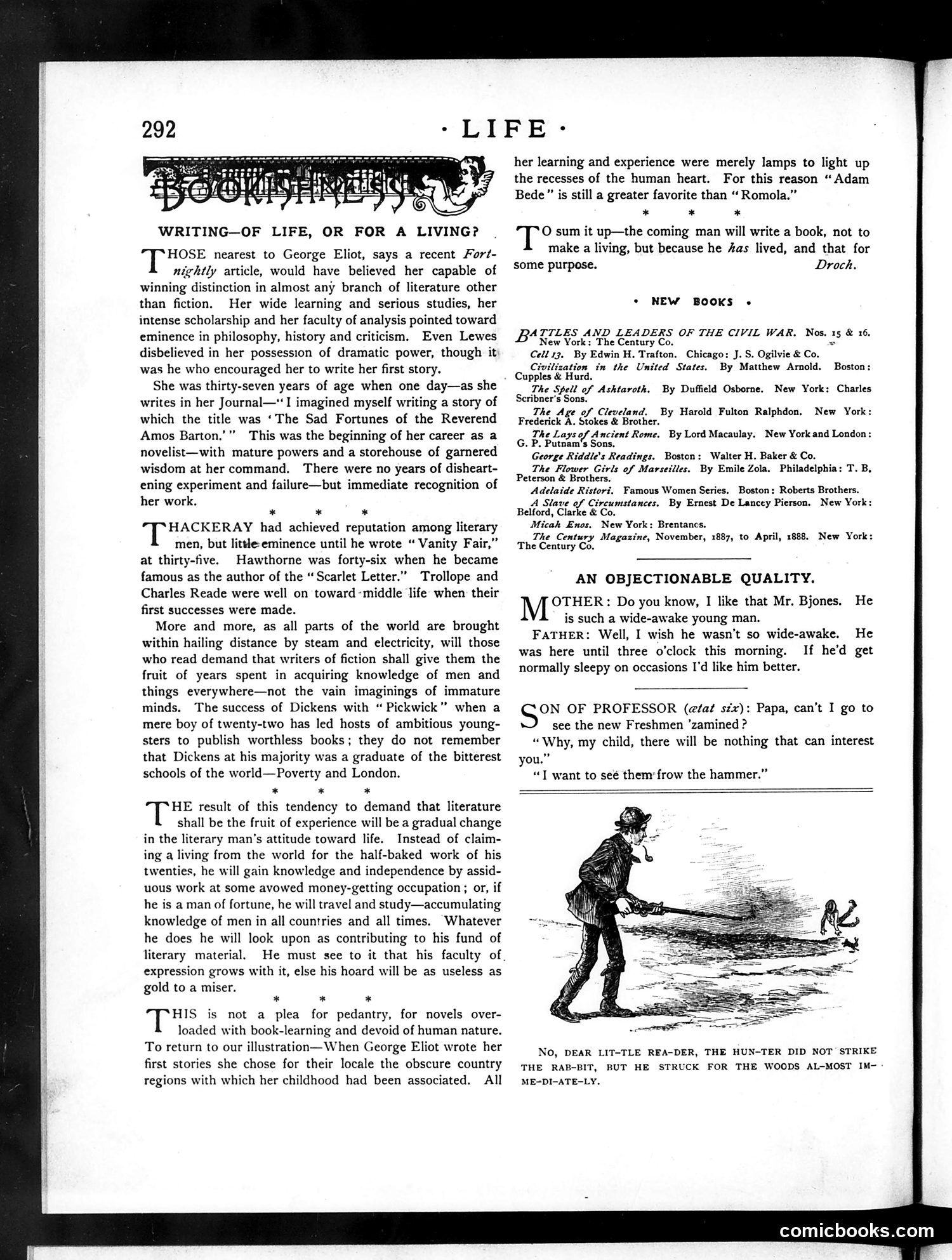
This page contains two distinct items: **Main Article**: "Writing—Of Life, or For a Living?" discusses whether aspiring writers should pursue literature for income or experience. It references George Eliot, Thackeray, Hawthorne, Dickens, and Charles Reade as examples of authors who achieved success despite—or because of—their life experiences outside pure academia. **Cartoon**: The lower illustration depicts a hunter firing a rifle, with accompanying caption text (partially visible) making a pun about striking "the woods" rather than hitting game. The crude drawing style and joke structure are typical of Life's humorous filler content from this era. The page reflects late-19th-century debates about literary professionalism and combines serious literary criticism with light satirical humor, characteristic of Life magazine's mixed-content format.
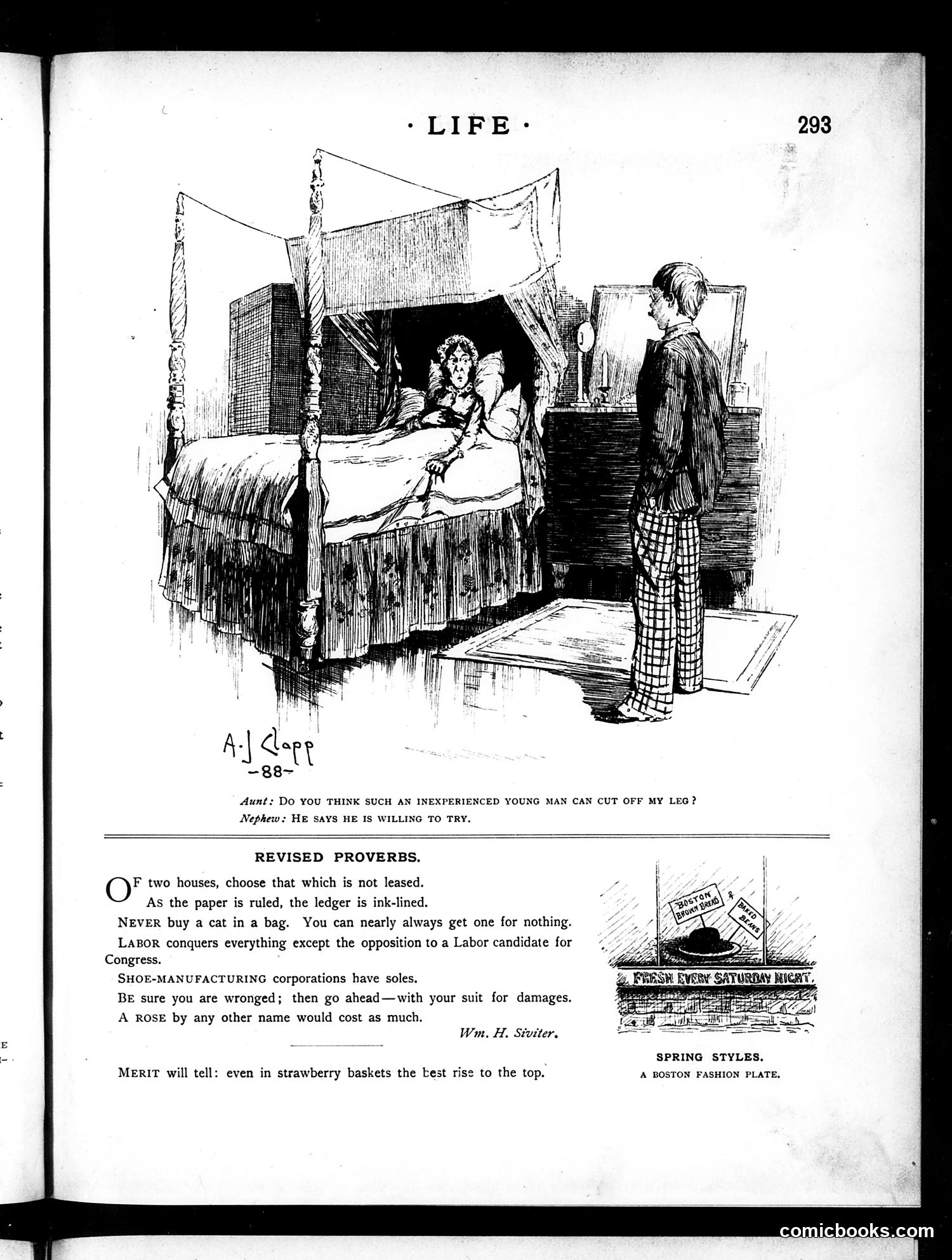
This page contains a single-panel cartoon by A.J. Clapp depicting a bedroom scene where an aunt questions a nephew about whether an "inexperienced young man" can amputate her leg, to which the nephew replies he's willing to try. The humor derives from the absurd situation: the aunt is casually proposing amateur surgery for a serious medical procedure. This likely satirizes either medical quackery of the era or the desperation of patients facing expensive legitimate medical care. Below the cartoon is a "Revised Proverbs" section offering humorous rewrites of traditional sayings, touching on housing, ledgers, cats, and politics. The page concludes with a fashion illustration labeled "Spring Styles."
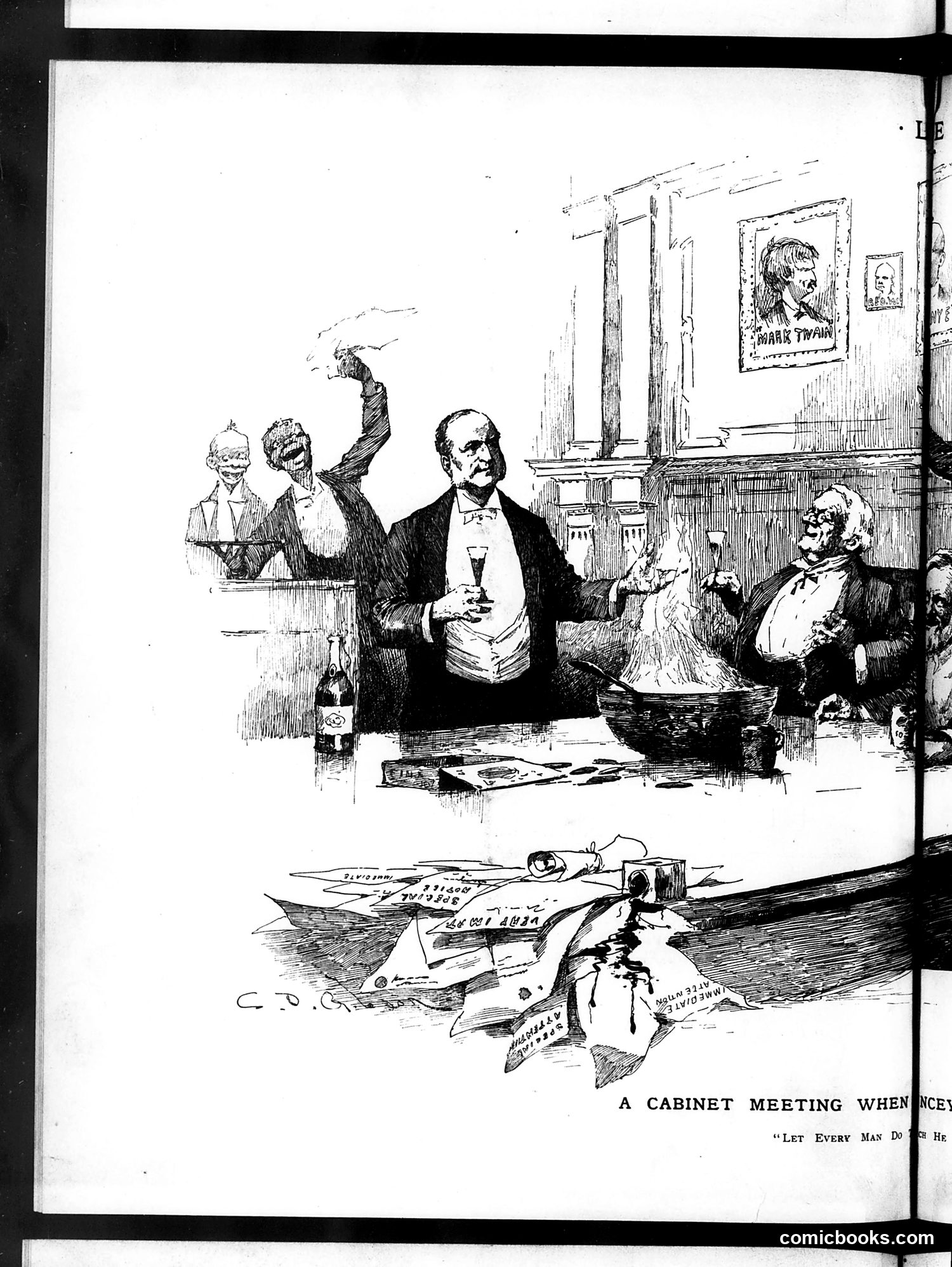
**Title:** "A Cabinet Meeting When..." (incomplete caption) **Scene:** A formal dining setting with well-dressed men in formal wear. A central figure raises his glass in a toast while others observe. A portrait of Mark Twain hangs on the wall. **Visual satire:** The bottom panel shows scattered papers/documents on the floor—appearing to depict governmental or official papers in disarray. **Interpretation:** This appears to be satirizing a Cabinet meeting (U.S. government executive branch), likely critiquing administrative chaos or incompetence. The incomplete motto beneath—"Let Every Man Do His..." —suggests commentary on individual responsibility versus collective governmental failure. **Limitation:** Without the complete caption and date, the specific political event or administration being lampooned cannot be definitively identified.
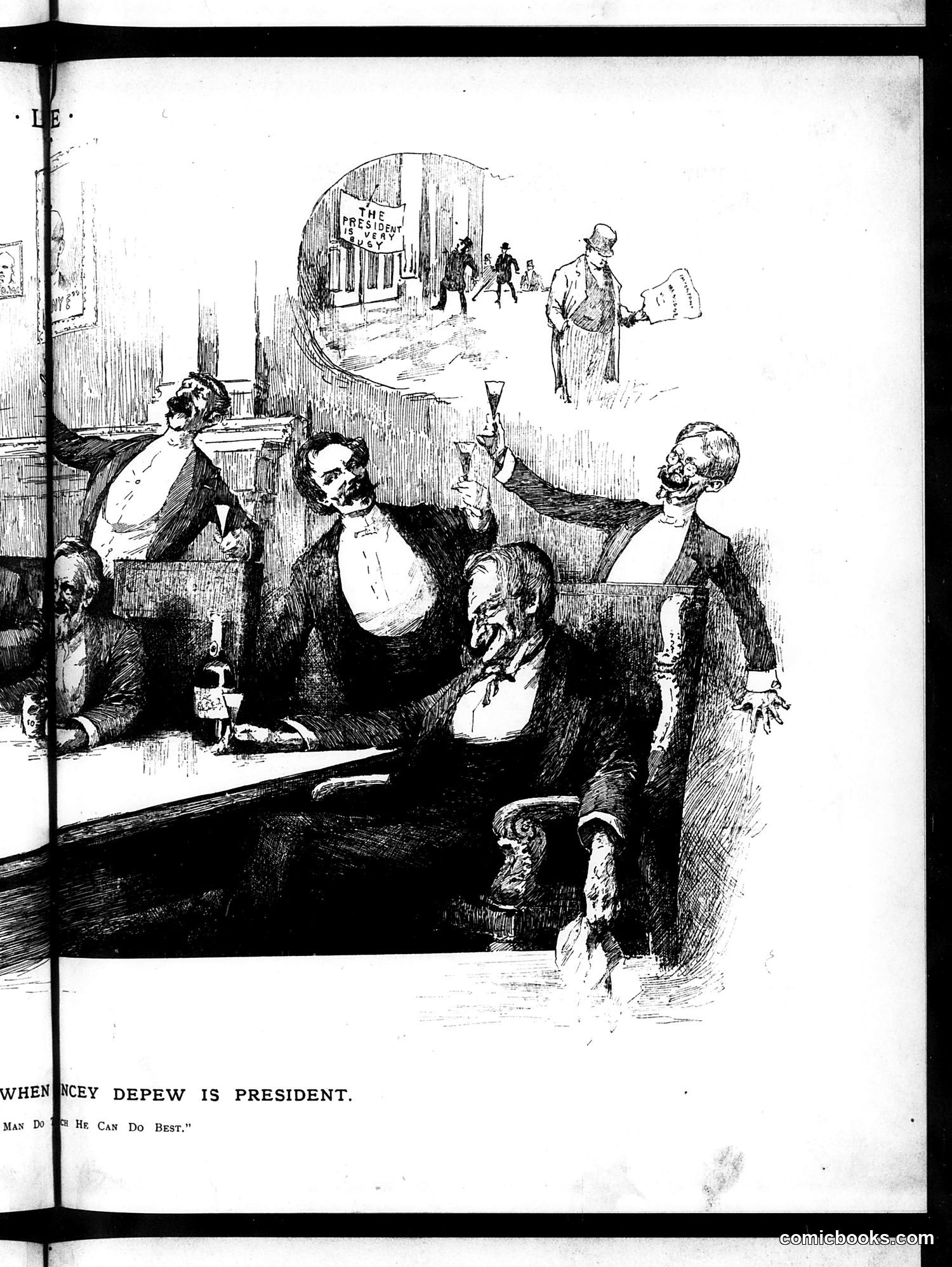
This satirical cartoon imagines a future presidency under Chauncey Depew (a prominent late-19th-century politician and railroad executive). The cartoon depicts well-dressed gentlemen in what appears to be an exclusive club or bar, toasting and celebrating, while through a window labeled "The President's Office" visible in the background, ordinary citizens conduct regular business outside. The satire suggests that a Depew presidency would primarily benefit wealthy elites and corporations—shown enjoying leisure and luxury indoors—while common people continue ordinary work outdoors. The subtitle "As He Can Do Best" implies Depew's perceived strengths lay in serving privileged interests rather than the general public, critiquing him as a tool of wealthy corporate interests rather than a people's president.
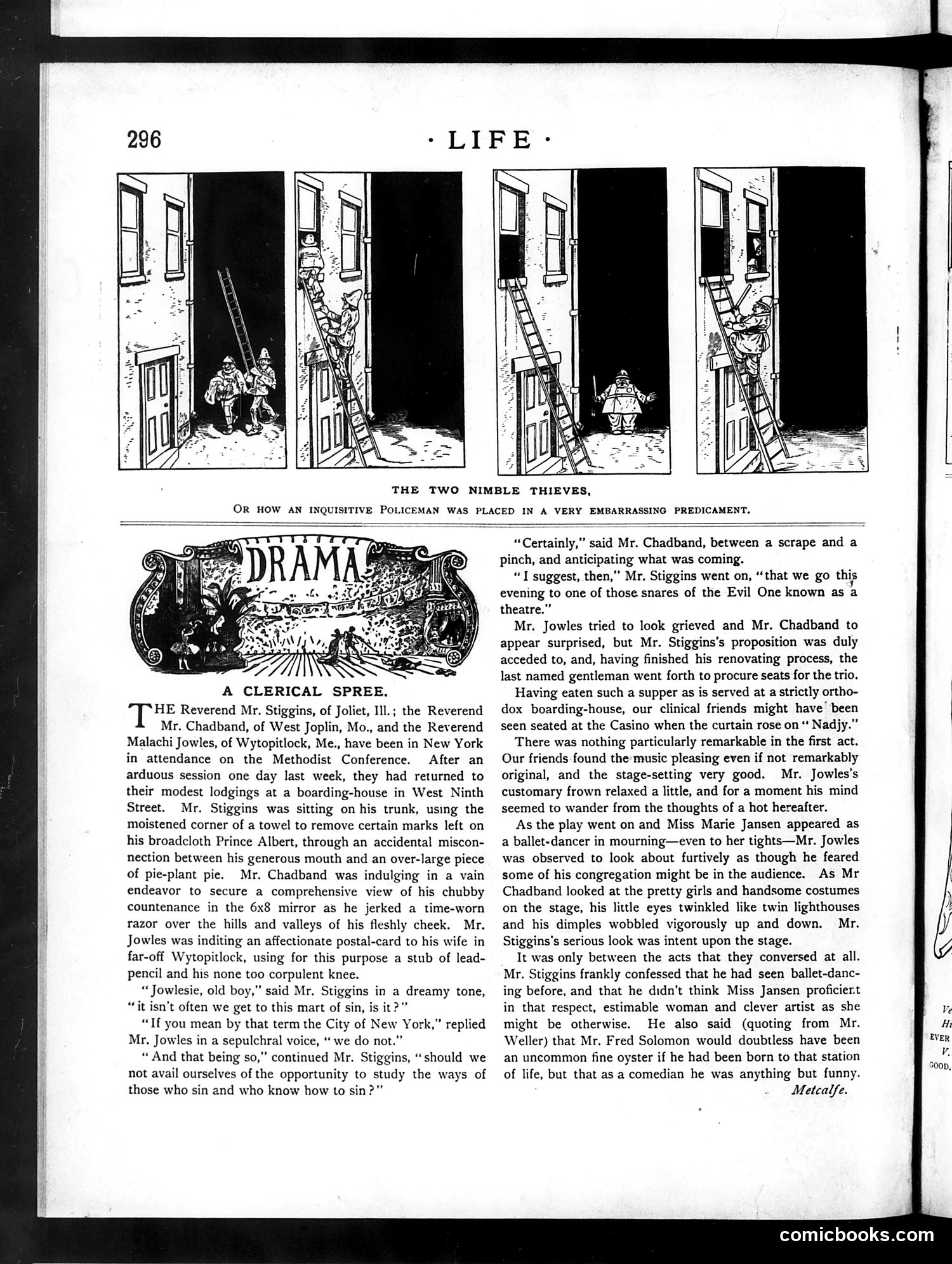
This satirical drama depicts three Methodist ministers—Reverends Stiggins, Chadband, and Jowles—attending a conference in New York. The comic premise involves their hypocrisy: while preaching morality, they sneak out to see a theatrical performance (ballet-dancing). The visual gag shows them using a ladder to enter a building window, literally "sneaking" to entertainment they publicly condemn. The satire mocks clerical pretense—these supposedly pious men break their own moral codes for worldly pleasures. The "two nimble thieves" likely refers to Stiggins and Chadband as the primary offenders. The joke exploits the tension between strict religious doctrine (condemning theater) and actual human behavior, suggesting clergymen were hypocrites who indulged privately while preaching publicly.
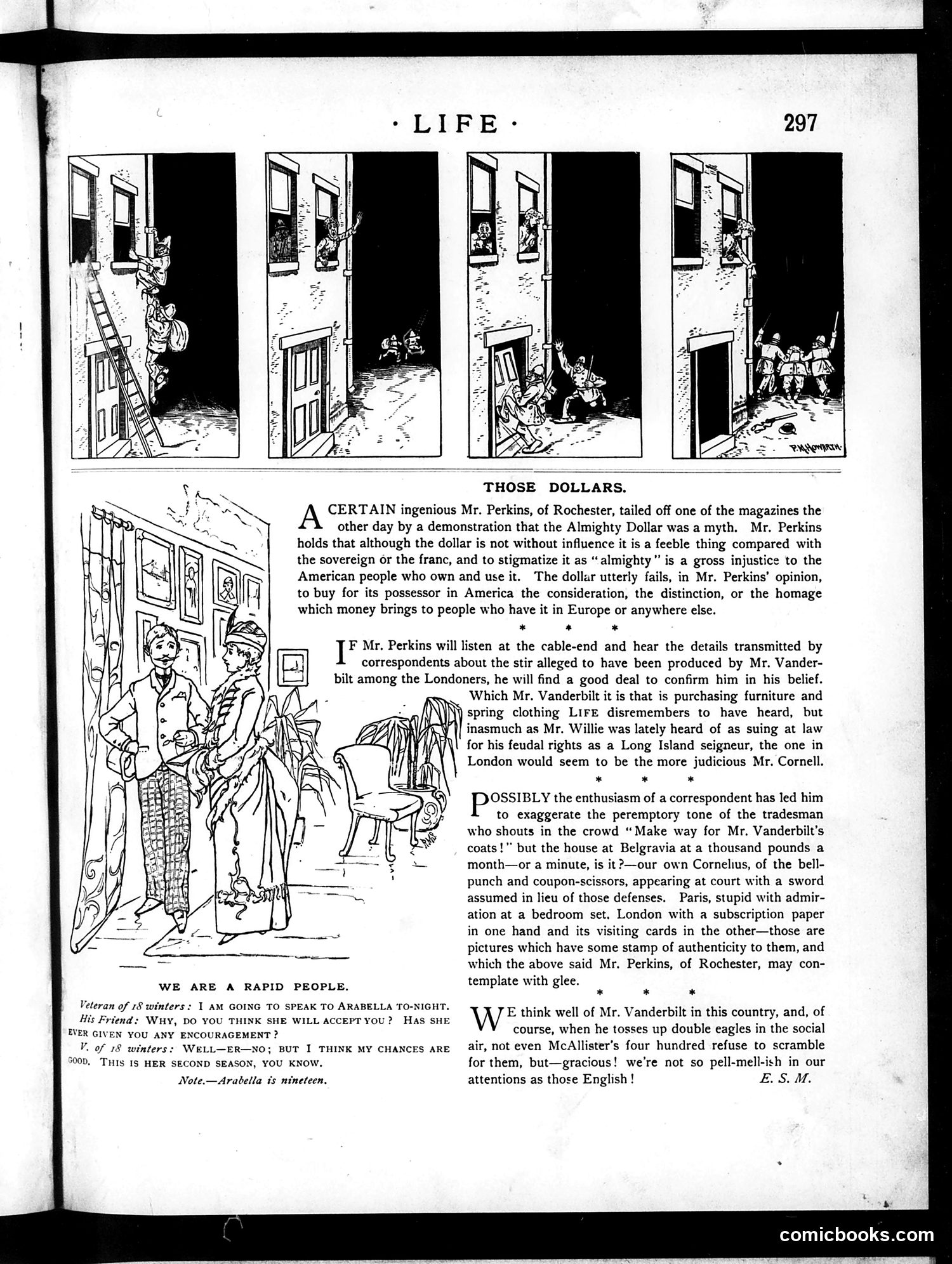
This article mocks Mr. Perkins of Rochester's claim that the American dollar lacks the prestige of European currency. Life's editors use the Vanderbilt family to prove him wrong, arguing that American wealth *does* command respect—even in Europe. The satire targets a Vanderbilt (likely "Mr. Cornell," a sarcastic reference to William Vanderbilt's legal claims as a Long Island landowner) who is apparently causing sensation in London by lavishly spending on furniture, clothing, and renting a Belgravia mansion. Life ridicules both European sycophancy toward American money and American pretension in flaunting it abroad. The smaller cartoon jokes about American social climbing: a 19-year-old woman named Arabella in her "second season" (of marriage prospects) receives little encouragement, yet the man pursues her anyway—suggesting Americans desperately seek status however possible. The message: American dollars *do* buy consideration abroad, proving Perkins wrong, though Americans remain socially gauche compared to refined Europeans.
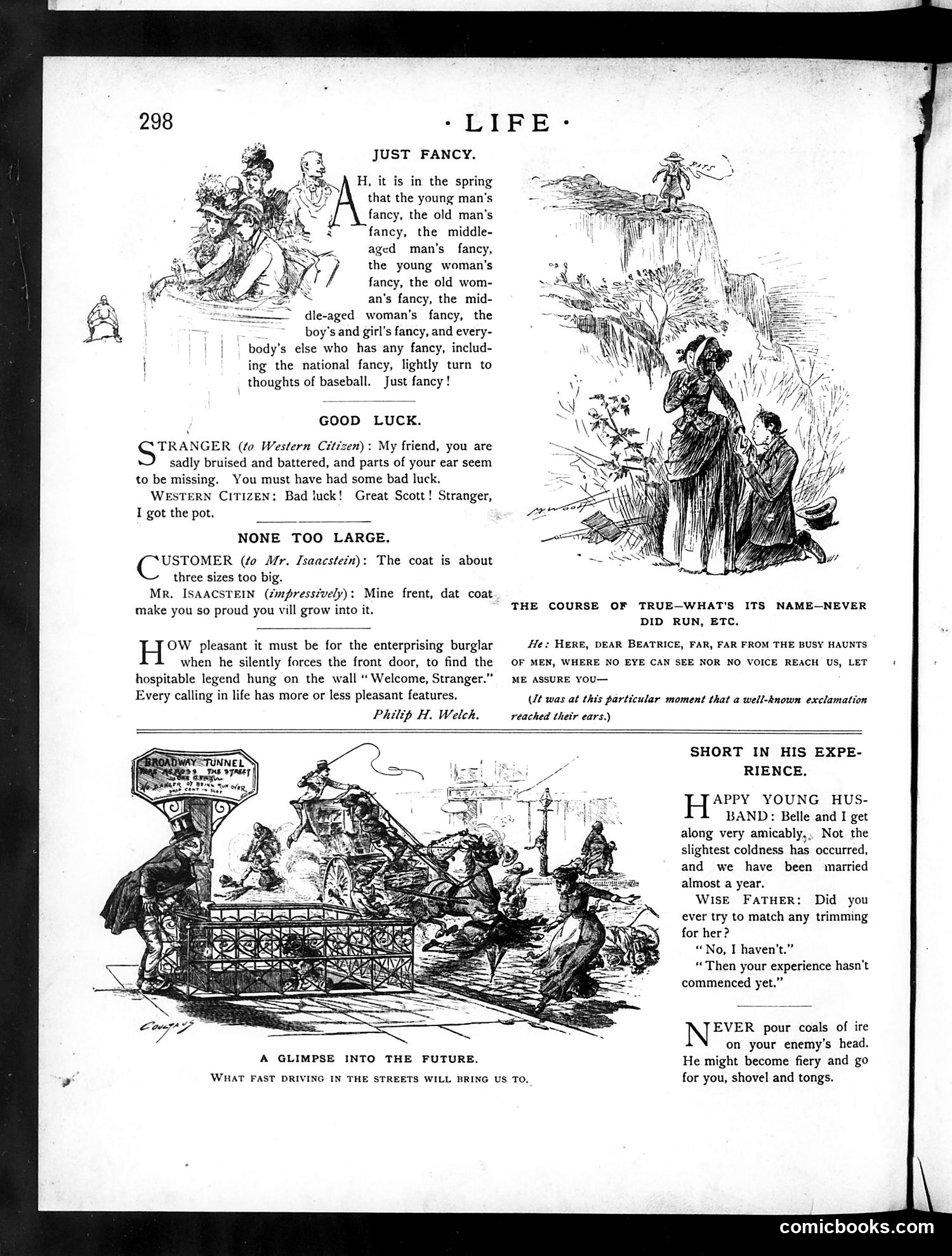
This page collects brief satirical pieces typical of *Life* magazine's humor format: **"Just Fancy"** jokes that spring baseball season captures everyone's imagination—a gentle jab at Americans' obsession with the sport. **"Good Luck"** features a Western prospector bruised from a fight, claiming "I got the pot"—likely referencing both poker winnings and gold prospecting, with the implication he won money but got beaten up in the process. **"None Too Large"** mocks a Jewish tailor (Isaacstein, identified by stereotypical dialect) who dismisses a customer's complaint that a coat is oversized, claiming the customer will "grow into it"—satirizing both overselling and immigrant merchants. **"A Glimpse Into the Future"** shows a couple's romantic moment interrupted by a train or automobile—mocking how modern technology intrudes on private moments. **"Short in His Experience"** suggests newlyweds haven't truly tested their marriage until they've tackled practical domestic challenges like clothes shopping. The page reflects early 20th-century American social anxieties: technology, immigration, consumerism, and changing gender relations.
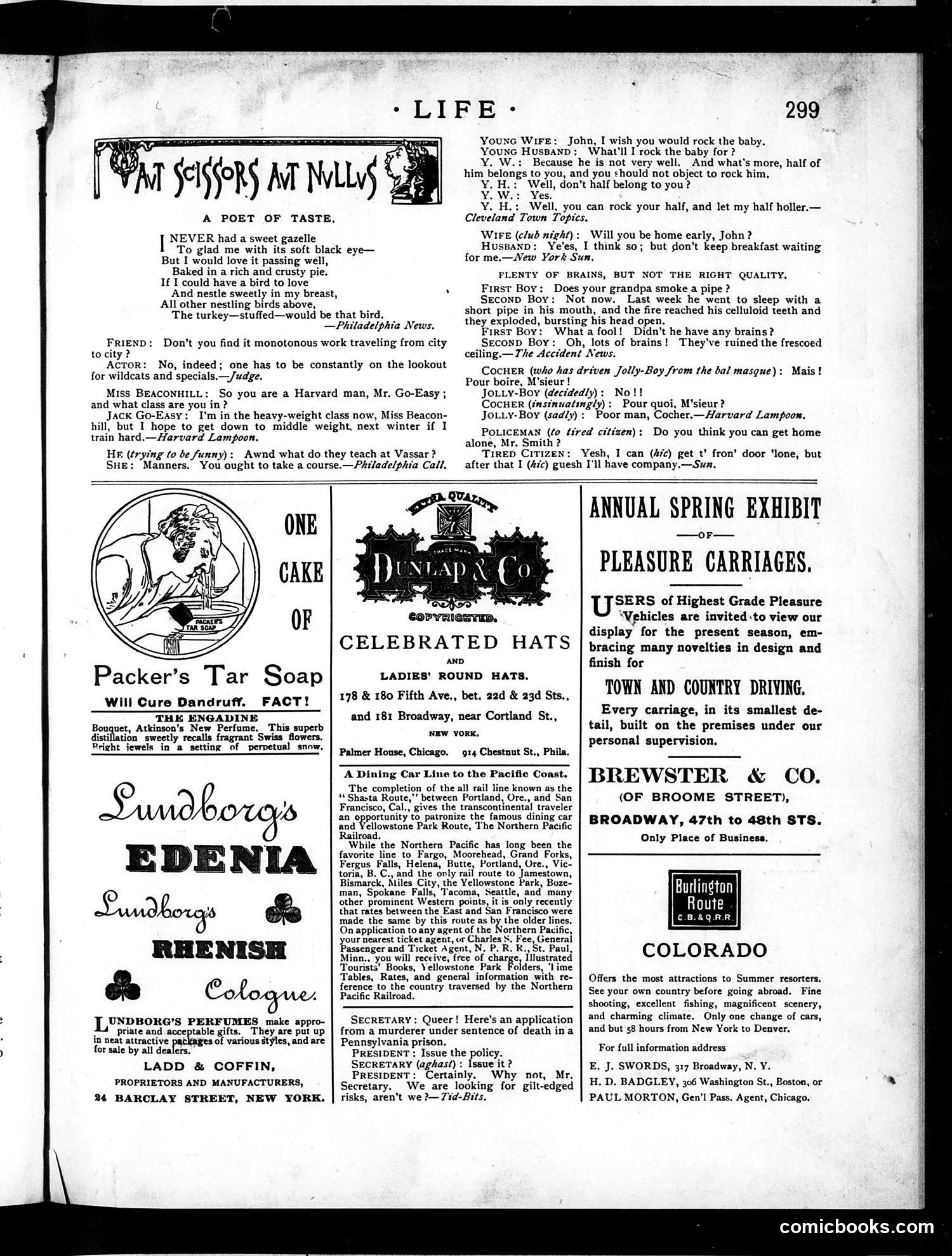
This page presents several short humorous exchanges typical of *Life* magazine's satirical style. The cartoons mock domestic life and social pretension: **"A Poet of Taste"** opens with mock-romantic verses about loving animals—only to reveal the speaker wants them roasted for dinner, satirizing Victorian sentimentality. The brief dialogues below lampoon various social types: a Harvard student called "Go-Easy," a traveling actor, and notably, a young married couple arguing about childcare duties. The husband refuses to rock the baby because "half" belongs to his wife, while she retorts he should rock his half—absurdist humor highlighting marital discord and male domestic avoidance. Another exchange mocks drunkenness: a "tired citizen" can barely reach his front door and expects his companions to carry him further. The page is primarily **advertising**, featuring Packer's Tar Soap, Lundborg's Perfumes, Dunlap hats, and railroad/carriage company promotions. The humor reflects upper-class concerns: manners, Harvard education, and leisure activities.
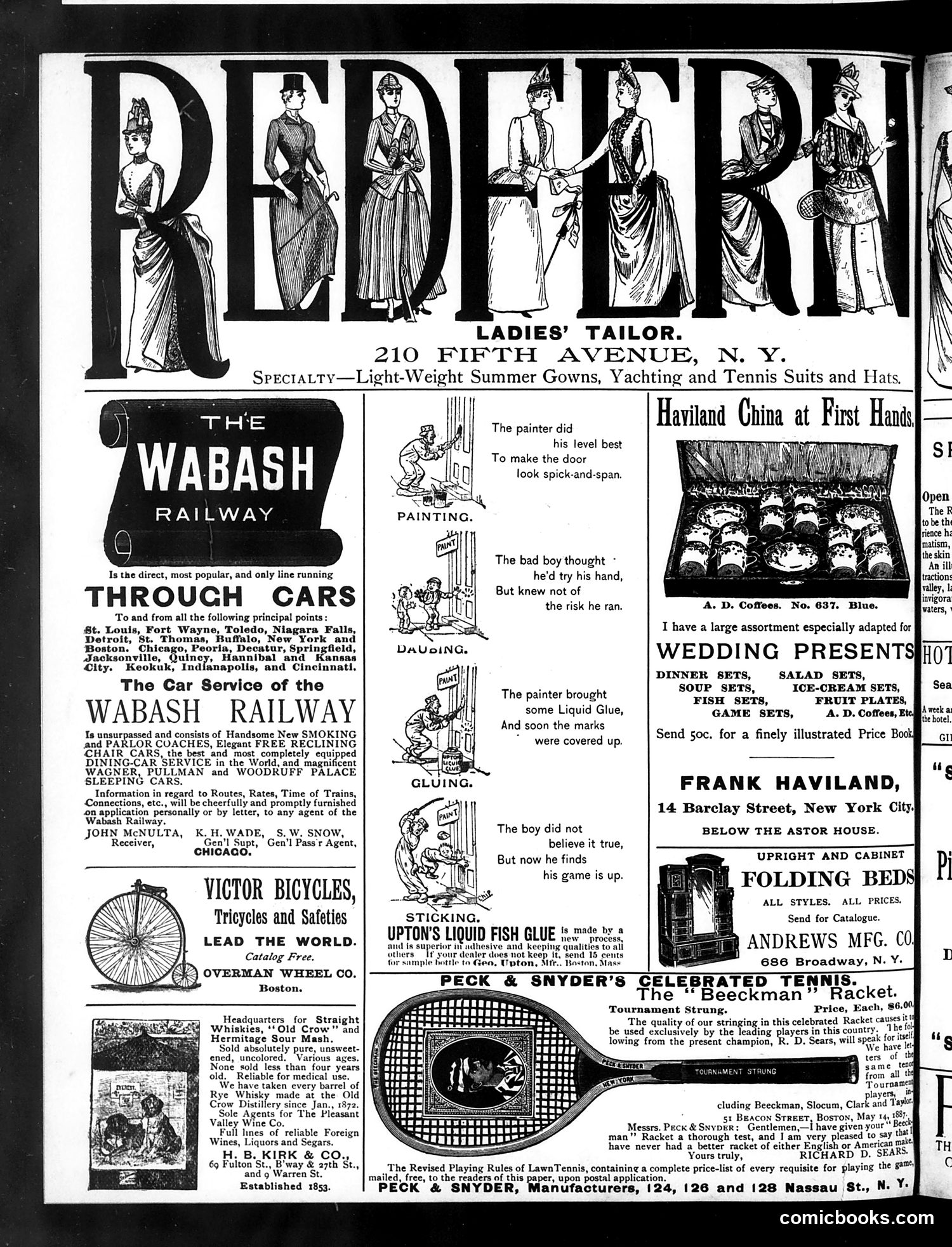
This page is primarily **advertising**, not political satire. The dominant content is commercial—railroads, bicycles, furniture, china, and sporting goods typical of late 19th-century magazines. The one narrative element is a **moral comic strip** titled "Painting," "Daubing," "Gluing," and "Sticking." It depicts a cautionary tale: a boy attempts to repair a door with liquid glue after a painter demonstrates the technique. The boy doesn't understand the risks, applies the glue, and gets caught—"his game is up." This is a **lesson about consequences**: mischievous children who imitate adults without understanding proper use face discovery and punishment. The humor and moral instruction would resonate with Victorian parents and children—disobedience and pranks lead to inevitable exposure. Modern readers might find the earnest tone quaint, but the message reflects period anxieties about unsupervised youth and the importance of parental authority. The rest of the page is straightforward product marketing for luxury goods and transportation services aimed at affluent readers.
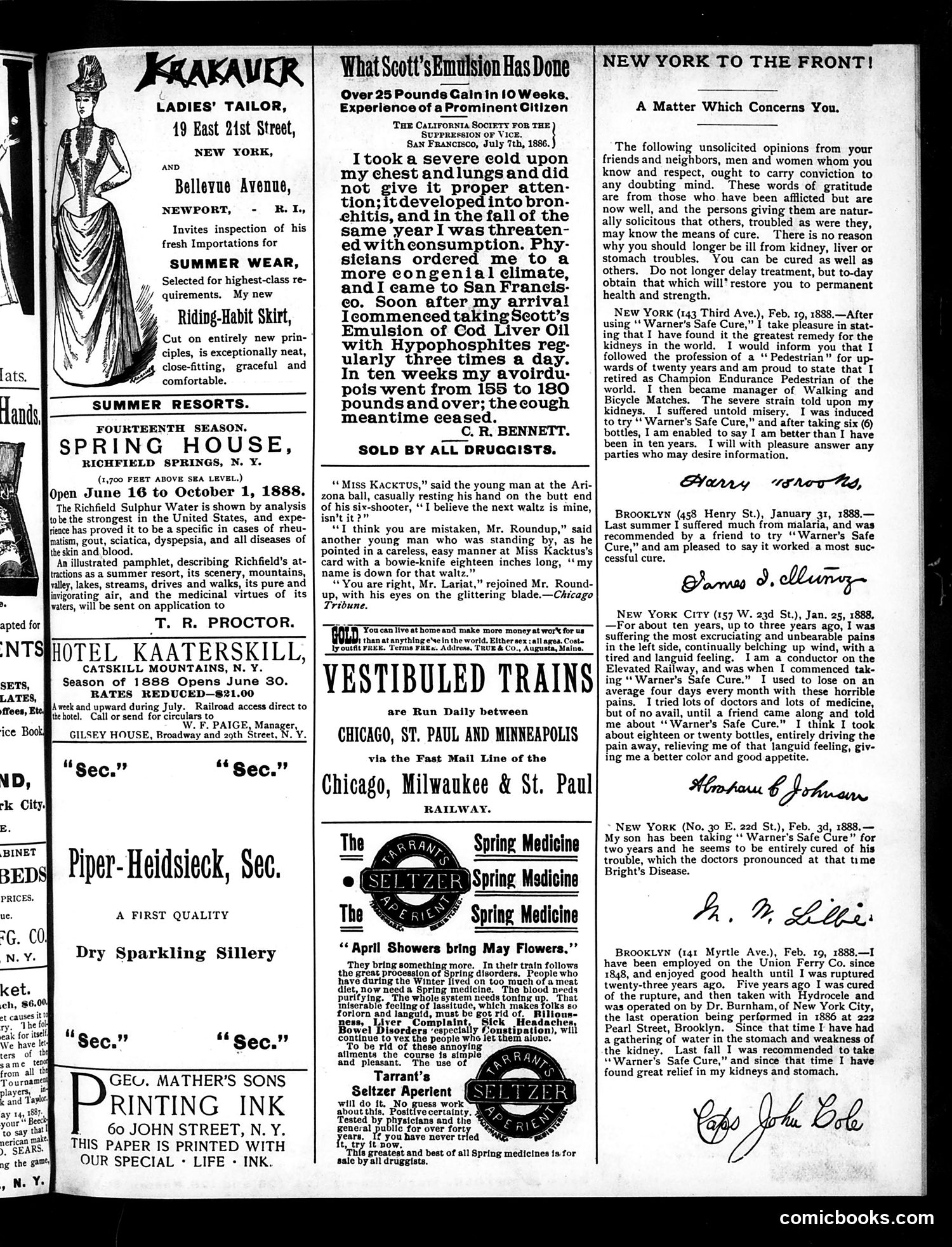
This is primarily a **advertisements page** from Life magazine (1888), not a political cartoon. The page consists of: **Main Content:** - Testimonial ads for patent medicines (Scott's Emulsion cod liver oil, Seltzer Spring Medicine) - Hotel and resort advertisements - A tailor's ad for women's fashions - A printing ink company ad **The One Humorous Item:** A brief anecdote (bottom left) from the *Chicago Tribune* about an Arizona ball where two men dispute a dance with a woman named "Miss Kacktus." They casually threaten each other with guns and knives—six-shooter and bowie knife—over the waltz, then politely resolve the dispute. The humor relies on the **contrast between frontier violence and genteel ballroom etiquette**, satirizing the Wild West's brutality coexisting with civilized social conventions. The testimonials use vague health claims typical of unregulated 1880s advertising—products supposedly cure consumption, rupture, kidney disease, and general malaise without scientific evidence.
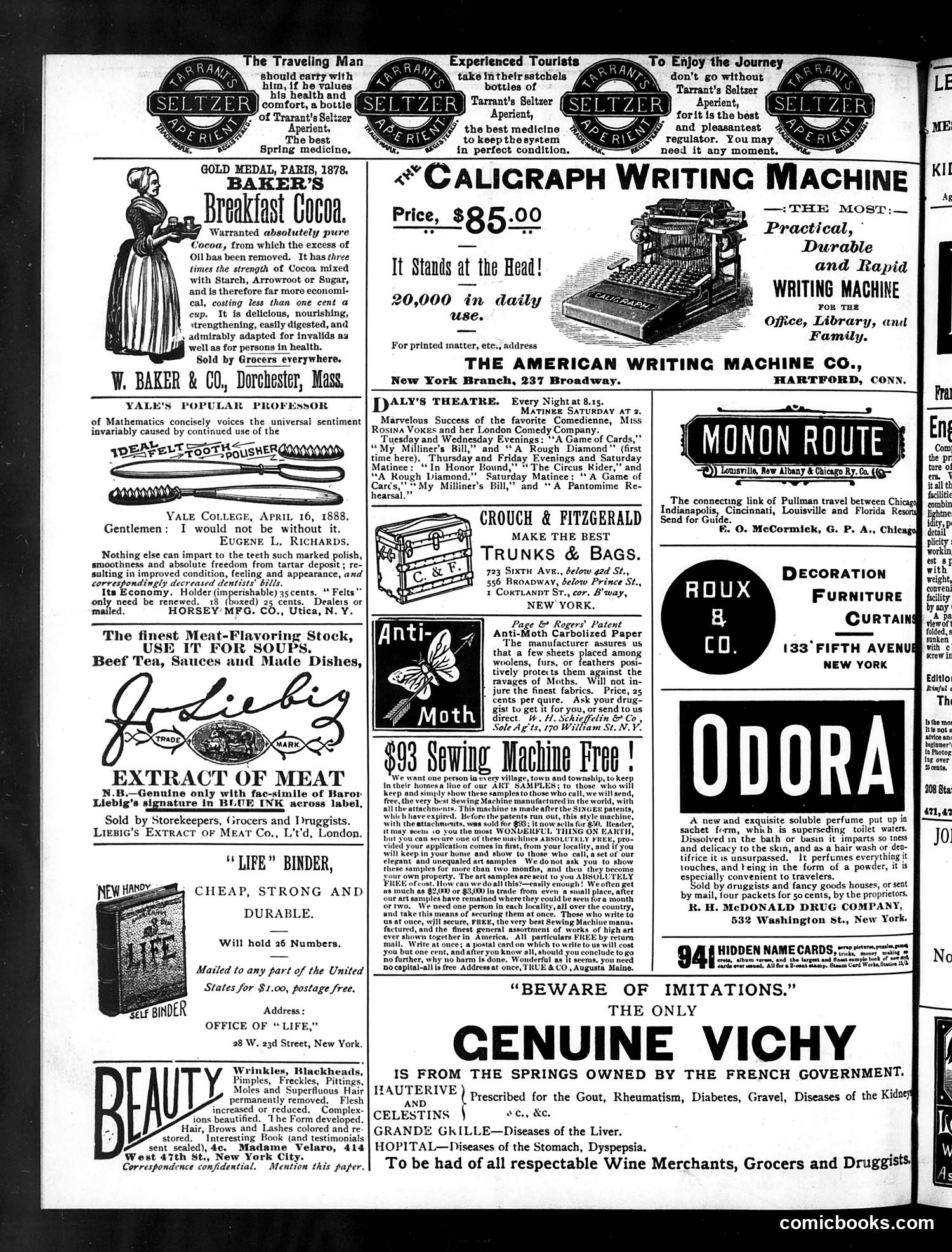
This page is **primarily advertisements** with no political cartoons or satirical content requiring historical explanation. The ads showcase late-19th-century consumer products: Seltzer water (marketed to travelers and tourists), breakfast cocoa, tooth powder endorsed by a Yale professor, meat extract, a writing machine priced at $85, and various beauty/health treatments. The only noteworthy contextual element is the **endorsement structure**: advertisements feature testimonials from authority figures (university professors, experienced travelers) to establish product credibility—a marketing strategy reflecting the era's appeal to expertise and respectability. The page also advertises theater performances, furniture, perfume, and anti-moth paper, representing typical upper-middle-class consumer concerns of the Gilded Age. **No satire or political commentary is present**—this is straightforward commercial advertising typical of *Life* magazine's revenue model during this period.
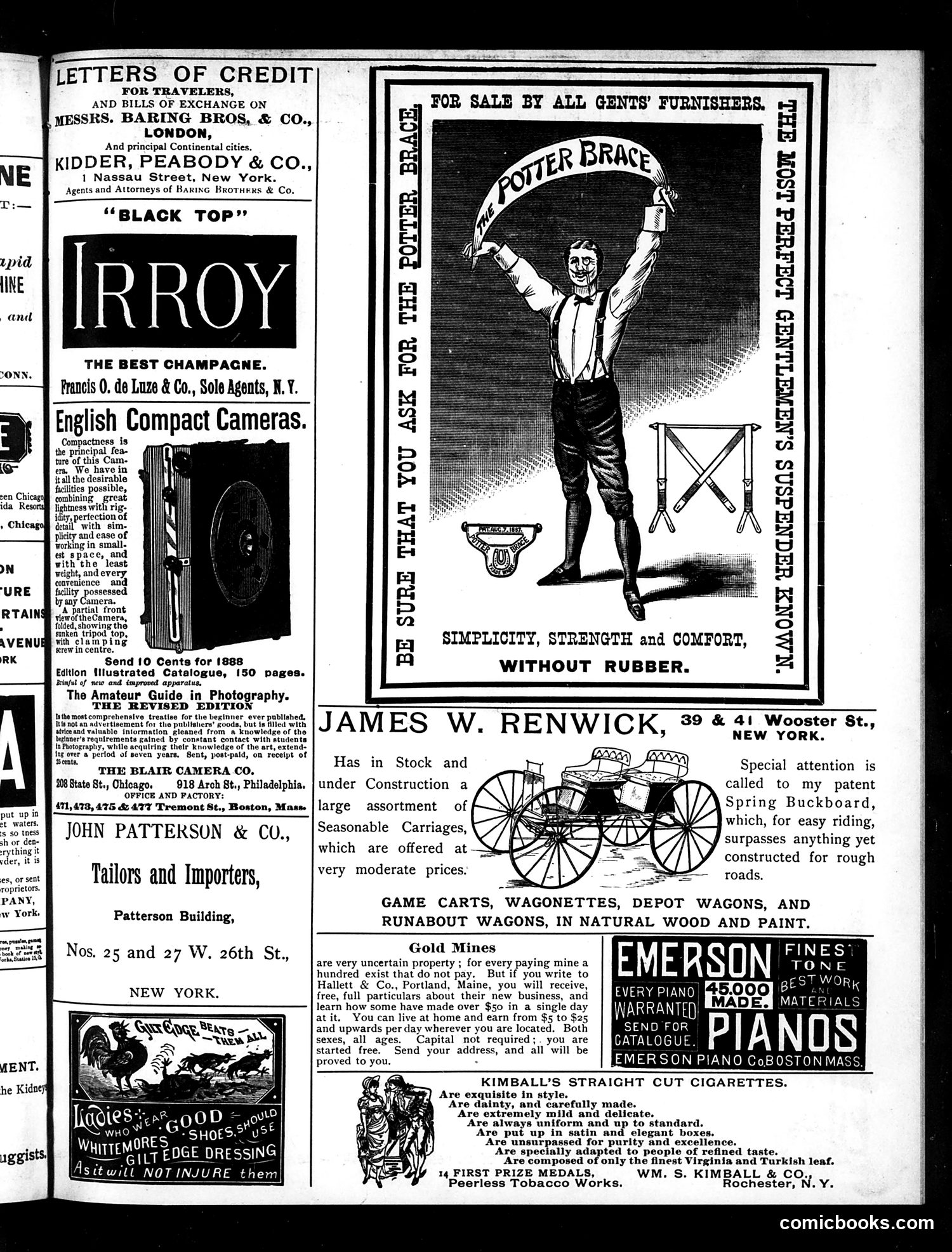
This is primarily an **advertising page** from Life magazine, not a political cartoon page. The page contains multiple commercial advertisements from the late 1880s. The only illustration with satirical potential is the **Potter Brace advertisement** (center-right), showing a man holding up a suspender-like device. The accompanying text emphasizes "SIMPLICITY, STRENGTH and COMFORT, WITHOUT RUBBER"—likely mocking contemporary rubber-based braces or suspenders by promoting this alternative product. The enthusiastic male figure serves as a testimonial to the product's superiority. The remaining content consists of straightforward advertising: champagne, cameras, carriages, gold-mining schemes, pianos, and cigarettes. These ads reflect 1880s consumer goods and services aimed at affluent readers. **No significant political or social satire is present** on this page beyond the implicit humor in the Potter Brace visual pitch.
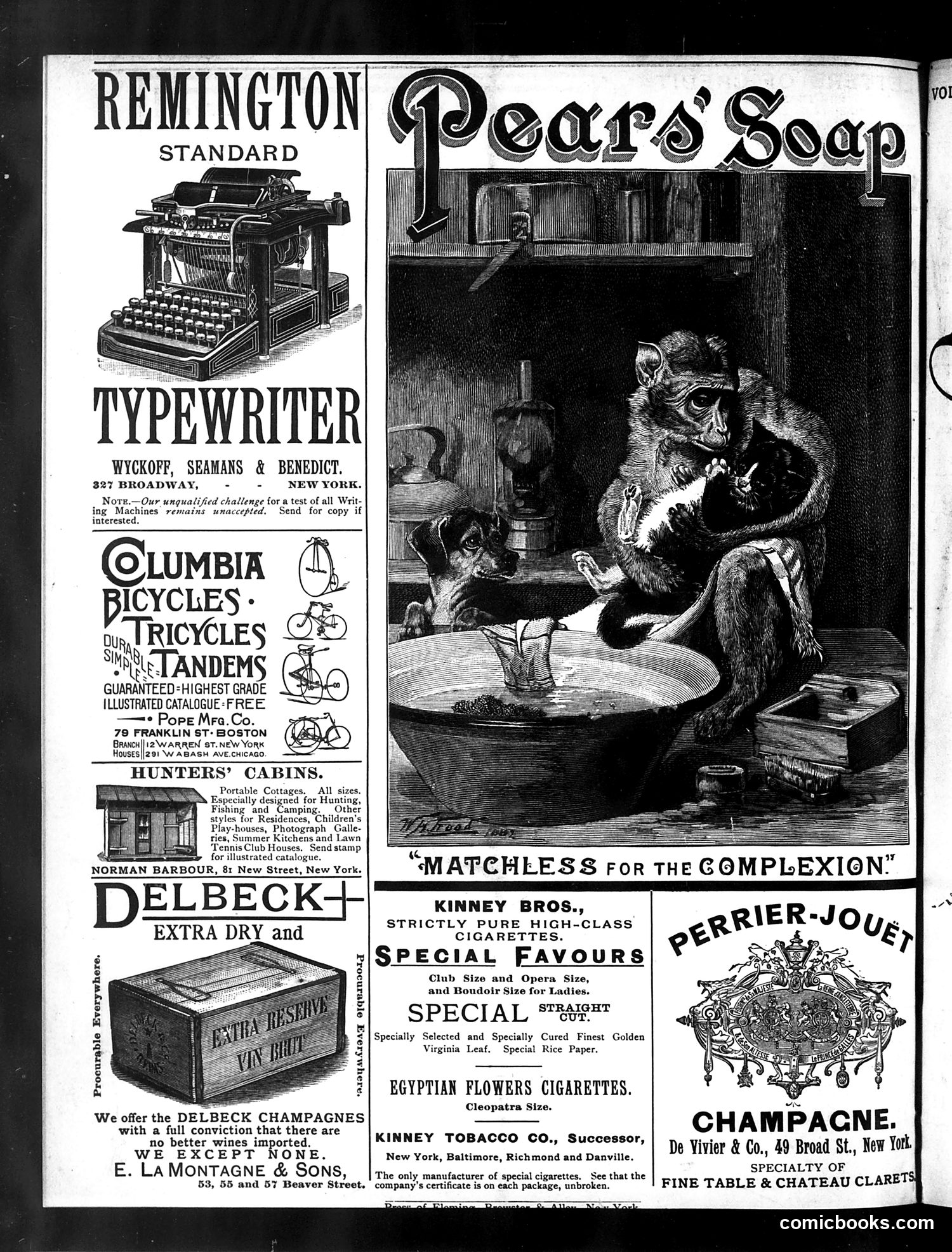
This page is primarily **advertising**, not political satire. The dominant image is a Pear's Soap advertisement featuring **anthropomorphized chimpanzees or apes** engaged in grooming behavior, with the caption "Matchless for the Complexion." The cartoon plays on a common Victorian advertising trope: using animals to humorously suggest that the product is so effective and natural that even primates would use it. The "joke" relies on the era's casual racism and pseudo-scientific theories about evolution and racial hierarchy—implying that even our "primitive cousins" recognize superior cleanliness standards. The surrounding advertisements (Remington typewriters, Columbia bicycles, Delbeck champagne, Kinney cigarettes, Perrier-Jouët) indicate this is a **late 19th-century American magazine page** targeting affluent readers. The Pear's ad represents typical period advertising humor that modern audiences would find offensive due to its dehumanizing animal imagery and underlying racial implications.