
Life, 1888-05-24 · page 6 of 18
Life — May 24, 1888 — page 6: what you’re looking at
What you’re looking at
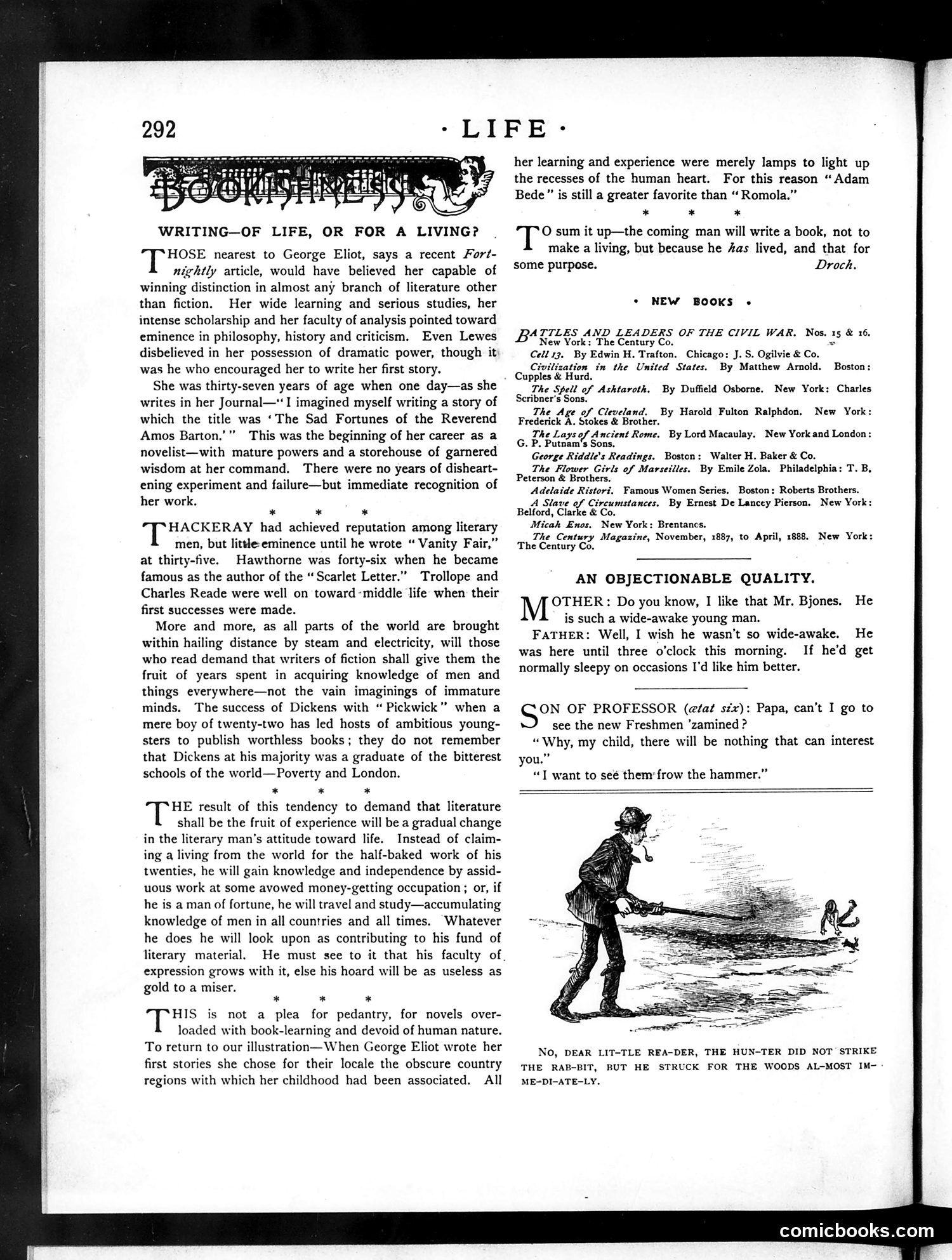
This page contains two distinct items: **Main Article**: "Writing—Of Life, or For a Living?" discusses whether aspiring writers should pursue literature for income or experience. It references George Eliot, Thackeray, Hawthorne, Dickens, and Charles Reade as examples of authors who achieved success despite—or because of—their life experiences outside pure academia. **Cartoon**: The lower illustration depicts a hunter firing a rifle, with accompanying caption text (partially visible) making a pun about striking "the woods" rather than hitting game. The crude drawing style and joke structure are typical of Life's humorous filler content from this era. The page reflects late-19th-century debates about literary professionalism and combines serious literary criticism with light satirical humor, characteristic of Life magazine's mixed-content format.
📄 Transcribed text from this page (OCR, searchable)
Machine-transcribed from the original scan — historical spelling and the odd misread are preserved.
LIFE WRITING—OF LIFE, OR FOR A LIVING? HOSE nearest to George Eliot, says a recent Fort- nightly article, would have believed her capable of winning distinction in almost any branch of literature other than fiction. Her wide learning and serious studies, her intense scholarship and her faculty of analysis pointed toward eminence in philosophy, history and criticism. Even Lewes disbelieved in her possession of dramatic power, though it was he who encouraged her to write her first story. She was thirty-seven years of age when one day—as she writes in her Journal—*I imagined myself writing a story of which the title was ‘The Sad Fortunes of the Reverend Amos Barton.’” This was the beginning of her career as a novelist—with mature powers and a storehouse of garnered wisdom at her command. There were no years of disheart- ening experiment and failure—but immediate recognition of her work. * * * HACKERAY had achieved reputation among literary men, but little eminence until he wrote “ Vanity Fair,” at thirty-five. Hawthorne was forty-six when he became famous as the author of the “Scarlet Letter.” Trollope and Charles Reade were well on toward -middle life when their first successes were made. More and more, as all parts of the world are brought within hailing distance by steam and electricity, will those who read demand that writers of fiction shall give them the fruit of years spent in acquiring knowledge of men and things everywhere—not the vain imaginings of immature minds. The success of Dickens with “ Pickwick” when a mere boy of twenty-two has led hosts of ambitious young- sters to publish worthless books; they do not remember that Dickens at his majority was a graduate of the bitterest schools of the world—Poverty and London. * * * HE result of this tendency to demand that literature shall be the fruit of experience will be a gradual change in the literary man’s attitude toward life. Instead of claim- ing a living from the world for the half-baked work of his twenties, he will gain knowledge and independence by assid- uous work at some avowed money-getting occupation ; or, if he is a man of fortune, he will travel and study—accumulating knowledge of men in all countries and all times. Whatever he does he will look upon as contributing to his fund of literary material. expression grows with it, else his hoard will be as useless as gold to a miser. * * * HIS is not a plea for pedantry, for novels over- loaded with book-learning and devoid of human nature. To return to our illustration—When George Eliot wrote her first stories she chose for their locale the obscure country regions with which her childhood had been associated. All He must see to it that his faculty of. her learning and experience were merely lamps to light up the recesses of the human heart. For this reason “Adam Bede” is still a greater favorite than “ Romola.” * * * O sum it up—the coming man will write a book, not to make a living, but because he Aas lived, and that for some purpose, Droch. * NEW BOOKS « (BATILES AND LEADERS OF THE CIVIL WAR. New York: The Century Co. Cell 13. By Edwin H. Trafton. Chicago: J. S. Ogilvie & Co. Civilization in the United States. By Matthew Arnold. Cupples & Hurd, The Spell of Ashtaroth. sara 's Sons. ¢ Age of Cleveland, By Harold Fulton Ralphdon. New York: Frode Xonee’® Brother. The Lays of Ancient Rome. G. P. Putnam's Sons. George Riddle's Readings. Boston : The Flower Girls of Marseiltes. Peterson & Brothers. Adelaide Ristori, Famous Women Series. Boston: Roberts Brothers. A Slave of Circumstances. By Ernest De Lancey Pierson. New York: Belford, Clarke & Co. Micah Enos. New York: Brentancs. The Century Magazine, November, 1887, to April, 1888. ‘The Century Co. Nos. 15 & 16, Boston : By Duffield Osborne. New York: Charles By Lord Macaulay. New York and London: Walter H. Baker & Co. By Emile Zola. Philadelphia: T. B, New York: AN OBJECTIONABLE QUALITY. OTHER: Do you know, I like that Mr. Bjones. is such a wide-awake young man. FATHER: Well, I wish he wasn’t so wide-awake. He was here until three o'clock this morning. If he'd get normally sleepy on occasions I'd like him better. He ON OF PROFESSOR (etat séx): Papa, can’t I go to see the new Freshmen ‘zamined ? “Why, my child, there will be nothing that can interest you.” “T want to seé them’ frow the hammer.” No, DEAR LIT-TLE REA-DER, THE HUN-TER DID NOT STRIKE THE RAB-BIT, BUT HE STRUCK FOR THE WOODS AL-MOST IM- ME-DI-ATE-LY. comicbooks.com