
Life, 1888-05-24 · page 2 of 18
Life — May 24, 1888 — page 2: what you’re looking at
What you’re looking at
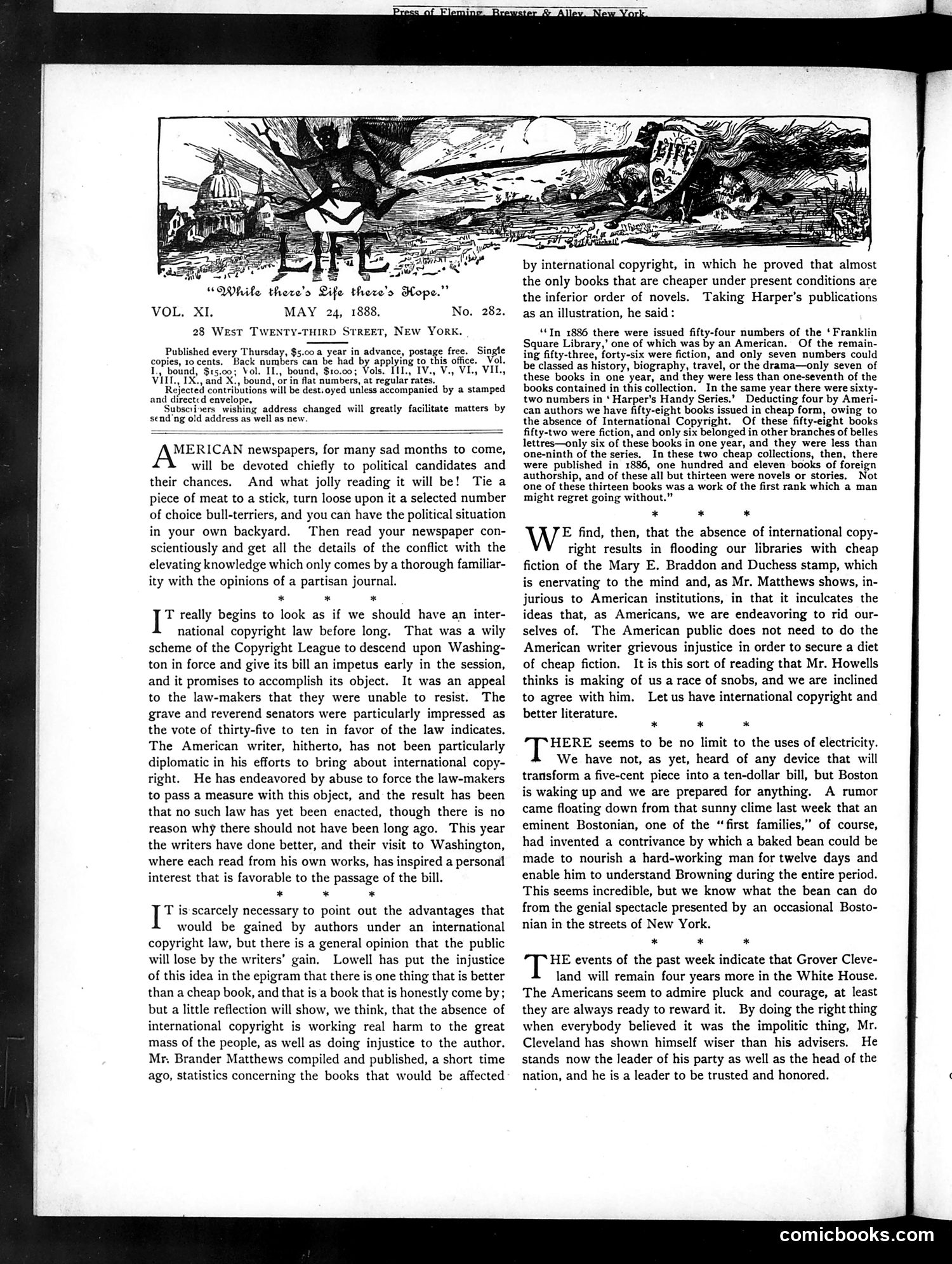
The masthead cartoon depicts a landscape with a bare tree, buildings, and a flag labeled "LIFE," illustrating the magazine's title "While there's Life there's Hope." The page is primarily text discussing **international copyright law**—a major political issue in 1888. The article argues that American publishers benefit from the *absence* of international copyright protection, allowing them to cheaply reprint foreign works without paying authors. The text criticizes this practice as unjust to foreign writers and advocates for stronger copyright laws. It references efforts by the "Copyright League" to lobby Congress and mentions President **Grover Cleveland** approvingly for supporting the measure. The piece also includes a humorous anecdote about a Boston inventor creating a device to power a baked bean to nourish a laborer—satirizing impractical technological solutions.
📄 Transcribed text from this page (OCR, searchable)
Machine-transcribed from the original scan — historical spelling and the odd misread are preserved.
“While there’s Life there’s Hope.” VOL. XI. MAY 24, 1888. No, 282. 28 West TWENTY-THIRD STREET, NEw York. Published every Thursday, $5.00 a year in advance, postage free, Single copies, 10 cents. Back numbers can be had by applying to this office. Vol. I., bound, $15.00; Vol. II., bound, $10.00; Vols. III., IV., V., VI., VIL, VIII., IX., and X., bound, or in flat numbers, at regular rates. Rejected contributions will be dest.oyed unless accompanied by a stamped and directed envelope. a Subscrivers wishing address changed will greatly facilitate matters by send'ng old address as well as new. MERICAN newspapers, for many sad months to come, will be devoted chiefly to political candidates and their chances. And what jolly reading it will be! Tie a piece of meat to a stick, turn loose upon it a selected number of choice bull-terriers, and you can have the political situation in your own backyard. Then read your newspaper con- scientiously and get all the details of the conflict with the elevating knowledge which only comes by a thorough familiar- ity with the opinions of a partisan journal. * * * T really begins to look as if we should have an inter- national copyright law before long. That was a wily scheme of the Copyright League to descend upon Washing- ton in force and give its bill an impetus early in the session, and it promises to accomplish its object. It was an appeal to the law-makers that they were unable to resist. The grave and reverend senators were particularly impressed as the vote of thirty-five to ten in favor of the law indicates. The American writer, hitherto, has not been particularly diplomatic in his efforts to bring about international copy- right. He has endeavored by abuse to force the law-makers to pass a measure with this object, and the result has been that no such law has yet been enacted, though there is no reason why there should not have been long ago. This year the writers have done better, and their visit to Washington, where each read from his own works, has inspired a personal interest that is favorable to the passage of the bill. * * * T is scarcely necessary to point out the advantages that would be gained by authors under an international copyright law, but there is a general opinion that the public will lose by the writers’ gain. Lowell has put the injustice of this idea in the epigram that there is one thing that is better than a cheap book, and that is a book that is honestly come by; but a little reflection will show, we think, that the absence of international copyright is working real harm to the great mass of the people, as well as doing injustice to the author. Mr. Brander Matthews compiled and published, a short time ago, statistics concerning the books that would be affected by international copyright, in which he proved that almost the only books that are cheaper under present conditions are the inferior order of novels. Taking Harper’s publications as an illustration, he said: ‘«In 1886 there were issued fifty-four numbers of the ‘Franklin Square Library,’ one of which was by an American. Of the remain- ing fifty-three, forty-six were fiction, and only seven numbers could be classed as history, biography, travel, or the drama—only seven of these books in one year, and they were less than one-seventh of the books contained in this collection. In the same year there were sixty- two numbers in ‘ Harper's Handy Series.’ Deducting four by Ameri- can authors we have fifty-eight books issued in cheap form, owing to the absence of International Copyright. Of these fifty-eight books fifty-two were fiction, and only six belonged in other branches of belles lettres—only six of these books in one year, and they were less than one-ninth of the series. In these two cheap collections, then, there were published in 1886, one hundred and eleven books of foreign authorship, and of these all but thirteen were novels or stories. Not one of these thirteen books was a work of the first rank which a man might regret going without.” * * * E find, then, that the absence of international copy- right results in flooding our libraries with cheap fiction of the Mary E. Braddon and Duchess stamp, which is enervating to the mind and, as Mr. Matthews shows, in- jurious to American institutions, in that it inculcates the ideas that, as Americans, we are endeavoring to rid our- selves of. The American public does not need to do the American writer grievous injustice in order to secure a diet of cheap fiction. It is this sort of reading that Mr. Howells thinks is making of us a race of snobs, and we are inclined to agree with him. Let us have international copyright and better literature. * * * HERE seems to be no limit to the uses of electricity. We have not, as yet, heard of any device that will transform a five-cent piece into a ten-dollar bill, but Boston is waking up and we are prepared for anything. A rumor came floating down from that sunny clime last week that an eminent Bostonian, one of the “first families,” of course, had invented a contrivance by which a baked bean could be made to nourish a hard-working man for twelve days and enable him to understand Browning during the entire period. This seems incredible, but we know what the bean can do from the genial spectacle presented by an occasional Bosto- nian in the streets of New York. * * * HE events of the past week indicate that Grover Cleve- land will remain four years more in the White House. The Americans seem to admire pluck and courage, at least they are always ready to reward it. By doing the right thing when everybody believed it was the impolitic thing, Mr. Cleveland has shown himself wiser than his advisers. He stands now the leader of his party as well as the head of the nation, and he is a leader to be trusted and honored. comicbooks.com