
Life, 1888-05-24 · page 10 of 18
Life — May 24, 1888 — page 10: what you’re looking at
What you’re looking at
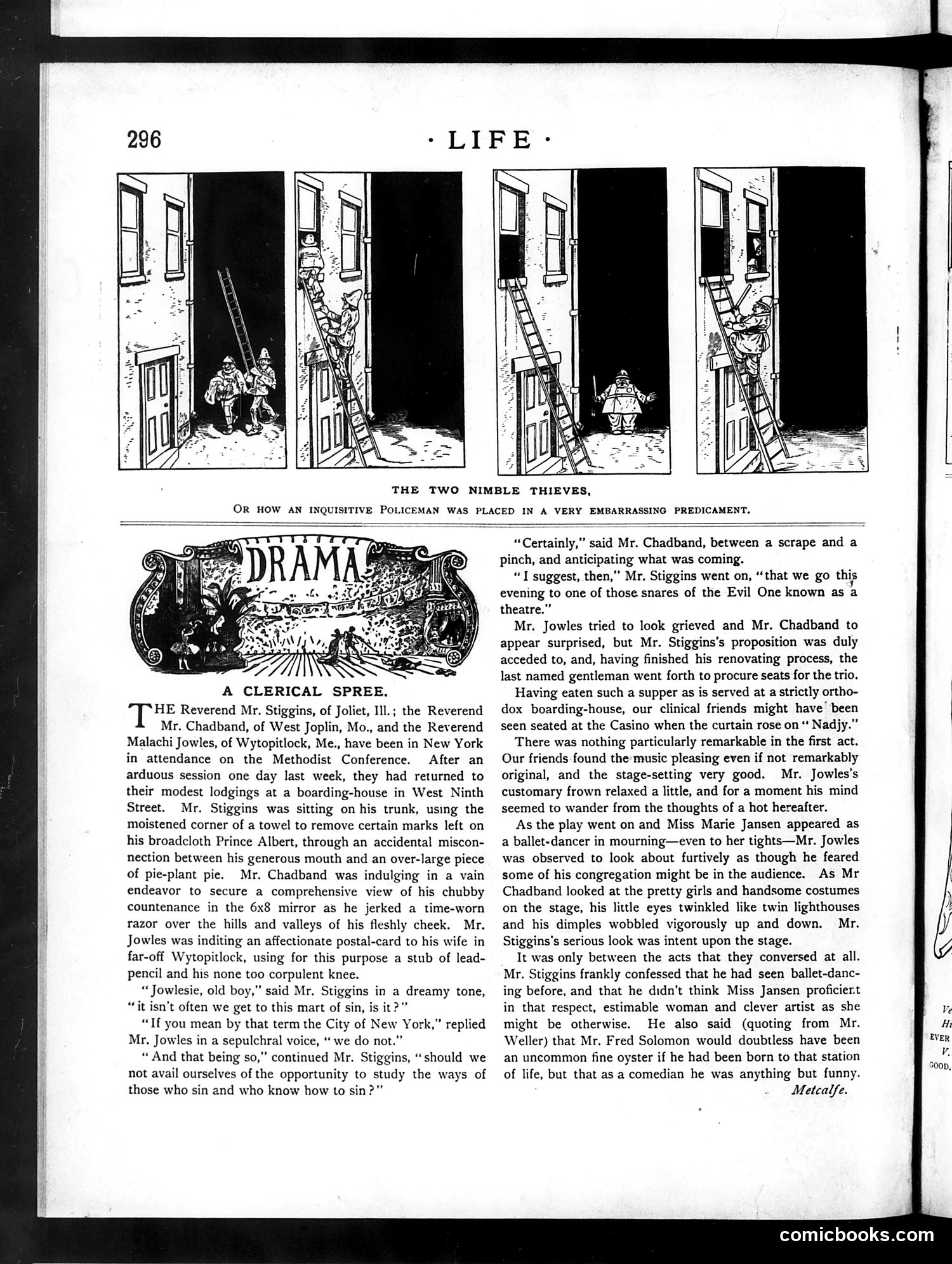
This satirical drama depicts three Methodist ministers—Reverends Stiggins, Chadband, and Jowles—attending a conference in New York. The comic premise involves their hypocrisy: while preaching morality, they sneak out to see a theatrical performance (ballet-dancing). The visual gag shows them using a ladder to enter a building window, literally "sneaking" to entertainment they publicly condemn. The satire mocks clerical pretense—these supposedly pious men break their own moral codes for worldly pleasures. The "two nimble thieves" likely refers to Stiggins and Chadband as the primary offenders. The joke exploits the tension between strict religious doctrine (condemning theater) and actual human behavior, suggesting clergymen were hypocrites who indulged privately while preaching publicly.
📄 Transcribed text from this page (OCR, searchable)
Machine-transcribed from the original scan — historical spelling and the odd misread are preserved.
THE TWO NIMBLE THIEVES, AN INQUISITIVE POLICEMAN WAS PLACED IN A VERY EMBARRASSING PREDICAMENT. A CLERICAL SPREE. T= Reverend Mr. Stiggins, of Joliet, Ill.; the Reverend Mr. Chadband, of West Joplin, Mo., and the Reverend Malachi Jowles, of Wytopitlock, Me., have been in New York in attendance on the Methodist Conference. After an arduous session one day last week, they had returned to their modest lodgings at a boarding-house in West Ninth Street. Mr. Stiggins was sitting on his trunk, using the moistened corner of a towel to remove certain marks left on his broadcloth Prince Albert, through an accidental miscon- nection between his generous mouth and an over-large piece of pie-plant pie. Mr. Chadband was indulging in a vain endeavor to secure a comprehensive view of his chubby countenance in the 6x8 mirror as he jerked a time-worn razor over the hills and valleys of his fleshly cheek. Mr. Jowles was inditing an affectionate postal-card to his wife in far-off Wytopitlock, using for this purpose a stub of lead- pencil and his none too corpulent knee. “Jowlesie, old boy,” said Mr. Stiggins in a dreamy tone, “it isn’t often we get to this mart of sin, is it?” “If you mean by that term the City of New York,” replied Mr. Jowles in a sepulchral voice, “ we do not.” “ And that being so,” continued Mr. Stiggins, “should we not avail ourselves of the opportunity to study the ways of those who sin and who know how to sin?” “Certainly,” said Mr. Chadband, between a scrape and a pinch, and anticipating what was coming. “I suggest, then,” Mr. Stiggins went on, “that we go this evening to one of those snares of the Evil One known as a theatre.” Mr. Jowles tried to look grieved and Mr. Chadband to appear surprised, but Mr. Stiggins’s proposition was duly acceded to, and, having finished his renovating process, the last named gentleman went forth to procure seats for the trio. Having eaten such a supper as is served at a strictly ortho- dox boarding-house, our clinical friends might have’ been seen seated at the Casino when the curtain rose on “ Nadjy.” There was nothing particularly remarkable in the first act. Our friends:found the music pleasing even if not remarkably original, and the stage-setting very good. Mr. Jowles’s customary frown relaxed a little, and for a moment his mind seemed to wander from the thoughts of a hot hereafter. As the play went on and Miss Marie Jansen appeared as a ballet-dancer in mourning—even to her tights—Mr. Jowles was observed to look about furtively as though he feared some of his congregation might be in the audience. As Mr Chadband looked at the pretty girls and handsome costumes on the stage, his little eyes twinkled like twin lighthouses and his dimples wobbled vigorously up and down. Mr. Stiggins’s serious look was intent upon the stage. It was only between the acts that they conversed at all. Mr. Stiggins frankly confessed that he had seen ballet-danc- ing before, and that he didn’t think Miss Jansen proficiert in that respect, estimable woman and clever artist as she might be otherwise. He also said (quoting from Mr. Weller) that Mr. Fred Solomon would doubtless have been an uncommon fine oyster if he had been born to that station of life, but that as a comedian he was anything but funny. Metcalfe. comicbooks.com