
A complete issue · 18 pages · 1888
Life — May 17, 1888
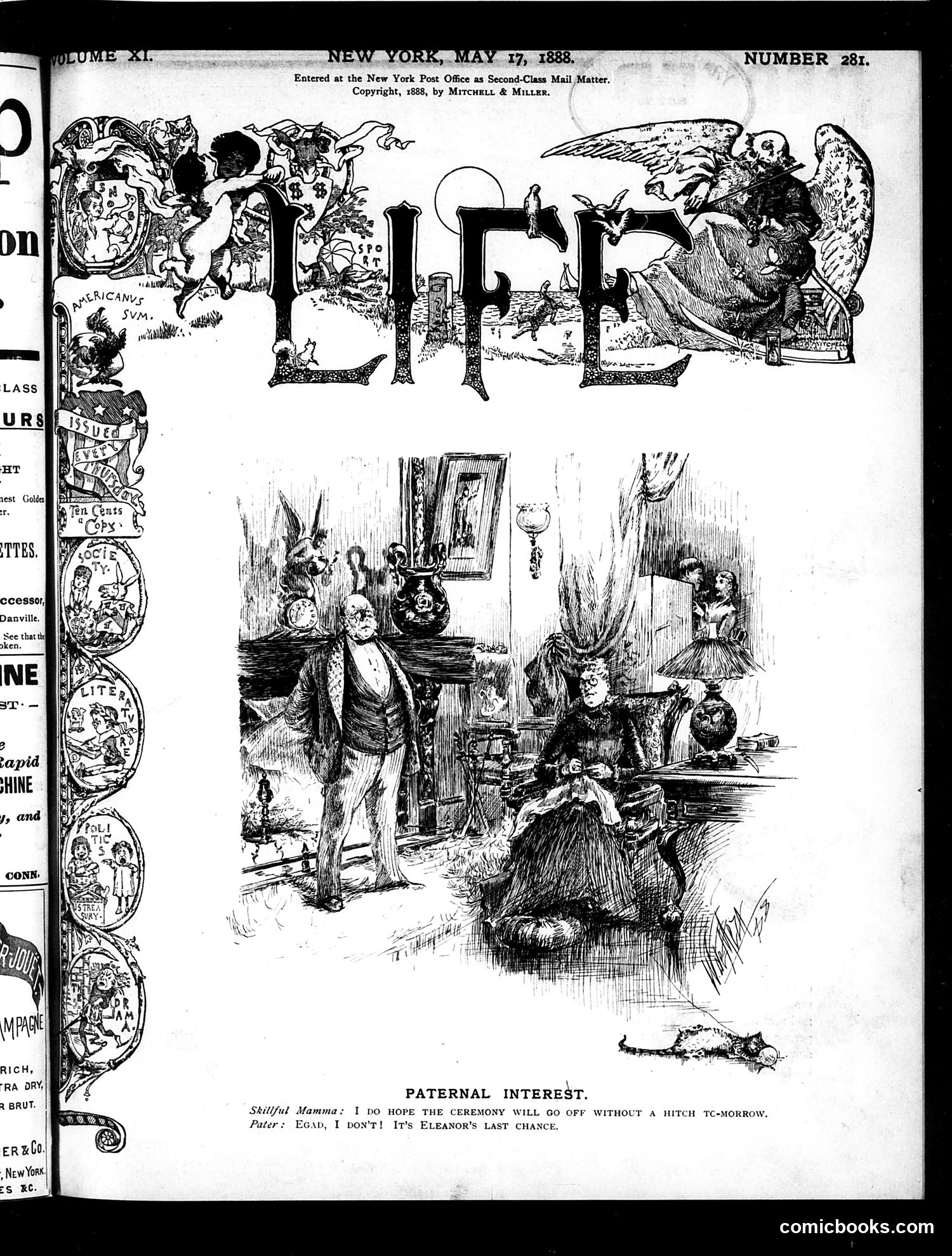
This cartoon satirizes a domestic dispute over marriage prospects. The caption presents dialogue between parents: **Skillful Mamma**: "I do hope the ceremony will go off without a hitch tomorrow." **Father**: "Egad, I don't! It's Eleanor's last chance." The humor lies in the father's cynical commentary—he's reluctant about his daughter Eleanor's wedding, sarcastically suggesting this may be her only opportunity to marry. This reflects Victorian-era anxieties about women's marriageability and the social pressure on daughters to secure husbands. The "last chance" remark implies Eleanor is aging out of the marriage market, making the father's reluctance absurd given the stakes. The cartoon mocks both parental concern and period attitudes toward women's limited life options beyond marriage.
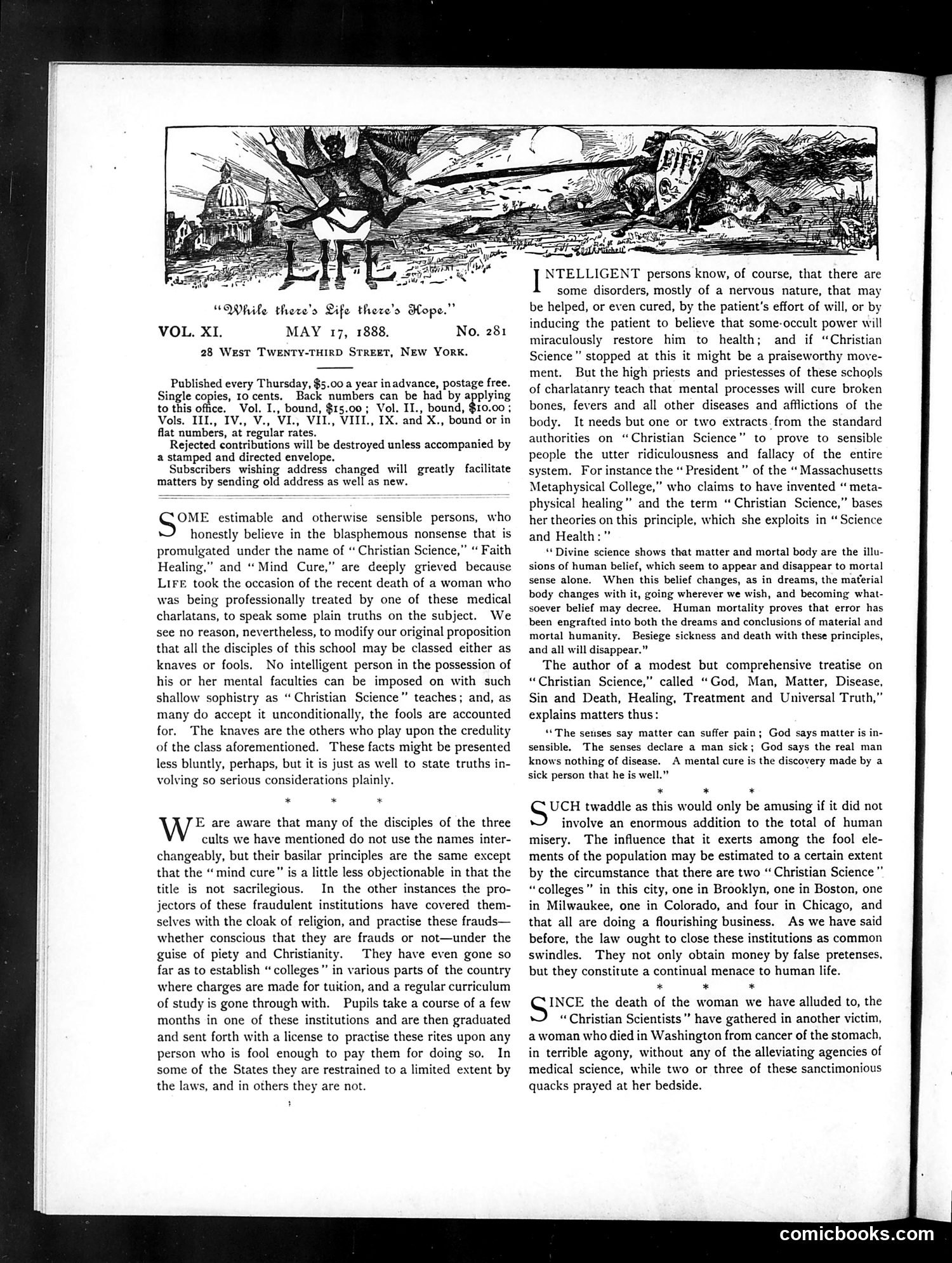
This page from *Life* (May 17, 1888) critiques fraudulent "Christian Science" medical practitioners. The masthead cartoon shows a grim reaper figure labeled "Life" amid a desolate landscape—visual irony for a magazine attacking false healers. The text attacks three related cults claiming miraculous cures through mental power alone, without actual medicine. The author mocks their pretentious terminology ("metaphysical healing," "Christian Science") and warns of their proliferation in major cities (Boston, Milwaukee, Colorado, Chicago). The satire targets how these charlatans exploit vulnerable, desperate people—particularly noting a woman who died of stomach cancer while "Christian Scientists" prayed rather than seek medical help. The piece argues these frauds are dangerous swindles masquerading as religion, preying on the credulous through pseudoscientific jargon.
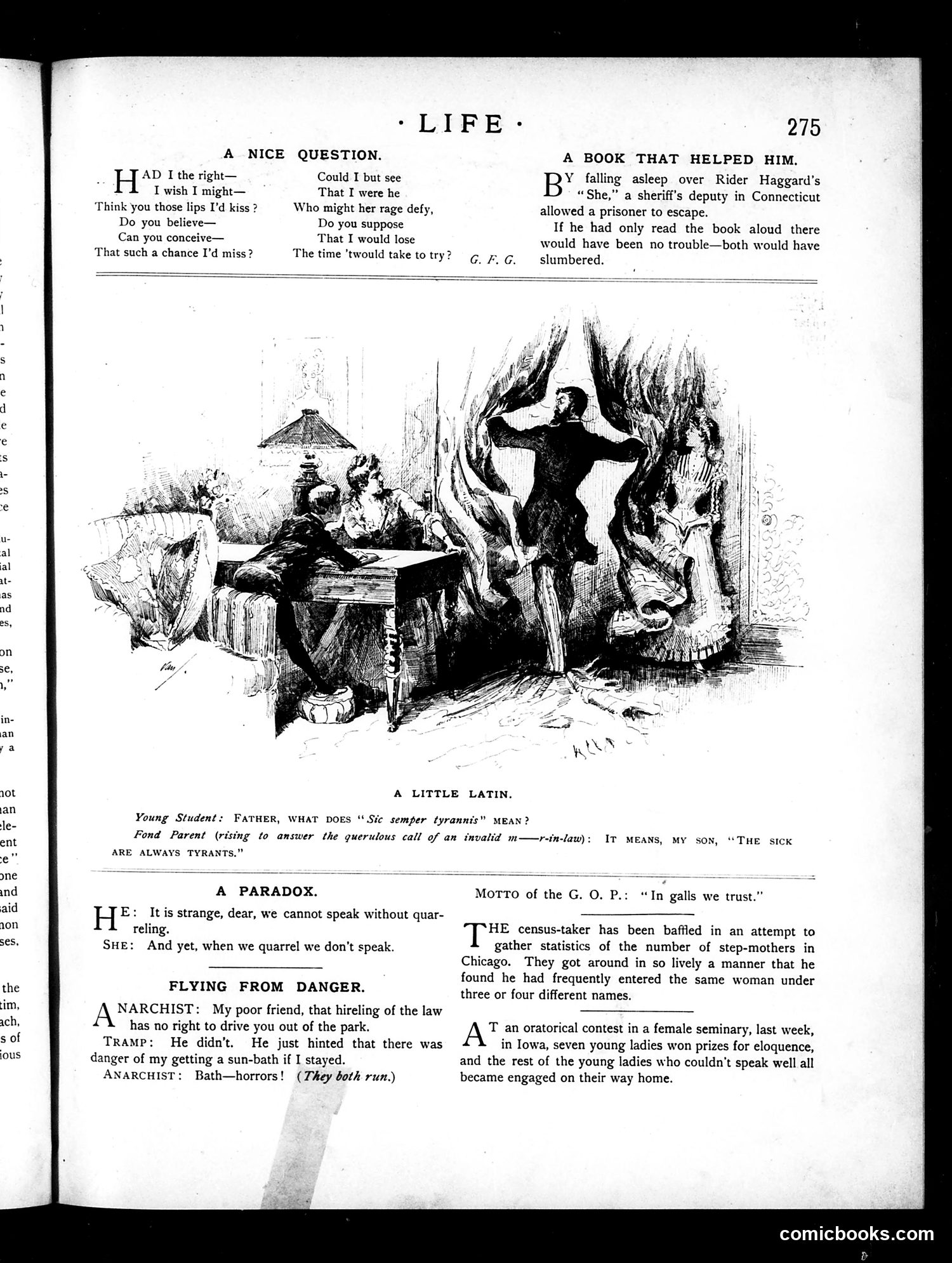
This page contains several short humorous pieces rather than a single cartoon. The main illustration shows a domestic scene where a man appears distressed while women in the background seem amused or mischievous—likely illustrating "A Little Latin," which jokes about a father's Latin phrase meaning "the sick are always tyrants." The other pieces are brief comedic sketches: - "A Nice Question" plays on romantic doubt - "A Paradox" explores the irony of quarreling couples who stop speaking - "Flying from Danger" depicts a man and woman fleeing—likely a humorous take on social scandal - Various brief anecdotes mock census-taking, female oratory contests, and social conventions The humor relies on Victorian-era domestic situations and wordplay rather than specific political references.
This page contains several brief satirical items rather than a single cartoon. The main article, "Mr. Blaine's Health," discusses James G. Blaine's physical appearance and political viability, suggesting his robust constitution contradicts rumors of his declining health. The shorter items mock various targets: the Brooklyn Eagle's classified ad seeking a room for a gentleman; Protectionist trade policies and their effects on workers; the Mail and Express newspaper's religious credibility; and Dr. Putz, a deaf advocate at a Methodist conference, whose infirmity is presented as ironic given his role. The final item jokes about General Badeau's anticipated emotional response to some unspecified event or discovery. The satire relies on personal mockery and policy criticism typical of 19th-century American political magazines.
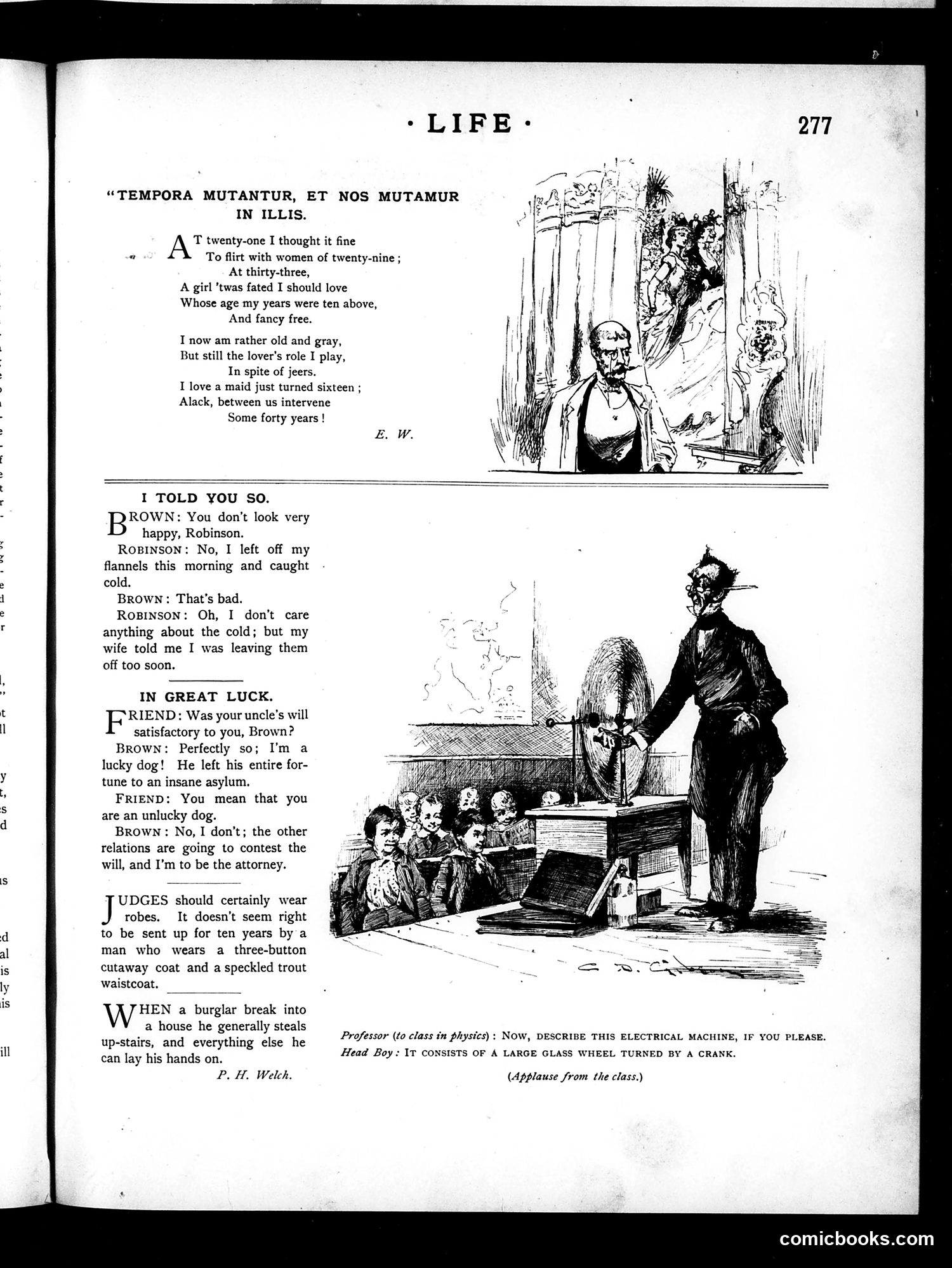
This page contains humorous prose pieces and sketches typical of Life's satirical content. The drawings illustrate comedic scenarios rather than political cartoons: The upper sketch shows a man observing elegantly dressed figures, likely accompanying a poem about aging and romantic nostalgia (the "Tempora Mutantur" piece by E.W.). The lower illustration depicts a classroom scene where a professor instructs students about an electrical machine—a large glass wheel turned by a crank. The humor appears to derive from the absurdity of the device itself or the professor's pompous explanation, with students responding sarcastically ("Applause from the class"). The surrounding text pieces mock various social conventions: judicial dress codes, burglary stereotypes, and romantic disappointments. These represent Life's typical light satirical commentary on everyday American life and manners rather than hard political critique.
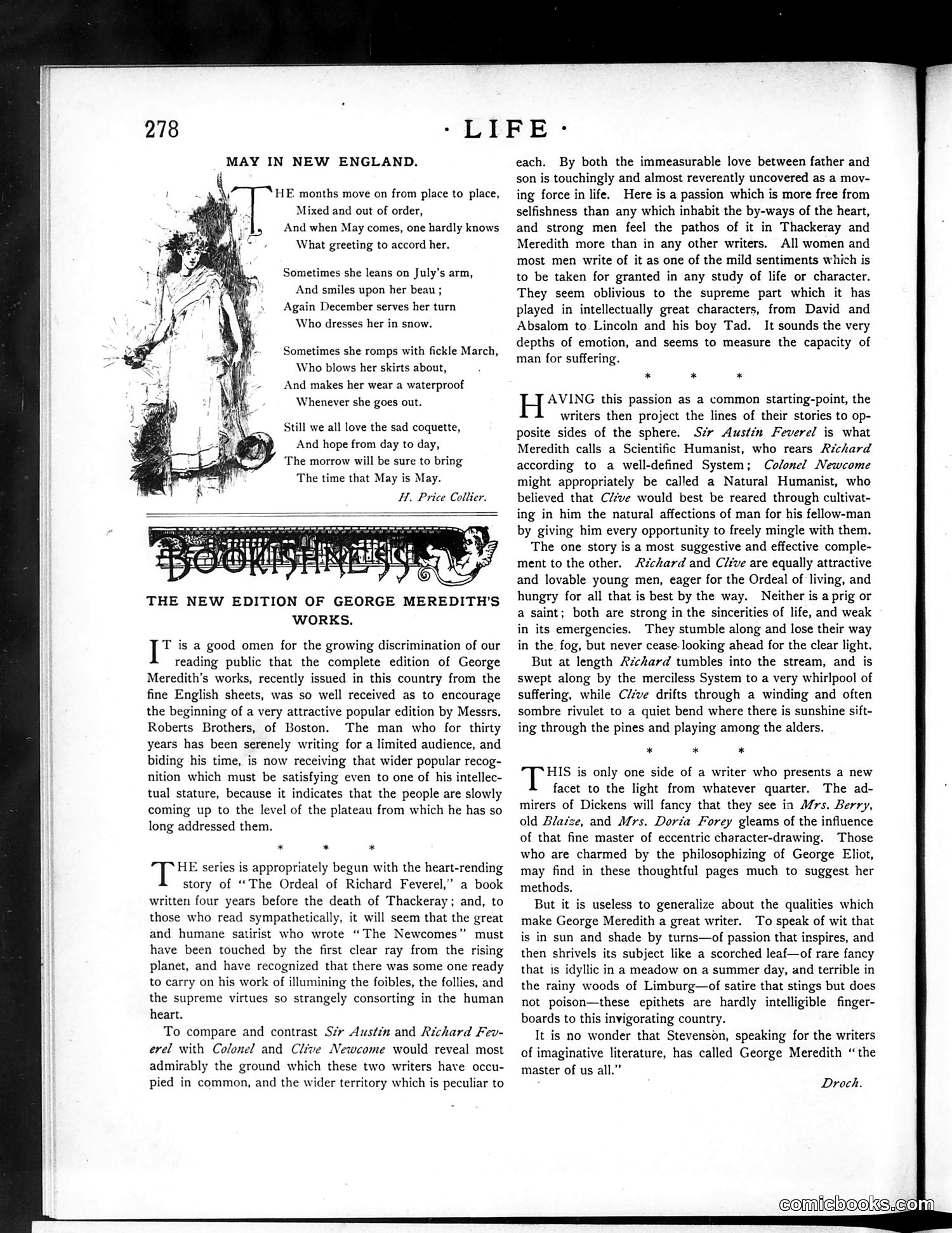
This page contains a literary review section rather than political satire. The main illustration appears to be a decorative initial letter or vignette featuring a woman in Victorian-era dress positioned among foliage or branches—likely related to the "May in New England" poem at the top. The content primarily discusses George Meredith's recently published works in a new American edition. The reviewer praises Meredith as a great writer and compares his characters (Richard and Clive) favorably to those of other Victorian authors like Dickens and Eliot. The "Bookshelf" section advertises this new Meredith edition from Roberts Brothers of Boston, suggesting Life magazine's role in promoting literary works to its educated readership. No political figures or satirical commentary appear on this page.
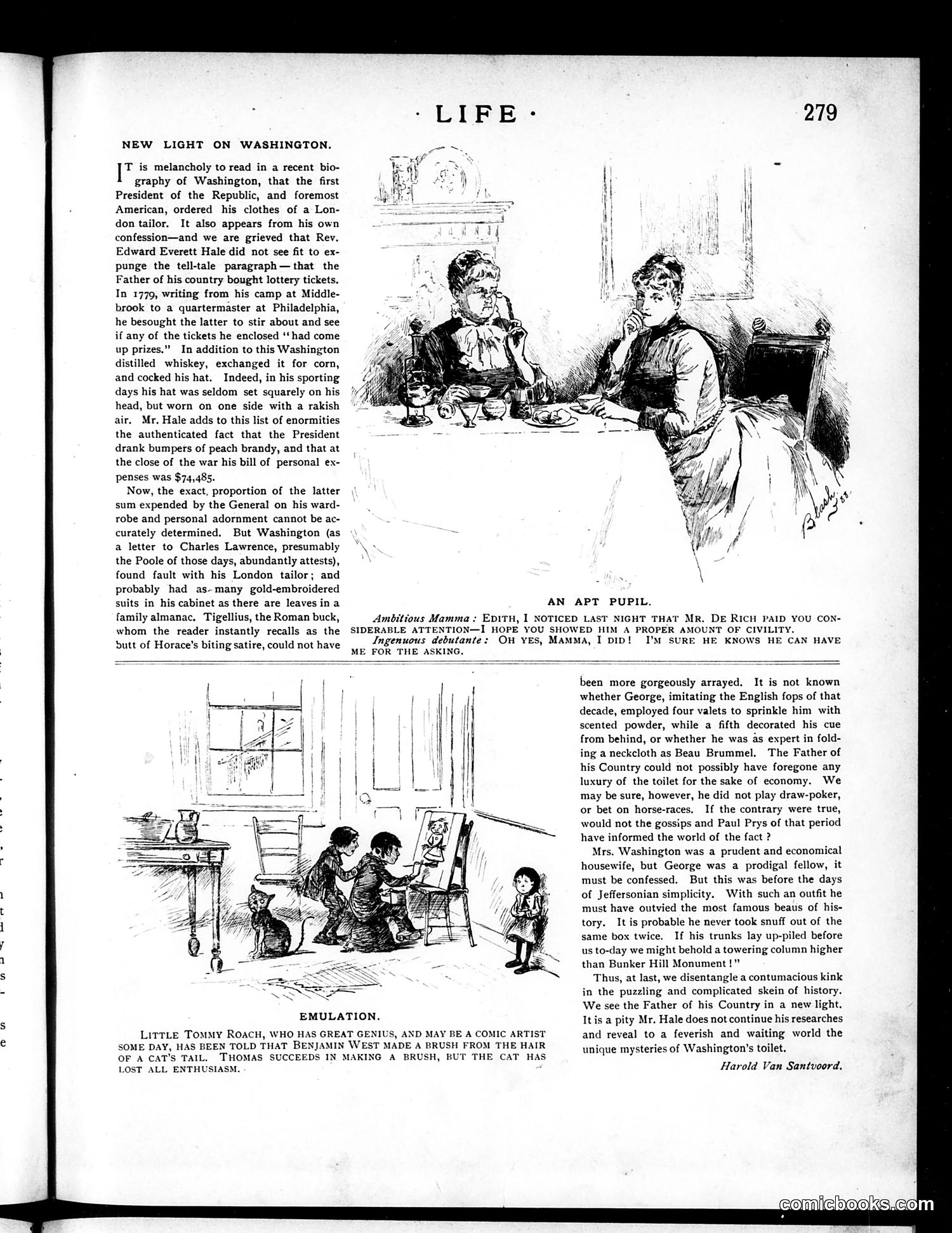
**"New Light on Washington"** discusses recently discovered details about George Washington's personal habits—specifically that he ordered clothes from a London tailor, drank peach brandy, and spent $74,485 on his wardrobe and personal expenses during the war. **"An Apt Pupil"** (top cartoon) shows a child asking their mother why Mr. De Rich paid attention to them, with the mother suspecting the child is being taught to be a "proper amount of civility"—satirizing wealthy socialites' performative politeness toward those beneath their station. **"Emulation"** (bottom cartoon) depicts children imitating a famous comic artist making a brush from a cat's tail, with the caption noting the cat has "lost all enthusiasm"—a dark joke about unthinking imitation of celebrity behavior.
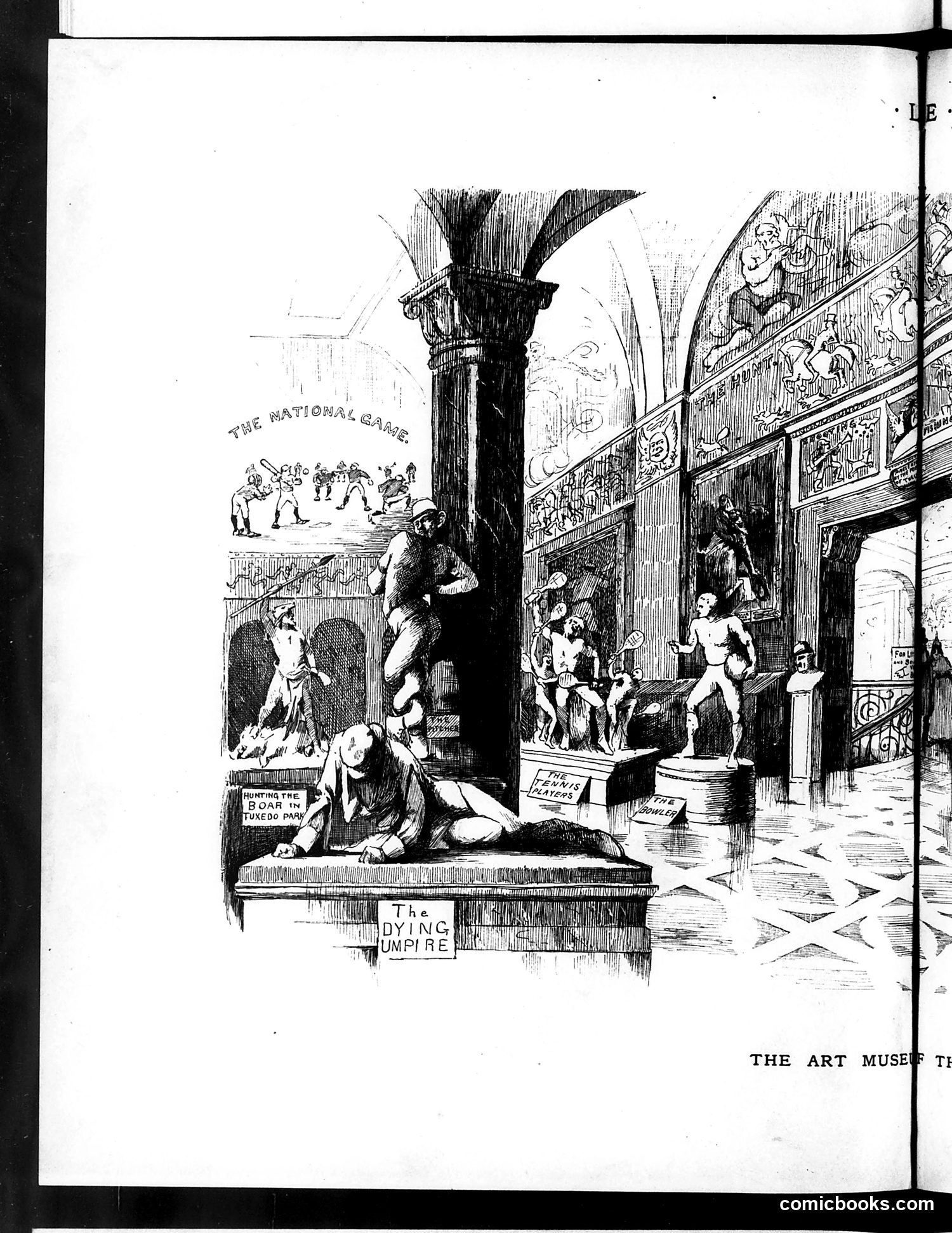
This engraving depicts "The Dying Umpire" at what appears to be an art museum or gallery labeled "The National Game." The central figure is a collapsed umpire positioned beneath a classical column, surrounded by classical statuary and Greek/Roman artistic elements. The satire critiques baseball's umpires through a classical art framework. By presenting the umpire's demise in the style of classical tragedy or death scenes (like famous artworks depicting fallen warriors or gods), the cartoonist mocks umpires as incompetent or despised figures. The juxtaposition of "The National Game" (baseball) with high art suggests baseball's pretensions to cultural importance, while the umpire's prominent collapse ironically emphasizes his centrality to the sport's dysfunction. The specific context and date remain unclear without additional publication information.
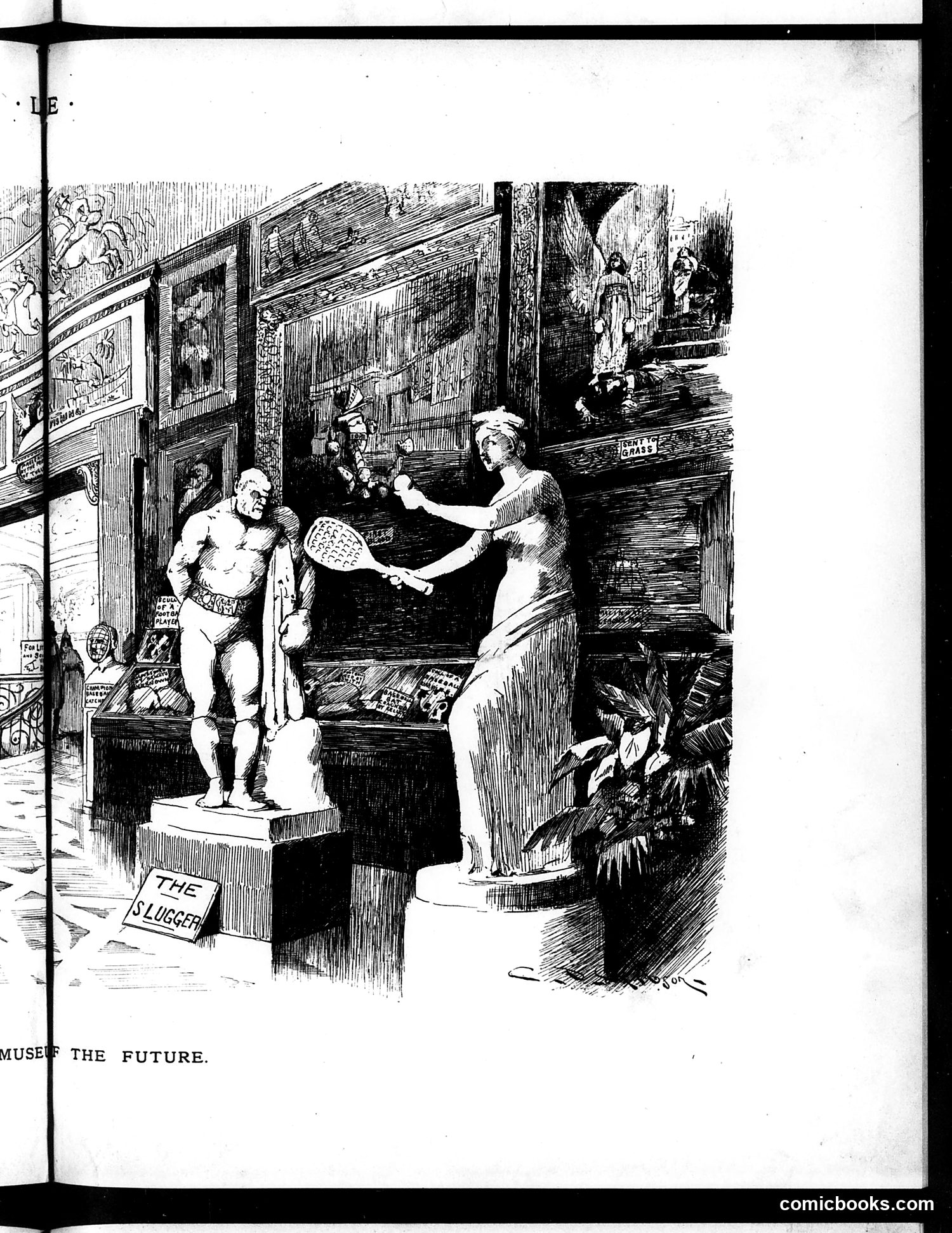
This cartoon satirizes the objectification of the human body in art and museum culture. A sculptor or artist presents a nude male figure labeled "The Slugger" (visible on the base) to a fashionably-dressed woman in what appears to be an art gallery or museum setting. The woman examines the figure with a fly-swatter or paddle—treating the living or statue-like man as an object to inspect, much as one might examine any museum piece. The satire likely mocks how museums display human forms, or comments on the commodification of the body in art. The woman's casual, inspecting demeanor with the paddle suggests she views the "slugger" as merely another exhibit rather than a person—a critique of detached aesthetic viewing or perhaps gender dynamics in artistic evaluation.
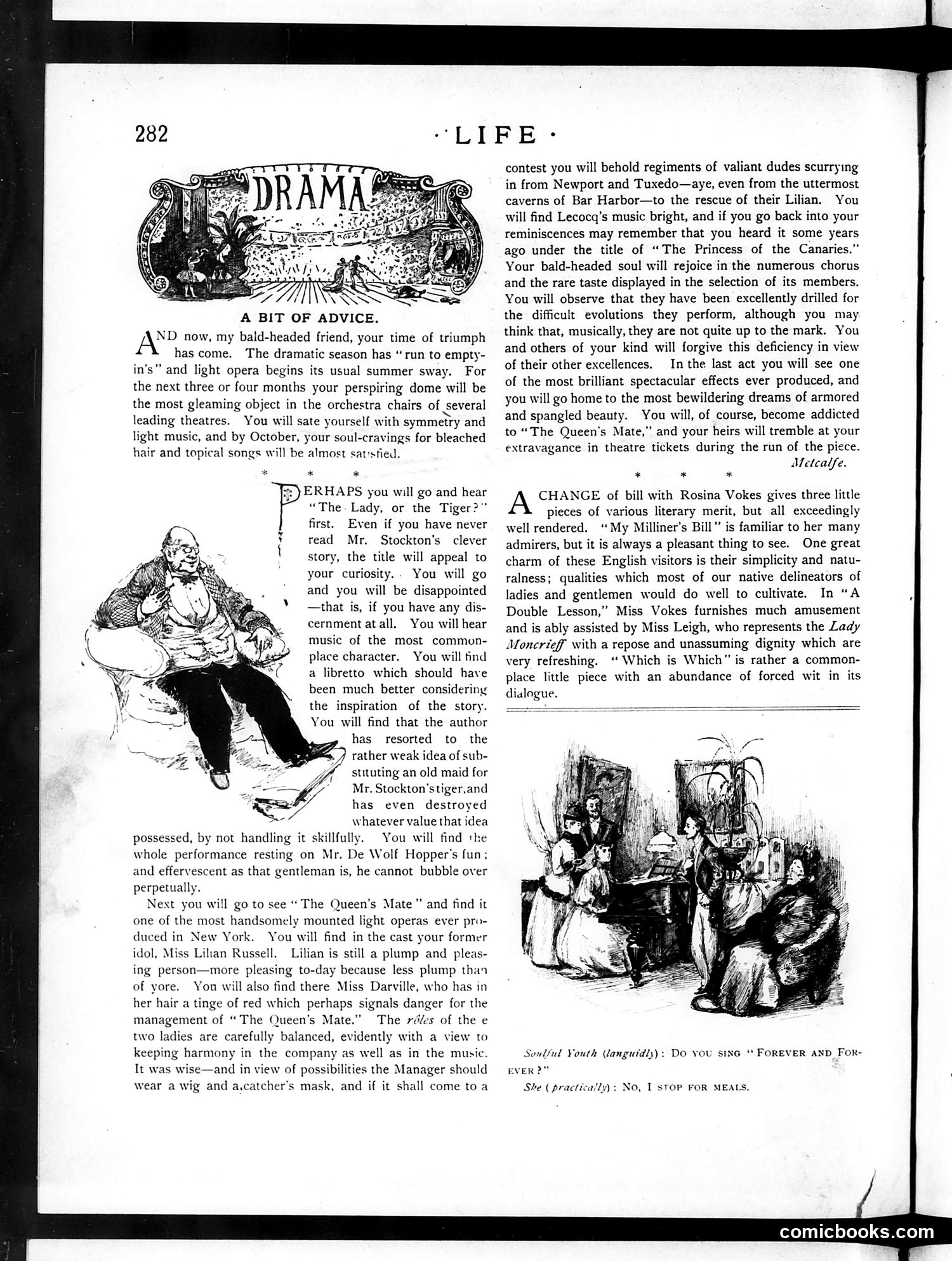
This page is primarily **theater criticism and review**, not political satire. The "Drama" section discusses upcoming theatrical productions for summer 1889. The illustrated figure (left) appears to be a **caricatured actor or theatrical character**—likely mocking a specific performer's style, though the person isn't identified in visible text. The reviews discuss several productions: "The Lady, or the Tiger?", "The Queen's Mate," and works featuring performers like Rosina Vokes, Miss Lilian Russell, and Miss Darville. The critic praises some performances while gently mocking theatrical conventions—particularly criticizing weak plot devices like substituting "an old maid for Mr. Stockton's tiger." The lower illustration shows what appears to be a **domestic scene**, possibly illustrating a plot point from one of the reviewed plays. This reflects **late Victorian theater criticism**, focusing on performance quality and dramatic merit rather than political commentary.
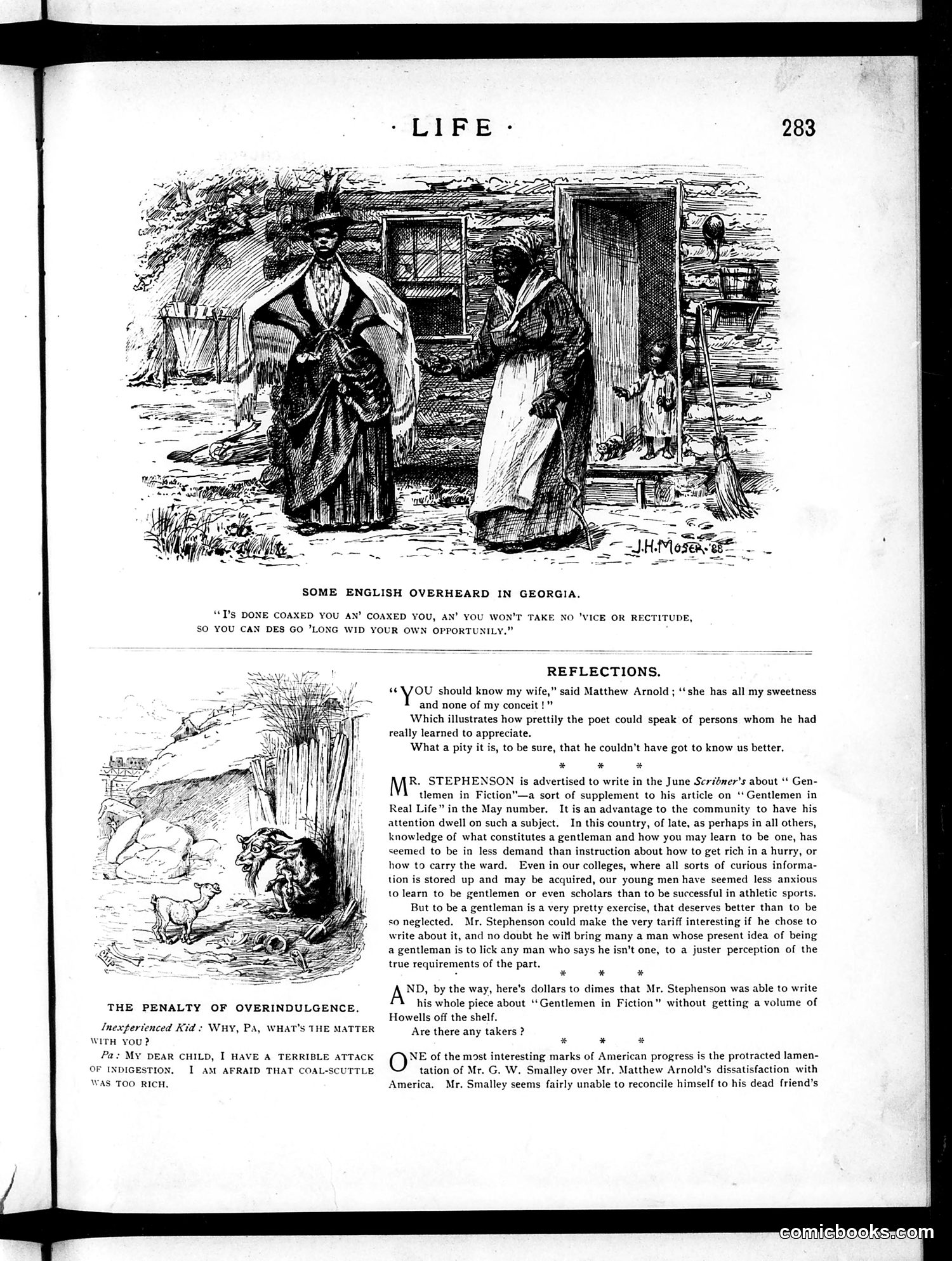
The top cartoon satirizes dialectal speech in Georgia, depicting two African American women. One scolds the other for rejecting good advice ("'vice or rectitude"), telling her to go her own way ("'long wid your own opportunity"). The satire mocks rural Southern dialect through exaggerated spelling and grammar—a common 19th-century Life magazine technique for portraying regional and racial "others" as comic subjects. The "Penalty of Overindulgence" cartoon shows a father claiming indigestion from eating a coal-scuttle (a metal bin), an absurdist joke about consuming non-food objects. The "Reflections" section includes literary commentary on Matthew Arnold and Mr. Stephenson's forthcoming essay on gentlemen, critiquing American culture's prioritization of wealth-getting and athletics over gentlemanly character and scholarship. It's satirical social criticism dressed as book chat.
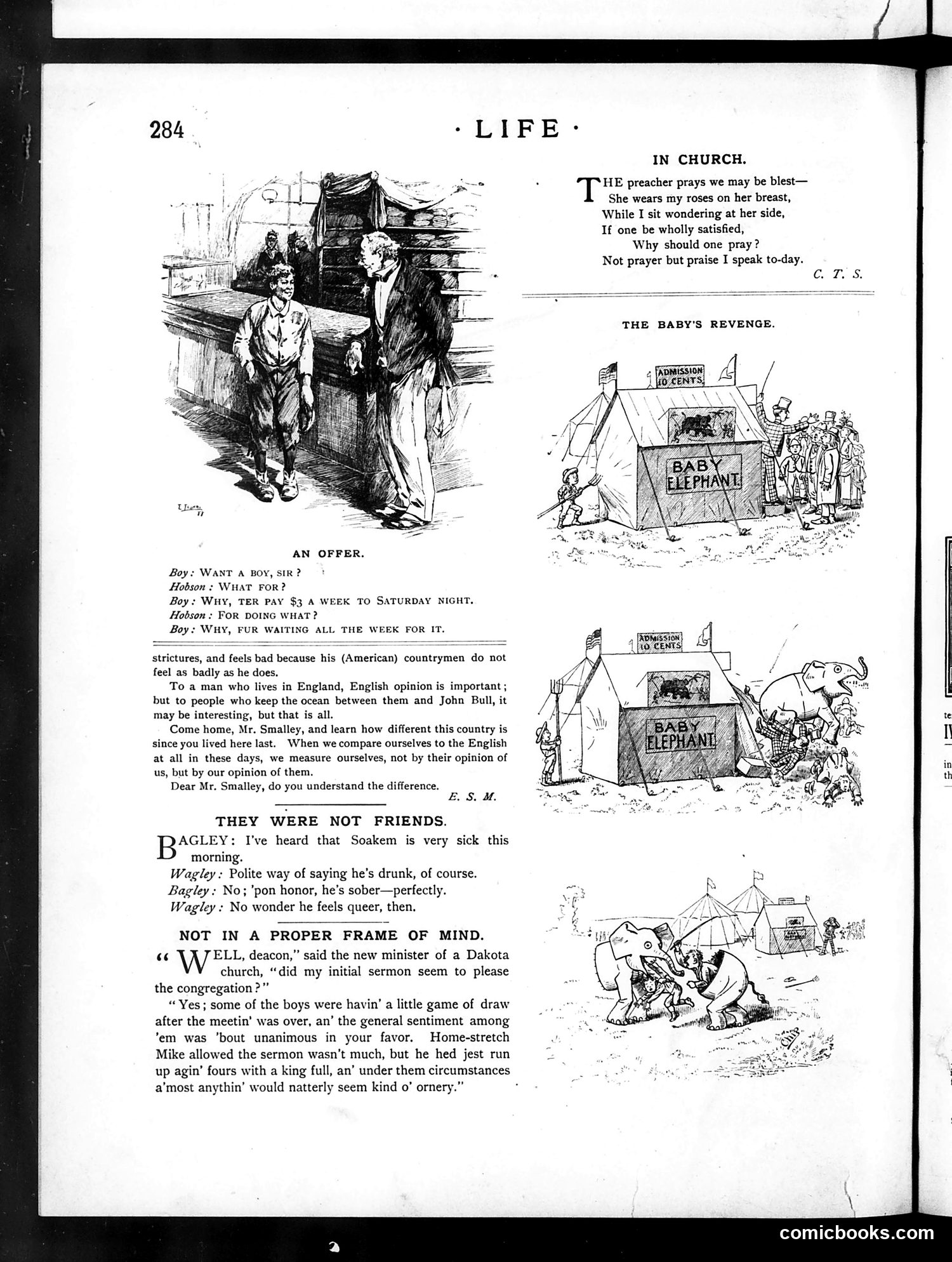
This page contains several satirical vignettes typical of *Life* magazine's social humor: **"In Church"**: A man sits beside a woman wearing his roses, questioning why he should pray when already satisfied—satirizing romantic distraction during worship. **"An Offer"**: A boy seeks employment at $3/week, but only plans to "wait" for payday Saturday—mocking lazy workers and poor work ethic. **"They Were Not Friends"**: A joke where Soakem being sober (unusual) makes him feel worse than being drunk—absurdist humor about contradiction. **"Not in a Proper Frame of Mind"**: A Dakota minister asks if his sermon pleased the congregation. A deacon reveals the men were gambling during the service; one man found the sermon "ornery" only because he'd just lost at poker—satirizing rural frontier morality and inattentiveness to religion. The cartoons mock human hypocrisy, idleness, and misplaced priorities across social classes.
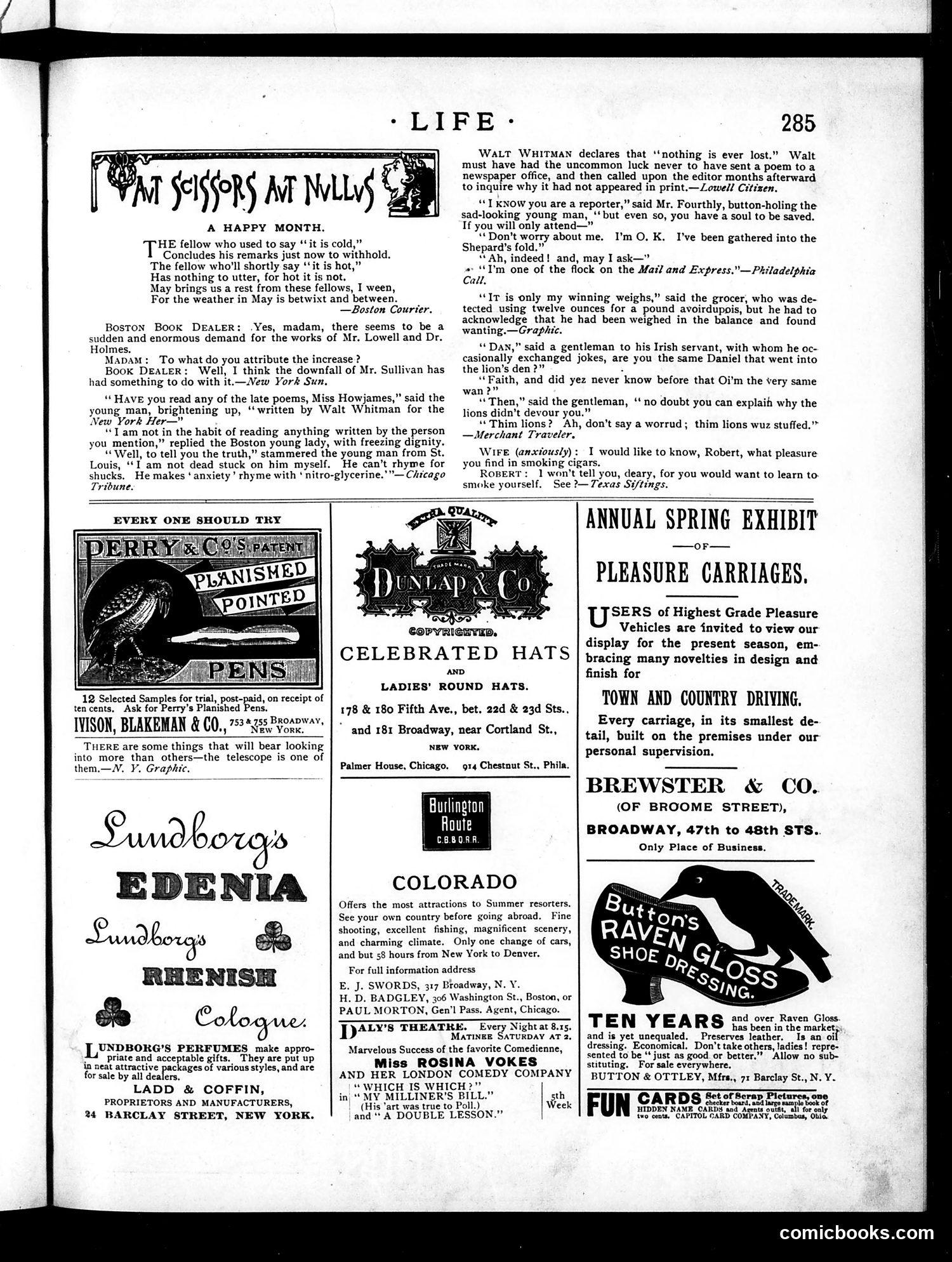
This is primarily an **advertising page** with scattered short humorous anecdotes rather than a coherent cartoon. The main satirical content consists of brief jokes poking fun at **Walt Whitman's poetry**. One anecdote mocks his unconventional rhyming (pairing "anxiety" with "nitro-glycerine"), while another suggests editors routinely reject his submissions. A third joke references Whitman's expansive philosophy ("nothing is ever lost"), implying poets lose work to indifferent editors. The page also contains unrelated vignettes: a grocer caught short-weighing customers; a Boston lady's snobbish rejection of Whitman; an Irish servant's humorous misunderstanding of the biblical Daniel in the lion's den; and a domestic squabble over cigar-smoking. **Context for modern readers:** Whitman was a controversial, innovative poet whose free verse and unconventional style made him an easy target for 19th-century satirists who preferred traditional rhyme and meter. These jokes reflect contemporary literary gatekeeping and ridicule of his work. The remainder of the page is **period advertising** for pens, perfumes, hats, carriages, and Colorado tourism.
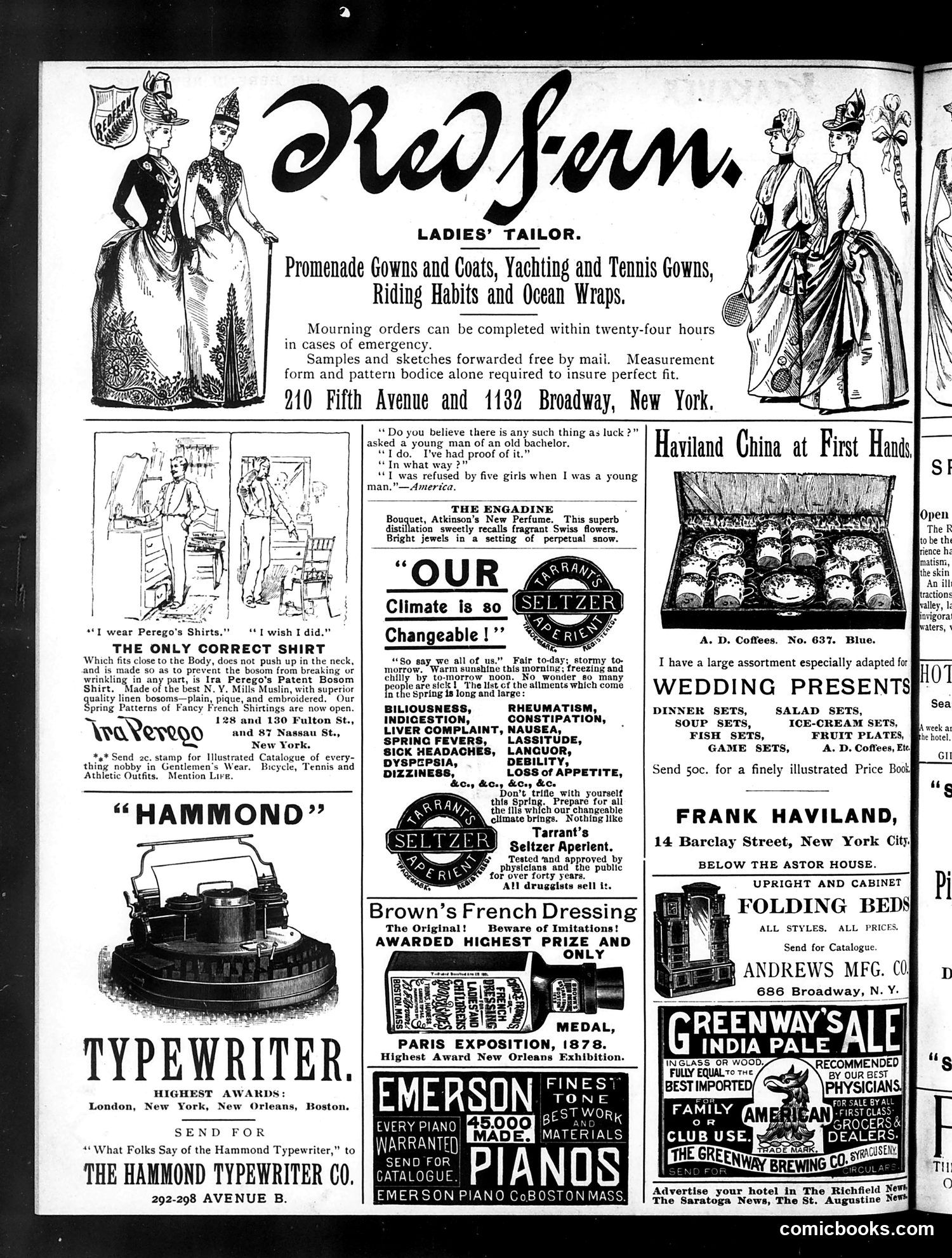
This is primarily a **page of period advertisements** from Life magazine, not political satire. The content reflects late 19th-century consumer culture and marketing. Notable advertisements include: - **Red Fern Ladies' Tailor**: Offers custom women's clothing with rush service - **Perego's Shirts**: Features a small comedic dialogue about shirt fit ("I wear Perego's Shirts"/"I wish I did") - **Hammond Typewriter**: Advertises with "highest awards" from major cities - **Seltzer Aperient**: A spring tonic addressing seasonal ailments (reflecting period belief that weather changes caused illness) - **Brown's French Dressing**: Claims "highest prize" from 1878 Paris Exposition - **Haviland China** and **Emerson Pianos**: Luxury goods for weddings and homes The small joke about an old bachelor's "luck" (being rejected by five girls) represents period humor about courtship. This page illustrates **how advertising dominated late 1800s magazines** and reflects contemporary consumer goods, technology (typewriters), and health beliefs now considered quaint.
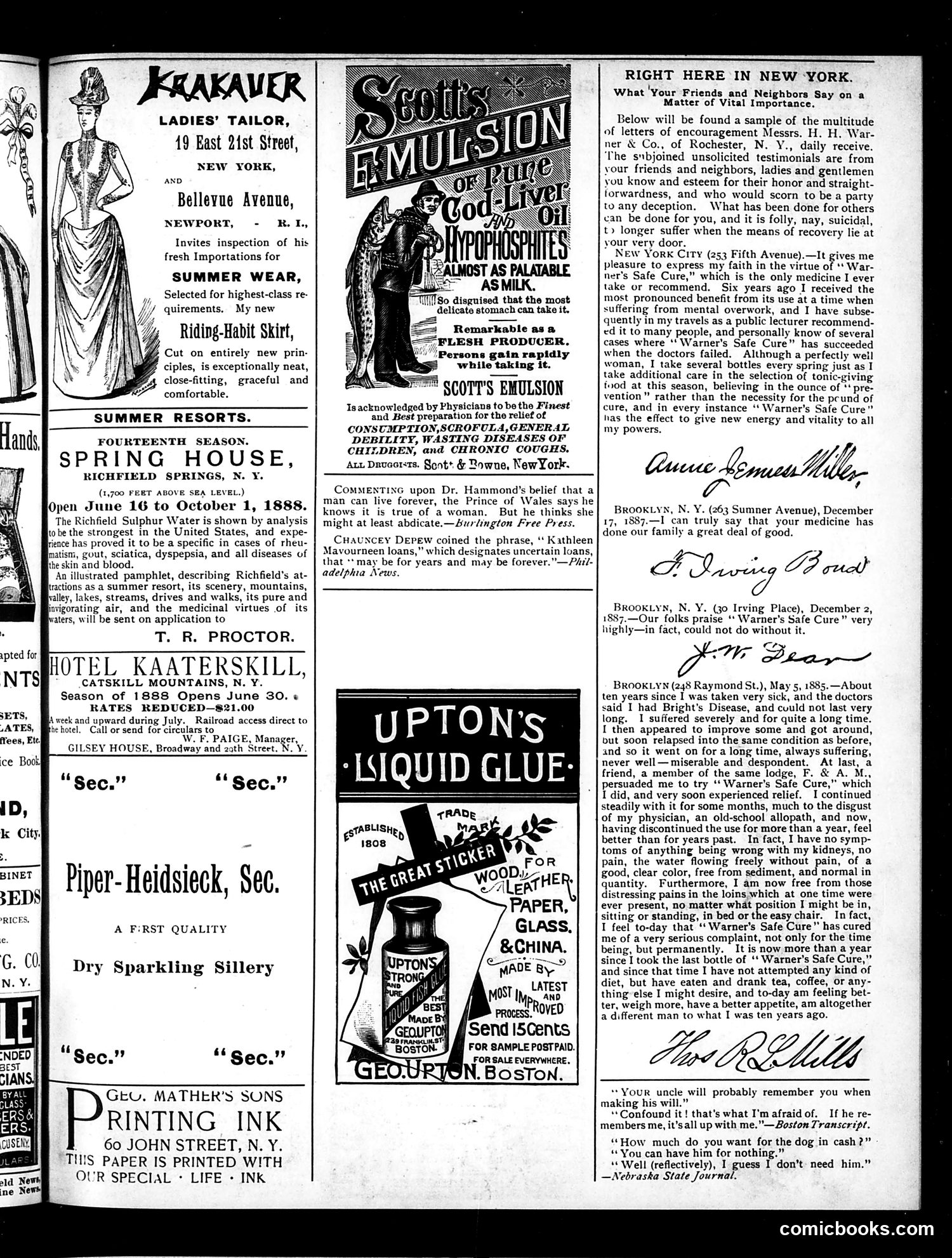
This page is primarily **advertising and testimonial content**, not political satire. The main focus is promoting **Warner's Safe Cure**, a patent medicine. The center features Scott's Emulsion (cod liver oil) and Upton's Liquid Glue advertisements, while the right column showcases unsolicited testimonials from New York residents praising Warner's Safe Cure for treating various ailments—kidney disease, mental overwork, and general debility. The page also includes brief humorous observations: a joke about the Prince of Wales claiming women can live forever but should "abdicate" (resign), and wordplay about Chauncey Depew's phrase "Kathleen Mavourneen loans" (uncertain loans). The testimonials are presented as endorsements from respectable neighbors to build consumer confidence in the patent medicine's efficacy—a common marketing tactic of the era before FDA regulation of medicinal claims.
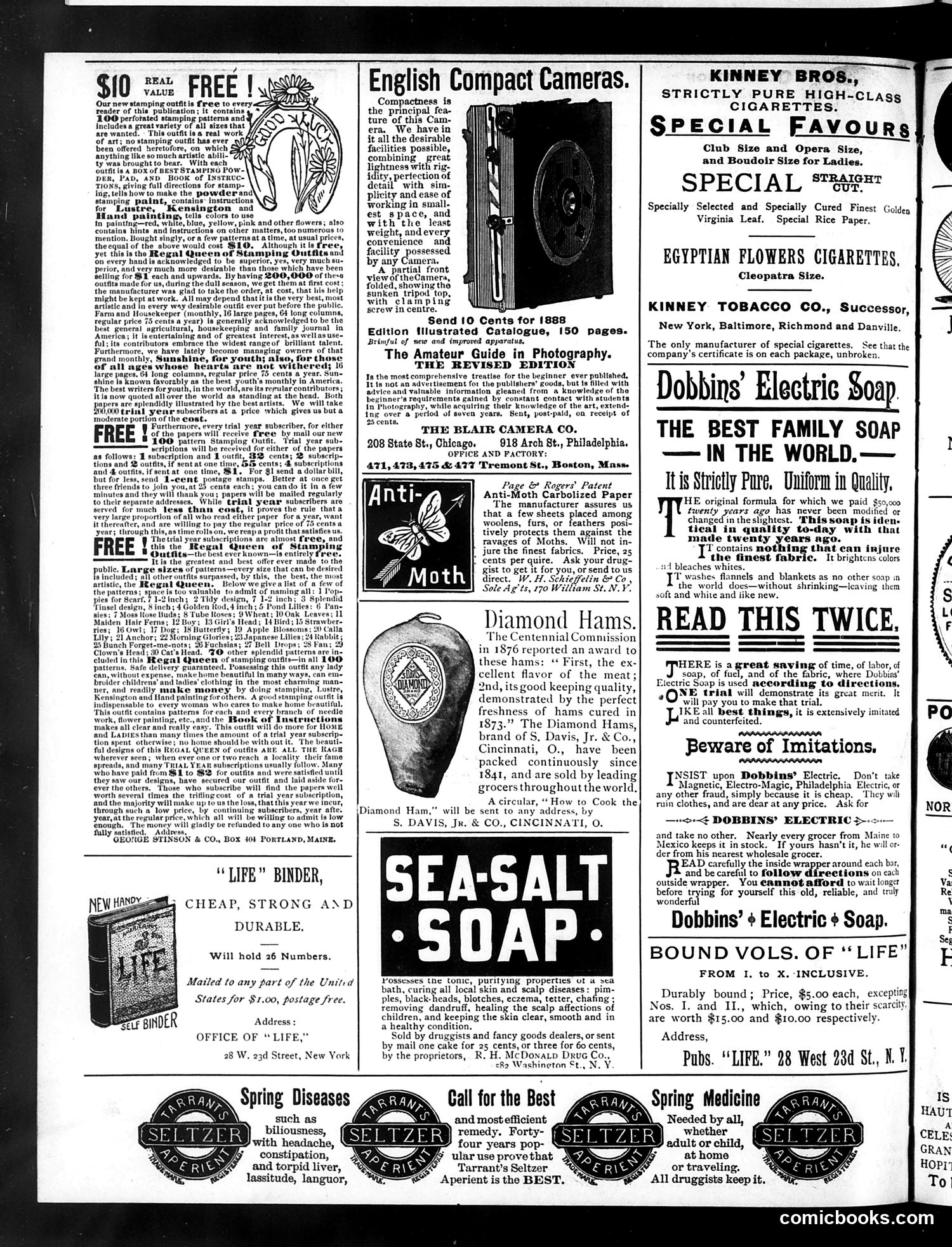
This page is primarily **advertising**, not political satire or cartooning. It contains: 1. **Multiple product advertisements** for stamping outfit kits, cameras, cigarettes, soap, and patent medicines—typical of late 19th-century publications. 2. **One small graphic**: An "Anti-Moth" product advertisement featuring a butterfly illustration, promoting carbolic paper to protect clothing from moths. 3. **No political cartoons or satire** are visible on this page. The advertisements reflect period concerns (domestic crafts, photography, pest control, health tonics) and marketing strategies (free offers, trial subscriptions). The page represents how *Life* magazine sustained itself financially through extensive paid advertising rather than editorial content alone. For modern readers, this illustrates how consumer culture and product promotion were central to late-1800s publishing, though the specific products and their claims reflect outdated assumptions about health and household management.
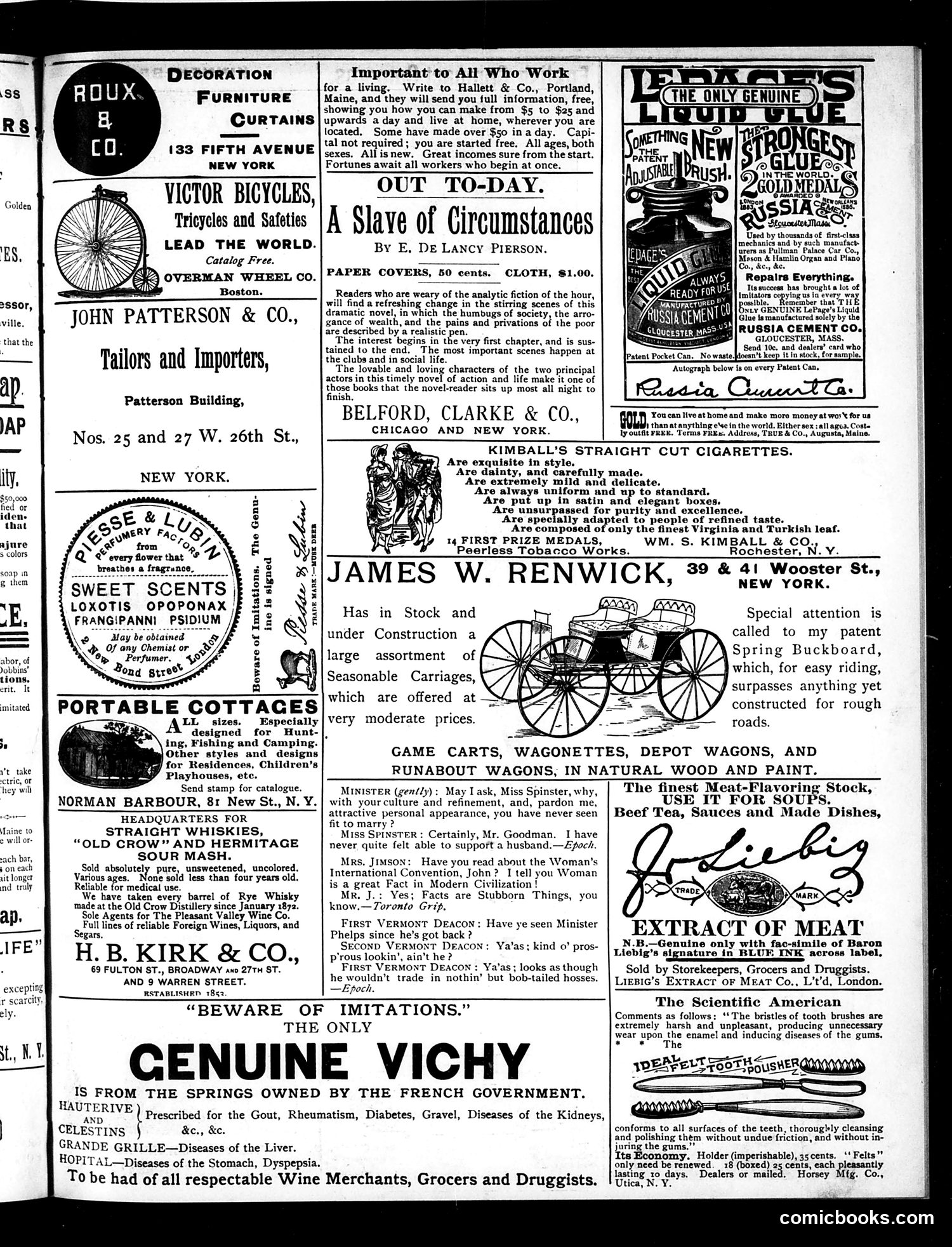
This page is **primarily advertising** with minimal editorial or satirical content. The dominant feature is "A Slave of Circumstances," a book advertisement for a novel by E. De Lancy Pierson about social inequality—describing "humbugs of society, the arrogance of wealth, and the pains and privations of the poor." The surrounding advertisements reveal period concerns: work-from-home schemes promising "$5 to $25 upward a day," bicycles, carriages, whiskey, cigarettes, and various consumer goods. Notably, ads emphasize purity and authenticity ("Beware of Imitations" for Vichy water; "The Only Genuine" liquid glue). **No clear political cartoons are visible.** The page appears to be from an era (late 19th century, based on products and typography) when *Life* functioned as both satirical magazine and advertising vehicle. The implicit satire may lie in juxtaposing the novel's social critique with advertisements for luxury goods—highlighting the consumer culture it critiques—but this is subtle rather than explicit.
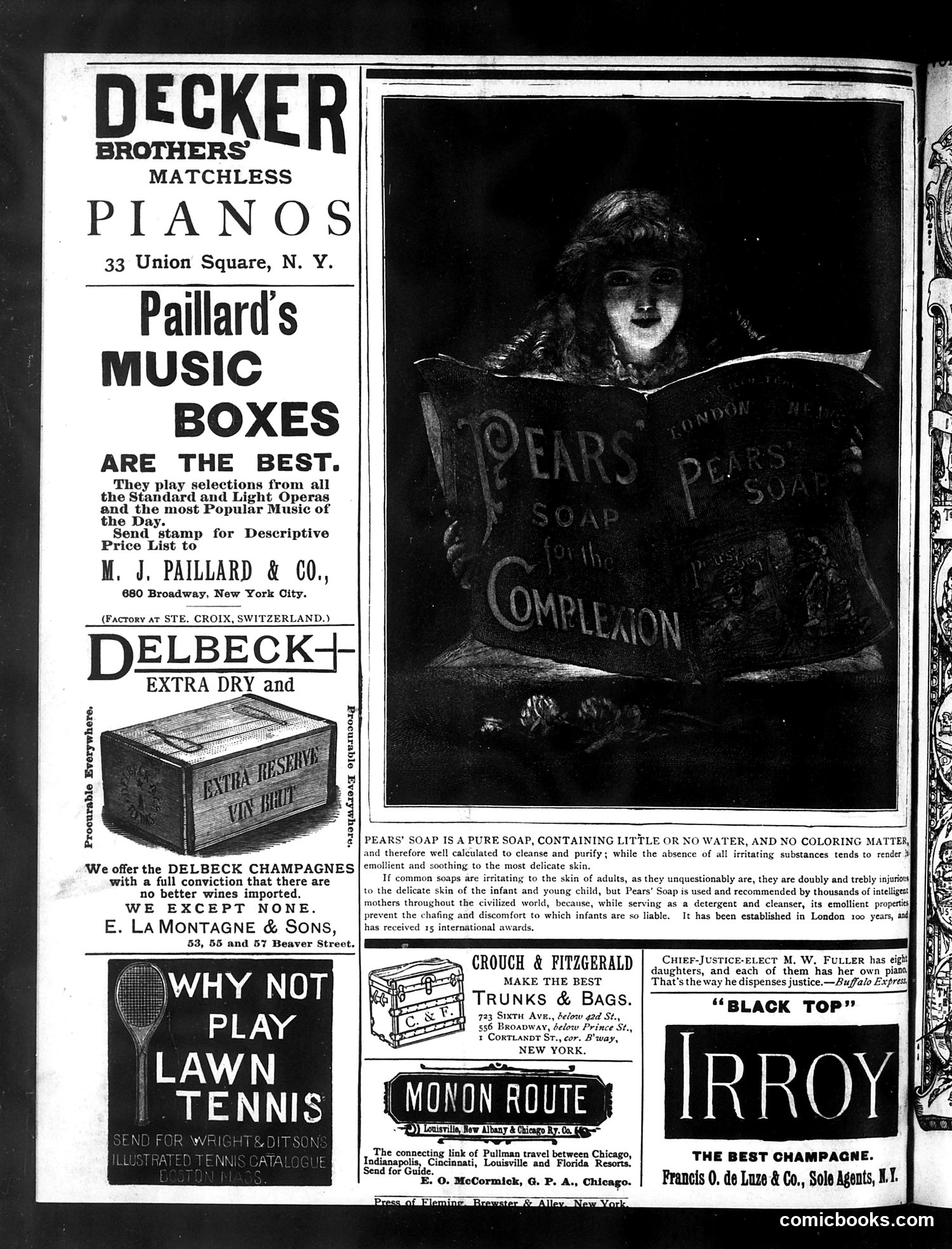
This is primarily an **advertisement page**, not a satirical cartoon page. It features various product ads typical of early 20th-century American magazines. The only humor content is a brief **joke about Chief Justice M.W. Fuller**: the caption notes he has eight daughters, each with her own piano, and quips "That's the way he dispenses justice"—a pun suggesting he "distributes" or provides for them generously. This is gentle social satire about wealth and judicial authority, playing on the notion that a Supreme Court justice can afford such luxuries. The rest of the page advertises pianos, music boxes, champagne, soap, trunks, and lawn tennis equipment—typical commercial offerings. **Pears' Soap** includes a substantial descriptive text promoting its gentleness for infants' delicate skin, representing the era's marketing of personal hygiene products. The ads reflect **Gilded Age commerce** and consumer culture aimed at affluent readers.