
Life, 1888-05-17 · page 6 of 18
Life — May 17, 1888 — page 6: what you’re looking at
What you’re looking at
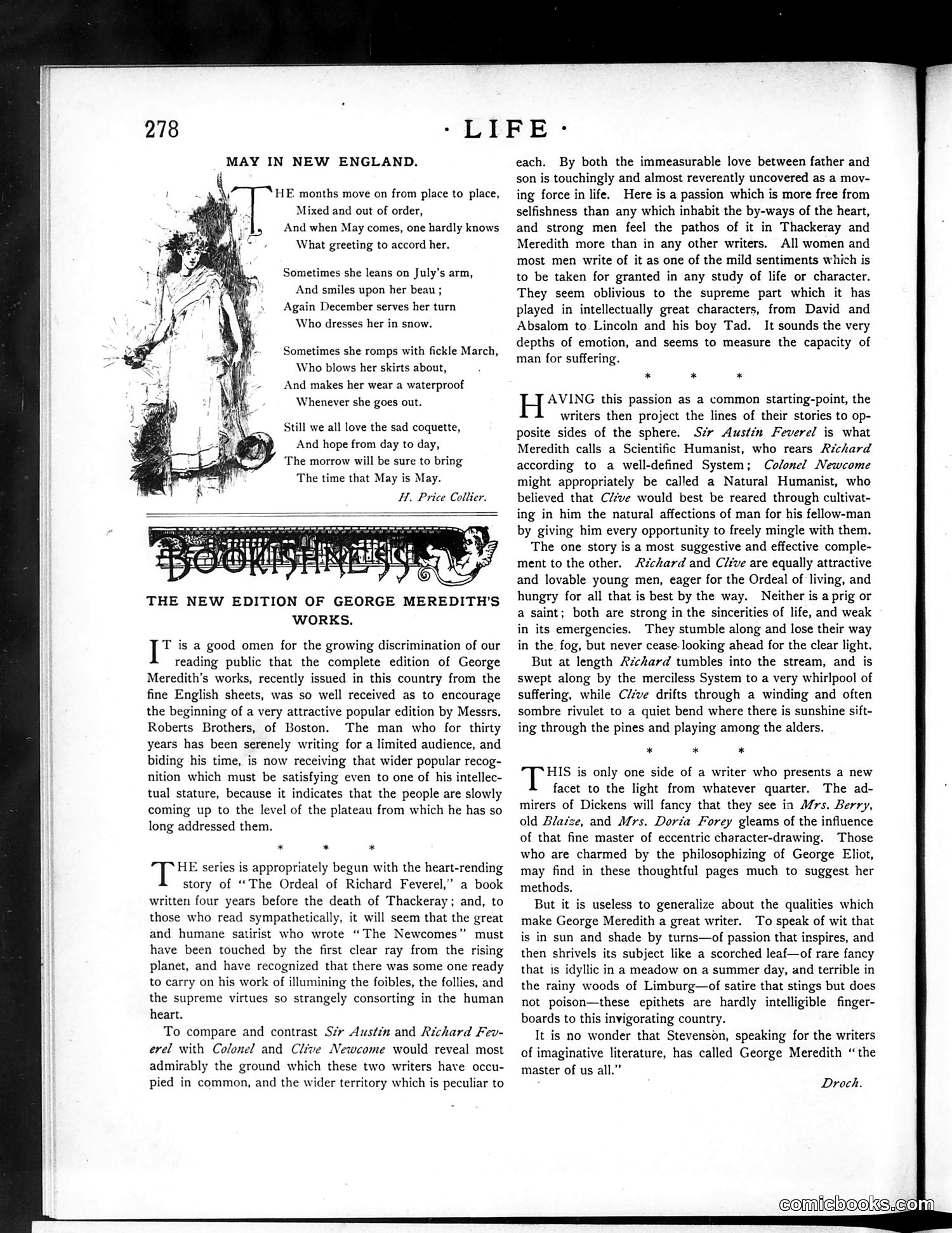
This page contains a literary review section rather than political satire. The main illustration appears to be a decorative initial letter or vignette featuring a woman in Victorian-era dress positioned among foliage or branches—likely related to the "May in New England" poem at the top. The content primarily discusses George Meredith's recently published works in a new American edition. The reviewer praises Meredith as a great writer and compares his characters (Richard and Clive) favorably to those of other Victorian authors like Dickens and Eliot. The "Bookshelf" section advertises this new Meredith edition from Roberts Brothers of Boston, suggesting Life magazine's role in promoting literary works to its educated readership. No political figures or satirical commentary appear on this page.
📄 Transcribed text from this page (OCR, searchable)
Machine-transcribed from the original scan — historical spelling and the odd misread are preserved.
- LIFE: MAY IN NEW ENGLAND. HE months move on from place to place, Mixed and out of order, And when May comes, one hardly knows What greeting to accord her. Sometimes she leans on July's arm, And smiles upon her beau ; Again December serves her turn Who dresses her in snow. Sometimes she romps with fickle March, Who blows her skirts about, And makes her wear a waterproof Whenever she goes out. Still we all love the sad coquette, And hope from day to day, The morrow will be sure to bring The time that May is May. H. Price Collier, THE NEW EDITION OF GEORGE MEREDITH'S WORKS. T is a good omen for the growing discrimination of our reading public that the complete edition of George Meredith’s works, recently issued in this country from the fine English sheets, was so well received as to encourage the beginning of a very attractive popular edition by Messrs. Roberts Brothers, of Boston. The man who for thirty years has been serenely writing for a limited audience, and biding his time, is now receiving that wider popular recog- nition which must be satisfying even to one of his intellec- tual stature, because it indicates that the people are slowly coming up to the level of the plateau from which he has so long addressed them. * * * Tr HE series is appropriately begun with the heart-rending story of “The Ordeal of Richard Feverel,” a book written four years before the death of Thackeray; and, to those who read sympathetically, it will seem that the great and humane satirist who wrote “The Newcomes” must have been touched by the first clear ray from the rising planet, and have recognized that there was some one ready to carry on his work of illumining the foibles, the follies, and the supreme virtues so strangely consorting in the human heart. To compare and contrast Sr Austin and Richard Fev- erel with Colonel and Clive Newcome would reveal most admirably the ground which these two writers have occu- pied in common, and the wider territory which is peculiar to each. By both the immeasurable love between father and son is touchingly and almost reverently uncovered as a mov- ing force in life. Here is a passion which is more free from selfishness than any which inhabit the by-ways of the heart, and strong men feel the pathos of it in Thackeray and Meredith more than in any other writers. All women and most men write of it as one of the mild sentiments which is to be taken for granted in any study of life or character. They seem oblivious to the supreme part which it has played in intellectually great characters, from David and Absalom to Lincoln and his boy Tad. It sounds the very depths of emotion, and seems to measure the capacity of man for suffering. * * * AVING this passion as a common starting-point, the writers then project the lines of their stories to op- posite sides of the sphere. Sir Austin Feverel is what Meredith calls a Scientific Humanist, who rears Réchard according to a well-defined System; Colonel Newcome might appropriately be called a Natural Humanist, who believed that CZ've would best be reared through cultivat- ing in him the natural affections of man for his fellow-man by giving him every opportunity to freely mingle with them. The one story is a most suggestive and effective comple- ment to the other. Rzchard and Clive are equally attractive and lovable young men, eager for the Ordeal of living, and hungry for all that is best by the way. Neither is a prig or a saint; both are strong in the sincerities of life, and weak in its emergencies. They stumble along and lose their way in the fog, but never cease-looking ahead for the clear light. But at length Rzchard tumbles into the stream, and is swept along by the merciless System to a very whirlpool of suffering, while C/ve drifts through a winding and often sombre rivulet to a quiet bend where there is sunshine sift- ing through the pines and playing among the alders. * * * HIS is only one side of a writer who presents a new facet to the light from whatever quarter. The ad- mirers of Dickens will fancy that they see in Mrs. Berry, old Blazze, and Mrs. Doria Forey gleams of the influence of that fine master of eccentric character-drawing. Those who are charmed by the philosophizing of George Eliot, may find in these thoughtful pages much to suggest her methods. But it is useless to generalize about the qualities which make George Meredith a great writer. To speak of wit that is in sun and shade by turns—of passion that inspires, and then shrivels its subject like a scorched leaf—of rare fancy that is idyllic in a meadow on a summer day, and terrible in the rainy woods of Limburg—of satire that stings but does not poison—these epithets are hardly intelligible finger- boards to this invigorating country. It is no wonder that Stevenson, speaking for the writers of imaginative literature, has called George Meredith “the master of us all.” Droch. comichooks.