
Life, 1888-05-17 · page 11 of 18
Life — May 17, 1888 — page 11: what you’re looking at
What you’re looking at
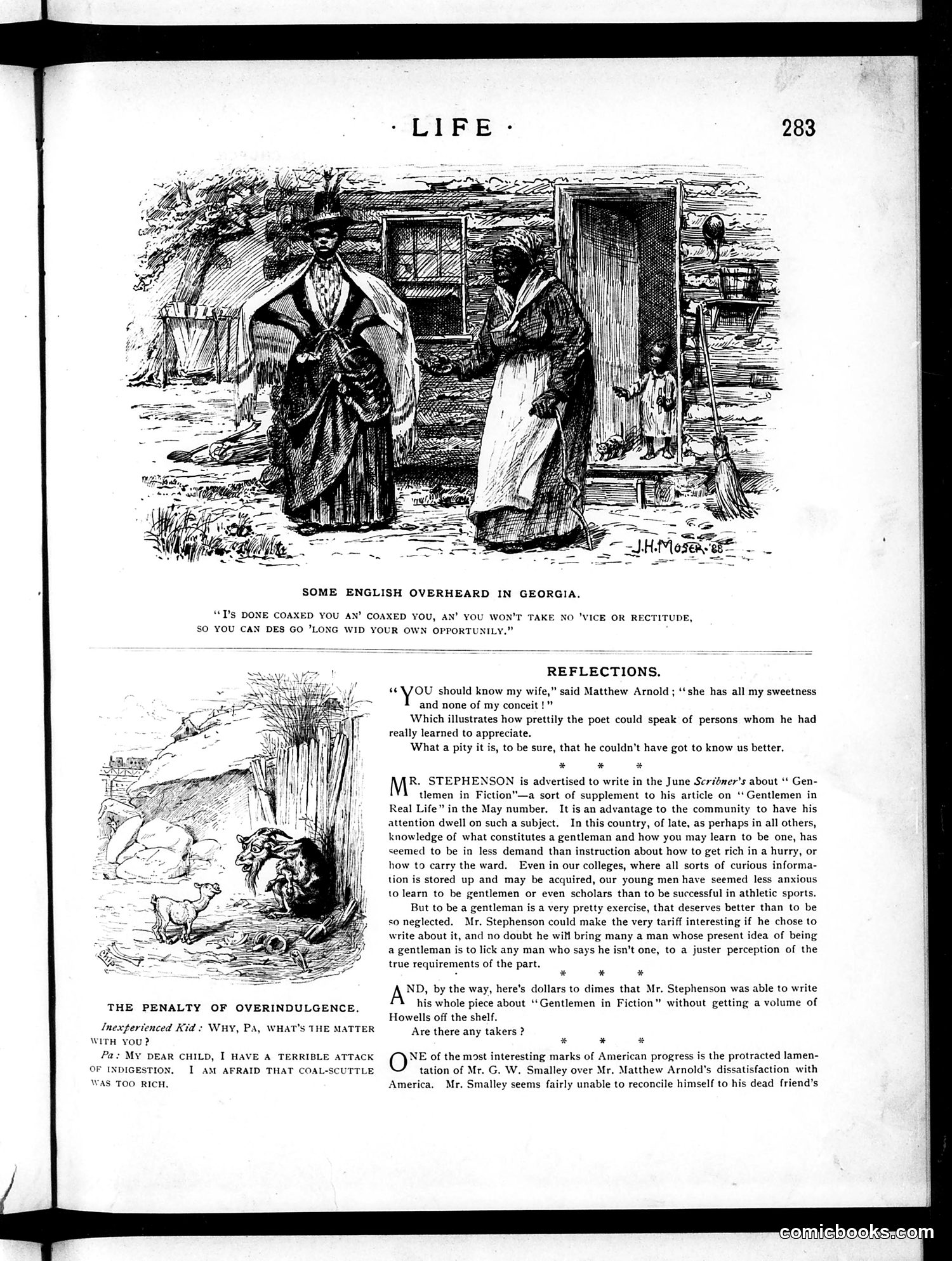
The top cartoon satirizes dialectal speech in Georgia, depicting two African American women. One scolds the other for rejecting good advice ("'vice or rectitude"), telling her to go her own way ("'long wid your own opportunity"). The satire mocks rural Southern dialect through exaggerated spelling and grammar—a common 19th-century Life magazine technique for portraying regional and racial "others" as comic subjects. The "Penalty of Overindulgence" cartoon shows a father claiming indigestion from eating a coal-scuttle (a metal bin), an absurdist joke about consuming non-food objects. The "Reflections" section includes literary commentary on Matthew Arnold and Mr. Stephenson's forthcoming essay on gentlemen, critiquing American culture's prioritization of wealth-getting and athletics over gentlemanly character and scholarship. It's satirical social criticism dressed as book chat.
📄 Transcribed text from this page (OCR, searchable)
Machine-transcribed from the original scan — historical spelling and the odd misread are preserved.
SOME ENGLISH OVERHEARD IN GEORGIA. “T's DONE COAXED YOU AN’ COAXED YOU, AN’ YOU WON'T TAKE NO 'VICE OR RECTITUDE, SO YOU CAN DES GO ’LONG WID YOUR OWN OPPORTUNILY.” THE PENALTY OF OVERINDULGENCE, Inexperienced Kid: Wy, PA, WHAT'S THE MATTER WITH You? Pa: MY DEAR CHILD, I HAVE A TERRIBLE ATTACK OF INDIGESTION, I AM AFRAID THAT COAL-SCUTTLE. WAS TOO RICH. REFLECTIONS. *¢ VOU should know my wife,” said Matthew Arnold ; ‘‘she has all my sweetness and none of my conceit Which illustrates how prettily the poet could speak of persons whom he had really learned to appreciate. What a pity it is, to be sure, that he couldn't have got to know us better. * * * R. STEPHENSON is advertised to write in the June Scrzéner’s about ‘* Gen- tlemen in Fiction"—a sort of supplement to his article on ‘Gentlemen in Real Life” in the May number. It is an advantage to the community to have his attention dwell on such a subject. In this country, of late, as perhaps in all others, knowledge of what constitutes a gentleman and how you may learn to be one, has seemed to be in less demand than instruction about how to get rich in a hurry, or how to carry the ward. Even in our colleges, where all sorts of curious informa- tion is stored up and may be acquired, our young men have seemed less anxious to learn to be gentlemen or even scholars than to be successful in athletic sports. But to be a gentleman is a very pretty exercise, that deserves better than to be so neglected. Mr. Stephenson could make the very tariff interesting if he chose to write about it, and no doubt he will bring many a man whose present idea of being a gentleman is to lick any man who says he isn’t one, to a juster perception of the true requirements of the part. : * * ND, by the way, here's dollars to dimes that Mr. Stephenson was able to write his whole piece about ‘‘Gentlemen in Fiction” without getting a volume of Howells off the shelf. Are there any takers ? * * # NE of the most interesting marks of American progress is the protracted lamen- tation of Mr. G. W. Smalley over Mr, Matthew Arnold's dissatisfaction with America. Mr. Smalley seems fairly unable to reconcile himself to his dead friend’s