
Life, 1888-05-17 · page 10 of 18
Life — May 17, 1888 — page 10: what you’re looking at
What you’re looking at
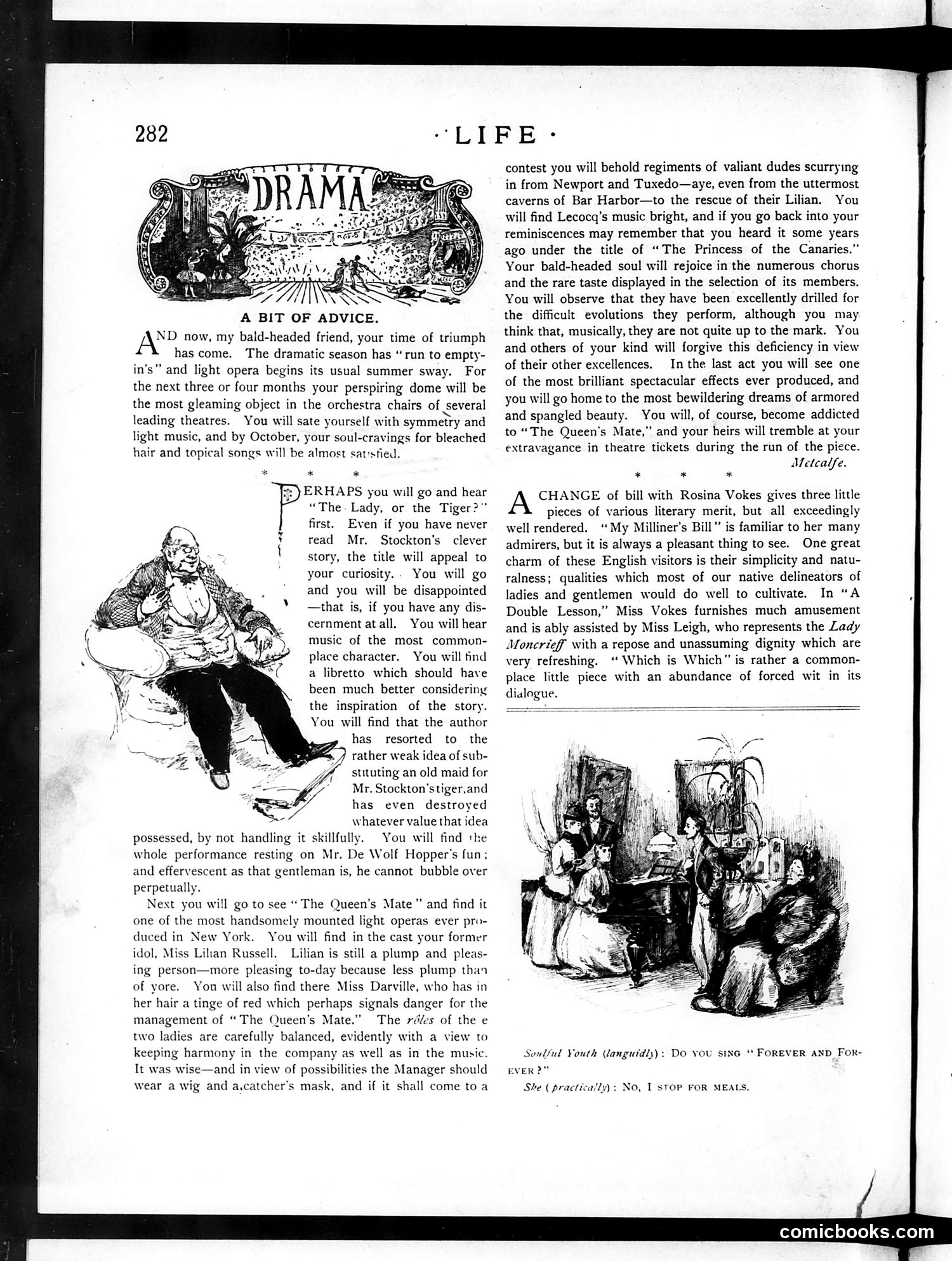
This page is primarily **theater criticism and review**, not political satire. The "Drama" section discusses upcoming theatrical productions for summer 1889. The illustrated figure (left) appears to be a **caricatured actor or theatrical character**—likely mocking a specific performer's style, though the person isn't identified in visible text. The reviews discuss several productions: "The Lady, or the Tiger?", "The Queen's Mate," and works featuring performers like Rosina Vokes, Miss Lilian Russell, and Miss Darville. The critic praises some performances while gently mocking theatrical conventions—particularly criticizing weak plot devices like substituting "an old maid for Mr. Stockton's tiger." The lower illustration shows what appears to be a **domestic scene**, possibly illustrating a plot point from one of the reviewed plays. This reflects **late Victorian theater criticism**, focusing on performance quality and dramatic merit rather than political commentary.
📄 Transcribed text from this page (OCR, searchable)
Machine-transcribed from the original scan — historical spelling and the odd misread are preserved.
“LIFE: A BIT OF ADVICE. AY? now, my bald-headed friend, your time of triumph has come. The dramatic season has “run to empty- in's” and light opera begins its usual summer sway. For the next three or four months your perspiring dome will be the most gleaming object in the orchestra chairs of several leading theatres. You will sate yourself with symmetry and light music, and by October, your soul-cravings for bleached hair and topical songs will be almost sat'stied. * * * ERHAPS you will go and hear “The. Lady, or the Tiger?” first. Even if you have never tead Mr. Stockton’s clever story, the title will appeal to your curiosity.- You will go and you will be disappointed —that is, if you have any dis- cernmentatall. You will hear music of the most common- place character. You will find a libretto which should have been much better considering the inspiration of the story. You will find that the author has resorted to the rather weak idea of sub- stituting an old maid for Mr. Stockton’stiger,and has even destroyed whatever value that idea possessed, by not handling it skillfully. You will find the whole performance resting on Mr. De Wolf Hopper’s fun; and effervescent as that gentleman is, he cannot bubble over perpetually. Next you will go to see “‘ The Queen's Mate” and find it one of the most handsomely mounted light operas ever pro- duced in New York. You will find in the cast your former idol, Miss Lian Russell. Lilian is still a plump and pleas- ing person—more pleasing to-day because less plump than of yore. Yon will also find there Miss Darville, who has in her hair a tinge of red which perhaps signals danger for the management of “The Queen’s Mate.” The réles of the two ladies are carefully balanced, evidently with a view to keeping harmony in the company as well as in the music. It was wise—and in view of possibilities the Manager should wear a wig and a,catcher’s mask, and if it shall come toa contest you will behold regiments of valiant dudes scurrying in from Newport and Tuxedo—aye, even from the uttermost caverns of Bar Harbor—to the rescue of their Lilian. You will find Lecocq’s music bright, and if you go back into your reminiscences may remember that you heard it some years ago under the title of “The Princess of the Canaries.” Your bald-headed soul will rejoice inthe numerous chorus and the rare taste displayed in the selection of its members. You will observe that they have been excellently drilled for the difficult evolutions they perform, although you may think that, musically, they are not quite up to the mark. You and others of your kind will forgive this deficiency in view of their other excellences. In the last act you will see one of the most brilliant spectacular effects ever produced, and you will go home to the most bewildering dreams of armored and spangled beauty. You will, of course, become addicted to “The Queen's Mate,” and your heirs will tremble at your extravagance in theatre tickets during the run of the piece. Metcalfe. * * * CHANGE of bill with Rosina Vokes gives three little pieces of various literary merit, but all exceedingly well rendered. “My Milliner's Bill” is familiar to her many admirers, but it is always a pleasant thing to see. One great charm of these English visitors is their simplicity and natu- ralness; qualities which most of our native delineators of ladies and gentlemen would do well to cultivate. In “A Double Lesson,” Miss Vokes furnishes much amusement and is ably assisted by Miss Leigh, who represents the Lady Moncrieff with a repose and unassuming dignity which are very refreshing. ‘‘ Which is Which” is rather a common- place little piece with an abundance of forced wit in its dialogue. Soulful Youth (languidly): Do you SING ‘ FOREVER AND FoR- EVER She ( practica'ly) : No, 1 STOP FOR MEALS. comicbooks.com