
A complete issue · 16 pages · 1888
Life — May 10, 1888
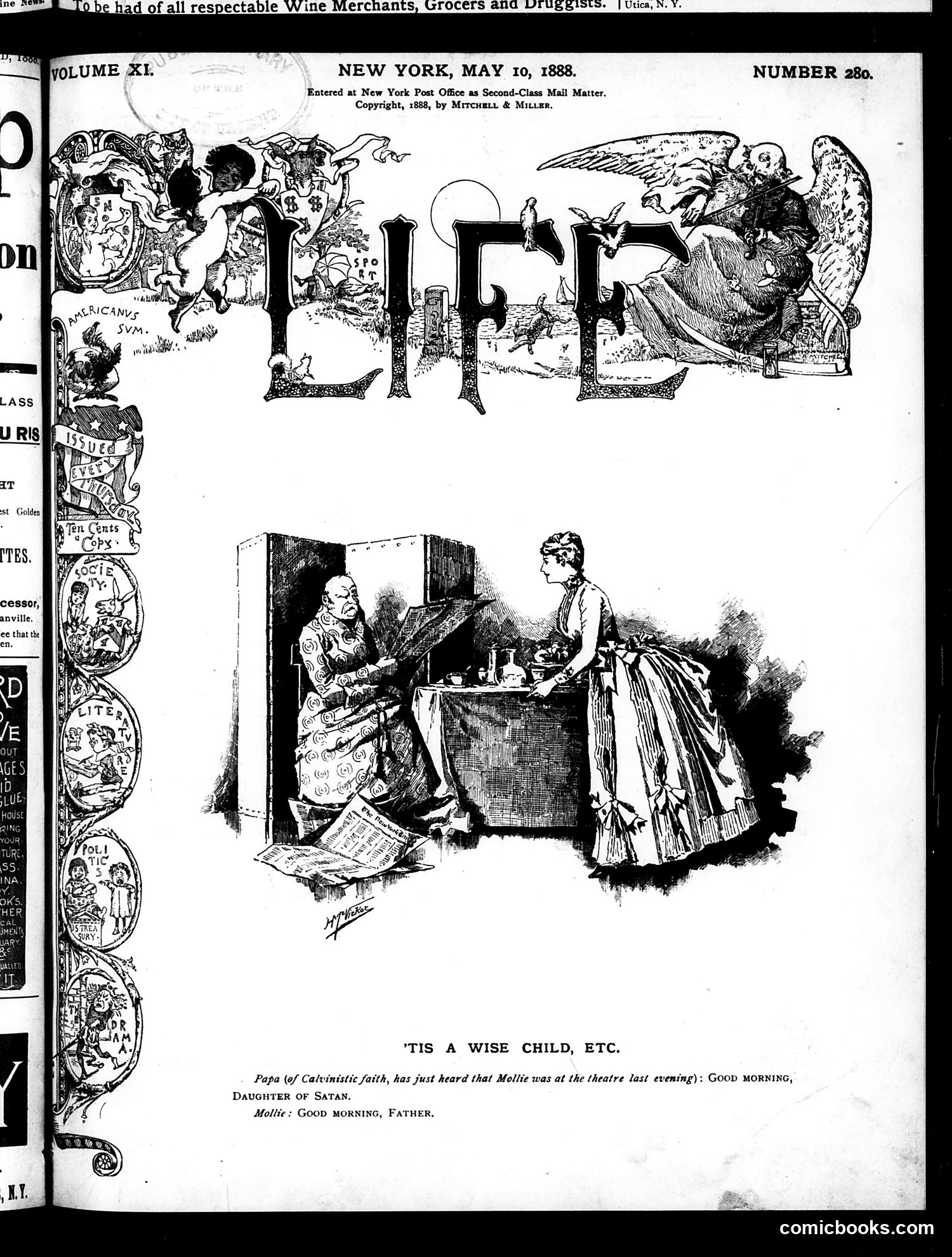
This satirical cartoon depicts a conversation between a father and daughter. The caption indicates the father has just learned his daughter attended the theater the previous evening and greeted him cheerfully with "Good morning, Daughter of Satan"—to which she responds innocently, "Good morning, Father." The joke relies on a religious/moral critique: the father, apparently of strict Calvinist faith, considers theater attendance sinful enough to warrant calling his daughter "Daughter of Satan." The daughter's innocent reciprocal greeting ("Father") becomes darkly comedic—suggesting the father himself deserves such a demonic title for his harsh judgment. This satirizes rigid Victorian religious moralism and parental hypocrisy, portraying the father as unreasonably austere.
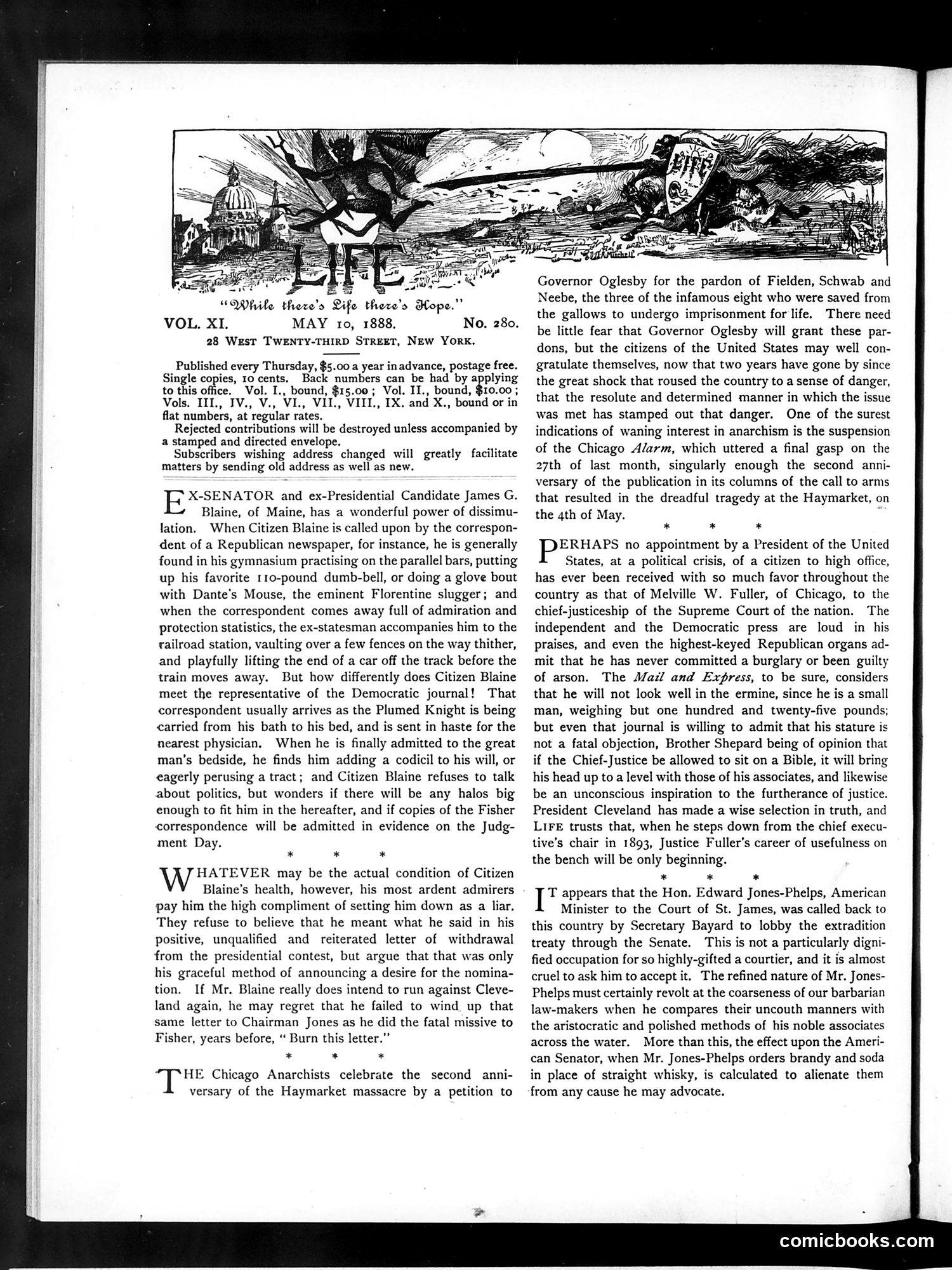
The masthead illustration depicts a surreal landscape with classical and medieval elements—a domed building, gnarled trees, and scattered figures—establishing the magazine's satirical tone. The main text discusses **James G. Blaine**, the ex-Senator and ex-Presidential candidate from Maine. The satire mocks the contrast between Blaine's public persona as a Republican newspaper editor and his actual behavior: he allegedly practices gymnastics, frequents trains, and conducts himself in undignified ways unbecoming a statesman. The piece suggests his admirers strain to defend him despite his obvious shortcomings, implying he lacks the character expected of presidential material. The satire questions whether he genuinely withdrew from politics or merely announced it dishonorably.
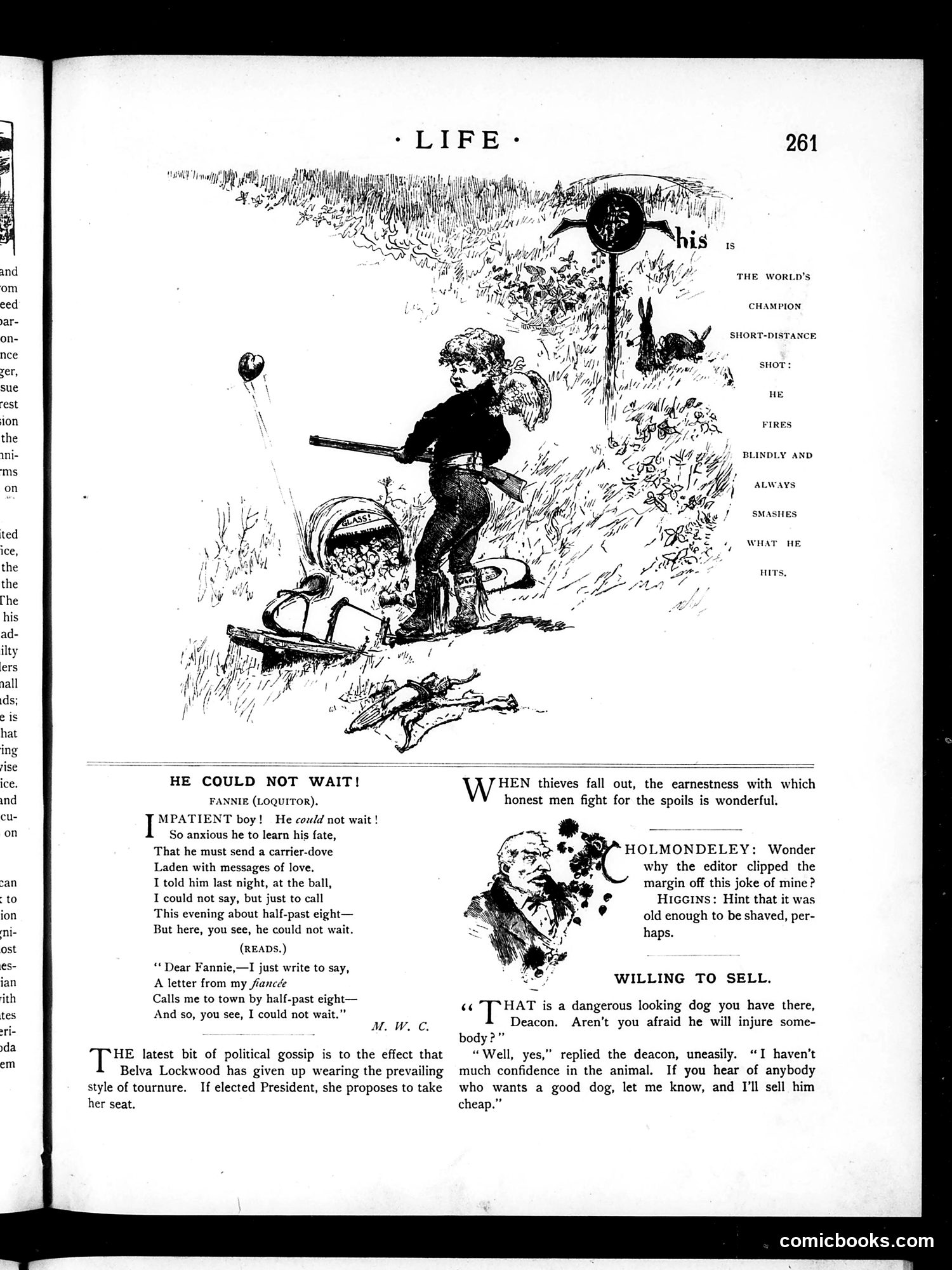
The main illustration depicts a figure shooting a rifle with exaggerated accuracy, captioned "his is THE WORLD'S CHAMPION SHORT-DISTANCE SHOT." The text praises this marksman's ability to "FIRE BLINDLY AND ALWAYS SMASHES WHAT HE HITS"—an ironic contradiction suggesting reckless success rather than genuine skill. Below, "He Could Not Wait!" by Fannie Gould presents a love-struck messenger eager to deliver romantic correspondence. The poem mocks impatient courtship. The small dialogue piece "Willing to Sell" features a deacon and another figure discussing a "dangerous looking dog," with the deacon offering to sell it cheaply—likely satirizing religious hypocrisy or opportunistic dealing. A brief political note mentions Belva Lockwood potentially running for President, referencing her unconventional stance on women's fashion and governance, typical of Life's political commentary on emerging women's rights issues.
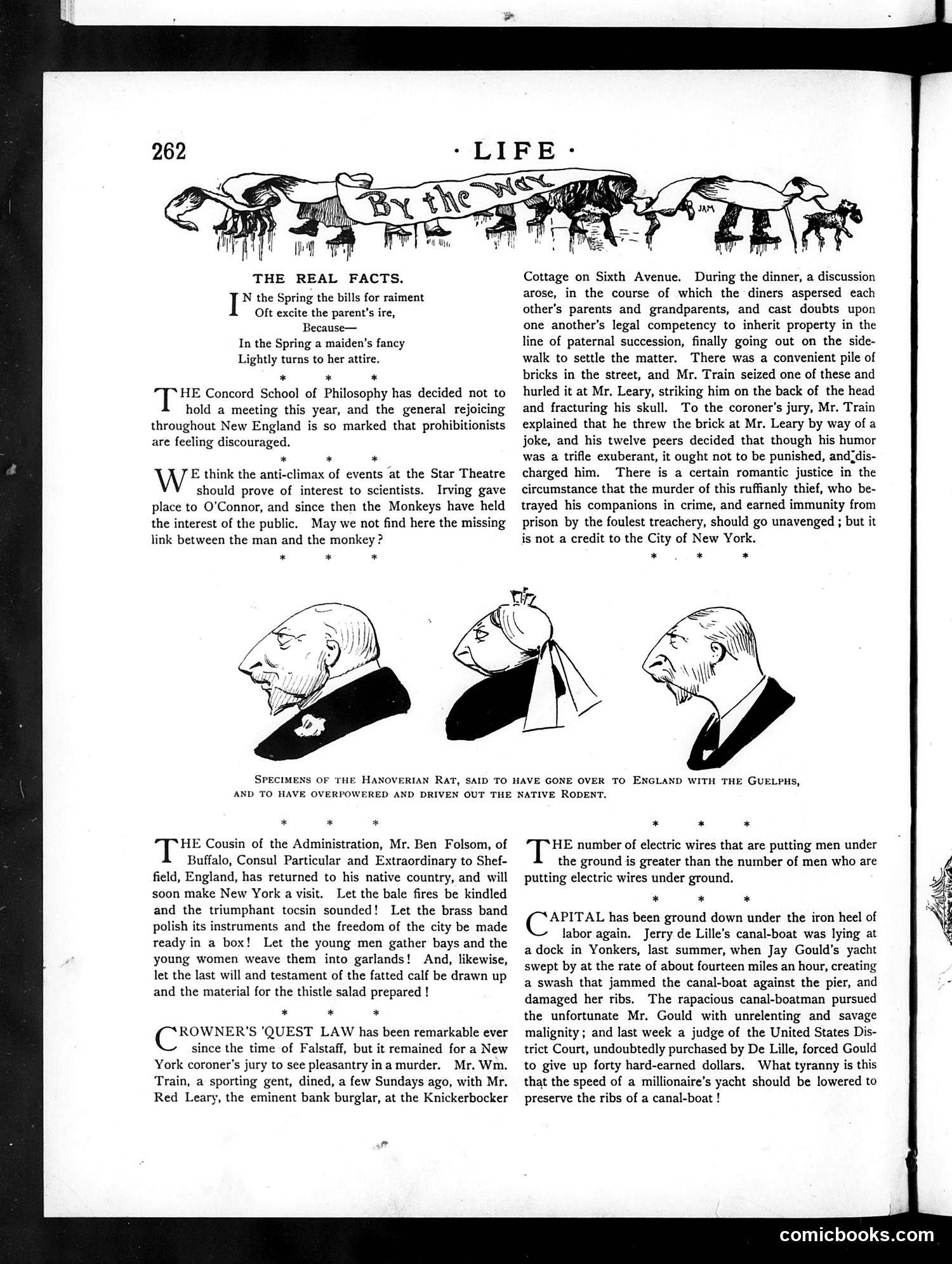
This page contains several brief satirical items mocking contemporary absurdities: 1. **"The Real Facts"** section ridicules spring sentimentality and the Concord School of Philosophy's decision against holding a meeting (apparently seen as prudish). 2. **The main cartoon** depicts three profile sketches labeled "Specimens of the Hanoverian Rat," sarcastically claiming these rats traveled to England with Guelph traders and displaced native rodents. This appears to be political satire using animal metaphor—likely attacking German influence or immigrant groups, though the specific reference is unclear without additional historical context. 3. **Bottom items** discuss a Buffalo consul's return, coroner's court proceedings involving a murder case, and a dispute over a damaged canal-boat—all presented as examples of urban absurdity and questionable justice in contemporary New York. The overall tone mocks social pretension, legal incompetence, and civic dysfunction.
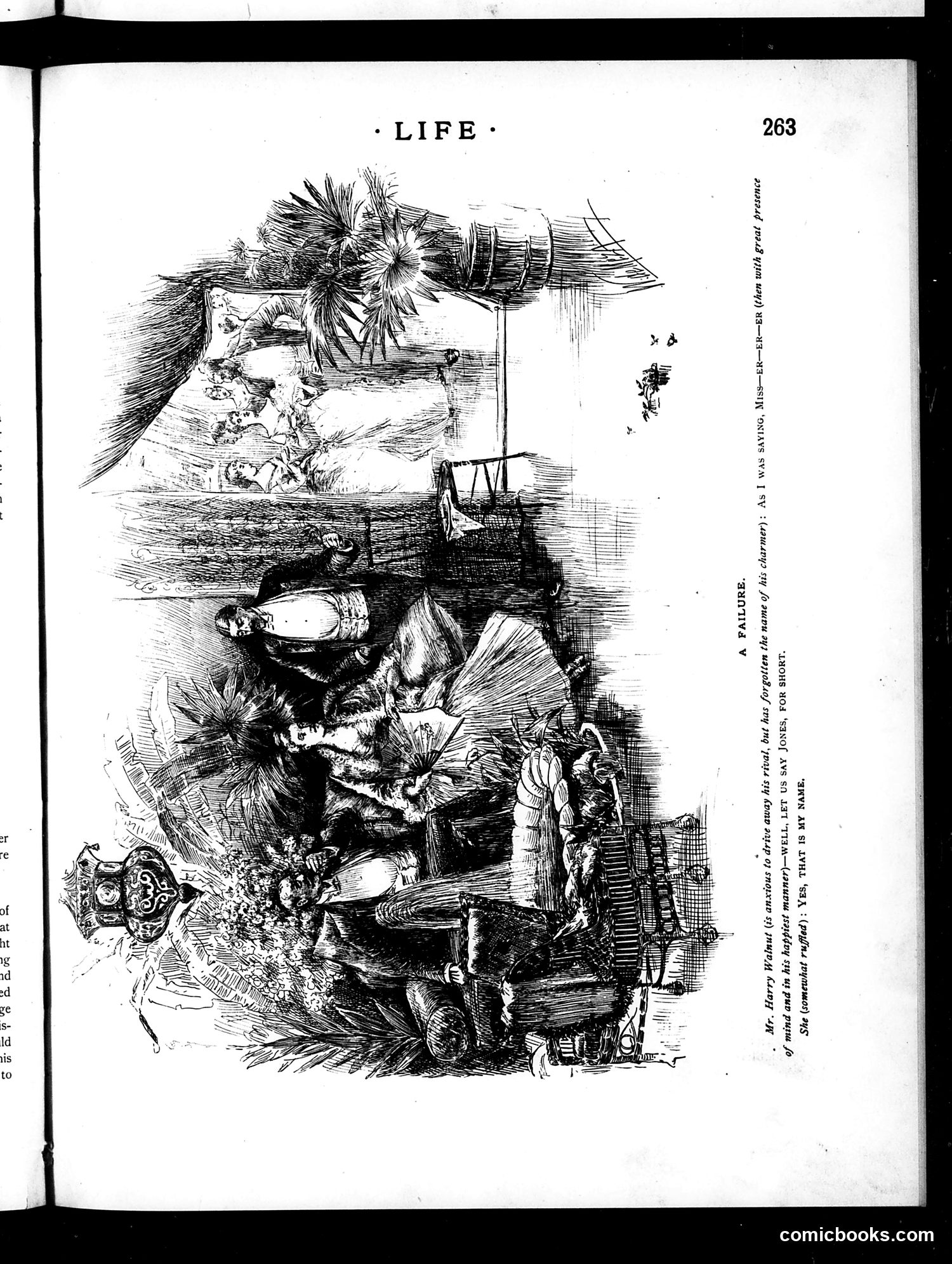
This satirical illustration depicts a scene of domestic or social failure. The central figure appears to be a well-dressed man in formal attire, positioned amid various symbolic elements suggesting misfortune or discord—flowers (possibly wilting), architectural elements, and what appears to be theatrical or domestic chaos. The caption "A Failure" indicates social commentary on unsuccessful aspirations, likely referencing a specific public figure or type of person known to Life's readers. The ornate, chaotic composition with flowers and domestic furnishings suggests satire of either failed romantic endeavors, unsuccessful social climbing, or broken promises. Without additional context about the specific publication date, the exact identity of the subject remains unclear, though the style and presentation suggest late 19th or early 20th-century American satirical commentary on class, ambition, or personal scandal.
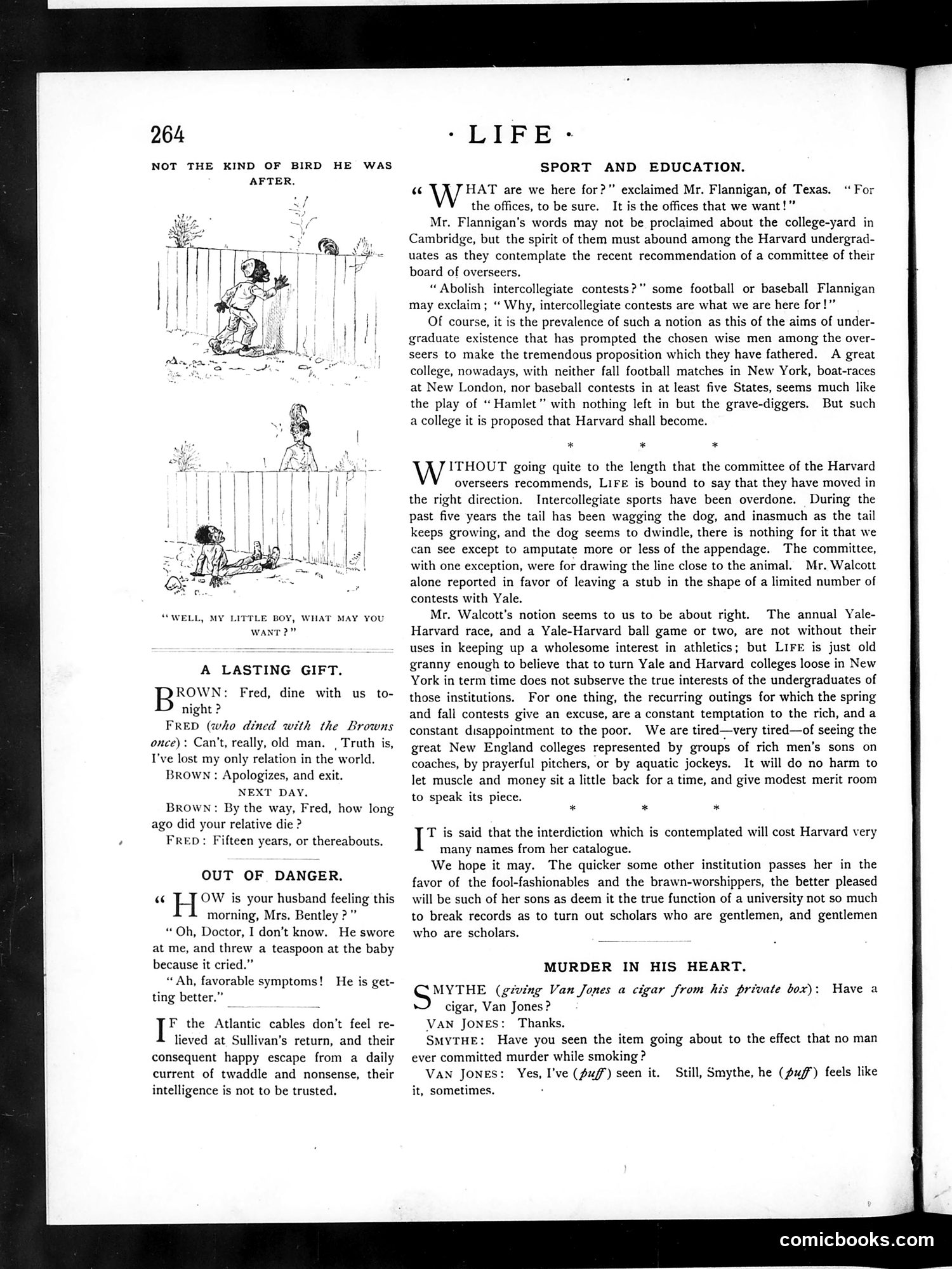
This page contains three separate satirical pieces: **"A Lasting Gift"** (top left): A comic dialogue between Brown and Fred about dining and death—likely a joke about morbid inheritance or grim hospitality. **"Out of Danger"** (middle left): A doctor reassures Mrs. Bentley that her husband's favorable reaction to a baby's crying indicates recovery, using ironic humor about parental stress. **"Sport and Education"** (main article): Life critiques Harvard's committee recommendation to abolish intercollegiate athletics. The satire argues that while sports can be excessive, eliminating them entirely would damage undergraduate life. The piece defends limited competition (like Yale-Harvard contests) as beneficial to students. **"Murder in His Heart"** (bottom): A dialogue about whether smoking cigars prevents criminal behavior—likely absurdist humor about correlation versus causation. The drawings illustrate domestic/child-rearing scenes with period detail.
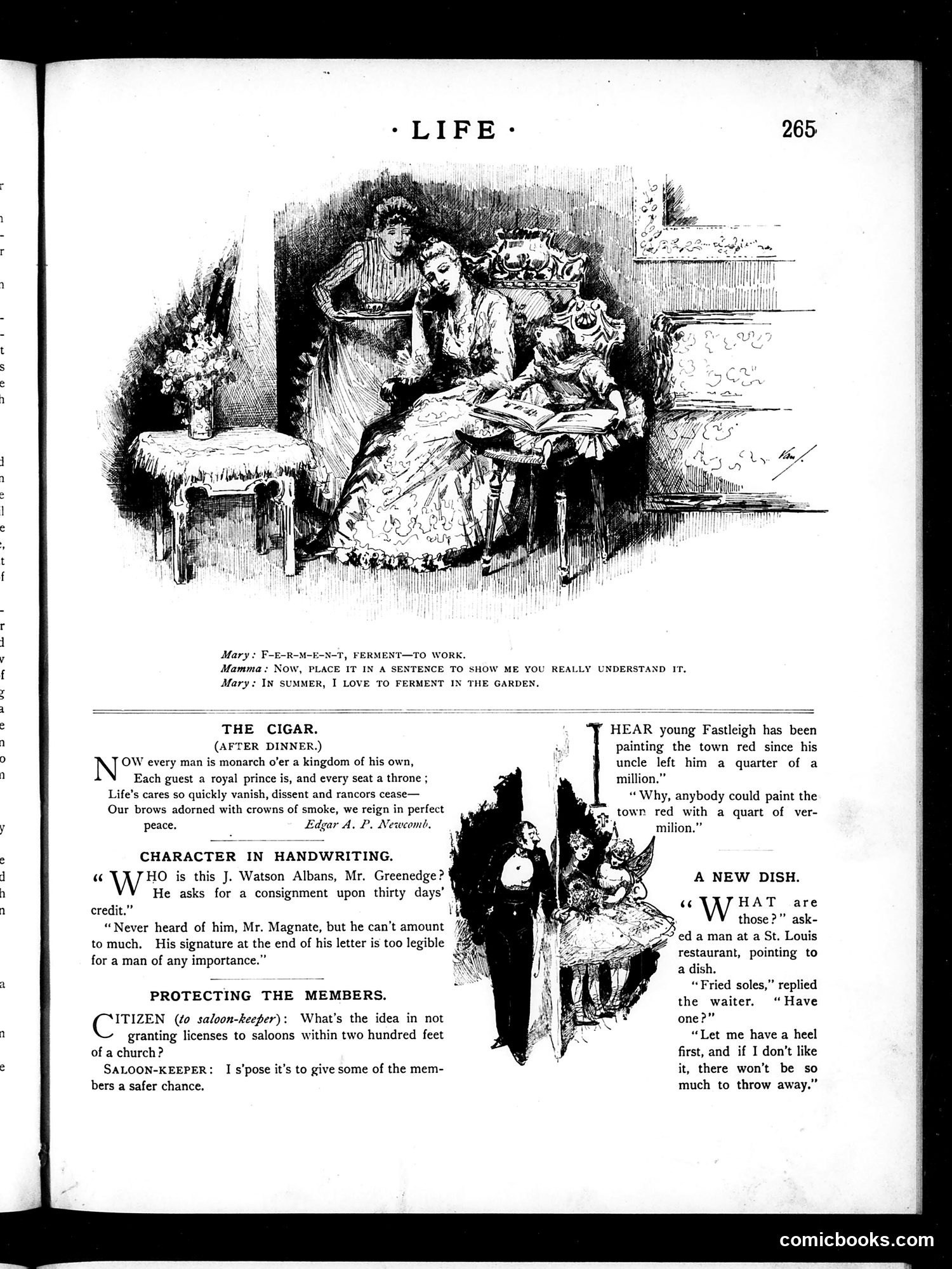
This page contains several satirical pieces typical of Life's humor magazine format: **"The Cigar"** - A humorous poem about men enjoying cigars after dinner, playing on the Victorian-era idea of smoking as a mark of leisure and masculine authority ("monarchy o'er a kingdom"). **"Character in Handwriting"** - A brief joke about someone named J. Watson Albans requesting credit, with the punchline that his signature is too illegible to be taken seriously. **"Protecting the Members"** - A dialogue satirizing church licensing debates, where a saloon-keeper argues against restricting alcohol sales near churches. **"A New Dish"** and **"The Cigar" illustration** - Humorous anecdotes about dining and art. The top illustration depicts women reading or discussing literature in a domestic interior, with dialogue about fermentation and gardening. These pieces represent typical turn-of-the-century American satirical humor targeting social customs, manners, and Victorian propriety.
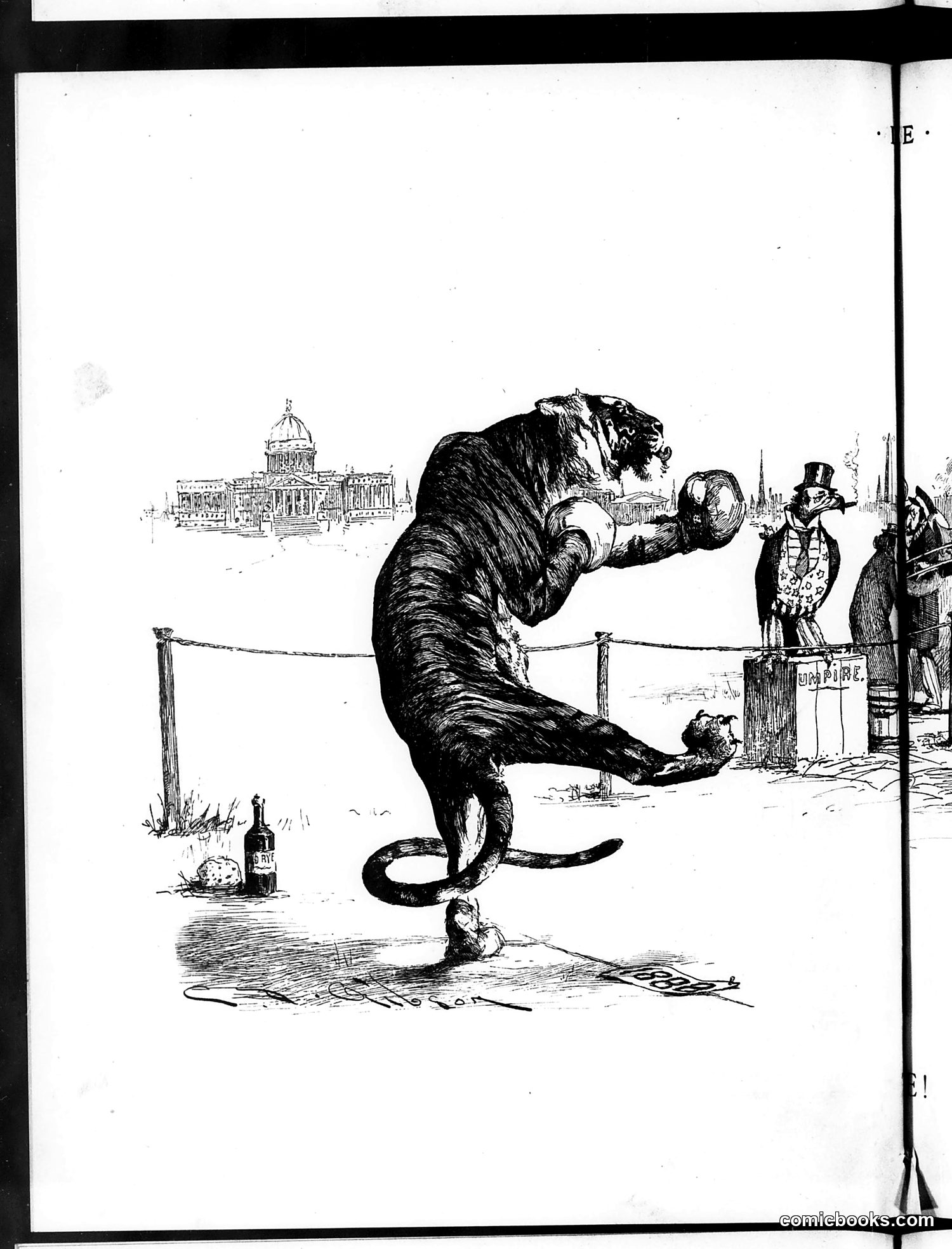
This is a satirical illustration depicting a bear performing an acrobatic trick, balancing a globe while standing on its tail. The bear appears to be a caricature of Russia (a common symbol in 19th-century political cartoons). In the background, the U.S. Capitol building is visible, and well-dressed observers watch from behind a fence. The satire likely comments on Russian political instability or international diplomatic precariousness during a period of tension between Russia and the United States. The bear's precarious balancing act—particularly holding the world—suggests criticism of Russia's unstable governance or aggressive foreign policy ambitions. The Capitol's presence indicates American concern about these actions. The formal observers suggest diplomatic scrutiny of Russian affairs.
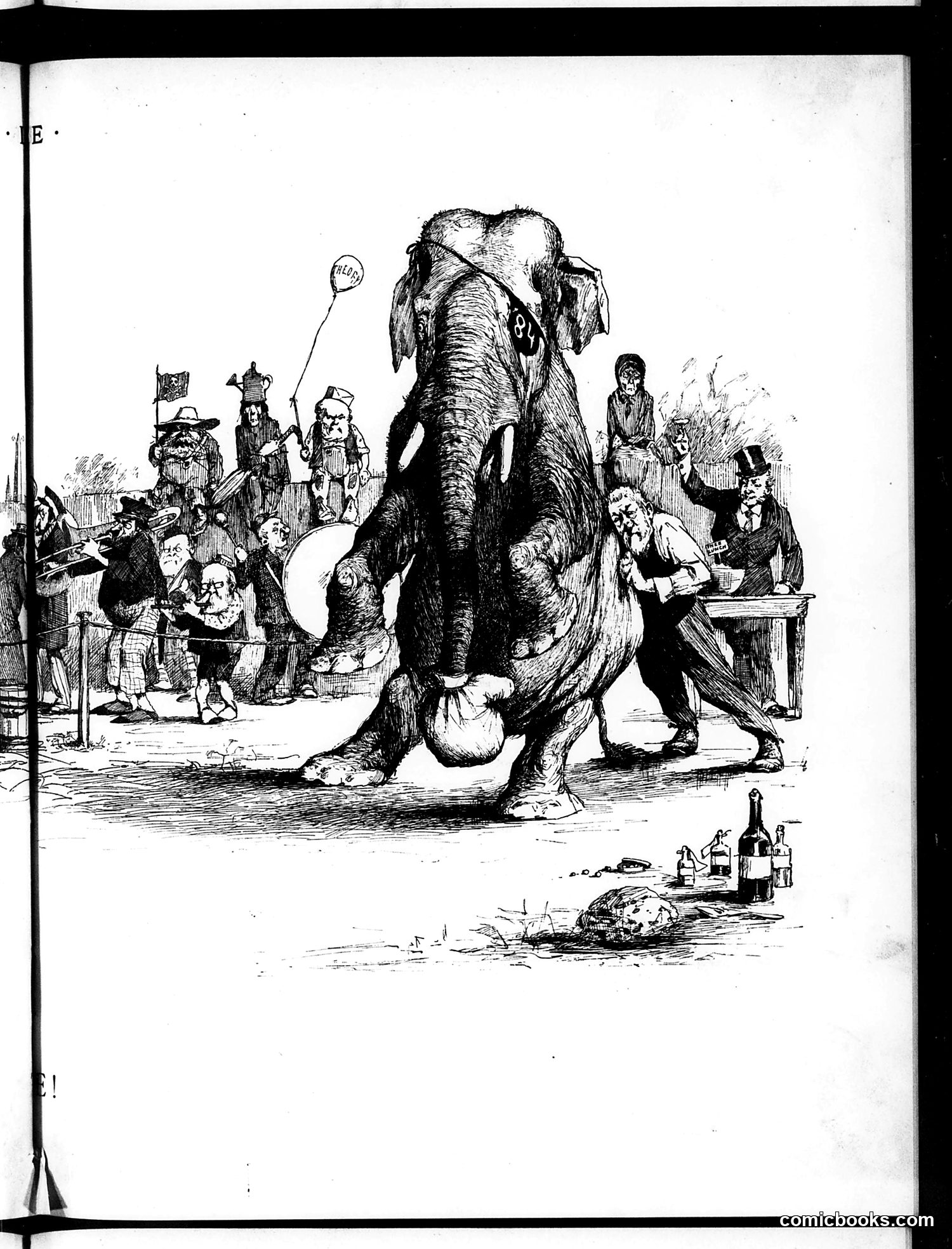
This satirical engraving depicts an elephant performing circus tricks before a crowd of well-dressed onlookers. The elephant appears to be the central metaphor, likely representing the Republican Party (which used the elephant as its symbol). The crowd of formally-dressed men surrounding the elephant—some holding poles with balloons, others at tables—suggests political operatives, party officials, or newspaper editors managing or controlling the elephant's performance. The satire appears to critique how Republican leadership manipulates party policy or public perception for effect, treating serious political matters as entertainment or spectacle. The circus setting reinforces the idea of performative politics—that the party conducts politics as mere show rather than substance. Without specific text visible identifying particular figures or dates, the exact political moment remains unclear.
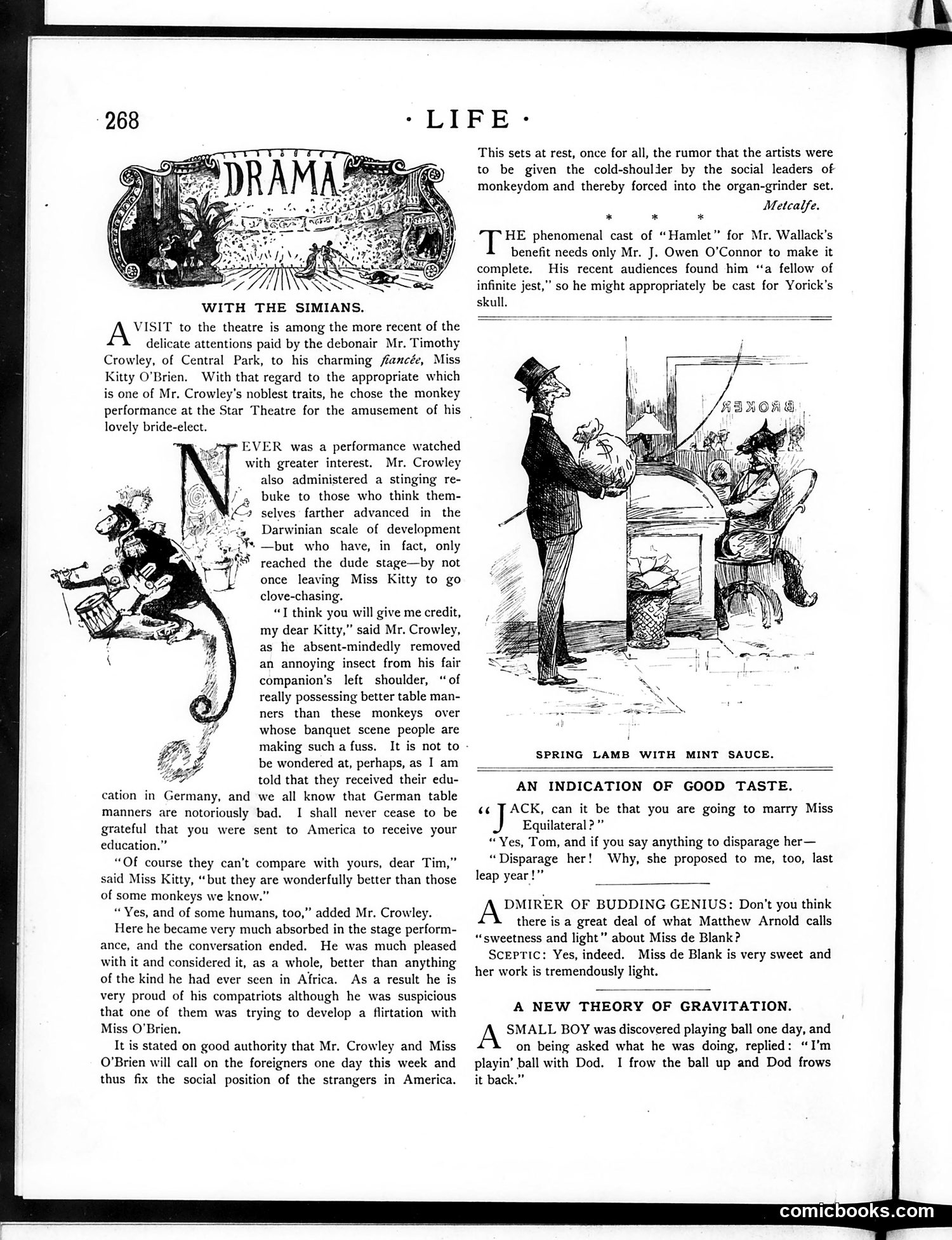
This page contains theatrical gossip and humor rather than political cartoons. The main article discusses Mr. Timothy Crowley's visit to the theater with Miss Kitty O'Brien, a "monkey performance" at the Star Theatre. The text satirizes the monkeys' allegedly superior table manners compared to some humans, referencing German dining etiquette as a contrast. The illustration labeled "Spring Lamb with Mint Sauce" depicts a comedic scene of formal dining mishap. Below are several brief satirical items: one mocking an engagement announcement, another about Matthew Arnold's literary criticism, and a final quip about a child's physics experiment with gravity. The page represents typical early 20th-century American satirical humor targeting social pretension and theatrical life rather than political figures.
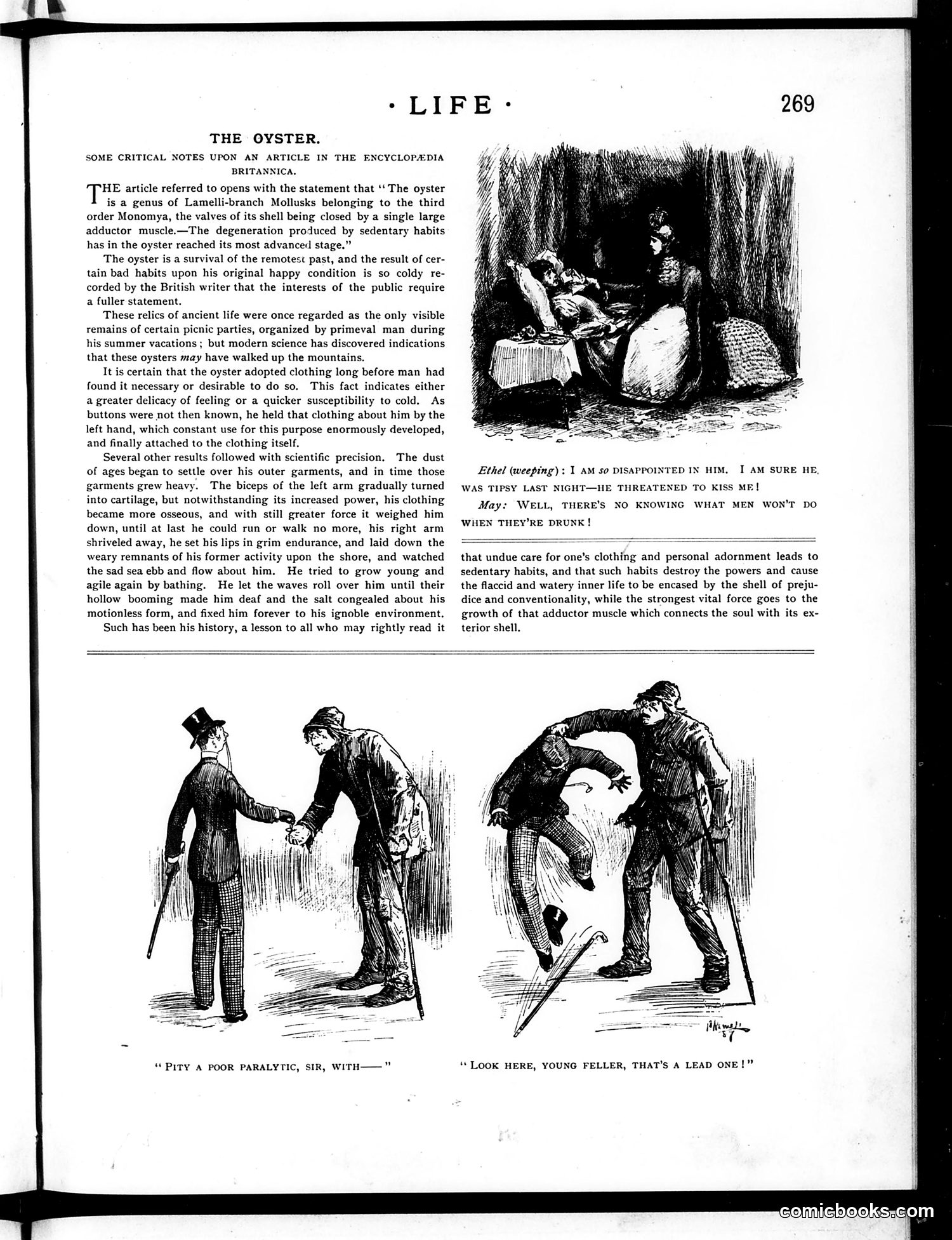
This page contains a satirical essay about oysters alongside unrelated cartoon vignettes. **"The Oyster" essay**: A mock-serious natural history that uses the oyster as metaphor for human moral decay. It humorously traces how an oyster's adoption of clothing led to sedentary habits, physical degeneration, and eventual paralysis—a cautionary tale about vanity and inactivity. The piece parodies encyclopedic writing while delivering social commentary on how excessive concern with appearance and convention destroys vitality. **Top cartoon**: Shows a woman (Ethel) upset that a drunk man threatened to kiss her; her friend (May) responds that drunken men are unpredictable—a joke about masculine behavior and alcohol. **Bottom cartoons**: Two street scenes. Left: A beggar claims poverty ("pity a poor paralytic"). Right: A skeptic exposes him as a fraud, calling his wooden leg/crutch a "lead one"—meaning he's faking disability for sympathy. The humor derives from exposing dishonest panhandling.
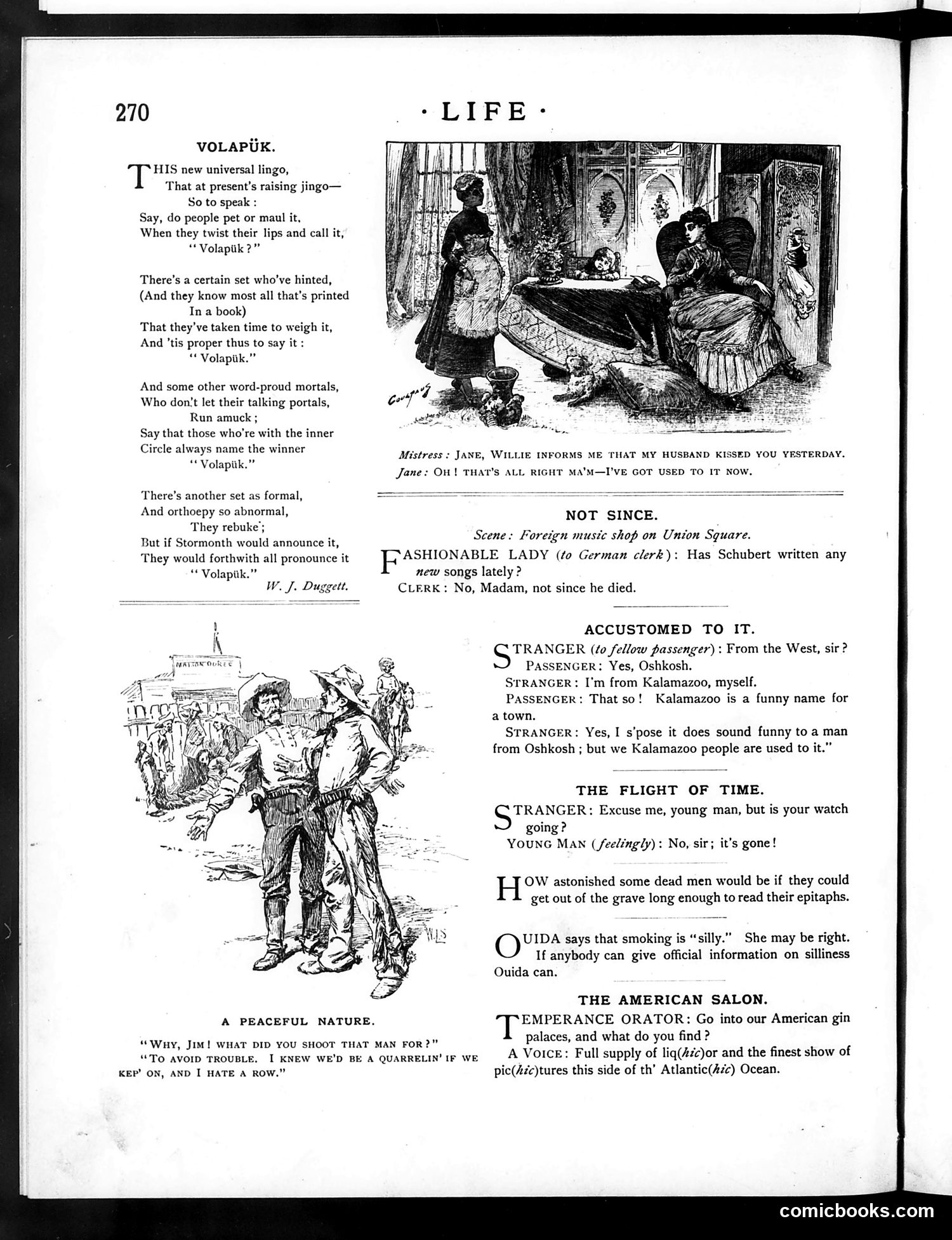
This satirical page mocks several contemporary trends and figures: **"Volapük"** (top): Satirizes an invented universal language gaining popularity. The poem ridicules pretentious intellectuals and social climbers who adopt it to seem cultured—suggesting they're mere poseurs following fashionable jargon. **"Mistress Jane"** illustration: A domestic humor joke about a wife's casual acceptance of her husband's infidelity, implying marital indiscretion was normalized among certain circles. **"Not Since"**: Mocks a fashionable lady's ignorance—she asks a German clerk about Schubert's new compositions, unaware the composer died decades ago. This targets wealthy dilettantes' pretended cultural sophistication. **Small jokes below**: Gentle humor about Midwestern town names ("Kalamazoo," "Oshkosh"), lost watches, and epitaphs. **"The American Salon"**: Attacks temperance reformers' hypocrisy—the temperance orator ironically describes American saloons' "supply of liquor," exposing the gap between prohibition rhetoric and reality. The page overall ridicules social pretension, faddishness, and hypocrisy among the educated classes.
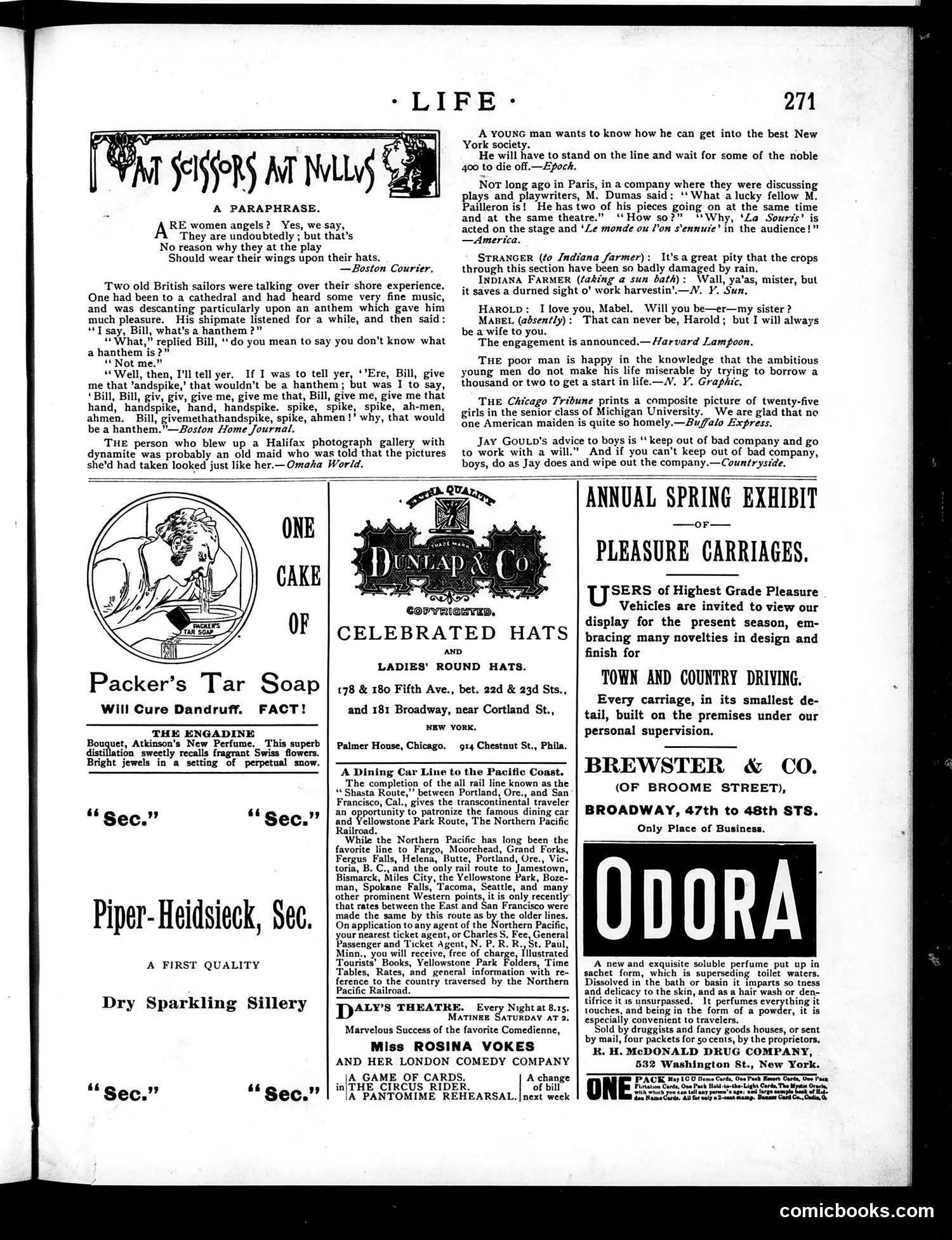
This page is primarily **advertising and humorous short items**, not political cartoons. The "SCISSORS AT NULLY" cartoon section contains brief satirical jokes rather than visual political commentary. These include: - **Women at theaters wearing large hats**: A joke mocking the fashion of the era where women wore elaborate bonnets with decorative elements (ironically comparing them to angel wings), which blocked other theatergoers' views—a genuine social complaint of the time. - **British sailors discussing anthems**: A dialect humor piece playing on working-class British accents and unfamiliarity with church music. - **Social climbing in New York**: A joke about the exclusive "400" (the wealthiest New York families), suggesting one must literally wait for society members to die to gain entry. - **Paris theater criticism**: A quip about a playwright's work being so dull the real entertainment is watching the bored audience. The rest of the page consists of **period advertisements** (tar soap, champagne, hats, perfume) and promotional notices for trains and carriages. This reflects Life magazine's mixed format of satirical commentary alongside commercial content.
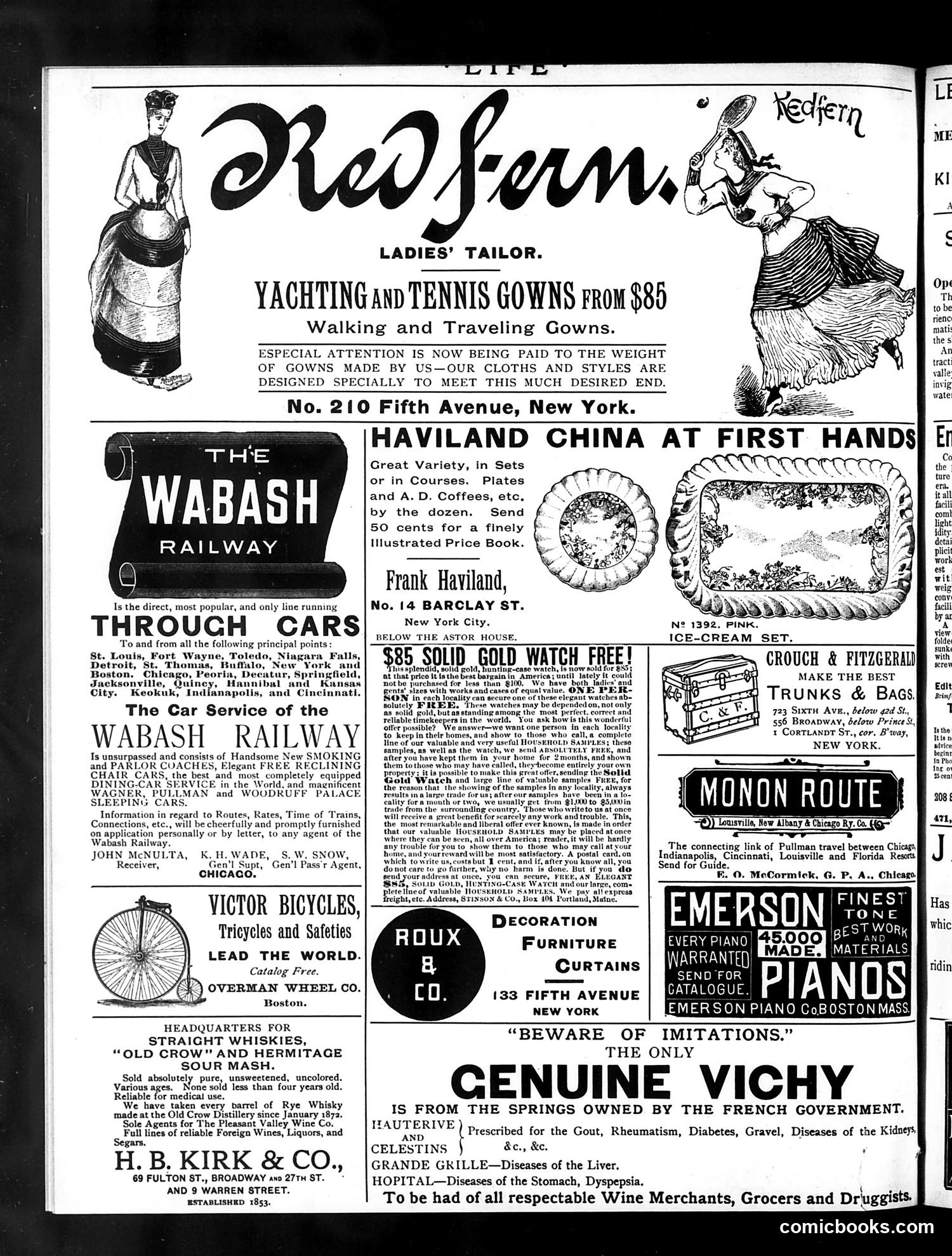
This page is **primarily advertising**, not editorial or satirical content. It contains vintage advertisements from what appears to be an early 20th-century issue of *Life* magazine. The ads include: - **Red Fern**: Ladies' tailor offering yachting and tennis gowns - **Wabash Railway**: Railroad service through the Midwest - **Victor Bicycles**: Overman Wheel Company promoting bicycles as leading the world - **Emerson Pianos**: Advertising 45,000 pianos made - **Genuine Vichy**: French mineral water for medical conditions - **Various other period products**: Whiskey, furniture, china, luggage There are **no political cartoons or satirical content** visible. The page functions as a commercial showcase typical of *Life*'s revenue model—mixing advertisements with editorial content to reach affluent readers interested in luxury goods, travel, and consumer products.
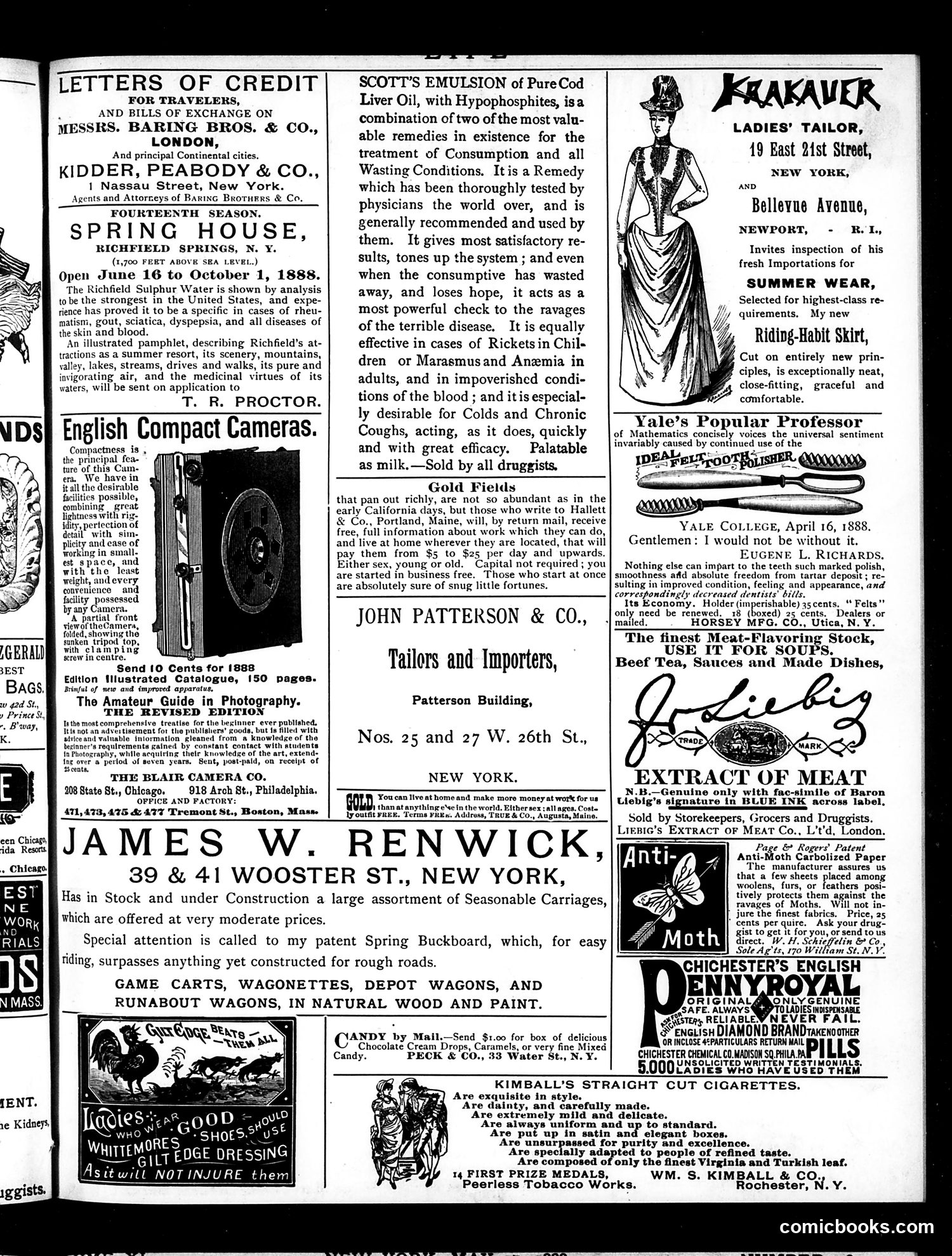
This page is primarily **advertising**, not satire or political commentary. It contains Victorian-era product advertisements from April 1888, including: - **Scott's Emulsion** (cod liver oil treatment for consumption/wasting diseases) - **Krakauer** (ladies' tailor) - **English Compact Cameras** - **James W. Renwick** (carriages with spring buckboards) - **Liebig's Extract of Meat** (food product) - **Anti-Moth paper** (pest prevention) - **Chichester's English Pennyroyal** (appears to be a contraceptive/abortifacient) - **Kimball's Straight Cut Cigarettes** There are small decorative illustrations and product logos, but **no political cartoons or satire**. The page reflects late 19th-century consumer culture and contemporary health/beauty concerns, with some products (like Pennyroyal) now recognized as medically dangerous.
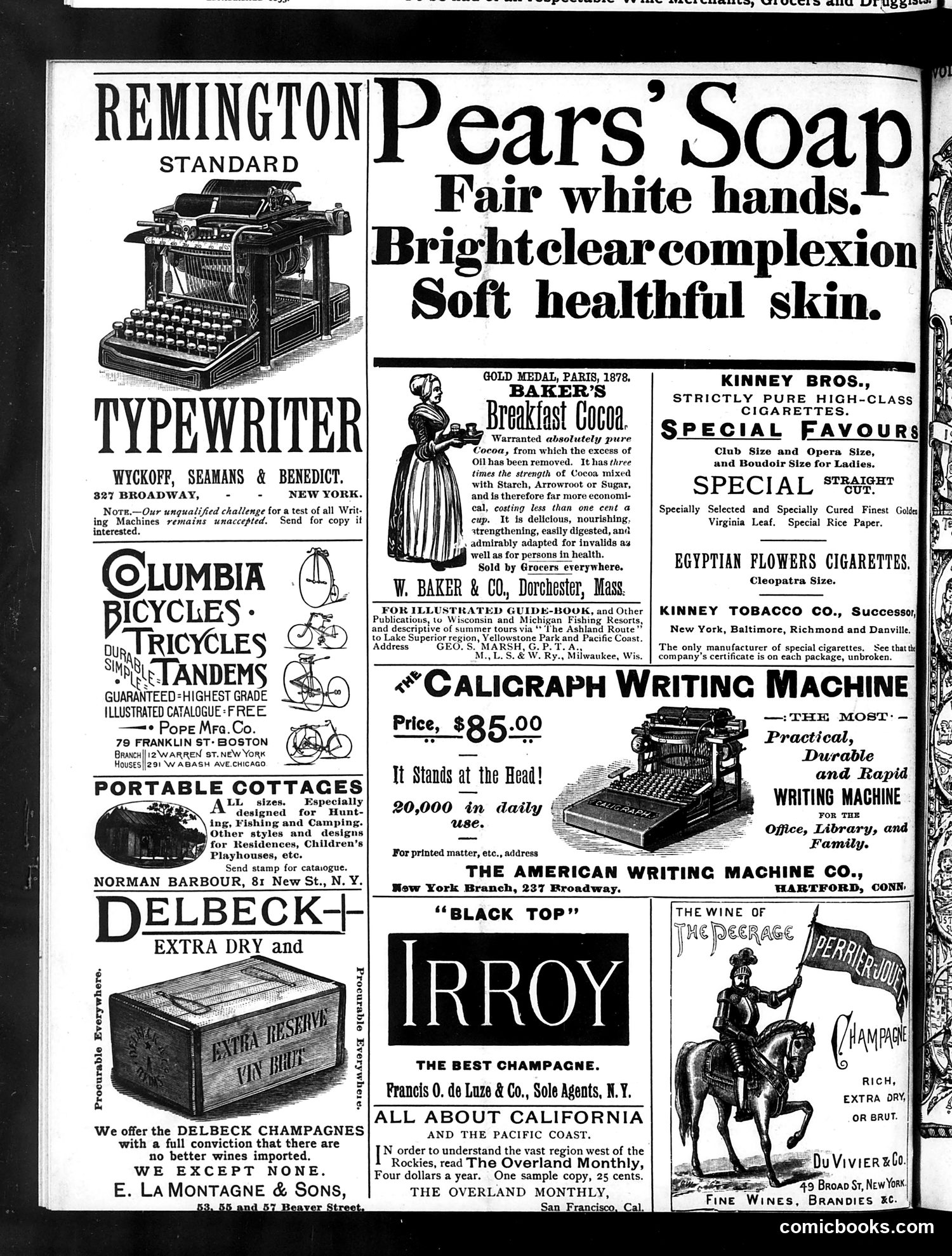
This page is **primarily advertisements** from an American magazine (Life), circa late 1880s. There are no political cartoons or satirical content to analyze. The ads reflect period consumer culture: typewriters (Remington), bicycles, portable cottages, champagnes, and toiletries like Pears Soap. Of historical note, **Pears Soap's advertisement uses language promoting "fair white hands" and "bright clear complexion"**—phrasing that reflects 19th-century beauty standards and racial attitudes of the era, though the ad itself doesn't contain explicit racist imagery on this page. Other notable ads include Baker's Breakfast Cocoa (claiming health benefits), Kinney cigarettes, and writing machines—all marketed as modern conveniences to affluent readers. **This is essentially a catalog page showing what affluent Americans purchased in the 1880s, not satirical content.**