
Life, 1888-05-10 · page 6 of 16
Life — May 10, 1888 — page 6: what you’re looking at
What you’re looking at
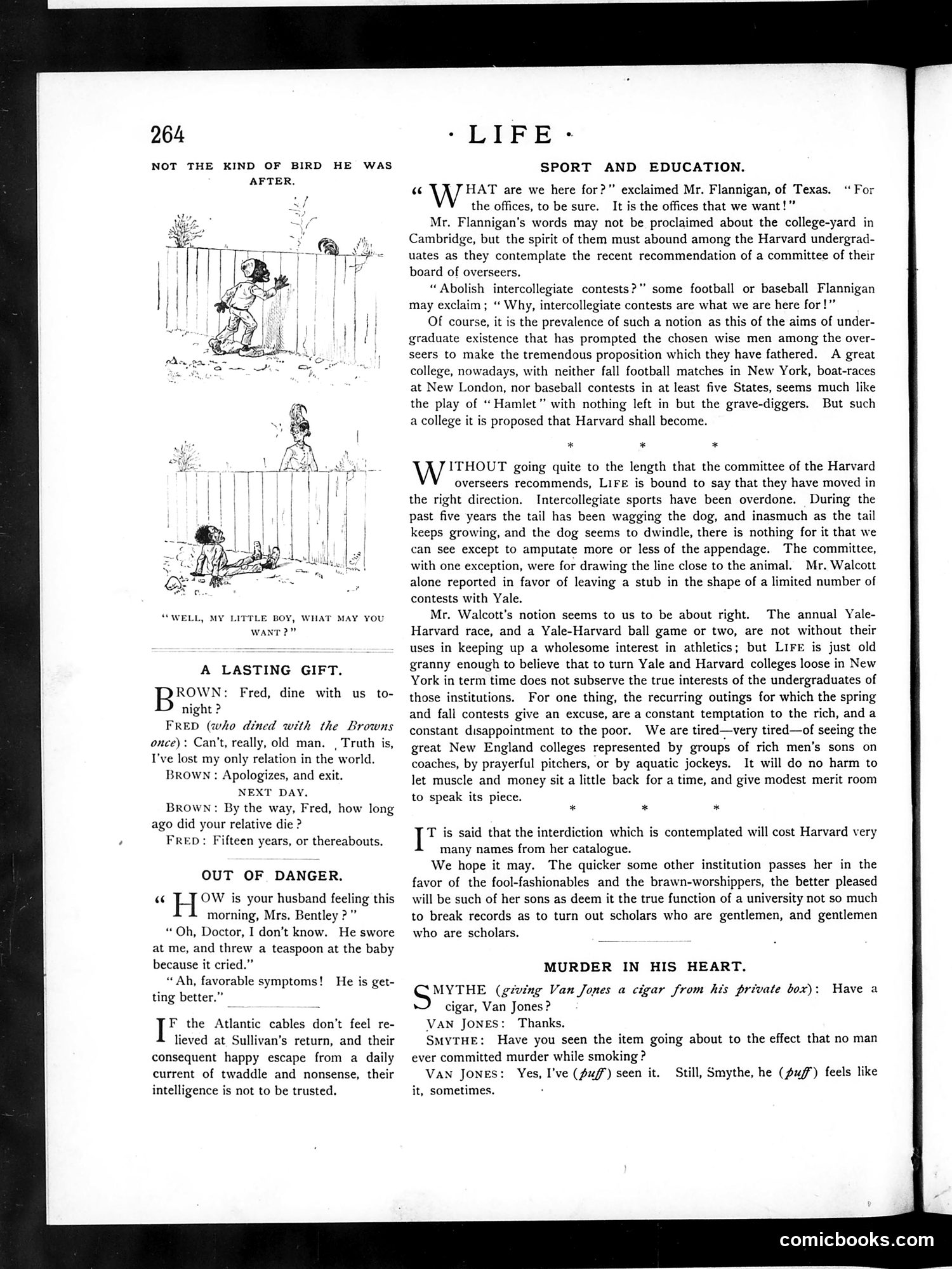
This page contains three separate satirical pieces: **"A Lasting Gift"** (top left): A comic dialogue between Brown and Fred about dining and death—likely a joke about morbid inheritance or grim hospitality. **"Out of Danger"** (middle left): A doctor reassures Mrs. Bentley that her husband's favorable reaction to a baby's crying indicates recovery, using ironic humor about parental stress. **"Sport and Education"** (main article): Life critiques Harvard's committee recommendation to abolish intercollegiate athletics. The satire argues that while sports can be excessive, eliminating them entirely would damage undergraduate life. The piece defends limited competition (like Yale-Harvard contests) as beneficial to students. **"Murder in His Heart"** (bottom): A dialogue about whether smoking cigars prevents criminal behavior—likely absurdist humor about correlation versus causation. The drawings illustrate domestic/child-rearing scenes with period detail.
📄 Transcribed text from this page (OCR, searchable)
Machine-transcribed from the original scan — historical spelling and the odd misread are preserved.
264 NOT THE KIND OF BIRD HE WAS “WELL, MY LITTLE Boy, WHAT MAY you WANT?” A LASTING GIFT. ROWN: night ? FRED (who dined with the Browns once): Can't, really, old man. , Truth is, I've lost my only relation in the world. BROWN : Apologizes, and exit. NEXT DAY. BRowN: By the way, Fred, how long ago did your relative die ? FRED: Fifteen years, or thereabouts. Fred, dine with us to- OUT OF DANGER. “ OW is your husband feeling this morning, Mrs. Bentley ?” “Oh, Doctor, I don’t know. He swore at me, and threw a teaspoon at the baby because it cried.” “ Ah, favorable symptoms! ting better.” He is get- F the Atlantic cables don’t feel re- lieved at Sullivan's return, and their consequent happy escape from a daily current of twaddle and nonsense, their intelligence is not to be trusted. > LIFE: SPORT AND EDUCATION. HAT are we here for?” exclaimed Mr. Flannigan, of Texas. “For the offices, to be sure. It is the offices that we want!” Mr. Flannigan’s words may not be proclaimed about the college-yard in Cambridge, but the spirit of them must abound among the Harvard undergrad- uates as they contemplate the recent recommendation of a committee of their board of overseers. “Abolish intercollegiate contests?” some football or baseball Flannigan may exclaim ; “‘ Why, intercollegiate contests are what we are here for!” Of course, it is the prevalence of such a notion as this of the aims of under- graduate existence that has prompted the chosen wise men among the over- seers to make the tremendous proposition which they have fathered. A great college, nowadays, with neither fall football matches in New York, boat-races at New London, nor baseball contests in at least five States, seems much like the play of “Hamlet” with nothing left in but the grave-diggers. But such a college it is proposed that Harvard shall become. * * * ITHOUT going quite to the length that the committee of the Harvard overseers recommends, LiFe is bound to say that they have moved in the right direction. Intercollegiate sports have been overdone. During the past five years the tail has been wagging the dog, and inasmuch as the tail keeps growing, and the dog seems to dwindle, there is nothing for it that we can see except to amputate more or less of the appendage. The committee, with one exception, were for drawing the line close to the animal. Mr. Walcott alone reported in favor of leaving a stub in the shape of a limited number of contests with Yale. Mr. Walcott’s notion seems to us to be about right. The annual Yale- Harvard race, and a Yale-Harvard ball game or two, are not without their uses in keeping up a wholesome interest in athletics; but LIFE is just old granny enough to believe that to turn Yale and Harvard colleges loose in New York in term time does not subserve the true interests of the undergraduates of those institutions. For one thing, the recurring outings for which the spring and fall contests give an excuse, are a constant temptation to the rich, and a constant disappointment to the poor. We are tired—very tired—of seeing the great New England colleges represented by groups of rich men’s sons on coaches, by prayerful pitchers, or by aquatic jockeys. It will do no harm to let muscle and money sit a little back for a time, and give modest merit room to speak its piece. * * * T is said that the interdiction which is contemplated will cost Harvard very many names from her catalogue. We hope it may. The quicker some other institution passes her in the favor of the fool-fashionables and the brawn-worshippers, the better pleased will be such of her sons as deem it the true function of a university not so much to break records as to turn out scholars who are gentlemen, and gentlemen who are scholars. MURDER IN HIS HEART. MYTHE (géving Van Jones a cigar from his private box): cigar, Van Jones? Van JONES: Thanks. SMYTHE: Have you seen the item going about to the effect that no man ever committed murder while smoking ? VAN Jones: Yes, I've (fuf’) seen it. Still, Smythe, he (pu) feels like it, sometimes. . Have a comicbooks.com