
Life, 1888-05-10 · page 11 of 16
Life — May 10, 1888 — page 11: what you’re looking at
What you’re looking at
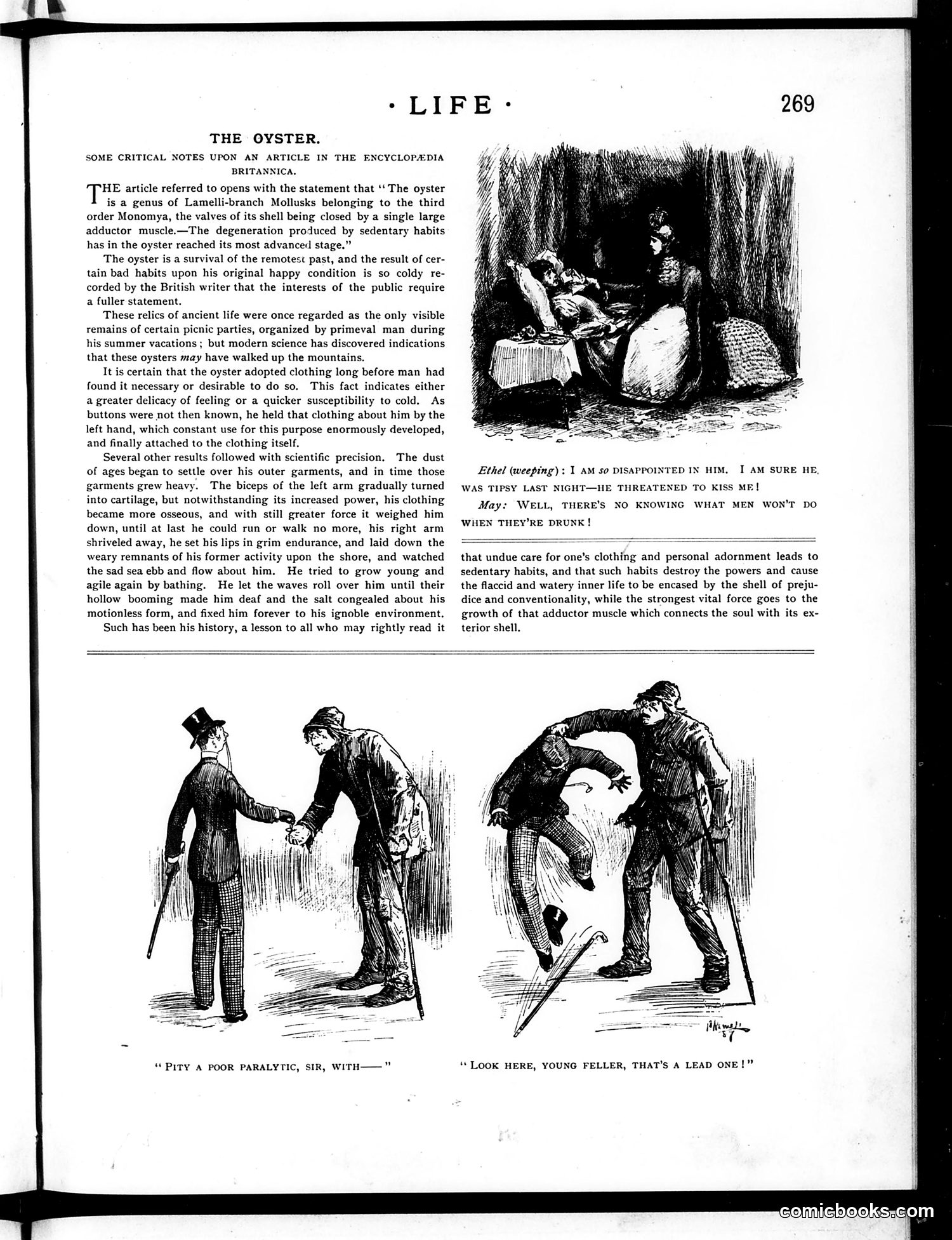
This page contains a satirical essay about oysters alongside unrelated cartoon vignettes. **"The Oyster" essay**: A mock-serious natural history that uses the oyster as metaphor for human moral decay. It humorously traces how an oyster's adoption of clothing led to sedentary habits, physical degeneration, and eventual paralysis—a cautionary tale about vanity and inactivity. The piece parodies encyclopedic writing while delivering social commentary on how excessive concern with appearance and convention destroys vitality. **Top cartoon**: Shows a woman (Ethel) upset that a drunk man threatened to kiss her; her friend (May) responds that drunken men are unpredictable—a joke about masculine behavior and alcohol. **Bottom cartoons**: Two street scenes. Left: A beggar claims poverty ("pity a poor paralytic"). Right: A skeptic exposes him as a fraud, calling his wooden leg/crutch a "lead one"—meaning he's faking disability for sympathy. The humor derives from exposing dishonest panhandling.
📄 Transcribed text from this page (OCR, searchable)
Machine-transcribed from the original scan — historical spelling and the odd misread are preserved.
- LIFE: THE OYSTER. SOME CRITICAL NOTES UPON AN ARTICLE IN BRITANNICA. THE ENCYCLOPEDIA 'HE article referred to opens with the statement that ‘‘ The oyster is a genus of Lamelli-branch Mollusks belonging to the third order Monomya, the valves of its shell being closed by a single large adductor muscle.—The degeneration produced by sedentary habits has in the oyster reached its most advanced stage.” The oyster is a survival of the remotest past, and the result of cer- tain bad habits upon his original happy condition is so coldy re- corded by the British writer that the interests of the public require a fuller statement. These relics of ancient life were once regarded as the only visible remains of certain picnic parties, organized by primeval man during his summer vacations ; but modern science has discovered indications that these oysters may have walked up the mountains. It is certain that the oyster adopted clothing long before man had found it necessary or desirable to do so. This fact indicates either a greater delicacy of feeling or a quicker susceptibility to cold. As buttons were not then known, he held that clothing about him by the left hand, which constant use for this purpose enormously developed, and finally attached to the clothing itself. Several other results followed with scientific precision. The dust of ages began to settle over his outer garments, and in time those garments grew heavy. The biceps of the left arm gradually turned into cartilage, but notwithstanding its increased power, his clothing became more osseous, and with still greater force it weighed him down, until at last he could run or walk no more, his right arm shriveled away, he set his lips in grim endurance, and laid down the weary remnants of his former activity upon the shore, and watched the sad sea ebb and flow about him. He tried to grow young and agile again by bathing. He let the waves roll over him until their hollow booming made him deaf and the salt congealed about his motionless form, and fixed him forever to his ignoble environment. Such has been his history, a lesson to all who may rightly read it Ethel (weeping) : 1 AM so DISAPPOINTED IN HIM. I AM SURE HE WAS TIPSY LAST NIGHT—HE THREATENED TO KISS ME! May: WELL, THERE'S NO KNOWING WHAT MEN WON'T DO WHEN THEY’RE DRUNK! that undue care for one's clothing and personal adornment leads to sedentary habits, and that such habits destroy the powers and cause the flaccid and watery inner life to be encased by the shell of preju- dice and conventionality, while the strongest vital force goes to the growth of that adductor muscle which connects the soul with its ex- terior shell. “PITY A POOR PARALYTIC, SIR, WITH——” ‘LOOK HERE, YOUNG FELLER, THAT'S A LEAD ONE!”