
A complete issue · 16 pages · 1888
Life — May 3, 1888
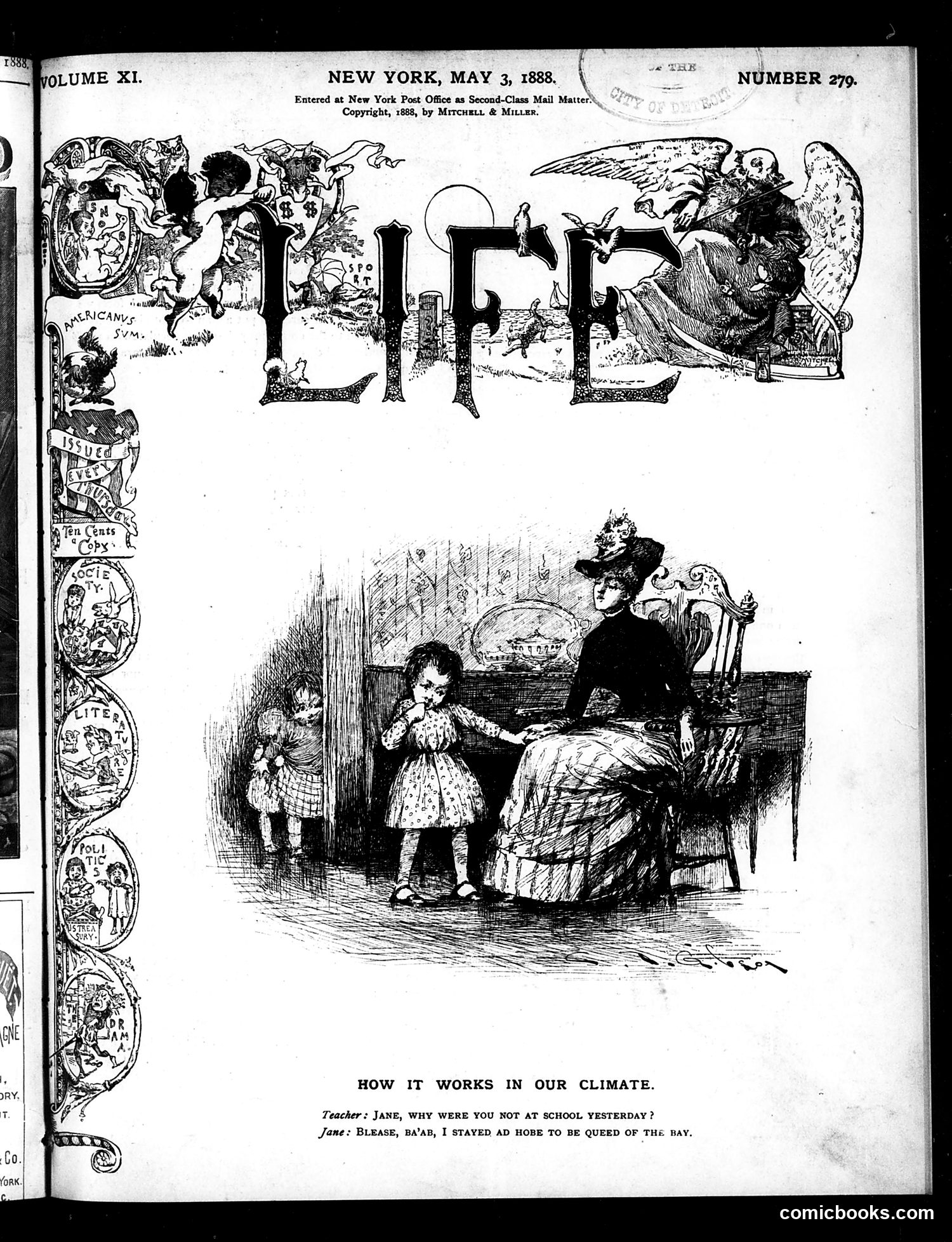
The cartoon satirizes truancy and parental excuses in late 19th-century America. A teacher questions a student named Jane about her absence from school. Jane's response—that she stayed home "to be cured of the hay"—represents a common Victorian-era excuse: hay fever (seasonal allergies). The joke mocks both the implausibility of the excuse and the era's tendency to treat minor ailments as serious medical conditions requiring home rest. The title "How It Works in Our Climate" suggests this is a typical American response to seasonal discomfort. The ornate left border contains other Life magazine content and advertisements, indicating this was a standard feature-page layout for the publication.
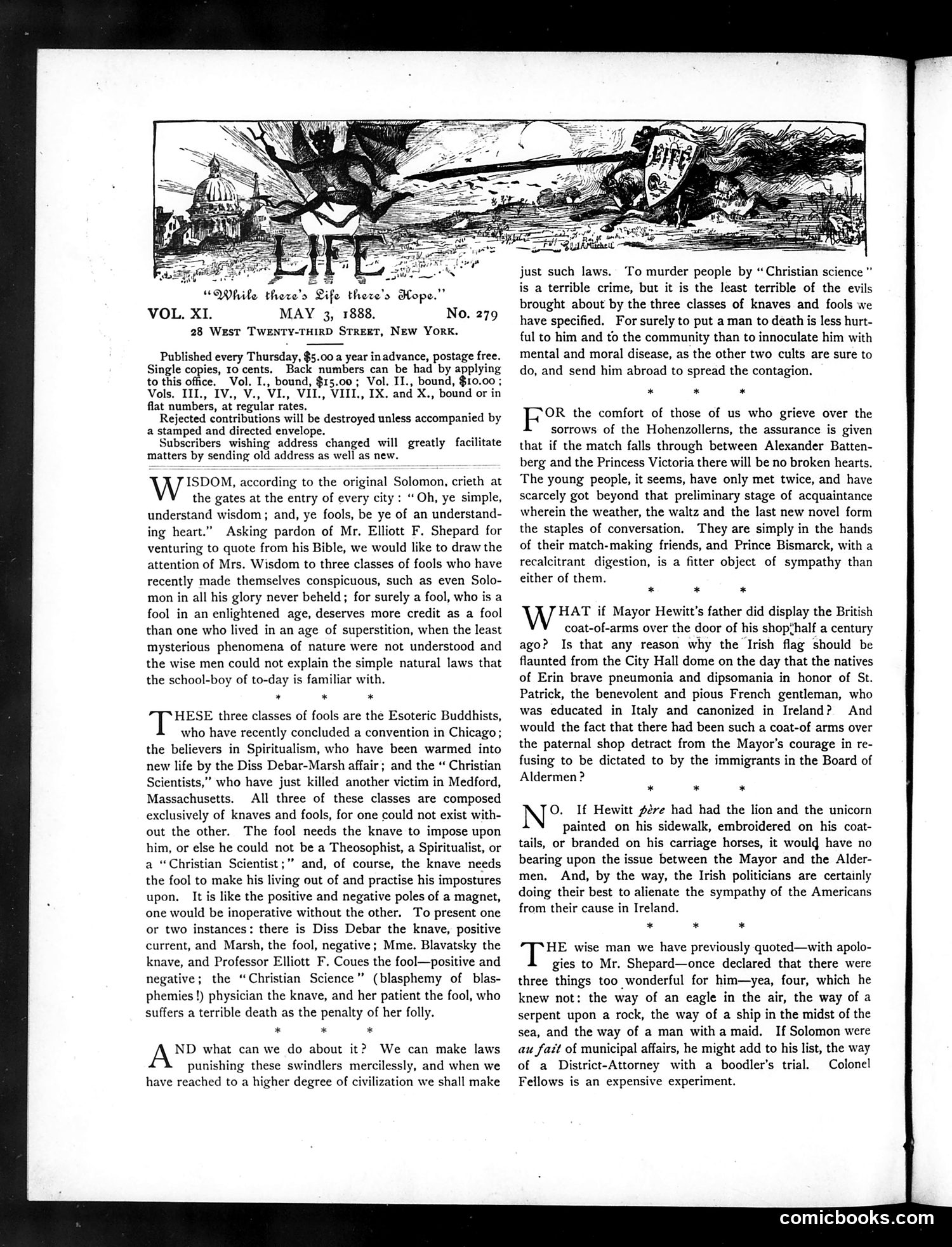
The page contains editorial commentary rather than cartoons. The masthead illustration shows a classical landscape with "Life" and "Hope" emblems, but the main content is satirical text attacking three groups the author calls "fools": Esoteric Buddhists, Spiritualists, and Christian Scientists. The piece critiques these movements for promoting dangerous practices—particularly "Christian Science" practitioners who allegedly caused a death in Medford, Massachusetts. The author argues these groups exploit gullible followers with unscientific claims. The text also discusses Irish-American political tensions, Mayor Hewitt, and references to British symbols and Irish nationalism in 1880s New York. The satire targets pseudoscientific movements gaining popularity in late-19th-century America, portraying their followers and practitioners as fraudulent and harmful.
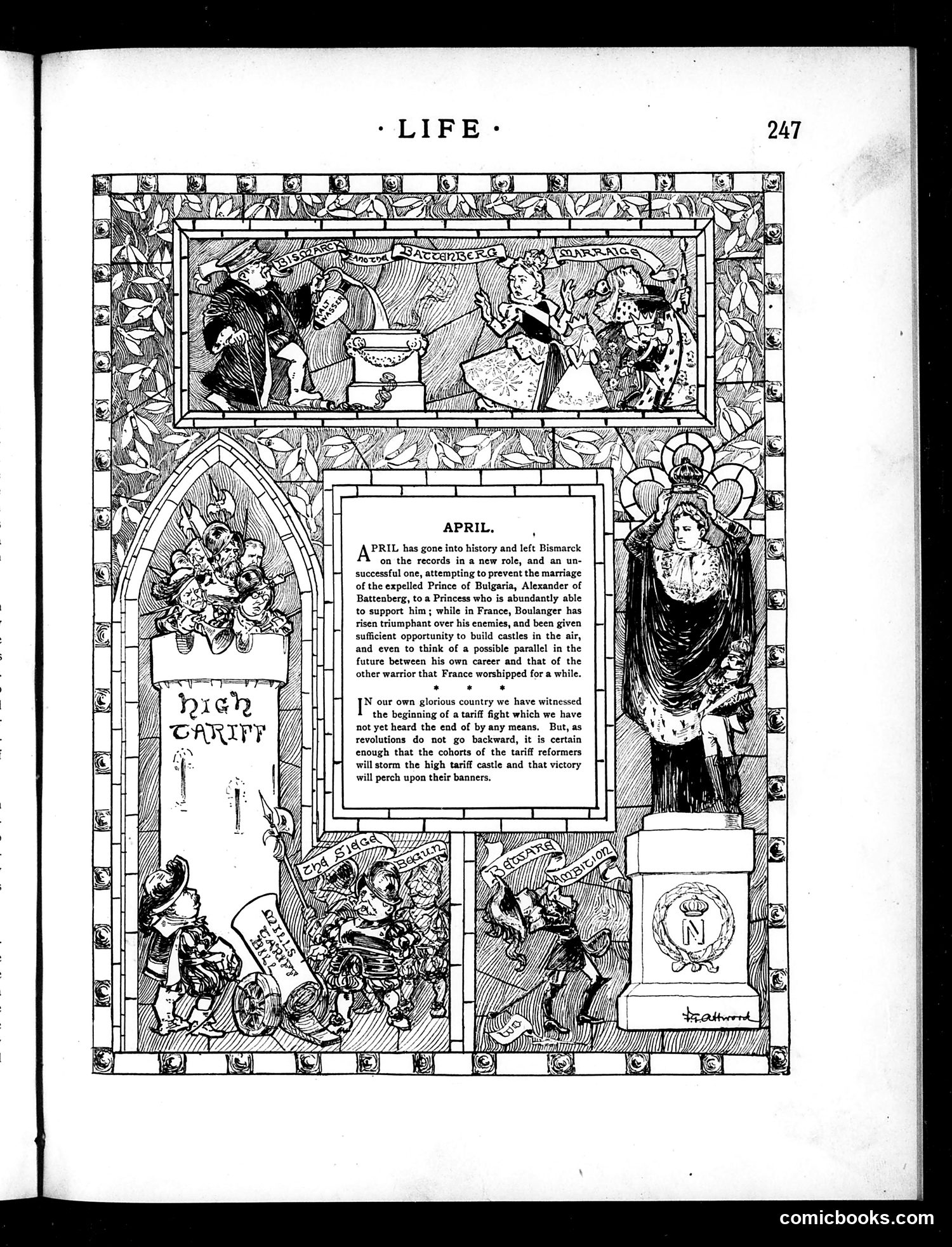
This page satirizes late 19th-century American tariff politics. The central illustration labeled "HIGH TARIFF" depicts a castle under siege, representing protectionist trade barriers as a defensive fortification. The text references recent political conflicts: April mentions Bismarck's diplomatic efforts in Europe and Boulanger's military ambitions in France. The second paragraph shifts to domestic American politics, discussing an ongoing "tariff fight" and predicting that protectionist forces will successfully defend high tariffs against reform efforts. The elaborate decorative border and period illustrations suggest this is from the 1880s-1890s, when American tariff policy was a major political battleground between protectionists (who wanted high tariffs) and free-trade advocates. The "castle" metaphor humorously depicts tariffs as both defensive and entrenched institutions.
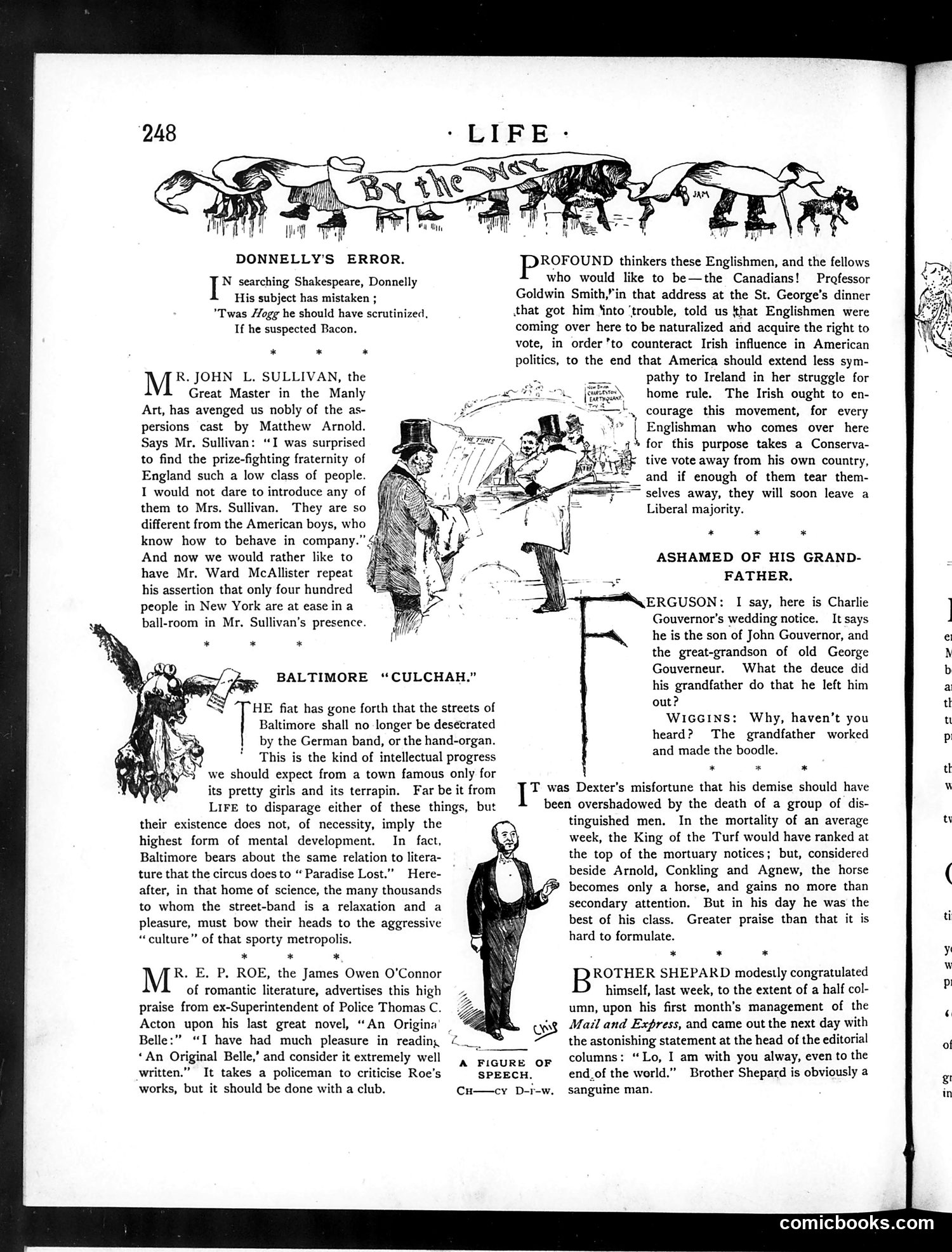
This page contains four separate satirical pieces: 1. **"Donnelly's Error"**: Mocks a Shakespeare scholar's mistake identifying "Hogs" in a text. 2. **"Mr. John L. Sullivan"**: Criticizes the prize-fighter's social pretensions. The text objects to Matthew Arnold introducing Sullivan to Mrs. Sullivan at a ball-room, noting the boxer's low class makes such company inappropriate—a jab at both Arnold's judgment and American social climbing. 3. **"Baltimore 'Culchah'"**: Sarcastically praises Baltimore's intellectual progress by banning German bands in favor of hand-organs, mocking the city's cultural pretensions while suggesting street bands represent decline masquerading as refinement. 4. **"A Figure of Speech"**: A brief anecdote about social embarrassment regarding a governor's grandson. The page demonstrates *Life*'s satirical focus on American social aspirations and cultural contradictions of the period.
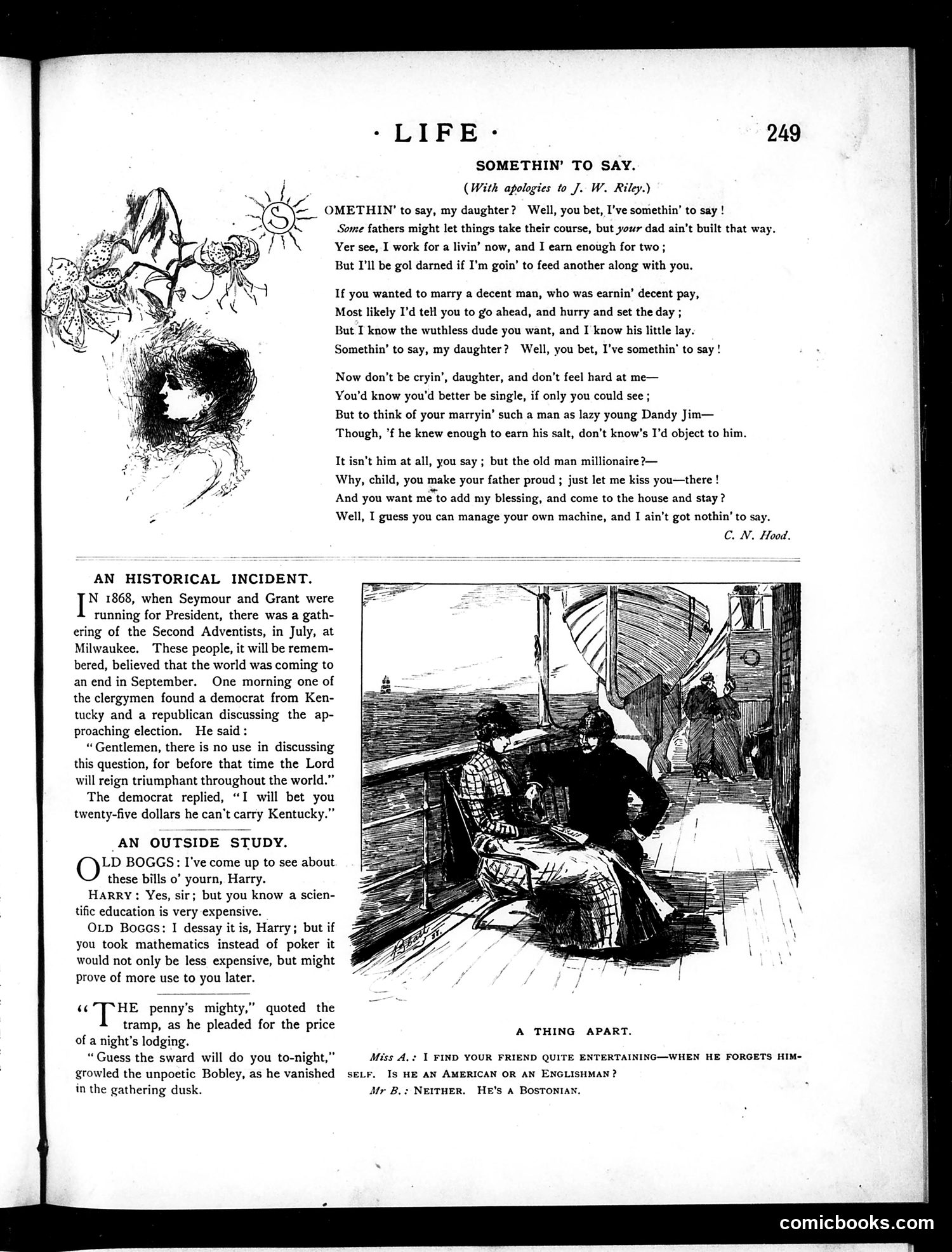
This page contains three distinct pieces: 1. **"Somethin' to Say"** (C.N. Hod): A poem about a father rejecting his daughter's suitor—a wealthy but lazy man. The father refuses to support an idle son-in-law, expressing working-class values about earning one's keep. 2. **"An Historical Incident"**: A brief anecdote from 1868 about Second Adventists predicting the world's end in September, with a clergyman's sardonic response about an election outcome making the prophecy moot. 3. **"An Outside Study"** and **"A Thing Apart"**: Humorous dialogue snippets—one about education costs, another questioning whether an entertaining friend is American or English (he's Bostonian). The illustrations are period sketches accompanying these satirical vignettes on class, religion, and American social types.
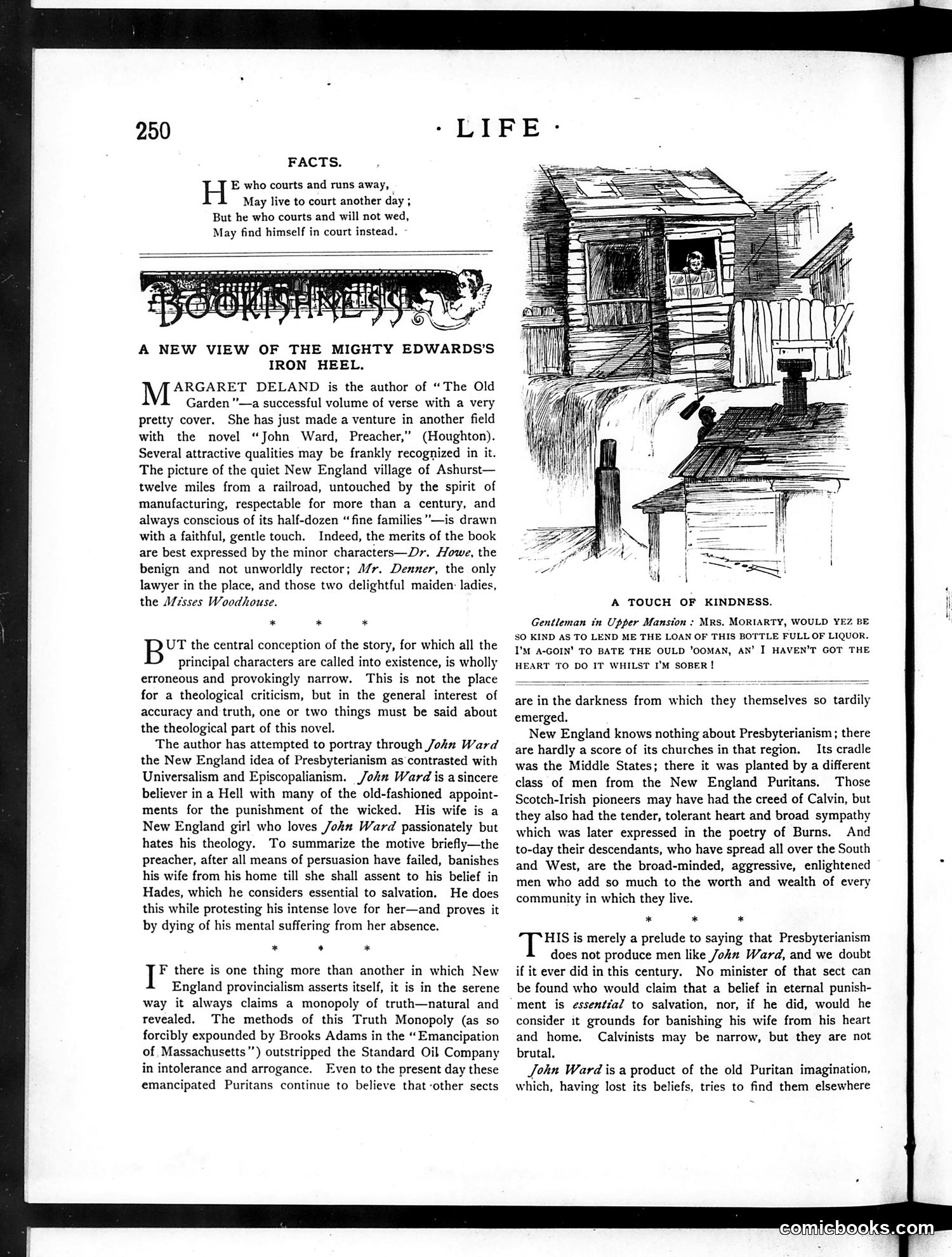
This page contains a literary book review rather than political satire. The main content discusses Margaret Bland's novel "John Ward, Preacher," which explores theological conflict in New England. The illustration labeled "A Touch of Kindness" depicts a modest rural dwelling and appears to visualize a scene from the novel involving a gentleman in an upper mansion lending liquor to a neighbor—a moment demonstrating human decency across class lines. The text critiques the novel's religious themes, particularly its portrayal of rigid Presbyterianism and Calvinism. The review argues that such stern theological beliefs, while producing inflexible characters like the protagonist John Ward, lack the "broad sympathy" found in Burns's poetry and are inconsistent with genuine Christian charity. The "Bookishness" header indicates this is part of Life's literary criticism section.
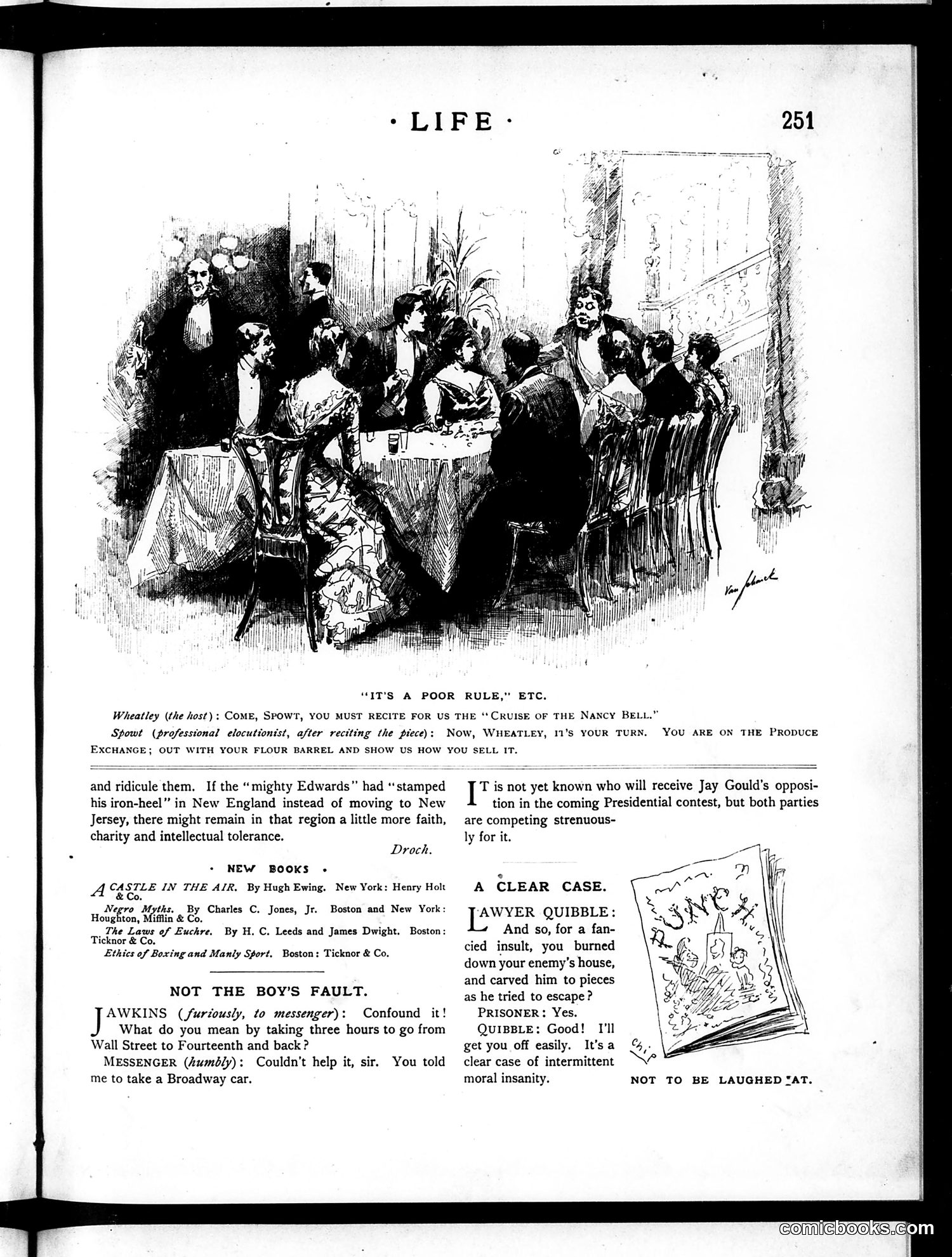
**Top Cartoon ("It's a Poor Rule, Etc."):** This depicts a parlor gathering where Wheatley (the host) pressures Swett, a professional elocutionist, to perform by reciting "The Cruise of the Nancy Bell." Swett deflects, suggesting Wheatley instead demonstrate selling flour from a barrel. The satire mocks the social obligation to perform entertainment at gatherings—the awkward expectation that guests must provide amusement on demand, particularly those with professional skills. **Lower Section:** Contains unrelated humorous skits and advertisements. "Not the Boy's Fault" depicts miscommunication between a messenger and Jawkins about travel time across Manhattan. "A Clear Case" shows a lawyer defending a prisoner accused of burning down an enemy's house, arguing "intermittent moral insanity." The page satirizes social conventions and legal absurdities of the era.
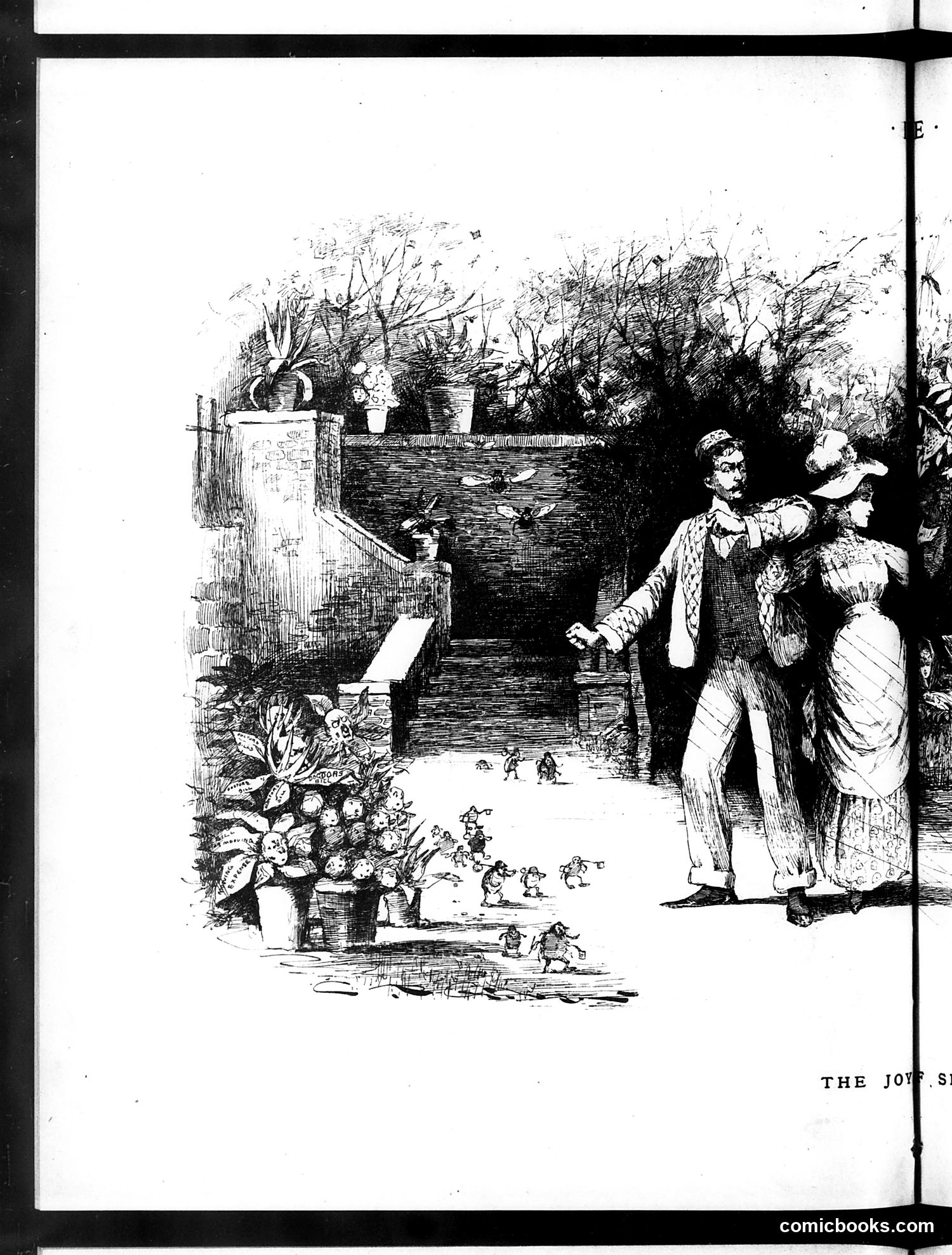
This appears to be an illustration titled "THE JOY S[...]" (title cut off). The engraving shows a garden scene with a man in Victorian-era clothing gesturing toward flowering plants and potted flowers. Several women in period dress stand nearby observing the display. The satire likely concerns Victorian attitudes toward horticulture and domesticity—perhaps mocking gentlemen who took excessive pride in their gardens, or the fashionable practice of cultivating ornamental plants as status symbols. The man's animated gesture suggests he's proudly displaying his botanical collection to admiring visitors. Without the complete title or accompanying text, the specific satirical target remains unclear, though it clearly reflects 19th-century upper-class leisure pursuits and gender conventions around domestic cultivation.
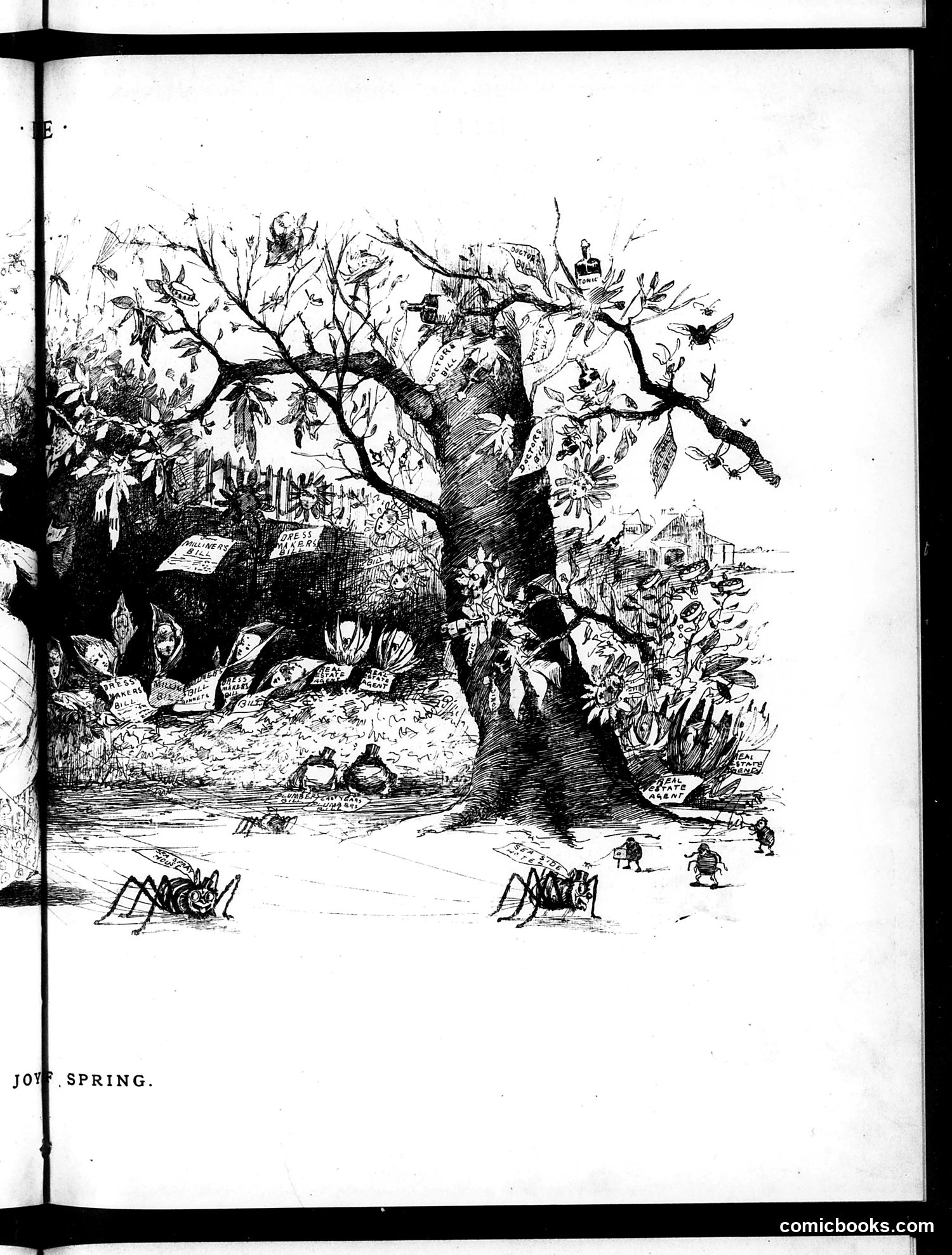
This appears to be a satirical illustration depicting spring as a chaotic, destructive force rather than a pleasant season. The central image shows a large tree laden with various items and figures, with insects (likely locusts or grasshoppers) swarming at its base—a clear reference to biblical plagues. The scattered objects hanging from branches and surrounding the tree appear to include price tags or commercial goods, suggesting commentary on consumer culture or economic upheaval during spring season. Small human figures at the bottom emphasize scale and vulnerability. The cartoon's ironic title—"Joys of Spring"—contrasts sharply with the depicted scene of destruction and infestation, likely satirizing how spring's promised renewal actually brings financial burdens, pest invasions, or other unwelcome seasonal realities to ordinary people.
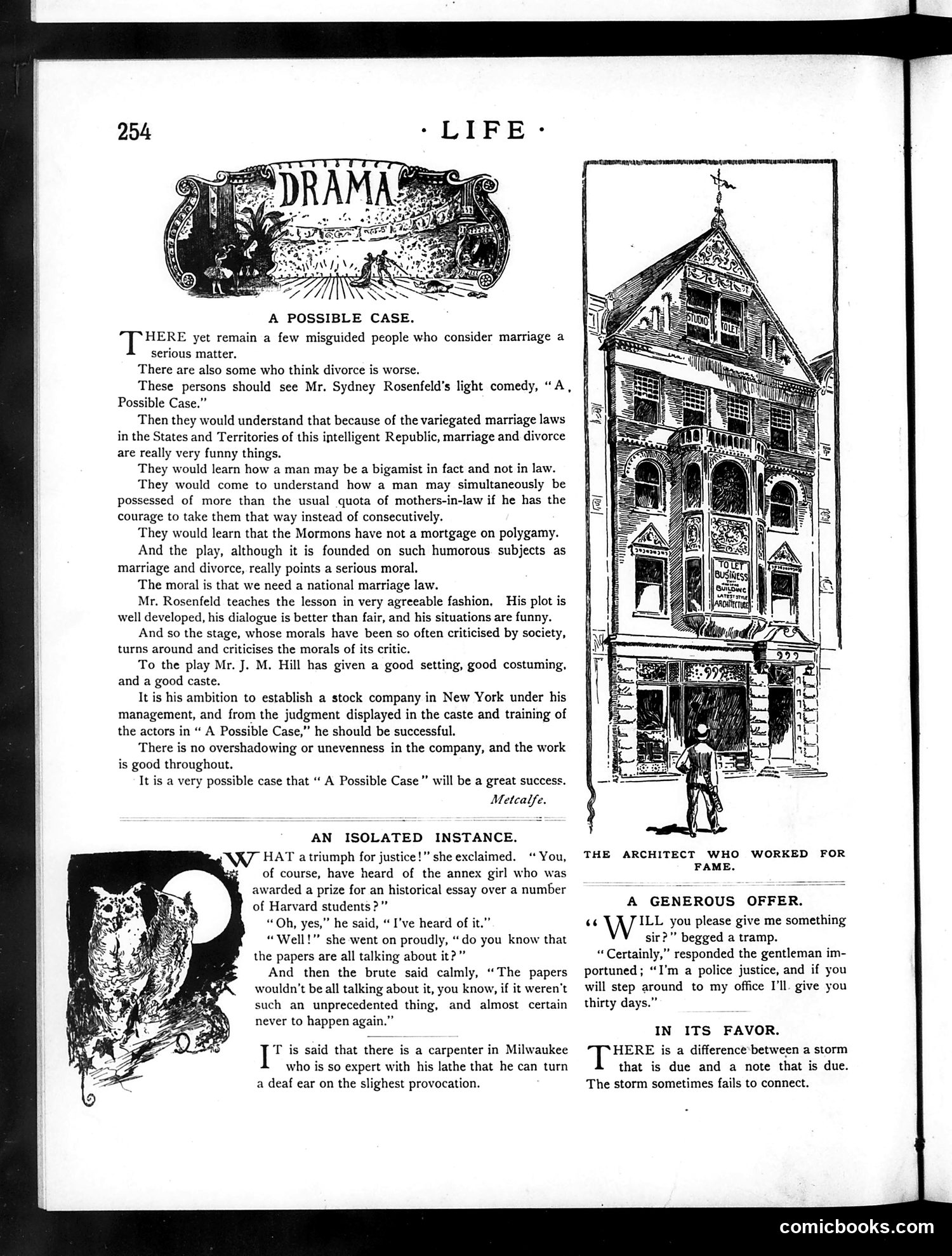
This page discusses Mr. Sydney Rosenfeld's light comedy "A Possible Case," which satirizes American marriage and divorce law. **The Satire's Point:** Rosenfeld's play highlights the absurdity that marriage laws vary dramatically between U.S. states and territories, creating situations where someone could simultaneously be legally married in one jurisdiction and divorced in another. The text notes this makes "a bigamist in fact and not in law"—exposing how inconsistent state laws create legal confusion. **Additional Content:** The page includes separate humorous anecdotes: one about Harvard students and a prize essay, another about a Milwaukee carpenter skilled at "turning a deaf ear," and brief jokes about a tramp and differences between storms and debts. **Visual Elements:** An ornate building illustration (likely the theater) appears alongside the text, though specific identifications of depicted individuals aren't clear from the image alone.
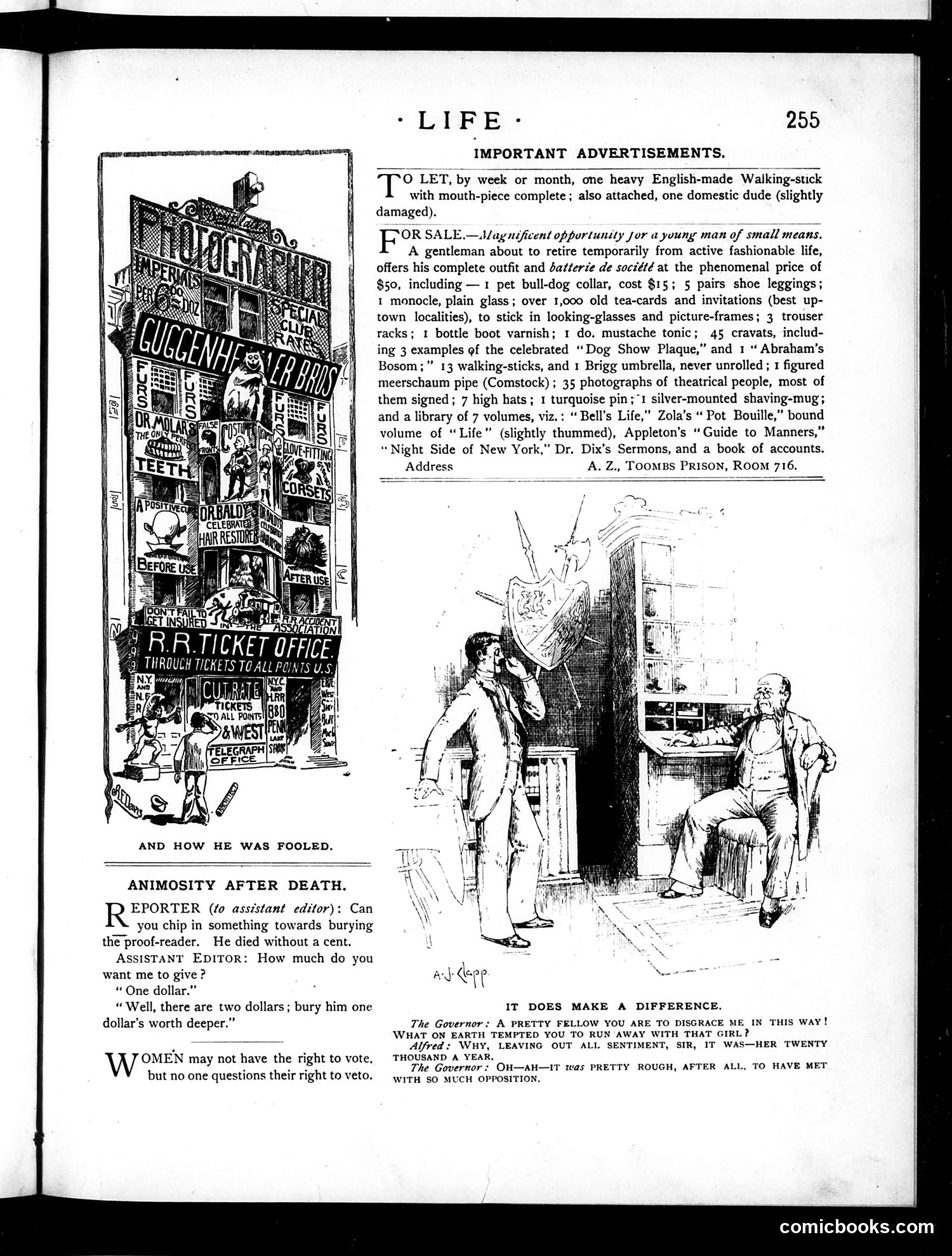
This page contains period satirical advertisements and two cartoon jokes mocking 1890s upper-class pretension. **The advertisements** parody fashionable young men of means—one listing a "domestic dude (slightly damaged)" for rent, another offering a gentleman's complete social outfit (monocle, cravats, walking-sticks, theatrical photographs) cheaply as he "retires temporarily from active fashionable life." The satire targets the superficiality of maintaining appearances through purchased accessories. **"Animosity After Death"** jokes about class indifference: a reporter asks the assistant editor to contribute to burying a poor proofreader; offered one dollar, he gives two to bury him "one dollar's worth deeper"—mocking callousness toward working-class death. **"It Does Make a Difference"** depicts a governor outraged his son ran away with a girl—until learning she's worth twenty thousand a year. The governor's opposition instantly vanishes. This satirizes how wealthy families' moral objections to relationships evaporate when money is involved, exposing mercenary hypocrisy beneath claims of principle.
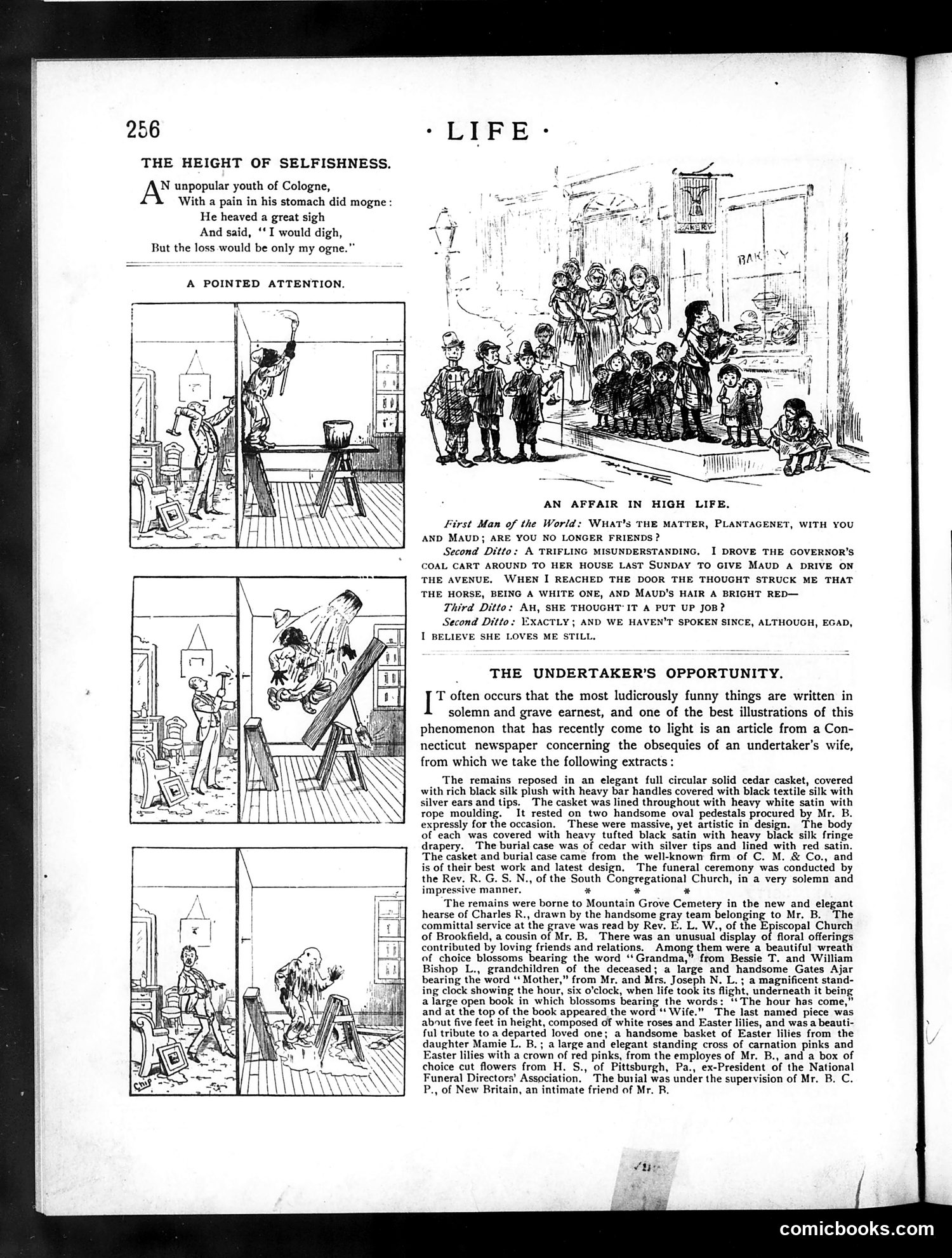
This page contains three distinct satirical pieces: **"The Height of Selfishness"** is a cruel limerick about a sick youth from Cologne who wishes for death only to avoid burdening others—mocking extreme selfishness wrapped in false altruism. **"An Affair in High Life"** satirizes upper-class pretension. Two wealthy men discuss a romantic misunderstanding: one drove his wealthy friend in a governor's coal cart, creating an awkward visual contrast between the white horse and the woman's red hair. She interpreted this as a deliberate insult ("put up job"), and they've stopped speaking—mocking how trivial matters damage elite relationships. **"The Undertaker's Opportunity"** is the sharpest satire. Life reprints a Connecticut newspaper's funeral announcement for an undertaker's wife, presented with such overwrought, excessive detail (elaborate caskets, floral displays, ceremonial minutiae) that it becomes unintentionally hilarious. The satire targets both the undertaker's self-serving pomposity and local journalism's breathless coverage of minor events as grand occasions.
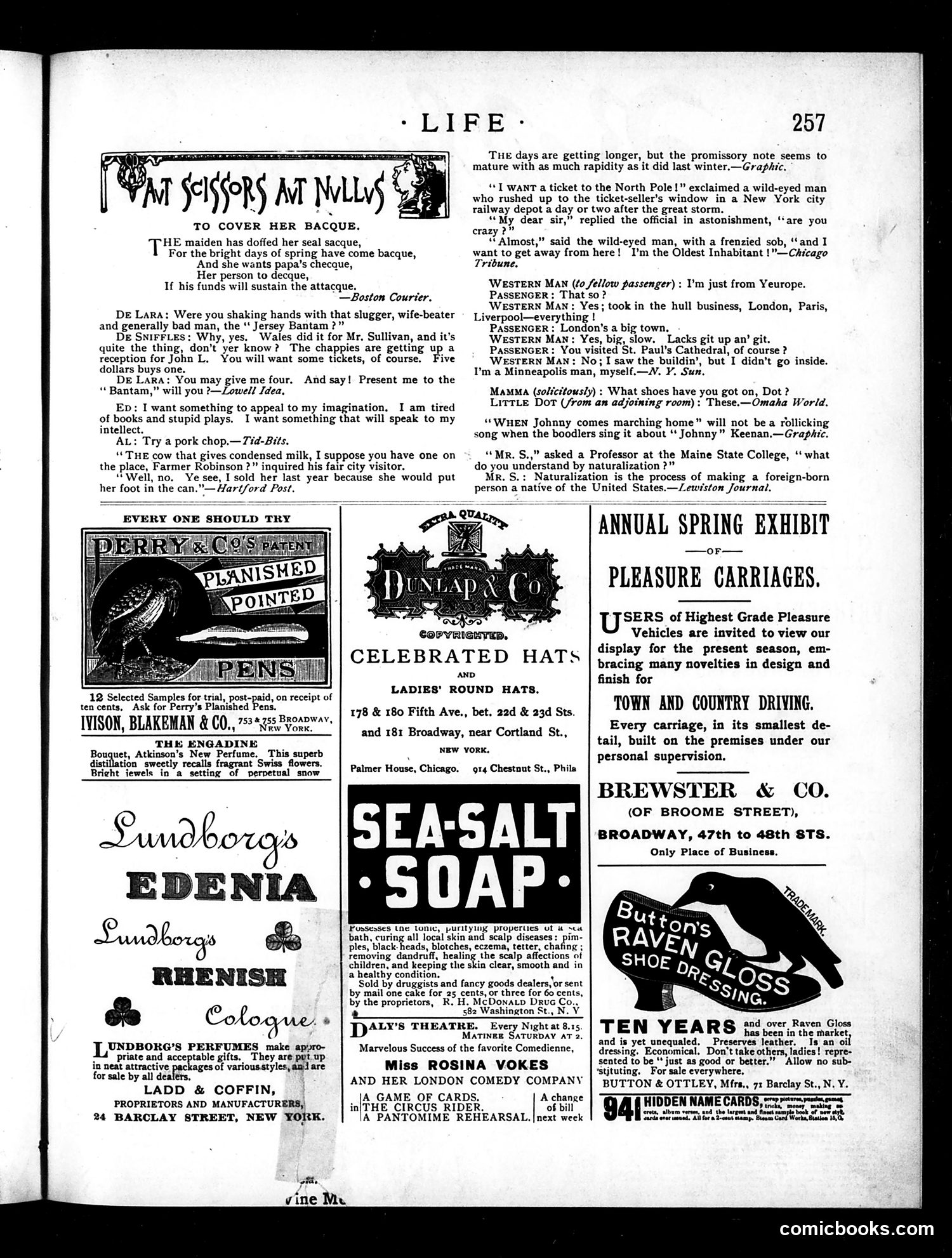
This is primarily an **advertising page** with scattered satirical humor pieces typical of Life magazine's format. The main content includes short jokes and quips rather than political cartoons. Notable pieces reference: - **John L. Sullivan**, the famous boxer and "wife-beater," being honored at a reception (the reference to "Wales" likely means Jim Wales, a fighter associated with Sullivan) - A joke about the "Oldest Inhabitant" of Chicago wanting to escape after a recent snowstorm - Regional humor contrasting a Midwestern man's superficial European tourism with his provincial attachments (he saw St. Paul's Cathedral but "didn't go inside" because he's from Minneapolis) The bulk of the page is **product advertisements** for hats, perfumes, pens, carriages, and soap—typical of 19th-century Life magazine's revenue model. These ads provide historical detail about contemporary consumer goods and shopping locations (Fifth Avenue, Broadway). The humor is gentle, pun-based, and domestically focused rather than sharply satirical about politics or major events.
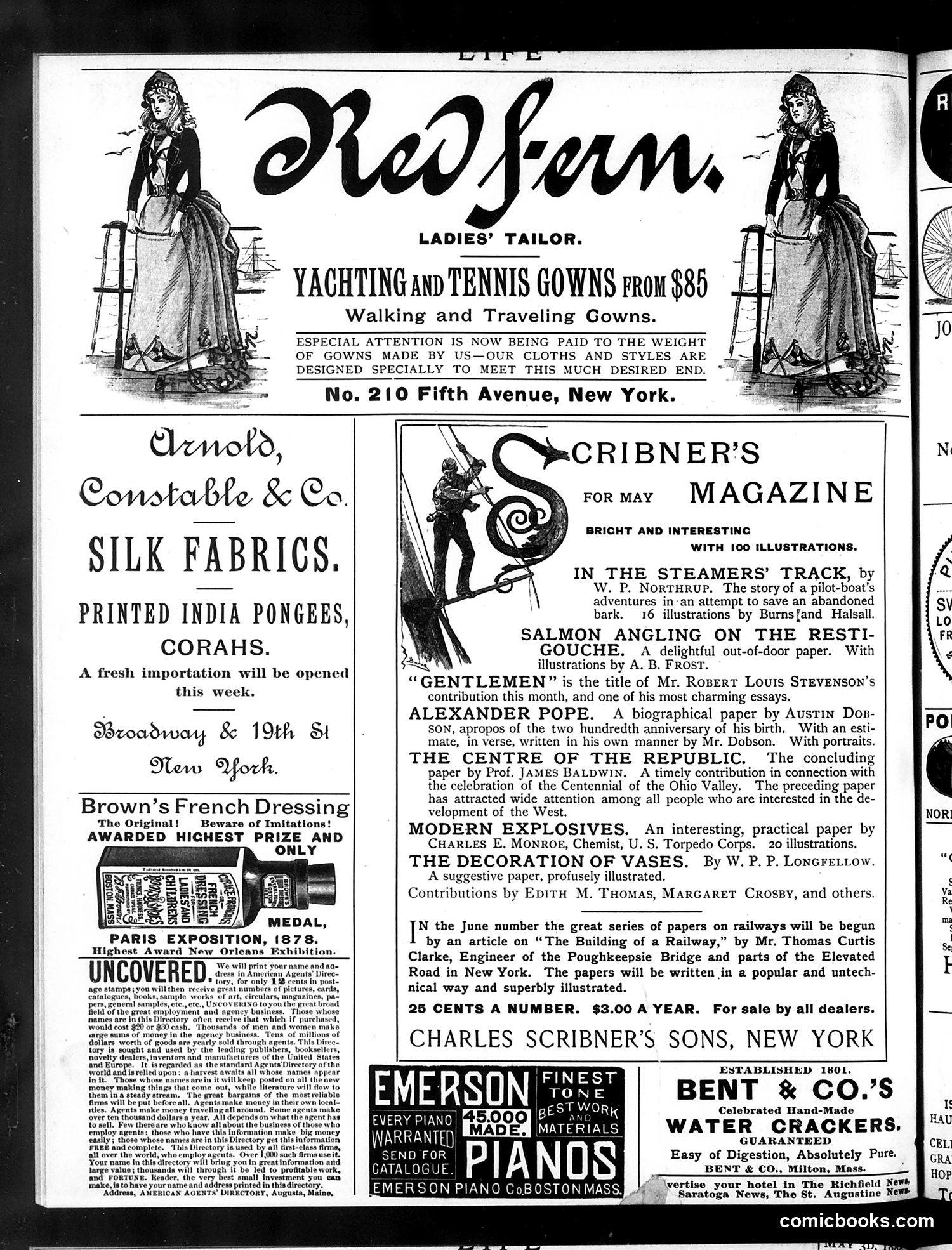
This is primarily an **advertising page** with minimal satirical content. The page features commercial advertisements for luxury goods aimed at affluent readers circa the 1880s-1890s: **Key Advertisements:** - **Red Fern**: Ladies' tailor offering yachting, tennis, and walking gowns ($85+) - **Scribner's Magazine**: Announces May issue featuring literary contributions by Robert Louis Stevenson and articles on railways, explosives, and decoration - **Brown's French Dressing**: Hair product claiming "Highest Prize" at Paris Exposition 1878 - **Emerson Pianos**: Boston-made instruments - **Bent & Co.'s Water Crackers**: Hand-made digestive biscuits The page reflects **Gilded Age consumer culture**, targeting wealthy urban readers interested in fashionable clothing, refined literature, and manufactured luxuries. No political satire or caricature appears present—this is straightforward commercial messaging typical of Life's advertising sections.
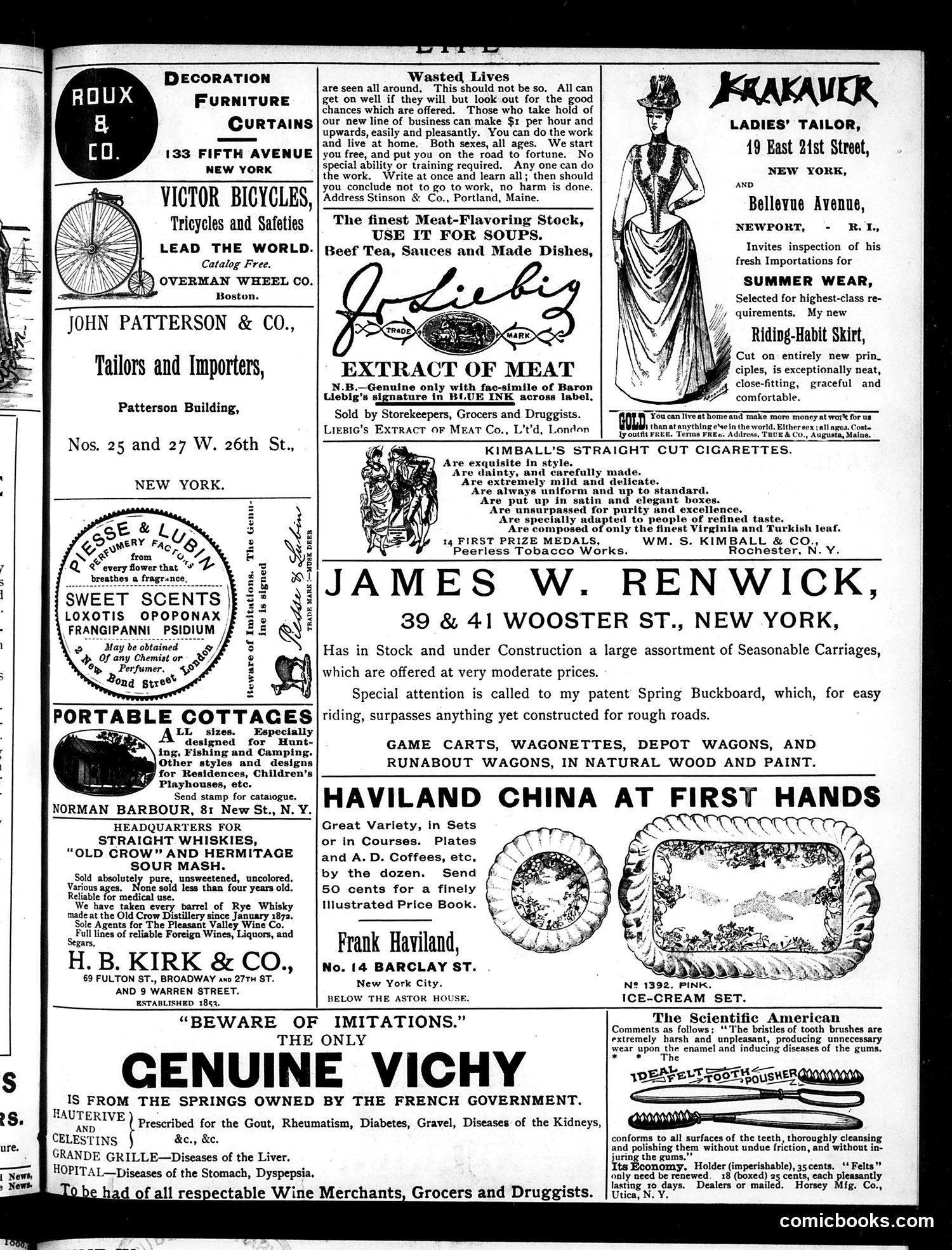
This is primarily a **commercial advertising page**, not a satirical cartoon. It's filled with late 19th-century product advertisements from New York businesses: bicycles, furniture, whiskey, carriages, china, and other goods. However, one advertisement stands out for its social commentary: **"Wasted Lives"** (upper center) is a job recruitment ad that appears to mock get-rich-quick schemes. It promises that "All can get on well" by joining "our new line of business" at "$1 per hour," claiming anyone can "do the work and live at home" with "no special ability or training required." The cautious fine print—"should you conclude not to go to work, no harm is done"—suggests skepticism about such dubious employment claims. This reflects 1890s anxieties about economic opportunity and fraud. Otherwise, the page is standard period advertising with no identifiable political cartoons or caricatures.
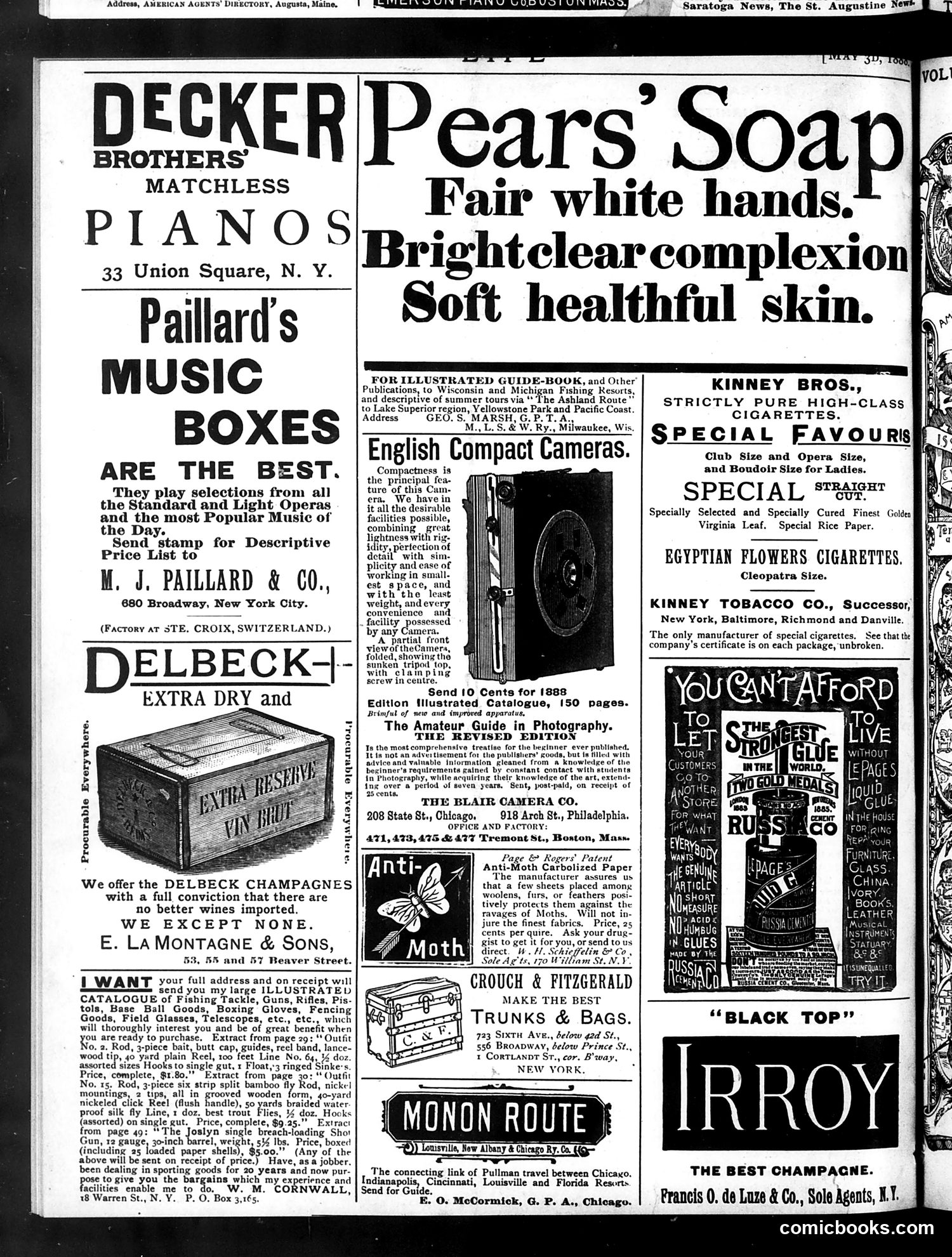
This is primarily an **advertising page** from *Life* magazine (dated May 30, 1888, visible at top). It contains no political cartoons or satire—rather, it's a collection of period product advertisements. Notable ads include: - **Pears' Soap** (top right): Promises "fair white hands," "bright clear complexion," and "soft healthful skin"—typical beauty claims of the era - **Delbeck Champagne**: Positioned as superior ("We except none") - **Music boxes and pianos**: Marketed as luxury goods - **Sporting goods catalog**: Detailed fishing and hunting equipment for gentlemen - **Anti-Moth paper**: A practical household product - **Trunks and bags**: Travel goods by Crouch & Fitzgerald The page reflects **late-19th-century consumer culture**: products marketed to affluent readers, emphasis on luxury imports, and genteel leisure activities (fishing, opera). The advertising density and style are characteristic of *Life's* revenue model during this period.