
Life, 1888-05-03 · page 4 of 16
Life — May 3, 1888 — page 4: what you’re looking at
What you’re looking at
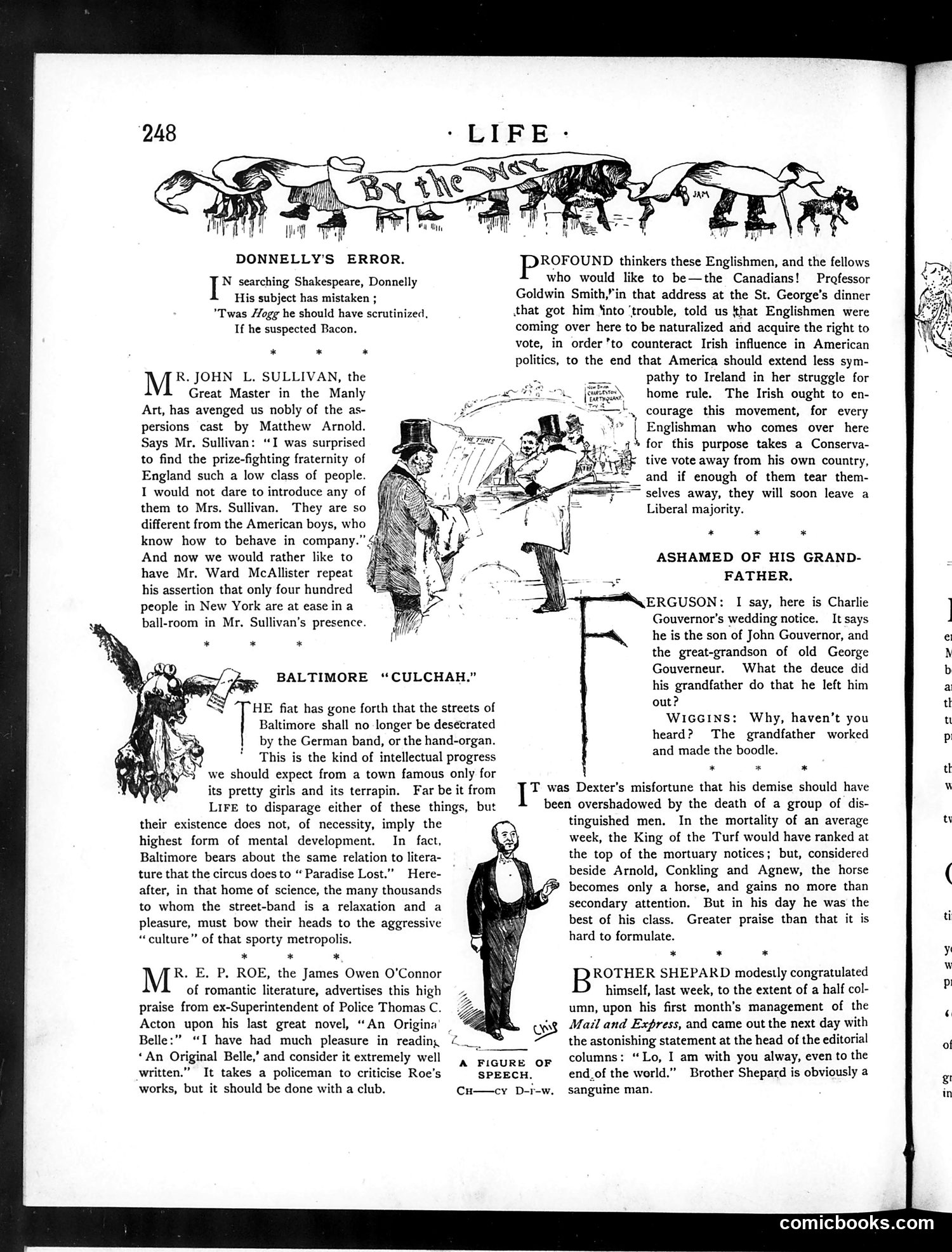
This page contains four separate satirical pieces: 1. **"Donnelly's Error"**: Mocks a Shakespeare scholar's mistake identifying "Hogs" in a text. 2. **"Mr. John L. Sullivan"**: Criticizes the prize-fighter's social pretensions. The text objects to Matthew Arnold introducing Sullivan to Mrs. Sullivan at a ball-room, noting the boxer's low class makes such company inappropriate—a jab at both Arnold's judgment and American social climbing. 3. **"Baltimore 'Culchah'"**: Sarcastically praises Baltimore's intellectual progress by banning German bands in favor of hand-organs, mocking the city's cultural pretensions while suggesting street bands represent decline masquerading as refinement. 4. **"A Figure of Speech"**: A brief anecdote about social embarrassment regarding a governor's grandson. The page demonstrates *Life*'s satirical focus on American social aspirations and cultural contradictions of the period.
📄 Transcribed text from this page (OCR, searchable)
Machine-transcribed from the original scan — historical spelling and the odd misread are preserved.
DONNELLY’S ERROR. N searching Shakespeare, Donnelly His subject has mistaken ; 'Twas Hogg he should have scrutinized, If he suspected Bacon. * * * R. JOHN L. SULLIVAN, the Great Master in the Manly Art, has avenged us nobly of the as- persions cast by Matthew Arnold. Says Mr. Sullivan: “I was surprised to find the prize-fighting fraternity of England such a low class of people. I would not dare to introduce any of them to Mrs. Sullivan. They are so different from the American boys, who know how to behave in company.” And now we would rather like to have Mr. Ward McAllister repeat his assertion that only four hundred people in New York are at ease ina ball-room in Mr. Sullivan’s presence. * * BALTIMORE “CULCHAH.” HE fiat has gone forth that the streets of Baltimore shall no longer be desecrated by the German band, or the hand-organ. This is the kind of intellectual progress we should expect from a town famous only for its pretty girls and its terrapin. Far be it from LIFE to disparage either of these things, but their existence does not, of necessity, imply the highest form of mental development. In fact, Baltimore bears about the same relation to litera- ture that the circus does to “ Paradise Lost.” Here- after, in that home of science, the many thousands to whom the street-band is a relaxation and a pleasure, must bow their heads to the aggressive “culture” of that sporty metropolis. * * * R. E. P. ROE, the James Owen O'Connor of romantic literature, advertises this high praise from ex-Superintendent of Police Thomas C. Acton upon his last great novel, “An Origina Belle:” “I have had much pleasure in reading «An Original Belle,’ and consider it extremely well written.” It takes a policeman to criticise Roe’s works, but it should be done with a club. A FIGURE OF SPEECH. Cu—cy D-r-w. ROFOUND thinkers these Englishmen, and the fellows who would like to be—the Canadians! Professor Goldwin Smith,”in that address at the St. George’s dinner that got him ‘nto ‘trouble, told us that Englishmen were coming over here to be naturalized and acquire the right to vote, in order "to counteract Irish influence in American politics, to the end that America should extend less sym- pathy to Ireland in her struggle for home rule. The Irish ought to en- », courage this movement, for every Englishman who comes over here : 4% for this purpose takes a Conserva- tive vote away from his own country, and if enough of them tear them- selves away, they will soon leave a Liberal majority. Fie), * * * ASHAMED OF HIS GRAND- FATHER. ERGUSON: I say, here is Charlie Gouvernor’s wedding notice. It says he is the son of John Gouvernor, and the great-grandson of old George Gouverneur. What the deuce did his grandfather do that he left him out? WIGGINS: Why, haven’t you heard? The grandfather worked and made the boodle. * x * T was Dexter’s misfortune that his demise should have been overshadowed by the death of a group of dis- tinguished men. In the mortality of an average week, the King of the Turf would have ranked at the top of the mortuary notices; but, considered beside Arnold, Conkling and Agnew, the horse becomes only a horse, and gains no more than secondary attention. But in his day he was the best of his class. Greater praise than that it is hard to formulate. * * * Bre SHEPARD modestly congratulated himself, last week, to the extent of a half col- umn, upon his first month’s management of the Mail and Express, and came out the next day with the astonishing statement at the head of the editorial columns: “Lo, I am with you alway, even to the end_of the world.” Brother Shepard is obviously a sanguine man. comicbooks.com