
Life, 1888-05-03 · page 10 of 16
Life — May 3, 1888 — page 10: what you’re looking at
What you’re looking at
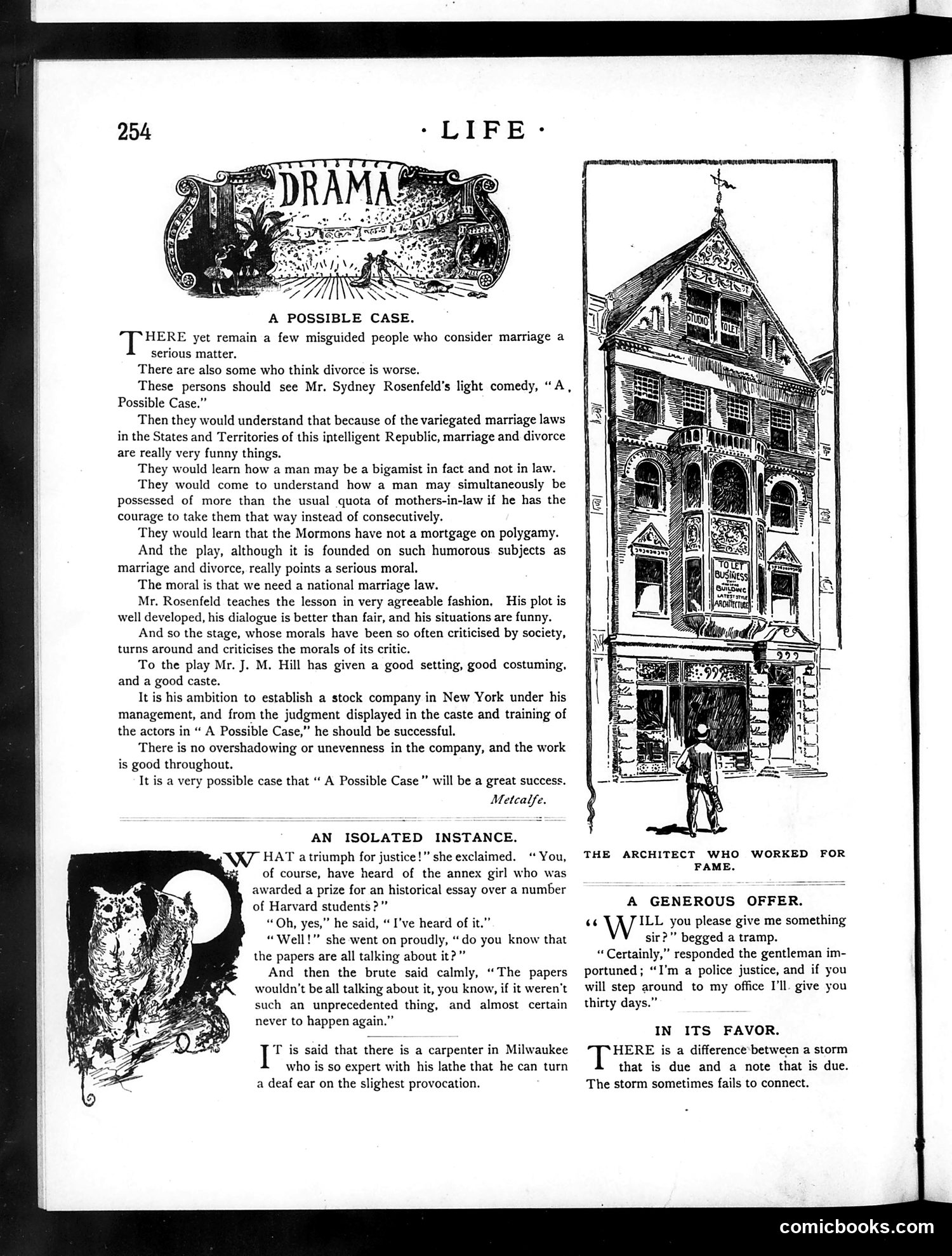
This page discusses Mr. Sydney Rosenfeld's light comedy "A Possible Case," which satirizes American marriage and divorce law. **The Satire's Point:** Rosenfeld's play highlights the absurdity that marriage laws vary dramatically between U.S. states and territories, creating situations where someone could simultaneously be legally married in one jurisdiction and divorced in another. The text notes this makes "a bigamist in fact and not in law"—exposing how inconsistent state laws create legal confusion. **Additional Content:** The page includes separate humorous anecdotes: one about Harvard students and a prize essay, another about a Milwaukee carpenter skilled at "turning a deaf ear," and brief jokes about a tramp and differences between storms and debts. **Visual Elements:** An ornate building illustration (likely the theater) appears alongside the text, though specific identifications of depicted individuals aren't clear from the image alone.
📄 Transcribed text from this page (OCR, searchable)
Machine-transcribed from the original scan — historical spelling and the odd misread are preserved.
A POSSIBLE CASE. HERE yet remain a few misguided people who consider marriage a serious matter. There are also some who think divorce is worse. These persons should see Mr. Sydney Rosenfeld’s light comedy, “A, Possible Case.” Then they would understand that because of the variegated marriage laws in the States and Territories of this intelligent Republic, marriage and divorce are really very funny things. They would learn how a man may be a bigamist in fact and not in law. They would come to understand how a man may simultaneously be possessed of more than the usual quota of mothers-in-law if he has the courage to take them that way instead of consecutively. They would learn that the Mormons have not a mortgage on polygamy. And the play, although it is founded on such humorous subjects as marriage and divorce, really points a serious moral. The moral is that we need a national marriage law. Mr. Rosenfeld teaches the lesson in very agreeable fashion, His plot is well developed, his dialogue is better than fair, and his situations are funny. And so the stage, whose morals have been so often criticised by society, turns around and criticises the morals of its critic. To the play Mr. J. M. Hill has given a good setting, good costuming, and a good caste. It is his ambition to establish a stock company in New York under his management, and from the judgment displayed in the caste and training of the actors in “ A Possible Case,” he should be successful. There is no overshadowing or unevenness in the company, and the work is good throughout. It is a very possible case that ‘‘ A Possible Case” will be a great success. Metcalfe. AN ISOLATED INSTANCE, WHAT a triumph for justice!” she exclaimed. ‘“ You, ss of course, have heard of the annex girl who was awarded a prize for an historical essay over a number of Harvard students?” “Oh, yes,” he said, “ I've heard of it.” “Well!” she went on proudly, “do you know that the papers are all talking about it?” And then the brute said calmly, “The papers wouldn't be all talking about it, you know, if it weren't such an unprecedented thing, and almost certain never to happen again.” T is said that there is a carpenter in Milwaukee who is so expert with his lathe that he can turn a deaf ear on the slighest provocation. THE ARCHITECT WHO WORKED FOR FAME. A GENEROUS OFFER. ““ ILL you please give me something sir?” begged a tramp. “Certainly,” responded the gentleman im- portuned; “I’m a police justice, and if you will step around to my office I'll. give you thirty days.” IN ITS FAVOR. HERE is a difference’ between a storm that is due and a note that is due. The storm sometimes fails to connect. comicbooks.com