
Life, 1888-05-03 · page 6 of 16
Life — May 3, 1888 — page 6: what you’re looking at
What you’re looking at
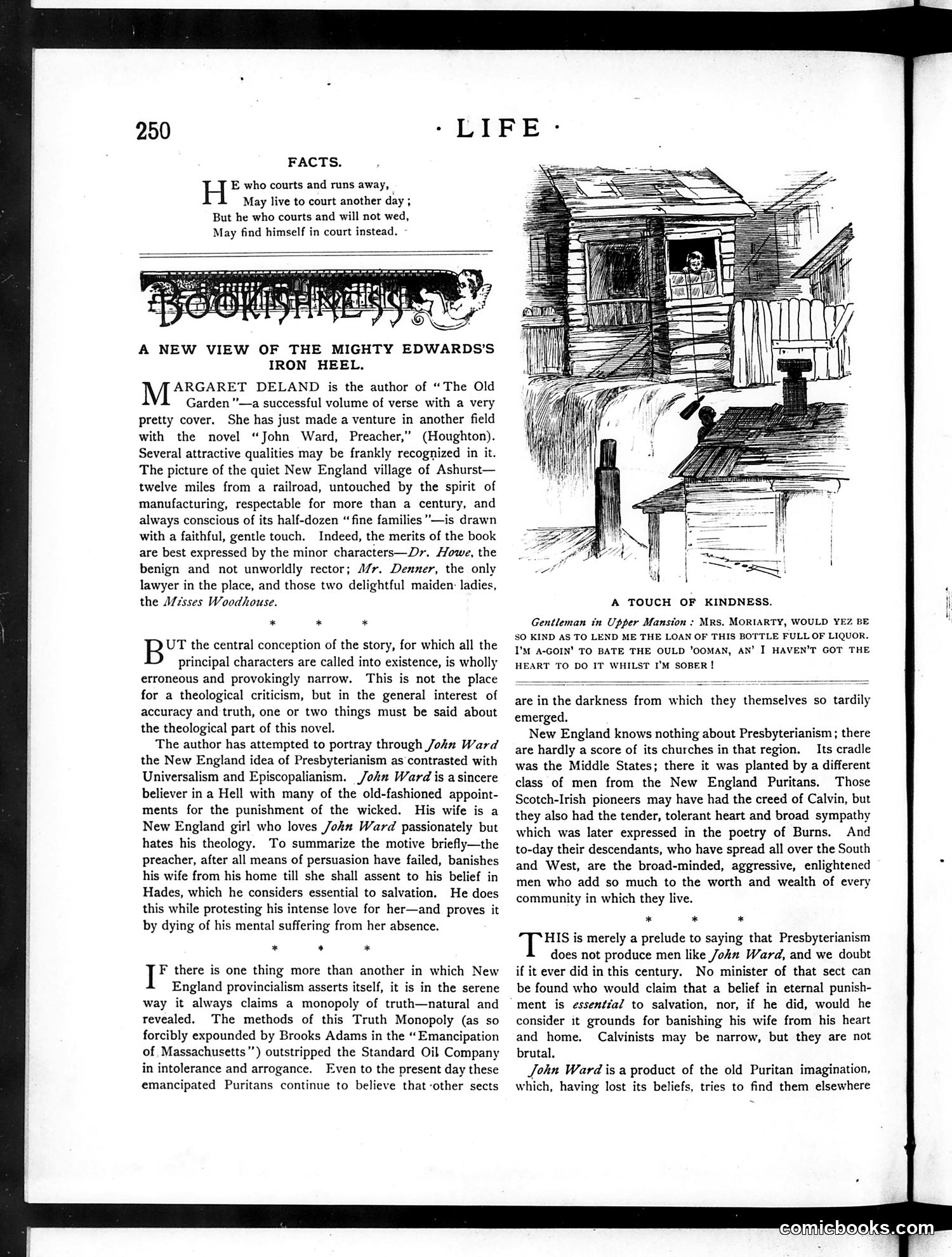
This page contains a literary book review rather than political satire. The main content discusses Margaret Bland's novel "John Ward, Preacher," which explores theological conflict in New England. The illustration labeled "A Touch of Kindness" depicts a modest rural dwelling and appears to visualize a scene from the novel involving a gentleman in an upper mansion lending liquor to a neighbor—a moment demonstrating human decency across class lines. The text critiques the novel's religious themes, particularly its portrayal of rigid Presbyterianism and Calvinism. The review argues that such stern theological beliefs, while producing inflexible characters like the protagonist John Ward, lack the "broad sympathy" found in Burns's poetry and are inconsistent with genuine Christian charity. The "Bookishness" header indicates this is part of Life's literary criticism section.
📄 Transcribed text from this page (OCR, searchable)
Machine-transcribed from the original scan — historical spelling and the odd misread are preserved.
FACTS. E who courts and runs away, May live to court another day ; But he who courts and will not wed, May find himself in court instead. A NEW VIEW OF THE MIGHTY EDWARDS'S IRON HEEL. ARGARET DELAND is the author of “The Old Garden "—a successful volume of verse with a very pretty cover. She has just made a venture in another field with the novel “John Ward, Preacher,” (Houghton). Several attractive qualities may be frankly recognized in it. The picture of the quiet New England village of Ashurst— twelve miles from a railroad, untouched by the spirit of manufacturing, respectable for more than a century, and always conscious of its half-dozen “fine families "—is drawn with a faithful, gentle touch. Indeed, the merits of the book are best expressed by the minor characters—Dr. Howe, the benign and not unworldly rector; A/r. Denner, the only lawyer in the place, and those two delightful maiden: ladies, the Misses Woodhouse. * * * UT the central conception of the story, for which all the principal characters are called into existence, is wholly erroneous and provokingly narrow. This is not the place for a theological criticism, but in the general interest of accuracy and truth, one or two things must be said about the theological part of this novel. The author has attempted to portray through John Ward the New England idea of Presbyterianism as contrasted with Universalism and Episcopalianism. John Ward is a sincere believer in a Hell with many of the old-fashioned appoint- ments for the punishment of the wicked. His wife is a New England girl who loves John Ward passionately but hates his theology. To summarize the motive briefly—the preacher, after all means of persuasion have failed, banishes his wife from his home till she shall assent to his belief in Hades, which he considers essential to salvation. He does this while protesting his intense love for her—and proves it by dying of his mental suffering from her absence. * * * F there is one thing more than another in which New England provincialism asserts itself, it is in the serene way it always claims a monopoly of truth—natural and revealed. The methods of this Truth Monopoly (as so forcibly expounded by Brooks Adams in the “ Emancipation of Massachusetts”) outstripped the Standard Oil Company in intolerance and arrogance. Even to the present day these emancipated Puritans continue to believe that -other sects A TOUCH OF KINDNESS. Gentleman in Upper Mansion : Mrs. MORIARTY, WOULD YEZ BE SO KIND AS TO LEND ME THE LOAN OF THIS BOTTLE FULL OF LIQUOR. I'M A-GOIN’ TO BATE THE OULD ’0OMAN, AN’ I HAVEN'T GOT THE HEART TO DO IT WHILST I'M SOBER! are in the darkness from which they themselves so tardily emerged. New England knows nothing about Presbyterianism ; there are hardly a score of its churches in that region. Its cradle was the Middle States; there it was planted by a different class of men from the New England Puritans. Those Scotch-Irish pioneers may have had the creed of Calvin, but they also had the tender, tolerant heart and broad sympathy which was later expressed in the poetry of Burns. And to-day their descendants, who have spread all over the South and West, are the broad-minded, aggressive, enlightened men who add so much to the worth and wealth of every community in which they live. * * * HIS is merely a prelude to saying that Presbyterianism does not produce men like John Ward, and we doubt if it ever did in this century. No minister of that sect can be found who would claim that a belief in eternal punish- ment is essential to salvation, nor, if he did, would he consider it grounds for banishing his wife from his heart and home. Calvinists may be narrow, but they are not brutal. John Ward is a product of the old Puritan imagination, which, having lost its beliefs, tries to find them elsewhere