
A complete issue · 16 pages · 1888
Life — March 15, 1888
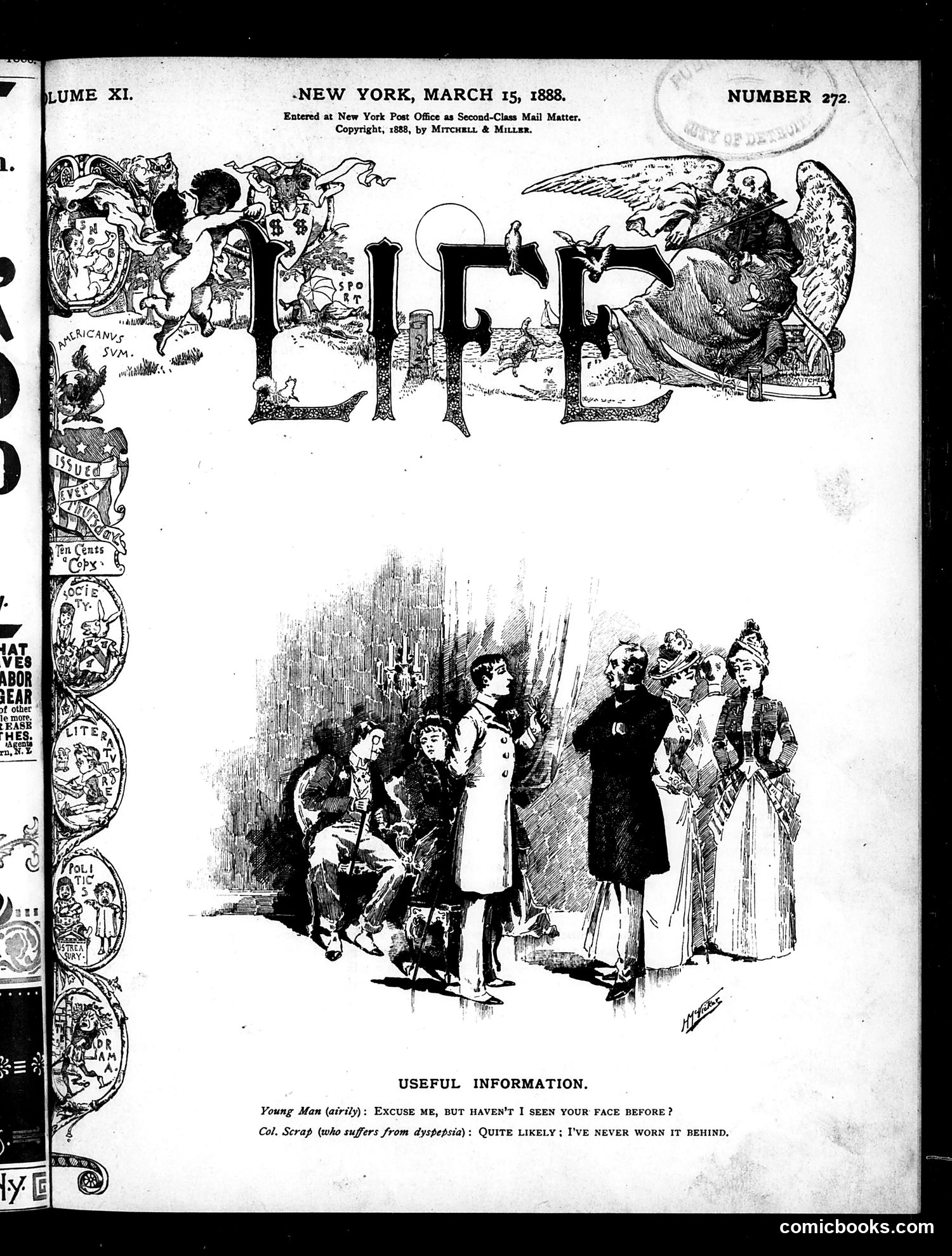
This page features a satirical cartoon titled "LIFE" with decorative fantasy illustrations above it. The main cartoon depicts a social scene with several Victorian-era figures, captioned "USEFUL INFORMATION." The joke concerns a Young Man encountering a woman, asking if he's seen her face before. Col. Scrap replies that he likely hasn't—he never "worn it behind," a crude reference to the Colonel's posterior. The humor relies on Victorian-era satirical wordplay about social awkwardness and appearance. The elaborate decorative border and fairy-tale imagery suggest Life magazine's characteristic blend of whimsy and social commentary. The specific identities of individuals depicted are unclear from the image alone, though the formal Victorian dress indicates upper-class social commentary typical of the era's satirical publications.
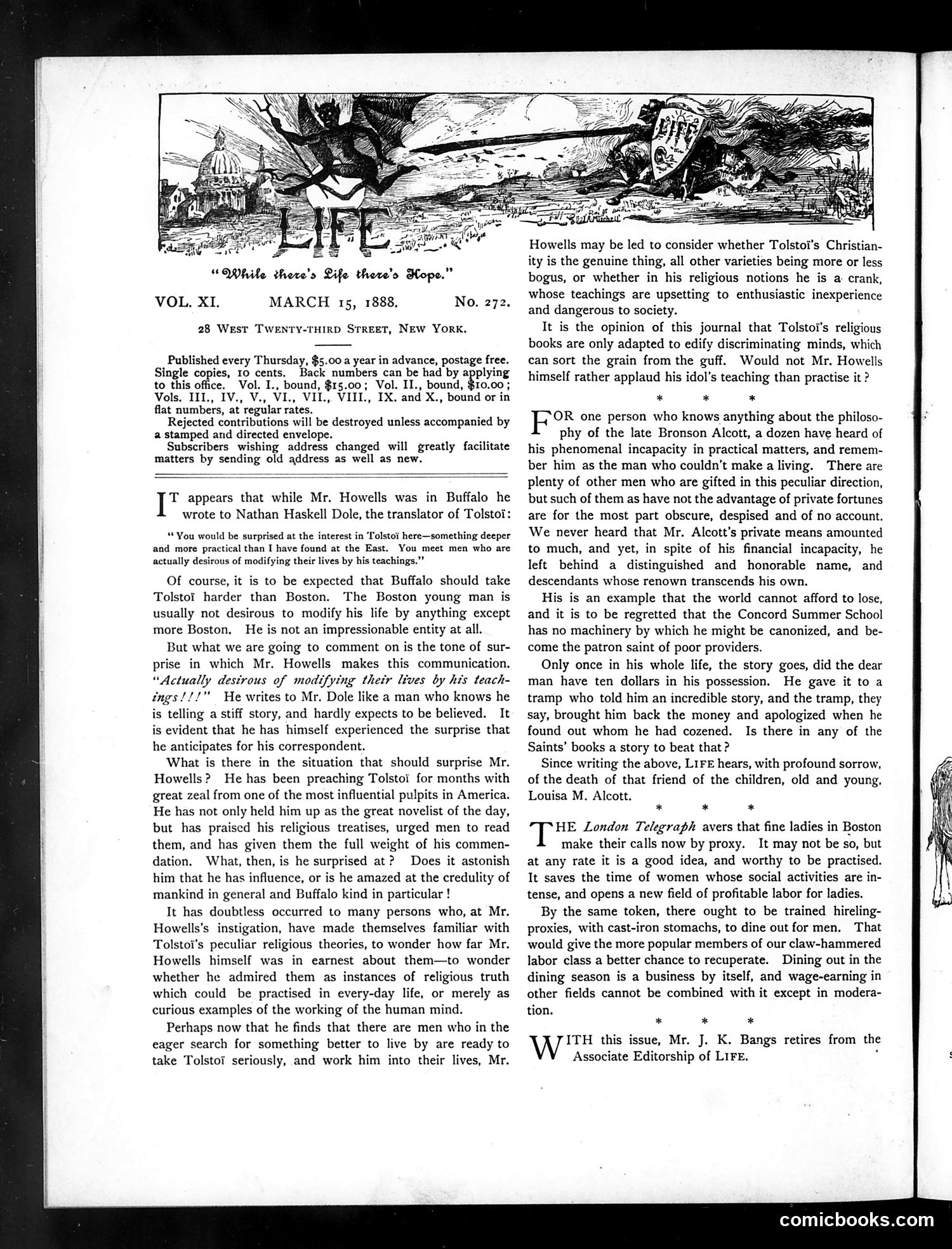
**The Cartoon:** The small illustration at top-left depicts a skeletal figure beneath a bare tree with the caption "While there's Life there's Hope." This appears to be a memento mori image—a traditional vanitas symbol representing mortality and the brevity of life. **The Editorial Content:** The page primarily contains commentary about **William Dean Howells' promotion of Tolstoy's writings** in America. The editors critique Howells' enthusiasm for Tolstoy's Christian philosophy, questioning whether Tolstoy's ideas are genuinely beneficial or potentially dangerous. The text also discusses **Bronson Alcott's impracticality** and reports on **the death of Louisa May Alcott**, Bronson's daughter. A brief note announces **J.K. Bangs' retirement** from Life's editorial staff.
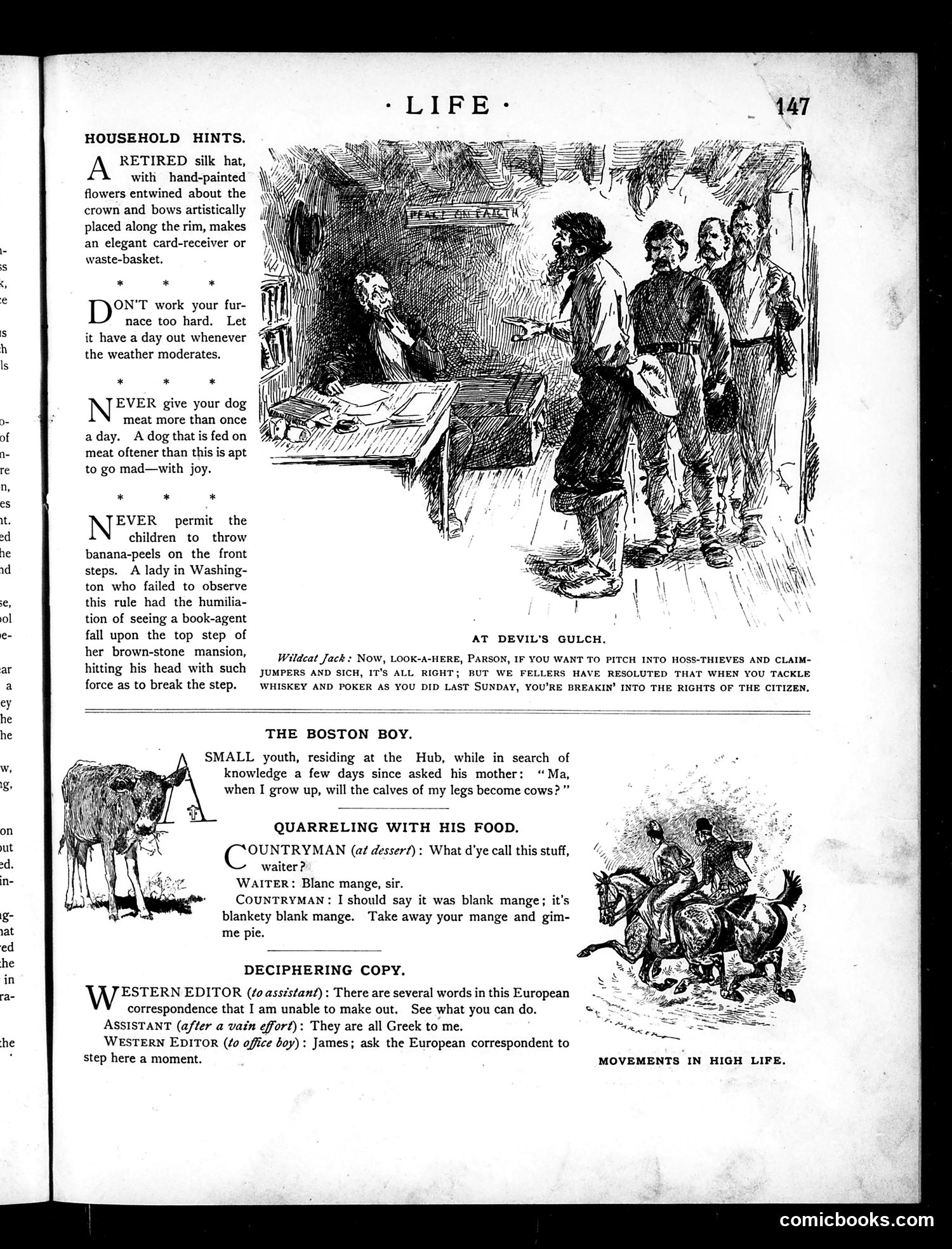
This page contains three satirical sections: **"At Devil's Gulch"** depicts what appears to be a Western saloon scene where rough characters discuss illegal activities (horse-thievery, gambling, whiskey). The joke seems to mock the hypocrisy of such criminals lecturing others about morality and proper behavior—specifically about respecting citizens' rights while engaged in crime themselves. **"The Boston Boy"** humorously presents a youth asking his mother if his legs will become "cows" when he grows up—apparently a child's misunderstanding of some adult conversation. **"Quarreling with His Food"** shows a countryman complaining to a waiter about "blanc mange" (a bland dessert), calling it "blanketly blank mange" in humorous frustration. **"Deciphering Copy"** depicts office workers struggling to read unclear correspondence, poking fun at communication difficulties in publishing.
The page header features a decorative illustration of various animals in a procession, likely serving as the magazine's satirical motif. The content consists primarily of **short opinion pieces and commentary** rather than political cartoons: - "A Common Error" critiques Robert Louis Stevenson's writing style, suggesting he occasionally becomes verbose and bossy - A correspondent complains about the "Belles Lettres" column focusing too much on men's work - Brief notes discuss Queen Victoria, Buck Grant as an editor, and a Milton Memorial Window inscription **"The Best Hundred Books"** lists classic and contemporary literature recommendations. This appears to be a **literary/cultural criticism page** rather than political satire. The humor is intellectual and aimed at educated readers debating authors, literary merit, and cultural taste—typical of Life magazine's sophisticated satirical approach.
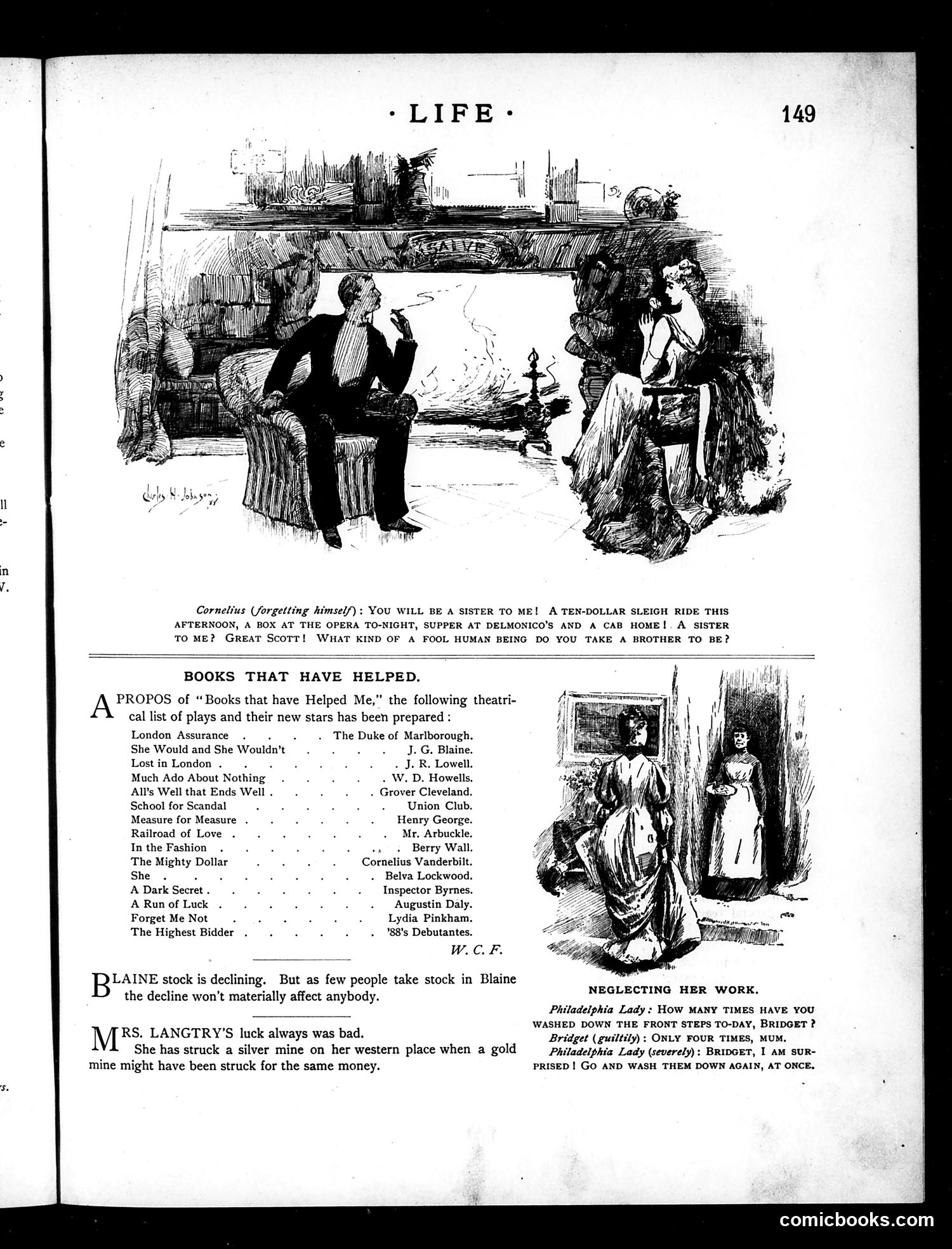
The top cartoon depicts a man named **Cornelius** (likely a character from contemporary theater) being propositioned by a woman offering him a luxurious evening: a ten-dollar sleigh ride, opera box, dinner at Delmonico's restaurant, and a cab ride home—all conditional on him becoming her "brother." The satire mocks **upper-class courtship rituals and transactional relationships**. The woman's euphemistic language ("brother") disguises what appears to be a kept-mistress arrangement, while the specific expensive venues (Delmonico's was an elite New York restaurant) emphasize wealthy Manhattan social pretension. The bottom section is unrelated text about "Books That Have Helped" theatrical productions and brief humorous anecdotes about Blaine and Mrs. Langtry, likely contemporary figures or gossip.
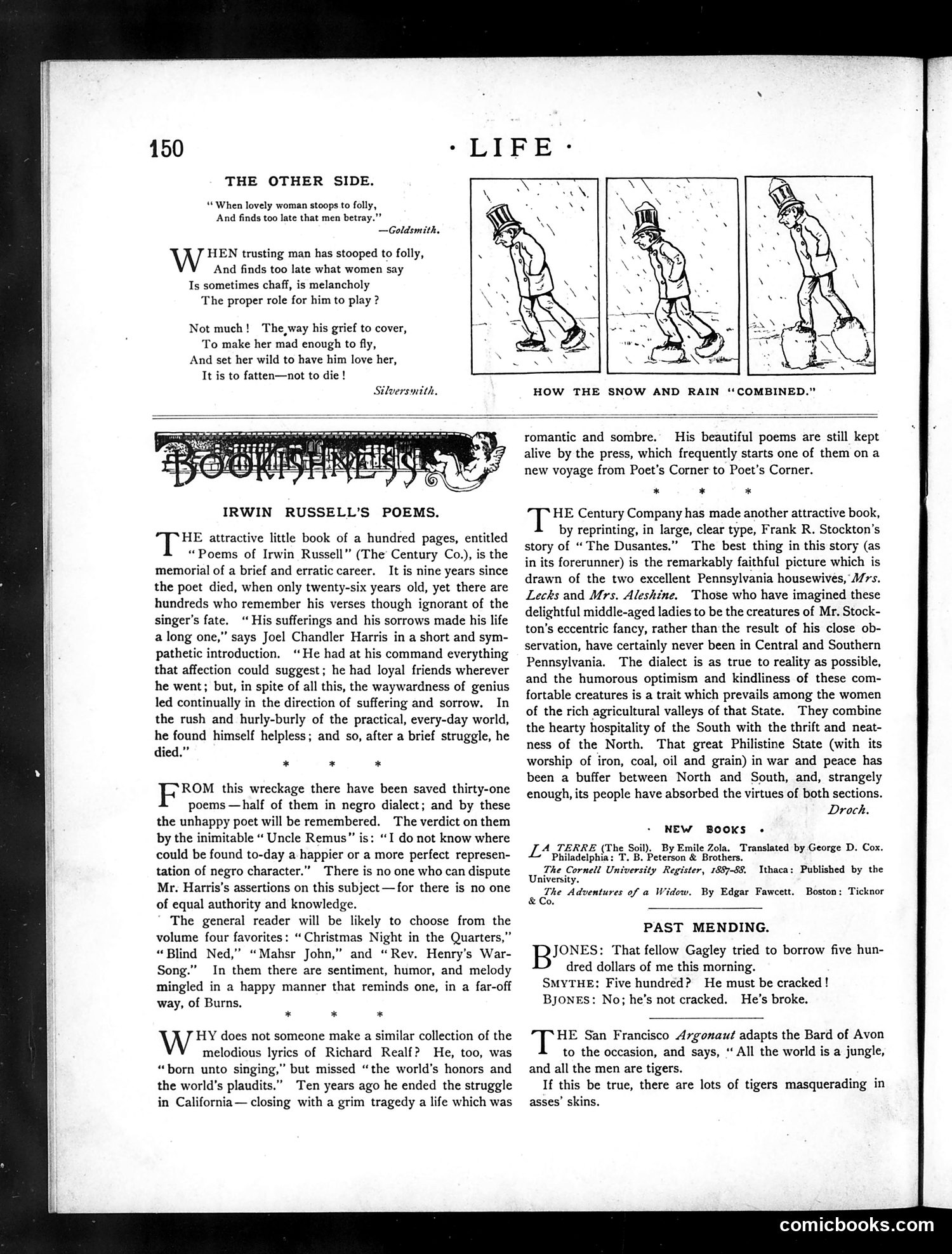
This three-panel comic depicts a man attempting to walk through severe winter weather. In each panel, he struggles progressively more against the elements—leaning forward against the wind and precipitation, seemingly losing his footing, and finally appearing to slip or fall. The title's ironic quotation marks suggest the "combination" of snow and rain creates impossible walking conditions. The visual joke relies on the common experience of treacherous winter weather making pedestrian travel difficult or comical. The page also contains book reviews, including discussion of Irwin Russell's poetry collection and Frank Stockton's "The Dusantes," indicating this is primarily a literary criticism page with one humorous illustration.
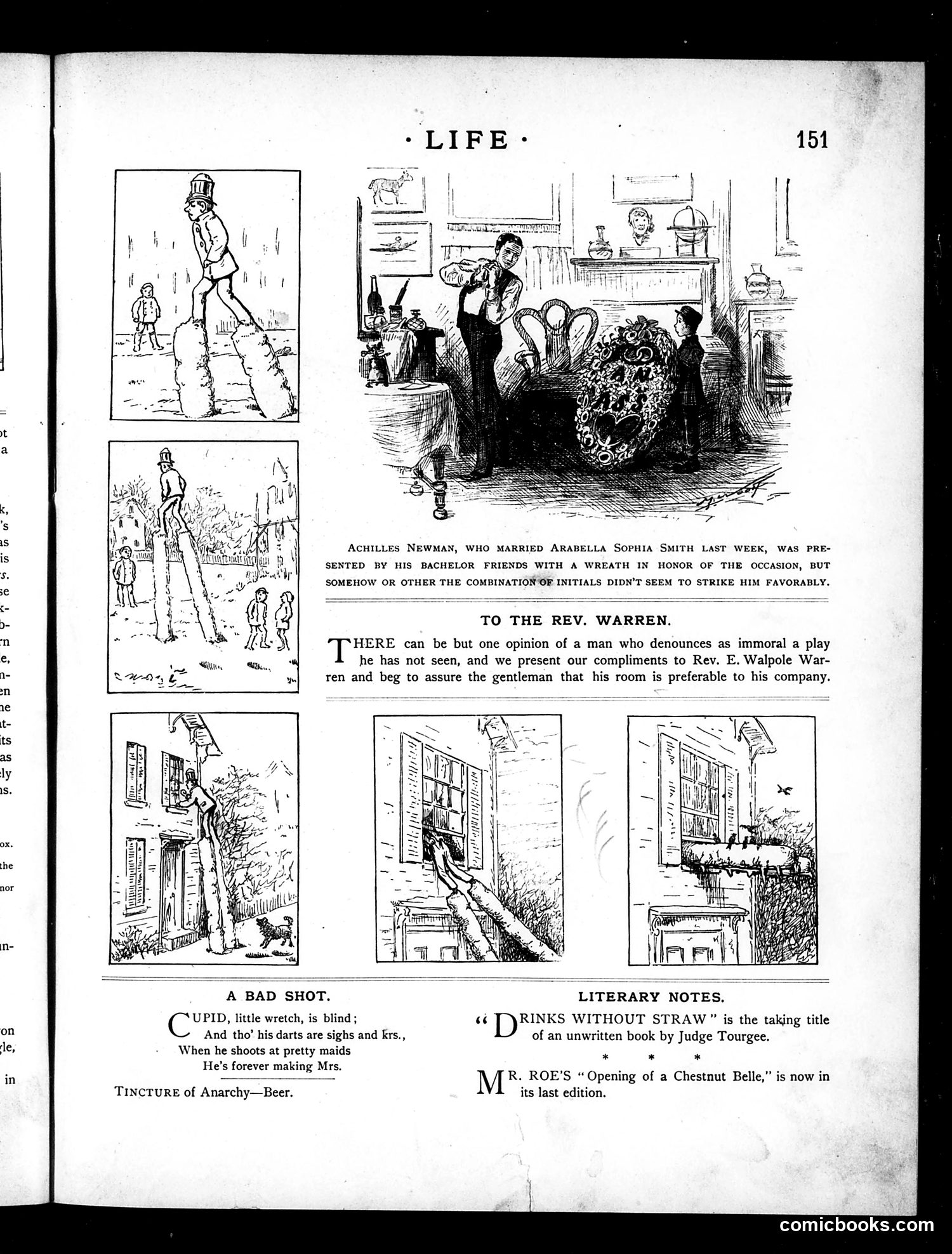
The main cartoon depicts a wedding celebration for "Achilles Newman, who married Arabella Sophia Smith last week." His bachelor friends presented him with a wreath, but the caption notes the wreath's design—apparently featuring initials or symbols—"didn't seem to strike him favorably," suggesting the friends made an insulting or embarrassing joke through the gift's composition. Below, "To the Rev. Warren" criticizes a clergyman who denounced a play he hadn't seen, suggesting he prefers his room to such company—mocking sanctimonious moral outrage based on hearsay rather than actual knowledge. The three sequential cartoons titled "A Bad Shot" and "Literary Notes" appear to be separate brief humorous pieces typical of Life's satirical format, though their specific references are unclear without additional context.
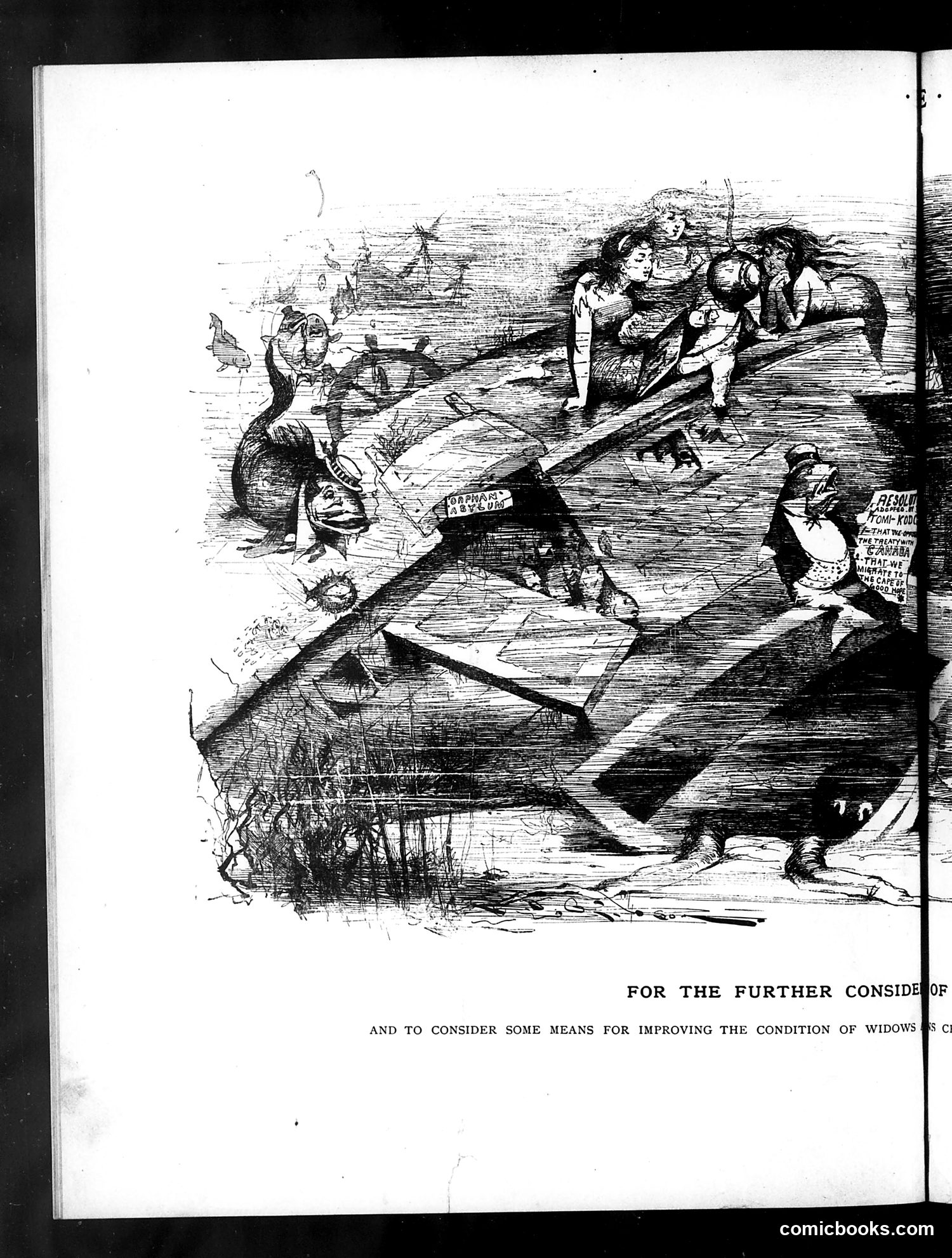
This page contains an etching-style satirical illustration depicting a chaotic seaside or waterfront scene with multiple figures. The visible text references consideration of "means for improving the condition of widows." The cartoon appears to be social satire about poverty or welfare, given the text's mention of widows' conditions. The crowded composition with various figures—some appearing distressed or in conflict—suggests commentary on social disorder or mismanagement of charitable concerns. However, without clearer identification of specific caricatured figures or visible labels/names in the image, I cannot definitively identify which political figures or events this targets. The artistic style and subject matter suggest late 19th or early 20th-century American social criticism, but the exact satirical point remains unclear from this reproduction.
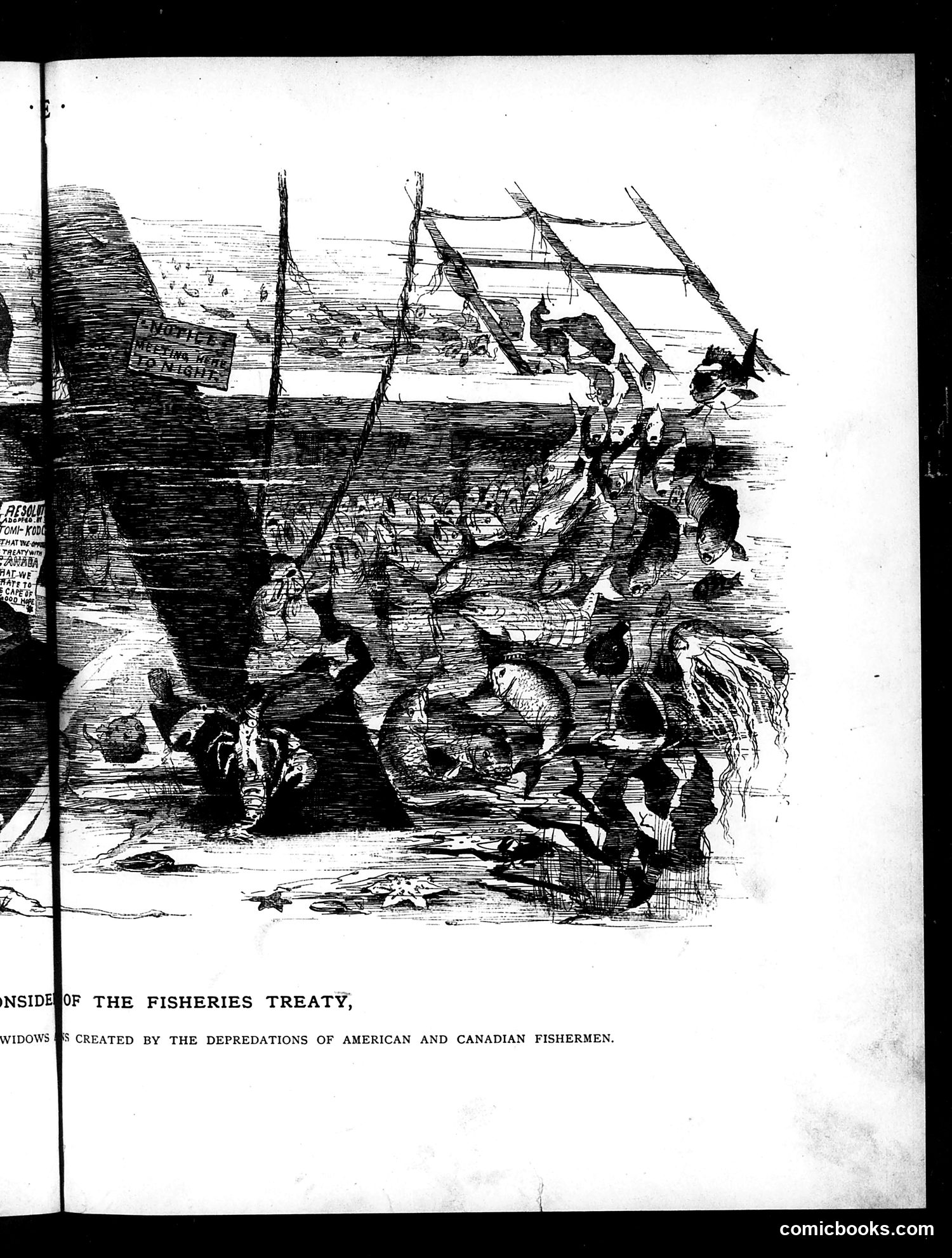
This engraving illustrates a conflict over the Fisheries Treaty, depicting what the caption describes as "widows created by the depredations of American and Canadian fishermen." The scene shows a maritime disaster or conflict—a damaged or sinking vessel with people in distress in the water. The satire appears to criticize fishing practices and territorial disputes between American and Canadian fishermen, suggesting their competition resulted in casualties or suffering. The caption's reference to "widows" indicates the cartoon is making a pointed moral argument: that commercial fishing disputes—likely involving illegal fishing or boundary violations—caused deaths that left families bereaved. Rather than depicting the fishermen themselves, the artist chose to show the human cost of their rivalry, using widows as a symbol of loss to heighten the emotional impact of the satire against whoever bore responsibility for these "depredations."
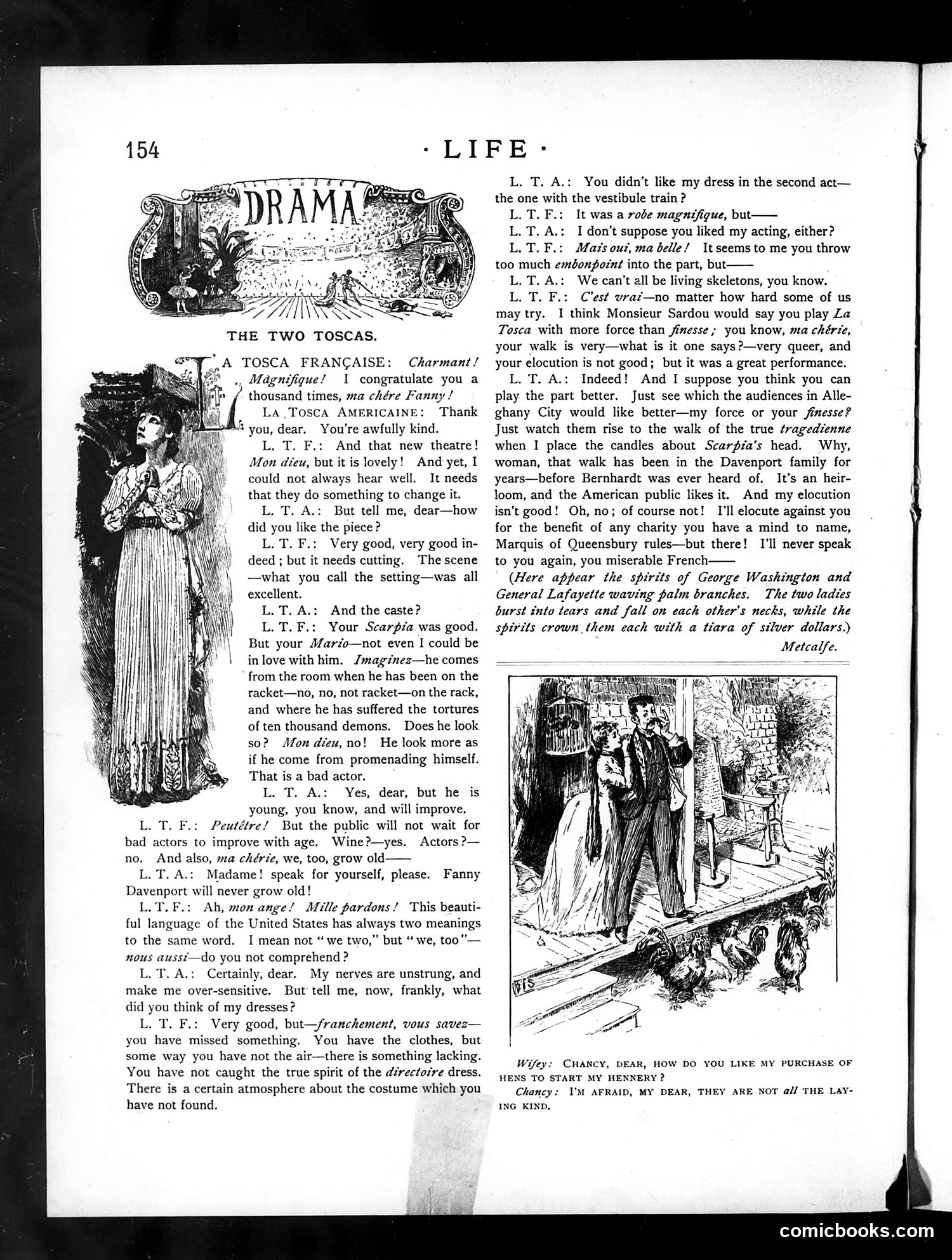
This page critiques a theatrical production of "La Tosca" (Puccini's famous opera/play). Two unnamed American theater critics—identified only as "L.T.A." and "L.T.F."—debate the performance's merits. The satire targets American actors performing European dramatic works. The critics dispute whether the lead actress's "Scarpia" was adequately tragic, whether the male lead "Mario" looked sufficiently tortured, and whether the performers captured authentic European theatrical atmosphere versus merely mimicking surface elements. The accompanying illustrations show theatrical scenes. A lower caption jokes about a character named Chancy purchasing hens for a henhouse—likely a separate theatrical sketch or comedic sidebar unrelated to Tosca. The humor lies in pretentious theatrical criticism of imported continental drama performed by American actors struggling with European sensibilities.
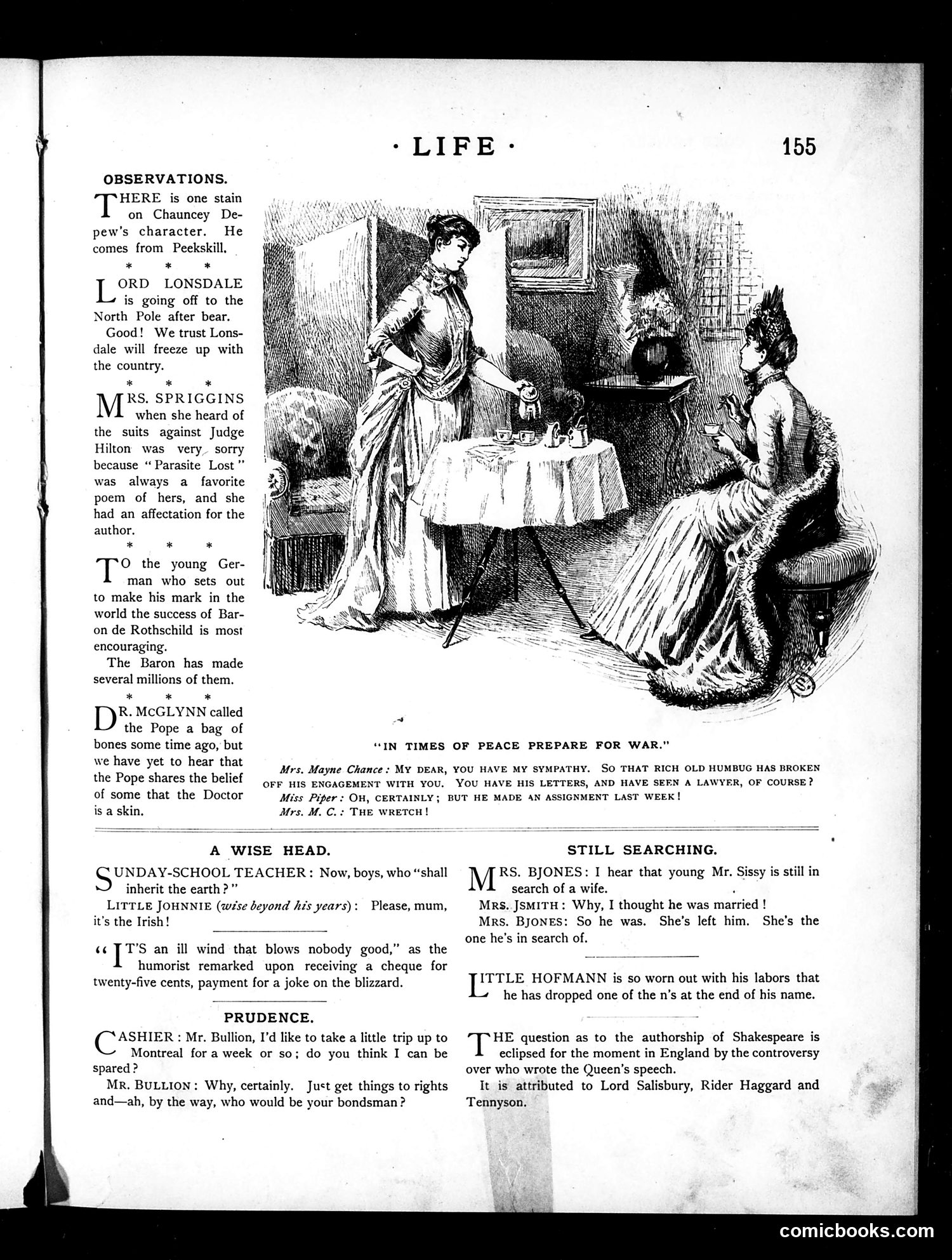
This page collects short satirical "observations"—jokes targeting public figures and social types of the era (likely late 1800s based on references). **Key targets include:** - **Chauncey Depew**: A prominent businessman/politician mocked for his Peekskill origins - **Lord Lonsdale**: Criticized for going bear-hunting; the joke wishes he'll "freeze up with the country" (unclear historical context) - **Judge Hilton**: Subject of lawsuits; satirized through a literary reference - **Baron de Rothschild**: Jewish banker caricatured through antisemitic stereotyping about making "millions" - **Dr. McGlynn**: A priest who criticized the Pope **The main cartoon** depicts two women discussing a broken engagement where the man made "an assignment" (financial ruin)—the joke being she's now searching for *him* rather than a new husband. **Social humor includes** ethnic stereotyping (Irish inheriting earth), class commentary (wealthy businessmen), and marital satire. The final note jokes that Queen Victoria's speech authorship matters less than Shakespeare's—typical Victorian literary debate.
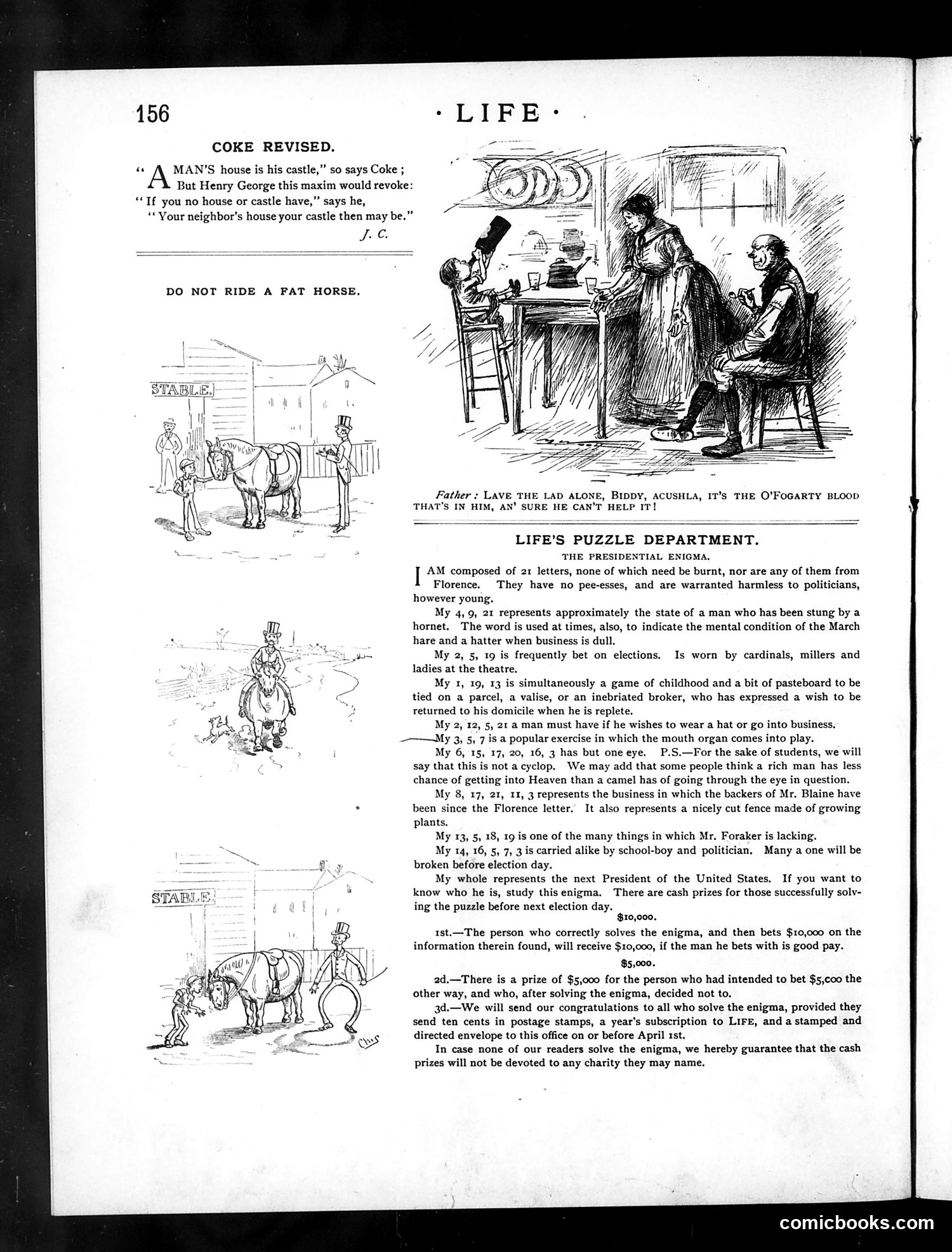
This page combines political commentary with humor typical of *Life* magazine's satirical approach. **Top section**: "Coke Revised" mocks legal theorist William Blackstone's famous maxim that "a man's house is his castle" by contrasting it with Henry George's land-reform philosophy—suggesting George would argue your neighbor's house becomes yours if you lack one. This satirizes contemporary debates over property rights and land taxation. **Middle cartoon**: The Irish father-and-son sketch stereotypes Irish-American immigrants, playing on period ethnic caricature conventions and suggesting hereditary behavioral traits ("O'Fogarty blood"). **Main feature**: "The Presidential Enigma" is a word puzzle where solving 21 letters reveals the next U.S. president's name. The clues reference contemporary political figures (James Blaine, Joseph Foraker) and mock the unpredictability of elections. The satirical "prize" structure (betting on the answer) jabs at election-day gambling and political uncertainty—essentially suggesting even solving the puzzle won't definitively predict outcomes.
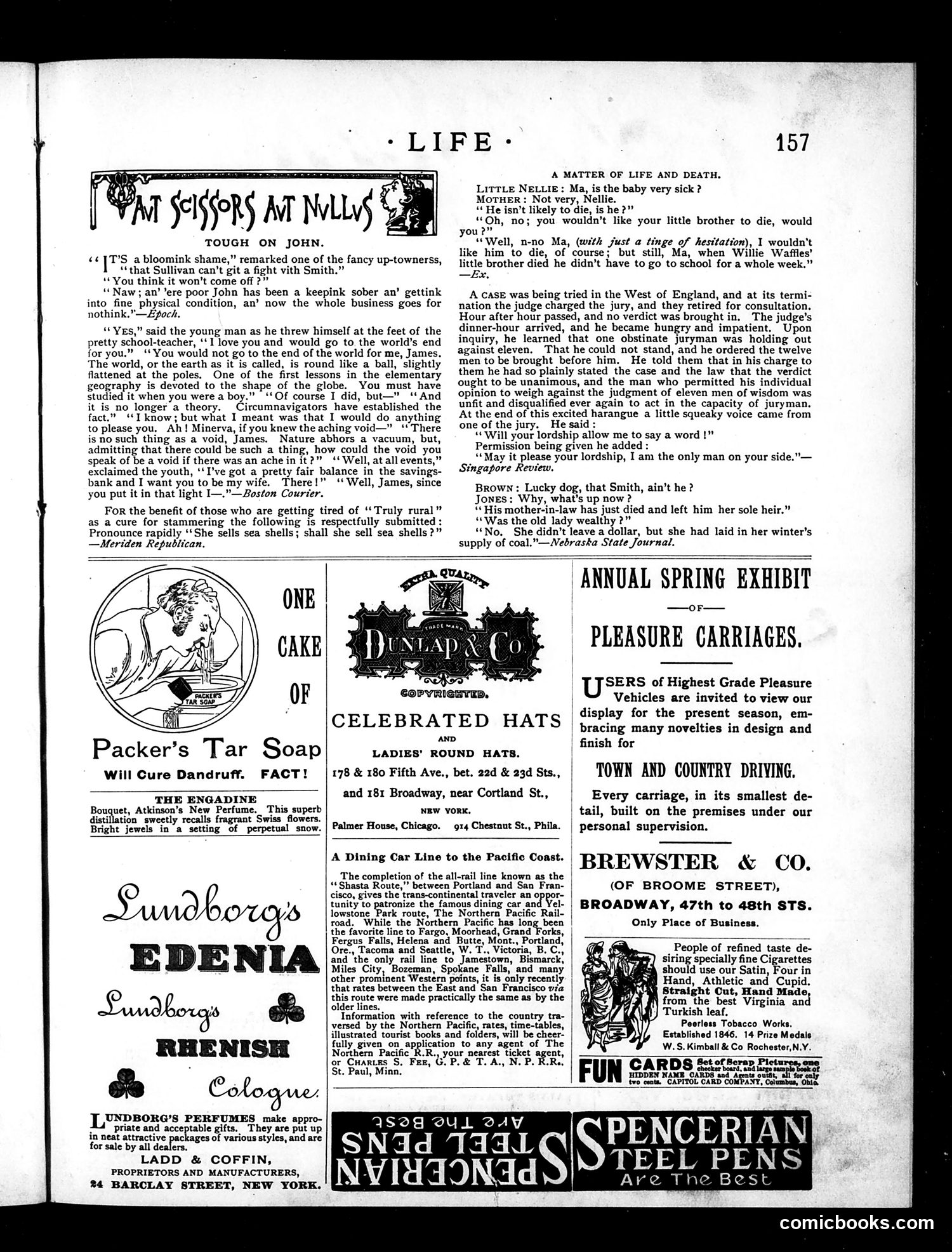
This page contains several humorous anecdotes typical of early 20th-century American satirical journalism: **"Tough on John"** references boxer John L. Sullivan, a famous heavyweight champion. The joke mocks fans disappointed that Sullivan can't secure a fight with Smith—despite training hard and staying sober, the match falls through. **"A Matter of Life and Death"** presents dark humor: a child admits she wouldn't mind her baby brother dying because his death would excuse her from school (referencing classmate Willie Waffles' sibling). **The jury anecdote** satirizes judicial arrogance: a judge bullies a holdout juror into silence, but the juror reveals he's actually *correct*—the other eleven are wrong. **The final joke** about Smith's mother-in-law's death plays on expectations: readers anticipate wealth inheritance, but she only left coal, making the "inheritance" useless. The page is primarily **advertisement-heavy**, featuring patent medicines, soaps, and carriages. The humor reflects period attitudes toward class, gender, and acceptable comedy targets.
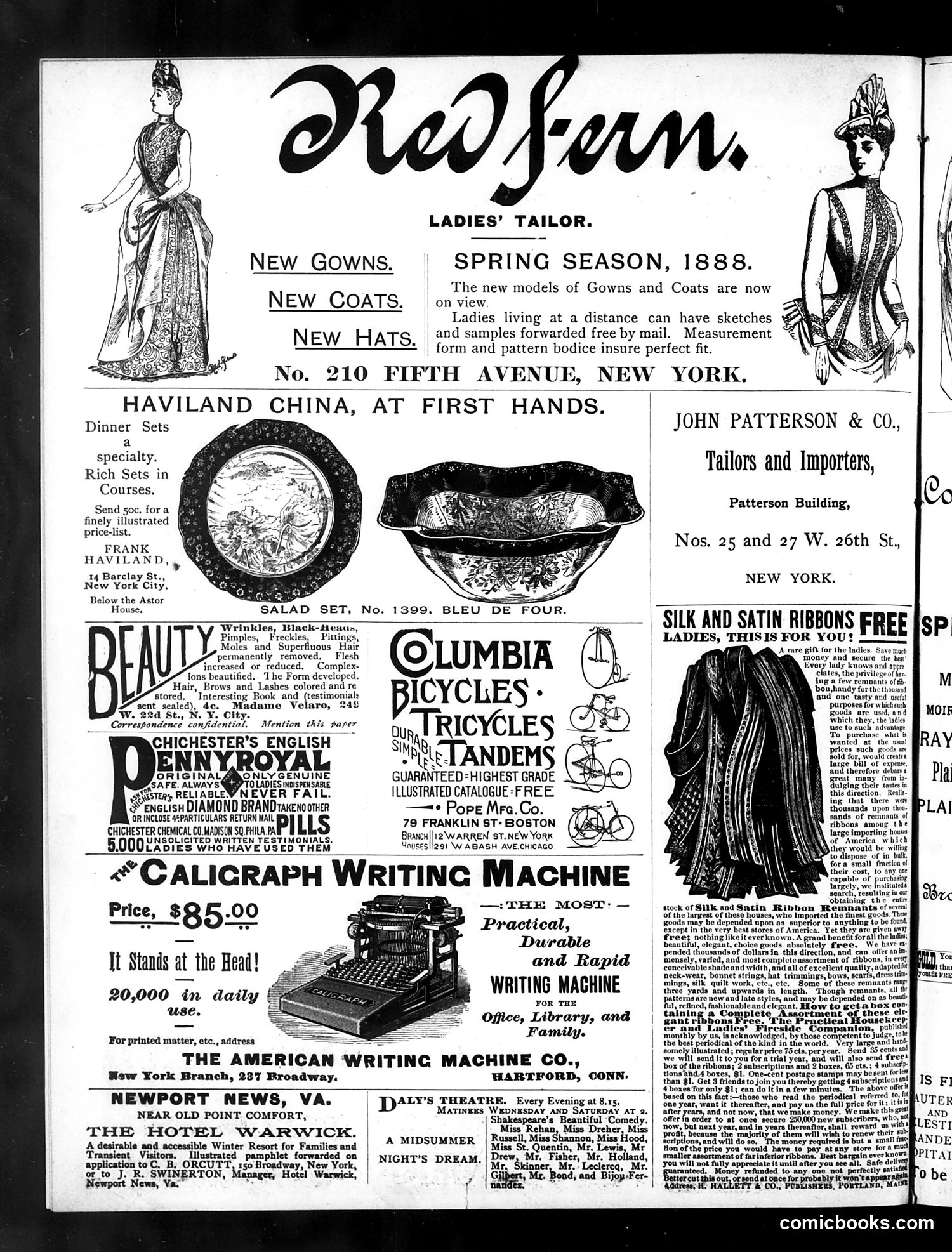
This is primarily an **advertising page** from Life magazine's Spring 1888 issue, not a political cartoon. It features Victorian-era commercial advertisements for luxury goods and services targeting affluent readers. **Notable ads include:** - **Red Fern** (ladies' tailor on Fifth Avenue, New York) advertising spring gowns, coats, and hats - **Haviland china** (fine dinnerware) - **Beauty services** (skin treatments, hair restoration by "Madame Velaro") - **Pennyroyal pills** (a contraceptive/abortion aid, discreetly advertised) - **Columbia bicycles and tricycles** - **Caligraph typewriter** ($85, claiming 20,000 daily users) - **Hotel Warwick** (Newport News resort) - **Daly's Theatre** (production of *A Midsummer Night's Dream*) - **Free silk and satin ribbon offer** (the largest ad, promising samples from imported stock) The page reflects 1888 consumer culture—emerging technologies (typewriters, bicycles), leisure travel, theater, and beauty/fashion industries targeting wealthy women.
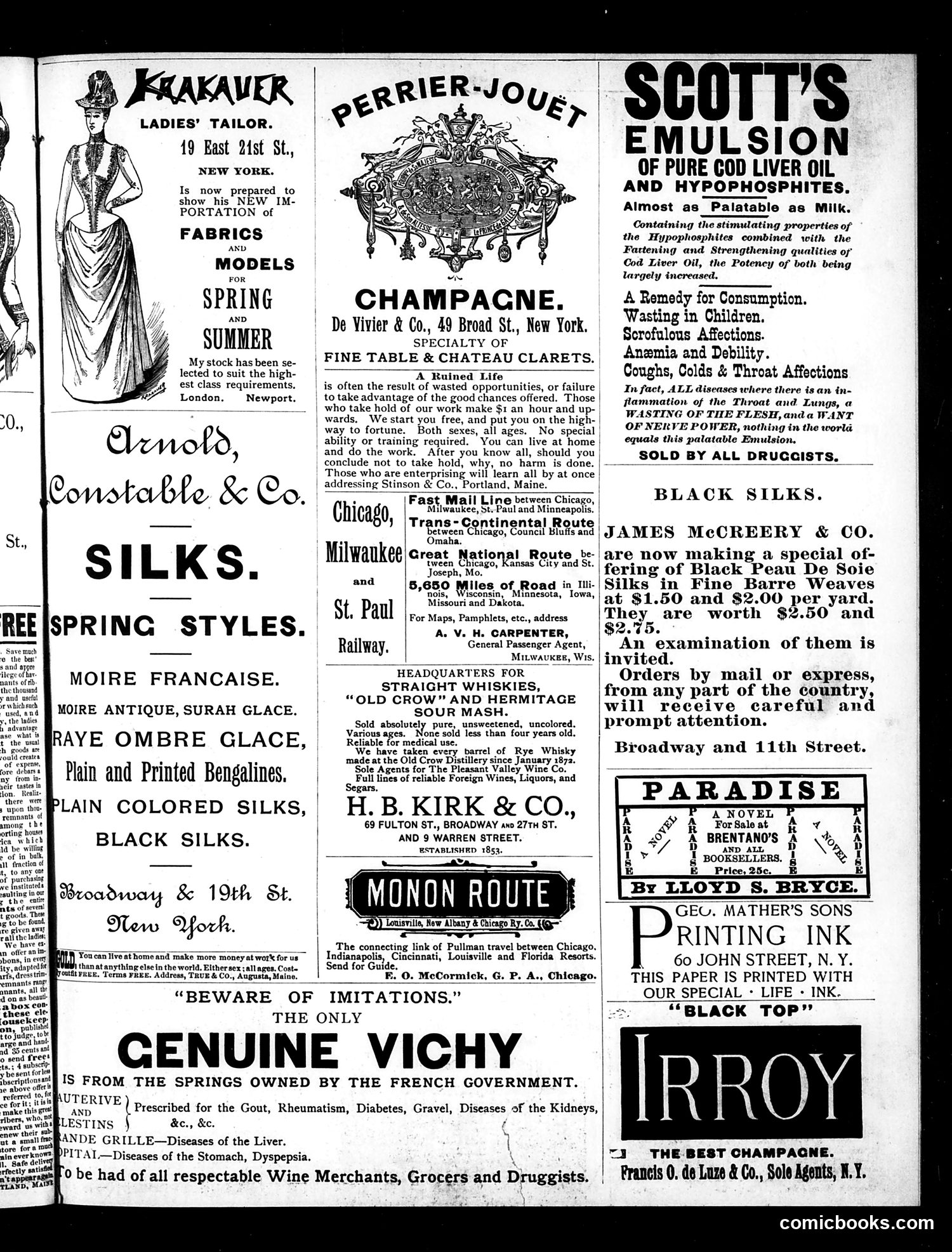
This page is **primarily advertisements** with no political cartoons or satirical content visible. The ads reflect late 19th-century commercial culture: luxury fabric merchants (silks, moires), patent medicines (Scott's Cod Liver Oil Emulsion for consumption and wasting diseases), champagne imports, and railroad services. The advertisements reveal period attitudes—particularly the aggressive medical claims for Scott's Emulsion, which promised to cure serious diseases like tuberculosis and "scrofulous affections," typifying the era's unregulated pharmaceutical marketing. Notable is the "Beware of Imitations" warning for Vichy water, reflecting contemporary concerns about product counterfeiting. The ads also show class-conscious marketing: fine fabrics for "highest class requirements," imported French champagne, and upscale addresses (Broadway locations). There is no discernible cartoon, satire, or political commentary on this page—it functions as a typical commercial publication section.
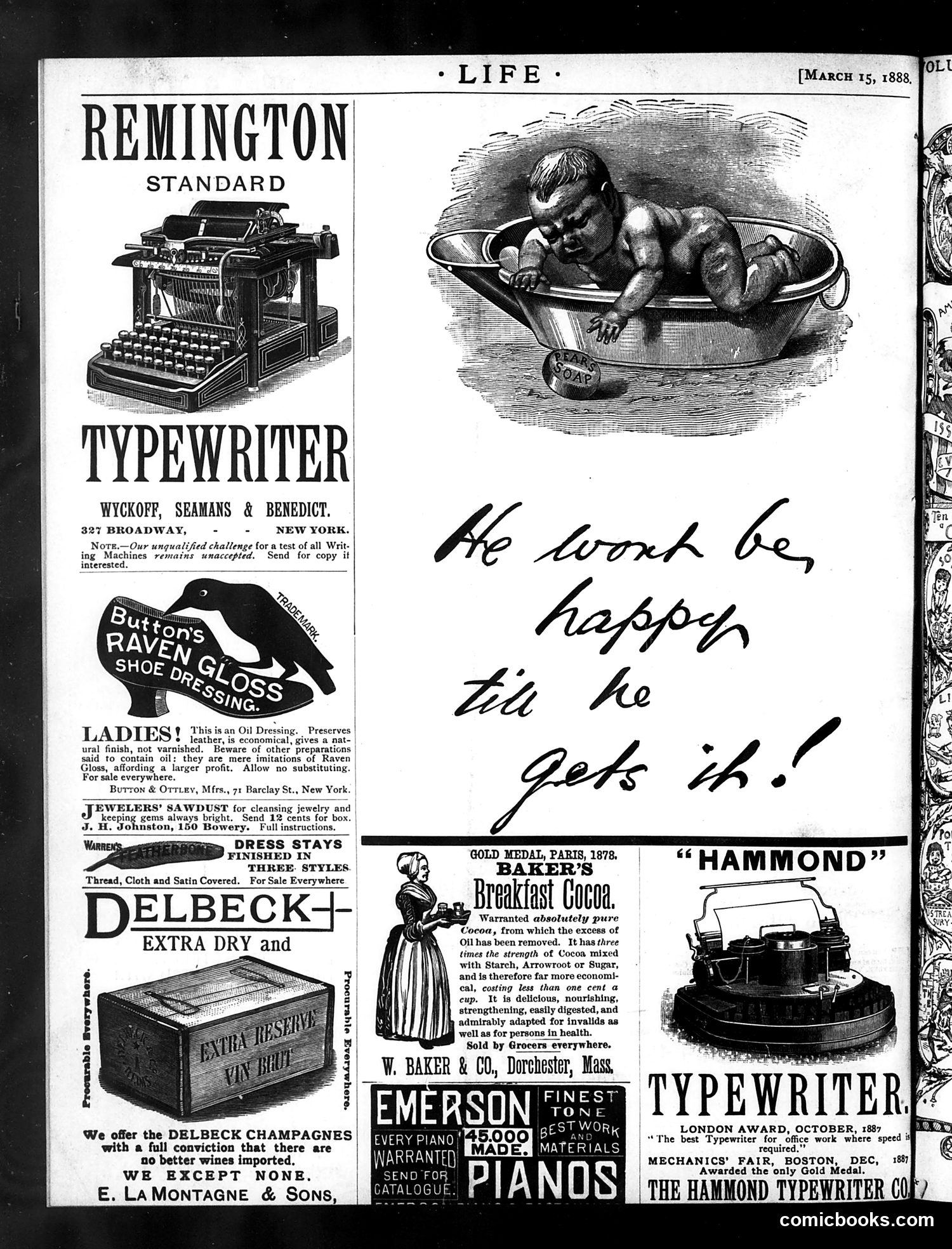
This page is primarily **advertising**, not political satire. It's from *Life* magazine (March 15, 1883) and features product advertisements for the era: typewriters (Remington Standard, Hammond), pianos (Emerson), cocoa (Baker's), champagne (Delbeck), shoe dressing, dress stays, and jewelry cleaner. The only illustration with narrative content shows a **cherub or baby in a bathtub with soap**, accompanied by handwritten text reading "He drunk be, happy till he gets in!" This appears to be a whimsical advertisement or humorous caption—likely promoting soap or bath products—playing on the innocent chaos of bathing a child. The page reflects late-19th-century consumer culture and advertising aesthetics rather than political commentary. The various product claims (gold medals, awards, superiority challenges) were typical marketing tactics of the period.