
Life, 1888-03-15 · page 6 of 16
Life — March 15, 1888 — page 6: what you’re looking at
What you’re looking at
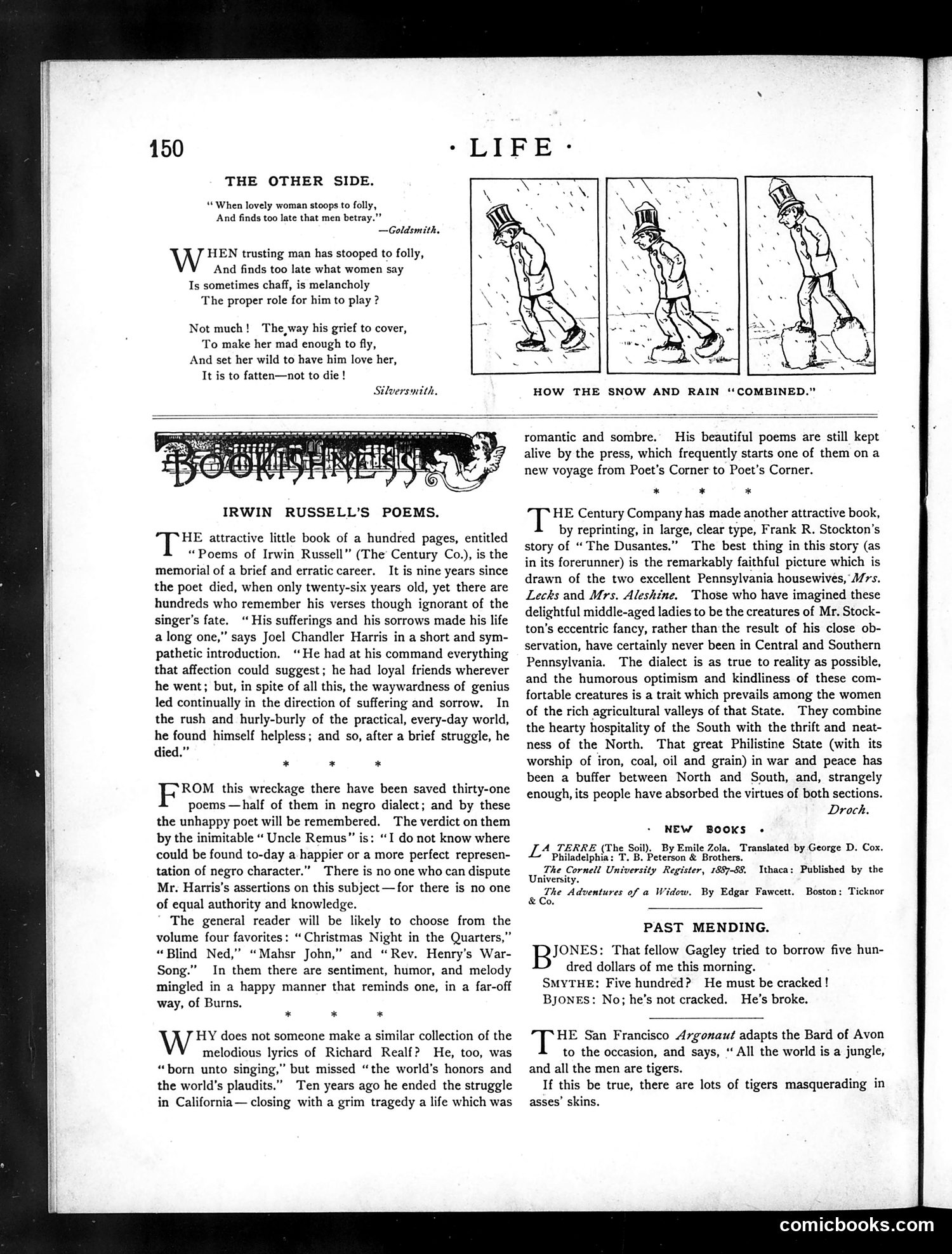
This three-panel comic depicts a man attempting to walk through severe winter weather. In each panel, he struggles progressively more against the elements—leaning forward against the wind and precipitation, seemingly losing his footing, and finally appearing to slip or fall. The title's ironic quotation marks suggest the "combination" of snow and rain creates impossible walking conditions. The visual joke relies on the common experience of treacherous winter weather making pedestrian travel difficult or comical. The page also contains book reviews, including discussion of Irwin Russell's poetry collection and Frank Stockton's "The Dusantes," indicating this is primarily a literary criticism page with one humorous illustration.
📄 Transcribed text from this page (OCR, searchable)
Machine-transcribed from the original scan — historical spelling and the odd misread are preserved.
THE OTHER SIDE. “When lovely woman stoops to folly, And finds too late that men betray.”” —Goldsmith. HEN trusting man has stooped to folly, And finds too late what women say Is sometimes chaff, is melancholy The proper role for him to play ? Not much! The,way his grief to cover, To make her mad enough to fly, And set her wild to have him love her, It is to fatten—not to die! Silversmith, HOW THE SNOW AND RAIN “COMBINED.” IRWIN RUSSELL’S POEMS. HE attractive little book of a hundred pages, entitled “Poems of Irwin Russell” (The Century Co.), is the memorial of a brief and erratic career. It is nine years since the poet died, when only twenty-six years old, yet there are hundreds who remember his verses though ignorant of the singer's fate. “ His sufferings and his sorrows made his life a long one,” says Joel Chandler Harris in a short and sym- pathetic introduction. “He had at his command everything that affection could suggest; he had loyal friends wherever he went; but, in spite of all this, the waywardness of genius led continually in the direction of suffering and sorrow. In the rush and hurly-burly of the practical, every-day world, he found himself helpless; and so, after a brief struggle, he died.” * * * ROM this wreckage there have been saved thirty-one poems —half of them in negro dialect; and by these the unhappy poet will be remembered. The verdict on them by the inimitable “ Uncle Remus” is: “I do not know where could be found to-day a happier or a more perfect represen- tation of negro character.” There is no one who can dispute Mr. Harris’s assertions on this subject —for there is no one of equal authority and knowledge. The general reader will be likely to choose from the volume four favorites: “Christmas Night in the Quarters,” “Blind Ned,” “Mahsr John,” and “Rev. Henry’s War- Song.” In them there are sentiment, humor, and melody mingled in a happy manner that reminds one, in a far-off way, of Burns, * * * HY does not someone make a similar collection of the melodious lyrics of Richard Realf? He, too, was “born unto singing,” but missed “the world’s honors and the world’s plaudits.” Ten years ago he ended the struggle in California— closing with a grim tragedy a life which was romantic and sombre. His beautiful poems are still kept alive by the press, which frequently starts one of them on a new voyage from Poet’s Corner to Poet’s Corner. * * * T HE Century Company has made another attractive book, by reprinting, in large, clear type, Frank R. Stockton’s story of “The Dusantes.” The best thing in this story (as in its forerunner) is the remarkably faithful picture which is drawn of the two excellent Pennsylvania housewives, Mrs. Lecks and Mrs. Aleshine. Those who have imagined these delightful middle-aged ladies to be the creatures of Mr. Stock- ton’s eccentric fancy, rather than the result of his close ob- servation, have certainly never been in Central and Southern Pennsylvania. The dialect is as true to reality as possible, and the humorous optimism and kindliness of these com- fortable creatures is a trait which prevails among the women of the rich agricultural valleys of that State. They combine the hearty hospitality of the South with the thrift and neat- ness of the North. That great Philistine State (with its worship of iron, coal, oil and grain) in war and peace has been a buffer between North and South, and, strangely enough, its people have absorbed the virtues of both sections. Droch. NEW BOOKS - [A TERRE (The Soil), By Emile Zola, Translated by George D. Cox. Philadelphia: T. B. Peterson & Brothers. The Cornell University Register, 1857-88. University. a Cit Adventures of a Widow. By Edgar Fawcett. 0. Ithaca: Published by the Boston: Ticknor PAST MENDING. Bones: That fellow Gagley tried to borrow five hun- dred dollars of me this morning. SMYTHE: Five hundred? He must be cracked! BJONES: No; he’s not cracked. He's broke. TZ San Francisco Argonaut adapts the Bard of Avon to the occasion, and says, ‘All the world is a jungle, and all the men are tigers. If this be true, there are lots of tigers masquerading in asses’ skins. comicbooks.com