
Life, 1888-03-15 · page 10 of 16
Life — March 15, 1888 — page 10: what you’re looking at
What you’re looking at
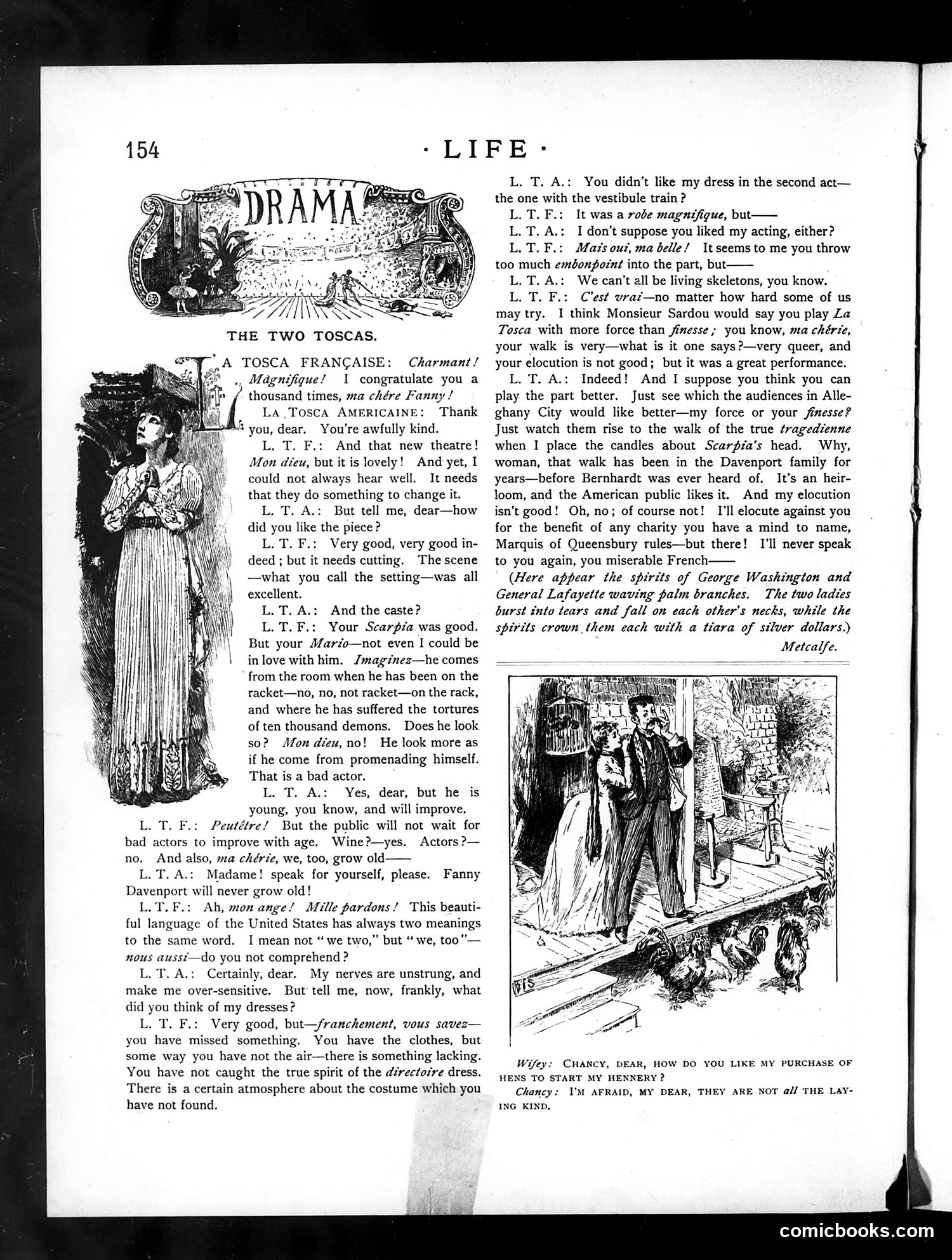
This page critiques a theatrical production of "La Tosca" (Puccini's famous opera/play). Two unnamed American theater critics—identified only as "L.T.A." and "L.T.F."—debate the performance's merits. The satire targets American actors performing European dramatic works. The critics dispute whether the lead actress's "Scarpia" was adequately tragic, whether the male lead "Mario" looked sufficiently tortured, and whether the performers captured authentic European theatrical atmosphere versus merely mimicking surface elements. The accompanying illustrations show theatrical scenes. A lower caption jokes about a character named Chancy purchasing hens for a henhouse—likely a separate theatrical sketch or comedic sidebar unrelated to Tosca. The humor lies in pretentious theatrical criticism of imported continental drama performed by American actors struggling with European sensibilities.
📄 Transcribed text from this page (OCR, searchable)
Machine-transcribed from the original scan — historical spelling and the odd misread are preserved.
- LIFE: THE TWO TOSCAS. ’ A TOSCA FRANCAISE: Charmant! ., Magnifique! 1 congratulate you a thousand times, ma chére Fanny! La ,Tosca AMERICAIN Thank * you, dear. You're awfully kind. L. T. F.: And that new theatre! Mon dieu, but it is lovely! And yet, I could not always hear well. It needs that they do something to change it. L. T. A.: But tell me, dear—how did you like the piece? L. T. F.: Very good, very good in- deed ; but it needs cutting. The scene —what you call the setting—was all excellent. L.T. A.: And the caste? L.T.F.: Your Scarpa was good. But your Marzo—not even I could be in love with him. Jmagznez—he comes from the room when he has been on the racket—no, no, not racket—on the rack, and where he has suffered the tortures of ten thousand demons. Does he look so? Mon dieu, no! He look more as if he come from promenading himself. That is a bad actor. L. T. A.: Yes, dear, but he is young, you know, and will improve. L. T. F.: Peutétre/ But the public will not wait for bad actors to improve with age. Wine?—yes. Actors ?— no. And also, ma chérie, we, too, grow old— L. T. A.: Madame! speak for yourself, please. Davenport will never grow old! L.T.F.: Ah, mon ange! Mille pardons! This beauti- ful language of the United States has always two meanings to the same word. I mean not “ we two,” but “ we, too”— nous aussit—do you not comprehend ? L. T. A.: Certainly, dear. My nerves are unstrung, and make me over-sensitive. But’ tell me, now, frankly, what did you think of my dresses? L. T. F.: Very good, but—/ranchement, vous savez— you have missed something. You have the clothes, but some way you have not the air—there is something lacking. You have not caught the true spirit of the drectotre dress. There is a certain atmosphere about the costume which you have not found. Fanny L. T. A.: You didn’t like my dress in the second act— the one with the vestibule train ? L. T. F.: It was a robe magnifique, but—— L. T. A.: I don’t suppose you liked my acting, either? L.T.F.: Mazs out, ma belle! It seems to me you throw too much embonfozn¢ into the part, but—— L. T. A.: We can’t all be living skeletons, you know. L. T. F.: C'est vraz—no matter how hard some of us may try. I think Monsieur Sardou would say you play La Tosca with more force than jinesse ; you know, ma chérie, your walk is very—what is it one says?—very queer, and your elocution is not good; but it was a great performance. L. T. A.: Indeed! And I suppose you think you can play the part better. Just see which the audiences in Alle- ghany City would like better—my force or your finesse? Just watch them rise to the walk of the true ¢ragedzenne when I place the candles about Scarpza’s head. Why, woman, that walk has been in the Davenport family for years—before Bernhardt was ever heard of. It’s an heir- loom, and the American public likes it. And my elocution isn’t good! Oh, no; of course not! I'll elocute against you for the benefit of any charity you have a mind to name, Marquis of Queensbury rules—but there! I'll never speak to you again, you miserable French—— (Here appear the spirits of George Washington and General Lafayette waving palm branches. The two ladies burst into tears and fall on each other's necks, while the spirits crown them each with a tiara of silver dollars.) Metcalfe. Wifey: CHANCY, DEAR, HOW DO YOU LIKE MY PURCHASE OF HENS TO START MY HENNERY ? Chancy: \'M AFRAID, MY DEAR, THEY ARE NOT @// THE Lay- ING KIND, comicbooks.com