
A complete issue · 16 pages · 1888
Life — March 1, 1888
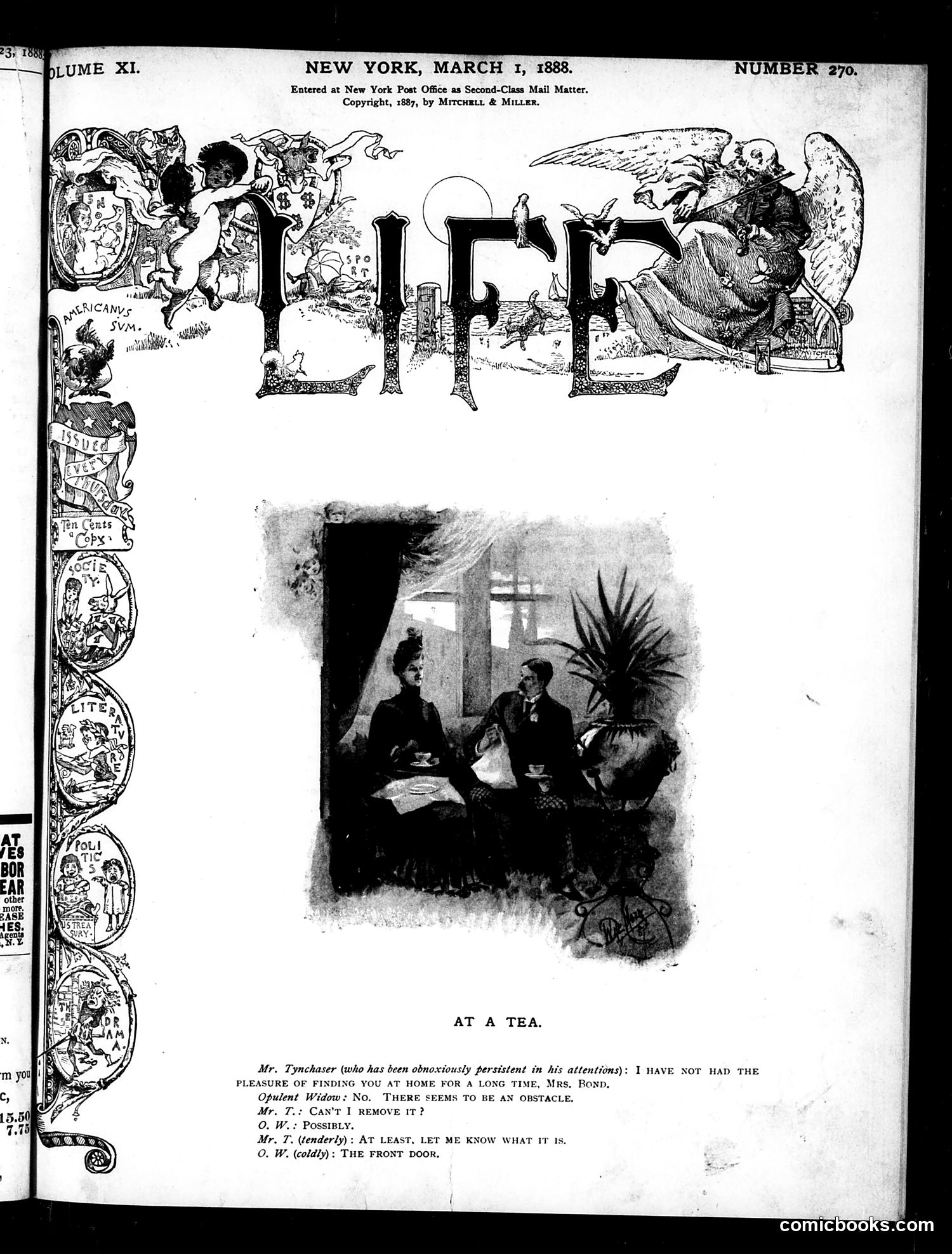
This satirical sketch depicts a social awkwardness at a tea gathering. Mr. Tynchaser complains to the hostess (Mrs. Roan) that he hasn't enjoyed visiting her home lately due to an obstacle. When asked to identify it, he obliquely refers to "the front door." The joke appears to target social pretension and cold hospitality: Tynchaser is sarcastically suggesting that Mrs. Roan's front door—the literal barrier to entry—has become an obstacle, implying she's unwelcoming or excluding him. The humor lies in the euphemistic, indirect complaint about not being invited, disguised as a discussion of a physical obstruction. This reflects Victorian-era social commentary on class dynamics and the subtle social snubs conveyed through hospitality practices.
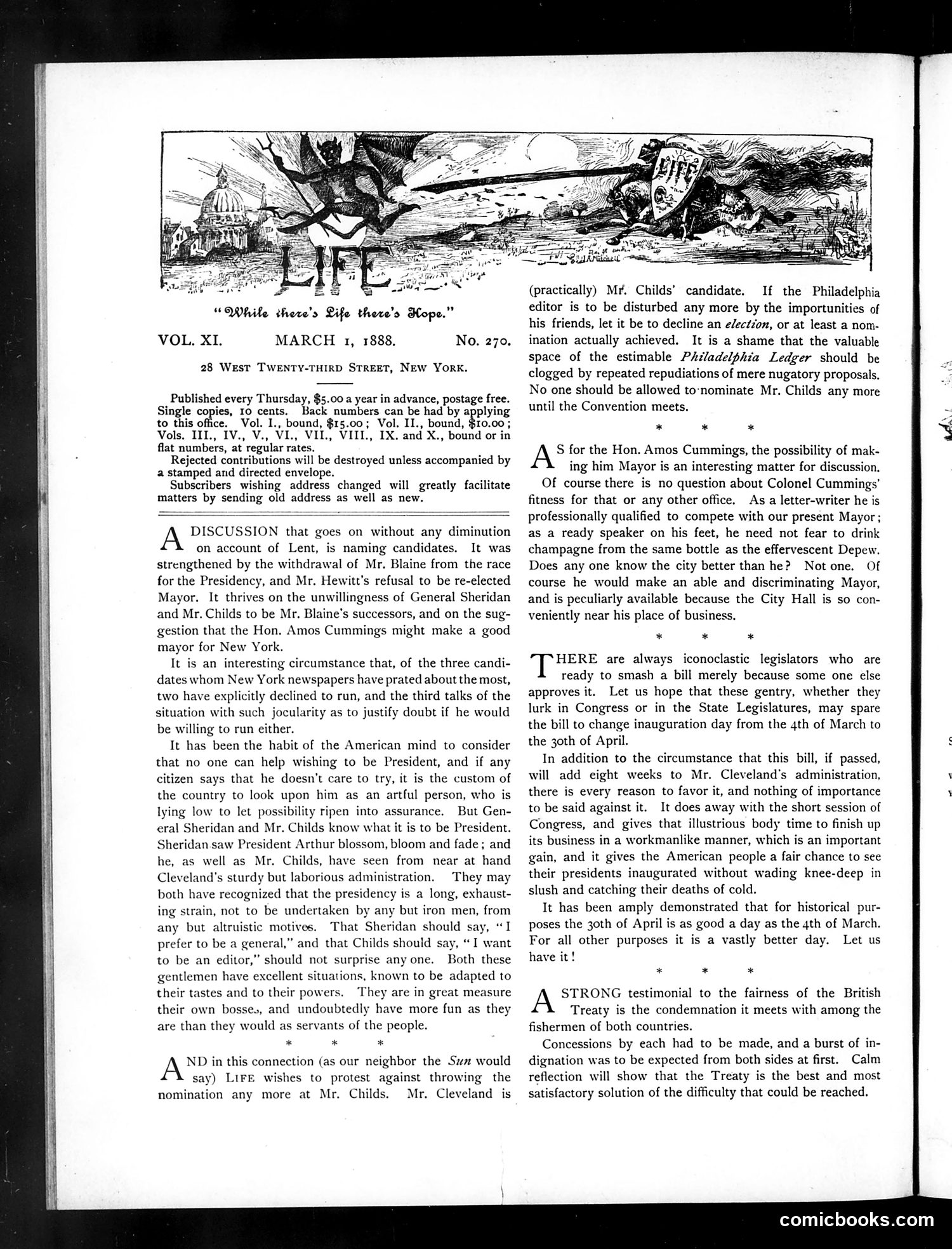
The main cartoon depicts **Death as a skeletal figure wielding a scythe**, with the caption "While there's Life there's Hope." This is a visual pun on the magazine's title. The text discusses the **1888 NYC mayoral race**, mentioning candidates including General Sheridan, Mr. Hewitt, Mr. Blaine, Mr. Childs, and Colonel Amos Cummings. The editorial debates their fitness for office, suggesting Cummings is particularly qualified given his familiarity with City Hall's location and his experience as a speaker. The piece also discusses Congressional legislation regarding presidential inauguration dates, advocating for moving it from March 4 to March 30. The satire critiques both the mediocrity of mayoral candidates and iconoclastic legislators who obstruct bills.
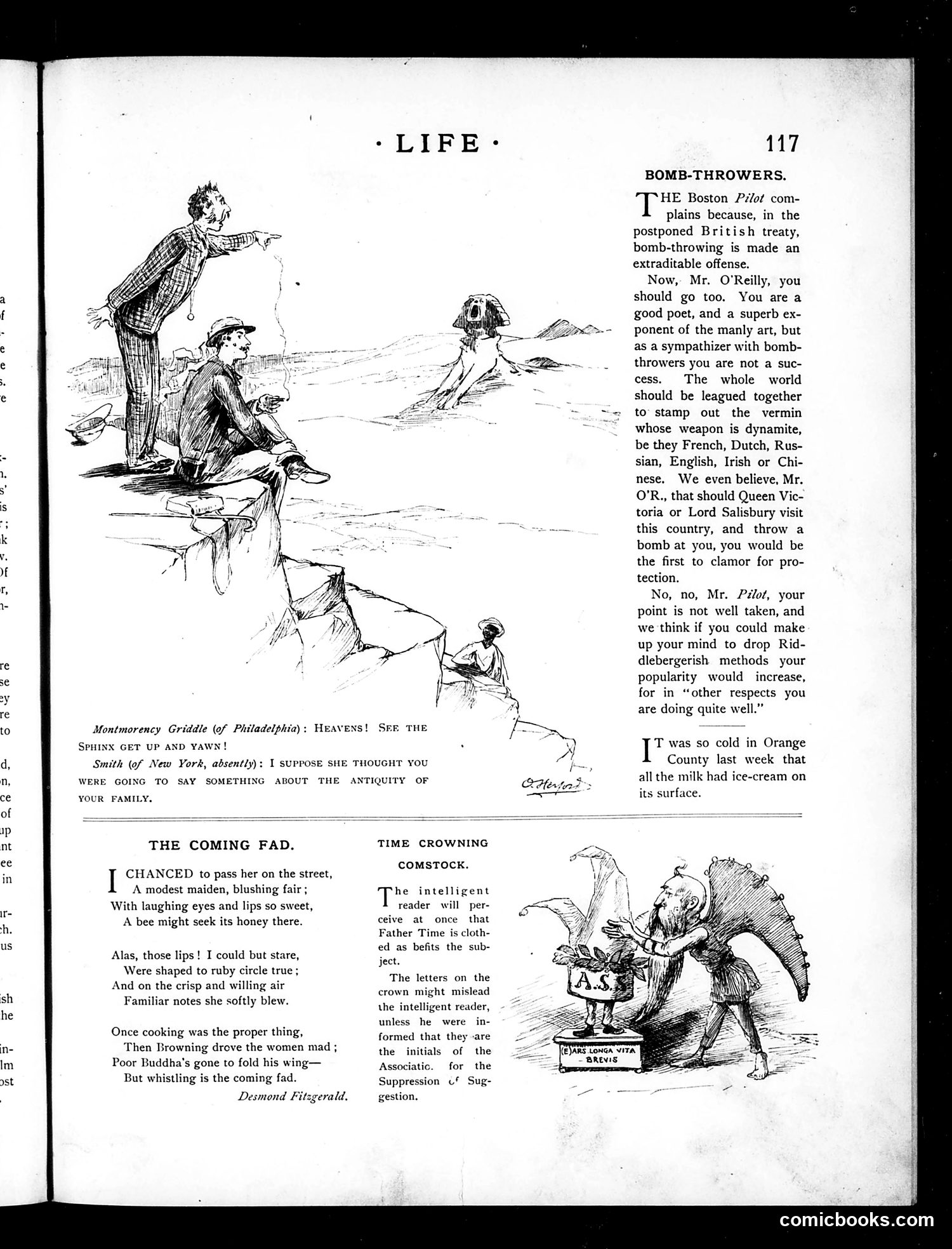
The top cartoon satirizes Irish-American bomb-throwing anarchists. A well-dressed man (labeled "Pilot," likely a Boston newspaper editor) and a woman stand on a cliff, pointing at a dog in the distance. The accompanying text mocks the *Boston Pilot's* complaint that dynamite-wielding radicals give Irish immigrants a bad reputation. The satire suggests the *Pilot* hypocritically sympathizes with bomb-throwers while condemning their methods as damaging to Irish respectability. The lower cartoon features Father Time as a winged creature carrying a basket labeled "AS TIME CARRIES VITA BREVIS" (life is short). This illustrates the adage that time flies quickly. The page reflects late 19th-century American anxiety about anarchist violence and Irish immigrant criminality.
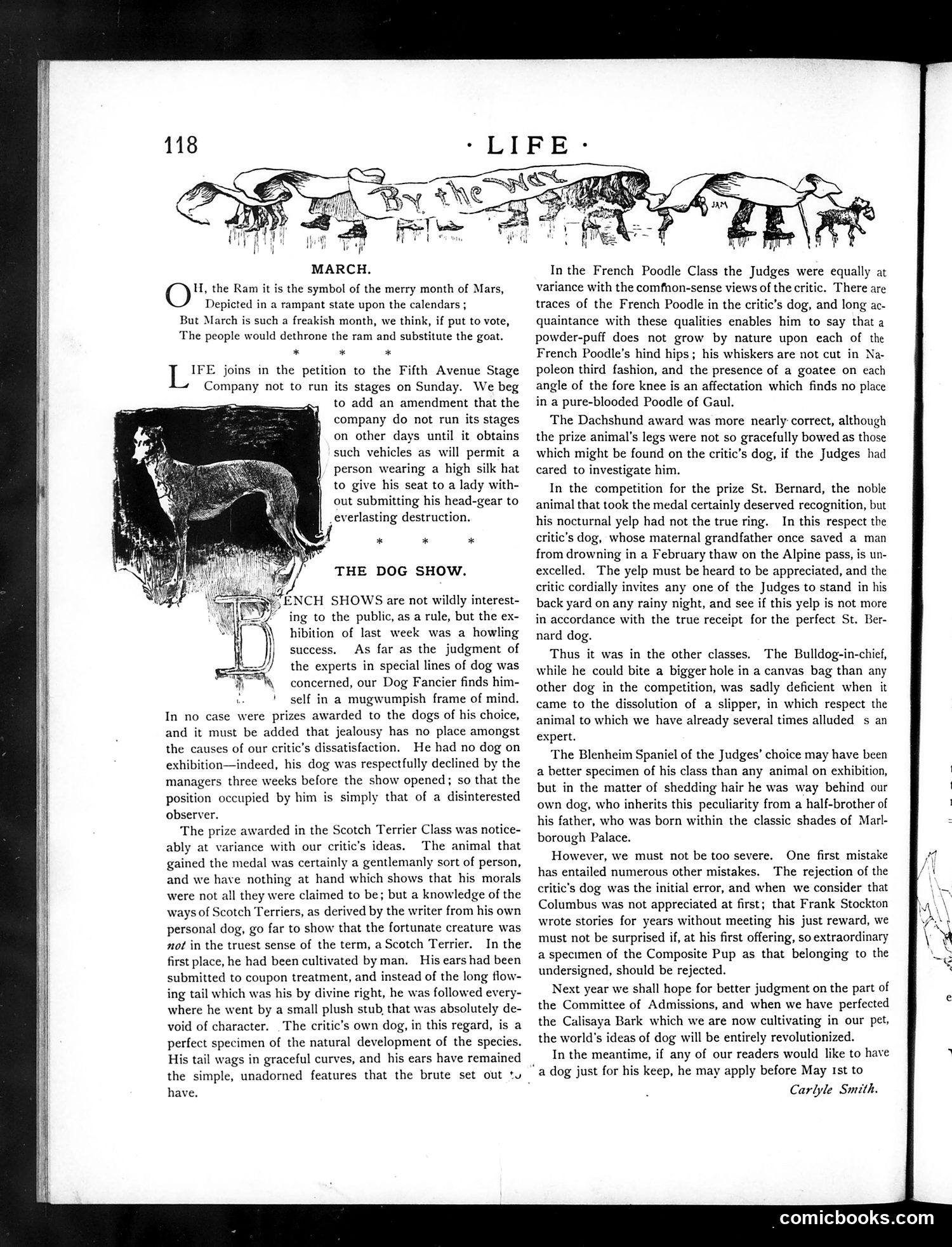
This page contains two distinct sections: **"March" Poem:** A brief verse mocking March as an unsuitable symbol for Mars, suggesting it's too "freakish" and proposing the goat as a replacement. **"The Dog Show" Article:** A satirical critique of dog show judging at what appears to be a recent Westminster-style competition. The author (Carlyle Smith) mocks the judges' decisions across multiple breeds—French Poodles, Dachshunds, St. Bernards, Bulldogs, and Blenheim Spaniels—suggesting their choices lack common sense and contradict breed standards. The accompanying illustration shows a Scottish Terrier, praised as properly embodying natural breed characteristics despite being rejected by judges. Smith's satire targets the arbitrary, fashionable nature of dog show judging rather than focusing on genuine animal merit.
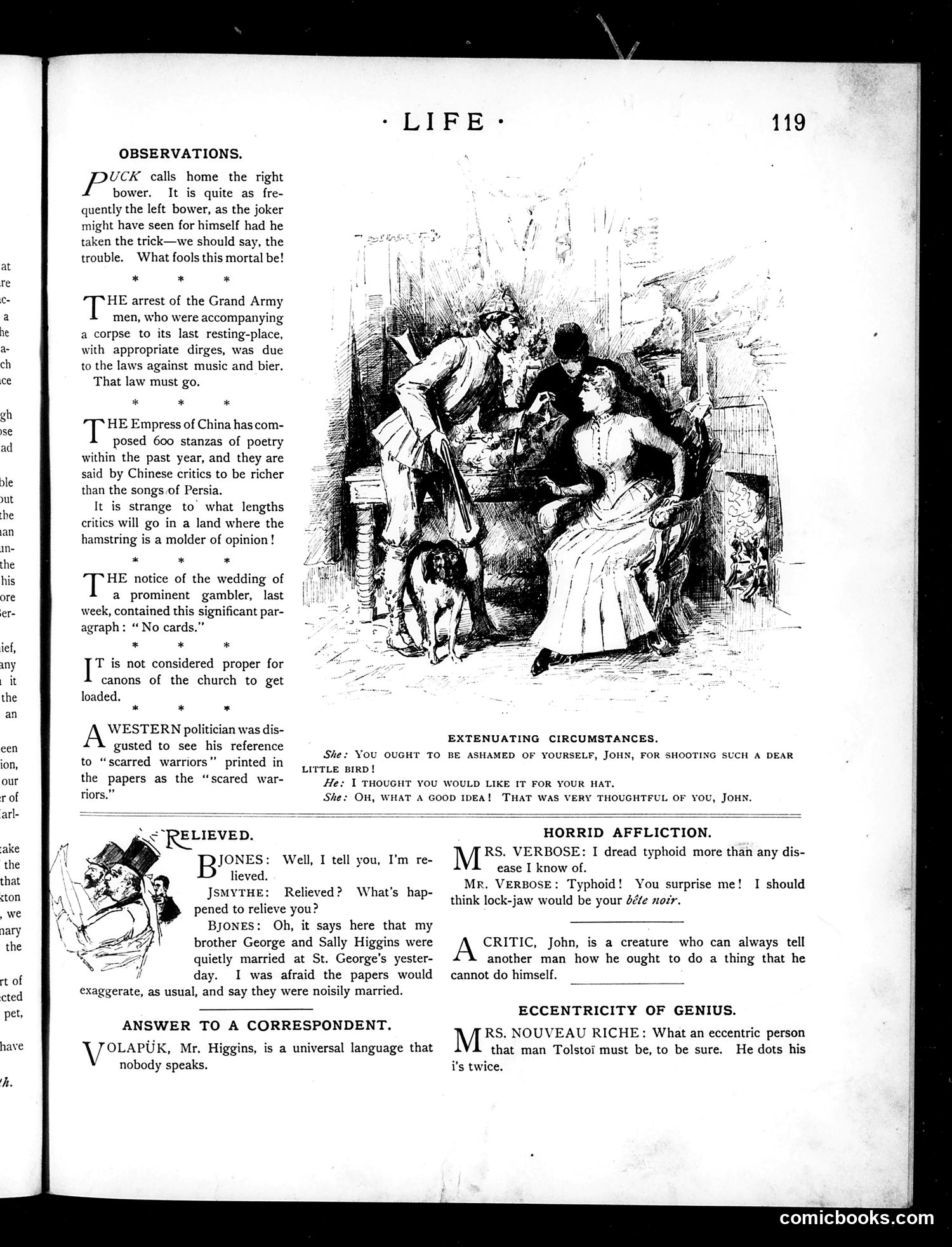
The main illustration depicts a domestic scene with a woman and children, captioned "EXTENUATING CIRCUMSTANCES." The dialogue shows a woman defending a child's hunting of a "dear little bird" to a man named John, suggesting the cartoon critiques parental indulgence or lax discipline. The page contains several brief satirical notes under "OBSERVATIONS": - A joke about a duck calling the "right bower" in card games - Commentary on Chinese poetry composition - A jab at a prominent gambler's wedding announcement reading "No cards" - A critique of church canons becoming "loaded" - A political comment about "scarred warriors" in newspapers These are typical *Life* magazine humor pieces—quick social and political jabs at contemporary issues, though specific references remain unclear without additional historical context.
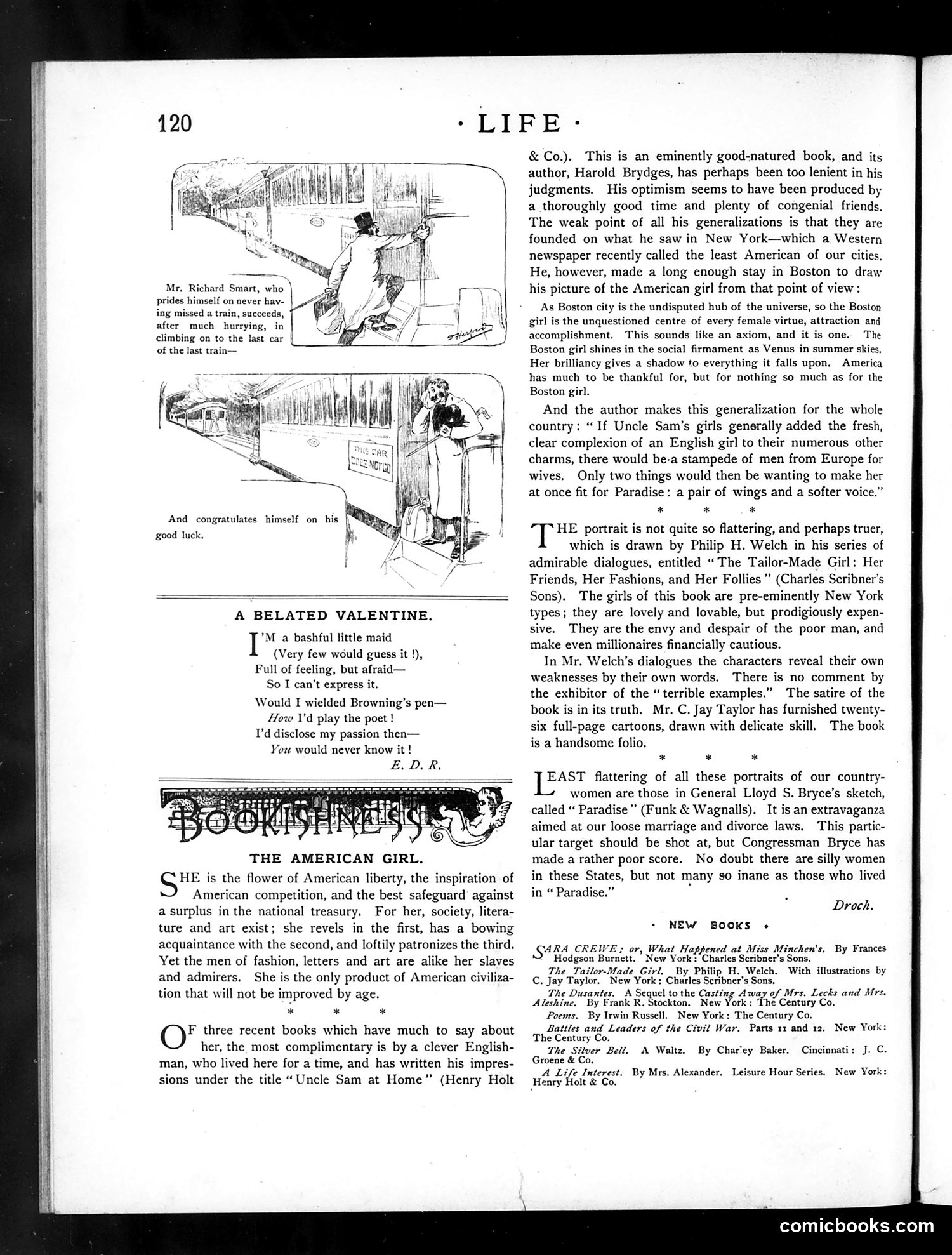
This page contains two cartoon vignettes (top) and literary commentary (bottom) about "The American Girl." **Top cartoons**: The first shows Mr. Richard Smart missing a train but successfully catching the last car—a visual pun on good fortune. The second depicts him congratulating himself on his "good luck," suggesting ironic commentary on American optimism and self-made success narratives. **Main content**: The page critiques recent books portraying American women, particularly the "Boston girl" as the apex of female accomplishment. The text satirizes authors' generalizations about American femininity, suggesting these portraits are overly idealized. References to Philip H. Welch's "Tailor-Made Girl" and General Lloyd S. Bryce's "Paradise" indicate this is literary criticism examining how women were stereotyped and romanticized in contemporary popular culture.
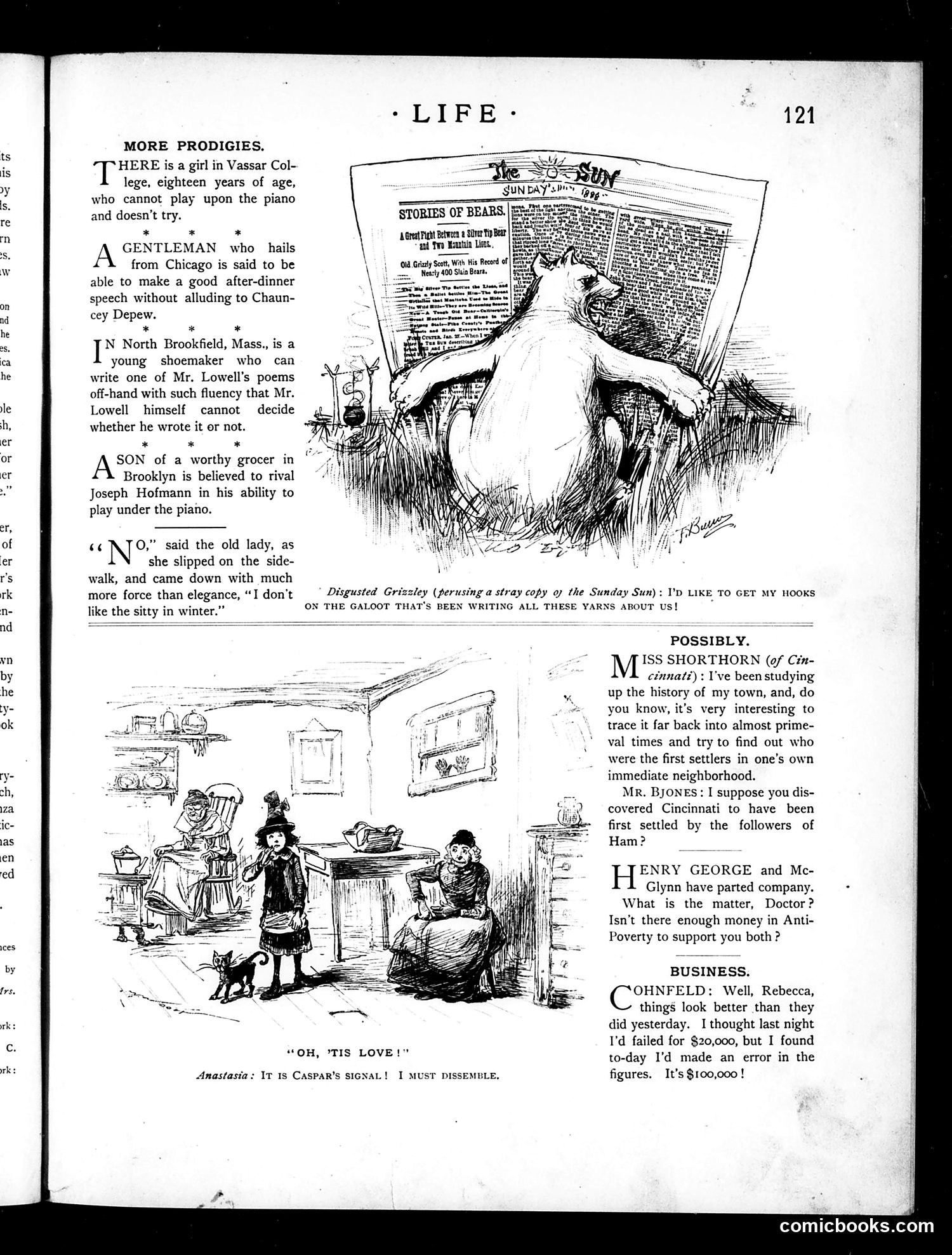
The page contains three distinct sections: **"More Prodigies"** (top left): Brief humorous notes about talented individuals—a girl who can't play piano, a Chicago man good at after-dinner speeches, a young shoemaker-poet, and a Brooklyn grocer's son who plays piano under it. **Main Cartoon** (center): Shows a disgusted grizzly bear reading a newspaper ("Stories of Bears"), complaining about exaggerated hunting tales. The caption jokes that the bear dislikes "yarns" written about his kind—a satire on sensationalized newspaper reporting. **Lower Cartoon** (bottom): Titled "Oh, 'Tis Love!" depicts a domestic scene where a woman signals a man, humorously captioned as "Caspar's signal" to disassemble—likely referencing a popular comic character or domestic routine of the era. The page exemplifies Life's typical satirical humor targeting journalism, human vanity, and domestic life.
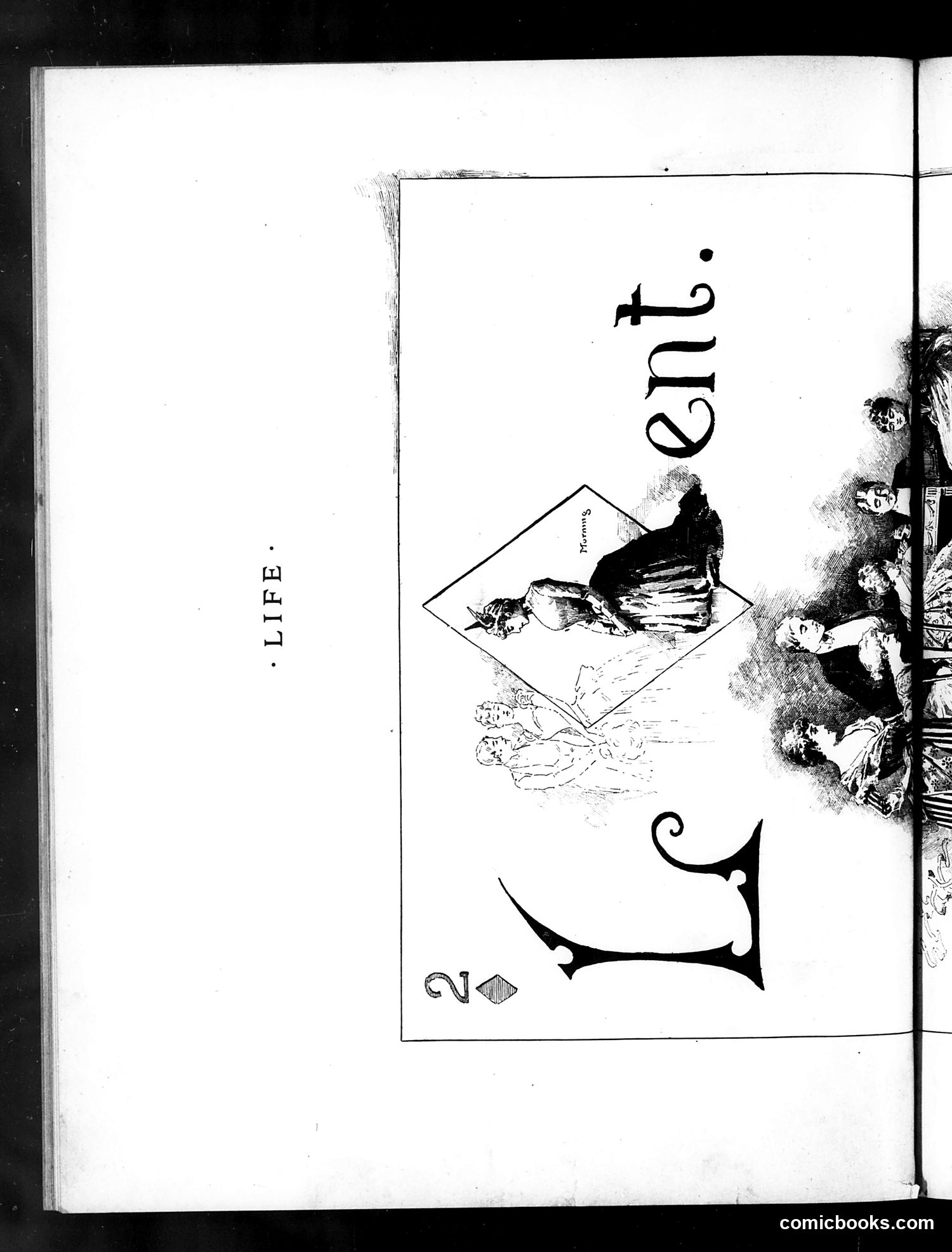
This appears to be a title page or section divider from *Life* magazine. The left side contains the word "LIFE" vertically oriented, while the right side displays "Life" as a large stylized heading, with the number "2" below it. The central image shows an illustration within a diamond-shaped frame depicting what appears to be figures in period dress, though the specific subject is unclear from this reproduction. The drawing style is characteristic of late 19th or early 20th-century satirical illustration. Without additional context about the issue date or accompanying text, I cannot definitively identify the political or social commentary this page intended to convey. The ornamental typography and framing suggest this is editorial/artistic rather than purely functional content.
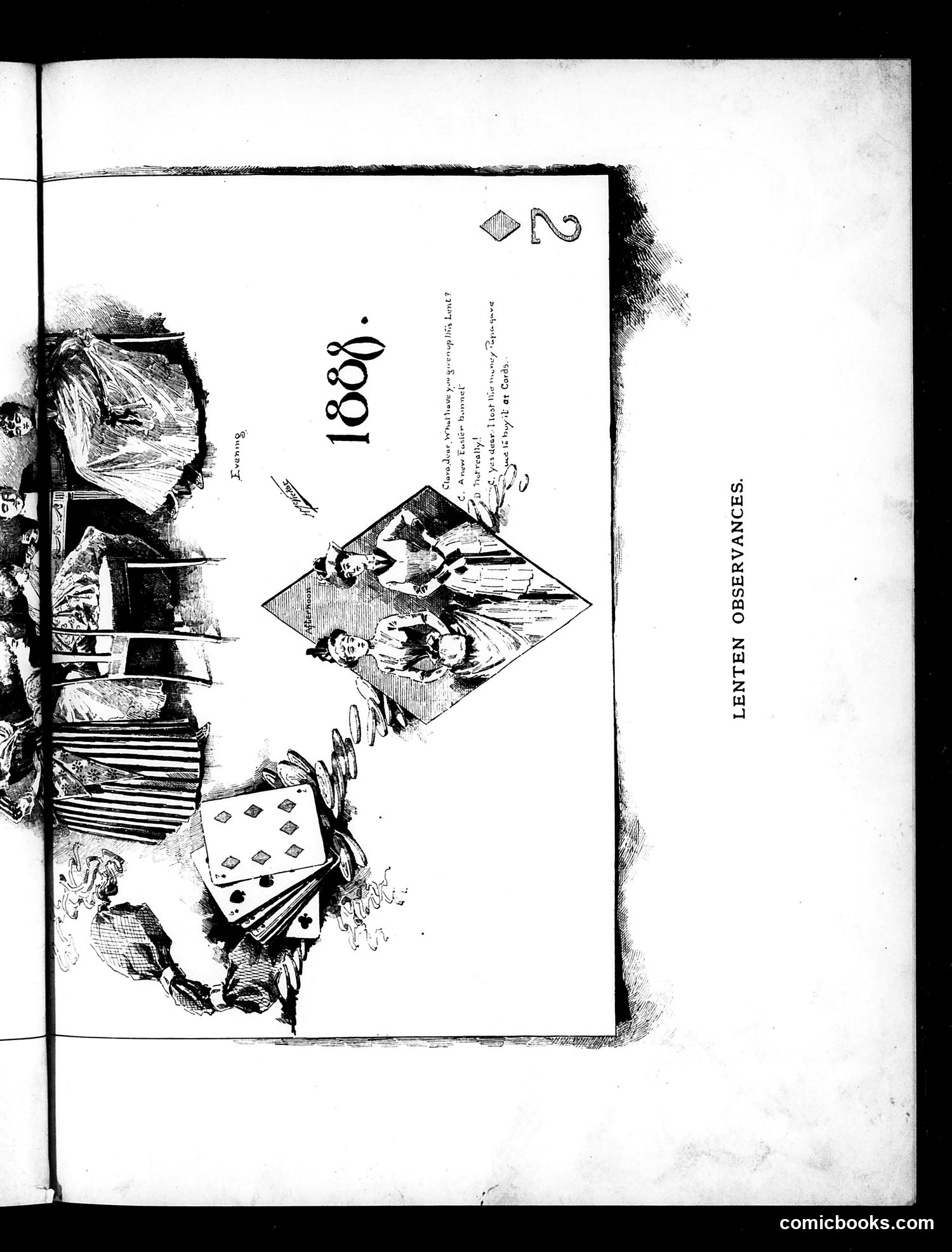
This page shows "Lantern Observances," depicting what appears to be satirical scenes related to 1880s social or political life. The central diamond-shaped illustration shows figures in what seems to be a domestic or social gathering scene. Below are playing cards displayed prominently, suggesting themes of gaming or chance. The exact political or social commentary is unclear from this reproduction, but the title "Lantern Observances" suggests these are scenes meant for projection or display—possibly commentary on contemporary social practices or follies viewed through a "lantern" lens (magic lantern shows were popular entertainment). Without clearer text or additional context about 1880 events, the specific targets of satire cannot be definitively identified.
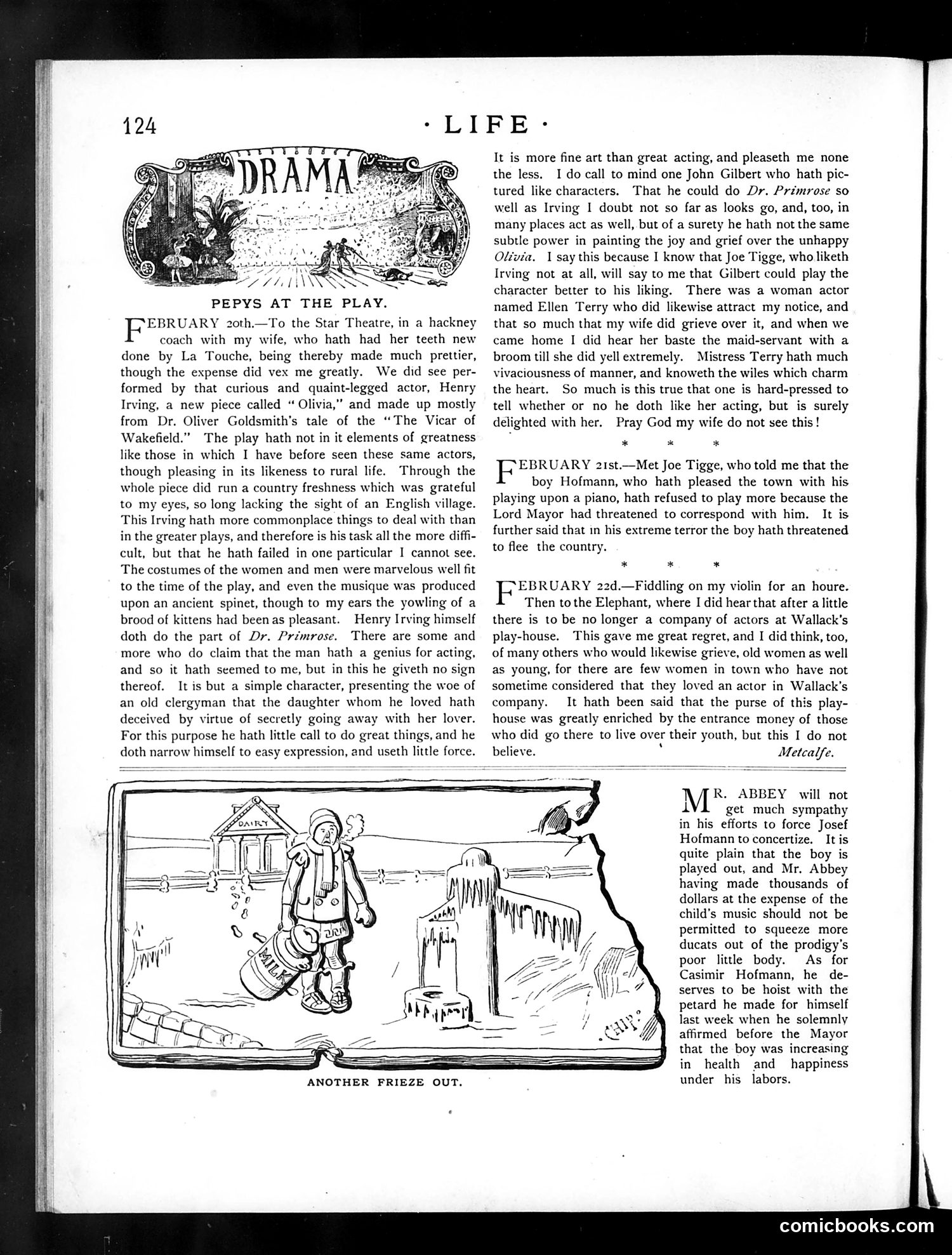
This cartoon satirizes the child prodigy pianist Josef Hofmann, who was touring America. The text describes how Hofmann's manager refused him permission to perform at Wallack's Theatre, citing the boy's need for rest. The Mayor had threatened correspondence over the refusal. The cartoon depicts a frozen, bundled figure (likely representing young Hofmann) planted in snow like a tree or vegetable, labeled "Another Prieze Out" — a pun on "prize" and the German name. The satire ridicules the exploitation of child performers and the commercialization of his talents, suggesting he's being preserved/protected like produce rather than allowed to perform, while managers profit from controlling access to him.
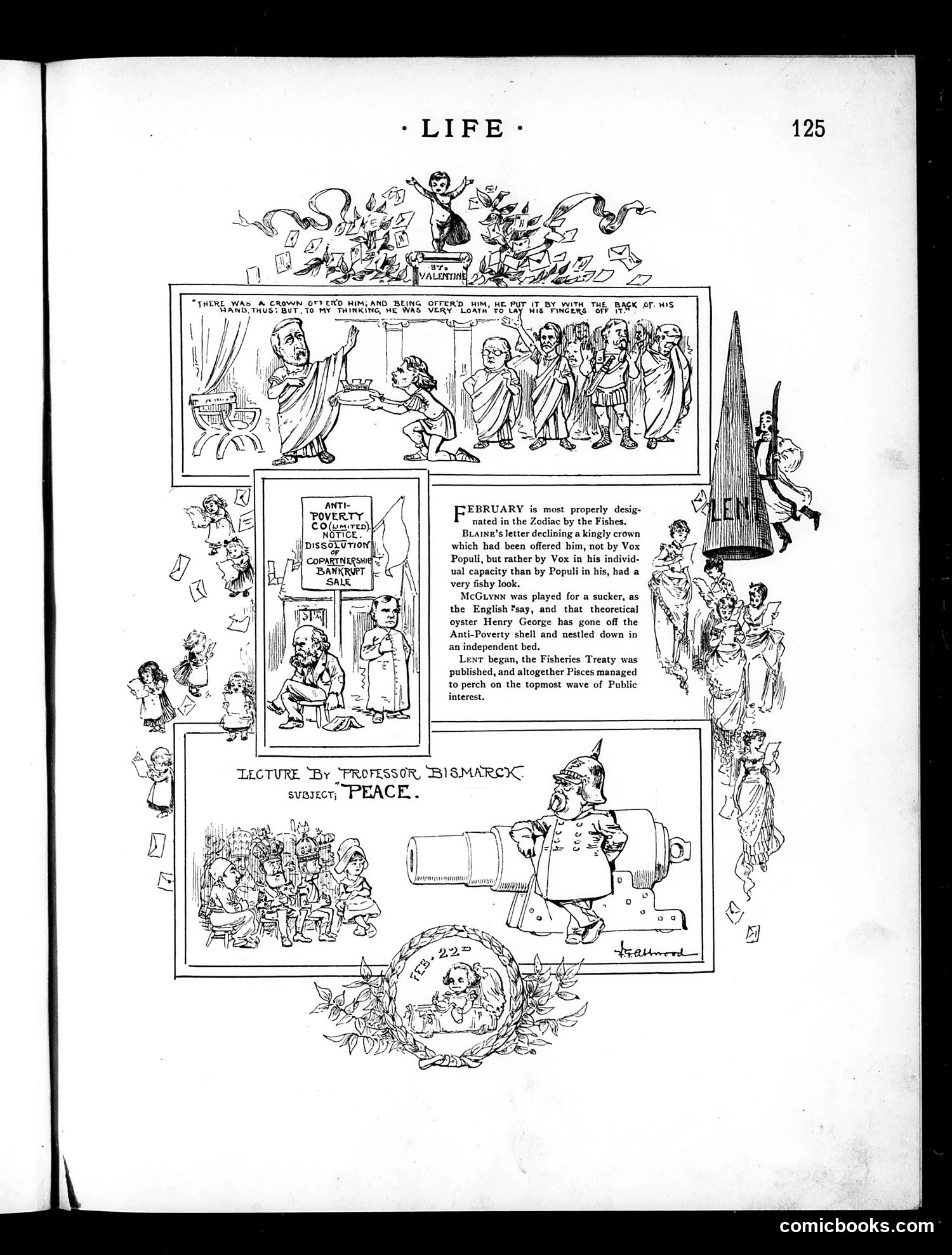
This page satirizes late-19th-century political figures and events through the "Fishes" zodiac symbol for February. The top panel references someone (likely a political figure) offered a crown but refusing it—a Shakespearean allusion suggesting false modesty about power. "Blaine's letter" appears to reference James G. Blaine declining a crown/nomination, which the satirist calls "fishy" (suspicious). McGlynn (likely Father Edward McGlynn, a controversial priest) is mocked as played for "a sucker," while Henry George (single-tax advocate) is compared to an oyster leaving his Anti-Poverty activism. The bottom cartoon shows Professor Bismarck lecturing on "Peace"—likely ironic, given Bismarck's reputation as a warmonger and realpolitik strategist. The Fisheries Treaty mentioned appears topical to this moment. Overall, the satire uses fish/ocean metaphors to ridicule political hypocrisy and questionable motives.
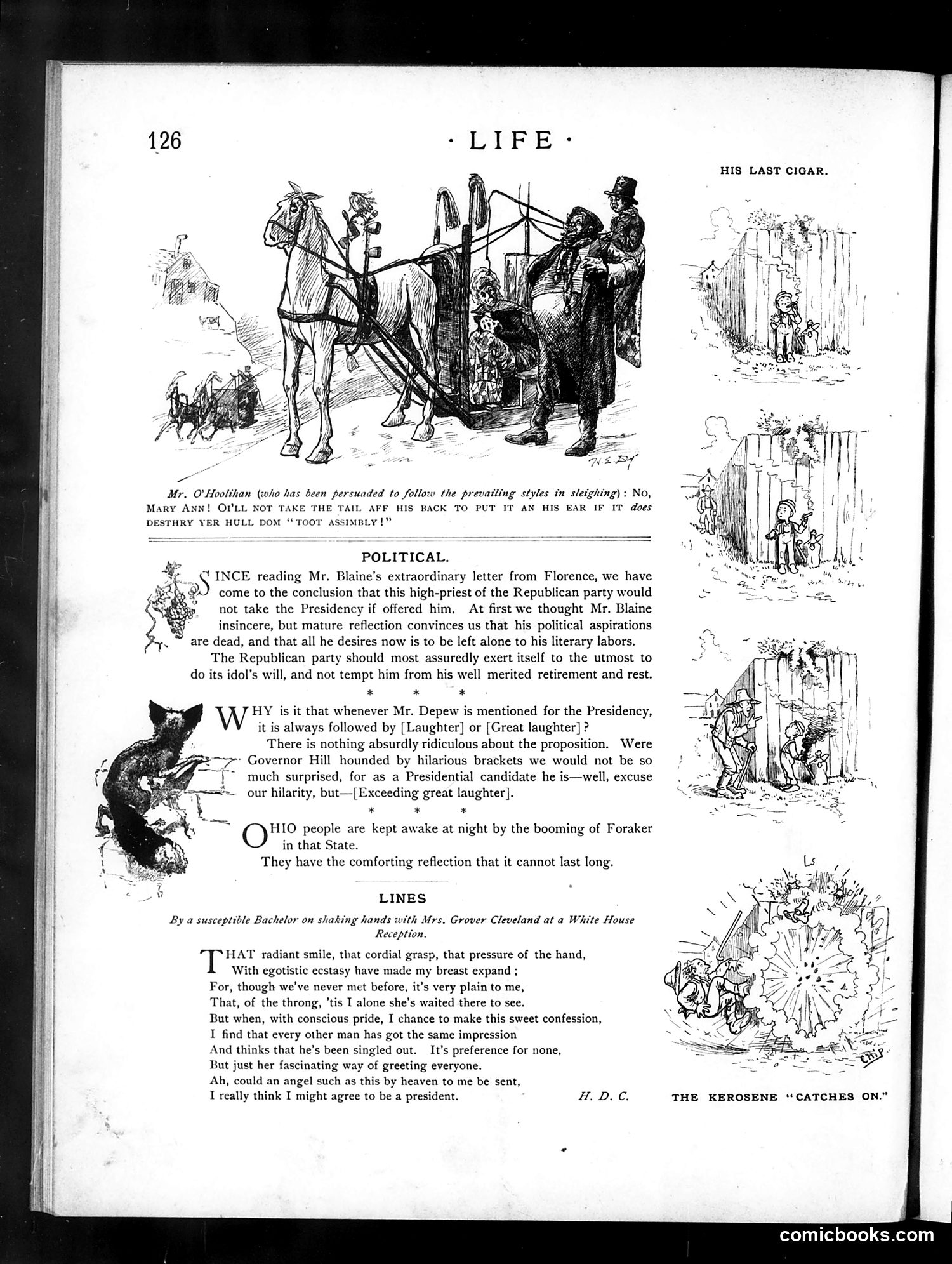
This page satirizes 1880s Republican politics. The main political section mocks several presidential prospects: **James G. Blaine** (former Secretary of State) claimed he wouldn't accept the presidency, which Life sarcastically endorses, suggesting his political ambitions are finished. **Chauncey Depew** is ridiculed as a laughable presidential candidate—the text notes his name always triggers laughter, implying he's inherently absurd. **Governor David Hill** receives similar mockery, triggering "exceeding great laughter." **Joseph B. Foraker** (Ohio politician) receives passing mention as a failed candidate. The "Lines" poem jokes about Mrs. Grover Cleveland's gracious handshake at a White House reception, where each guest believes himself uniquely favored—satirizing both her politeness and masculine vanity. The top cartoon shows an Irish immigrant (O'Hoolihan) refusing to remove his horse's tail for fashionable sleigh decoration, mocking adoption of upper-class customs.
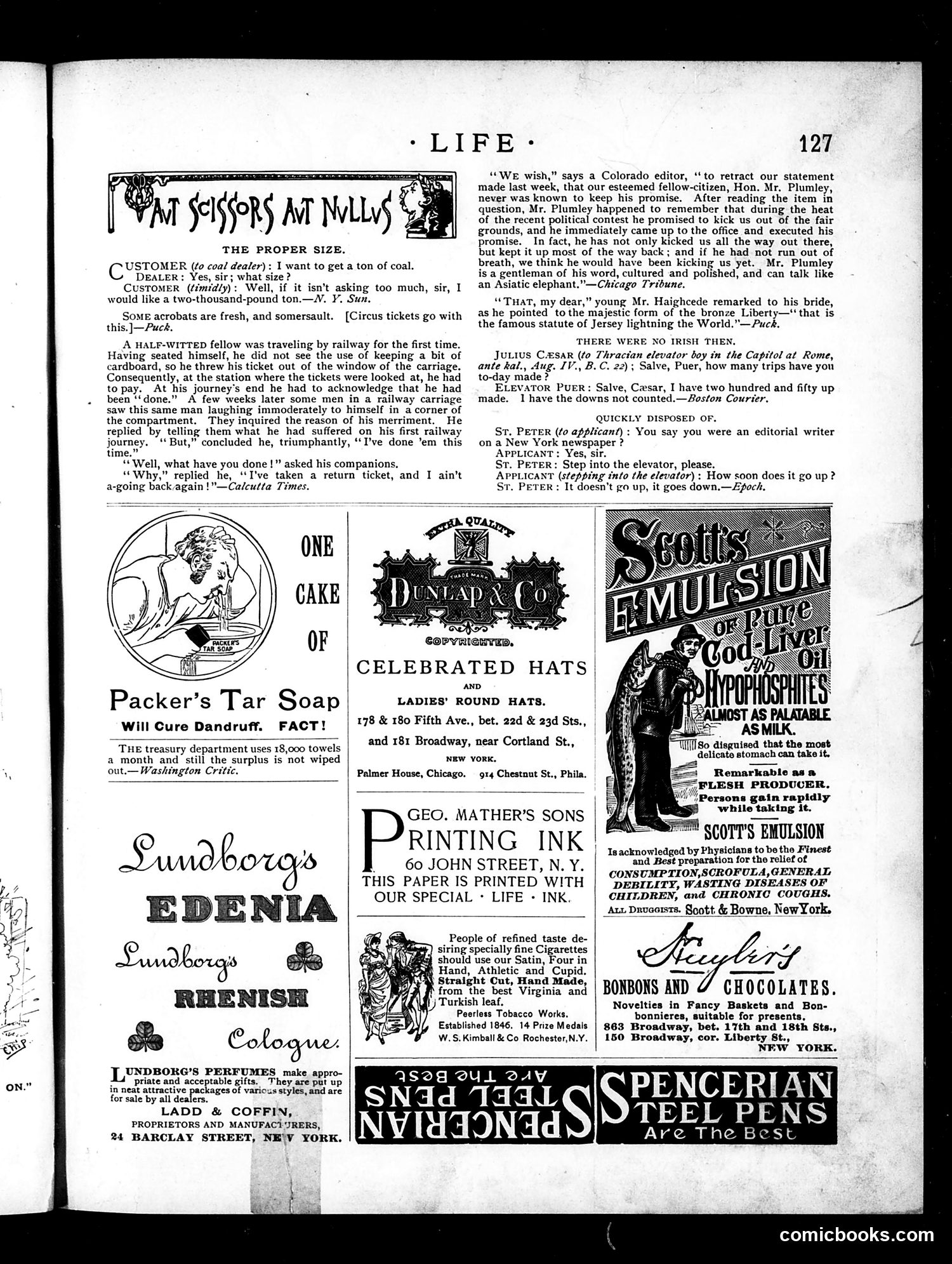
This page is primarily **advertising with interspersed short humorous pieces**, typical of Life magazine's format in this era. The jokes satirize human folly and institutional absurdity: 1. **Coal dealer anecdote**: Mocks a customer's timidity in specifying what seems a reasonable request ("two-thousand-pound ton"). 2. **Railway ticket story**: A simpleton throws away his ticket, gets charged, but later laughs at having "done" the conductor—ironic reversal suggesting the joke's on him. 3. **Editor's retraction**: A Colorado editor backhands praises politician Plumley, claiming his "promise" was to kick them out—they were indeed kicked out, so technically he kept his word. Satire of political dishonesty dressed in false praise. 4. **Statue anecdote**: Newlywed Haighcede misidentifies the Statue of Liberty as "Jersey lightning"—mocking ignorance. 5. **Julius Caesar/Elevator Boy**: Latin wordplay where the boy reports "downs not counted," implying heavenly judgment against the unworthy. 6. **St. Peter/Newspaper Editor**: Darkly jokes that editorial writers go to hell ("down" not "up"). The advertisements dominate the visual space.
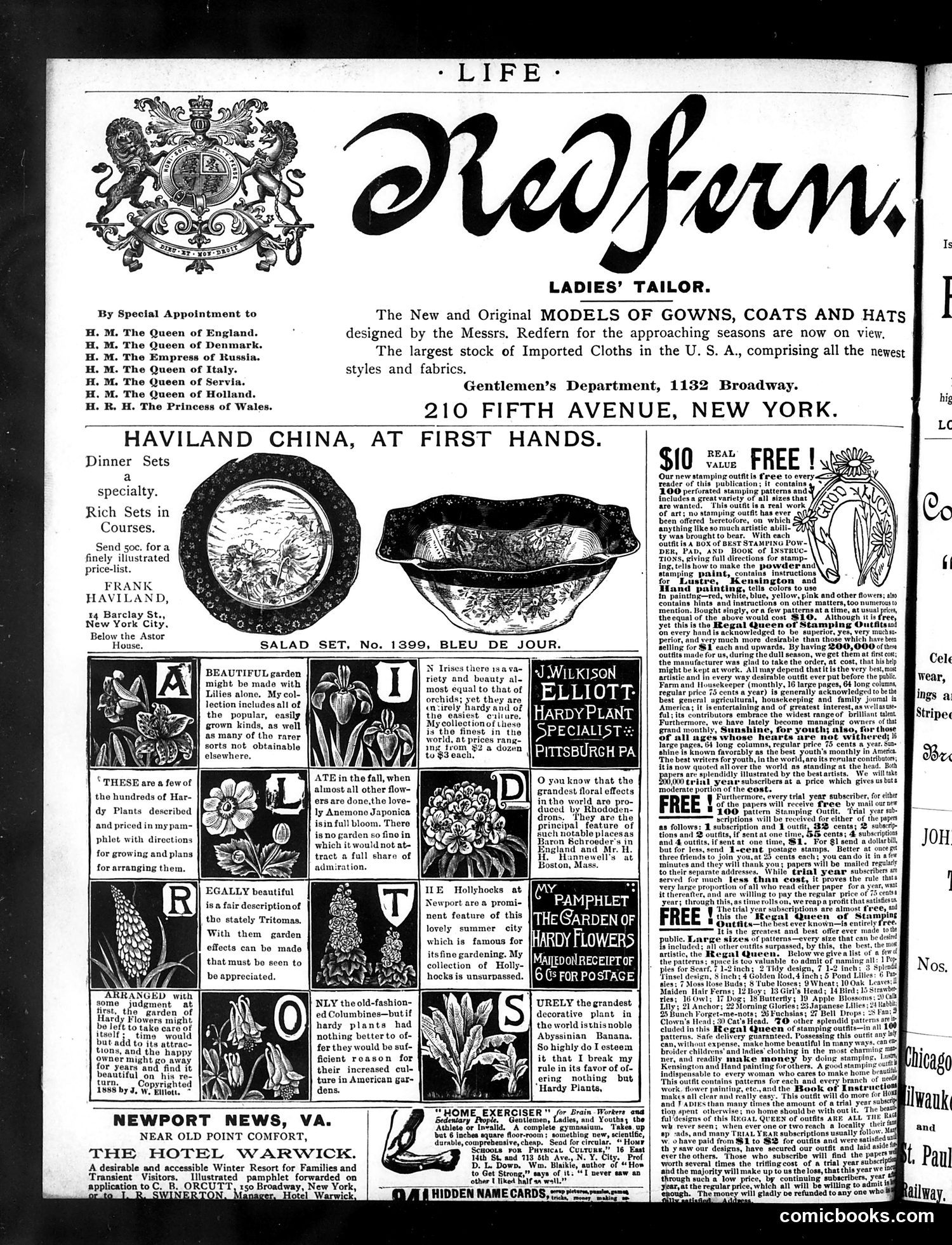
This page is primarily **advertisements and commercial content** with no discernible political satire or cartoon work. The dominant feature is a **decorative floral alphabet** (letters A-S visible) advertising J. Wilkinson Elliott's hardy plant catalog. Each letter is ornately illustrated with garden flowers—lilies, irises, hollyhocks, rhododendrons, columbines—and accompanying promotional text describing plants suitable for American gardens. The page also contains **period fashion and home goods advertising**: Redfern ladies' tailoring on Fifth Avenue (boasting royal patronage), Haviland china dinnerware, and the Hotel Warwick resort in Newport News, Virginia. One small item advertises "Hidden Name Cards"—a craft activity involving stamping and painting designs. This appears to be a **typical Life magazine page from the 1880s**, mixing high-end commercial advertising with illustrated educational or decorative content. There is no political commentary or satirical intent evident.
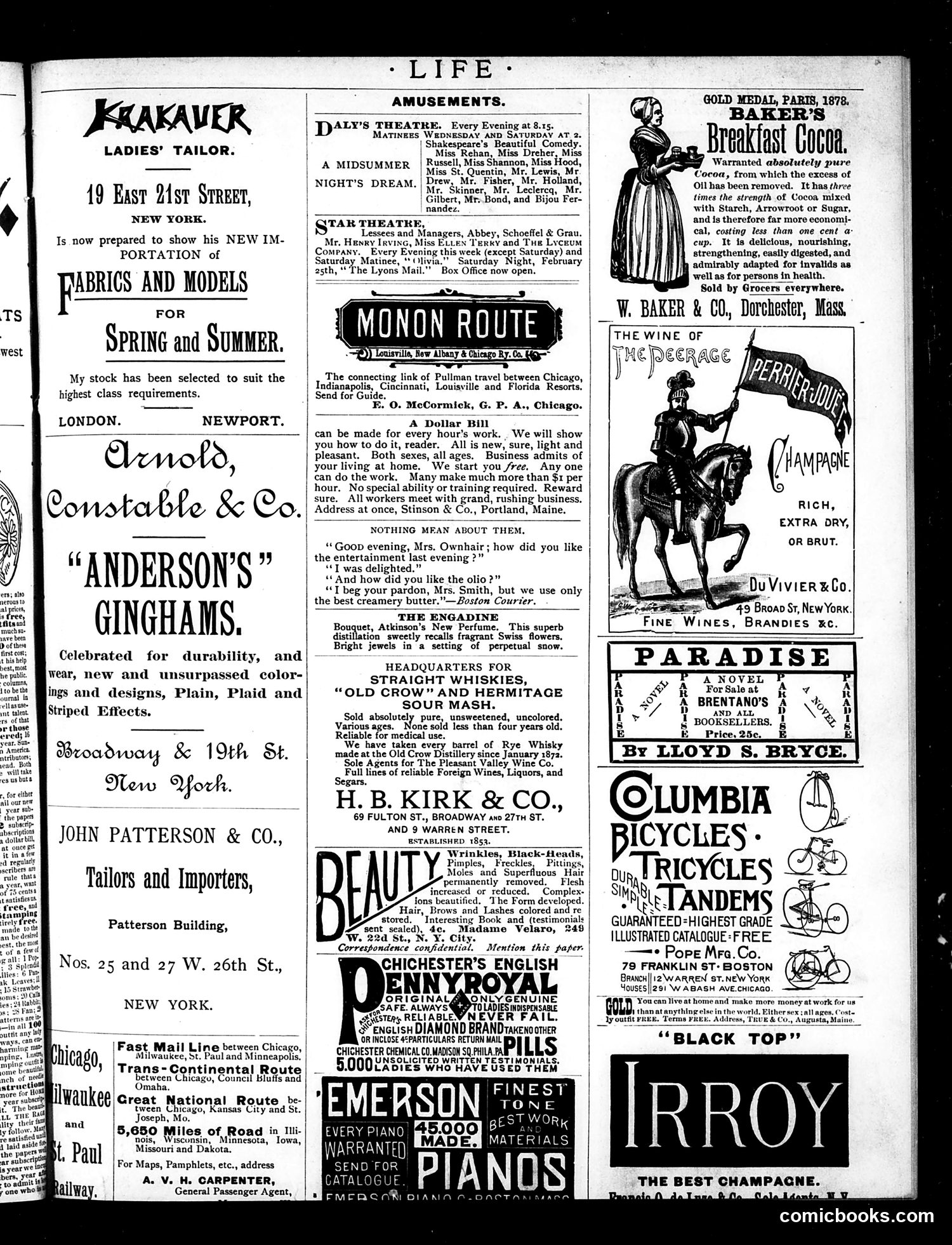
This page is **predominantly advertising**, with no political cartoons or satirical content. It represents a typical page from *Life* magazine's early era, when the publication relied heavily on commercial advertisements to fund operations. The ads reflect late-19th-century consumer culture: ladies' tailors and fabric importers (Arnold, Constable & Co.; Anderson's Ginghams), railroad lines promoting transcontinental travel, patent medicines and beauty treatments (Madame Velaro's skin treatments), whiskey distributors, and piano manufacturers. The "amusements" section lists theatrical productions, including Shakespeare's *A Midsummer Night's Dream* at Daly's Theatre and *The Lyons Mail* at Star Theatre—standard dramatic fare of the period. One brief humor piece ("Nothing Mean About Them") presents a pun about "olio" (theatrical variety acts) being mistaken for "oleo" (butter substitute), exemplifying the mild, domestic humor typical of the era. This page captures *Life* as a commercial-entertainment publication rather than hard-hitting satire.
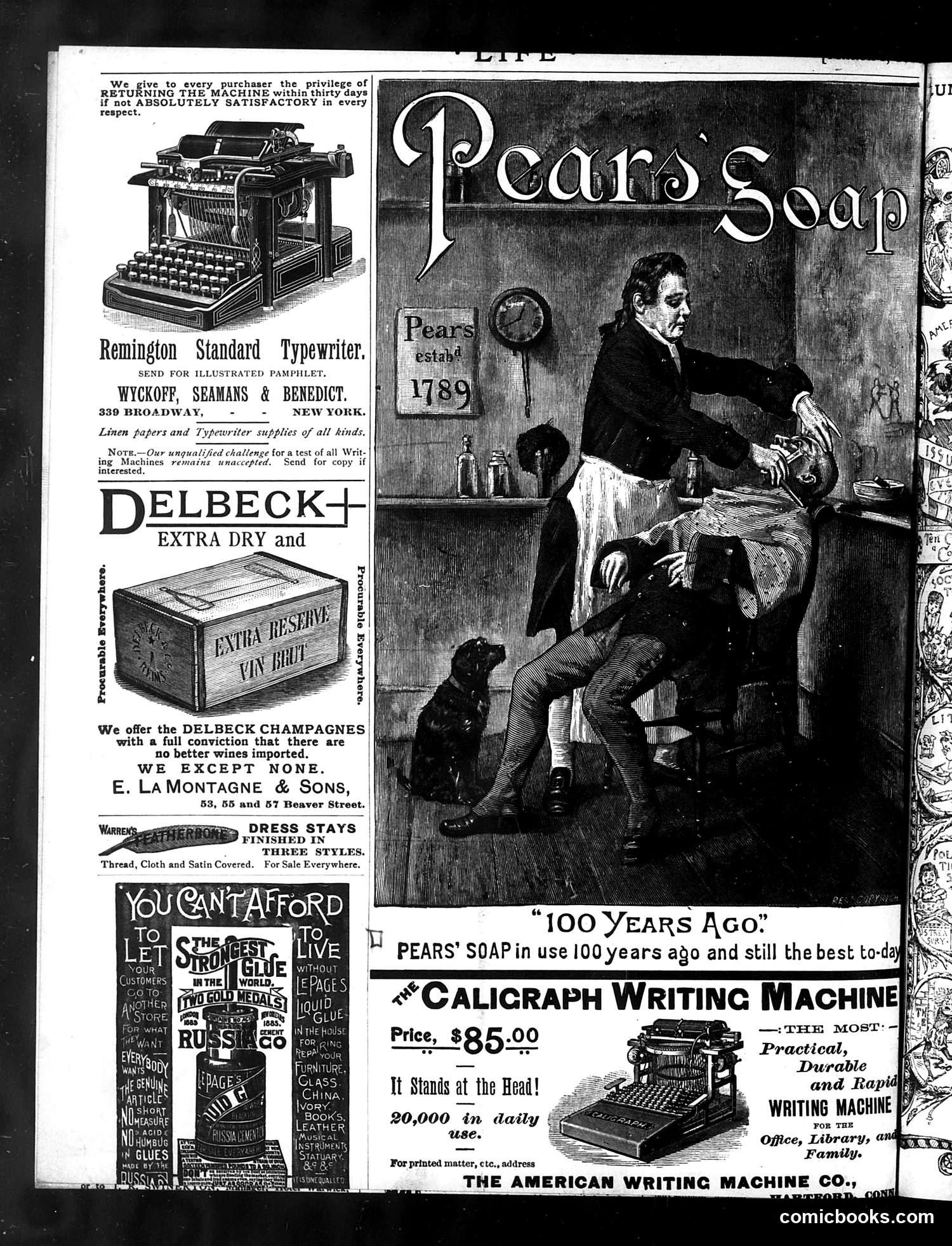
This page is primarily **advertising**, not political satire or editorial cartooning. It contains multiple product advertisements typical of late 19th-century publications. The main illustrated content—labeled **"100 Years Ago"**—is a Pears' Soap advertisement featuring a genre scene of what appears to be a gentleman being attended to, likely depicting hygiene or grooming. The caption claims Pears' Soap has been in use for a century and remains "the best to-day," establishing the brand's longevity as a marketing claim. Surrounding advertisements promote: - Remington Standard Typewriter - Delbeck Champagnes - Dress Stays (women's undergarment) - Calicraph Writing Machine ($85) - Various other consumer goods The page reflects consumer culture and industrial products of the era, with no apparent political commentary or satirical intent—it's a straightforward commercial publication designed to generate advertising revenue.