
Life, 1888-03-01 · page 6 of 16
Life — March 1, 1888 — page 6: what you’re looking at
What you’re looking at
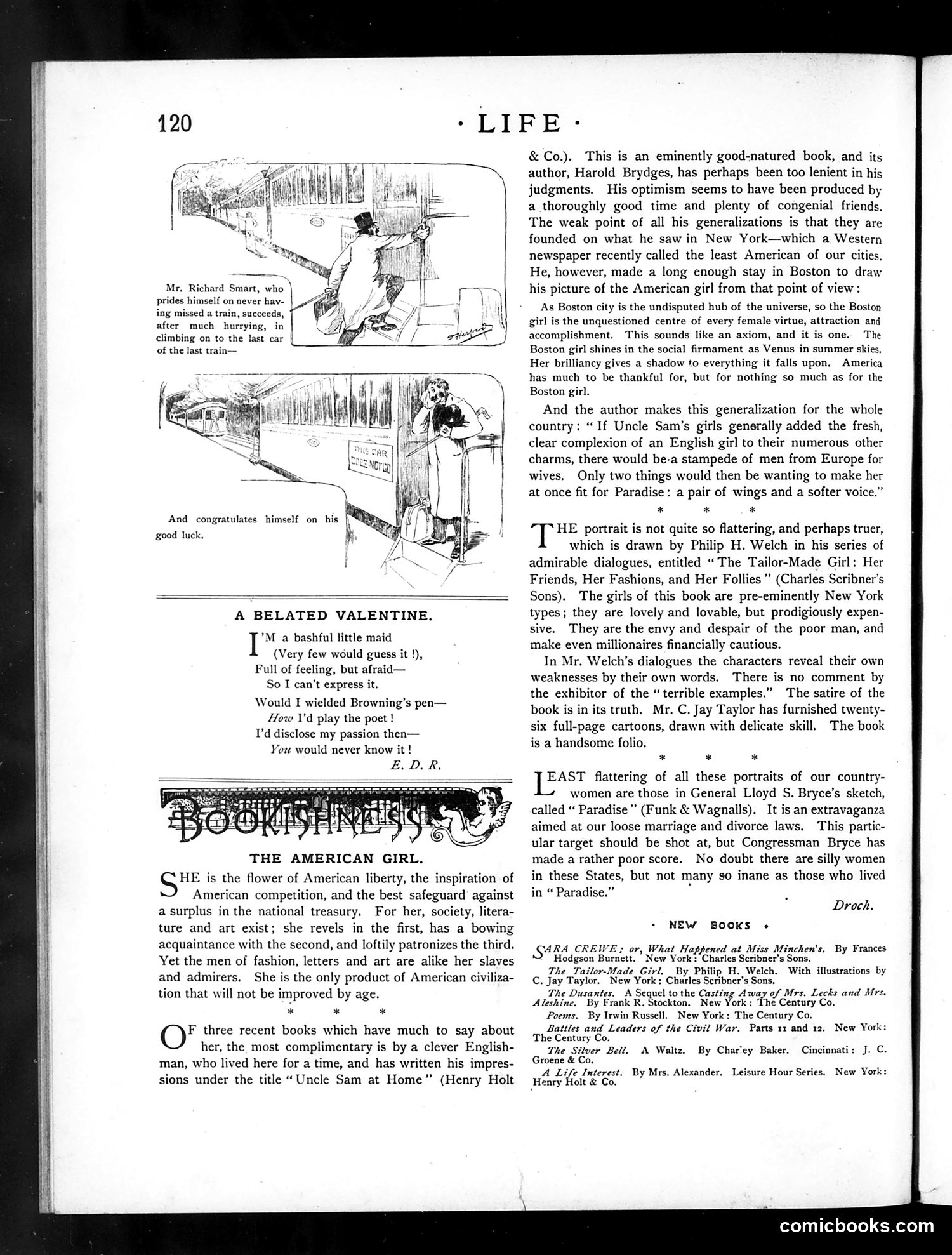
This page contains two cartoon vignettes (top) and literary commentary (bottom) about "The American Girl." **Top cartoons**: The first shows Mr. Richard Smart missing a train but successfully catching the last car—a visual pun on good fortune. The second depicts him congratulating himself on his "good luck," suggesting ironic commentary on American optimism and self-made success narratives. **Main content**: The page critiques recent books portraying American women, particularly the "Boston girl" as the apex of female accomplishment. The text satirizes authors' generalizations about American femininity, suggesting these portraits are overly idealized. References to Philip H. Welch's "Tailor-Made Girl" and General Lloyd S. Bryce's "Paradise" indicate this is literary criticism examining how women were stereotyped and romanticized in contemporary popular culture.
📄 Transcribed text from this page (OCR, searchable)
Machine-transcribed from the original scan — historical spelling and the odd misread are preserved.
LIFE Mr. Richard Smart, who | prides himself on never hav- ing missed a train, succeeds, after much hurrying, in climbing on to the last car of the last train— And congratulates himself on his good luck. A BELATED VALENTINE. [% a bashful little maid (Very few would guess it !), Full of feeling, but afraid— So I can’t express it. Would I wielded Browning's pen— How I'd play the poet ! I'd disclose my passion then— You would never know it! THE AMERICAN GIRL. HE is the flower of American liberty, the inspiration of American competition, and the best safeguard against a surplus in the national treasury. For her, society, litera- ture and art exist; she revels in the first, has a bowing acquaintance with the second, and loftily patronizes the third. Yet the men of fashion, letters and art are alike her slaves and admirers. She is the only product of American civiliza- tion that will not be improved by age. * * * F three recent books which have much to say about her, the most complimentary is by a clever English- man, who lived here for a time, and has written his impres- sions under the title “Uncle Sam at Home” (Henry Holt ‘Henry & Co.). This is an eminently good-natured book, and its author, Harold Brydges, has perhaps been too lenient in his judgments. His optimism seems to have been produced by a thoroughly good time and plenty of congenial friends. The weak point of all his generalizations is that they are founded on what he saw in New York—which a Western newspaper recently called the least American of our cities, He, however, made a long enough stay in Boston to draw his picture of the American girl from that point of view: As Boston city is the undisputed hub of the universe, so the Boston girl is the unquestioned centre of every female virtue, attraction and accomplishment. This sounds like an axiom, and it is one. The Boston girl shines in the social firmament as Venus in summer skies, Her brilliancy gives a shadow to everything it falls upon. America has much to be thankful for, but for nothing so much as for the Boston girl. And the author makes this generalization for the whole country: “If Uncle Sam’s girls generally added the fresh, clear complexion of an English girl to their numerous other charms, there would be-a stampede of men from Europe for wives. Only two things would then be wanting to make her at once fit for Paradise: a pair of wings and a softer voice.” * * * HE portrait is not quite so flattering, and perhaps truer, which is drawn by Philip H. Welch in his series of admirable dialogues, entitled “The Tailor-Made Girl: Her Friends, Her Fashions, and Her Follies ” (Charles Scribner's Sons). The girls of this book are pre-eminently New York types; they are lovely and lovable, but prodigiously expen- sive. They are the envy and despair of the poor man, and make even millionaires financially cautious. In Mr. Welch’s dialogues the characters reveal their own weaknesses by their own words. There is no comment by the exhibitor of the “terrible examples.” The satire of the book is in its truth. Mr. C. Jay Taylor has furnished twenty- six full-page cartoons, drawn with delicate skill, The book is a handsome folio. * * * EAST flattering of all these portraits of our country- women are those in General Lloyd S. Bryce’s sketch, called “ Paradise” (Funk & Wagnalls). It is an extravaganza aimed at our loose marriage and divorce laws. This partic- ular target should be shot at, but Congressman Bryce has made a rather poor score. No doubt there are silly women in these States, but not many so inane as those who lived in “ Paradise.” . . Droch. + NEW BOOKS - ‘ARA CREWE; or, What Happened at Miss Minchen’s. Hodgson Burnett. New York: Charles Scribner's Sons. The Tailor-Made Girl. By Philip H. Welch. With illustrations by C. Jay Taylor. New York: Churles Scribner's Sons. The Dusantes. A Sequel to the Castin, Ane of Mrs. Lecks and Mrs. Aleshine, By Frank R. Stockton. New Phe Century Co. Poems. By Irwin Russell. New York : The Century Co. Battles and Leaders of the Civil War. Parts 11 and 12. The Century Co. The Silver Bell. Groene & Co. A Life Interest. jolt & Co, By Frances New York: A Waltz, By Char'ey Baker. Cincinnati: J. C. By Mrs. Alexander. Leisure Hour Series. New York: comicbooks.com