
A complete issue · 21 pages · 1887
Life — December 29, 1887
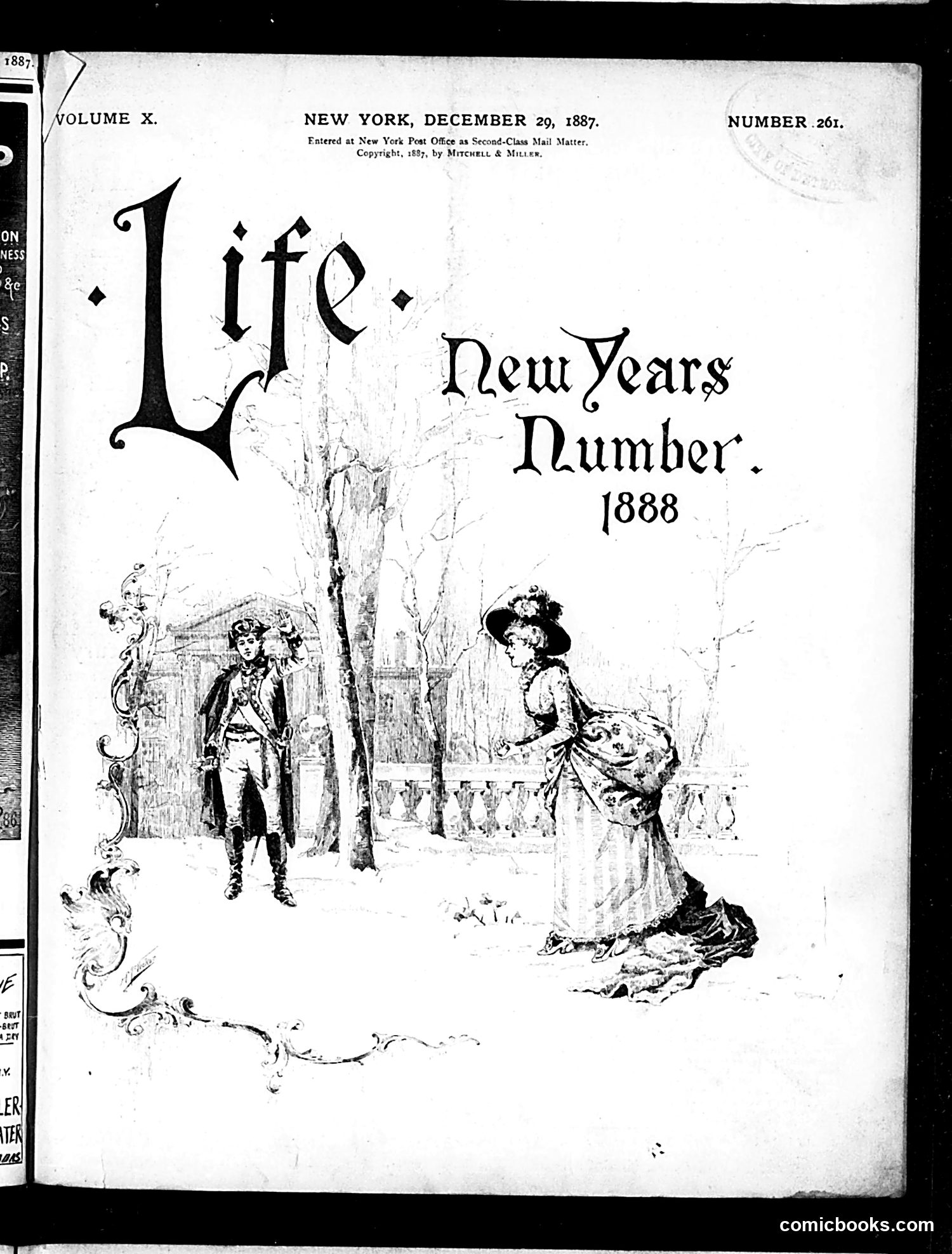
This is the cover of Life's New Year's issue for 1888, featuring an illustrated scene rather than political satire. The image shows two figures in a winter setting: a man in formal dress and a woman in an elegant gown with an elaborate hat, positioned near bare trees in what appears to be a snow-covered landscape. The composition and styling suggest a romantic or social scenario typical of Life's satirical commentary on contemporary manners and relationships. Without additional context or text explaining the specific reference, the exact social commentary intended remains unclear, though the elegant dress and winter setting invoke themes of courtship or New Year's social gatherings common to the era's satire.
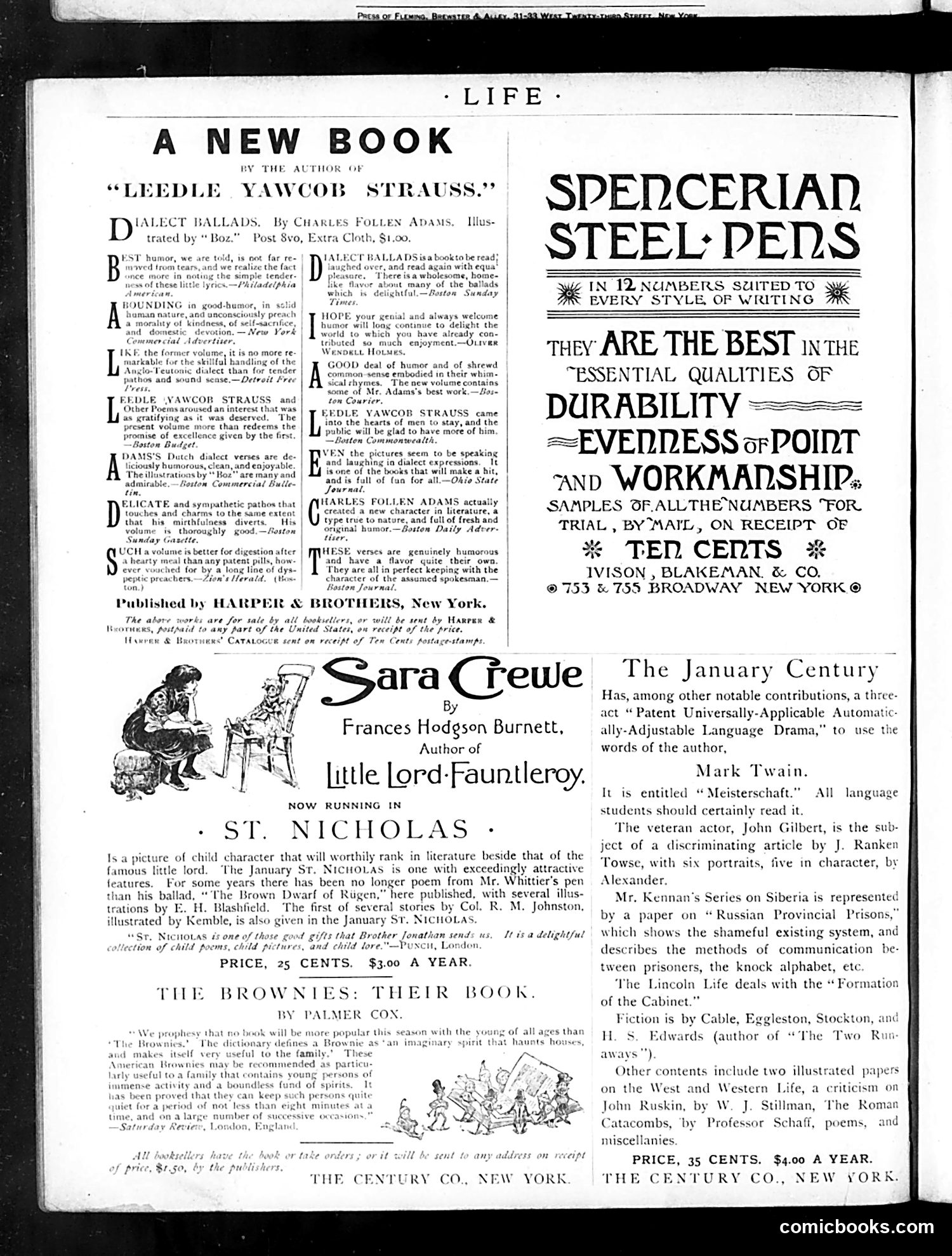
This page is primarily **advertising and book notices** rather than political satire. The main content features advertisements for books including "Sara Crewe" by Frances Hodgson Burnett and "The Brownies: Their Book" by Palmer Cox. The small illustration accompanying the Sara Crewe ad shows two figures in Victorian dress—apparently depicting a scene from the children's novel. There is **no political cartoon or satire** on this page. The remaining space contains literary notices for "The January Century" magazine and information about "The Brownies," which were popular fictional creatures in children's literature of this era. The content reflects Life magazine's practice of mixing satirical commentary with literary advertising and reviews.
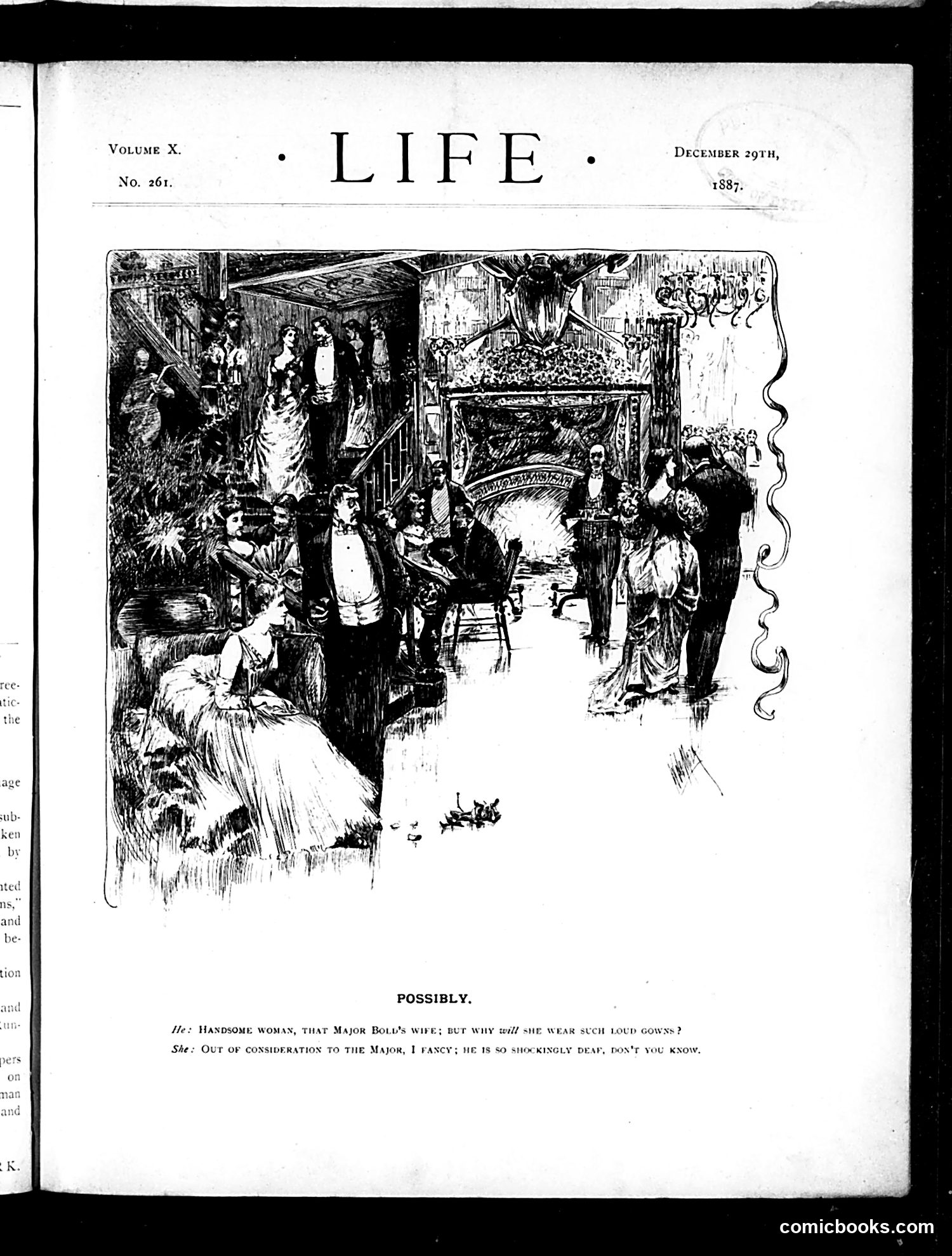
This satirical cartoon depicts a grand social gathering, likely a formal ball or reception. The caption's dialogue suggests a humorous exchange about a woman's loud clothing or appearance at the event. The joke hinges on class and social etiquette: a gentleman observes that a woman (identified as "Major Bold's wife") wears conspicuously loud or garish gowns. She responds that she does so out of "consideration to the Major" because "he is so shockingly deaf." The satire mocks both the woman's fashion choices and her excuse—implying her loud dress is meant to compensate for her husband's hearing loss, making the situation ridiculous. It reflects Victorian-era concerns about propriety, fashion, and marital dynamics in high society.
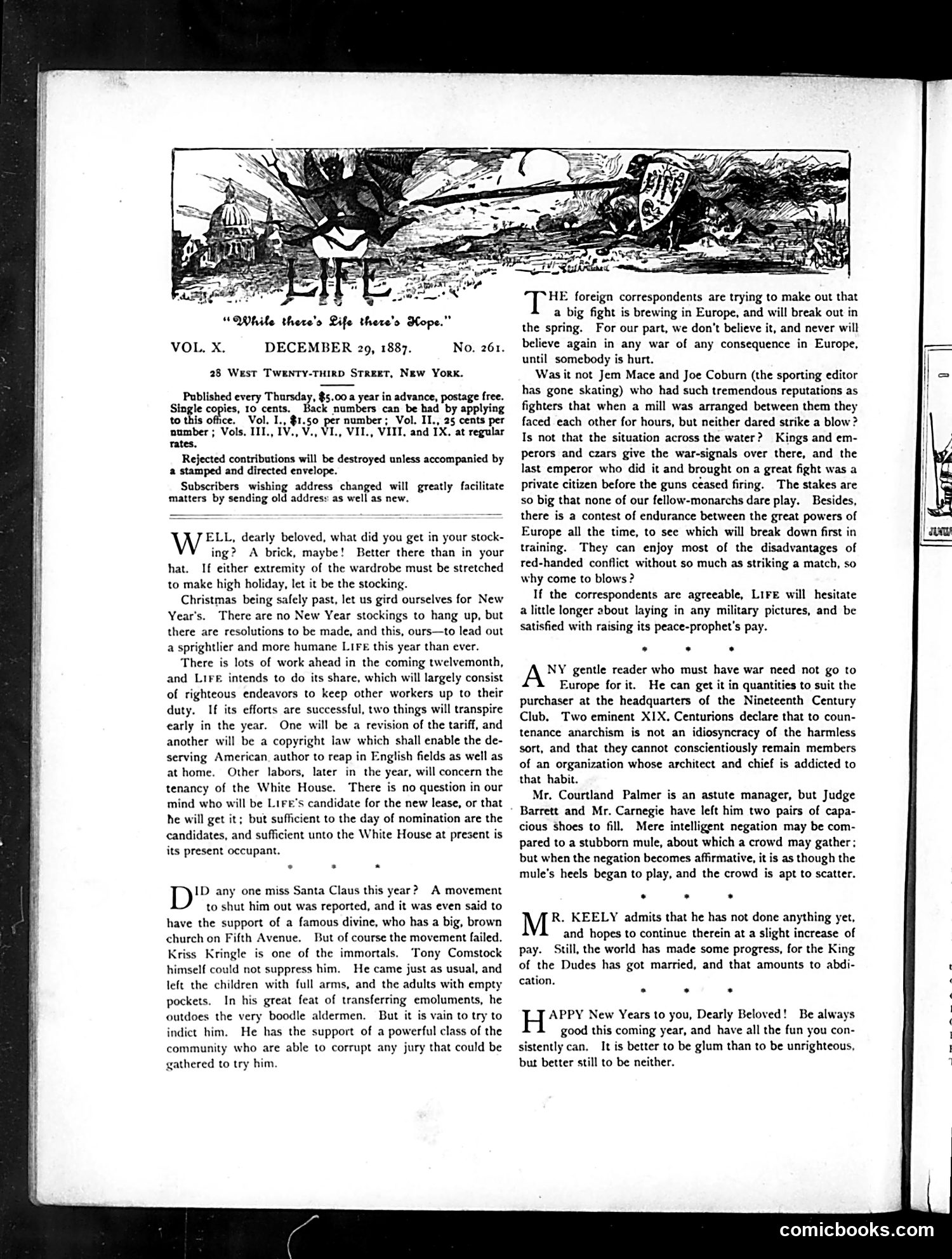
The masthead cartoon depicts a stark, gnarled tree against a landscape with "While there's Life there's Hope" as its motto—a visual pun on the magazine's name suggesting resilience despite hardship. The editorial content addresses European political tensions, specifically dismissing foreign correspondents' predictions of imminent warfare. The editors express skepticism about whether a conflict will actually occur, noting that past antagonists (referencing figures like "Jem Mace and Joe Coburn," boxing champions) have talked big but avoided actual fighting. The piece satirizes both sensationalist war reporting and European political theater, suggesting that despite posturing by kings, emperors, and czars, economic and practical considerations will likely prevent actual combat—a commentary on late-19th-century European power dynamics and media speculation.
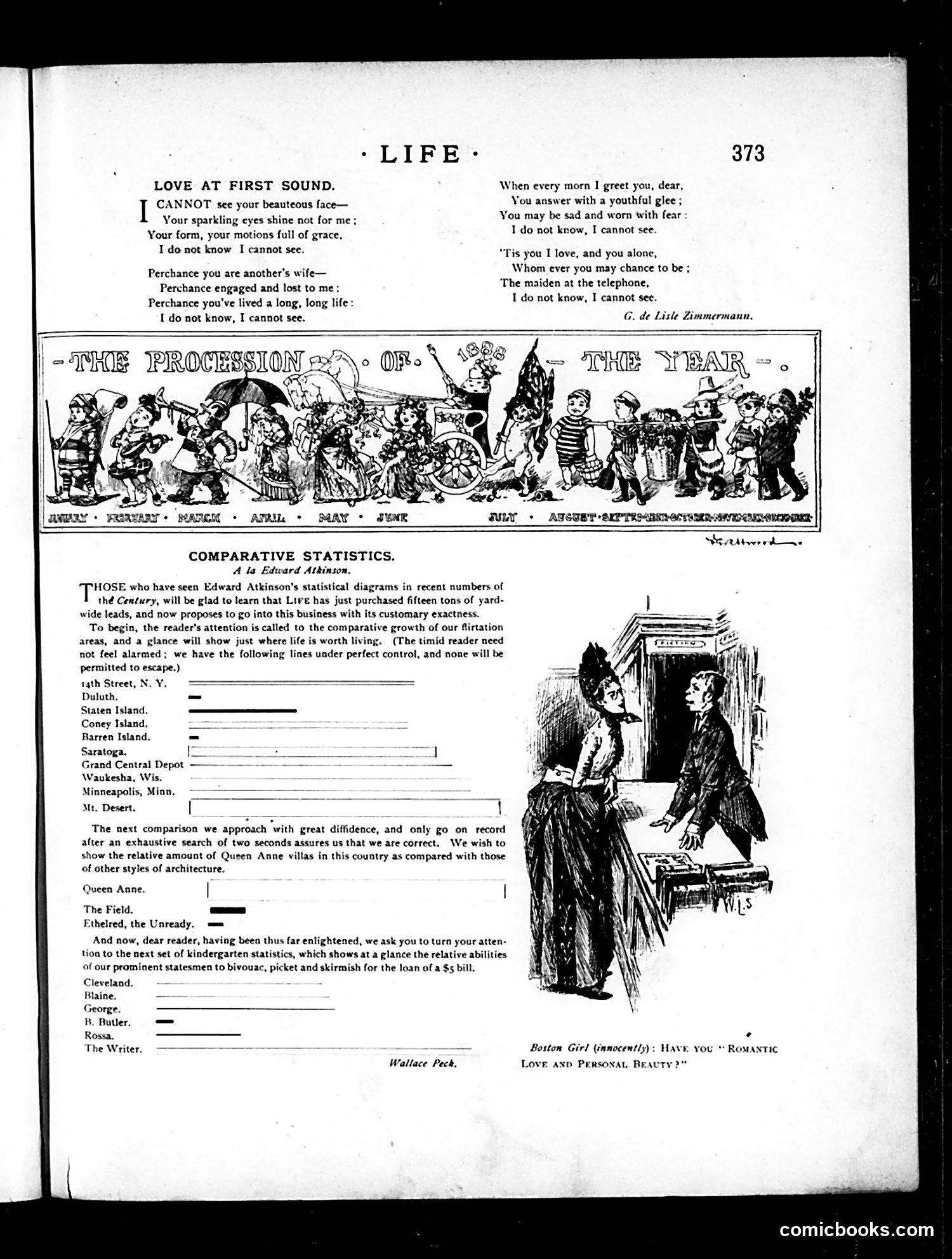
This page satirizes Edward Atkinson's statistical diagrams about American infrastructure and development. The cartoon uses comparative bar charts to humorously rank various locations by yard-width lead and flirtation capacity—absurd metrics that mock the era's obsession with quantifying and comparing cities and regions. The specific comparisons (various New York locations, Staten Island, Saratoga, Minneapolis, etc.) suggest Atkinson was producing earnest statistical analyses of American progress. Life's parody ridicules both the pretension of reducing complex social phenomena to simple charts and the competitive boosterism between American cities. The illustration of a "Boston Girl" asking about "romantic love and personal beauty" complements this satire, suggesting such human qualities resist statistical measurement—the cartoon's central joke.
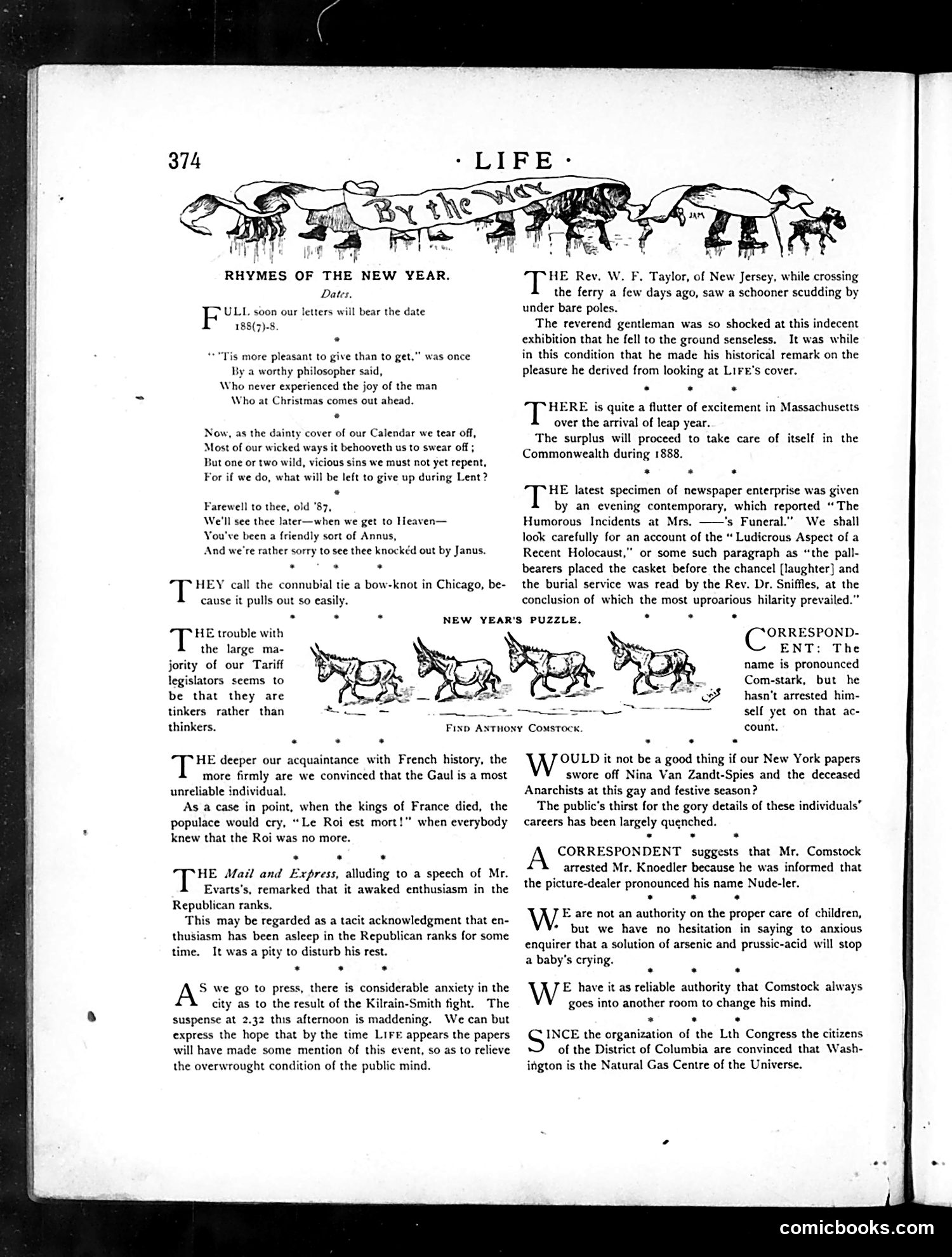
The page contains **"Rhymes of the New Year"** (poetry) and several short satirical commentary pieces typical of *Life* magazine's format, but **no political cartoon is visible** in this image. The content references contemporary 1880s issues: a schoolboy's indecent behavior near a ferry; Massachusetts preparing for leap year 1888; newspaper sensationalism around a "Ludicrous Casket" incident; and a figure named Comstock (likely Anthony Comstock, the famous anti-obscenity crusader) arresting someone named Knoedler, a picture-dealer, possibly over allegedly obscene materials. The "New Year's Puzzle" shows four similar horse drawings—a visual riddle rather than political satire. The page is primarily **text-based humor and social commentary**, not cartooning.
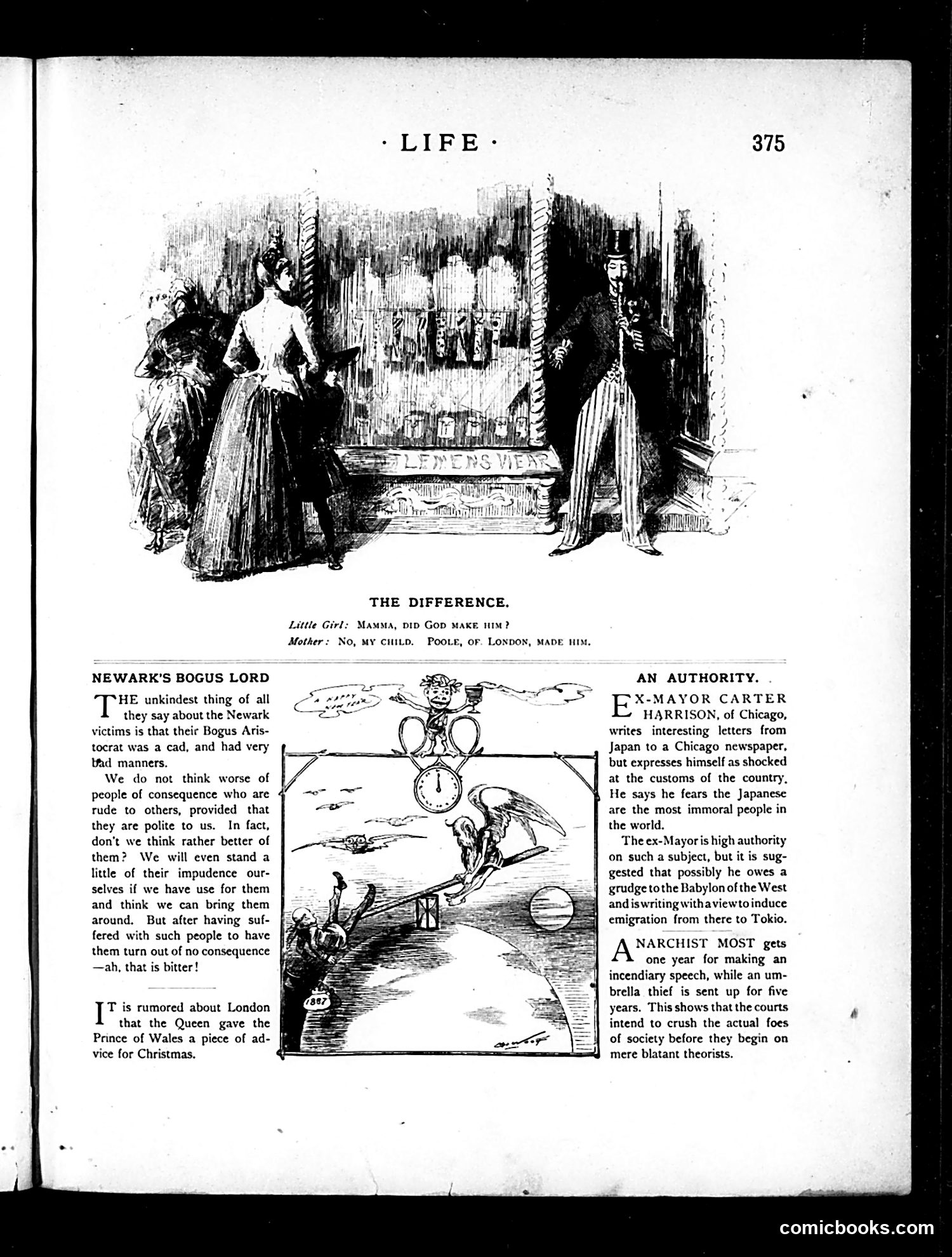
**"The Difference"** (top cartoon): A satirical jab at class distinctions. A working-class child asks their mother who made them, and she replies "Poole, of London"—referencing an exclusive London tailor. The joke mocks how wealthy families traced their importance to fashionable makers and establishments, while poor families had no such pretensions. **"Newark's Bogus Lord"**: Criticizes an aristocratic con artist who exploited London society through false manners and claims of nobility, then fled—likely a contemporary scandal. The text condemns how the wealthy tolerate rudeness from supposed "superiors." **"An Authority"**: Satirizes ex-Mayor Carter Harrison of Chicago for writing inflammatory letters about Japanese immorality based on limited experience, suggesting his criticism stems from Western prejudice rather than genuine expertise.
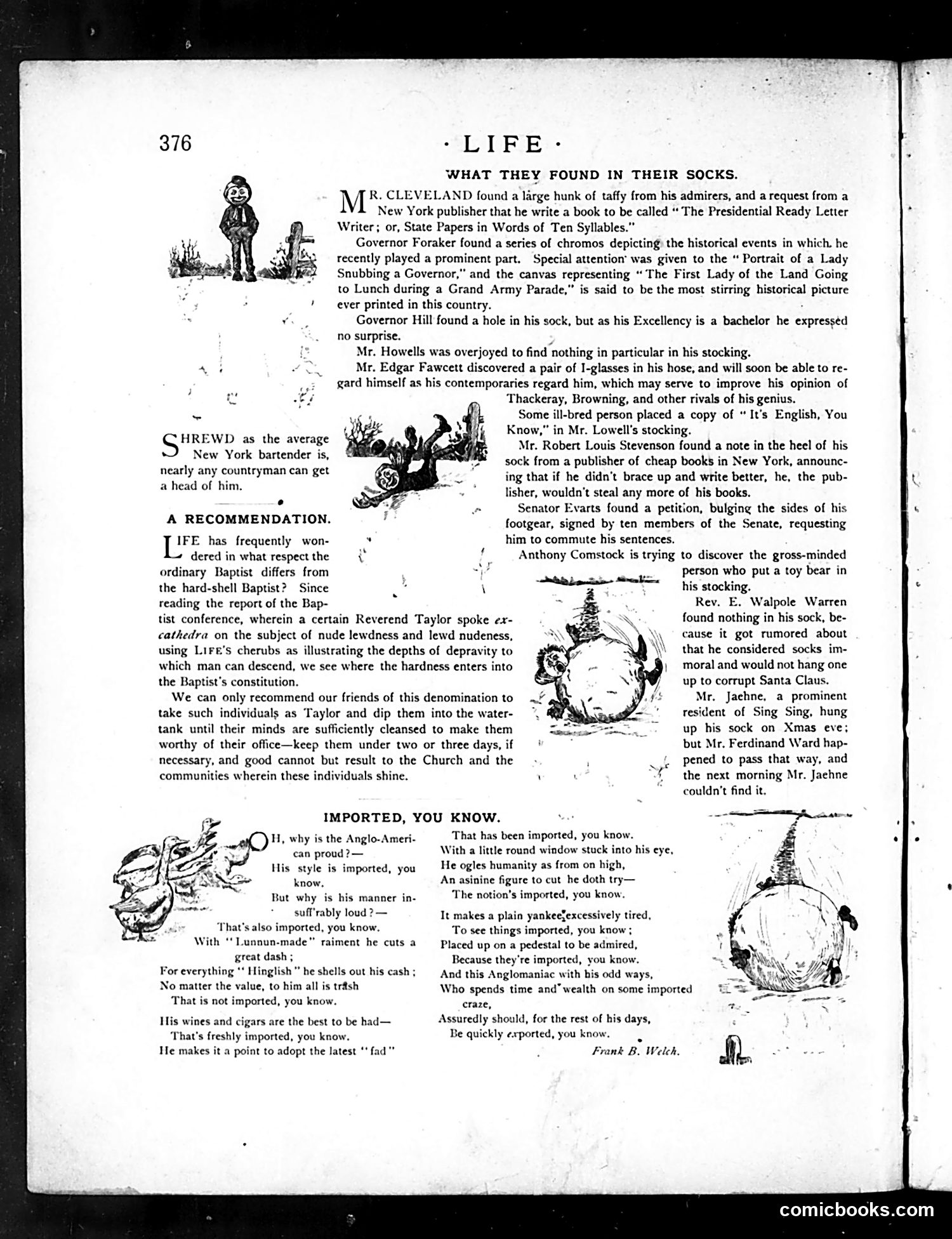
This humorous piece satirizes prominent public figures by imagining absurd discoveries in their socks—a genteel joke format typical of Life's society satire. The targets include: - **Mr. Cleveland**: criticized for being a bachelor (surprising for a governor) - **Mr. Howells**: found nothing, disappointing readers - **Mr. Edgar Fawcett**: discovered l-glasses in his hose - **Senator Evarts**: had a petition to commute a death sentence - **Anthony Comstock**: allegedly hid a toy bear (unclear significance) - **Rev. E. Walpole Warren**: found nothing; the joke implies this reflects his moral character The satire mocks both the public figures themselves and contemporary obsessions with celebrity gossip. The accompanying poem "Imported, You Know" ridicules Anglo-American snobbery and pretension—clearly Life's broader target here.
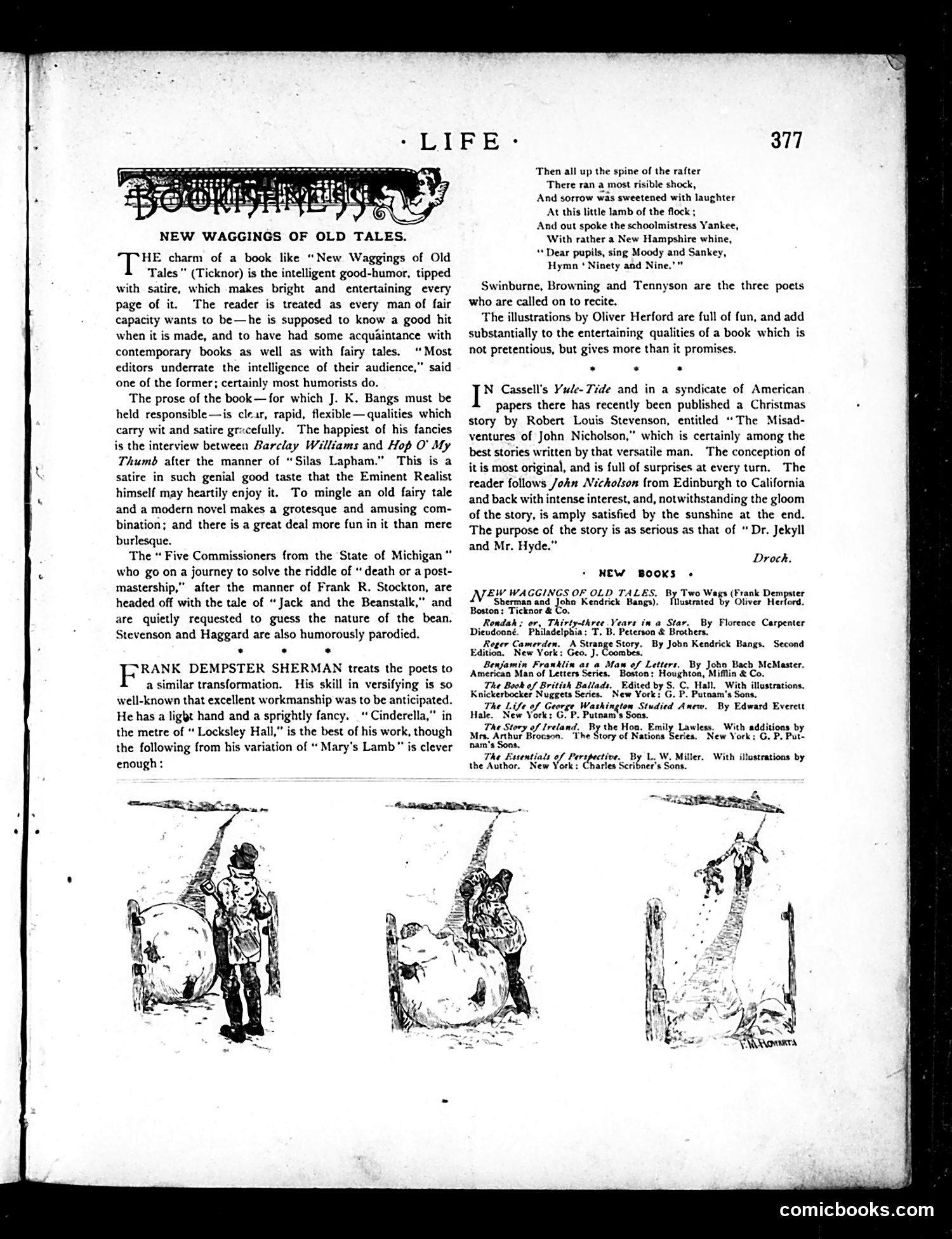
This page primarily contains **book reviews** rather than political cartoons. The main content discusses "New Waggings of Old Tales" by J.K. Bangs, praised for its satirical wit and entertaining retellings of fairy tales. The three illustrations at the bottom appear to be **humorous drawings related to the reviewed books**, showing figures in exaggerated or comedic situations—likely depicting scenes from the tales being reviewed. The page also lists several other "New Books," including works by Frank Dempster Sherman and references to various literary titles of the period. **This is a literary review section, not political satire.** No specific political figures or social commentary are evident from the visible content—it's focused on contemporary book recommendations for Life's readers.
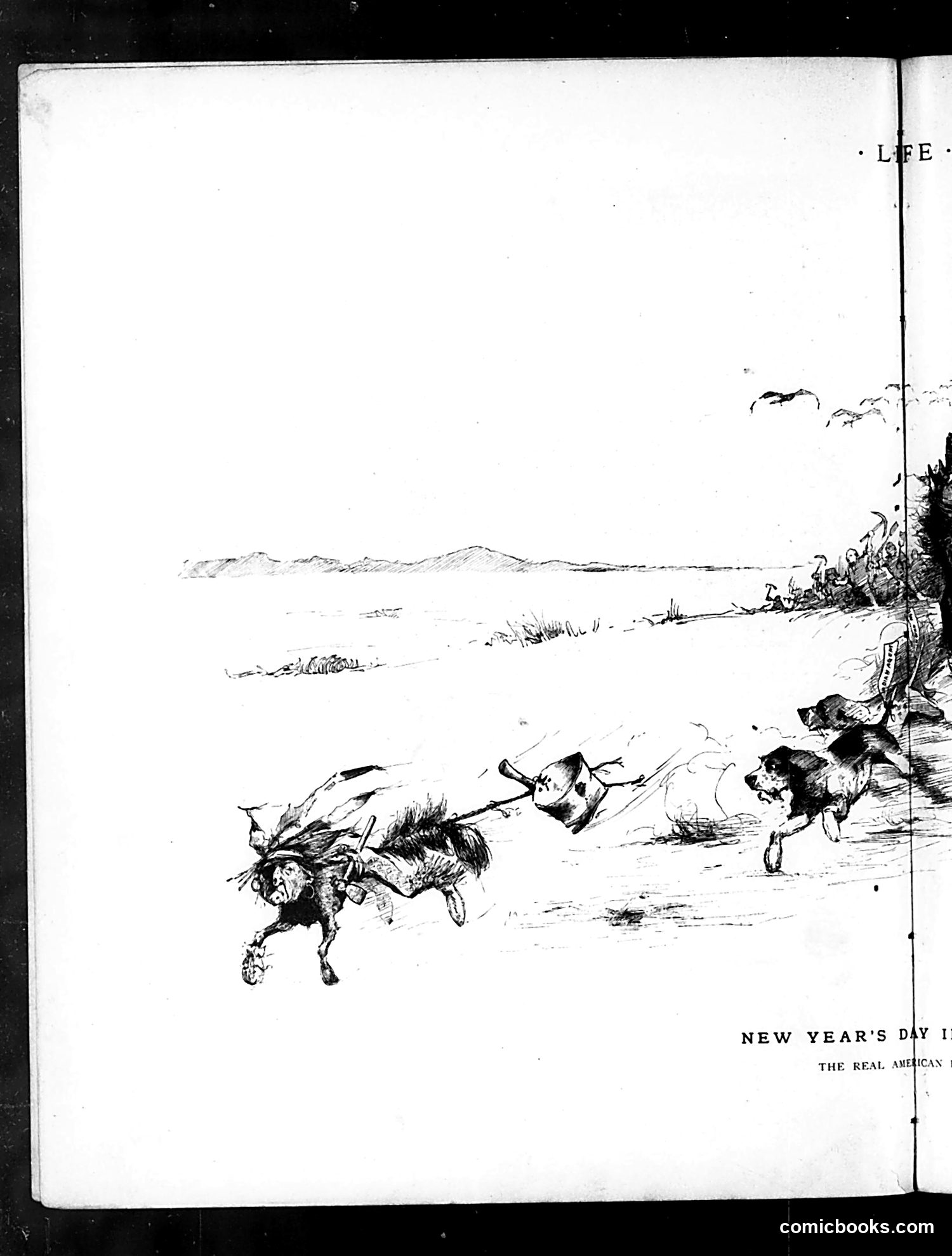
This page appears to be from Life magazine and features an illustration titled "NEW YEAR'S DAY IN THE REAL AMERICA" (partial text visible). The sketch depicts dogs engaged in what looks like a chaotic chase or fight scene on a beach or sandy area, with water and distant hills in the background. People can be seen on the right side of the image. The satire likely critiques American society by contrasting "real America" with idealized portrayals—using dogs behaving chaotically to represent actual American life versus more dignified public images. The specific social or political commentary remains unclear without additional context or the complete article text, though the irreverent tone is characteristic of Life magazine's satirical approach to contemporary American culture.
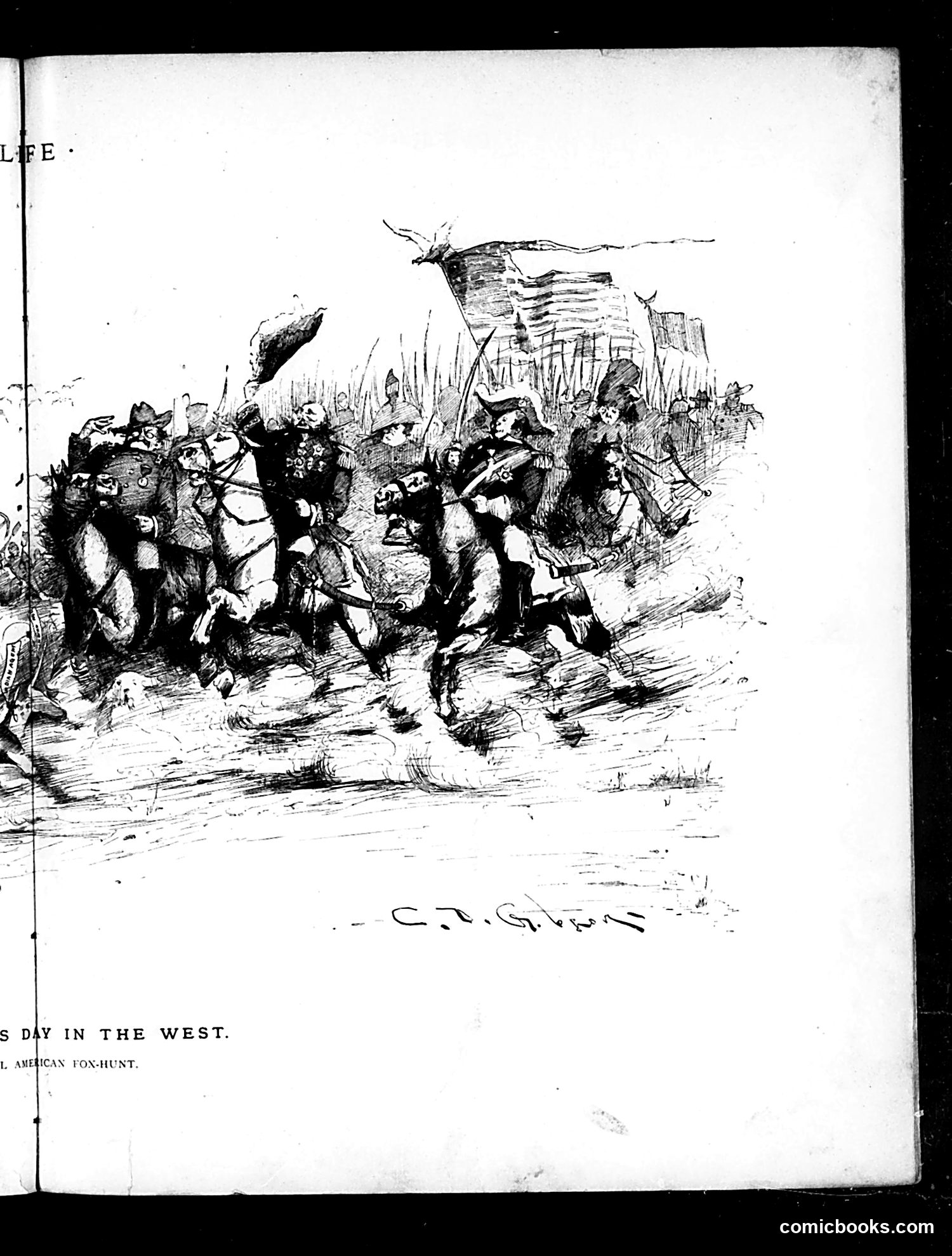
This satirical illustration depicts what appears to be a chaotic "American Fox-Hunt" set in the West. The sketch shows mounted figures in military or formal dress engaged in what looks like a disorderly pursuit, with flags visible and figures in apparent disarray. Given the title's reference to a "fox hunt" in an American Western context, this likely satirizes either: - Military campaigns or expeditions presented as sport/entertainment - Political or social pursuits portrayed as chaotic rather than orderly - Possibly American expansionism or frontier conflicts The deliberately rough, caricatured style and apparent confusion of the scene suggests mockery of the pretensions or actual conduct of the activity being depicted. However, without clearer OCR text or additional context, the specific political target remains unclear. The work demonstrates Life magazine's characteristic use of visual satire to critique American institutions or events.
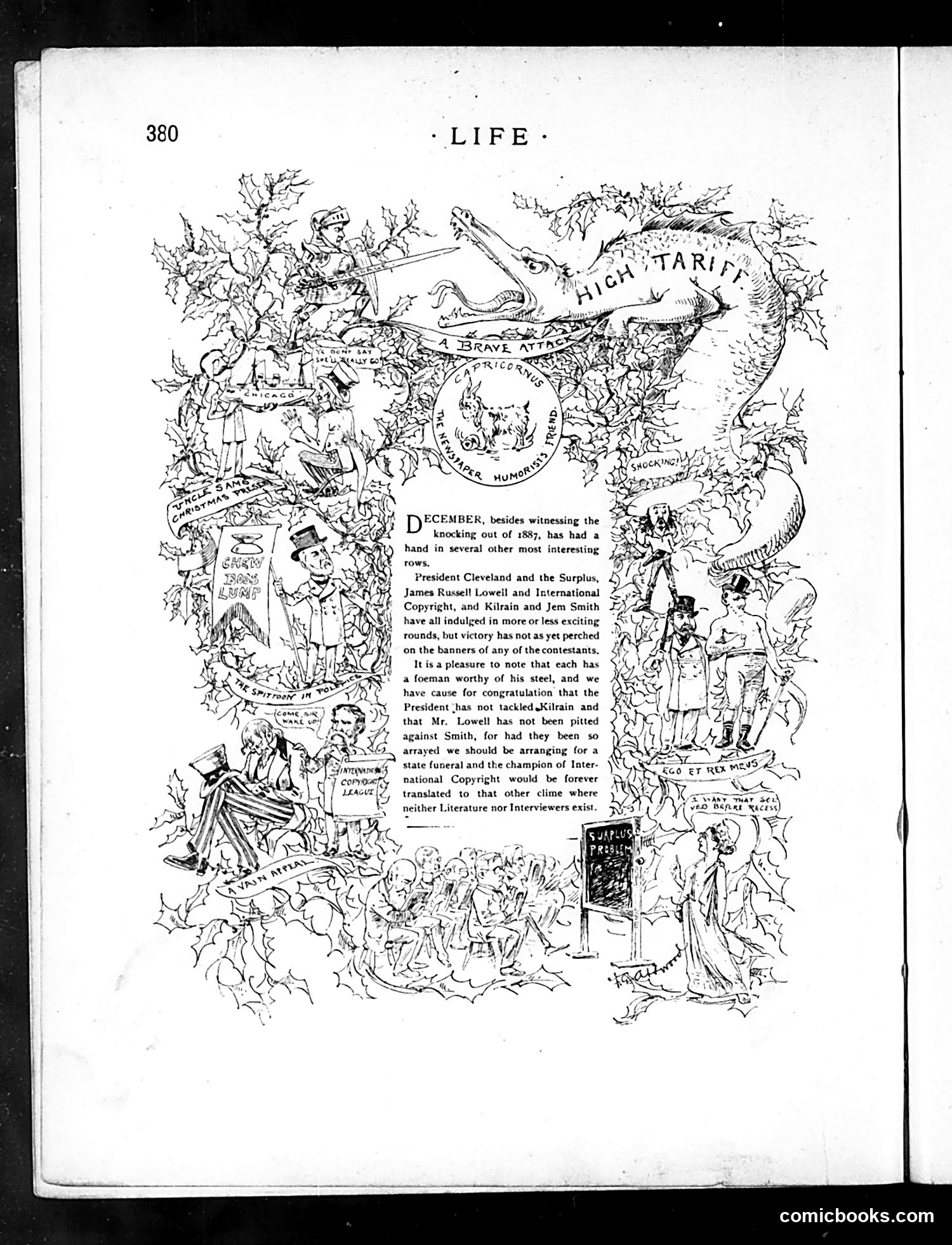
This page satirizes several prominent December 1887 disputes. The elaborate border illustration depicts figurative "battles" between: 1. **President Cleveland vs. the Surplus** — Cleveland's dispute over federal budget surplus (a major political issue of his administration) 2. **James Russell Lowell vs. International Copyright advocates** — the literary establishment's debate over copyright protections 3. **Kilrain vs. Jem Smith** — a heavyweight boxing match between these famous pugilists The text humorously suggests these contestants are evenly matched, then jokes that it's fortunate Cleveland didn't fight boxer Kilrain and Lowell didn't face Smith—because the outcomes would be so lopsided that funerals and obituaries would be needed. The satire mocks these public controversies by treating them with mock-serious athletic language, implying they're as culturally significant (and entertaining) as major sporting events.
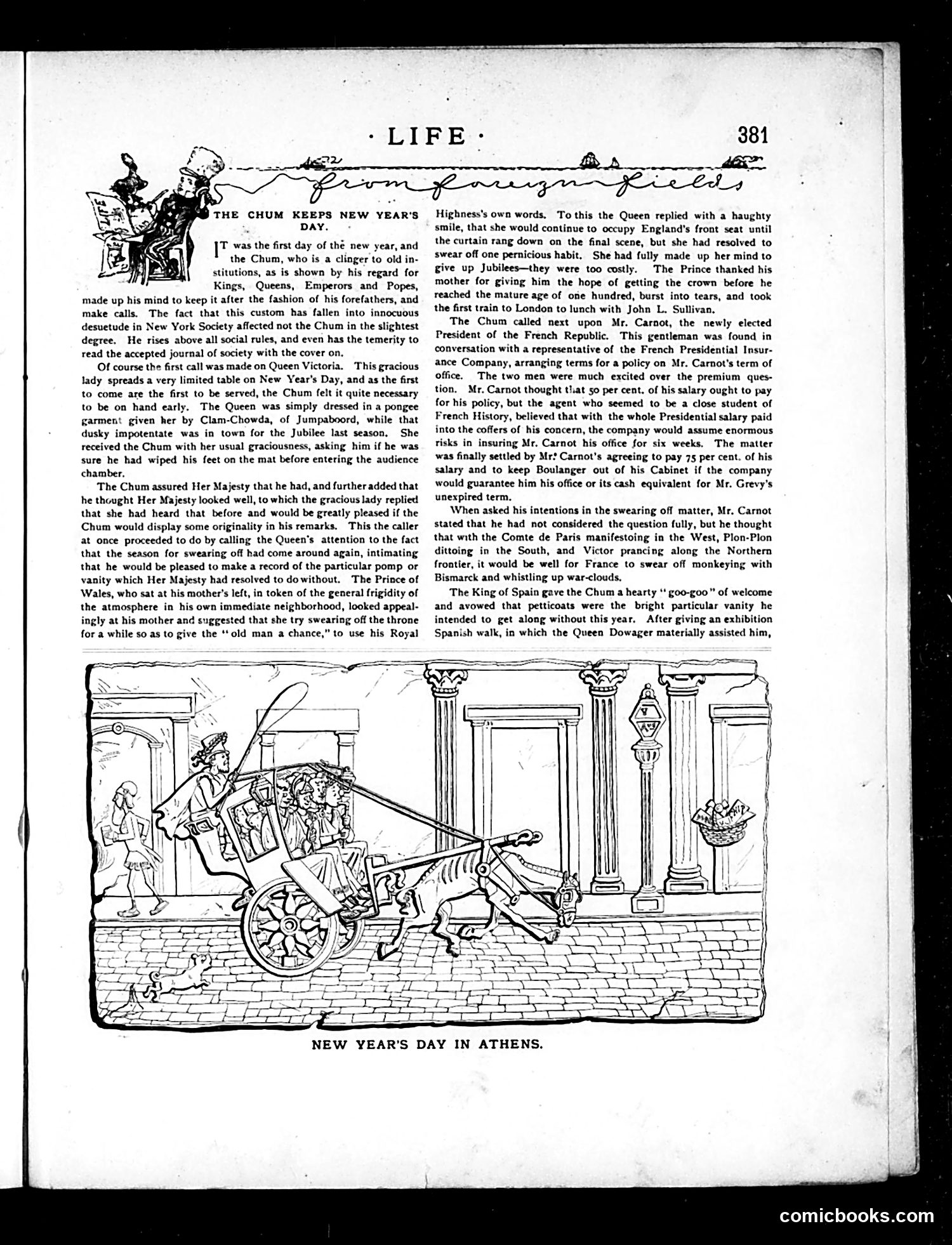
This page satirizes New Year's Day social calls—an old-fashioned custom the "Chum" (the magazine's recurring character) insists on maintaining despite it being outdated in New York society. The cartoon depicts the Chum's visits to Queen Victoria and French President Carnot. The satire mocks: **Queen Victoria**: Her refusal to "swear off" (give up) her throne, despite the Prince of Wales's plea for a chance at the crown. Her resolution instead—to end costly jubilees—prompts the Prince to flee to lunch with boxer John L. Sullivan. **President Carnot**: His negotiating Presidential life insurance with a company skeptical of French political stability (referencing Boulanger and other rival claimants). The joke: his office is so precarious that the insurer demands he pay 75% of his salary as premium and keep political rival General Boulanger from his cabinet. The humor targets political instability in France and British monarchy's rigidity through the lens of absurd New Year's etiquette.
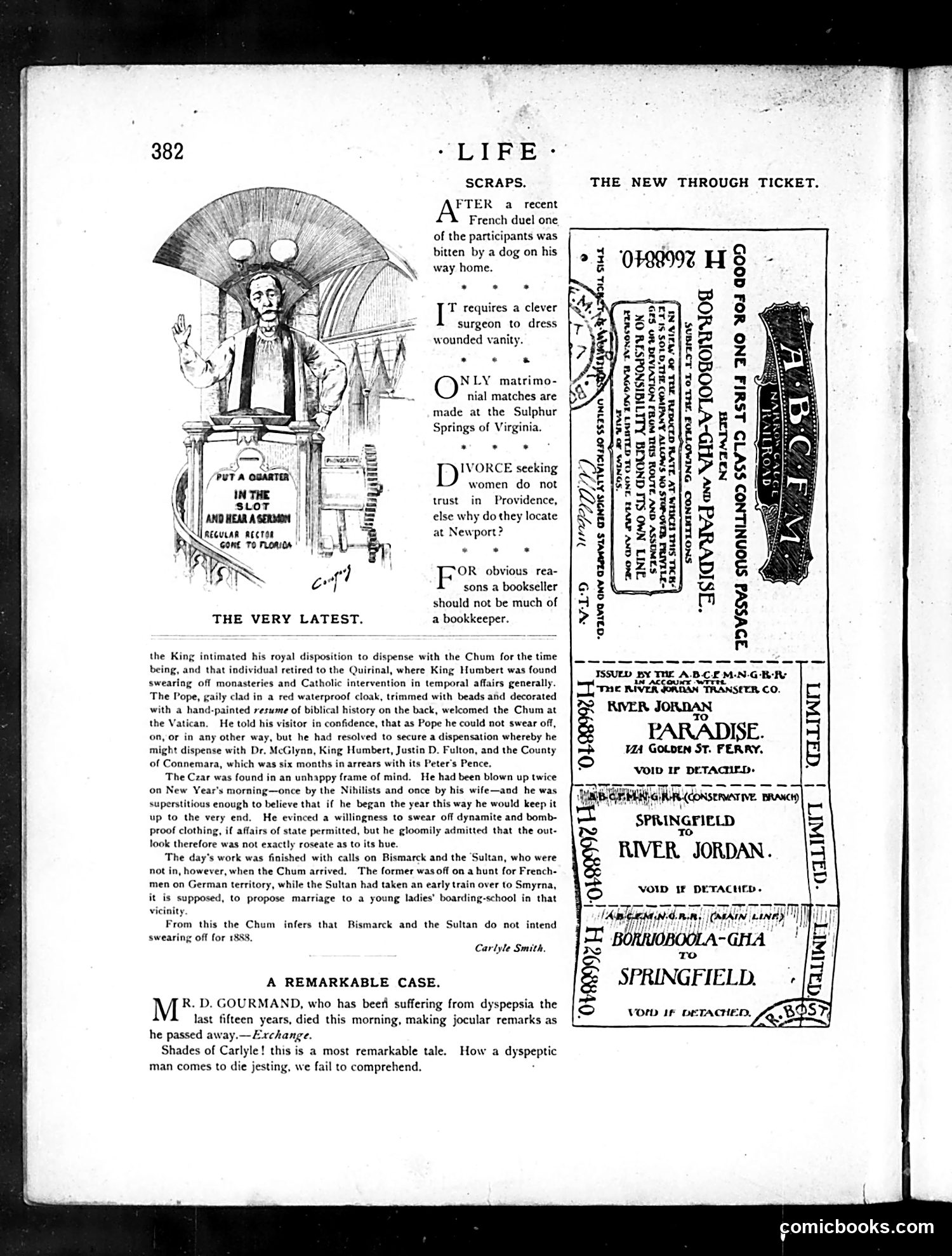
The main cartoon, "The Very Latest," depicts a figure in a pulpit labeled "Put a Quarter in the Slot and Hear a Sermon" — likely satirizing commercialized religion or perhaps a specific preacher. The accompanying text snippets mock various contemporary foibles: dueling Frenchmen, matrimonial matchmaking at Virginia springs, divorce-seeking women at Newport, and the confusion between booksellers and bookkeepers. The longer article describes a fictional "Chum" visiting world leaders (the Pope, Czar, Bismarck, the Sultan) to convince them to "swear off" various vices—monasteries, dynamite, military aggression—for 1888. The satire ridicules both the absurdity of expecting reform from these figures and contemporary reform movements themselves. The right side contains advertisements for railway tickets to "River Jordan" and "Borroboola-Gha," appearing to satirize both religious pilgrimage culture and colonial expansion fantasies. The final item mocks a man who dies jovially after 15 years of dyspepsia—an absurdist joke about incompatible character traits.
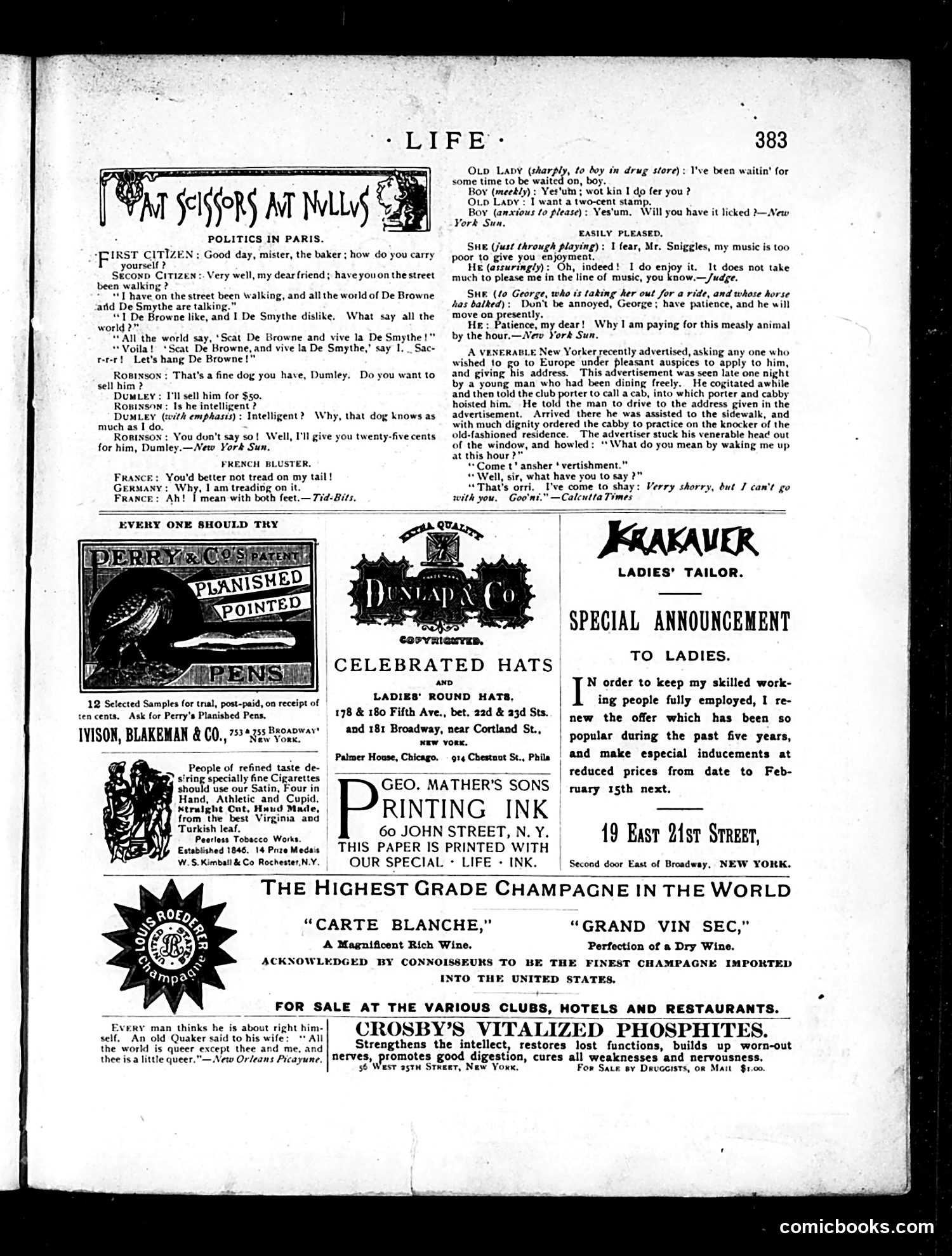
This page is primarily **a collection of humor jokes and advertisements** rather than political cartoons. The humor pieces contain brief comedic exchanges: - "**Politics in Paris**" satirizes French-German relations through fractured-English dialogue about politicians "De Browne" and "De Smythe" (likely fictional stand-ins), and a barb about German military aggression ("treading on France's tail"). - Several short jokes lampoon everyday American life: an impatient customer buying stamps, a musician fishing for compliments, and a drunk man arriving at a stranger's door claiming to respond to a European travel advertisement. The remaining space is filled with **period advertisements** for hats, printing ink, cigarettes, and a tailor's sale. The "French Bluster" joke appears to reference contemporary Franco-German tensions, though without specific historical context visible here. The other humor is topical domestic satire—gentle mockery of social manners rather than sharp political commentary.
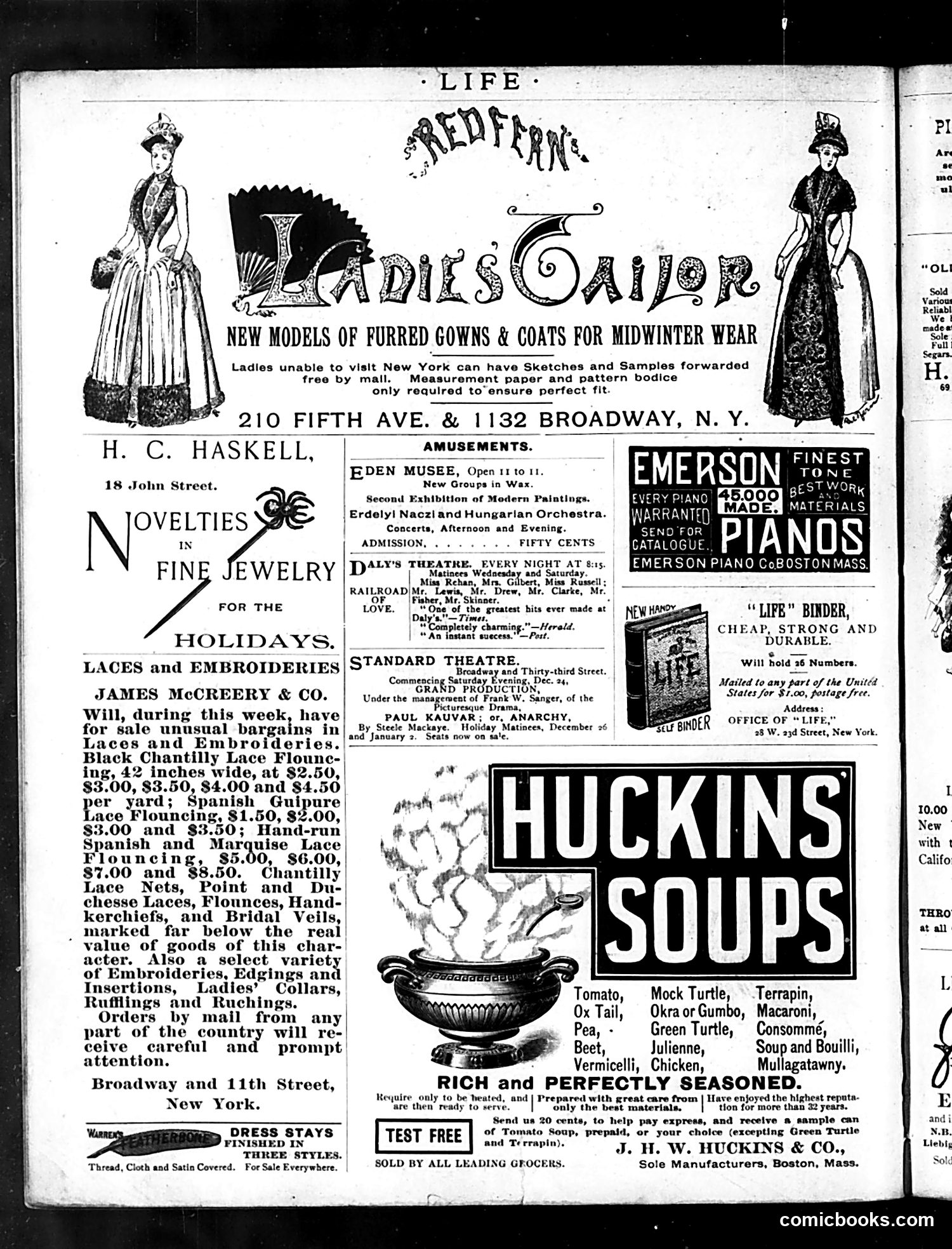
This is primarily an **advertising page** from Life magazine, not a satirical cartoon. The page showcases late 19th-century commercial products and services aimed at affluent readers. **Key advertisements include:** - **Red Fern Ladies' Tailor** (top): Fashionable furred coats and gowns for winter, with mail-order service for out-of-town customers - **James McCreery & Co.**: Holiday lace and embroidery sales - **Theater listings**: Including Daly's Theatre and Standard Theatre productions - **Huckins Soups** (large central ad): A major feature promoting canned soups in various varieties, emphasizing quality and convenience - **Emerson Pianos** and other luxury goods The advertisements reflect Gilded Age consumer culture—catering to wealthy urban dwellers with disposable income for fine clothing, theater, and prepared foods. There is **no political satire** on this page; it represents Life's primary revenue source: advertising to its affluent readership.
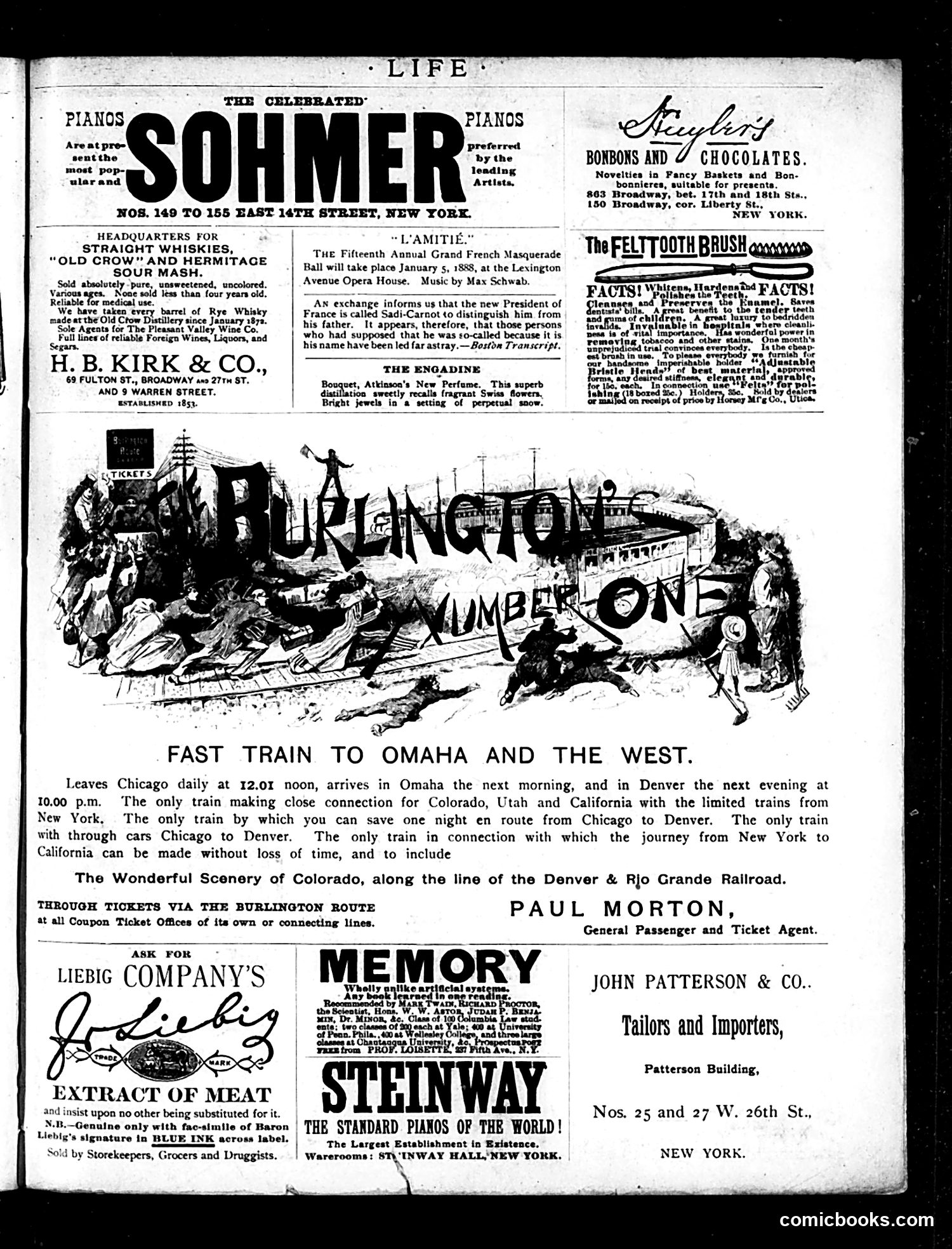
This page is primarily **advertising**, not political satire. It contains commercial announcements for luxury goods and services popular in 1880s New York: pianos (Sohmer), chocolates, whisky, perfume, railroads, meat extract, and tailoring. The only satirical content is a brief **joke about French politics**: A newspaper exchange notes that the new French President is named "Sadi-Carnot" to distinguish him from his father. The humor mocks people who supposedly thought he was called that because "it is his name"—a light joke about confusion over the distinction between inherited surnames and distinguishing epithets. The large illustrated advertisement for "Burlington Number One" train service dominates the page, promoting fast rail travel from Chicago to Denver and Omaha. This appears to be a typical Life magazine page mixing light humor with revenue-generating advertisements aimed at affluent urban readers.
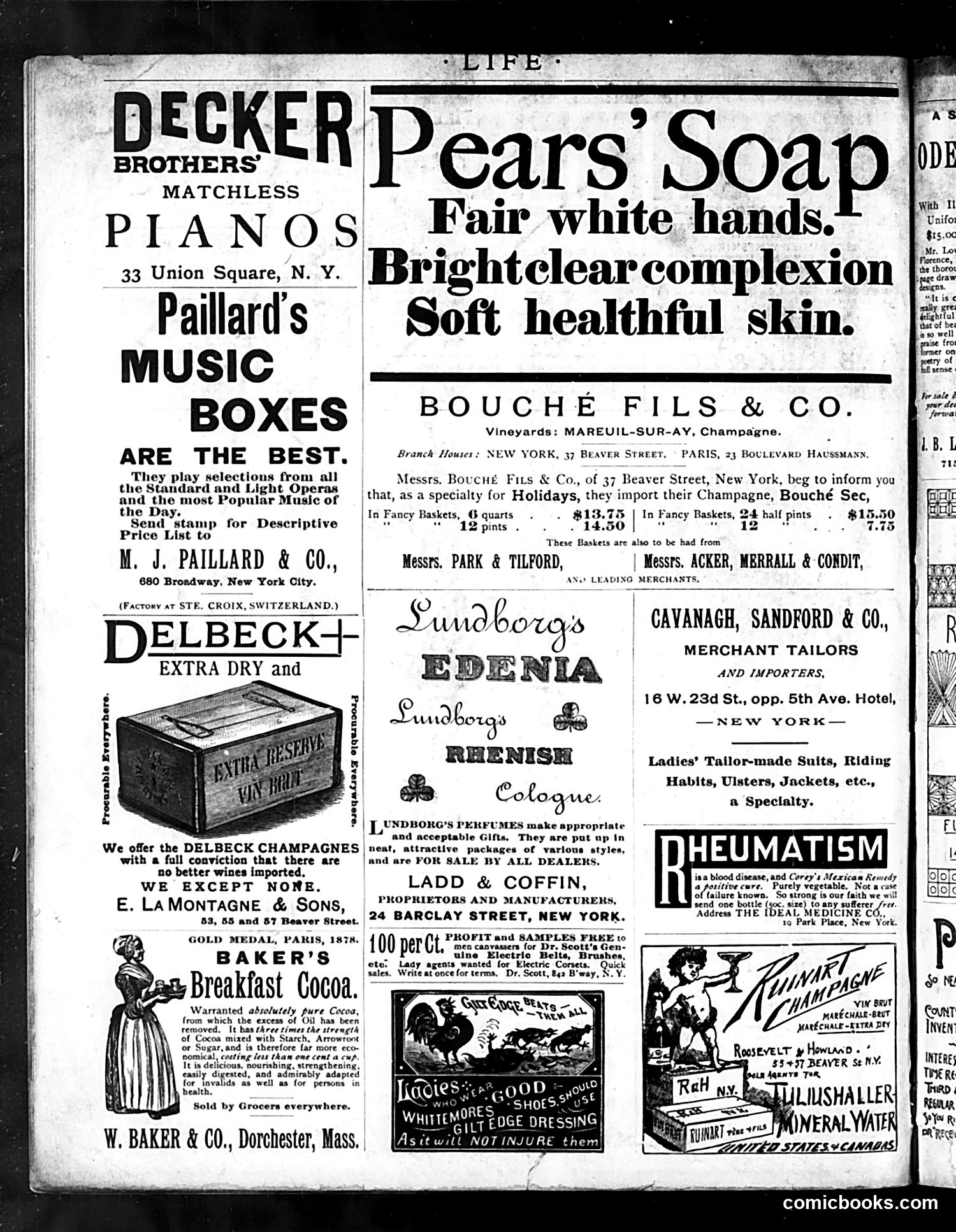
This page is **primarily advertising**, not satire or political commentary. It consists of turn-of-the-century product advertisements typical of Life magazine's commercial content. Key ads include Pears' Soap (promoting "fair white hands" and "bright clear complexion"—reflecting period beauty standards valuing paleness), Delbeck Champagne, Baker's Breakfast Cocoa, and various luxury goods (pianos, perfumes, tailor services). The ads reveal **late-Victorian consumer culture**: emphasis on imported European goods (champagne from France, Swiss chocolate), pseudo-scientific health claims (Dr. Scott's "Electric Belts"), and gendered marketing (ladies' tailoring, skin whitening). **For modern readers**: These ads are historically significant not as humor but as cultural artifacts showing period anxieties about class, complexion, health, and consumption. The "fair white hands" messaging particularly reflects racist beauty standards of the era. The page documents advertising's evolution and the social values Life's audience held.
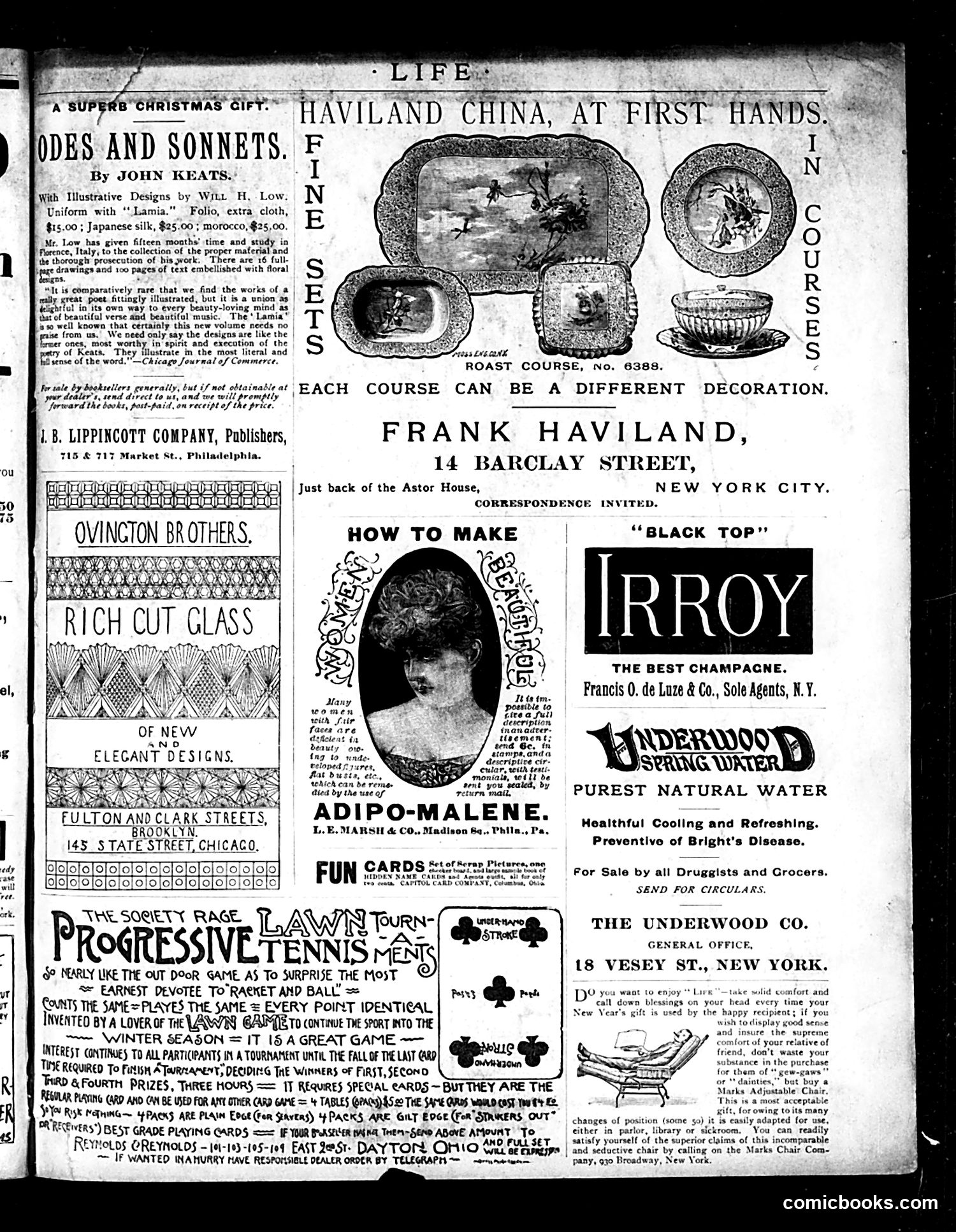
This page is **primarily advertising**, with no significant political cartoon or satirical content requiring historical context. The main feature is a "How to Make" instruction piece for "Adipo-Malene," a beauty product promising facial improvements—typical turn-of-the-century snake-oil advertising targeting women concerned with appearance. The page includes promotional content for various luxury goods (Haviland china, Irroy champagne, Underwood furniture) and recreational items (a "Progressive Lawn Tennis" card game). There's also an advertisement for Keats's *Odes and Sonnets* with illustrations by Will H. Low. The "Progressive Lawn Tennis" description suggests an indoor card game mimicking outdoor tennis, marketed as winter entertainment for enthusiasts—a novelty product for leisure activity. No identifiable political figures, satirical commentary on current events, or social critique appears on this page. It represents standard commercial advertising from early 20th-century *Life* magazine.
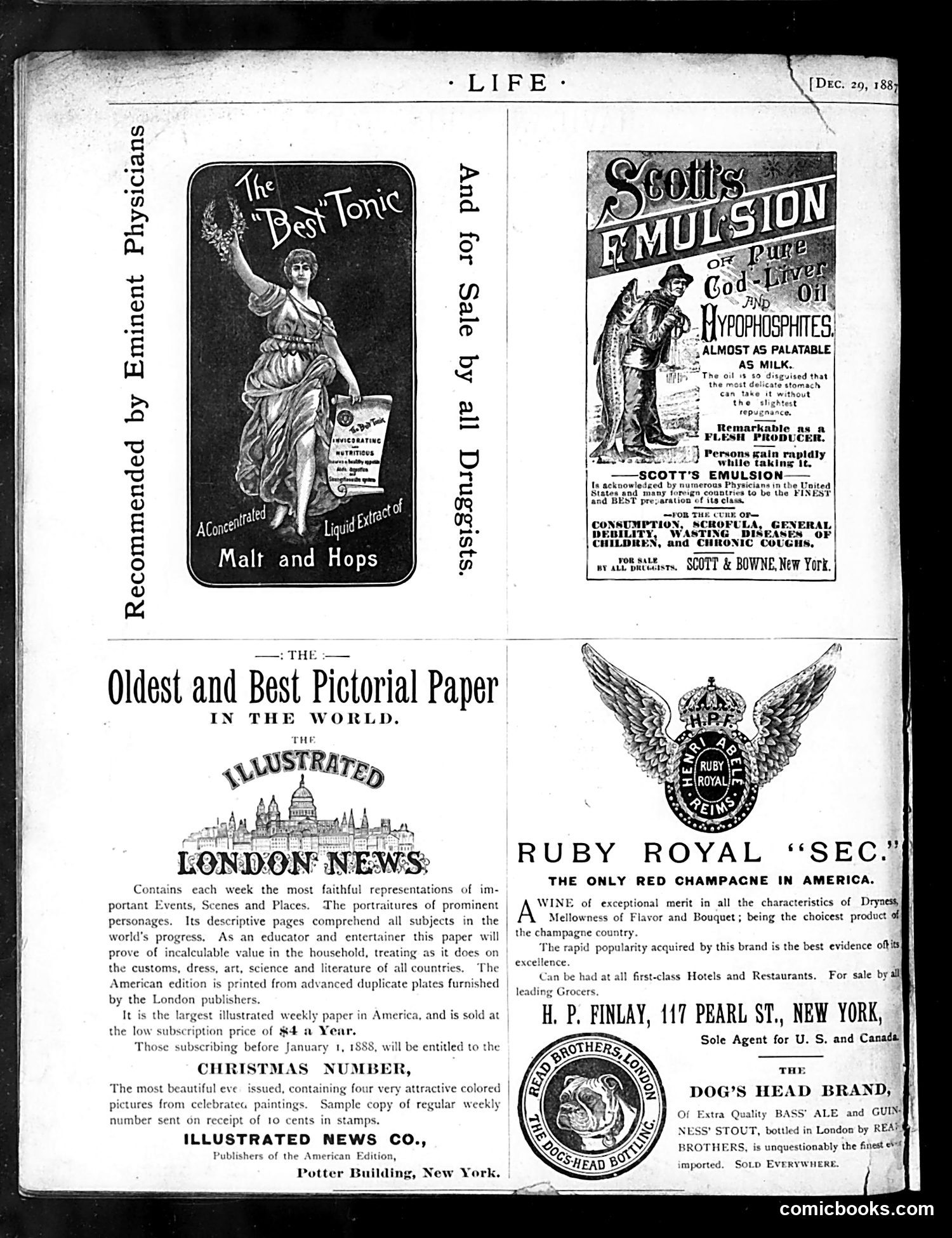
This is primarily an **advertising page** rather than satirical content. It features Victorian-era patent medicine and luxury product advertisements: **Notable ads include:** - "The Best Tonic" (malt and hops extract) endorsed by physicians - Scott's Emulsion (cod liver oil), marketed as a "flesh producer" that aids weight gain - Ruby Royal champagne, claimed as "the only red champagne in America" - Dog's Head Brand ale and stout The page also promotes the **Illustrated London News** American edition as "the oldest and best pictorial paper in the world." These ads reflect late-19th-century consumer culture and medical marketing practices. The exaggerated health claims (cod liver oil making people gain weight rapidly) and product endorsements by unnamed physicians are typical of the era's largely unregulated advertising. The luxury imports (champagne, British ale) appealed to aspirational American consumers.
I can see this is a page from Life magazine that appears almost entirely black with minimal visible content. While the OCR text only shows "comicbooks.com" (likely a watermark from the digital source), the image itself is too dark and degraded to discern any cartoon figures, caricatures, text, or satirical content with confidence. The page may contain political commentary or humor typical of Life's satirical approach, but without legible visual or textual elements, I cannot reliably identify specific figures, historical references, or the intended jokes. This appears to be either a heavily damaged scan, a blank page, or an image captured during a particularly dark portion of the publication.