
A complete issue · 16 pages · 1887
Life — October 20, 1887
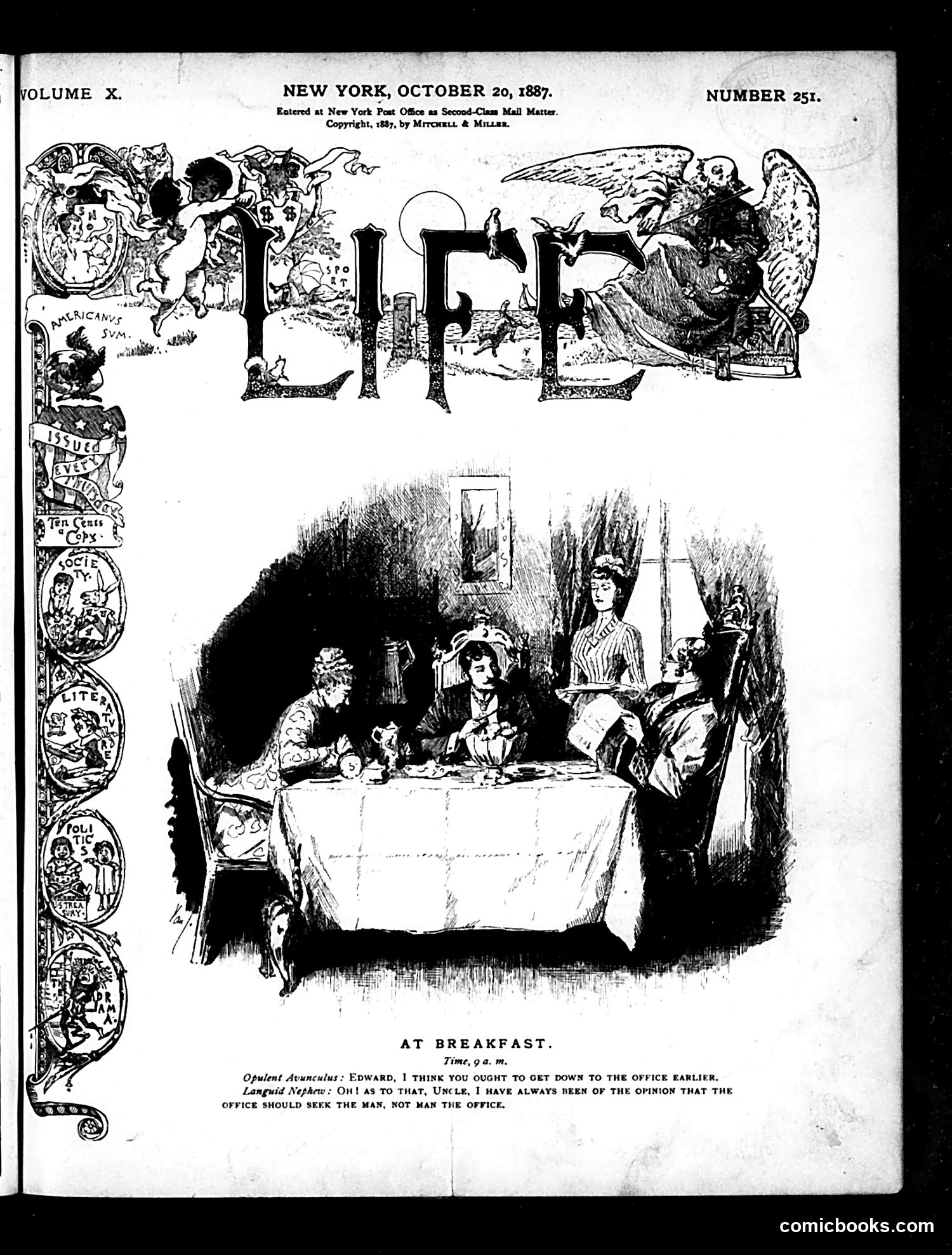
This page features a satirical cartoon titled "At Breakfast" depicting an office workplace conflict. The dialogue reveals the satire's target: a debate about workplace hierarchy and arrival times. **The Joke:** An uncle (likely a senior figure or owner) is being told by a younger employee that he should arrive at the office earlier. The uncle responds that he's always held the opinion "that the office should seek the man, not man the office"—a humorous inversion of workplace expectations. **The Satire:** The cartoon mocks aristocratic or privileged attitudes about work obligations. The uncle represents an older generation expecting deference and accommodation, while the younger worker's suggestion that bosses should arrive early represents emerging modern business efficiency standards. The ornate decorative border and classical mythological figures in the header are typical of Life's visual style during this era.
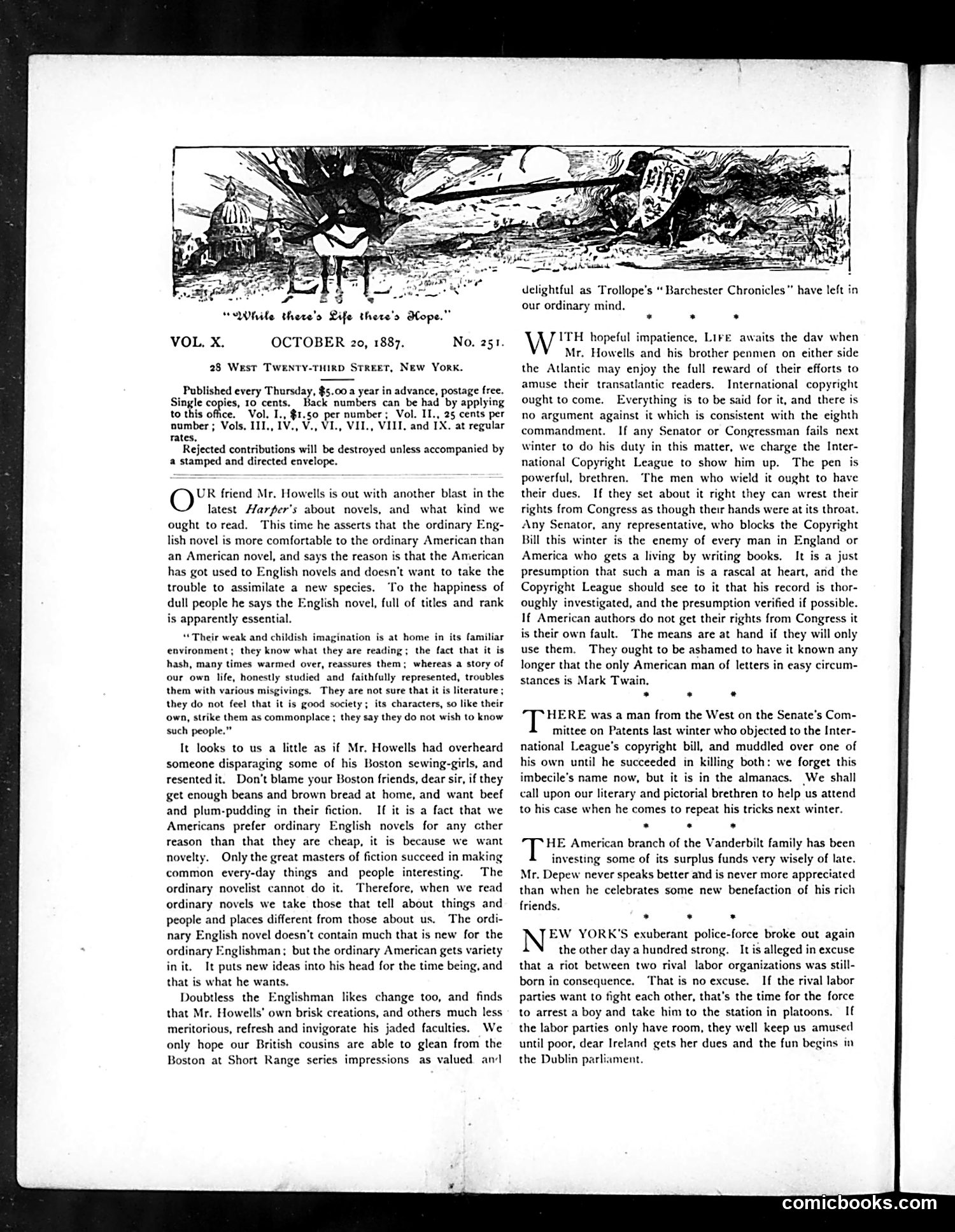
The small cartoon at the top left, captioned "While there's Life there's Hope," appears to be a symbolic illustration rather than a specific political caricature. It shows figures in a dramatic landscape, likely reflecting the magazine's general satirical tone. The page's main content addresses literary matters and copyright issues. Text discusses Mr. Howells' novels and defends American literature against British preferences. A significant passage advocates for international copyright protection, attacking a Western Senator who opposed the copyright bill and "succeeded in killing both" protections—likely referring to contemporary copyright debates in Congress. The final section briefly mentions a New York police dispute and the Vanderbilt family's charitable investments, maintaining the magazine's typical mix of social commentary and cultural criticism.
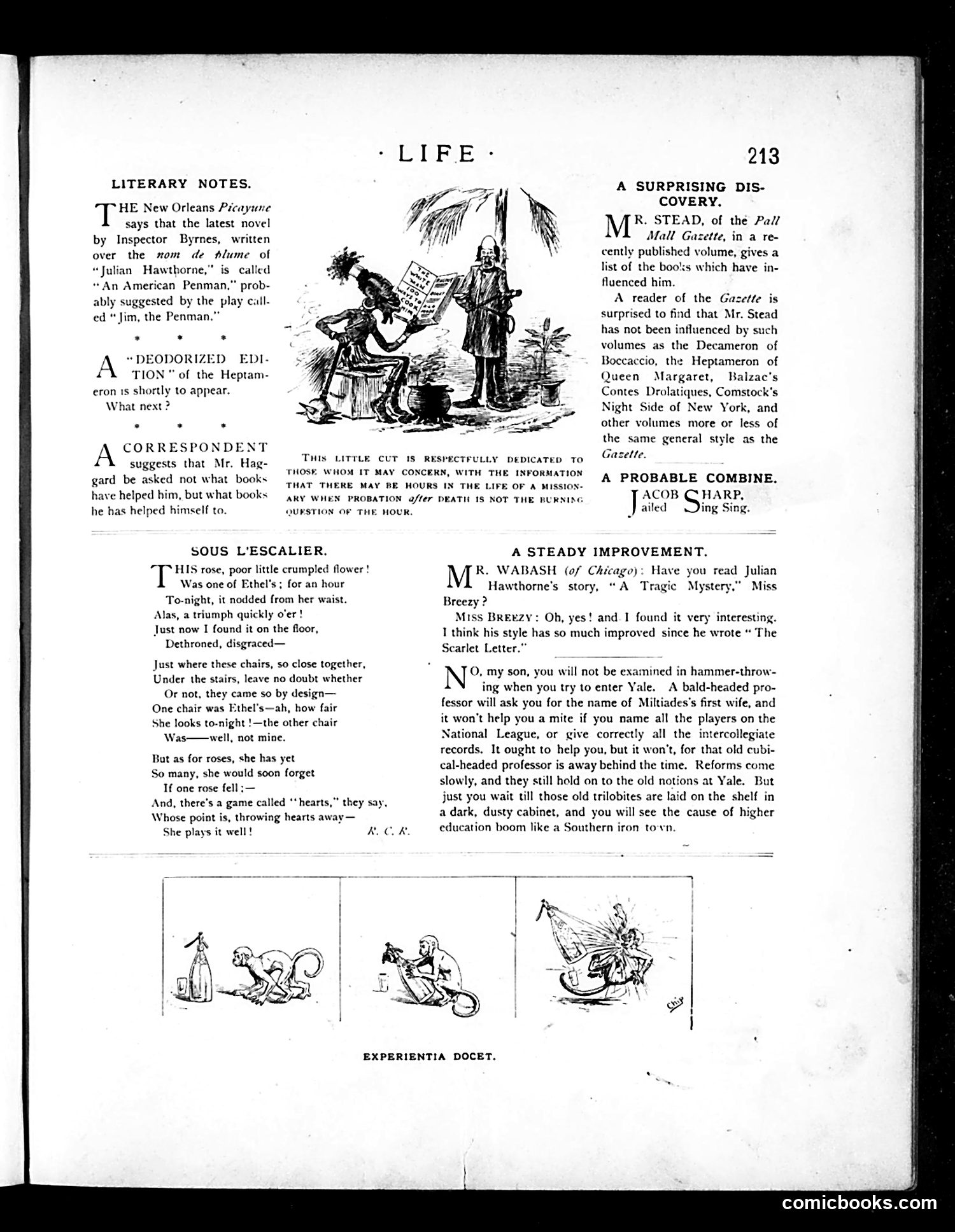
This page contains **literary notes and humor** rather than political cartoons. The main content includes: **"Sous L'Escalier"** — A poem about a wilted flower found under stairs, likely commenting on discarded romance or lost beauty. **"A Steady Improvement"** — A dialogue mocking Yale University's educational standards, suggesting students aren't properly educated and that old academic traditions remain entrenched despite claimed reforms. **"Experientia Docet"** — Three small humorous illustrations at the bottom (unclear exactly what they depict, but appear to be sight gags or visual jokes). The page reflects *Life*'s satirical approach to American institutions, particularly higher education's resistance to modernization. No specific political figures are identifiable.
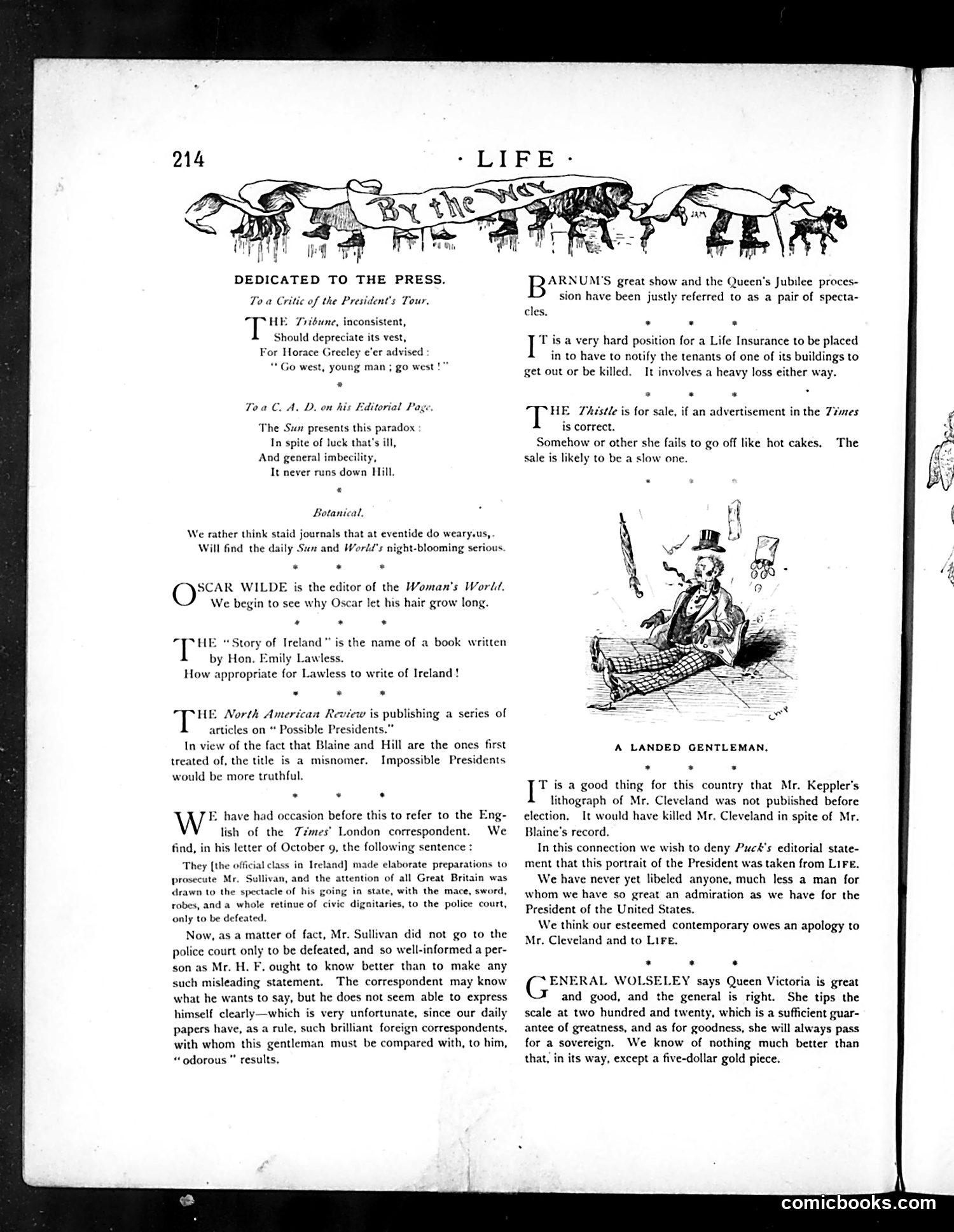
This page is primarily **satirical commentary** rather than a political cartoon. It contains several brief editorial jabs at contemporary figures and publications: - **Oscar Wilde**: mocked for editing *Woman's World* and his long hair - **Emily Lawless**: criticized for writing "The Story of Ireland" - *The North American Review*: satirized for calling certain presidential candidates "impossible" - **The Times newspaper**: jabbed for slow advertising sales - **Mr. Cleveland**: praised in a lithograph by Keppler; the editors defend him against *Puck* magazine's criticism The single illustration shows "A Landed Gentleman"—a well-dressed figure in a boat. The page emphasizes Life's role as a satirical arbiter of taste and politics, taking shots at rival publications and public figures through witty, brief commentary.
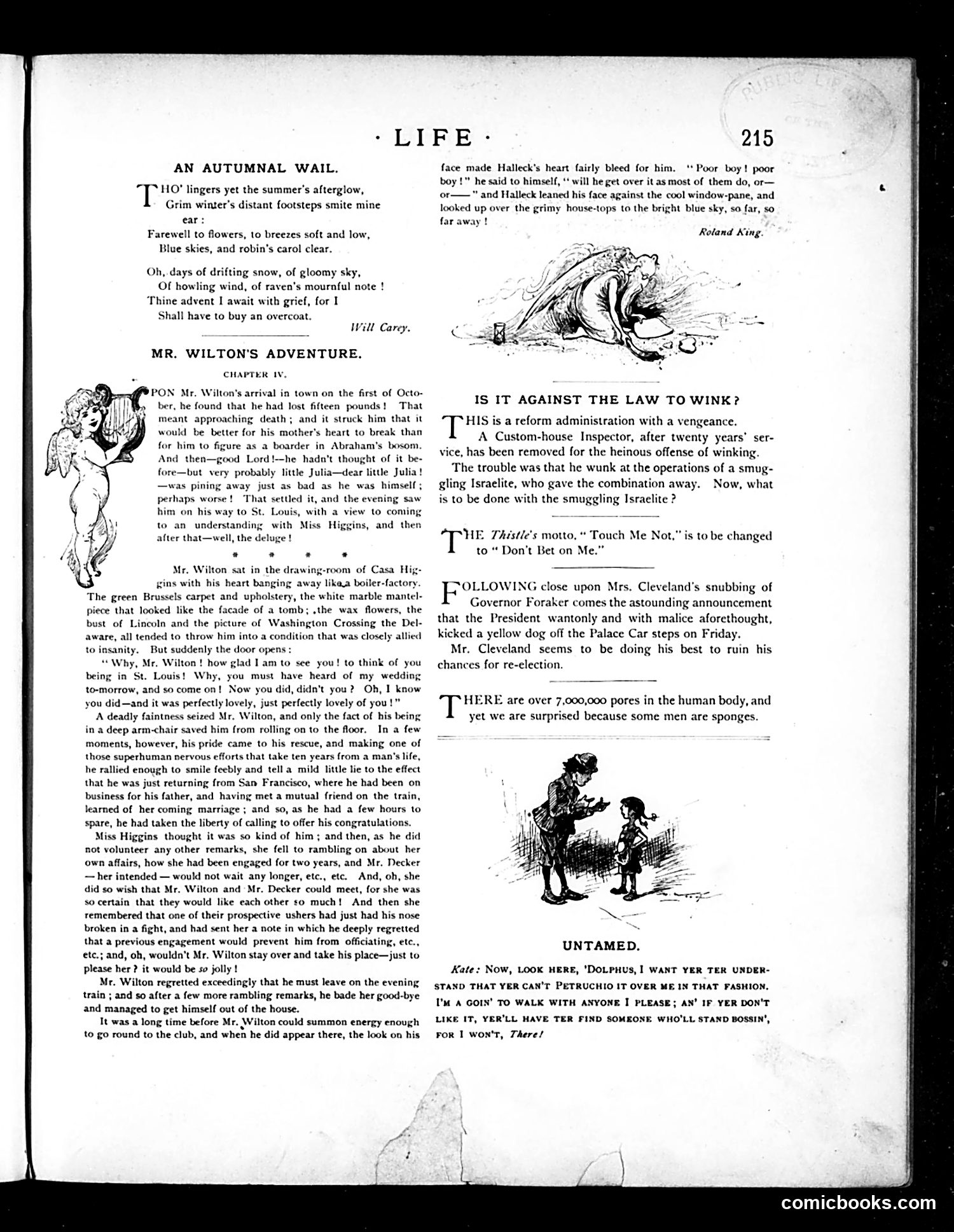
This page contains three distinct sections: 1. **"An Autumnal Wail"** and **"Mr. Wilson's Adventure"** (Chapter IV): A serialized story about Mr. Wilson's arrival in town and romantic entanglements, illustrated with period sketches. 2. **"Is It Against the Law to Wink?"**: A brief satirical piece criticizing a customs inspector's removal for smuggling information. The joke plays on double meanings of "winking"—both flirtation and turning a blind eye to smuggling. 3. **"Untamed"**: A dialogue-based cartoon where a character named Dolphius refuses to walk with anyone unless they find him a "hard bossin'" companion, satirizing presumptuous romantic expectations. The illustrations are typical early-20th-century ink drawings. Without clearer identification of specific political figures or dated events in the text, the satire appears focused on social manners, romance, and minor administrative absurdities rather than major political commentary.
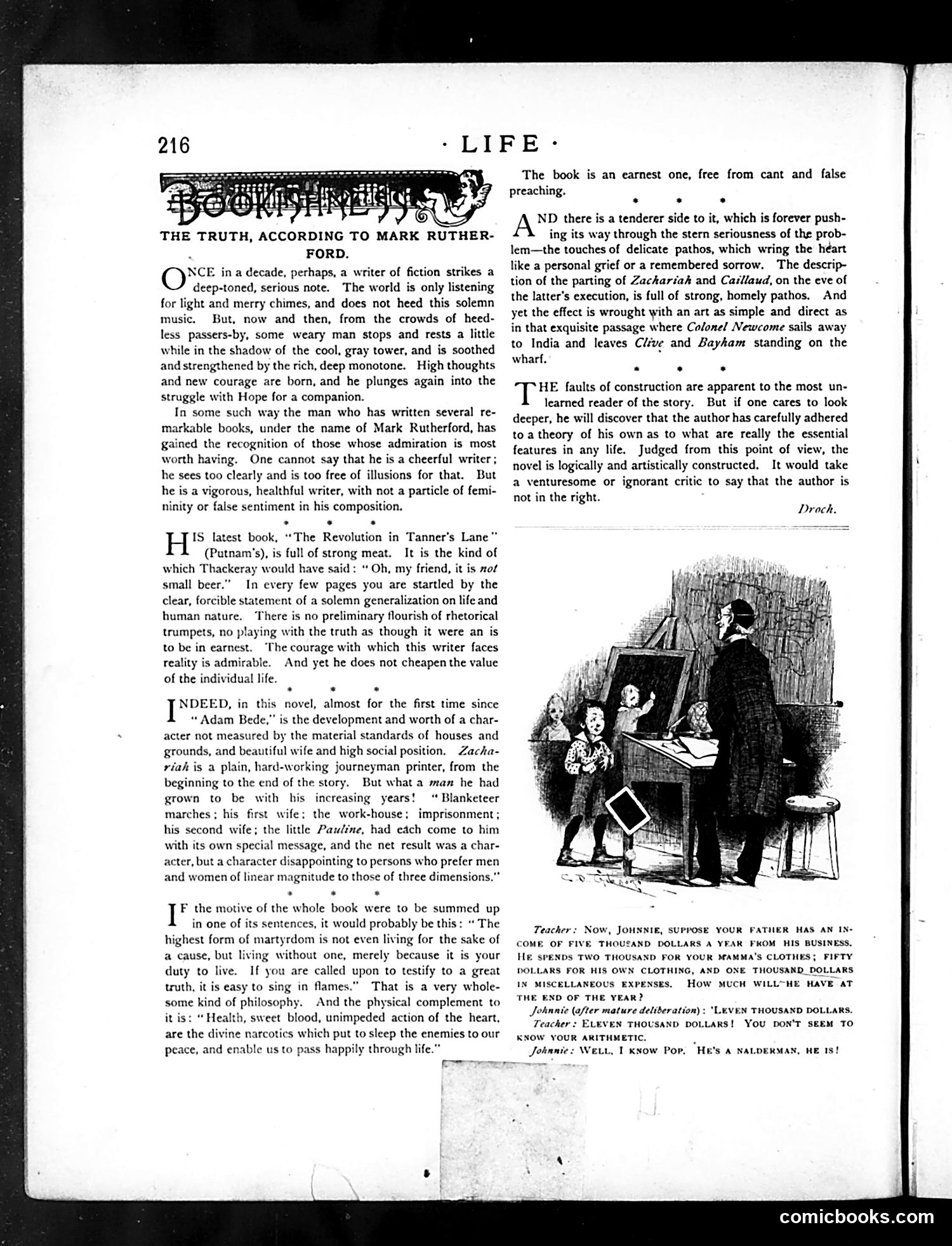
This page reviews Mark Rutherford's novel "The Revolution in Tanner's Lane." The accompanying illustration shows a schoolroom scene where a teacher addresses students about arithmetic and money. The cartoon's satirical point appears to be about class economics and education. The teacher discusses a father's income (five thousand dollars), spending on the mother's clothes (two thousand), the son's schooling (one thousand), and miscellaneous expenses—then asks students to calculate what remains. The student's answer ("eleven thousand dollars") is absurdly wrong, prompting the teacher's retort that the boy must be "a salderman." The satire likely critiques either the disconnect between privileged children and financial reality, or the absurdity of Victorian arithmetic problems divorced from realistic middle-class budgeting. The illustration humorously demonstrates how wealth insulates children from practical understanding.
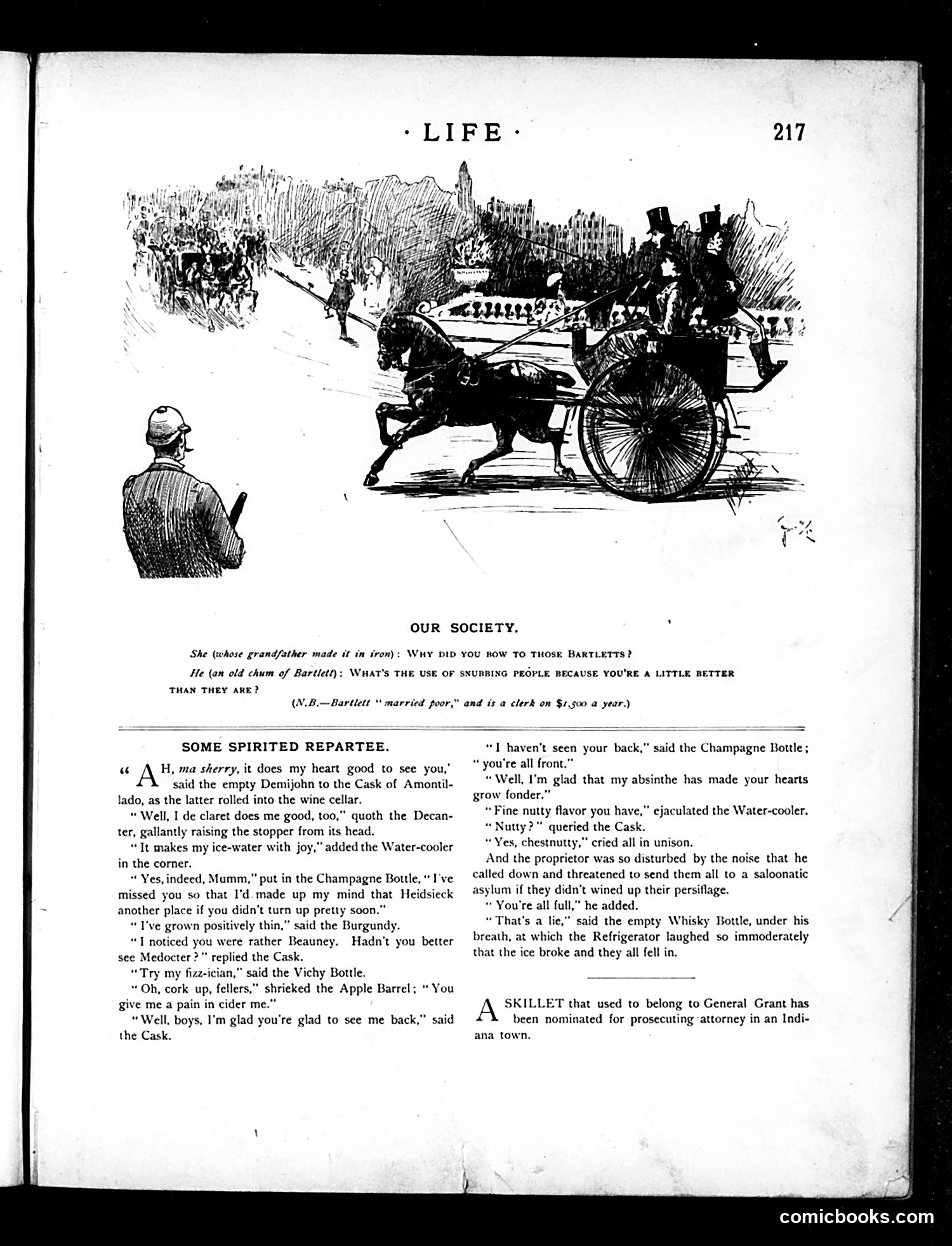
**Main Cartoon ("Our Society"):** This sketch satirizes class pretension. It depicts a wealthy person (labeled "Sir") snubbing working-class "Bartletts," claiming superiority justifies social rudeness. The note explains "Bartlett" is a married poor clerk earning $1,500 yearly—barely middle-class. The satire mocks how the wealthy use minor financial advantages to justify condescension toward those only slightly less affluent, suggesting arbitrary and absurd class hierarchies. **"Some Spirited Repartee":** A humorous dialogue personifying wine containers (Champagne Bottle, Cask, Demijohn, etc.) reuniting and exchanging witty banter. The jokes rely on wine-related puns and personality stereotypes assigned to different bottle types—light, playful satirical humor typical of Life's period style. The overall page ridicules both class pretension and consumer culture.
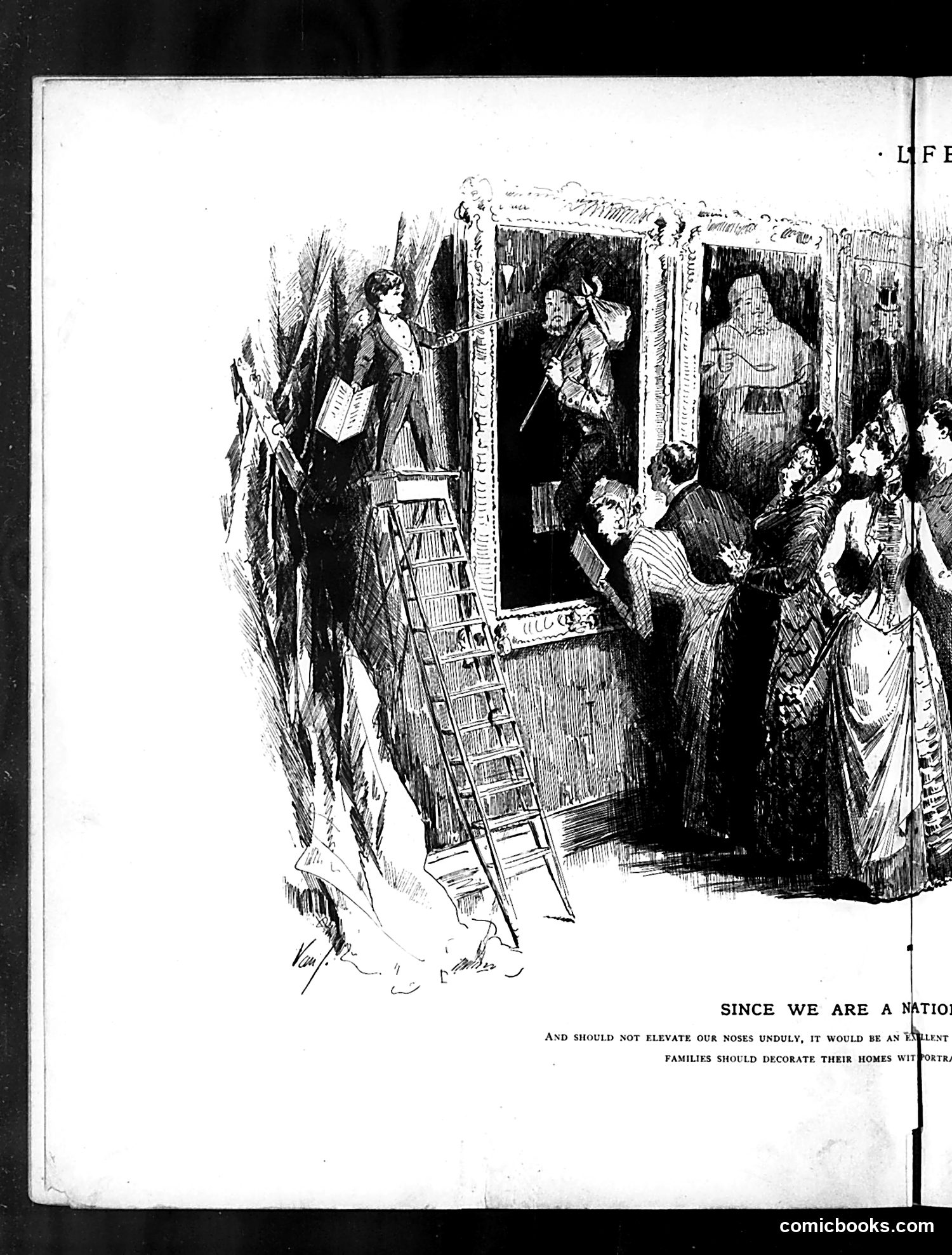
This illustration shows a satirical scene of home decoration, likely from the early 20th century. A man stands on a ladder outside a building, apparently decorating the facade with patriotic bunting or flags. A crowd of well-dressed women and onlookers gather to watch, suggesting this is a public or noteworthy event. The accompanying text reads: "Since we are a nation / And should not elevate our noses unduly, it would be an excellent / Families should decorate their homes wit[h] [patriotic symbols]" The satire appears to mock upper-class pretension about patriotism—suggesting that wealthy families are being pressured to display patriotic decorations publicly to avoid appearing unpatriotic or snobbish. The illustration ridicules both the performative nature of such displays and the social pressure to conform to nationalistic expectations during an era of heightened patriotic sentiment.
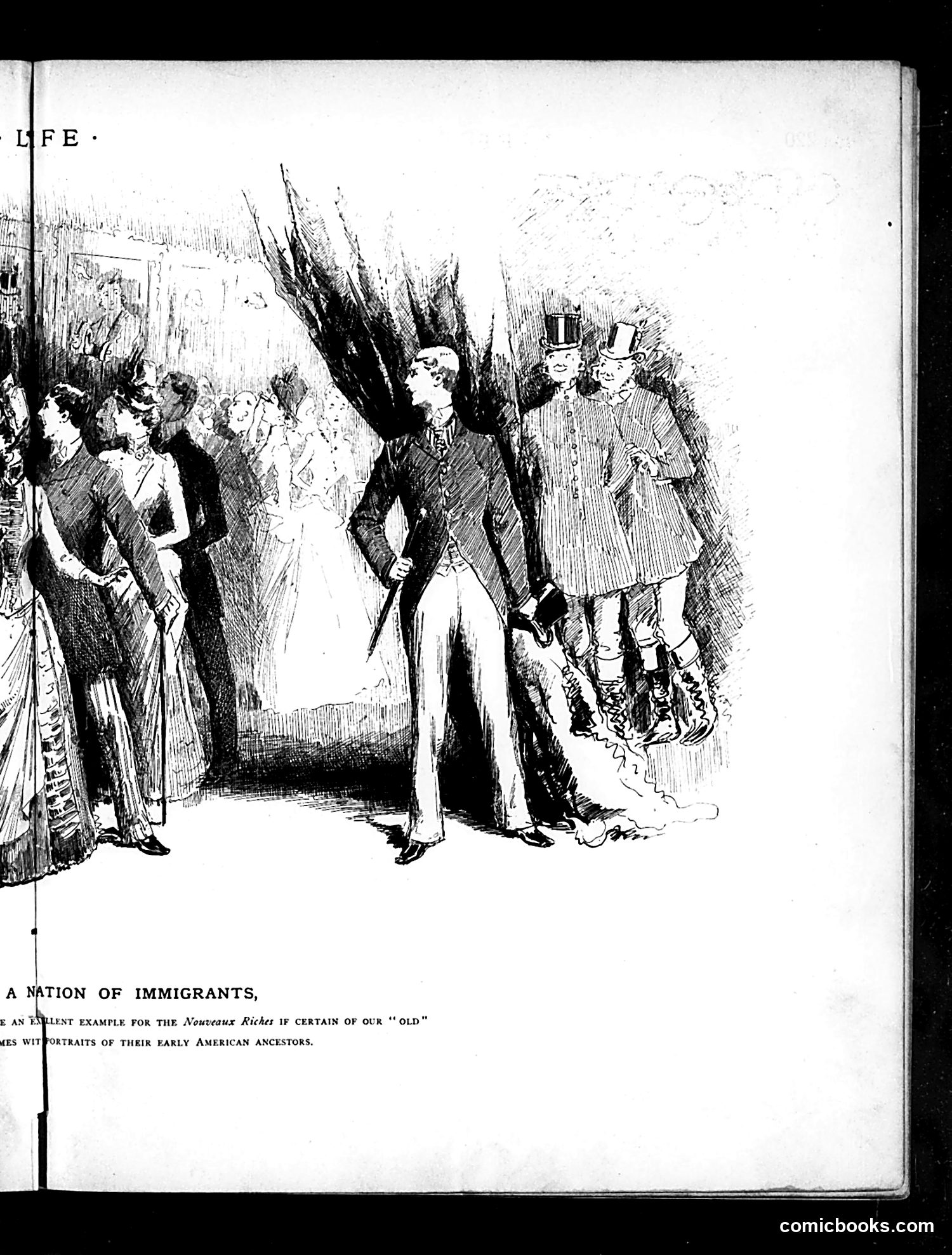
This satirical cartoon illustrates "A Nation of Immigrants" with the caption referencing the "Nonsense Riches" concept and comparing contemporary figures to "early American ancestors." The image depicts a social gathering with figures in formal 19th-century dress. A central figure with notably exaggerated features stands prominently, surrounded by well-dressed attendees wearing top hats and period clothing. The artistic style uses heavy cross-hatching typical of period satirical illustration. The satire appears to mock wealthy or socially prominent Americans who claim distinguished ancestry, while the caption suggests irony about American genealogical claims. The exaggerated portraiture and juxtaposition of figures implies commentary on class pretension or the gap between claimed heritage and actual immigrant origins. Without a visible date or clearer attribution, the specific targets remain unclear, though the theme reflects common 19th-century American anxieties about immigration and social status.
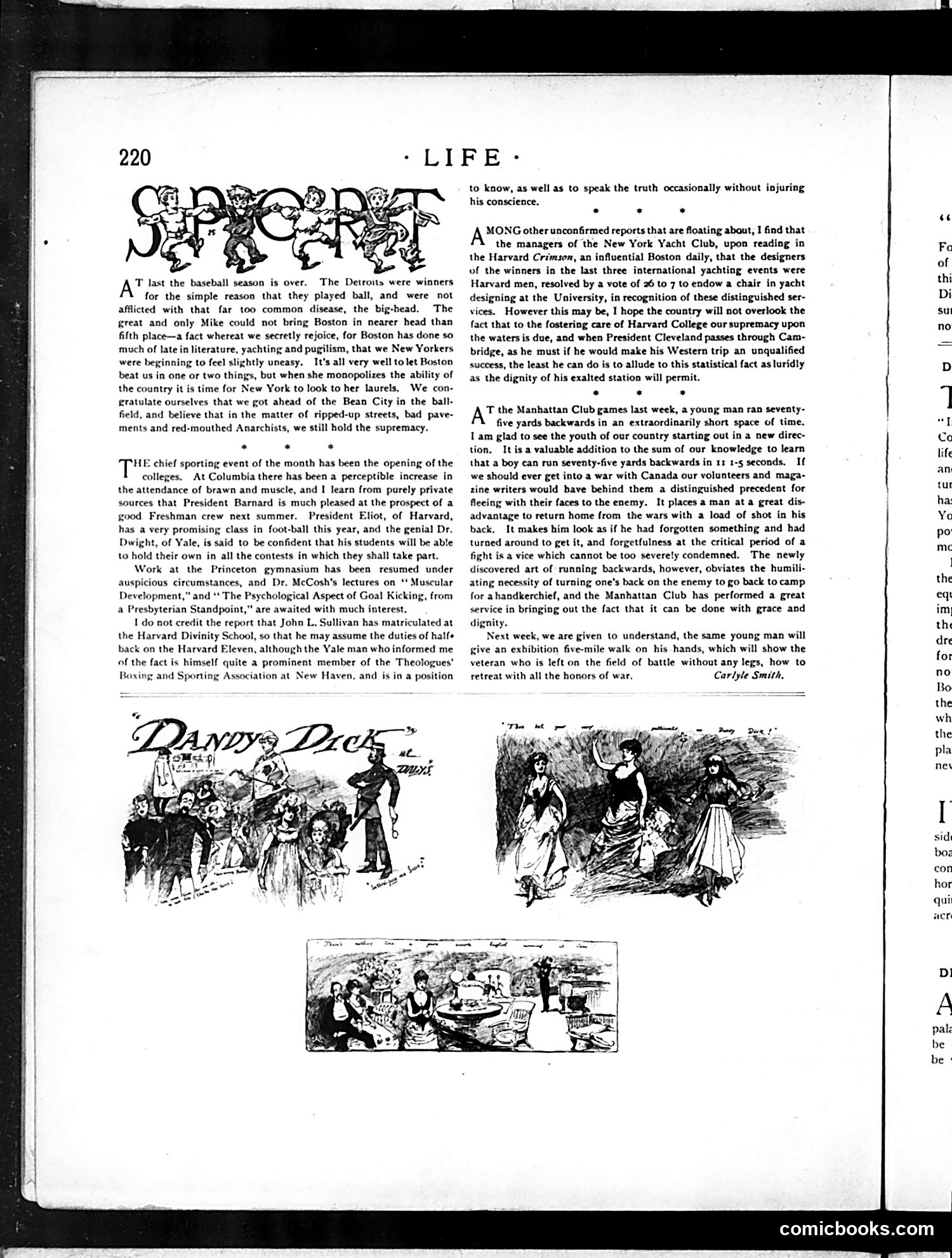
This page from *Life* magazine contains three illustrated vignettes titled "Dandy Dick" (visible in the header). The cartoons appear to depict scenes of a fashionable, well-dressed man in various social situations—likely at leisure activities or social gatherings typical of upper-class life. The satire targets genteel, fashionable society. "Dandy Dick" was a stock character representing an excessively refined, vain man preoccupied with appearance and social status. The multiple scenes humorously expose the absurdities of this lifestyle and its pretensions. The accompanying text discusses college sports and athletic achievements, suggesting the cartoons may satirize contrasts between idle dandyism and vigorous physical activity valued in American culture.
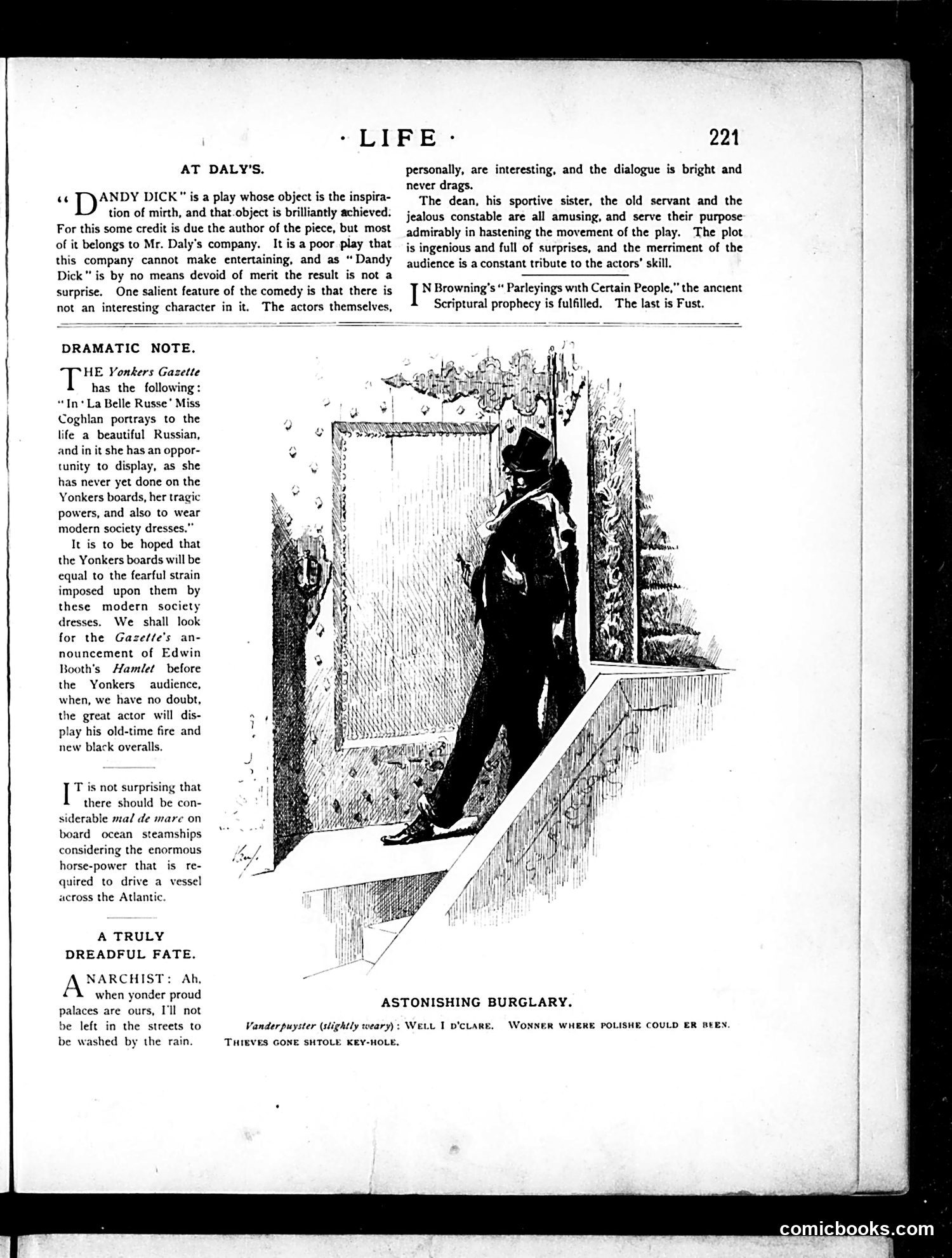
This page from *Life* magazine contains theatrical criticism and comic vignettes typical of the publication's satirical style. **Theater Reviews:** The page discusses performances at Daly's Theater, including "Dandy Dick" and "La Belle Russe." The critic praises the acting company's ability to enliven weak material, though notes "Dandy Dick" contains no interesting characters—the entertainment derives purely from skilled performances. **Comic Sketches:** 1. **"A Truly Dreadful Fate"**: An anarchist laments that when revolutionaries seize palaces, he'll still be left poor and unwashed by rain—mocking both revolutionary rhetoric and class anxiety. 2. **"Astonishing Burglary"**: A tired gentleman (Vanderpuyster) expresses bewilderment that thieves could enter through a keyhole, using phonetically-rendered working-class dialect for comedic effect. The page exemplifies *Life*'s mix of cultural criticism and class-based humor typical of the Gilded Age period.
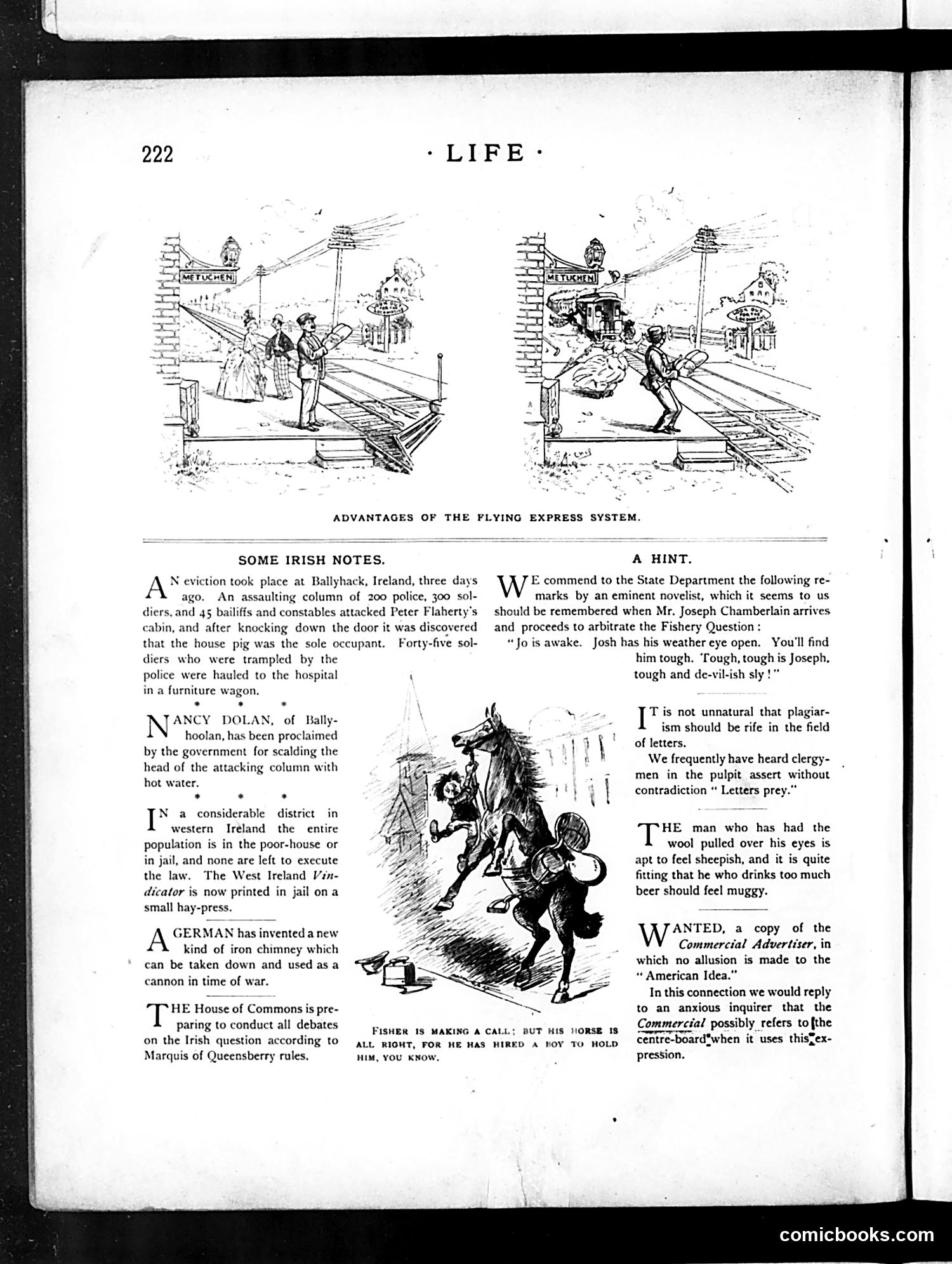
This page contains satirical commentary on late-19th century Irish and American politics. **Irish Notes**: The pieces mock British enforcement of Irish evictions and the chaotic state of Irish affairs. The absurd scenarios—a column attacking an empty cabin containing only a pig, Nancy Dolan scalding attackers with hot water, an entire district's population in poorhouses or jail—satirize the brutality and dysfunction of British rule in Ireland. **Political References**: "Joseph Chamberlain" (mentioned in "A Hint") was a British politician involved in fisheries disputes with America. The "Fishery Question" refers to ongoing Anglo-American negotiations over fishing rights. **Other Items**: Brief satirical quips about plagiarism in letters, a German military invention, and wordplay about the "Commercial Advertiser" newspaper. The top cartoons labeled "Advantages of the Flying Express System" appear to illustrate comic scenarios, though their specific meaning is unclear without additional context. The overall tone mocks both British-Irish tensions and contemporary American political figures and publications.
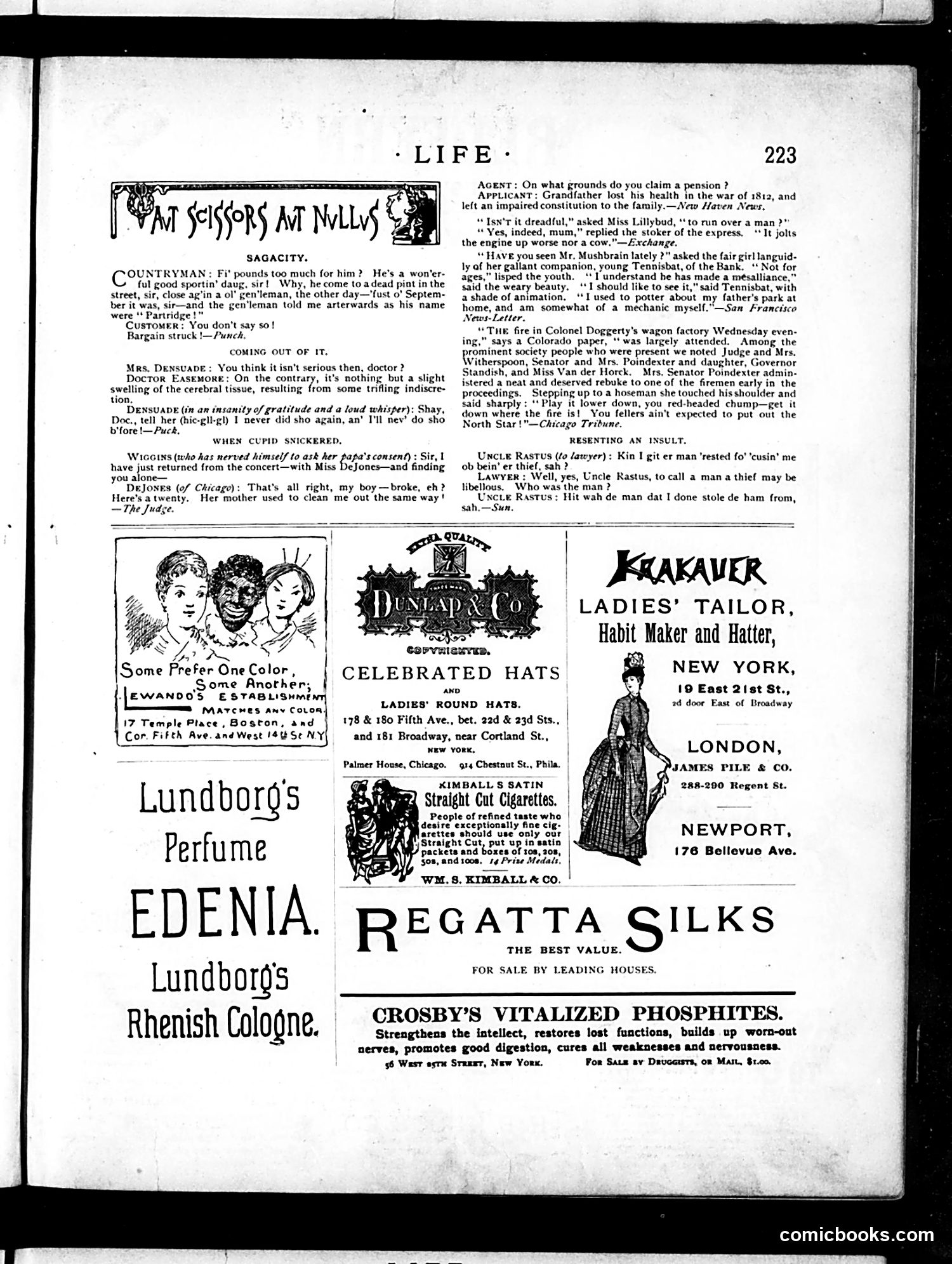
This page contains several short humorous anecdotes typical of Life magazine's satirical style, plus advertisements. **Main cartoons/jokes:** 1. **"Sagacity"**: A countryman convinces a customer to buy an expensive dog by claiming it once stood near a man named "Partridge"—implying the dog has sporting pedigree. The joke is the transparent con. 2. **"Coming Out of It"**: A drunk patient, relieved his doctor says his condition is minor, loudly promises to reform—the humor lies in his obvious insincerity (the "hic-gl-gl" indicates hiccups). 3. **"When Cupid Snickered"**: A young man borrows money from his girlfriend's father to court her, who reveals the mother did the same thing—suggesting the family's financial dependency on relationships. 4. **"Resenting an Insult"**: Uncle Rastus (a racial caricature using dialect) wants to sue a man for calling him a thief—the "joke" being that Rastus actually *did* steal from that man, making the complaint absurd. The page is primarily **advertisements** for hats, perfume, cigarettes, and silks.
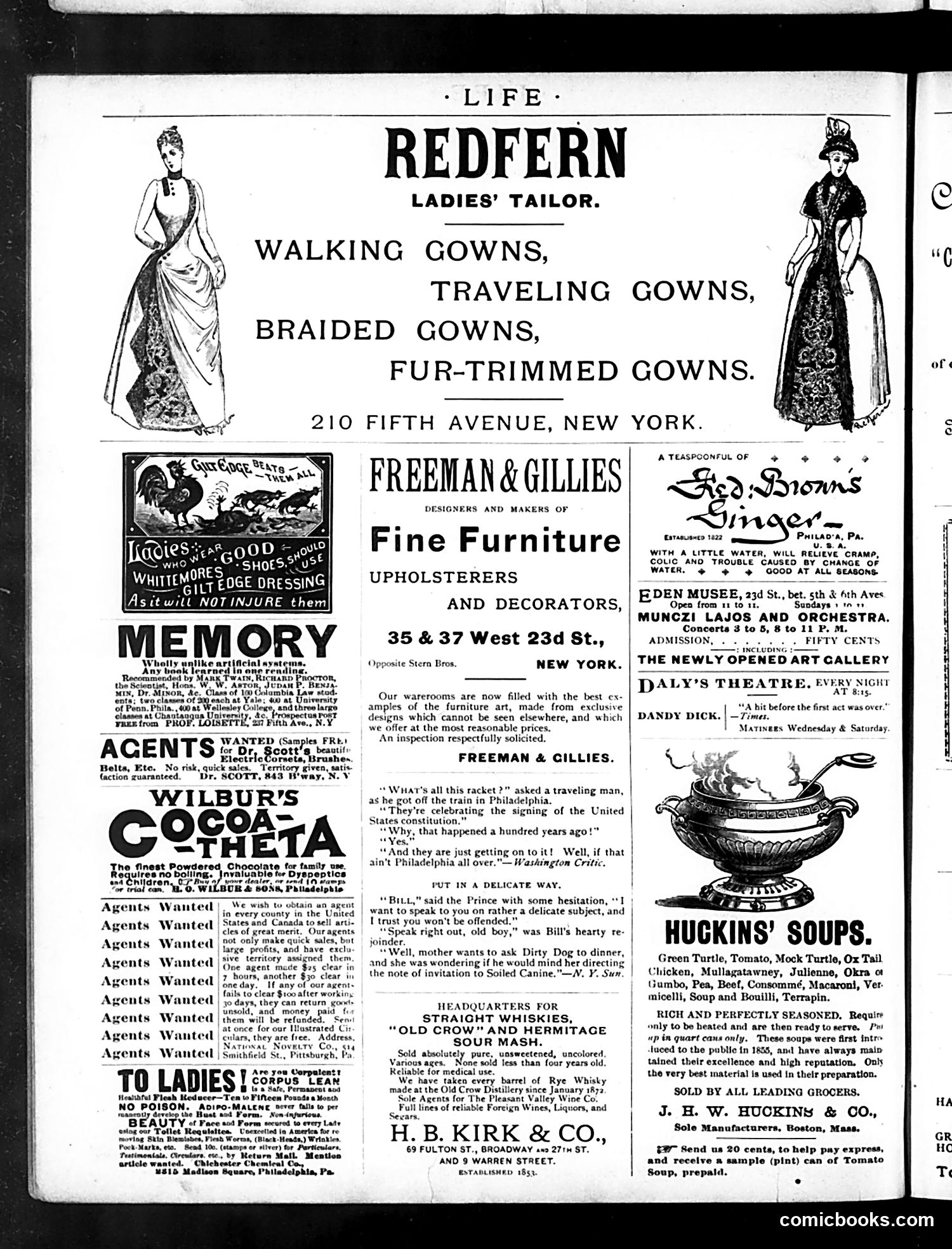
This is primarily an **advertising page** from Life magazine, not a political cartoon page. However, it contains two brief **satirical anecdotes** embedded among the ads: 1. **Philadelphia Centennial Joke**: A traveling man jokes that Philadelphia is celebrating the U.S. Constitution's signing—which happened a century ago—as if it were breaking news. The satire mocks Philadelphia's perceived backwardness and slow progress. 2. **"Delicate Subject" Joke**: A Prince hesitates to invite a friend ("Dirty Dog"/"Soiled Canine") to dinner, asking if the invited guest would mind receiving an invitation addressed to his insulting nickname. It's a gentle joke about aristocratic politeness masking crude behavior. The rest is **genuine commercial advertising**: women's tailoring, furniture, cocoa, patent medicines, flesh reducers, and whiskey—typical of the era. The ads reveal period concerns (weight loss for women, "electrical" medical devices, unmarked patent medicines) that modern readers would find quaint or alarming.
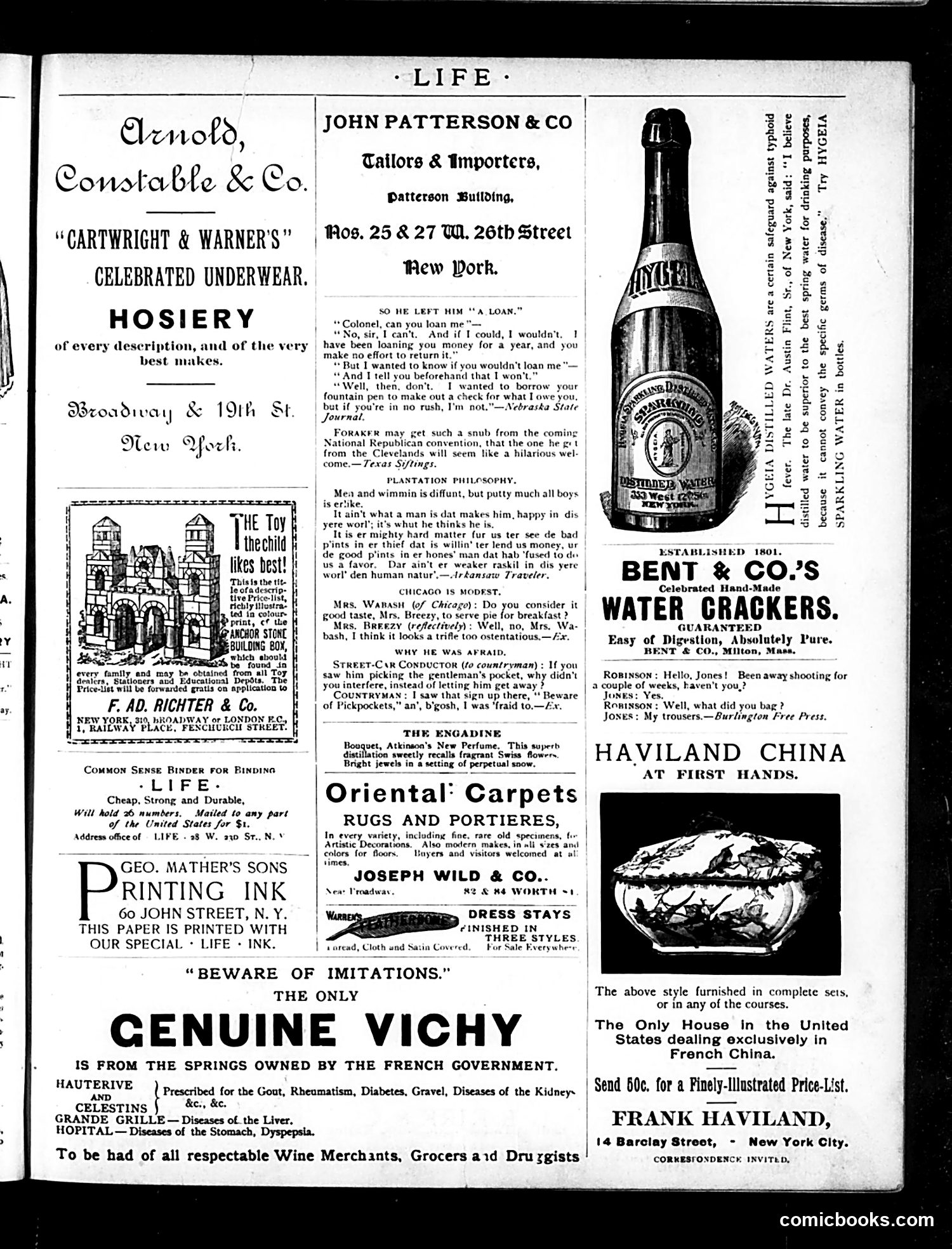
This is primarily an **advertising page** from Life magazine, with minimal editorial content. The few short humorous items are typical of Life's satirical format: **The jokes featured:** - A sketch about someone repeatedly asking to borrow money and a fountain pen, playing on persistence and debt - A reference to Senator Foraker facing criticism at a Republican convention - "Plantation Philosophy" — dialect humor presented as folk wisdom - A street conductor anecdote about a pickpocket spotting a "Beware of Pickpockets" sign **Historical context:** These pieces reflect late 19th-century American humor conventions, including heavy use of racial dialect humor (common in period publications) and gentle satirizing of social situations. **The advertisements** promote gentlemen's clothing, water treatment, carpets, printing services, and patent medicines — typical for the era. The Vichy water ad emphasizes French origins as a selling point for medicinal products, reflecting contemporary faith in "taking the waters" for health. The page lacks political cartoons or sustained satirical commentary — it's essentially a revenue-generating advertising section with light filler humor.
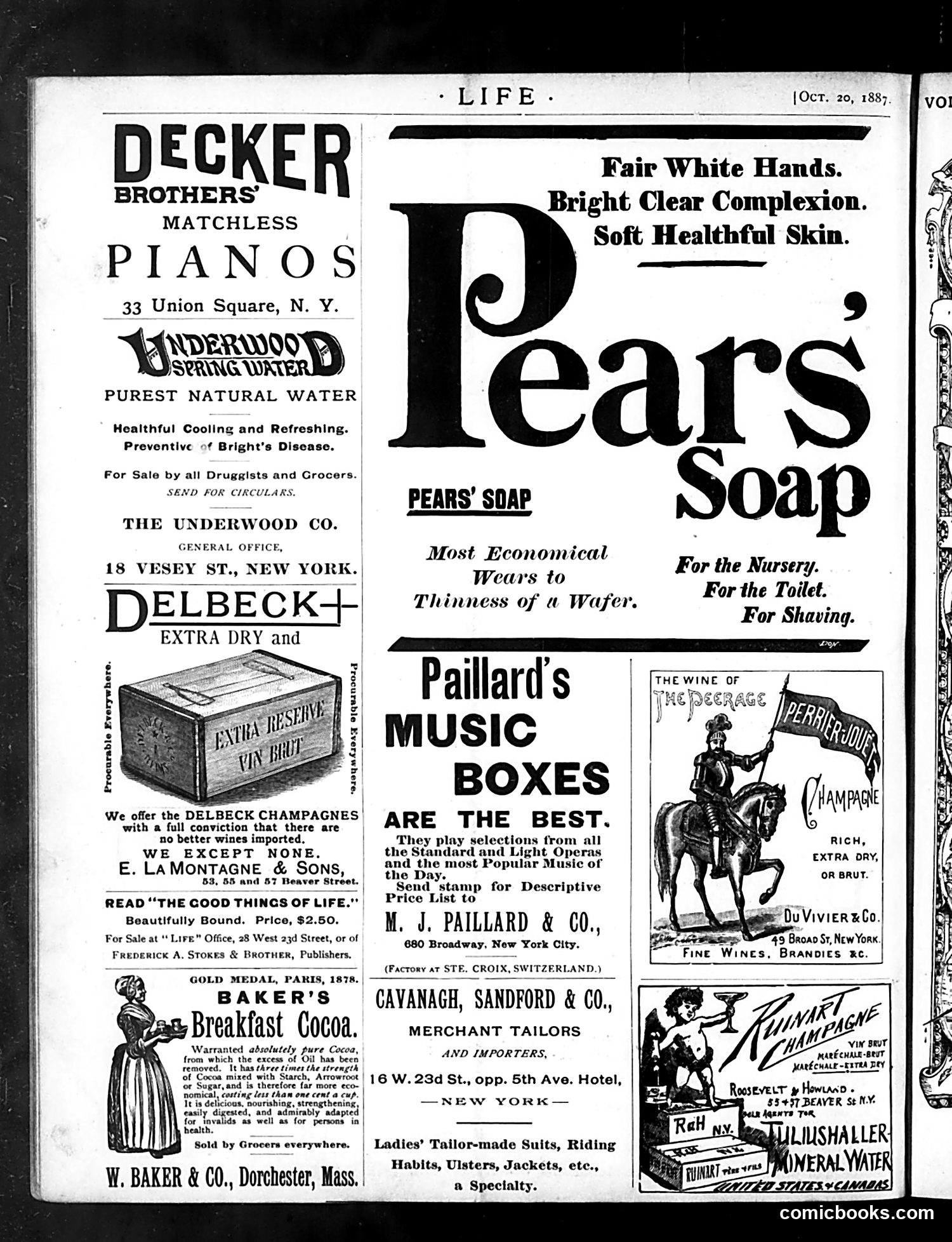
This page is primarily **advertising**, not political satire or comics. It's from *Life* magazine (October 20, 1887), a publication that mixed satirical content with paid advertisements. The ads promote consumer goods typical of the Gilded Age: luxury pianos, champagne, spring water (claimed to prevent Bright's disease—a kidney ailment), Pears' Soap (emphasizing fair skin and bright complexion—reflecting period beauty standards), music boxes, cocoa, wines, and tailor services. Notable is the **Pears' Soap ad's focus on "Fair White Hands" and "Bright Clear Complexion,"** reflecting Victorian beauty ideals and the racial prejudices embedded in 19th-century marketing. These ads reveal what affluent Americans valued: imported luxuries, health tonics of questionable efficacy, and appearance-focused products. There are **no political cartoons visible**—just commercial imagery (cherubs, classical figures) meant to suggest elegance and refinement.