
Life, 1887-10-20 · page 2 of 16
Life — October 20, 1887 — page 2: what you’re looking at
What you’re looking at
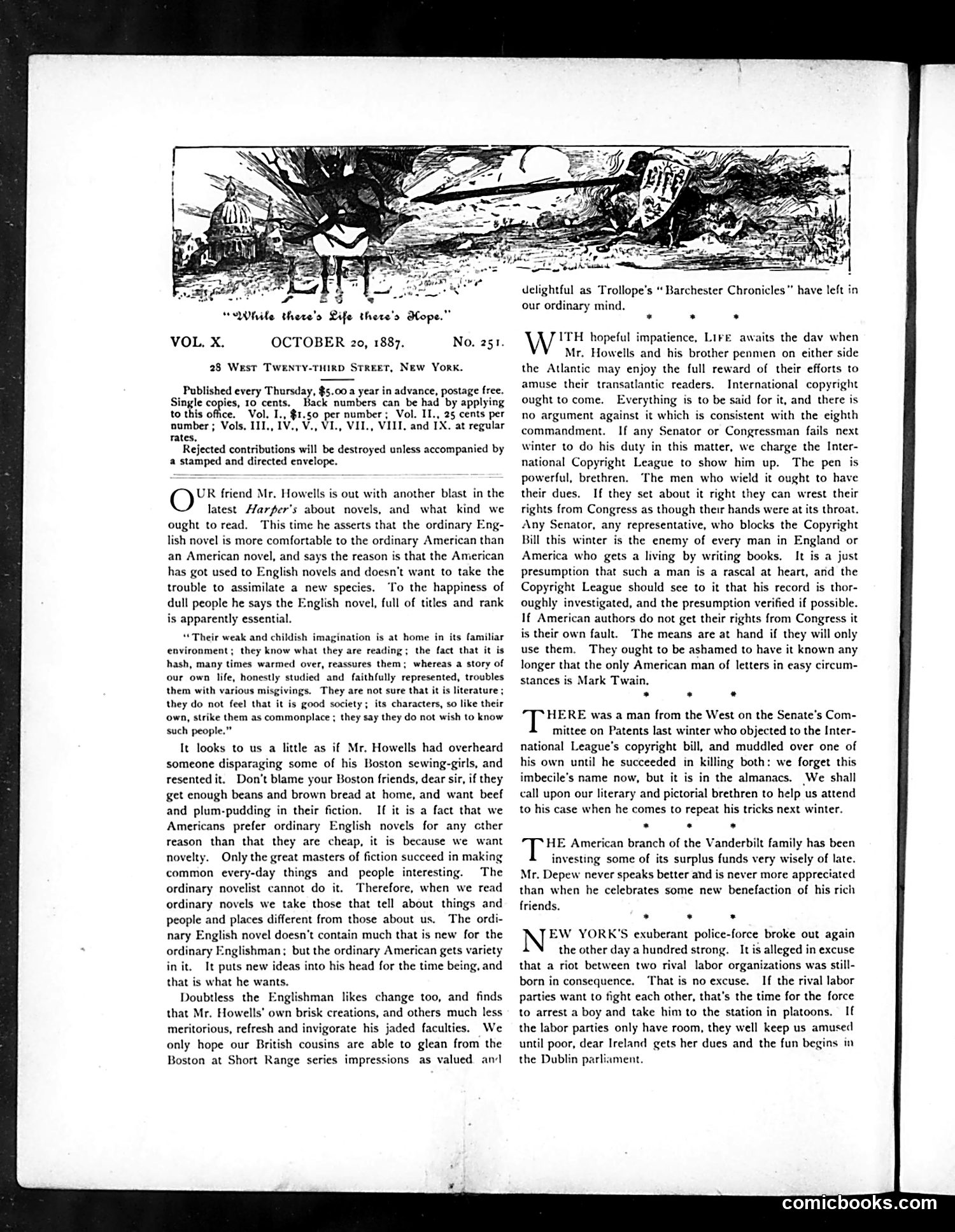
The small cartoon at the top left, captioned "While there's Life there's Hope," appears to be a symbolic illustration rather than a specific political caricature. It shows figures in a dramatic landscape, likely reflecting the magazine's general satirical tone. The page's main content addresses literary matters and copyright issues. Text discusses Mr. Howells' novels and defends American literature against British preferences. A significant passage advocates for international copyright protection, attacking a Western Senator who opposed the copyright bill and "succeeded in killing both" protections—likely referring to contemporary copyright debates in Congress. The final section briefly mentions a New York police dispute and the Vanderbilt family's charitable investments, maintaining the magazine's typical mix of social commentary and cultural criticism.
📄 Transcribed text from this page (OCR, searchable)
Machine-transcribed from the original scan — historical spelling and the odd misread are preserved.
“Write there's Life there's Hope.” VOL, X. OCTOBER 20, 1887. 28 West TWENTY-THIRD STREET, New York. No. 251. Published every Thursday, $5.00 a year in advance, postage free. Single copies, 10 cents. Back numbers can be had by applying to this office. Vol. I., $1.50 per number; Vol. II., 25 cents per number ; Vols. III., IV., V., VI., VIL, VIII, and IX. at regular rates, Rejected contributions will be destroyed unless accompanied by a stamped and directed envelope. UR friend Mr. Howells is out with another blast in the latest. Harper's about novels, and what kind we ought to read. This time he asserts that the ordinary Eng- lish novel is more comfortable to the ordinary American than an American novel, and says the reason is that the American has got used to English novels and doesn’t want to take the trouble to assimilate a new species. To the happiness of dull people he says the English novel, full of titles and rank is apparently essential. “Their weak and childish imagination is at home in its familiar environment; they know what they are reading; the fact that it is hash, many times warmed over, reassures them; whereas a story of our own life, honestly studied and faithfully represented, troubles them with various misgivings. They are not sure that it is literature ; they do not feel that it is good society; its characters, so like their own, strike them as commonplace ; they say they do not wish to know such people.” It looks to us a little as if Mr. Howells had overheard someone disparaging some of his Boston sewing-girls, and resented it. Don’t blame your Boston friends, dear sir, if they get enough beans and brown bread at home, and want beef and plum-pudding in their fiction. If it is a fact that we Americans prefer ordinary English novels for any cther reason than that they are cheap, it is because we want novelty. Only the great masters of fiction succeed in making common every-day things and people interesting. The ordinary novelist cannot do it. Therefore, when we read ordinary novels we take those that tell about things and people and places different from those about us. The ordi- nary English novel doesn’t contain much that is new for the ordinary Englishman; but the ordinary American gets variety in it. It puts new ideas into his head for the time being, and that is what he wani Doubtless the Englishman likes change too, and finds that Mr. Howells’ own brisk creations, and others much less meritorious, refresh and invigorate his jaded faculties. We only hope our British cousins are able to glean from the Boston at Short Range series impressions as valued an delightful as Trollope’s “ Barchester Chronicles” have left in our ordinary mind. . . . V ITH hopeful impatience, Lire awaits the dav when Mr. Howells and his brother penmen on either side the Atlantic may enjoy the full reward of their efforts to amuse their transatlantic readers. International copyright ought to come. Everything is to be said for it, and there is no argument against it which is consistent with the eighth commandment. If any Senator or Congressman fails next winter to do his duty in this matter, we charge the Inter- national Copyright League to show him up. The pen is powerful, brethren. The men who wield it ought to have their dues. If they set about it right they can wrest their rights from Congress as though their hands were at its throat. Any Senator, any representative, who blocks the Copyright Bill this winter is the enemy of every man in England or America who gets a living by writing books. It is a just presumption that such a man is a rascal at heart, and the Copyright League should see to it that his record is thor- oughly investigated, and the presumption verified if possible. If American authors do not get their rights from Congress it is their own fault. The means are at hand if they will only use them. They ought to be ashamed to have it known any longer that the only American man of letters in easy circum- stances is Mark Twain. . . * HERE was a man from the West on the Senate’s Com- mittee on Patents last winter who objected to the Inter- national League’s copyright bill, and muddled over one of his own until he succeeded in killing both: we forget this imbecile’s name now, but it is in the almanacs. We shall call upon our literary and pictorial brethren to help us attend to his case when he comes to repeat his tricks next winter. . . . HE American branch of the Vanderbilt family has been investing some of its surplus funds very wisely of late. Mr. Depew never speaks better and is never more appreciated than when he celebrates some new benefaction of his rich friends. . . . EW YORK'S exuberant police-force broke out again the other day a hundred strong. It is alleged in excuse that a riot between two rival labor organizations was still- born in consequence. That is no excuse. If the rival labor parties want to fight each other, that's the time for the force to arrest a boy and take him to the station in platoons. If the labor parties only have room, they well keep us amused until poor, dear Ireland gets her dues and the fun begins in the Dublin parliament. comicbooks.com