
Life, 1887-10-20 · page 6 of 16
Life — October 20, 1887 — page 6: what you’re looking at
What you’re looking at
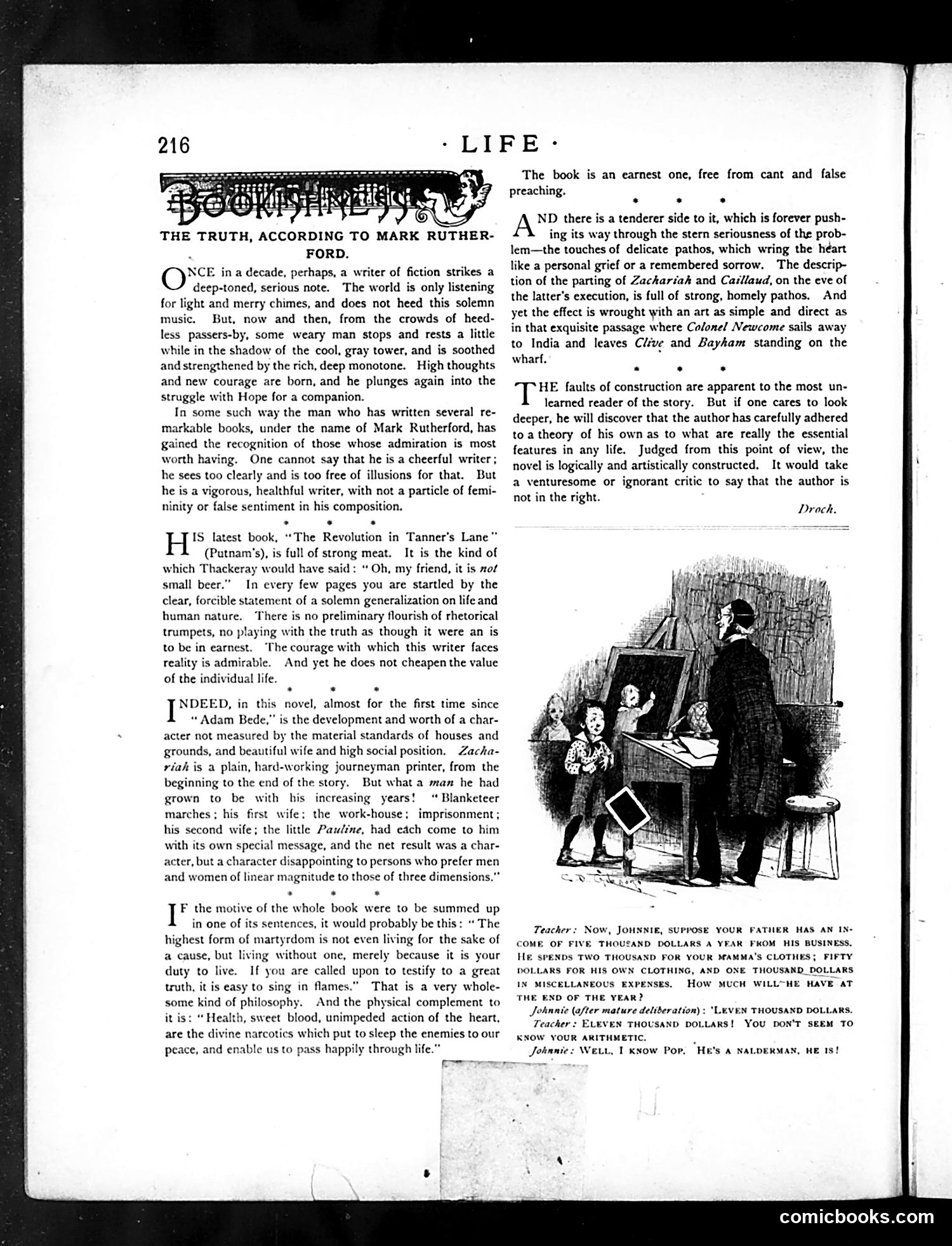
This page reviews Mark Rutherford's novel "The Revolution in Tanner's Lane." The accompanying illustration shows a schoolroom scene where a teacher addresses students about arithmetic and money. The cartoon's satirical point appears to be about class economics and education. The teacher discusses a father's income (five thousand dollars), spending on the mother's clothes (two thousand), the son's schooling (one thousand), and miscellaneous expenses—then asks students to calculate what remains. The student's answer ("eleven thousand dollars") is absurdly wrong, prompting the teacher's retort that the boy must be "a salderman." The satire likely critiques either the disconnect between privileged children and financial reality, or the absurdity of Victorian arithmetic problems divorced from realistic middle-class budgeting. The illustration humorously demonstrates how wealth insulates children from practical understanding.
📄 Transcribed text from this page (OCR, searchable)
Machine-transcribed from the original scan — historical spelling and the odd misread are preserved.
- LIFE: THE TRUTH, ACCORDING TO MARK RUTHER- . FORD. NCE ina decade, perhaps, a writer of fiction strikes a deep-toned, serious note. The world is only listening for light and merry chimes, and does not heed this solemn music. But, now and then, from the crowds of heed- less passers-by, some weary man stops and rests a little while in the shadow of the cool, gray tower, and is soothed and strengthened by the rich, deep monotone. High thoughts and new courage are born, and he plunges again into the struggle with Hope for a companion. In some such way the man who has written several re- markable books, under the name of Mark Rutherford, has gained the recognition of those whose admiration is most worth having. One cannot say that he is a cheerful writer ; he sees too clearly and is too free of illusions for that. But he is a vigorous, healthful writer, with not a particle of femi- ninity or false sentiment in his composition. . . . IS latest book, ‘The Revolution in Tanner's Lane” (Putnam's), is full of strong meat. It is the kind of which Thackeray would have said: “Oh, my friend, it is of small beer.” In every few pages you are startled by the clear, forcible statement of a solemn generalization on lifeand human nature. There is no preliminary flourish of rhetorical trumpets, no playing with the truth as though it were an is to be in earnest. ‘The courage with which this writer faces reality is admirable. And yet he does not cheapen the value of the individual life. * . | bare in this novel, almost for the first time since “ Adam Bede,” is the development and worth of a char- acter not measured by the material standards of houses and grounds, and beautiful wife and high social position. Zacha- riah is a plain, hard-working journeyman printer, from the beginning to the end of the story. But what a man he had grown to be with his increasing years! “ Blanketeer marches ; his first wife; the work-house; imprisonment; his second wife; the little Pau/ine, had each come to him with its own special message, and the net result was a char- acter, but a character disappointing to persons who prefer men and women of linear magnitude to those of three dimensions.”" . . . IF the motive of the whole book were to be summed up in one of its sentences, it would probably be this: “ The highest form of martyrdom is not even living for the sake of a cause, but living without one, merely because it is your duty to live. If you are called upon to testify to a great truth, it is easy to sing in flames.” That is a very whole- some kind of philosophy. And the physical complement to it is: “Health, sweet blood, unimpeded action of the heart, are the divine narcotics which put to sleep the enemies to our peace, and enable us to pass happily through life.” — The book is an earnest one, free from cant and false preaching. ‘ ra x ND there is a tenderer side to it, which is forever push- ing its way through the stern seriousness of the prob- lem—the touches of delicate pathos, which wring the héart like a personal grief or a remembered sorrow. The descrip- tion of the parting of Zachariah and Casllaud, on the eve of the latter’s execution, is full of strong, homely pathos. And yet the effect is wrought with an art as simple and direct as in that exquisite passage where Colonel Newcome sails away to India and leaves C/rve and Bayhkam standing on the wharf. . . . . HE faults of construction are apparent to the most un- learned reader of the story. But if one cares to look deeper, he will discover that the author has carefully adhered toatheory of his own as to what are really the essential features in any life. Judged from this point of view, the novel is logically and artistically constructed. It would take a venturesome or ignorant critic to say that the author is not in the right. Droch. Teacher: Now, JOUNNIE, SUPPOSE YOUR FATHER HAS AN IN- COME OF FI THOUSAND DOLLARS A YEAR FKOM HIS BUSINESS, He SPENDS TWO THOUSAND FOR YOUR MAMMA'S CLOTHES; FIFTY DOLLARS FOR HIS OWN CLOTHING, AND ONE THOUSAND DOLLARS IN MISCELLANEOUS EXPENSES. HOW MUCH WILL“HE HAVE AT THE END OF THE YEAR? Johnnie (after mature deliberation) : "L. Teacher : ELEVEN THOUSAND DOLLARS! KNOW YOUR ARITHMETIC. . Johnnie: Weir, I Kxow Pop. H. EN THOUSAND DOLLARS. You DON'T SEEM TO A NALDERMAN, HE 18! comicbooks.com