
A complete issue · 16 pages · 1887
Life — September 29, 1887
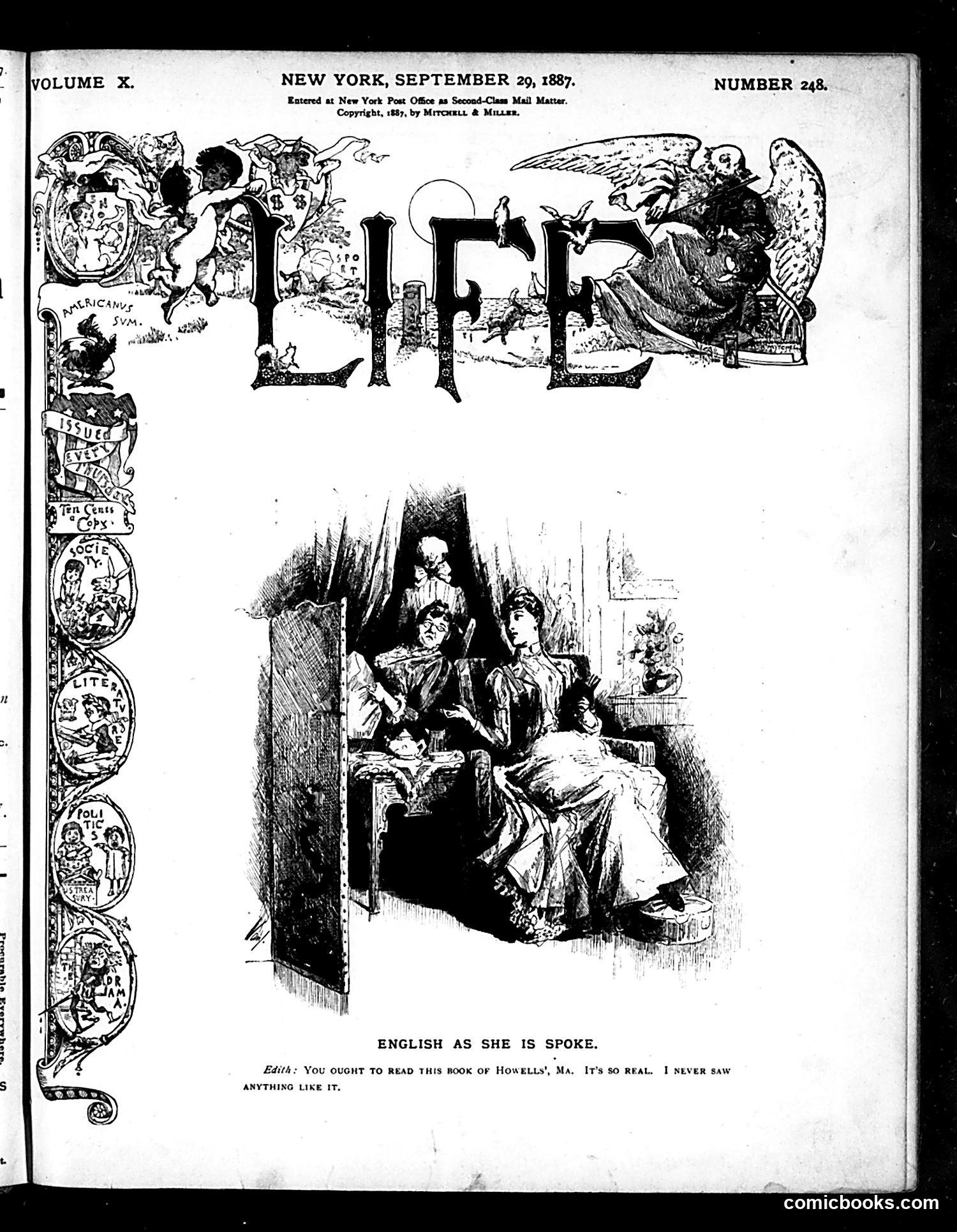
This satirical piece mocks a book titled "Howells' Ma" (likely referencing William Dean Howells, a prominent American author and editor). The illustration depicts what appears to be a working-class or immigrant woman speaking to well-dressed ladies, with exaggerated or improper English dialogue. The caption's quoted text—"You ought to read this book of Howells', Ma. It's so real. I never saw anything like it"—suggests the satire targets Howells' literary realism depicting "authentic" working-class speech. The joke appears to be that Howells' realistic portrayals of colloquial or non-standard English are themselves comically inauthentic or overwrought. This reflects late-19th-century literary debates about dialect writing and authenticity in American fiction.
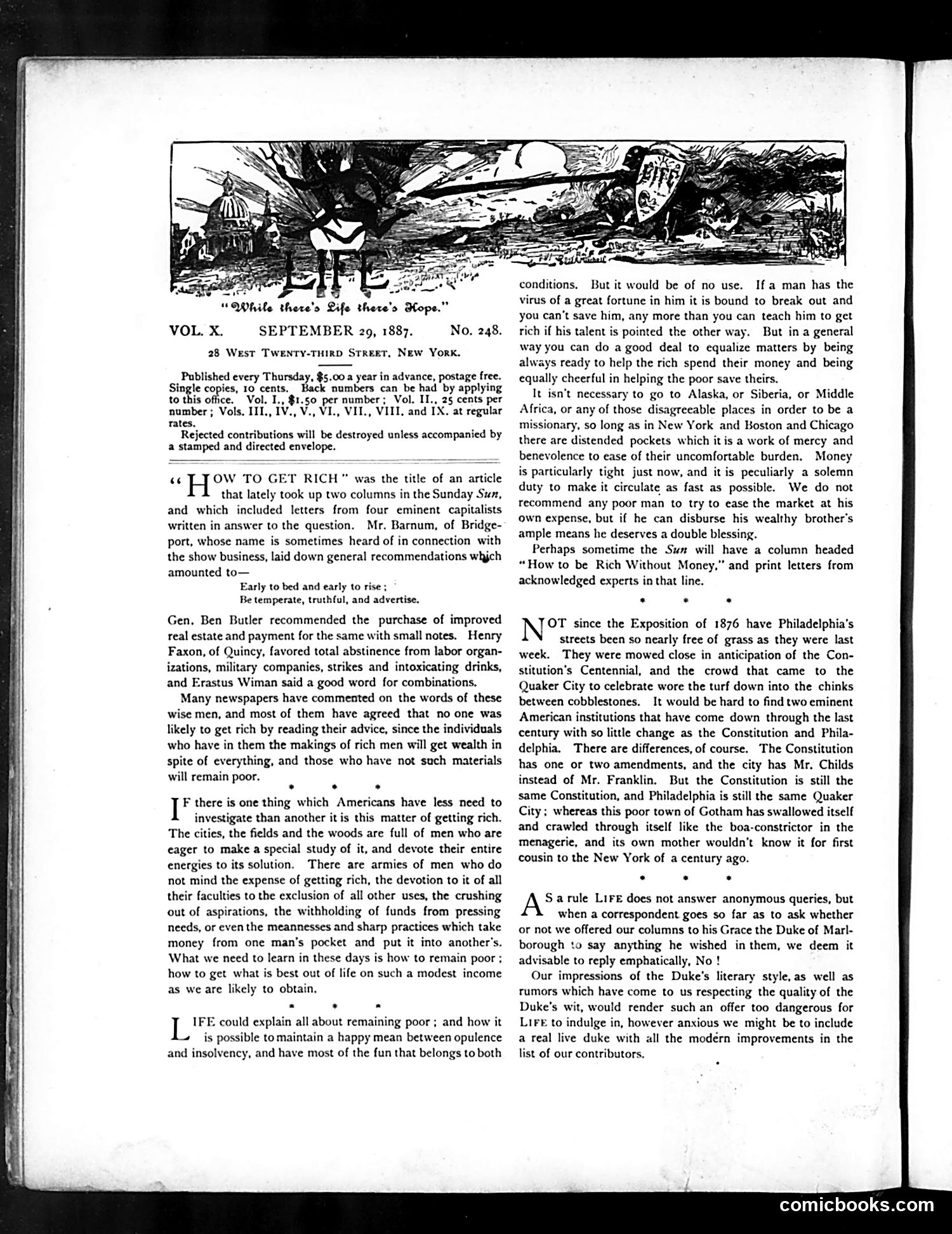
The masthead illustration depicts a skeletal figure labeled "Life" sitting beneath a tree, with the caption "Where there's Life there's Hope." The page's editorial content discusses wealth-building advice, referencing an earlier article titled "How to Get Rich." The editors critique capitalists like Gen. Ben Butler and Henry Faxon who offer get-rich schemes, noting such advice rarely benefits poor people. A separate section comments on Philadelphia's streets during the 1876 Exposition celebration, comparing the city unfavorably to other American institutions. The editors mock how little Philadelphia has changed since the Constitution's creation, sarcastically suggesting the city remains as backward as a fictional "poor town of Gotham." The content is primarily satirical social commentary rather than visual political cartooning.
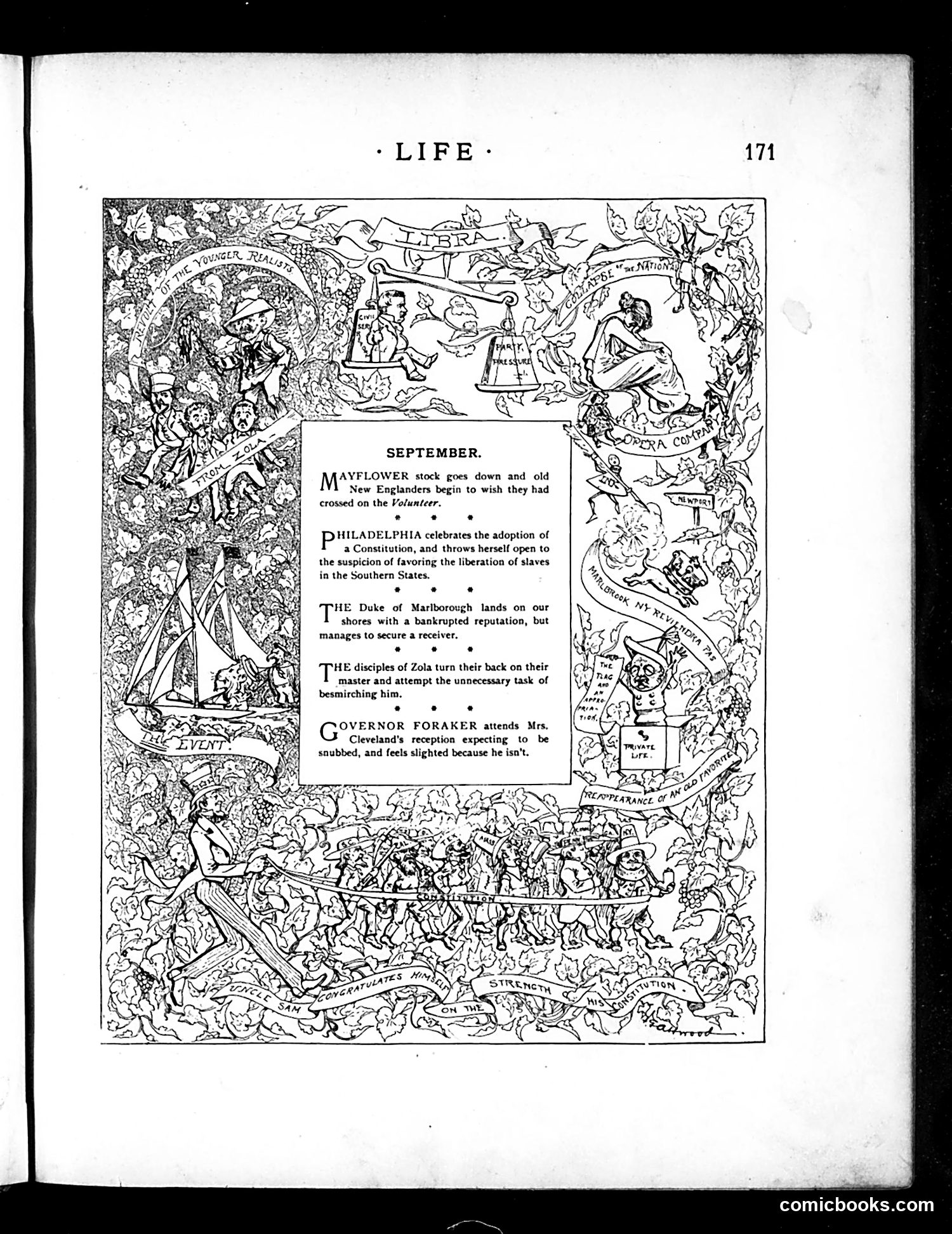
This page presents September events through elaborate satirical illustration. The text references: 1. **Mayflower/Volunteer controversy**: New Englanders' regret over the Mayflower voyage 2. **Philadelphia Constitution**: The city celebrates adoption of the Constitution while facing suspicion it favors slave liberation in Southern states 3. **Duke of Marlborough**: Arrives bankrupted but secures a financial receiver 4. **Zola's disciples**: They abandon their master, attempting an unnecessary task (likely referencing the Dreyfus Affair and French literary politics) 5. **Governor Boraiker and Mrs. Cleveland**: A reception goes poorly; Cleveland feels "slighted" The ornate border illustrations contain numerous figures engaged in satirical vignettes commenting on these events. The overall effect mocks contemporary political figures, constitutional debates, and international scandals through dense, detailed caricature.
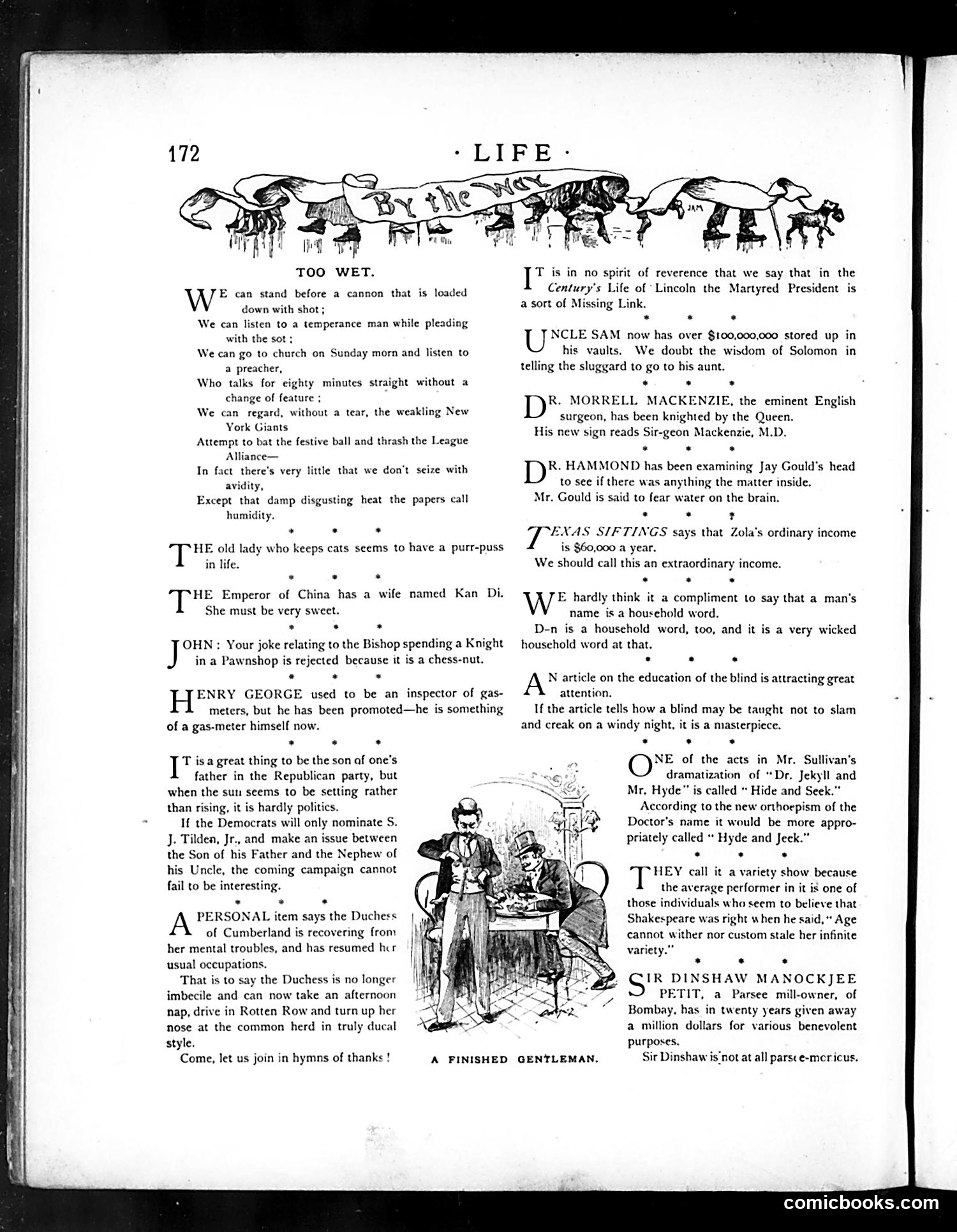
This page contains miscellaneous satirical observations rather than a coherent cartoon narrative. The illustrated vignette at bottom shows "A Finished Gentleman"—a well-dressed man in what appears to be a social setting, likely satirizing affectation or pretentiousness in Victorian-era manners. The text items mock various contemporary subjects: Uncle Sam's wealth, a knighted surgeon (Dr. Mackenzie), Jay Gould's intelligence, and incomes. One joke references chess-playing bishops, another critiques the Duchess of Cumberland's social pretensions. A notable item discusses Sullivan's dramatization of "Dr. Jekyll and Mr. Hyde," debating whether it should be called "Hide and Jeck." The final entry praises Sir Dinshaw Manockjee Petit, a Parsee philanthropist who donated a million dollars over twenty years—this appears genuine praise rather than satire.
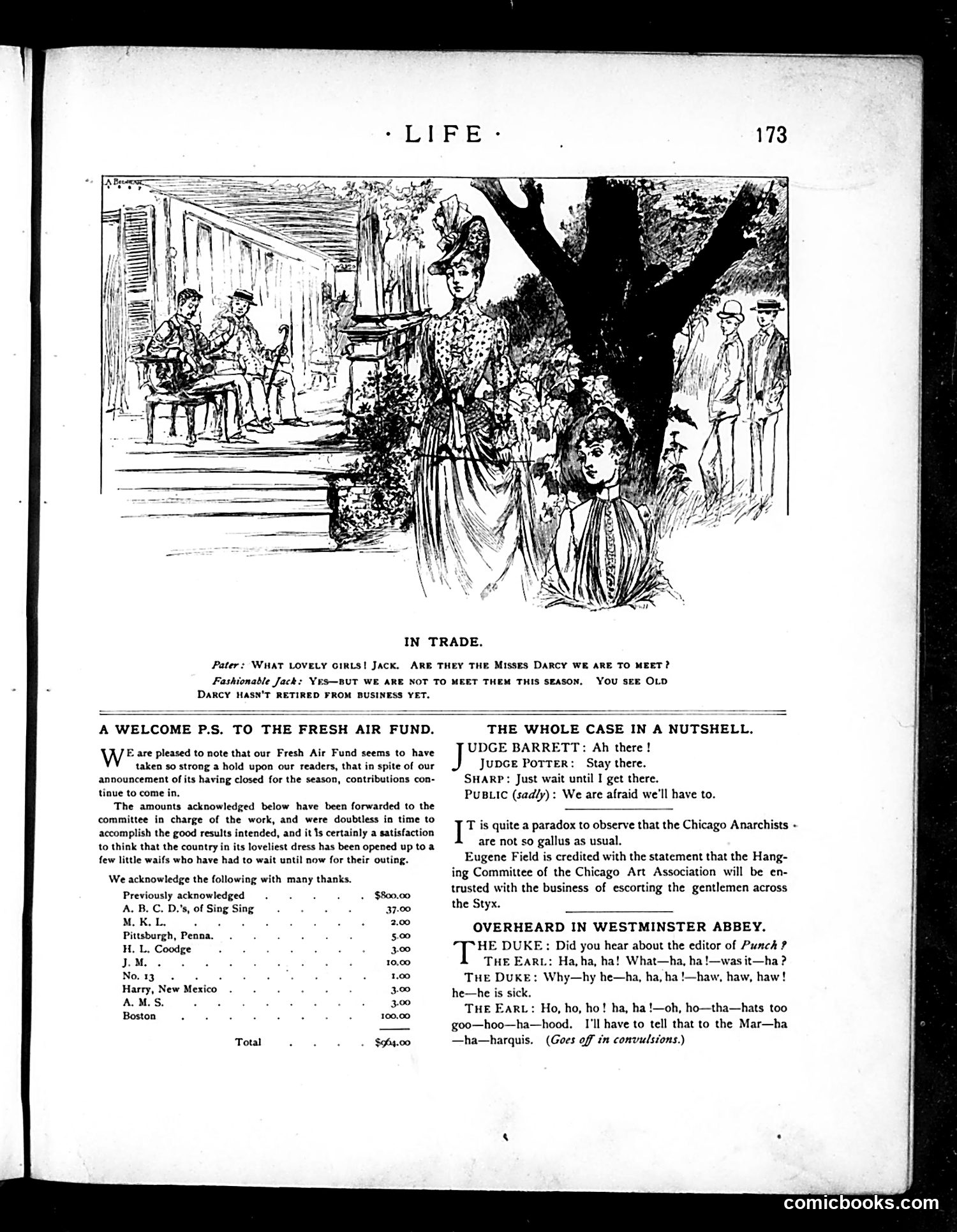
**Top Cartoon - "In Trade":** This depicts a social encounter where "Fashionable Jack" encounters well-dressed women ("the Misses Darcy"). The joke hinges on class distinction: Jack notes these aren't THE Misses Darcy they'd expect to meet because "Old Darcy hasn't retired from business yet." The satire targets nouveau riche social pretension—suggesting that only wealthy, retired gentlemen's daughters qualify as proper society, while working families remain outside polite circles regardless of their current means. **Lower Content:** The page includes fundraising notices for the "Fresh Air Fund" (charitable donations for poor children) and humorous theatrical snippets. The satire reflects Progressive-era concern with class mobility and social boundaries in American society.
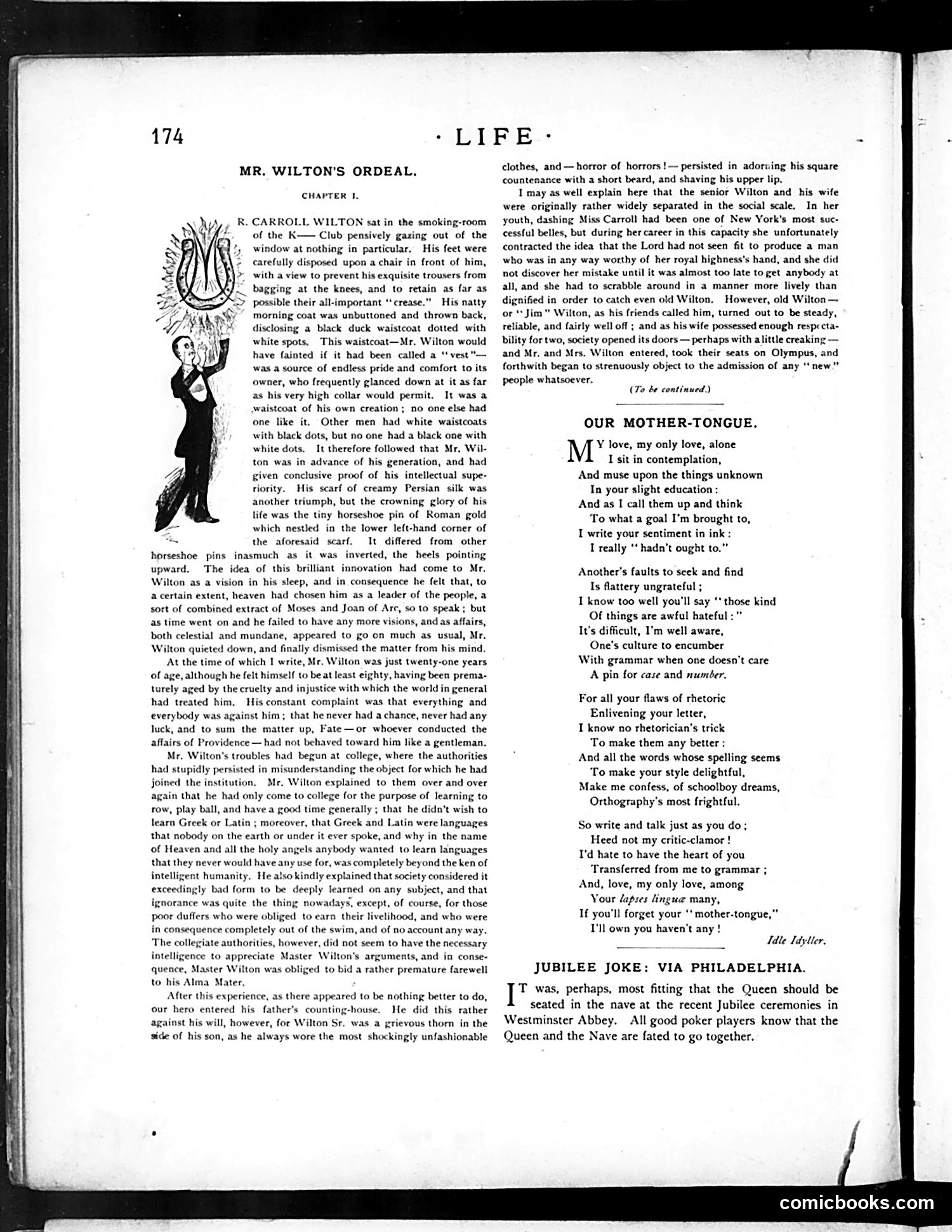
This page contains **"Mr. Wilton's Ordeal,"** a serialized story beginning with Chapter I. The accompanying illustration shows a man in formal dress examining his reflection, apparently vain about his appearance—particularly his distinctive black waistcoat with white dots, which he considers a mark of intellectual superiority. The text satirizes Mr. Wilton as a pretentious intellectual who falsely believes his fashionable attire signals cultural distinction. The narrative mocks his pomposity, noting he's twenty-one years old yet acts superior, complains constantly about society, and failed to secure a leadership position despite his self-regard. The page also includes unrelated poetry ("Our Mother-Tongue") and a brief joke about the Queen attending Jubilee ceremonies. This appears to be general satirical content typical of Life's social commentary.
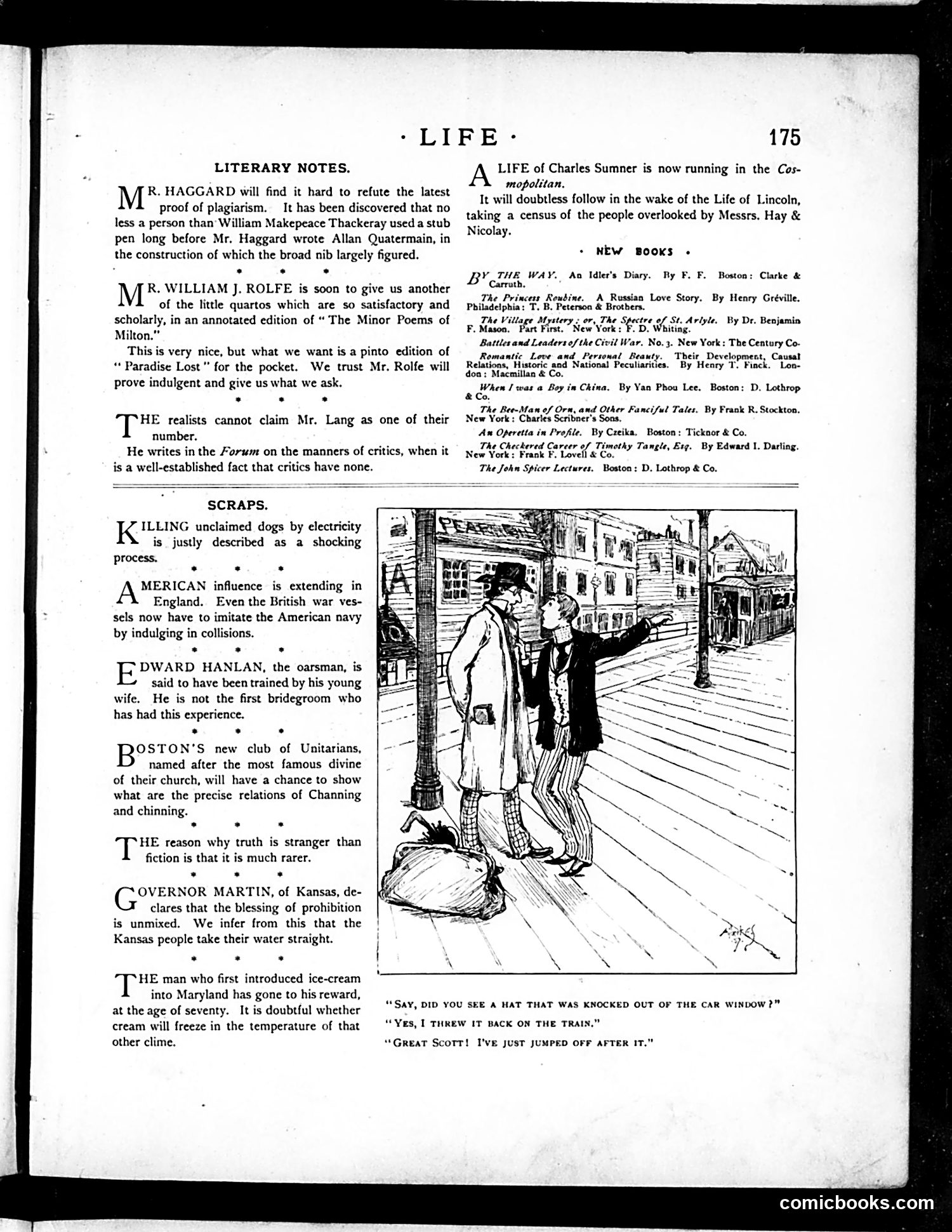
The illustration depicts a street scene with three figures observing what appears to be a hat flying through the air. The dialogue below reveals the joke's context: someone lost their hat when it was knocked out of a car window, threw it back onto a train, and then jumped off after it. This is a visual gag about absurd, escalating consequences—a slapstick humor format typical of early 20th-century comic illustration. The joke relies on the increasingly ridiculous actions of someone determined to retrieve a lost hat, treating a trivial item as worthy of physically dangerous pursuit. The "Literary Notes" and "Scraps" sections contain period observations about American literature and social commentary, but the main cartoon is primarily comedic rather than satirical.
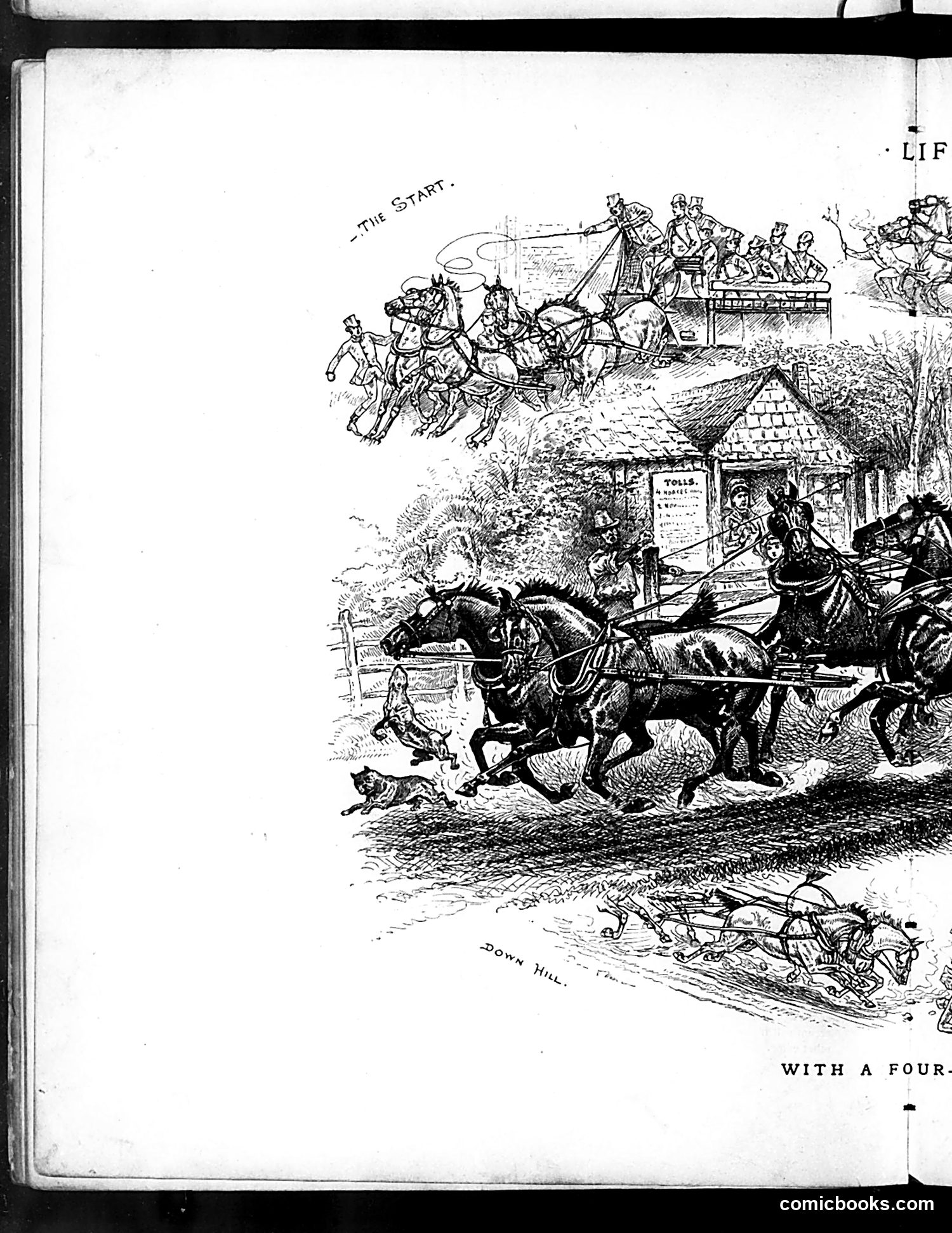
This illustration depicts a stagecoach scene labeled "The Start" at top and "Down Hill" at bottom, appearing to show a journey's progression. The upper portion shows horses and passengers departing from what appears to be a toll house (marked "TOLLS"), while the lower section shows the same conveyance in apparent disarray or accident going downhill. The satire likely comments on toll roads or turnpikes—a contentious issue in 19th-century America. The "start" at the toll booth, followed by chaos "down hill," suggests the cartoon mocks either the inefficiency of toll systems, the poor condition of toll-maintained roads, or the financial consequences of toll collection. The detailed rendering emphasizes the journey's deterioration, making a social or political point about transportation infrastructure and public expenditure.
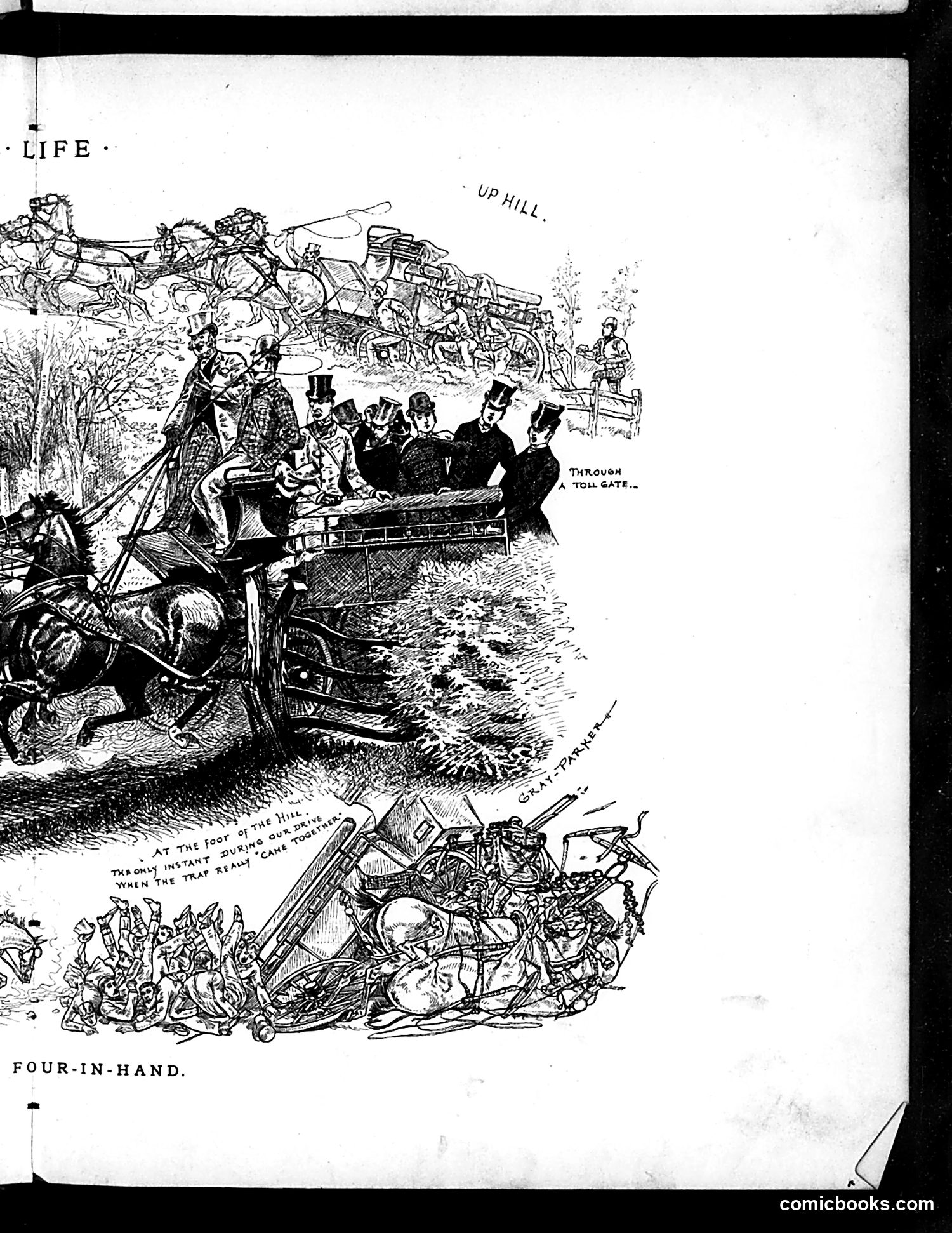
This satirical cartoon depicts wealthy, well-dressed gentlemen in a carriage labeled "THROUGH A TOLL GATE," traveling "UP HILL." The scene contrasts sharply with the chaotic wreckage below, labeled "GREAT PANIC," showing overturned carriages and distressed figures. The satire appears to mock economic inequality during a financial crisis. While ordinary people suffer in the "great panic" (likely referencing the 1893 economic depression), the privileged elite travel smoothly uphill through toll gates—suggesting they navigate crises unaffected while the working class faces ruin. The title "FOUR-IN-HAND" references an expensive carriage style, emphasizing class distinction. The cartoon critiques how wealth insulates the rich from economic hardship that devastates common people.
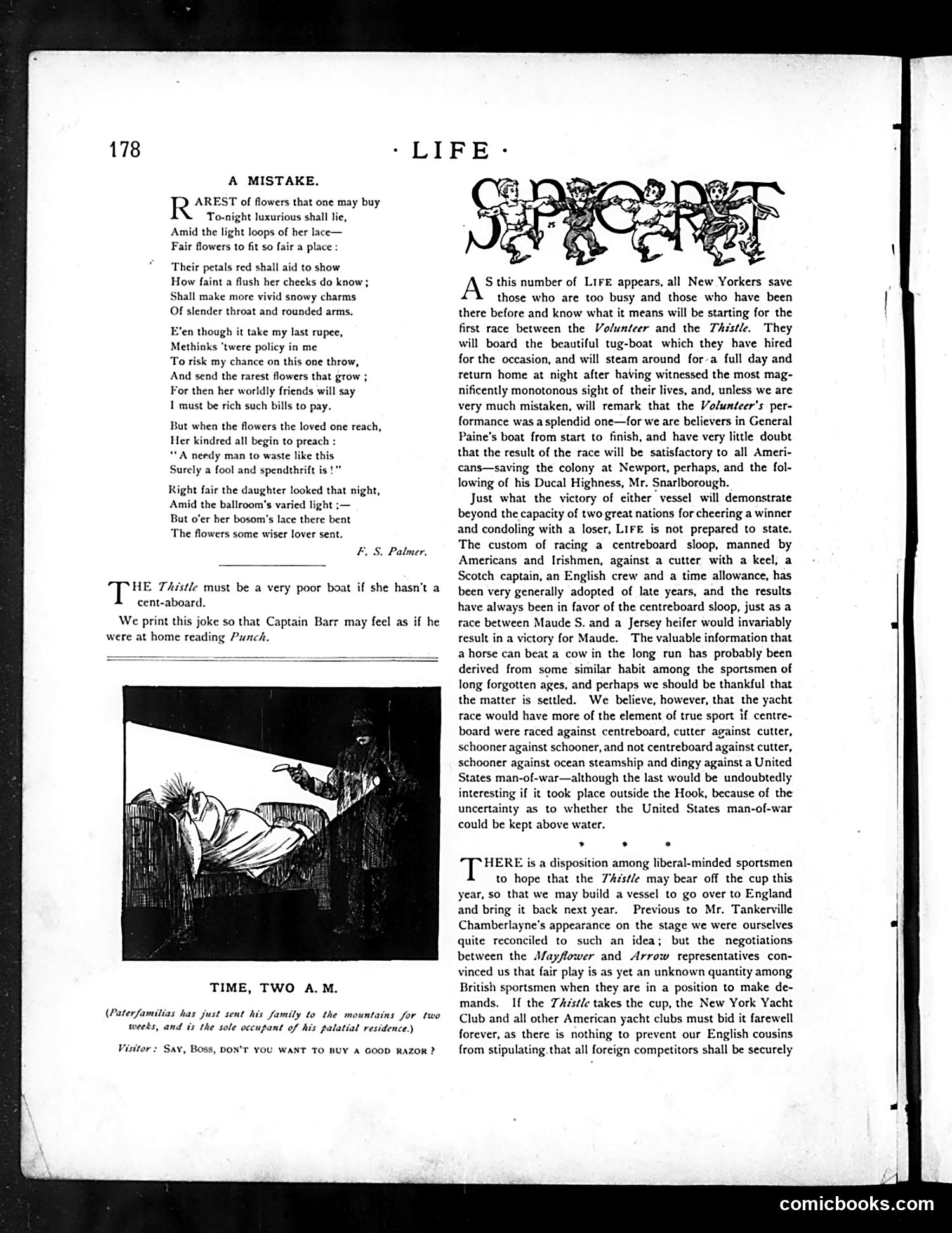
This page contains two separate satirical pieces: **"A Mistake"** (poem by F.S. Palmer): A romantic poem mocking a suitor's failed courtship attempt, where flowers fail to win over the intended recipient. **"Sport" section**: Commentary on yacht racing, specifically discussing an upcoming race between the *Volunteer* and the *Thistle*. The text discusses Captain Barr and references to the boat competition, with debate about whether American or British vessels should compete. **"Time, Two A.M."** (illustration): A humorous sketch showing a late-night domestic scene where a visitor asks a homeowner (identified as Peterfamilias) if he wants to buy a razor—apparently commenting on masculine grooming or self-care in an absurdist way. The page mixes romantic satire with sports commentary and domestic humor typical of Life magazine's format.
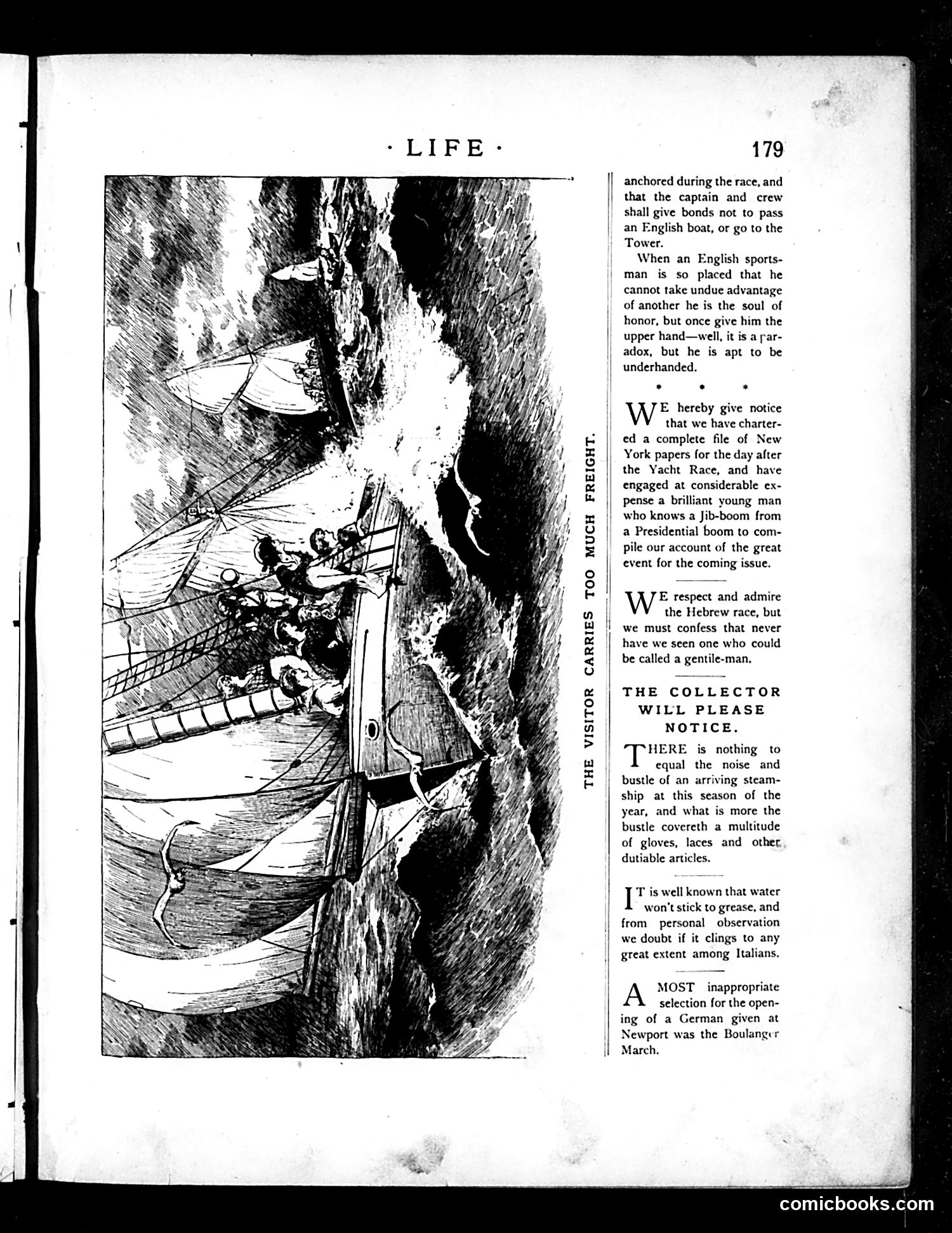
This page contains several brief satirical pieces typical of Life magazine's format. The main illustration depicts a yacht race, accompanying text mocking English sportsmanship—claiming Englishmen are honorable only when disadvantaged, but become "underhanded" when given advantage. Additional items include: **"The Collector Will Notice"**: Jokes about smuggling at ports, suggesting arriving steamships conceal contraband (gloves, laces) among legitimate cargo during busy arrivals. **Anti-Semitic content**: A crude stereotype about Jewish people, which reflects the magazine's regrettable editorial bias of the era. **"Boulanger March" reference**: Appears to mock an inappropriate musical choice (a German military march) at a Newport social event, likely implying poor taste or international tension awareness. The page exemplifies early Life magazine's mix of gentle social observation and period prejudices now considered offensive.
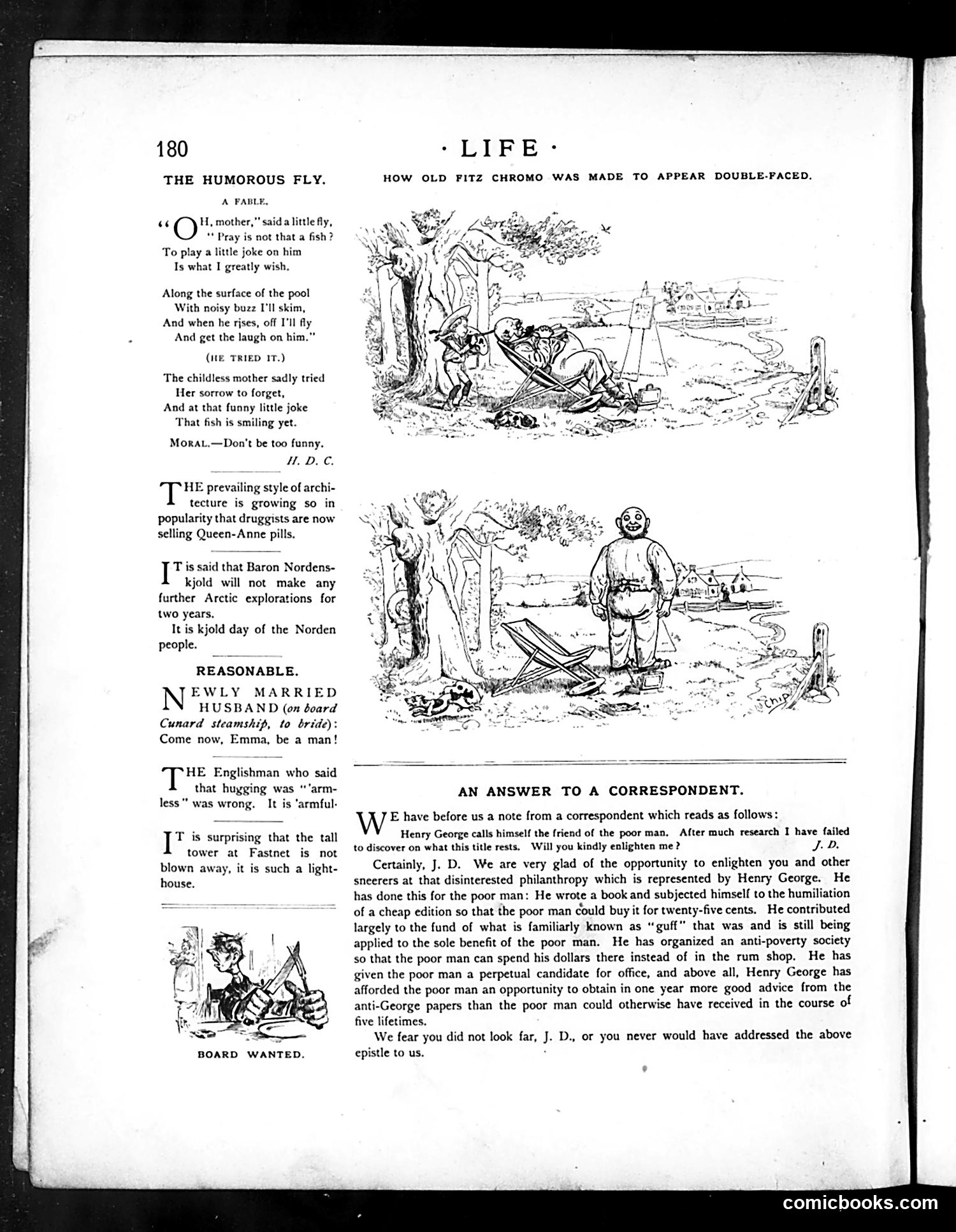
This page from *Life* magazine contains several satirical pieces: **"The Humorous Fly"** is a fable mocking overconfidence. A young fly boasts to his mother about pranking a fish by skimming the water's surface, but the fish catches and kills him. The moral warns against excessive joking—dark humor typical of Victorian-era fables. **The main article responds to a correspondent** questioning Henry George's claim to be "the friend of the poor man." *Life's* editors deliver biting sarcasm: they sarcastically praise George for writing cheap editions, promoting vague "anti-poverty" rhetoric, and inadvertently providing poor people with years' worth of criticism via hostile newspapers. The piece savagely ridicules George's philanthropic pretensions as empty self-promotion and ineffectual gestures. **Other brief items** mock architectural trends (Queen-Anne pills), Arctic exploration, and honeymoon etiquette—standard magazine humor filler. The page demonstrates *Life's* role as a satirical organ critiquing both social movements and public figures of the Gilded Age.
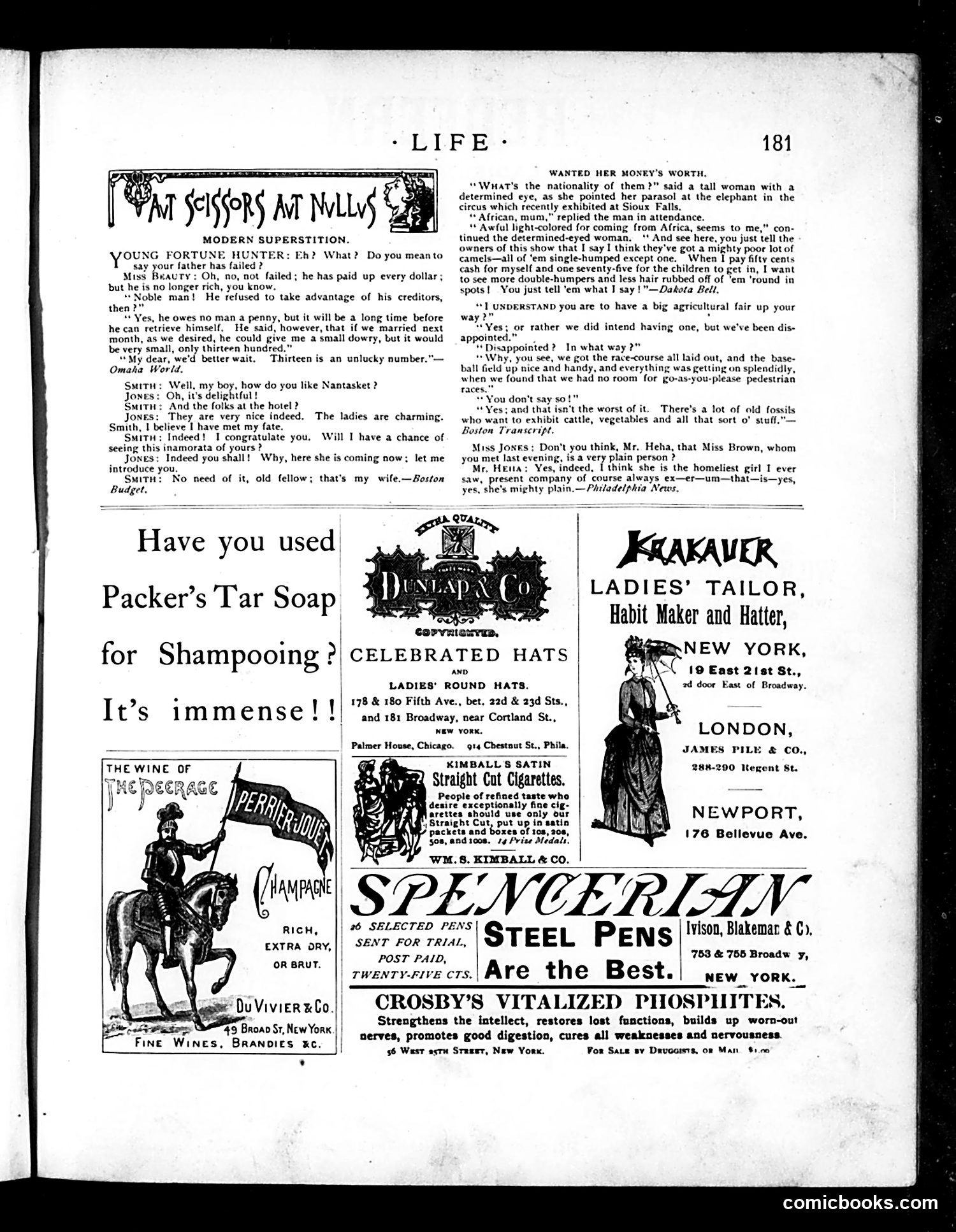
This page contains three satirical humor pieces reflecting late-19th-century social attitudes: **"Modern Superstition"** mocks the wealthy by contrasting a fortune hunter's disappointment that a woman's father *honorably* paid his debts (leaving no fortune) with a nobleman's romantic interest only in her money. The satire targets the era's marriage-market culture where wealth determined desirability. **"Wanted Her Money's Worth"** depicts a penny-pinching woman at a circus demanding better value—criticizing the elephant's light coloring and the camels' single humps. The joke ridicules miserly, complaining customers who nitpick entertainments. **The Jones/Smith dialogue** humorously captures a social mishap: Smith accidentally insults Miss Brown's appearance to her suitor, Mr. Helia, stammering through an awkward recovery when he realizes his blunder. The remainder is period advertising (tar soap, champagne, tailoring services, steel pens, patent medicine). These pieces reflect genteel humor about courtship, class pretension, and social embarrassment—typical of Life's satirical commentary on American manners.
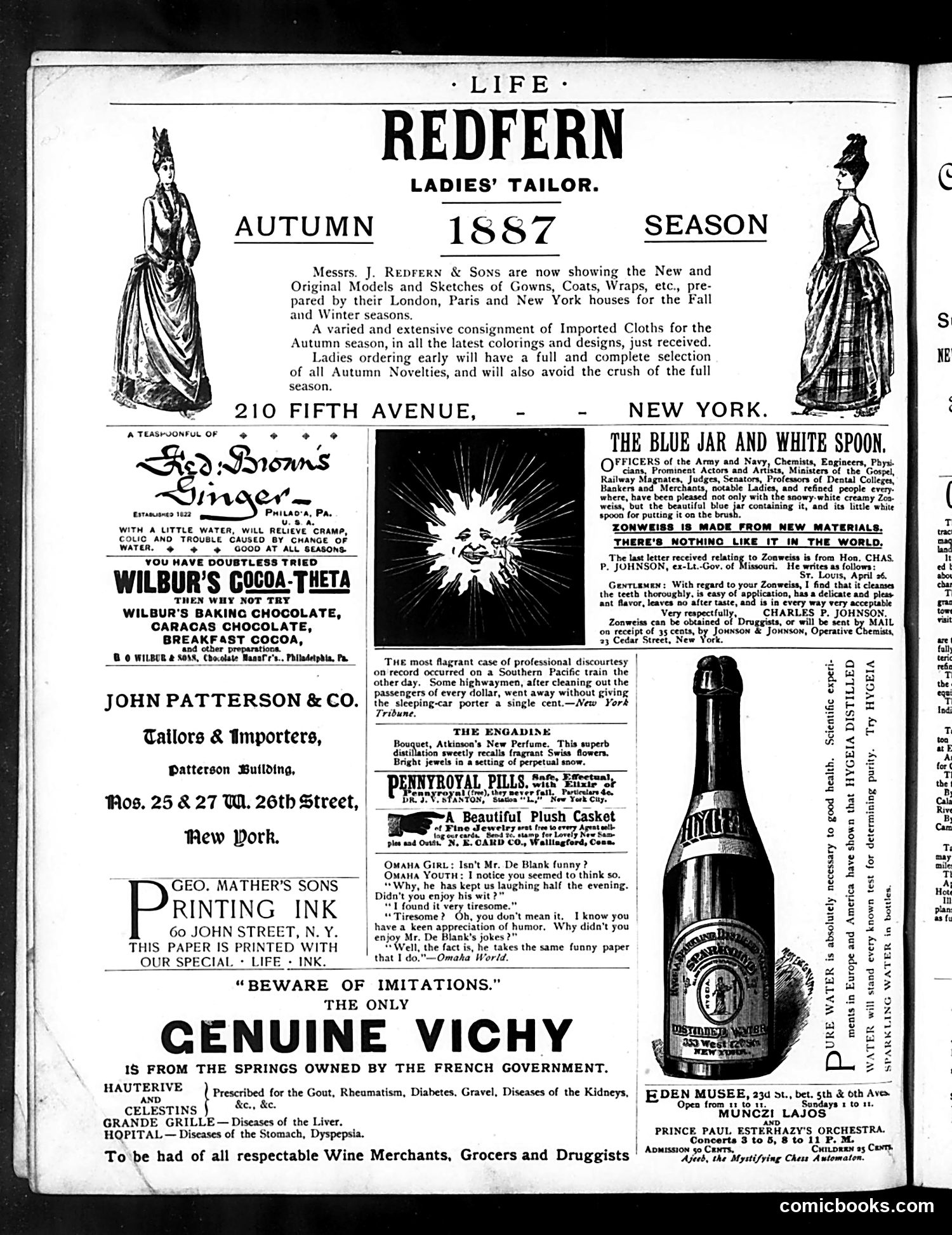
This page is primarily **advertising**, not a political cartoon. It's from Life magazine's 1887 autumn season issue. The main content consists of luxury brand advertisements: Redfern (a high-end ladies' tailor), Vichy water (a French mineral water marketed for medicinal purposes), Wilson's cocoa, and various other upscale products. These ads target wealthy, refined consumers—officers, professionals, "notable Ladies." **The only humor piece** is a brief joke at the bottom about "Omaha Girl" and "Omaha Youth." The joke satirizes a man who tells the same jokes repeatedly from newspapers; the girl found him tedious rather than funny. It's gentle social satire about boring dinner companions who recycle material. The page reflects 1880s consumer culture: imported European luxury goods, patent medicines with exaggerated health claims, and the aspirational lifestyle marketed to the American elite. The "Beware of Imitations" warning about Vichy water shows companies already combating counterfeits in this era.
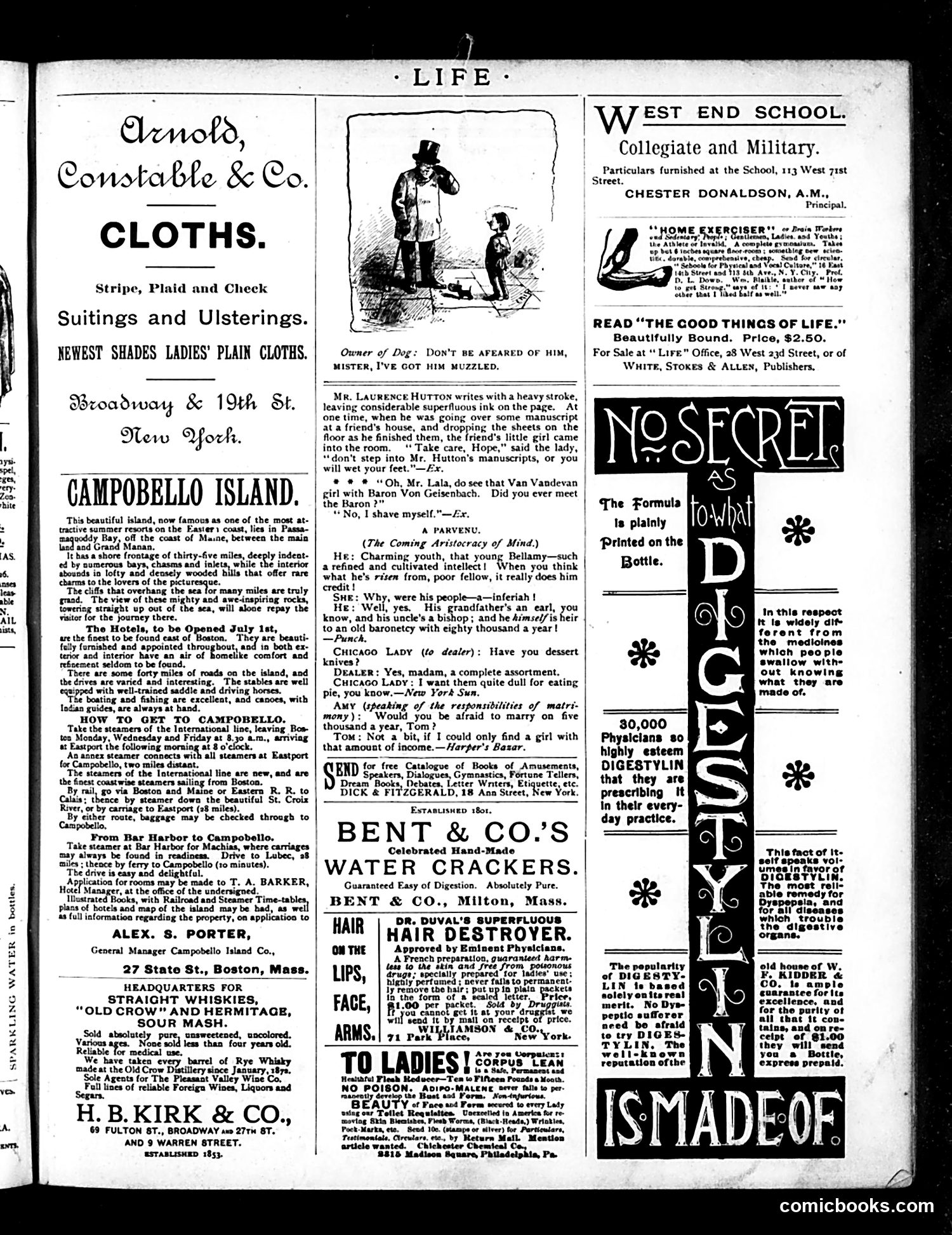
This page is primarily **advertisements and filler content** rather than political satire. The main cartoon shows a man with a muzzled dog reassuring a woman ("Don't be afraid of him, mister, I've got him muzzled")—a simple joke about a perceived threat being safely controlled. The text includes brief comic anecdotes: one about writer Laurence Hutton's messy handwriting, another playing on the phrase "shave myself" as a misunderstanding. The bulk of the page consists of **commercial advertisements** for clothiers (Arnold, Constable & Co.), Campobello Island resort tourism, West End School, hair destruction products, water crackers, and whiskey. There's also a large advertisement for "No Secret" digestive product. This appears to be a typical late-19th-century *Life* magazine page—primarily revenue-generating advertisements interspersed with light humor, rather than substantive political or social commentary.
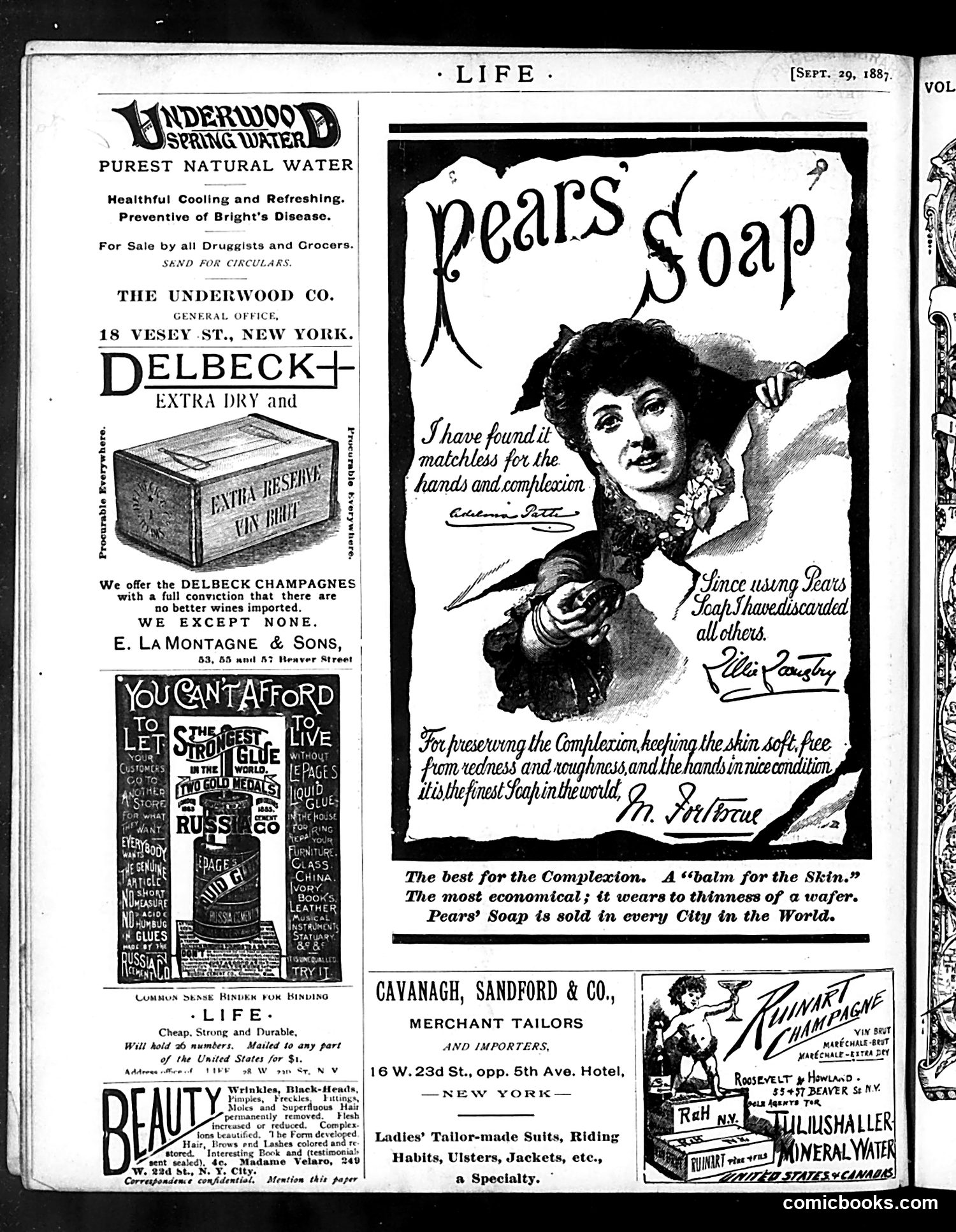
This is primarily a **product advertisement**, not political satire. The page features Pears' Soap's endorsement strategy, common in late 19th-century marketing. The central image shows a well-dressed woman (identity unclear from the text alone) testifying to the soap's benefits for "hands and complexion." Two signatures appear—one identifying the endorser as someone named "Lillie Langtry" (visible in the image), a famous British actress of the era known for her beauty and celebrity status. Below, another testimonial (signed "M. Pattmore," unclear who this is) praises the soap for preserving complexion and softening skin. **The satire angle**: Rather than mocking Pears', *Life* magazine likely ran this ad because celebrity endorsements themselves were becoming a subject of ridicule—the idea that famous people would publicly endorse consumer products was a newer, somewhat absurd marketing tactic worth satirizing to readers. The page is otherwise filled with period advertisements for champagne, spring water, tailoring services, and beauty treatments.