
Life, 1887-09-29 · page 6 of 16
Life — September 29, 1887 — page 6: what you’re looking at
What you’re looking at
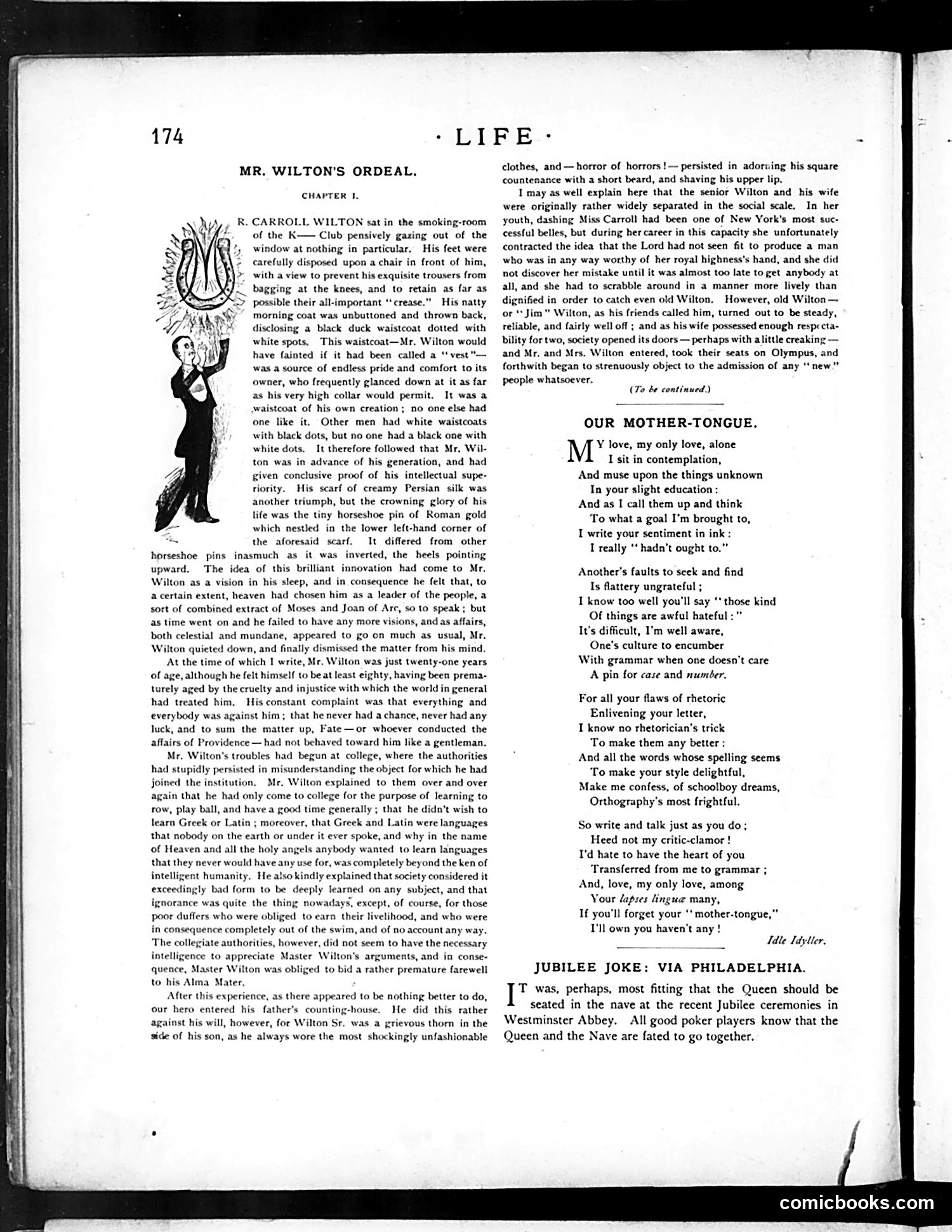
This page contains **"Mr. Wilton's Ordeal,"** a serialized story beginning with Chapter I. The accompanying illustration shows a man in formal dress examining his reflection, apparently vain about his appearance—particularly his distinctive black waistcoat with white dots, which he considers a mark of intellectual superiority. The text satirizes Mr. Wilton as a pretentious intellectual who falsely believes his fashionable attire signals cultural distinction. The narrative mocks his pomposity, noting he's twenty-one years old yet acts superior, complains constantly about society, and failed to secure a leadership position despite his self-regard. The page also includes unrelated poetry ("Our Mother-Tongue") and a brief joke about the Queen attending Jubilee ceremonies. This appears to be general satirical content typical of Life's social commentary.
📄 Transcribed text from this page (OCR, searchable)
Machine-transcribed from the original scan — historical spelling and the odd misread are preserved.
- LIFE: MR. WILTON’S ORDEAL. CHAPTER 1. R. CARROLL WILTON sat in the smoking-room of the K— Club pensively gazing out of the window at nothing in particular. His feet were carefully disposed upon a chair in front of him, — with a view to prevent his exquisite trousers from bagging at the knees, and to retain as far as possible their all-important “crease.” His natty morning coat was unbuttoned and thrown back, disclosing a black duck waistcoat dotted with white spots, This waistcoat—Mr. Wilton would have fainted if it had been called a “vest"— was a source of endless pride and comfort to its owner, who frequently glanced down at it as far as his very high collar would permit. It was a waistcoat of his own creation; no one else had one like it. Other men had white waistcoats with black dots, but no one had a black one with white dots, It therefore followed that Mr, Wil- ton was in advance of his generation, and had given conclusive proof of his intellectual supe- riority. His scarf of creamy Persian silk was another triumph, but the crowning glory of his life was the tiny horseshoe pin of Roman gold which nestled in the lower left-hand corner of a the aforesaid scarf, It differed from other horseshoe pins inasmuch as it was inverted, the heels pointing upward, The idea of this brilliant innovation had come to Mr. Wilton as a vision in his sleep, and in consequence he felt that, to a certain extent, heaven had chosen him as a leader of the people, a sort of combined extract of Moses and Joan of Arc, so to speak; but as time went on and he failed to have any more visions, and as affairs, both celestial and mundane, appeared to go on much as usual, Mr. Wilton quieted down, and finally dismissed the matter from his mind. At the time of which I write, Mr, Wilton was just twenty-one years of age, although he felt himself to beat least eighty, having been prema- turely aged by the cruelty and injustice with which the world in general had treated him. His constant complaint was that everything and everybody was against him; that he never had a chance, never had any luck, and to sum the matter up, Fate—or whoever conducted the affairs of Providence —had not behaved toward him like a gentleman, Mr. Wilton’s troubles had begun at college, where the authorities had stupidly persisted in misunderstanding the object for which he had joined the institution, Mr, Wilton explained to them over and over again that he had only come to college for the purpose of learning to row, play ball, and have a good time generally ; that he didn’t wish to learn Greek or Latin ; moreover, that Greek and Latin were languages that nobody on the earth or under it ever spoke, and why in the name of Heaven and all the holy angels anybody wanted to learn languages that they never would have any use for, was completely beyond the ken of intelligent humanity, He also kindly explained that society considered it exceedingly bad form to be deeply learned on any subject, and that ignorance was quite the thing nowadays, except, of course, for those poor duffers who were obliged to earn their livelihood, and who were in consequence completely out of the swim, and of no account any way. The collegiate authorities, however, did not seem to have the necessary intelligence to appreciate Master Wilton's arguments, and in conse- quence, Master Wilton was obliged to bid a rather premature farewell to his Alma Mater, After this experience, as there appeared to be nothing better to do, our hero entered his father’s counting-house. He did this rather against his will, however, for Wilton Sr. was a grievous thorn in the side of his son, as he always wore the most shockingly unfashionable clothes, and—horror of horrors !— persisted in adorning his square countenance with a short beard, and shaving his upper lip. I may as well explain hese that the senior Wilton and his wife were originally rather widely separated in the social scale, In her youth, dashing Miss Carroll had been one of New York's most suc- cessful belles, but during her career in this capacity she unfortunately contracted the idea that the Lord had not seen fit to produce a man who was in any way worthy of her royal highness’s hand, and she did not discover her mistake until it was almost too late to get anybody at all, and she had to scrabble around in a manner more lively than dignified in order to catch even old Wilton, However, old Wilton — or * Jim” Wilton, as his friends called him, turned out to be steady, reliable, and fairly well off ; and as his wife possessed enough respccta- bility for two, society opened its doors — perhaps with alittle creaking — and Mr. and Mrs. Wilton entered, took their seats on Olympus, and forthwith began to strenuously object to the admission of any new” le whatsoever. Cie (To be continued.) OUR MOTHER-TONGUE. Y love, my only love, alone I sit in contemplation, And muse upon the things unknown In your slight education : And as I call them up and think To what a goal I'm brought to, I write your sentiment in ink : I really ‘hadn't ought to. Another's faults to seek and find Is flattery ungrateful ; I know too well you'll say "' those kind Of things are awful hateful :" It's difficult, I'm well aware, One's culture to encumber With grammar when one doesn't care A pin for case and number, For all your flaws of rhetoric Enlivening your letter, I know no rhetorician’s trick To make them any better: And all the words whose spelling seems To make your style delightful, Make me confess, of schoolboy dreams, Orthography’s most frightful. So write and talk just as you Heed not my critic-clamor ! I'd hate to have the heart of you ‘Transferred from me to grammar ; And, love, my only love, among Your lapses lingua many, If you'll forget your “* mother-tongue,” T'll own you haven't any ! Idle Idyller. JUBILEE JOKE: VIA PHILADELPHIA. [* was, perhaps, most fitting that the Queen should be seated in the nave at the recent Jubilee ceremonies in Westminster Abbey. All good poker players know that the Queen and the Nave are fated to go together. comicbooks.com