
Life, 1887-09-29 · page 2 of 16
Life — September 29, 1887 — page 2: what you’re looking at
What you’re looking at
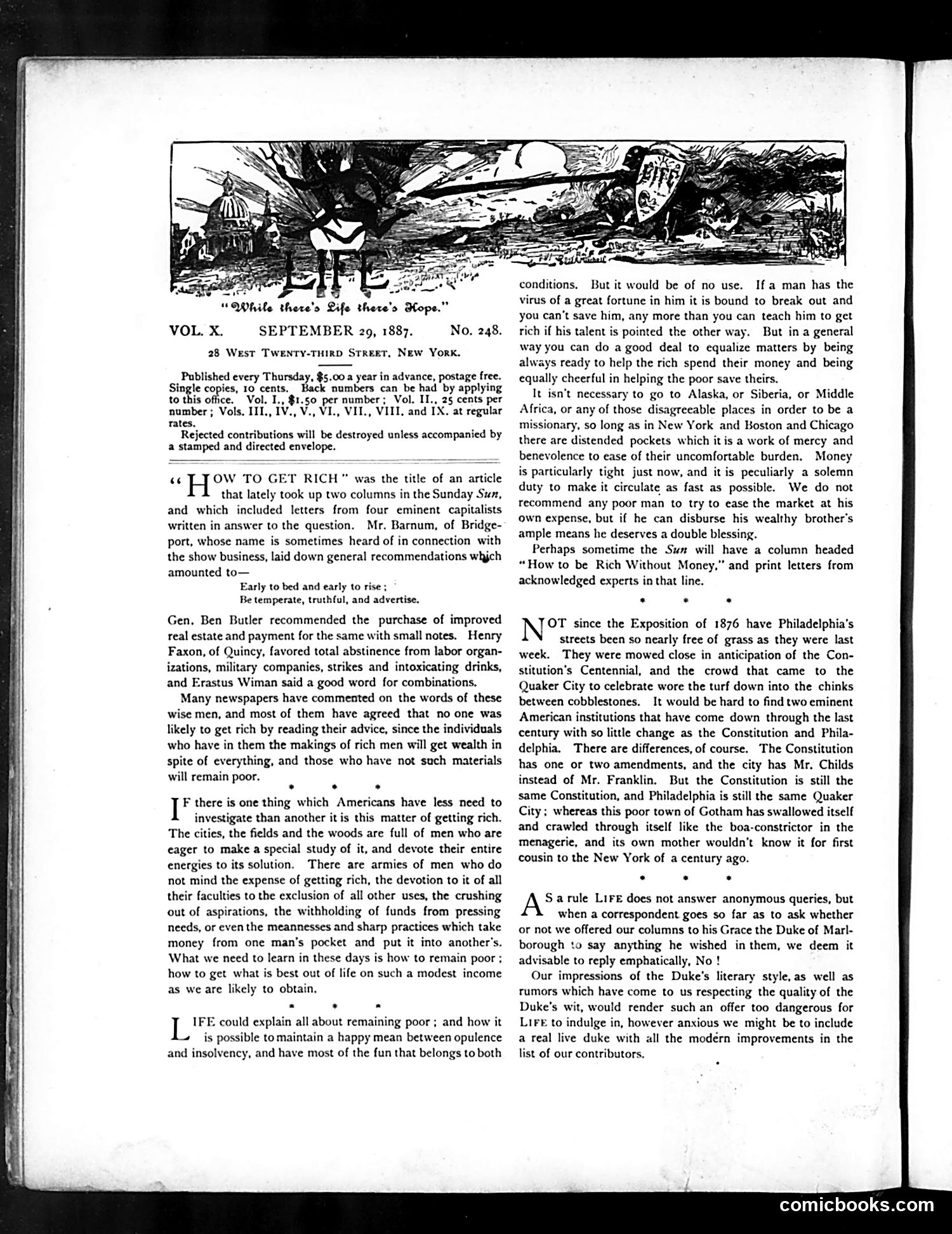
The masthead illustration depicts a skeletal figure labeled "Life" sitting beneath a tree, with the caption "Where there's Life there's Hope." The page's editorial content discusses wealth-building advice, referencing an earlier article titled "How to Get Rich." The editors critique capitalists like Gen. Ben Butler and Henry Faxon who offer get-rich schemes, noting such advice rarely benefits poor people. A separate section comments on Philadelphia's streets during the 1876 Exposition celebration, comparing the city unfavorably to other American institutions. The editors mock how little Philadelphia has changed since the Constitution's creation, sarcastically suggesting the city remains as backward as a fictional "poor town of Gotham." The content is primarily satirical social commentary rather than visual political cartooning.
📄 Transcribed text from this page (OCR, searchable)
Machine-transcribed from the original scan — historical spelling and the odd misread are preserved.
-§] ] “OMhile there's Life there's VOL.X. | SEPTEMBER 29, 1887. 28 West TWENTY-THIRD STREET, New York. No. 248. Published every Thursday, $5.00 a year in advance, postage free. Single copies, 10 cents, Back numbers can be had by applying to this office. Vol. I., $1.50 per number ; Vol. II., 25 cents per V., VI, VIL, VIII, and IX. at regular number; Vols, III., I rates, Rejected contributions will be destroyed unless accompanied by a stamped and directed envelope. ‘“ OW TO GET RICH” was the title of an article that lately took up two columns in the Sunday Suz, and which included letters from four eminent capitalists written in answer to the question. Mr. Barnum, of Bridge- port, whose name is sometimes heard of in connection with the show business, laid down general recommendations whjch amounted to— Early to bed and early to rise; Be temperate, truthful, and advertise. Gen, Ben Butler recommended the purchase of improved real estate and payment for the same with small notes. Henry Faxon, of Quincy, favored total abstinence from labor organ- izations, military companies, strikes and intoxicating drinks, and Erastus Wiman said a good word for combinations. Many newspapers have commented on the words of these wise men, and most of them have agreed that no one was likely to get rich by reading their advice, since the individuals who have in them the makings of rich men will get wealth in spite of everything, and those who have not such materials will remain poor. . . F there is one thing which Americans have less need to investigate than another itis this matter of getting rich. The cities, the fields and the woods are full of men who are eager to make a special study of it, and devote their entire energies to its solution. There are armies of men who do not mind the expense of getting rich, the devotion to it of all their faculties to the exclusion of all other uses, the crushing out of aspirations, the withholding of funds from pressing needs, or even the meannesses and sharp practices which take money from one man’s pocket and put it into another's. What we need to learn in these days is how to remain poor ; how to get what is best out of life on such a modest income as we are likely to obtain. . . * IFE could explain all about remaining poor ; and how it is possible to maintain a happy mean between opulence and insolvency, and have most of the fun that belongs to both conditions, But it would be of no use. If a man has the virus of a great fortune in him it is bound to break out and you can’t save him, any more than you can teach him to get rich if his talent is pointed the other way. But in a general way you can do a good deal to equalize matters by being always ready to help the rich spend their money and being equally cheerful in helping the poor save theirs. It isn’t necessary to go to Alaska, or Siberia, or Middle Africa, or any of those disagreeable places in order to be a missionary, so long as in New York and Boston and Chicago there are distended pockets which it is a work of mercy and benevolence to ease of their uncomfortable burden. Money is particularly tight just now, and it is peculiarly a solemn duty to make it circulate as fast as possible. We do not recommend any poor man to try to ease the market at his own expense, but if he can disburse his wealthy brother's ample means he deserves a double blessing. Perhaps sometime the Sus will have a column headed “How to be Rich Without Money,” and print letters from acknowledged experts in that line. OT since the Exposition of 1876 have Philadelphia's streets been so nearly free of grass as they were last week. They were mowed close in anticipation of the Con- stitution’s Centennial, and the crowd that came to the Quaker City to celebrate wore the turf down into the chinks between cobblestones. It would be hard to find two eminent American institutions that have come down through the last century with so little change as the Constitution and Phila- delphia. There are differences, of course. The Constitution has one or two amendments, and the city has Mr. Childs instead of Mr. Franklin. But the Constitution is still the same Constitution, and Philadelphia is still the same Quaker City; whereas this poor town of Gotham has swallowed itself and crawled through itself like the boa-constrictor in the menagerie, and its own mother wouldn't know it for first cousin to the New York of a century ago. . . . Sarule LiFe does not answer anonymous queries, but when a correspondent goes so far as to ask whether or not we offered our columns to his Grace the Duke of Marl- borough to say anything he wished in them, we deem it advisable to reply emphatically, No ! Our impressions of the Duke's literary style, as well as tumors which have come to us respecting the quality of the Duke's wit, would render such an offer too dangerous for LiFe to indulge in, however anxious we might be to include a real live duke with all the modérn improvements in the list of our contributors. comicbooks.com