
Life, 1887-09-29 · page 10 of 16
Life — September 29, 1887 — page 10: what you’re looking at
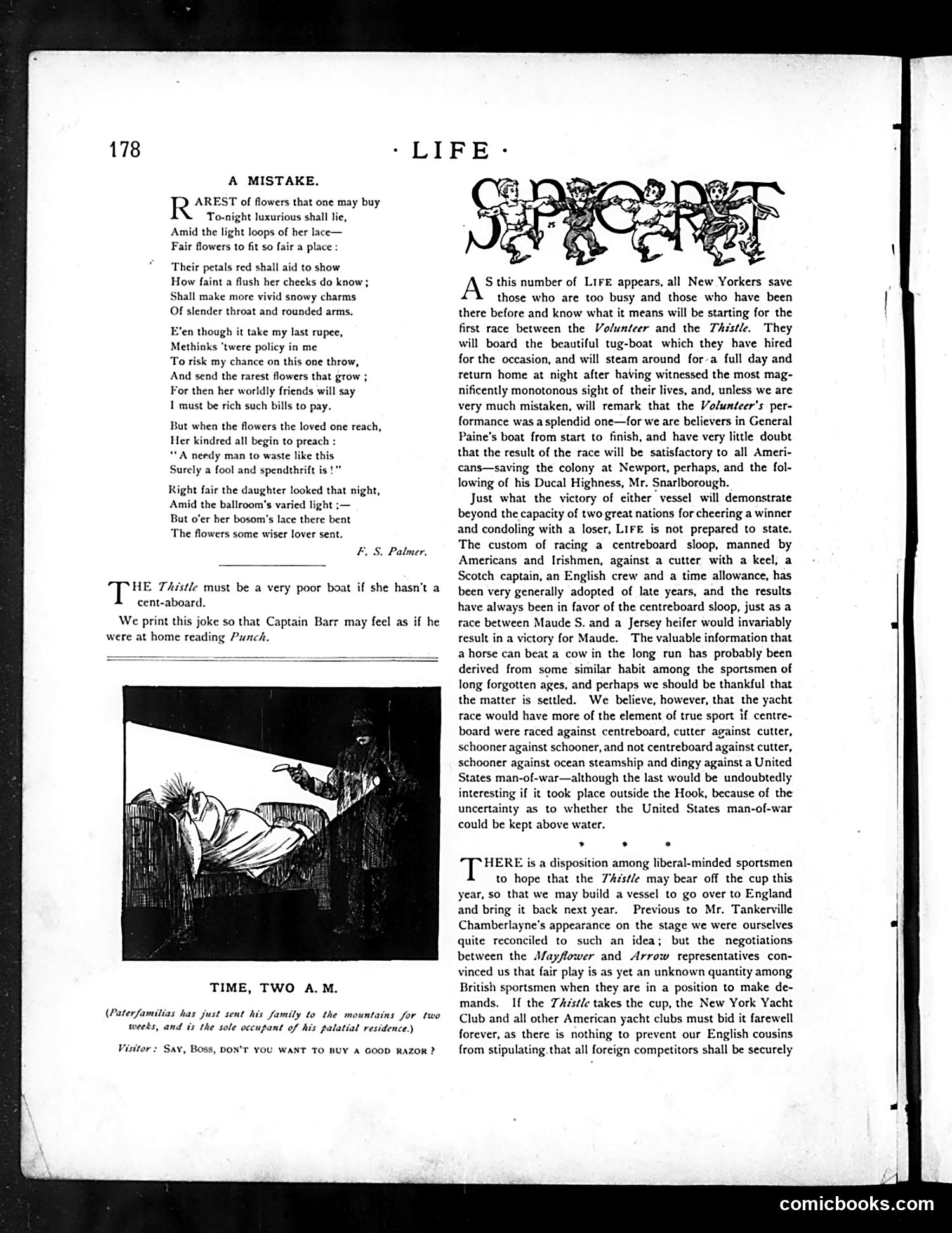
What you’re looking at
This page contains two separate satirical pieces: **"A Mistake"** (poem by F.S. Palmer): A romantic poem mocking a suitor's failed courtship attempt, where flowers fail to win over the intended recipient. **"Sport" section**: Commentary on yacht racing, specifically discussing an upcoming race between the *Volunteer* and the *Thistle*. The text discusses Captain Barr and references to the boat competition, with debate about whether American or British vessels should compete. **"Time, Two A.M."** (illustration): A humorous sketch showing a late-night domestic scene where a visitor asks a homeowner (identified as Peterfamilias) if he wants to buy a razor—apparently commenting on masculine grooming or self-care in an absurdist way. The page mixes romantic satire with sports commentary and domestic humor typical of Life magazine's format.
📄 Transcribed text from this page (OCR, searchable)
Machine-transcribed from the original scan — historical spelling and the odd misread are preserved.
A MISTAKE, AREST of flowers that one may buy To-night luxurious shall lie, Amid the light loops of her lace— Fair flowers to fit so fair a place : Their petals red shall aid to show How faint a flush her cheeks do know; Shall make more vivid snowy charms Of slender throat and rounded arms. E’en though it take my last rupee, Methinks ‘twere policy in me To risk my chance on this one throw, And send the rarest flowers that grow ; For then her worldly friends will say I must be rich such bills to pay. But when the flowers the loved one reach, Her kindred all begin to preach : “A needy man to waste like this Surely a fool and spendthrift is!” Right fair the daughter looked that night, Amid the ballroom’s varied light ;— But o'er her bosom's lace there bent The flowers some wiser lover sent. F. S. Palmer, HE TAéstle must be a very poor boat if she hasn't a cent-aboard. We print this joke so that Captain Barr may feel as if he were at home reading Punch. TIME, TWO A.M. (Paterfamilias has just sent his family to the mountains for two weeks, and is the sole occupant of his palatial residence.) Visitor : Say, Boss, DON'T YOU WANT TO BUY A GOOD RAZOR ? S this number of LiFe appears, all New Yorkers save those who are too busy and those who have been there before and know what it means will be starting for the first race between the Volunteer and the Thistle. They will board the beautiful tug-boat which they have hired for the occasion, and will steam around for-a full day and return home at night after having witnessed the most mag- nificently monotonous sight of their lives, and, unless we are very much mistaken, will remark that the Volunteer's per- formance was a splendid one—for we are believers in General Paine's boat from start to finish, and have very little doubt that the result of the race will be satisfactory to all Ameri- cans—saving the colony at Newport, perhaps, and the fol- lowing of his Ducal Highness, Mr. Snarlborough. Just what the victory of either vessel will demonstrate beyond the capacity of two great nations for cheering a winner and condoling with a loser, LIFE is not prepared to state. The custom of racing a centreboard sloop, manned by Americans and Irishmen, against a cutter with a keel, a Scotch captain, an English crew and a time allowance, has been very generally adopted of late years, and the results have always been in favor of the centreboard sloop, just as a race between Maude S. and a Jersey heifer would invariably result in a victory for Maude. The valuable information that a horse can beat a cow in the long run has probably been derived from some similar habit among the sportsmen of long forgotten ages, and perhaps we should be thankful that the matter is settled. We believe, however, that the yacht race would have more of the element of true sport if centre- board were raced against centreboard, cutter against cutter, schooner against schooner, and not centreboard against cutter, schooner against ocean steamship and dingy against a United States man-of-war—although the last would be undoubtedly interesting if it took place outside the Hook, because of the uncertainty as to whether the United States man-of-war could be kept above water. * . . HERE is a disposition among liberal-minded sportsmen to hope that the 7Azst/e may bear off the cup this year, so that we may build a vessel to go over to England and bring it back next year. Previous to Mr. Tankerville Chamberlayne’s appearance on the stage we were ourselves quite reconciled to such an idea; but the negotiations between the Mayflower and Arrow representatives con- vinced us that fair play is as yet an unknown quantity among British sportsmen when they are in a position to make de- mands. If the TAést/e takes the cup, the New York Yacht Club and all other American yacht clubs must bid it farewell forever, as there is nothing to prevent our English cousins from stipulating. that all foreign competitors shall be securely comicbooks.com