
A complete issue · 16 pages · 1887
Life — August 18, 1887
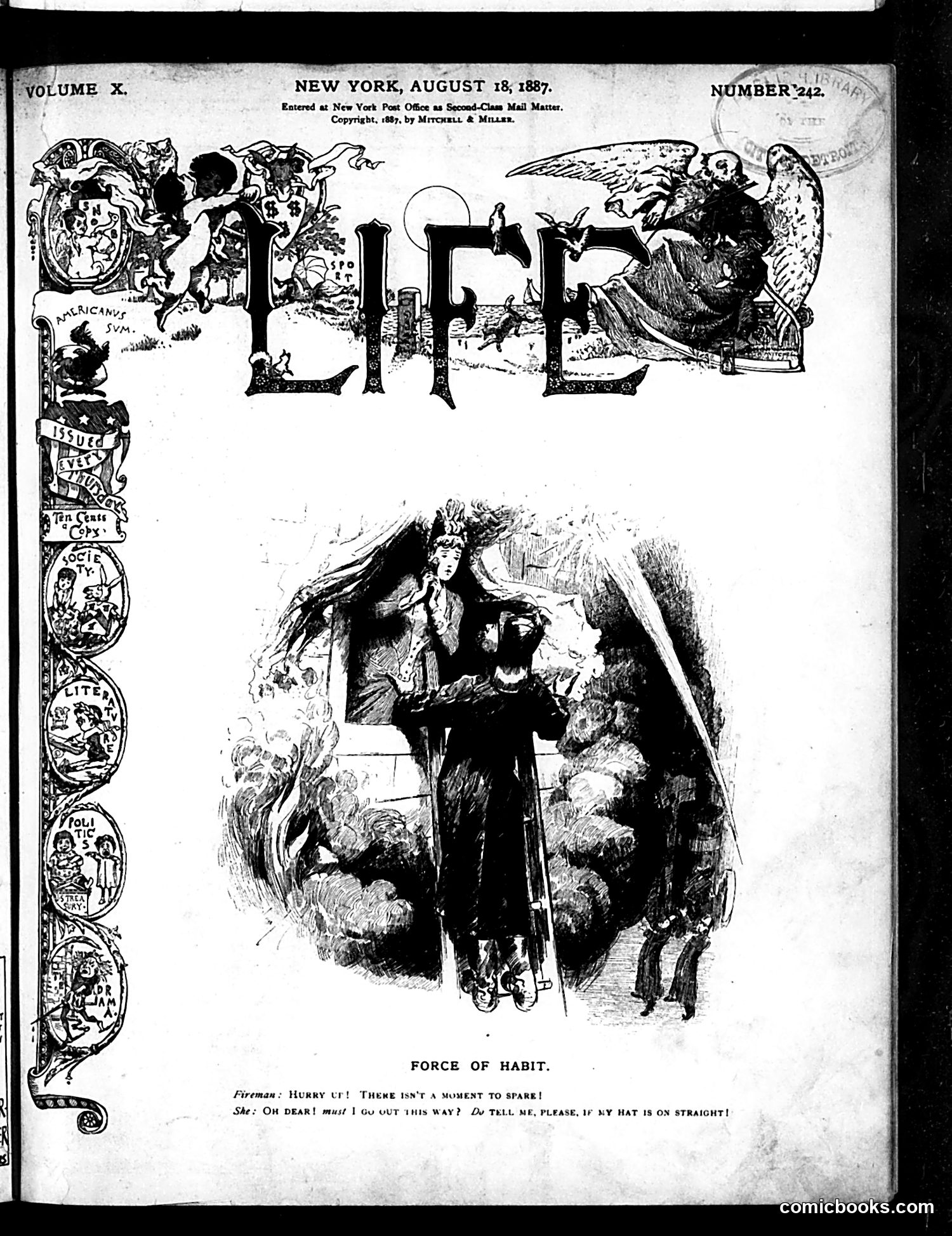
This cartoon satirizes **religious or superstitious adherence to outdated practices**. The main illustration shows a woman in a carriage during what appears to be an emergency or crisis situation. The fireman's dialogue is key: he urgently tells her "HURRY UP! THERE ISN'T A MOMENT TO SPARE!" but she responds "OH DEAR! must I go out THIS WAY? IN TELL ME, PLEASE, IF MY HAT IS ON STRAIGHT!" The satire mocks how people—particularly women—prioritize social conventions and appearance even in urgent circumstances. Despite danger, the woman worries about her hat's alignment rather than her safety. The title "Force of Habit" suggests ingrained social conditioning overrides practical judgment. This reflects Victorian-era commentary on rigid social expectations constraining rational behavior.
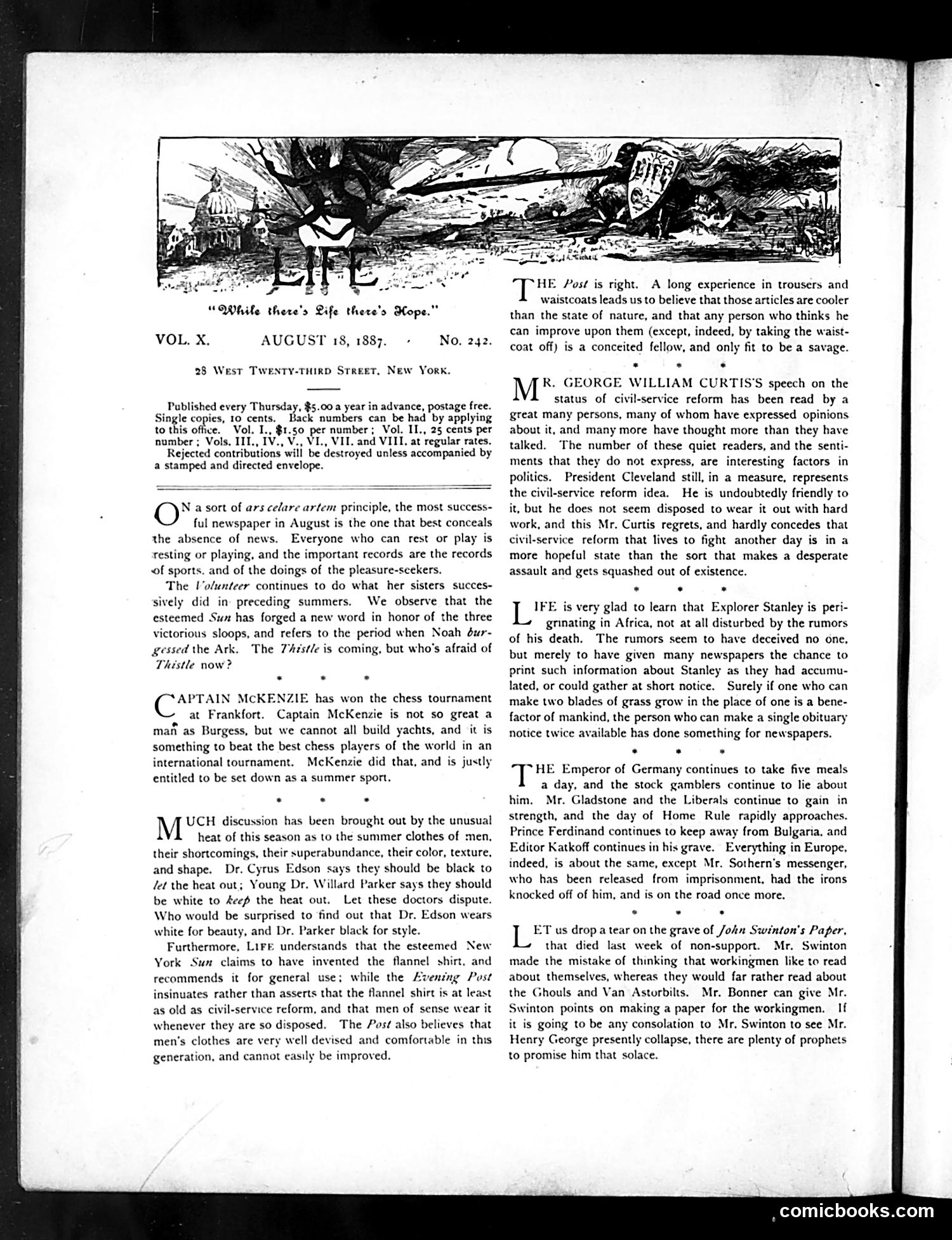
The cartoon at top depicts a figure beneath a dead tree with the caption "While there's Life there's Hope." This appears to be a visual pun on the magazine's title—a satirical commentary on the magazine's own resilience or optimistic outlook despite difficult circumstances. The right column discusses George William Curtis's speech on civil-service reform, noting that President Cleveland supports the idea but lacks enthusiasm for hard work on the issue. The text mocks how reform efforts keep "fighting another day" without real progress. Other brief items mock various public figures including the German Emperor's eating habits, references to explorer Stanley, and commentary on newspaper coverage. The overall tone is characteristically cynical political satire typical of 1880s American humor magazines.
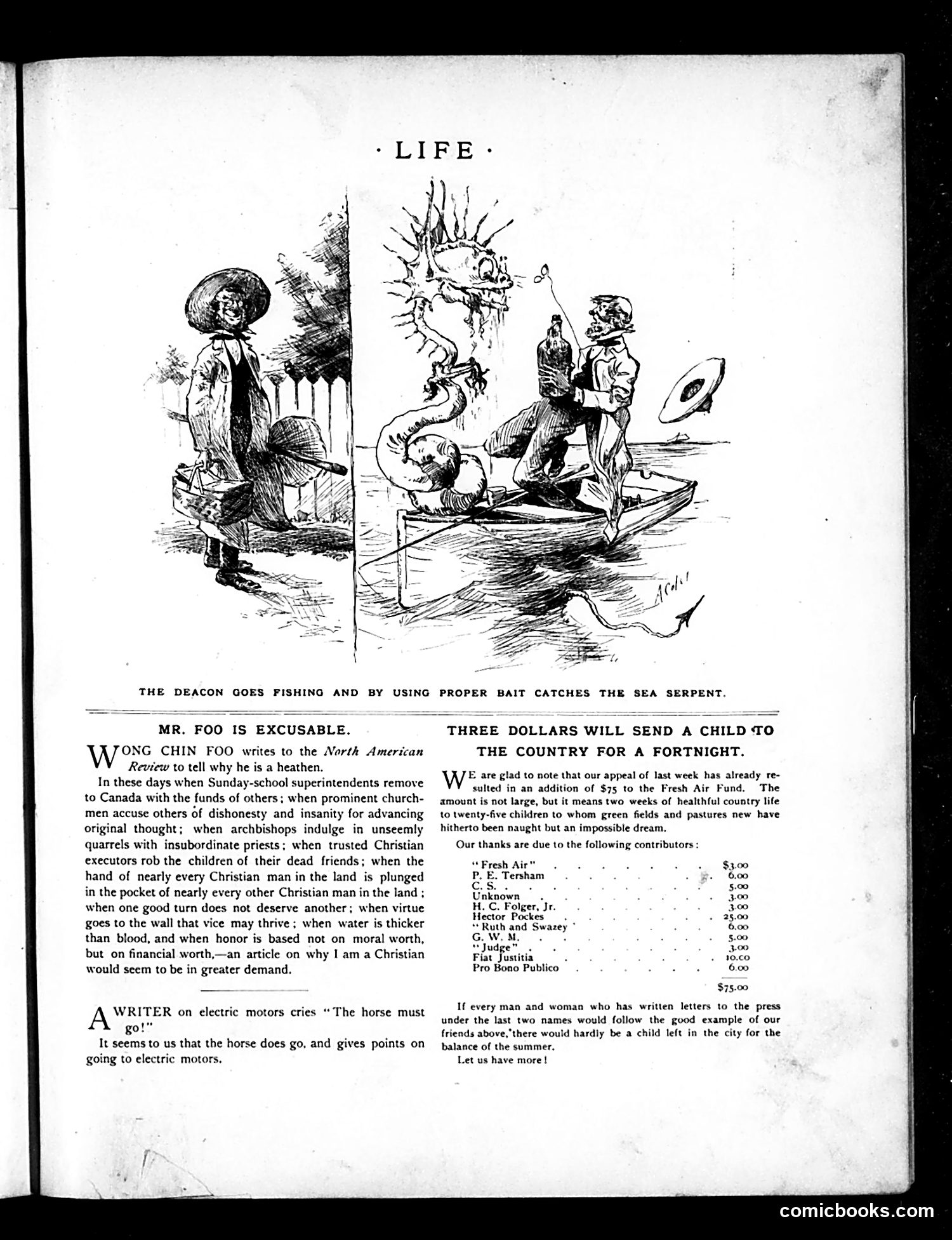
The main cartoon illustrates the satirical caption "The Deacon Goes Fishing and by Using Proper Bait Catches the Sea Serpent." It depicts a religious figure (identifiable by his formal dress) successfully catching a mythical sea serpent using fishing tackle—a visual metaphor for effective strategy. The accompanying text criticisms address religious hypocrisy and moral failures within Christianity. The article "Mr. Foo is Excusable" sarcastically defends a Chinese man's heathenism, arguing that Christian leaders' dishonesty, corruption, and moral compromises make Christianity itself disreputable. The second piece discusses electric motors' practicality, seemingly unrelated to the religious satire above. The page appears to be social/religious commentary typical of *Life* magazine's satirical approach to institutional criticism.
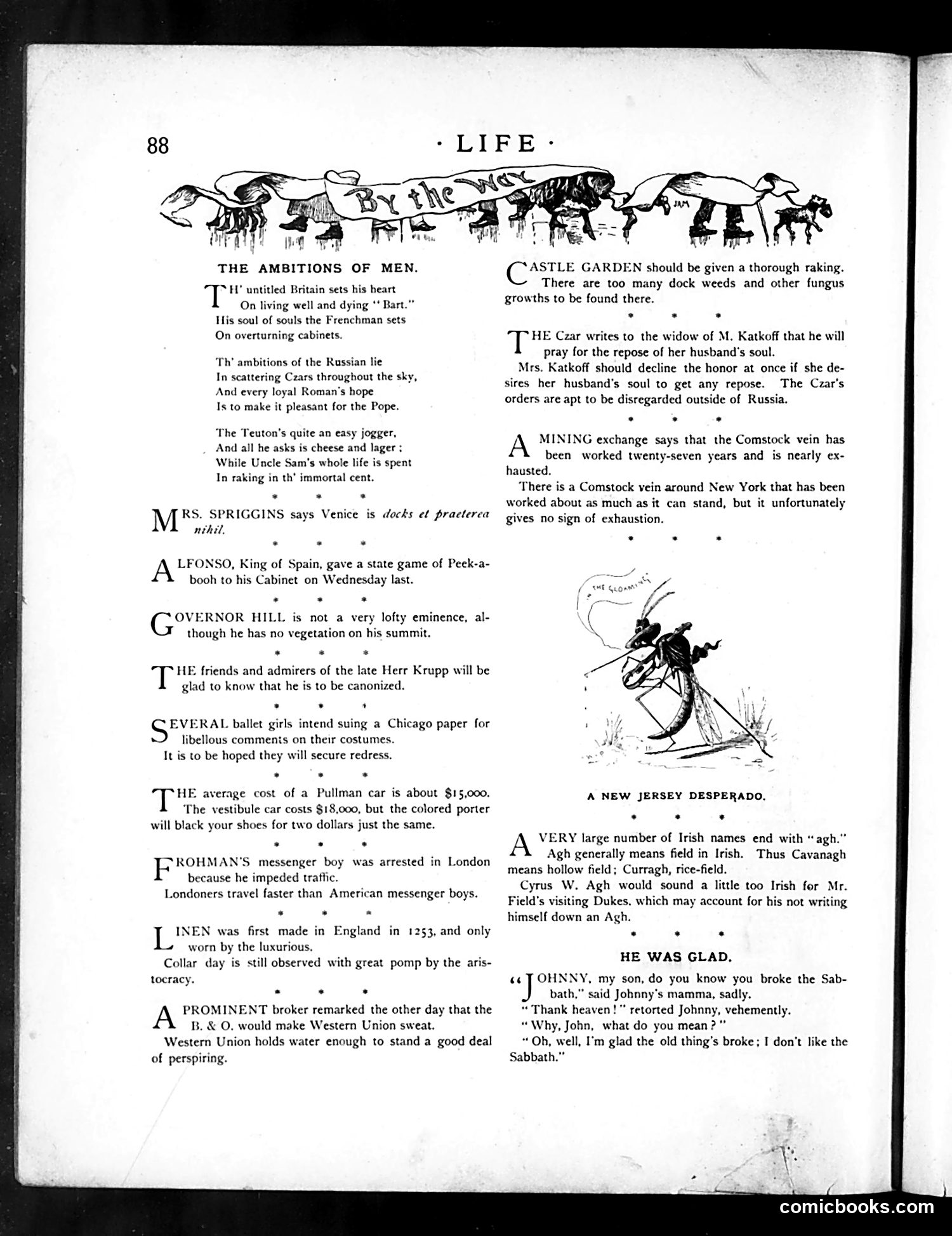
This page contains miscellaneous satirical notes and anecdotes rather than formal political cartoons. The content includes: **"The Ambitions of Men"** — A poem mocking various national stereotypes: British ambitions for comfort, Russian desires for power, French financial scheming, and American materialism. **"Mrs. Spriggins says Venice is *docks et praeterea nihil*"** — A joke about pretentious social commentary. **Various brief satirical items** about mining exhaustion, Pullman car costs, messenger boys, and linen manufacture—typical turn-of-century business and social observations. **"A New Jersey Desperado"** — An illustration (unclear without clearer image) apparently mocking minor crime or regional stereotypes. **"He Was Glad"** — A dialect joke about an Irish boy and a broken bathtub, playing on ethnic humor common to the period. The page reflects *Life's* format of short satirical commentary on contemporary American and international affairs.
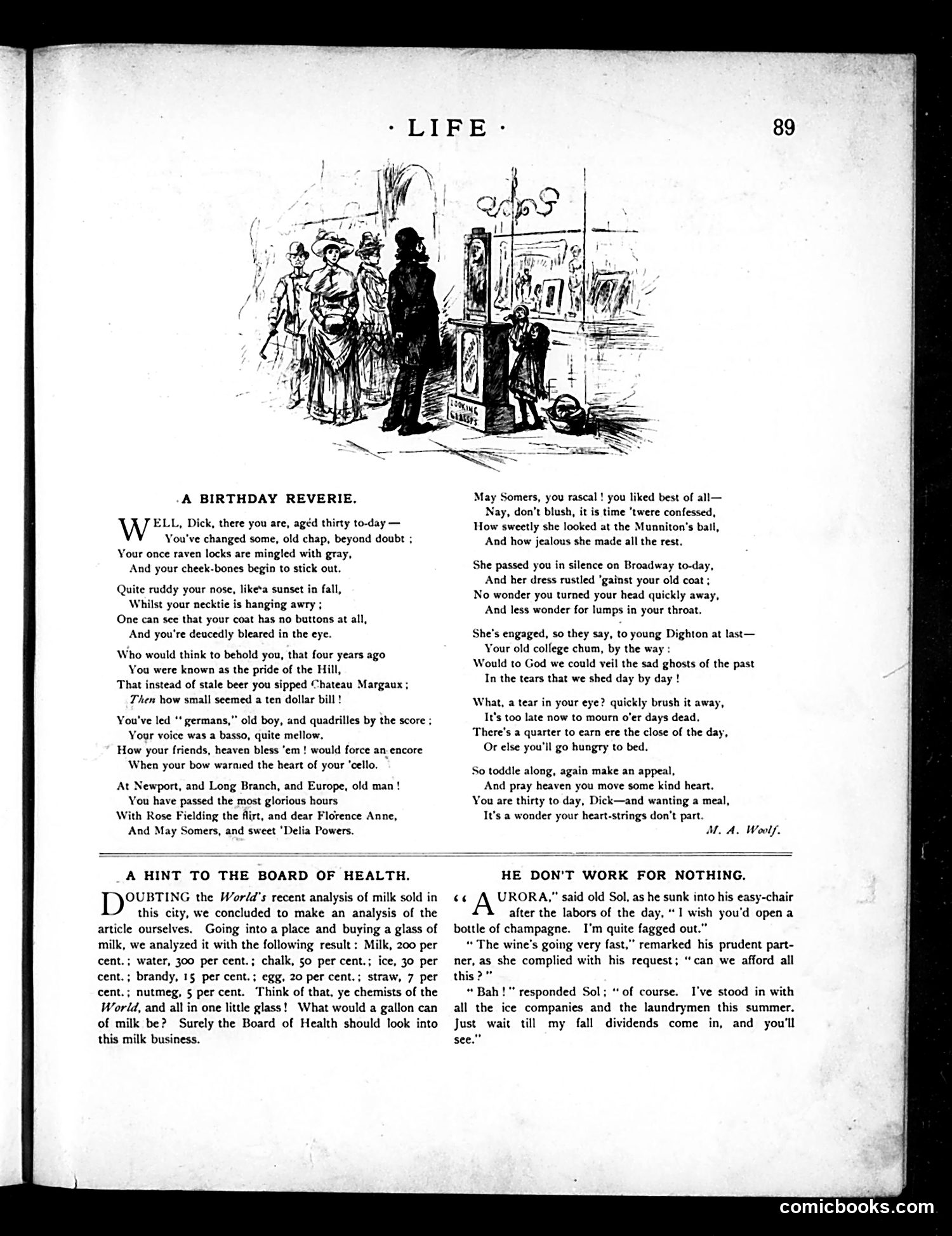
The page contains three distinct pieces: 1. **"A Birthday Reverie"** (poem by M.A. Woolf): A satirical birthday greeting to someone named Dick, turning 30. The poem mocks his aging and past romantic conquests, referencing specific locations (Newport, Long Branch, Europe) and women (Flo, Florence Anne, May Somers, Della Powers). It's gentle mockery of a man's dissolute youth catching up with him. 2. **"A Hint to the Board of Health"**: Exposes adulterated milk sold in cities. The analysis reveals milk composition includes water (30%), chalk (50%), and various other cheap additives—satirizing public health negligence and commercial fraud. 3. **"He Don't Work for Nothing"**: A comic dialogue between Sol and his partner about living off investment dividends rather than labor, satirizing leisured wealth and idleness. The illustration depicts a street scene, likely related to the milk adulteration piece.
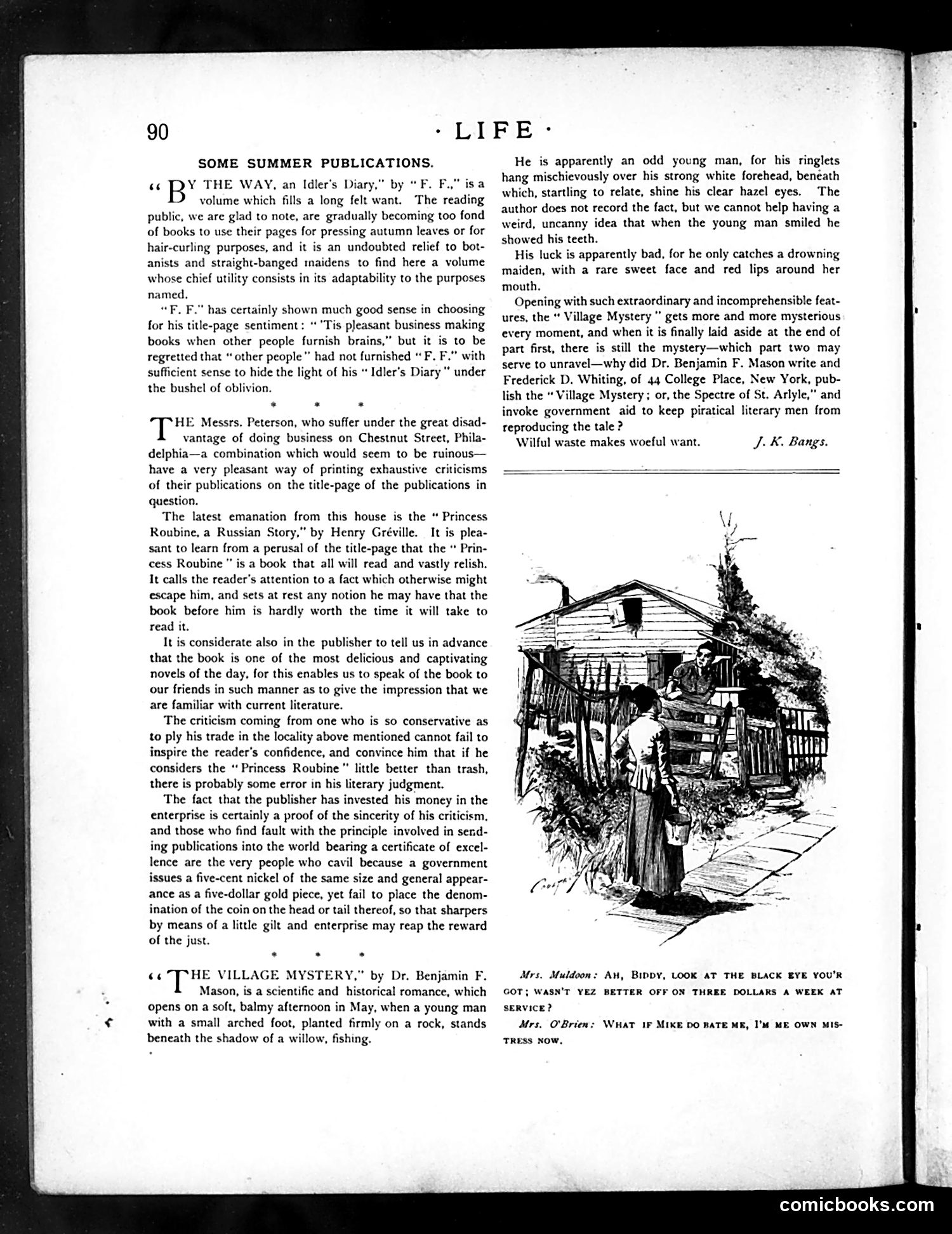
This page contains book reviews rather than political cartoons. The main illustration is a simple sketch of a dilapidated wooden house or cabin with overgrown vegetation—likely accompanying a review of "The Village Mystery" by Dr. Benjamin F. Mason, described as "a scientific and historical romance" opening with a young man fishing beneath a willow tree. The reviews discuss three publications: "By the Way, an Idler's Diary," "Princess Roubine: a Russian Story" by Henry Gréville, and "The Village Mystery." The accompanying dialogue (bottom right) appears to be satirical domestic humor between Mrs. Maldon and Mrs. O'Brien, discussing financial hardship and a character named Mike—typical of period light social satire.
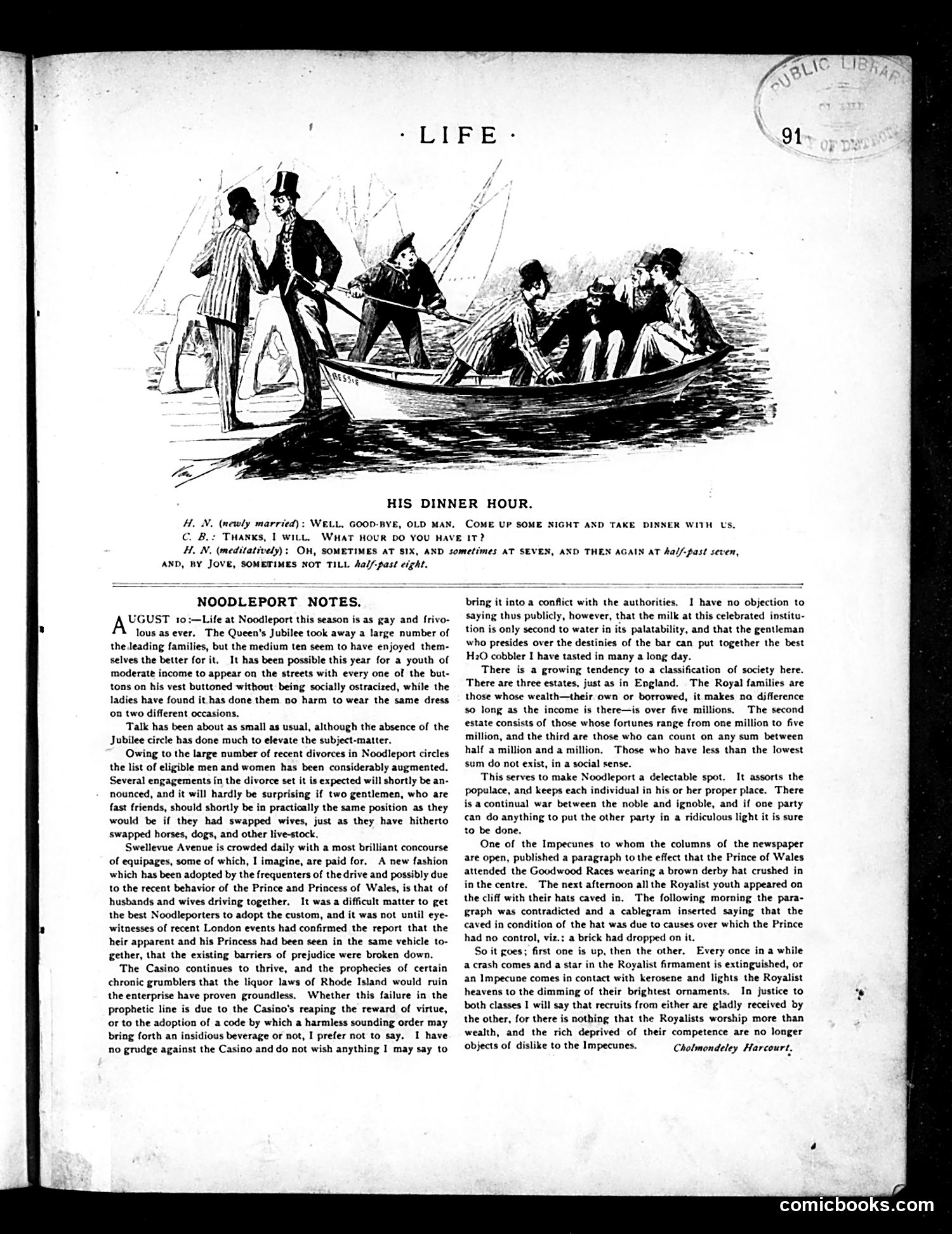
This cartoon satirizes wealthy British social customs, specifically the rigid dinner schedules of the upper classes. The caption presents a dialogue where a newly married man invites an acquaintance to dinner, but the response reveals the absurdity of aristocratic dining times: dinner occurs at various hours—sometimes 6 or 7 p.m., or even "half-past seven," and sometimes "not till half-past eight." The joke targets the pretentiousness of the British elite, who maintain such strict, inflexible dinner protocols that even inviting someone becomes complicated by scheduling conventions. The boat scene suggests leisure-class activities, emphasizing that these concerns occupy the wealthy's daily lives. The satire mocks both the formality and the apparent randomness of upper-class dining customs.
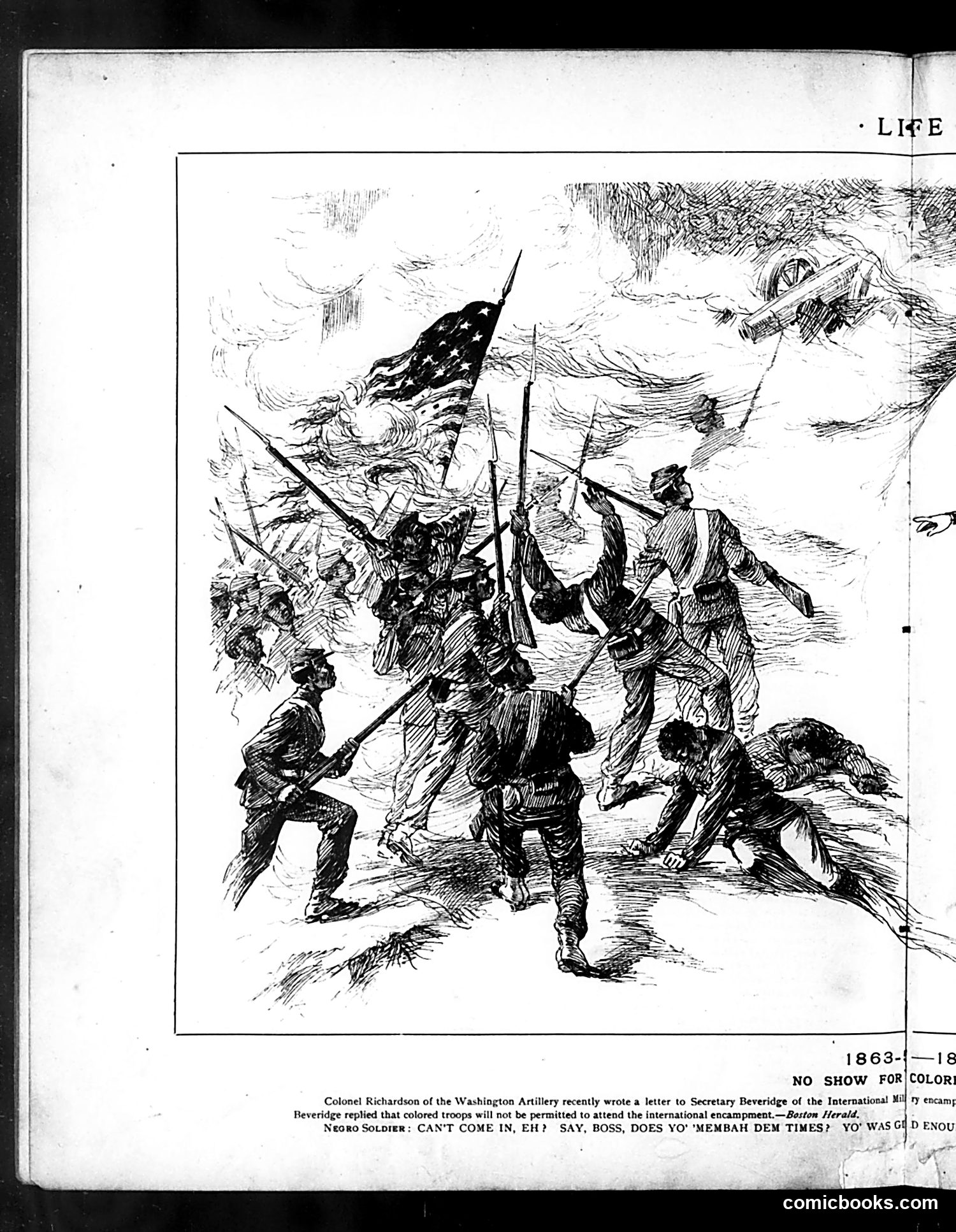
This is a Civil War-era satirical cartoon from *Life* magazine (circa 1863). The image depicts Union soldiers with an American flag, apparently encountering or confronting Black soldiers or freedmen. The caption references Colonel Richardson of the Washington Artillery writing to Secretary Beveridge about colored troops being permitted at an international encampment. The dialogue at bottom—"NEGRO SOLDIER: 'CAN'T COME IN, EH?' SAY, BOSS, DOES YO' 'MEMBAH DEM TIMES?' YO' WAS GIT ENOU[GH]"—appears to satirize the exclusion of Black soldiers from integrated military spaces, while suggesting ironic role reversal or commentary on racial discrimination within the Union Army. The cartoon seems to critique racial prejudice within the military during the Civil War period, when the participation and recognition of Black soldiers remained controversial.
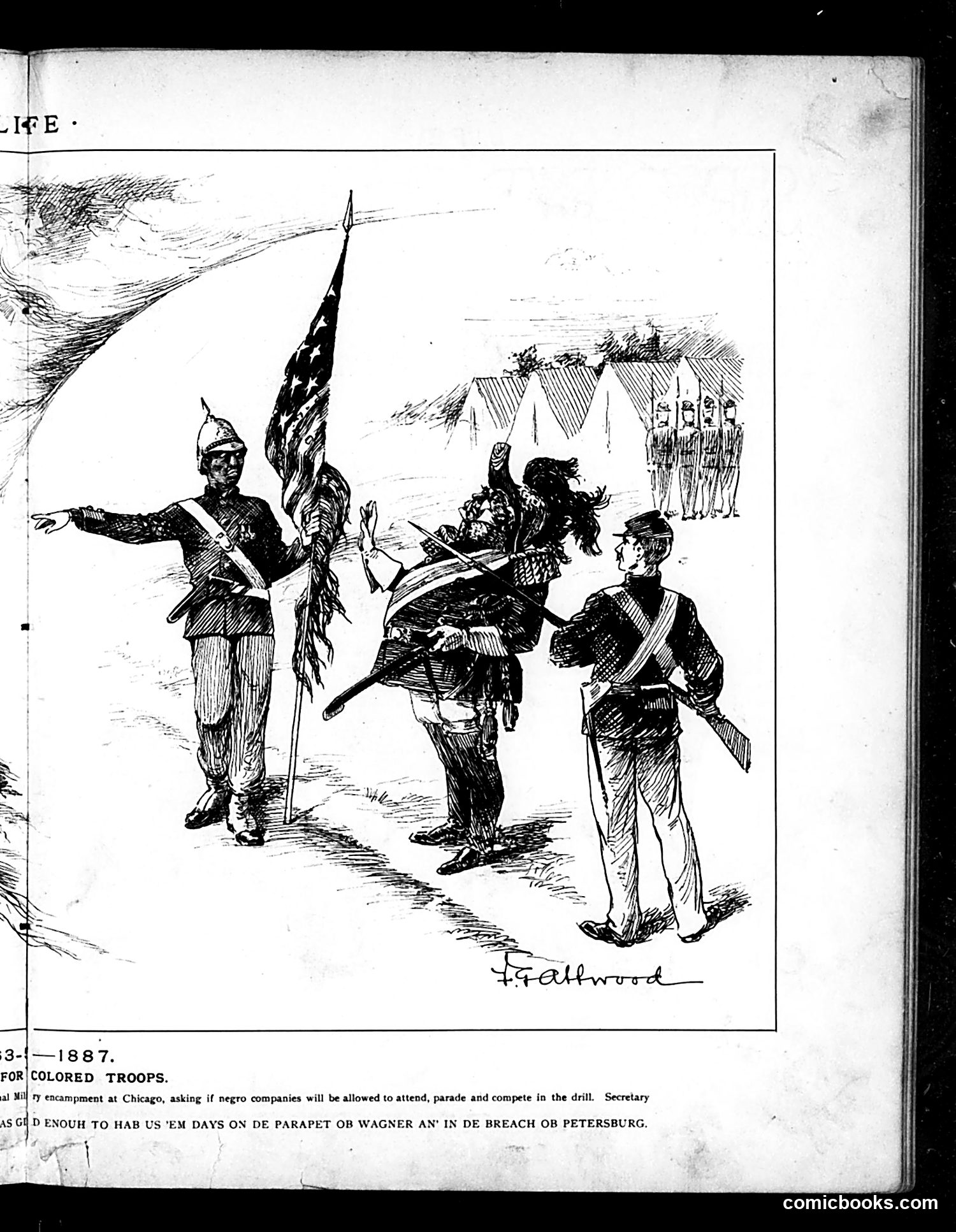
This cartoon satirizes military discrimination against African American soldiers. The image shows a uniformed officer holding an American flag, gesturing toward what appears to be Black soldiers or recruits, while other uniformed figures stand nearby. The accompanying text references an 1887 military encampment in Chicago and questions whether "negro companies will be allowed to attend, parade and compete in the drill." The bottom text fragment mentions "DAYS ON DE PARAPET OR WAGNER AN' IN DE BREACH OF PETERSBURG"—likely referencing Civil War battles where Black soldiers fought. The satire critiques the military's reluctance to grant Black troops equal participation and recognition despite their service record, highlighting the racial segregation and discrimination embedded in post-Civil War American institutions.
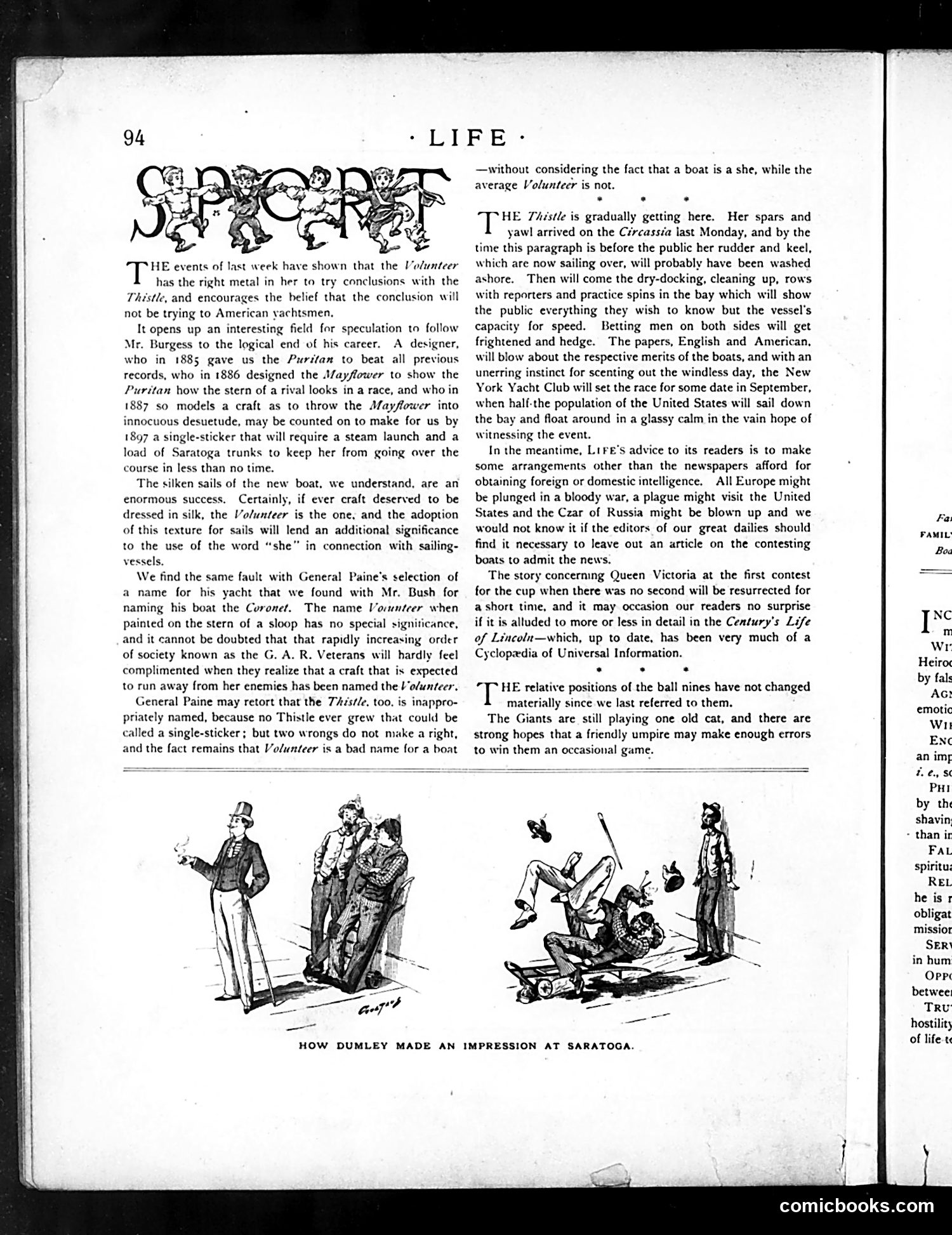
This cartoon satirizes someone named Dumley at Saratoga (the famous New York racetrack and resort). The left panel shows well-dressed gentlemen observing; the right panel depicts Dumley having apparently fallen or been thrown from a horse, landing awkwardly on the ground with his belongings scattered. The joke is a social satire: Dumley attempted to make a fashionable "impression" at the prestigious Saratoga resort but instead created a comical spectacle through his mishap. The contrast between his presumed social aspirations and his undignified tumble mocks pretentious behavior. The cartoon plays on the gap between intention and embarrassing reality—a common theme in Life magazine's satirical humor about upper-class society.
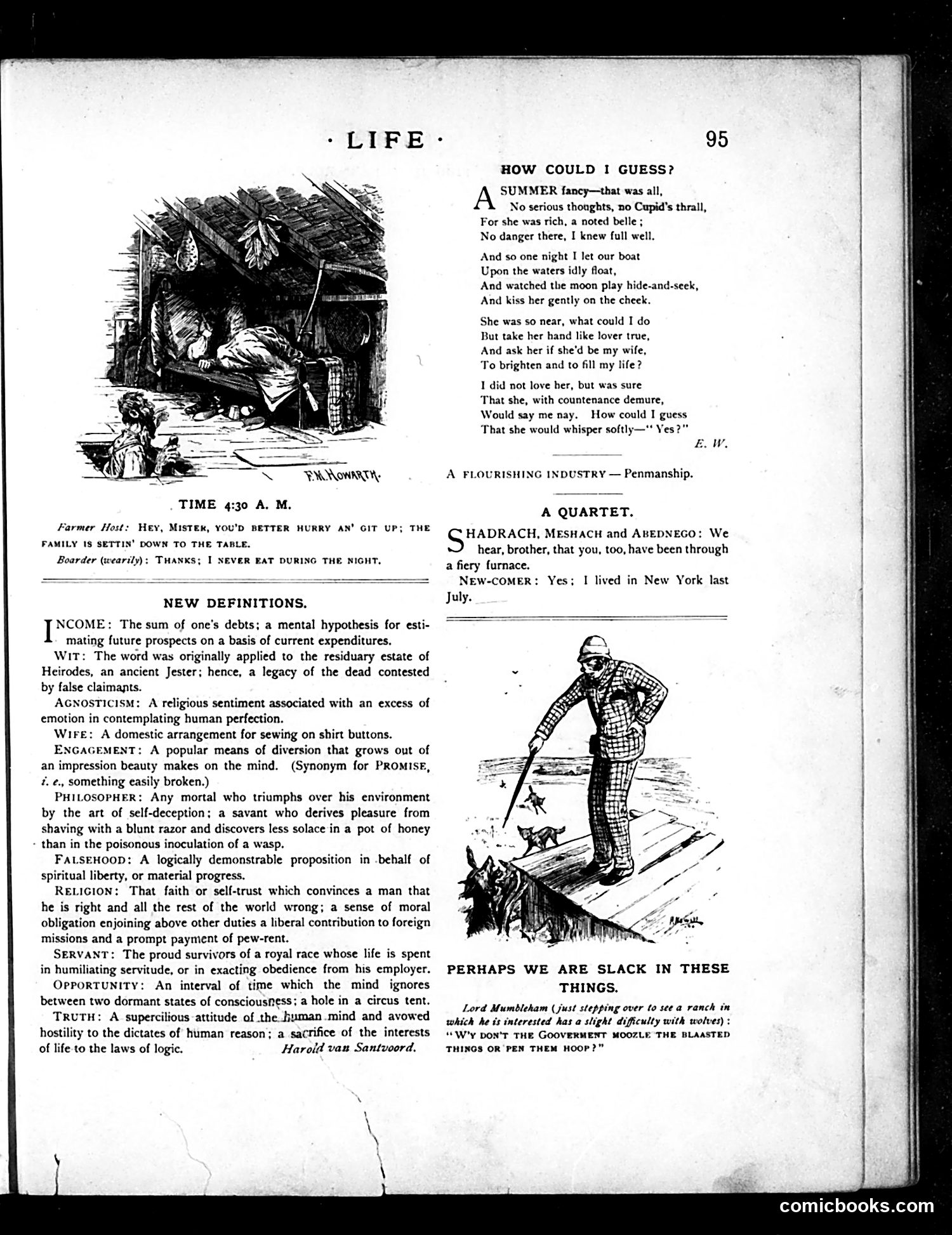
This page from *Life* magazine contains several discrete humorous pieces mocking Victorian-era conventions and American society: **The cartoon "Perhaps We Are Slack in These Things"** depicts an English aristocrat ("Lord Mumbieham") complaining about wolves on his ranch, suggesting the government should "muzzle" or pen them. The satire targets European nobility's entitlement and cluelessness about practical frontier problems—he expects government intervention for minor inconveniences rather than accepting natural hazards. **"New Definitions"** is a satirical lexicon redefining common terms with cynical inversions—for example, defining "engagement" as "something easily broken" and "religion" as self-righteousness tied to financial obligation ("pew-rent"). This mocks hypocrisy in social institutions. **The poetry and other sketches** (the farmer/boarder dialogue, romantic verses) use gentle irony about courtship, class differences, and rural life. The overall tone is *Life*'s characteristic late-19th/early-20th-century satirical style: urbane mockery of pretension, social convention, and human folly across class lines.
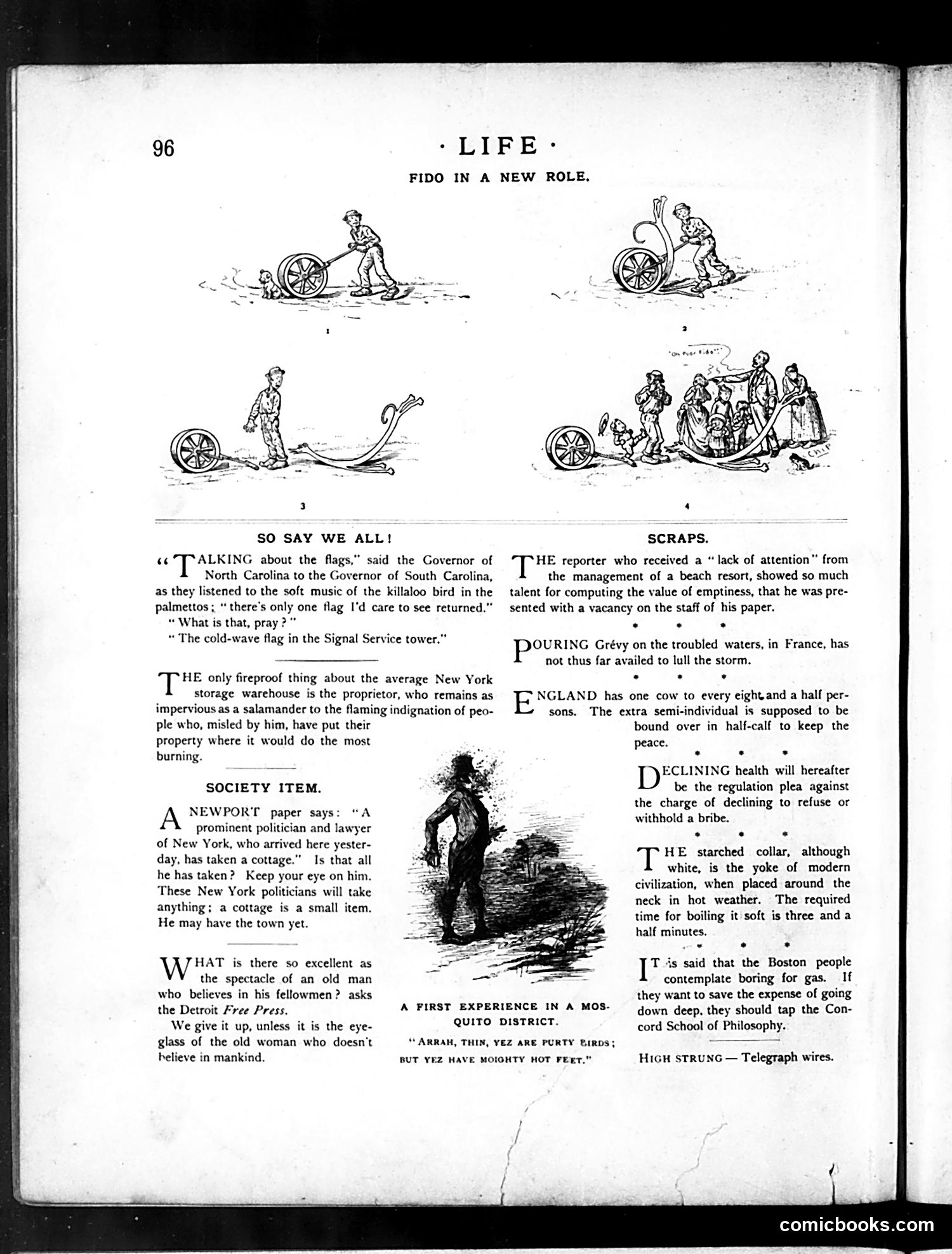
This page contains four sequential cartoon panels depicting a dog (Fido) pulling a wheeled cart that progressively fills with human passengers and cargo—satirizing how people exploit animals for labor while expanding demands. The surrounding text comprises unrelated short satirical items mocking contemporary institutions and behaviors: - **Political governors** joking about weather flags instead of substantive issues - **New York warehouse owners** who remain indifferent to fires destroying customers' property - **Newport society** suspecting a politician-lawyer of petty theft ("Keep your eye on him") - **French politics**: a reference to President Grévy attempting to calm domestic turmoil - **England's cattle-to-population ratio**, with a pun about "half-calf" bindings - **Boston intellectuals** (the Concord School of Philosophy) portrayed as pretentious and useless The overall tone is cynical, mocking human hypocrisy, corruption, and absurdity across politics, society, and institutions. The humor relies on wordplay, exaggeration, and assumed reader familiarity with contemporary scandals and figures.
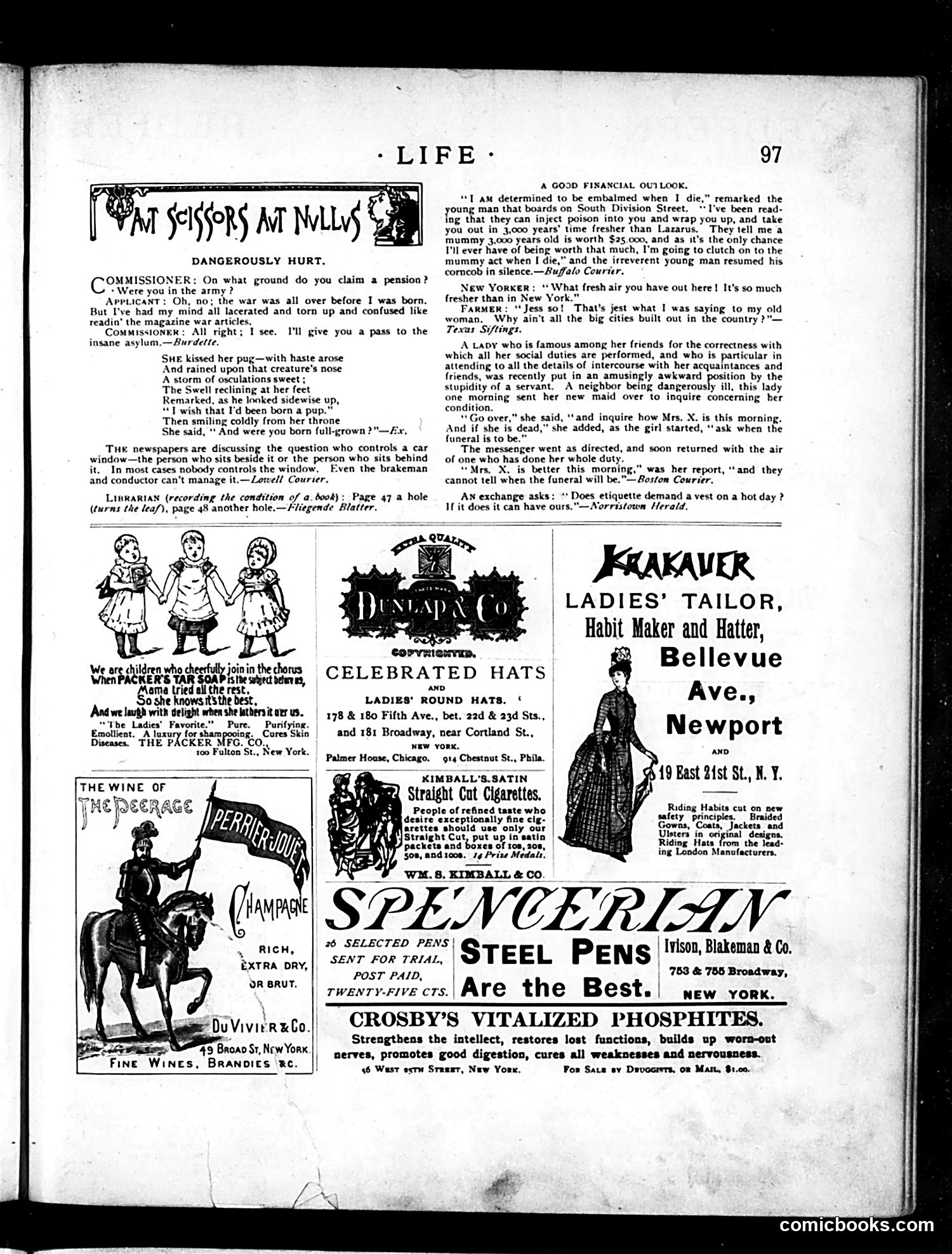
This page from Life magazine (undated but likely late 19th century based on advertising styles) contains several short satirical pieces typical of the publication's humor: The main cartoon, "Scissors at Nullus" (top), depicts a pension applicant claiming mental distress from reading war articles in magazines—satire on people seeking pensions for dubious reasons, and on sensationalized war reporting. Other brief jokes mock contemporary absurdities: a young man planning to be embalmed as a financial investment; confusion about fresh air and rural living; a servant misunderstanding instructions about a sick neighbor; newspaper debates over who controls train windows. The page is primarily **advertisements** for ladies' fashion, wine, steel pens, and patent medicines—typical late-Victorian commercial content. The satirical pieces are brief filler between ads, characteristic of Life's format as a humor magazine subsidized by advertising.
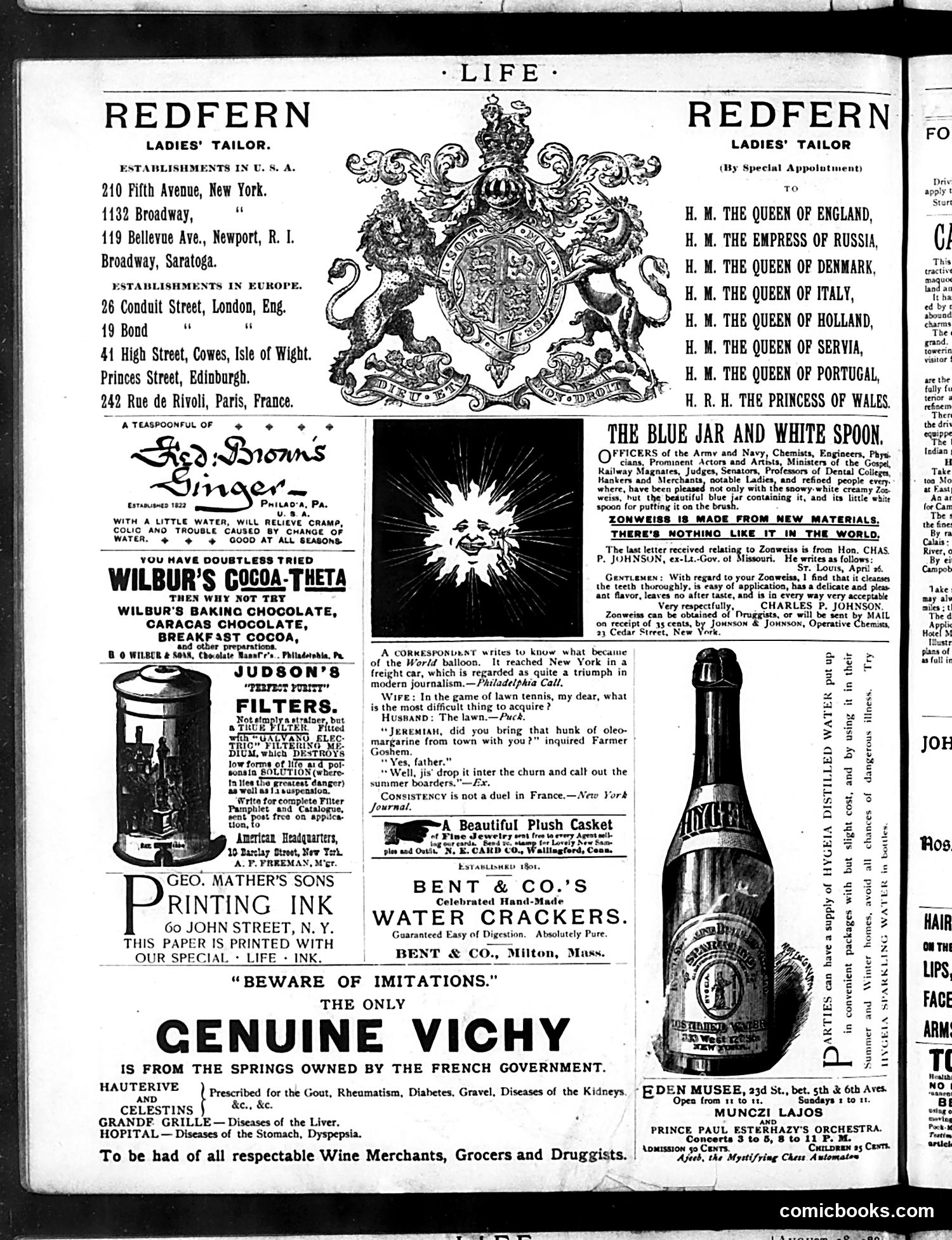
This page is primarily **advertising**, not political satire or editorial cartooning. The central image—a royal coat of arms—supports Redfern's (a ladies' tailor) listing of royal and aristocratic clients: queens of England, Russia, Denmark, Italy, Holland, Serbia, and Portugal, plus the Princess of Wales. This was a prestige marketing tactic, using royal patronage to advertise tailoring services. The remainder consists of commercial advertisements for patent medicines (Zonaweiss tooth powder, Vichy water), food products (Wilbur's cocoa, Bent & Co.'s crackers), and services (printing ink, plush caskets). Brief humorous items appear—jokes about lawn tennis, farm life, and balloon travel—but these are filler content, not political commentary. No specific cartoons or satire requiring historical context appear on this page.
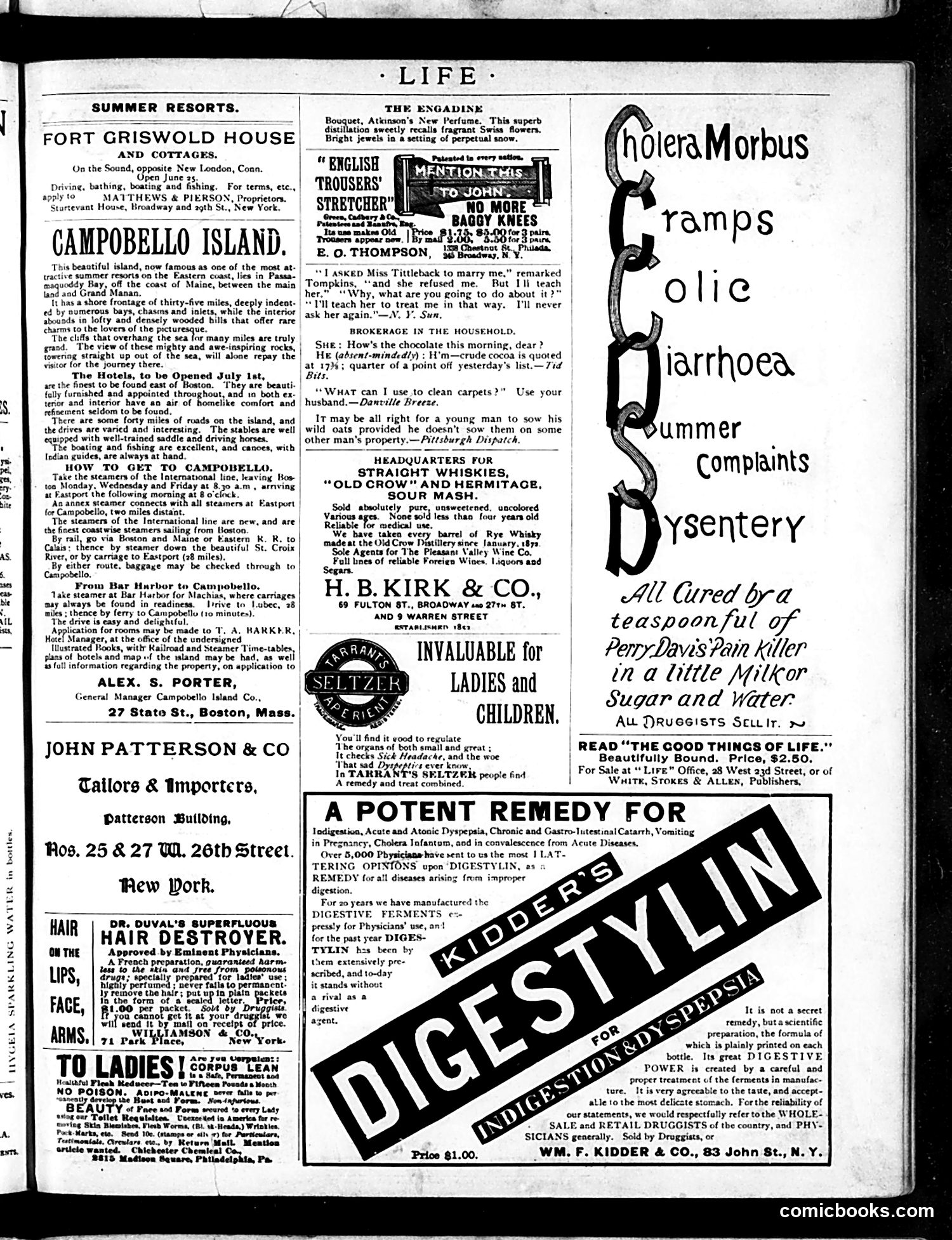
This page is **primarily advertising**, not political satire or editorial cartoons. It features: **Summer resort advertisements** (Fort Griswold House, Campobello Island) typical of leisure publications targeting wealthy readers. **The only visual element** is a decorative illustration on the right side—a skeletal figure labeled "Cholera Morbus" with a chain of complaints (cramps, colic, diarrhea, dysentery, summer complaints) depicted as linked afflictions. This accompanies an advertisement for **Perry Davis' Pain Killer**, a patent medicine marketed as a cure-all. **The satirical implication**: The skeleton imagery and chain of symptoms create dark humor about illness, playing on Victorian-era anxieties about disease (cholera was still feared). The ad exploits these fears to sell the product as a miraculous remedy—typical of 19th-century medical advertising's exaggerated claims. The page also contains ads for hair removal, weight reduction, and other personal care products, reflecting period beauty standards.
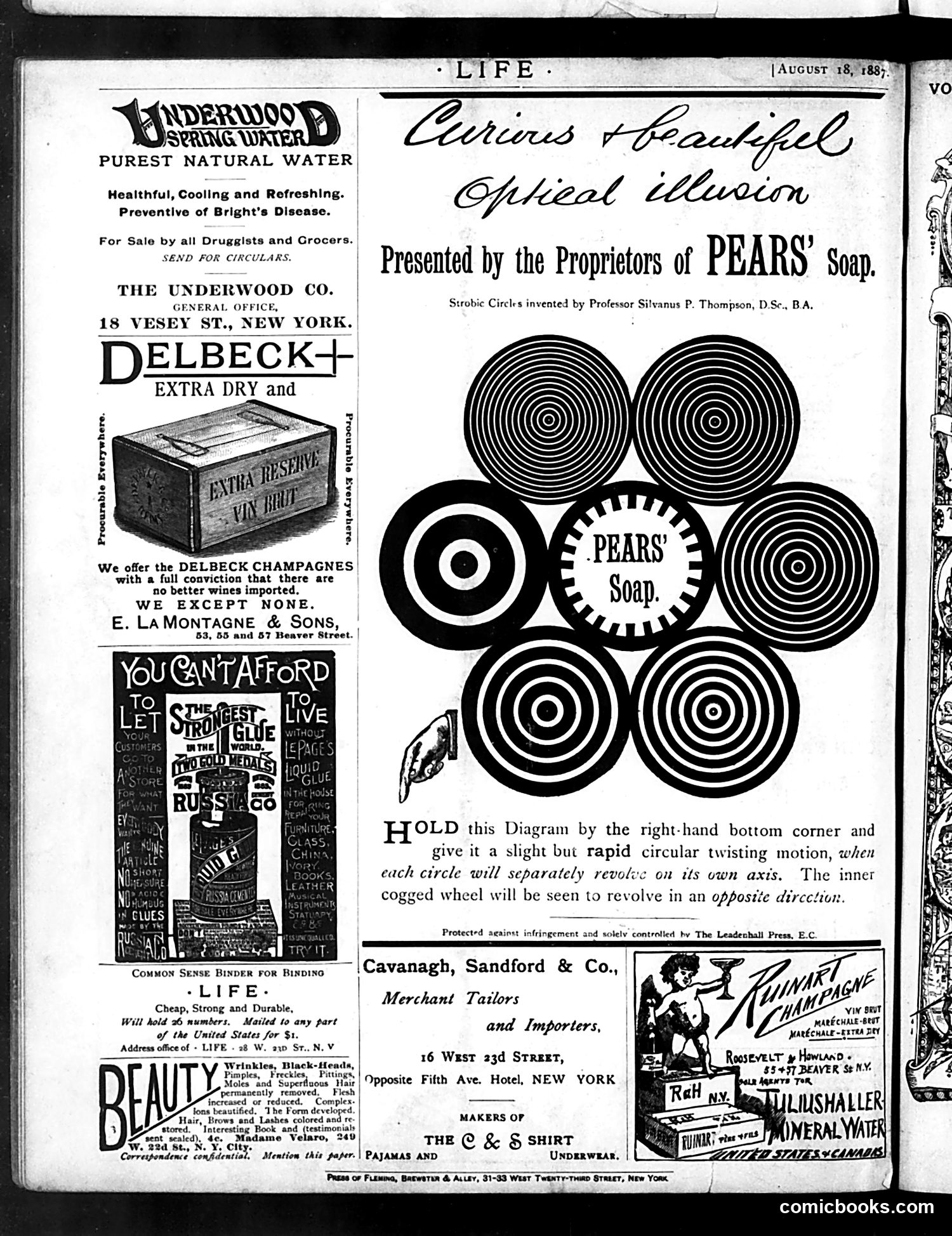
This page is primarily **advertising**, not political satire. The main content is a visual illusion presented by Pears' Soap featuring concentric circles arranged in a flower pattern around a central "PEARS' Soap" label. The illusion, credited to Professor Silvanus P. Thompson, is a **strobic circle** (optical illusion). Readers are instructed to hold the diagram by the bottom corner and twist it slightly; the circles will appear to rotate independently, with the inner "cogged wheel" appearing to turn opposite to the outer circles. This was a popular Victorian-era novelty—using optical illusions for product advertising. The joke/appeal isn't satirical but rather **interactive entertainment** meant to engage readers and make the Pears' Soap advertisement memorable. The surrounding ads promote champagne, spring water, binding services, and beauty treatments—typical late-19th-century Life magazine content mixing satire with commercial pitches.