
Life, 1887-08-18 · page 2 of 16
Life — August 18, 1887 — page 2: what you’re looking at
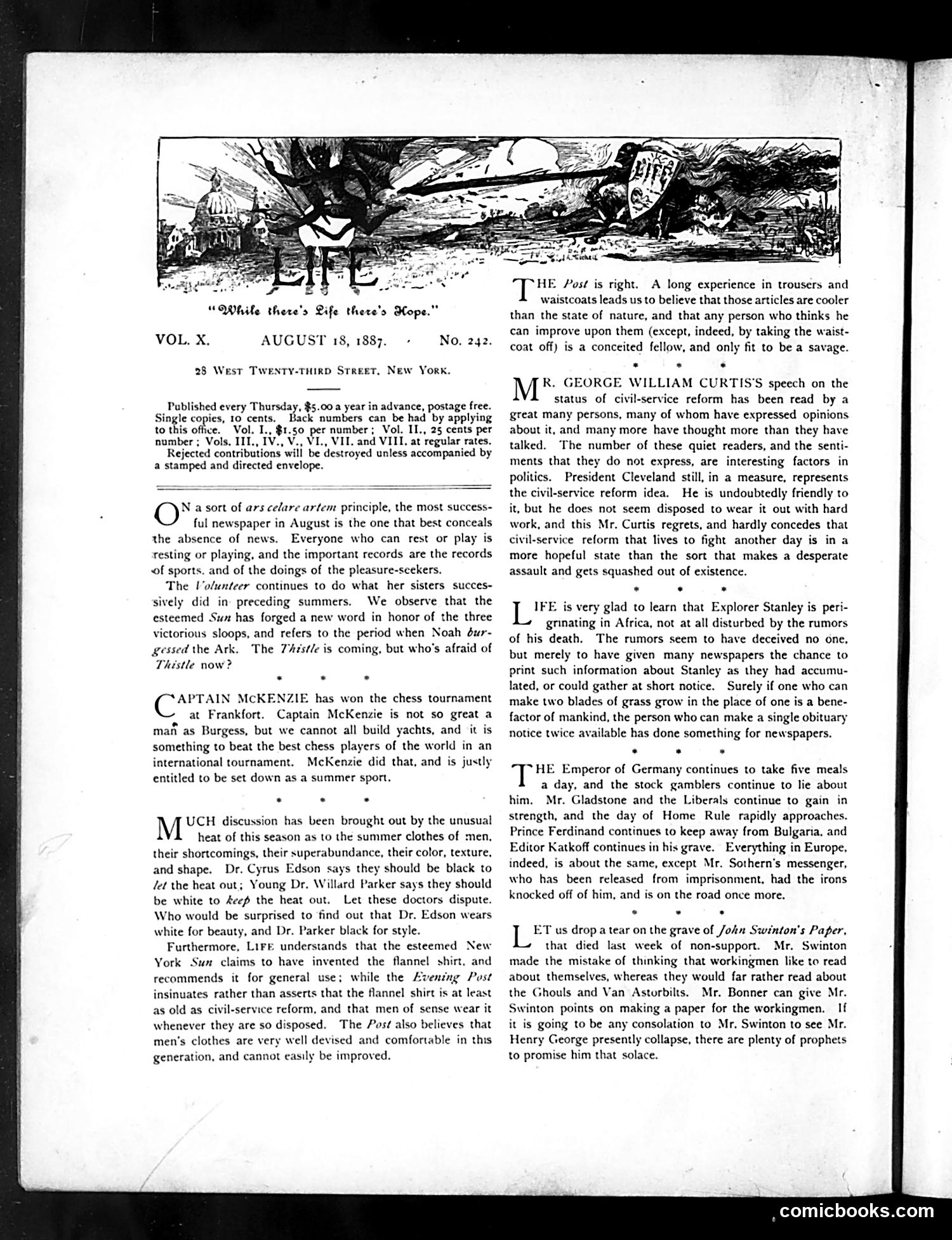
What you’re looking at
The cartoon at top depicts a figure beneath a dead tree with the caption "While there's Life there's Hope." This appears to be a visual pun on the magazine's title—a satirical commentary on the magazine's own resilience or optimistic outlook despite difficult circumstances. The right column discusses George William Curtis's speech on civil-service reform, noting that President Cleveland supports the idea but lacks enthusiasm for hard work on the issue. The text mocks how reform efforts keep "fighting another day" without real progress. Other brief items mock various public figures including the German Emperor's eating habits, references to explorer Stanley, and commentary on newspaper coverage. The overall tone is characteristically cynical political satire typical of 1880s American humor magazines.
📄 Transcribed text from this page (OCR, searchable)
Machine-transcribed from the original scan — historical spelling and the odd misread are preserved.
“OWMhile there's Life there's Hope.” VOL. X. AUGU 18, 1887. No. 242. 28 West TWENTY-THIRD Street, New York. Published every Thursday, $5.00 a year in advance, postage free. Single copies, 10 cents. Back numbers can be had by applying to this office. Vol. I., $1.50 per number; Vol. II., 25 cents per number ; Vols, IIT, IV., V., VI., VII. and VIII, at regular rates. Rejected contributions will be destroyed unless accompanied by a stamped and directed envelope. O* a sort of ars celare artem principle, the most success- ful newspaper in August is the one that best conceals the absence of news. Everyone who can rest or play is resting or playing, and the important records are the records of sports. and of the doings of the pleasure-scekers. The Volunteer continues to do what her sisters succes- sively did in: preceding summers. We observe that the esteemed Sux has forged a new word in honor of the three victorious sloops, and refers to the period when Noah dur- gessed the Ark. The 7Azst/e is coming, but who's afraid of Thistle now? . . * APTAIN McK IE has won the chess tournament at Frankfort. Captain McKenzie is not so great a man as Burgess, but we cannot all build yachts, and it is something to beat the best chess players of the world in an international tournament. McKenzie did that, and is justly entitled to be set down as a summer sport. . . . UCH discussion has Leen brought out by the unusual heat of this season as to the summer clothes of men, their shortcomings, their superabundance, their color, texture, and shape. Dr. Cyrus Edson says they should be black to et the heat out; Young Dr. Willard Parker says they should be white to Aeep the heat out. Let these doctors dispute. Who would be surprised to find out that Dr. Edson wears white for beauty, and Dr. Parker black for style. Furthermore, Lire understands that the esteemed New York Sux claims to have invented the flannel shirt, and recommends it for general use; while the Evening Post insinuates rather than asserts that the flannel shirt is at least as old as civil-service reform, and that men of sense wear it whenever they are so disposed. The Post also believes that men’s clothes are very well devised and comfortable in this generation, and cannot easily be improved. HE Post is right. A long experience in trousers and waistcoats leads us to believe that those articles are cooler than the state of nature, and that any person who thinks he can improve upon them (except, indeed, by taking the waist- coat off) is a conceited fellow, and only fit to be a savage. R. GEORGE WILLIAM CURTIS'S speech on the status of civil-service reform has been read by a great many persons, many of whom have expressed opinions about it, and many more have thought more than they have talked. The number of these quiet readers, and the senti- ments that they do not express, are interesting factors in politics. President Cleveland still, in a measure, represents the civil-service reform idea. He is undoubtedly friendly to it, but he does not seem disposed to wear it out with hard work, and this Mr. Curtis regrets, and hardly concedes that civil-service reform that lives to fight another day is in a more hopeful state than the sort that makes a desperate assault and gets squashed out of existence. IFE is very glad to learn that Explorer Stanley is peri- grinating in Africa, not at all disturbed by the rumors of his death. The rumors seem to have deceived no one, but merely to have given many newspapers the chance to print such information about Stanley as they had accumu- lated, or could gather at short notice. Surely if one who can make two blades of grass grow in the place of one is a bene- factor of mankind, the person who can make a single obituary notice twice available has done something for newspapers. . . . T HE Emperor of Germany continues to take five meals a day, and the stock gamblers continue to lie about him. Mr. Gladstone and the Liberals continue to gain in strength, and the day of Home Rule rapidly approaches. Prince Ferdinand continues to keep away from Bulgaria, and Editor Katkoff continues in his grave. Everything in Europe, indeed, is about the same, except Mr. Sothern’s messenger, who has been released from imprisonment, had the irons knocked off of him, and is on the road once more, Te r us drop a tear on the grave of John Swinton's Paper, that died last week of non-support. Mr. Swinton made the mistake of thinking that workingmen like to read about themselves, whereas they would far rather read about the Ghouls and Van Astorbilts. Mr. Bonner can give Mr. Swinton points on making a paper for the workingmen. If it is going to be any consolation to Mr. Swinton to see Mr. Henry George presently collapse, there are plenty of prophets to promise him that solace. , comicbooks.com