
A complete issue · 16 pages · 1887
Life — August 11, 1887
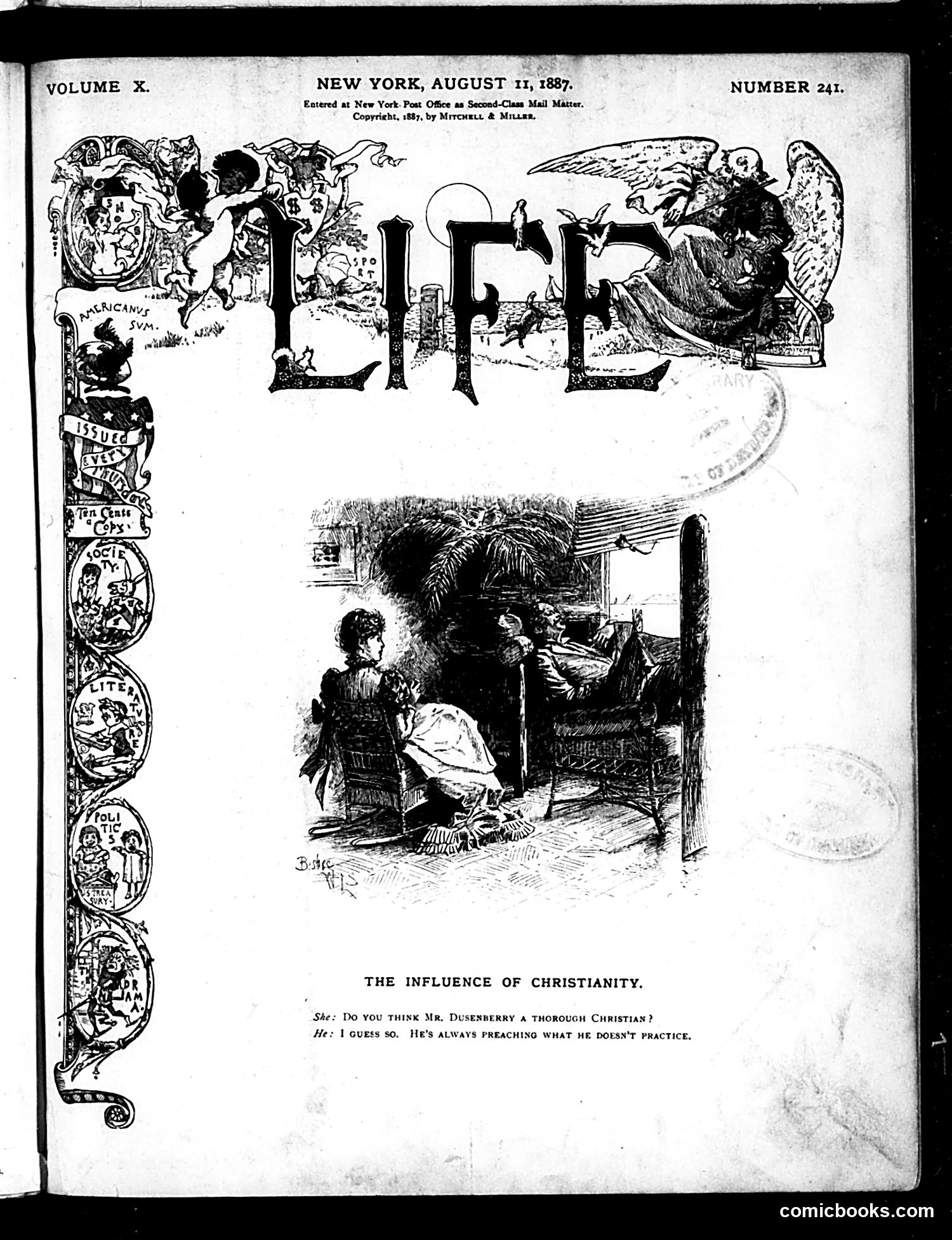
This page features a satirical cartoon titled "The Influence of Christianity," depicting what appears to be a domestic scene where a woman questions a man (possibly named Dusenberry based on the dialogue) about his Christian faith. The joke's premise is a classic hypocrisy critique: the woman asks if Dusenberry is "a thorough Christian," and the man replies "I guess so. He's always preaching what he doesn't practice." The satire targets religious hypocrisy—specifically men who publicly profess Christian values while privately behaving contrary to those principles. The ornate decorative border and illustrated header suggest this was a prominent feature in Life's satirical lineup during this period of American social commentary.
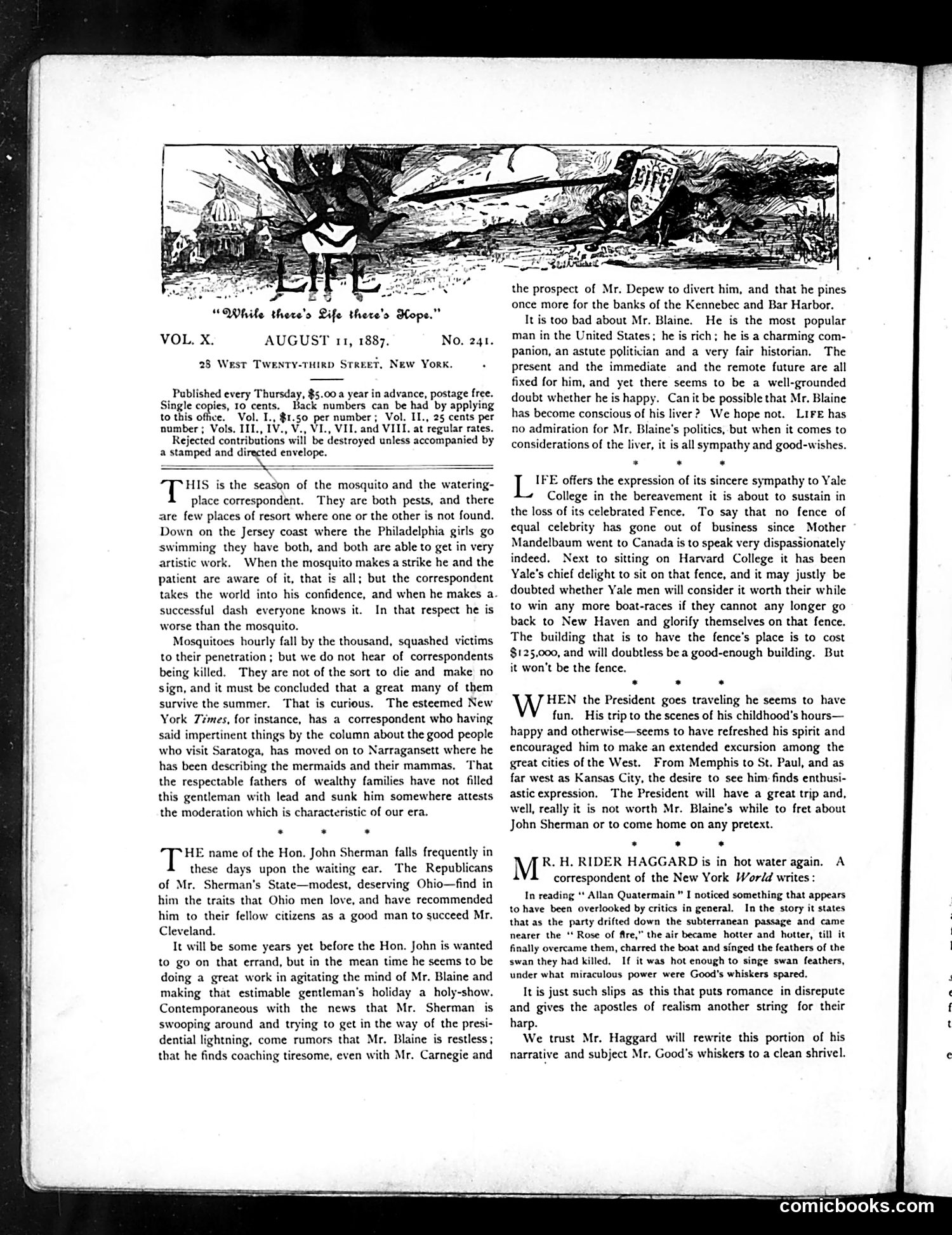
The masthead cartoon depicts a gnarled tree with the caption "While there's Life there's Hope"—a visual pun on the magazine's title. The text discusses contemporary figures and social commentary rather than displaying political cartoons. It references: - **Mr. Blaine**: Described as "the most popular man in the United States," wealthy, charming, and a politician. The writer expresses sympathy for him while questioning his happiness—a veiled critique wrapped in politeness. - **Yale College's lost Fence**: Apparently a celebrated structure whose demolition is lamented. - **President's travels**: Commentary on the president's western tour, praised as refreshing. - **Mr. Haggard's narrative**: A criticism of H. Rider Haggard's novel "Allan Quatermain," claiming it romanticizes violence unrealistically. The page is primarily satirical commentary on personalities and literature rather than visual political satire.
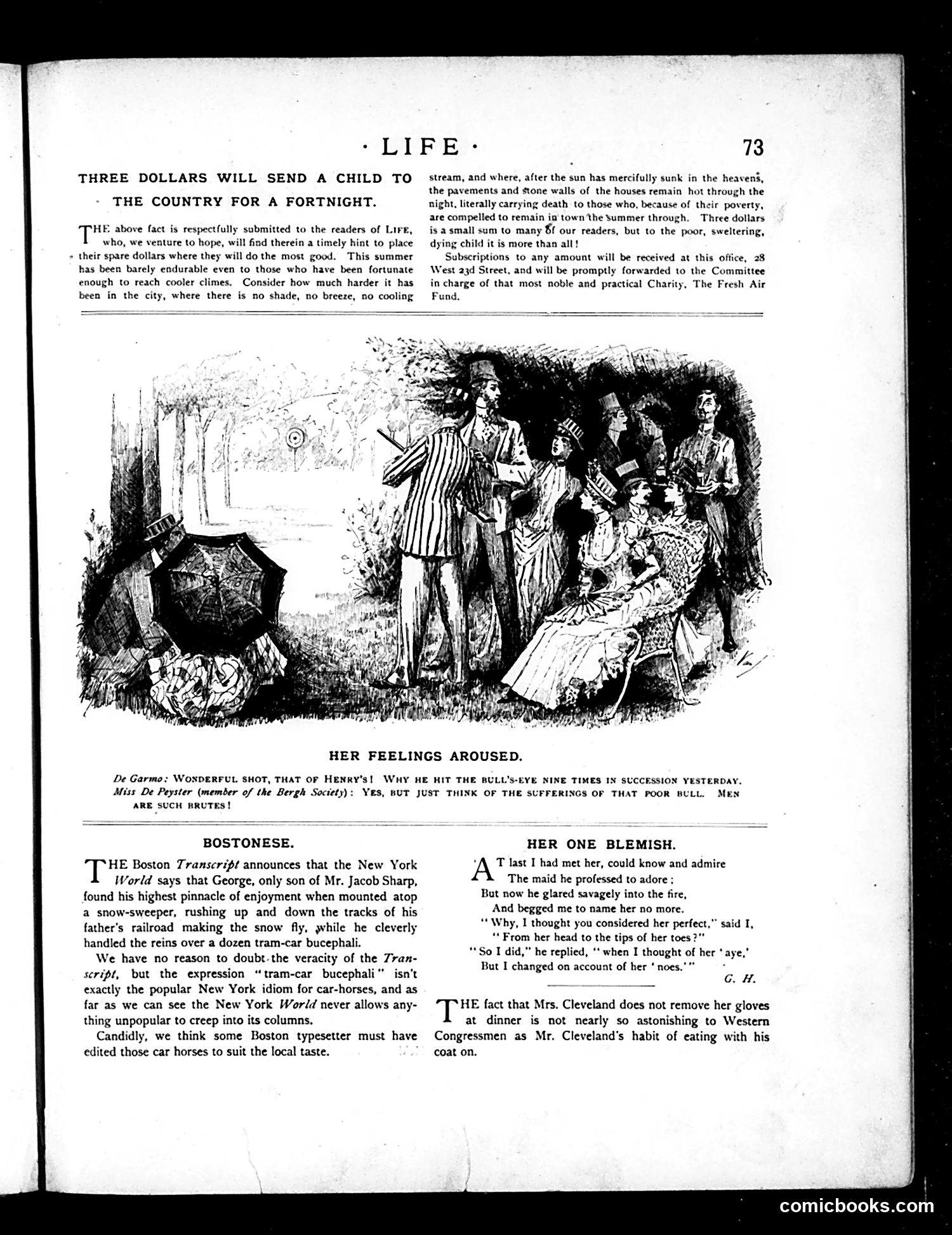
The main cartoon titled "Her Feelings Aroused" depicts a social scene where a woman (identified in the caption as Miss De Peyster of the Berg Society) expresses outrage about animal cruelty. She references Henry's shooting of a bull's eye nine times, expressing concern for "that poor bull" while men around her appear amused or indifferent. The satire targets wealthy socialites who performatively champion animal welfare causes while remaining oblivious to human suffering. The caption's emphasis on Miss De Peyster's society affiliation suggests mockery of upper-class charitable priorities—caring more about bulls than poor children, as referenced in the page's opening article about sending underprivileged children to the country. The cartoon ridicules selective moral outrage among the privileged classes.
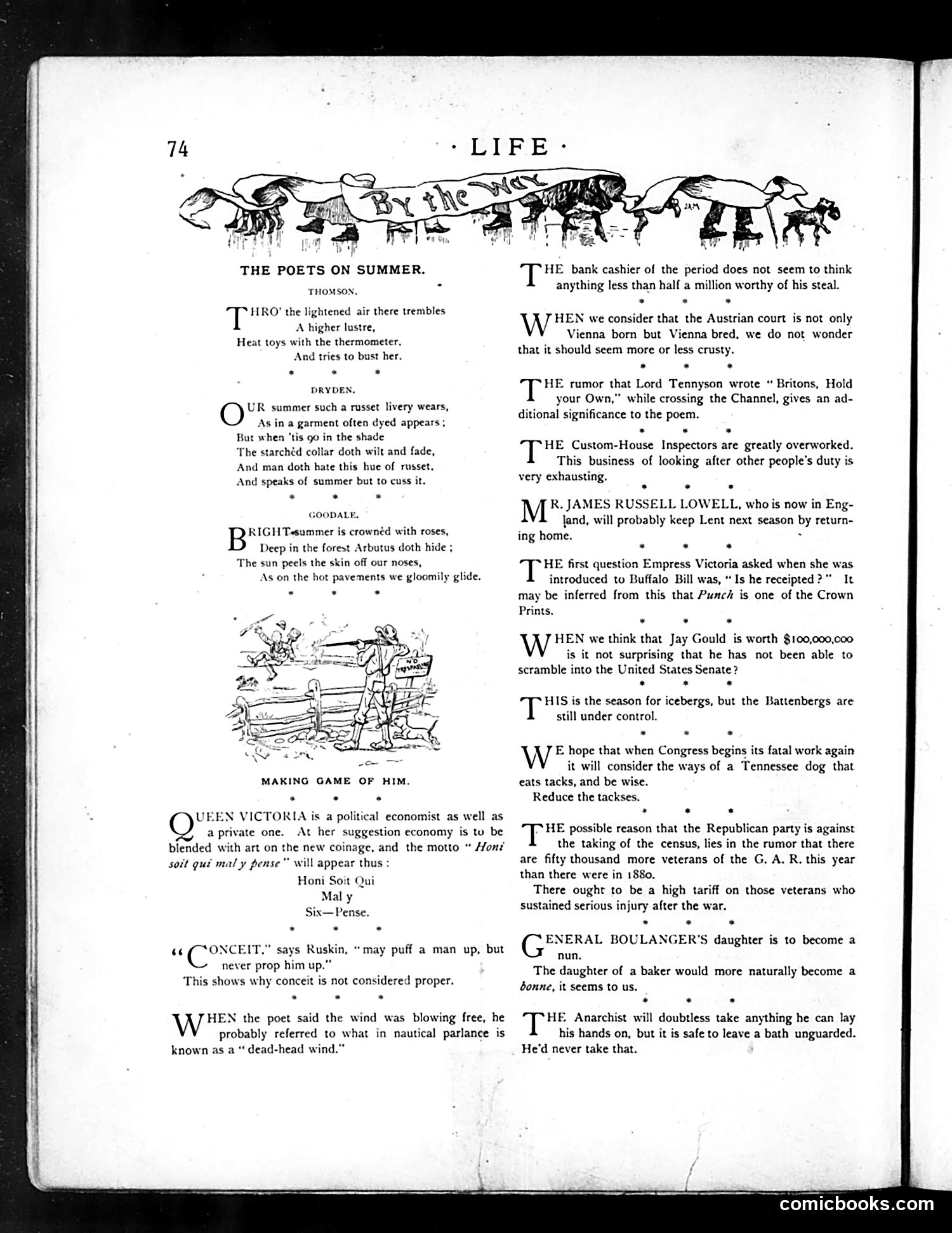
This page contains satirical commentary and poetry on summer themes rather than a single political cartoon. "The Poets on Summer" features verses by Thomson, Dryden, and Goodale celebrating the season. The small illustration labeled "Making Game of Him" shows a figure in a rural/pastoral setting, likely accompanying one of the summer poems. The right column contains brief satirical notes on contemporary issues: Austrian court scandals, Lord Tennyson's poetry, overworked Custom-House Inspectors, and commentary on Queen Victoria as a "political economist." There are also jabs at Jay Gould's wealth, Republican census policies, and General Boulanger's daughter becoming a nun. These are typical *Life* magazine items—quick political and social jokes rather than extended political cartoons, reflecting late 19th-century American satire and current events.
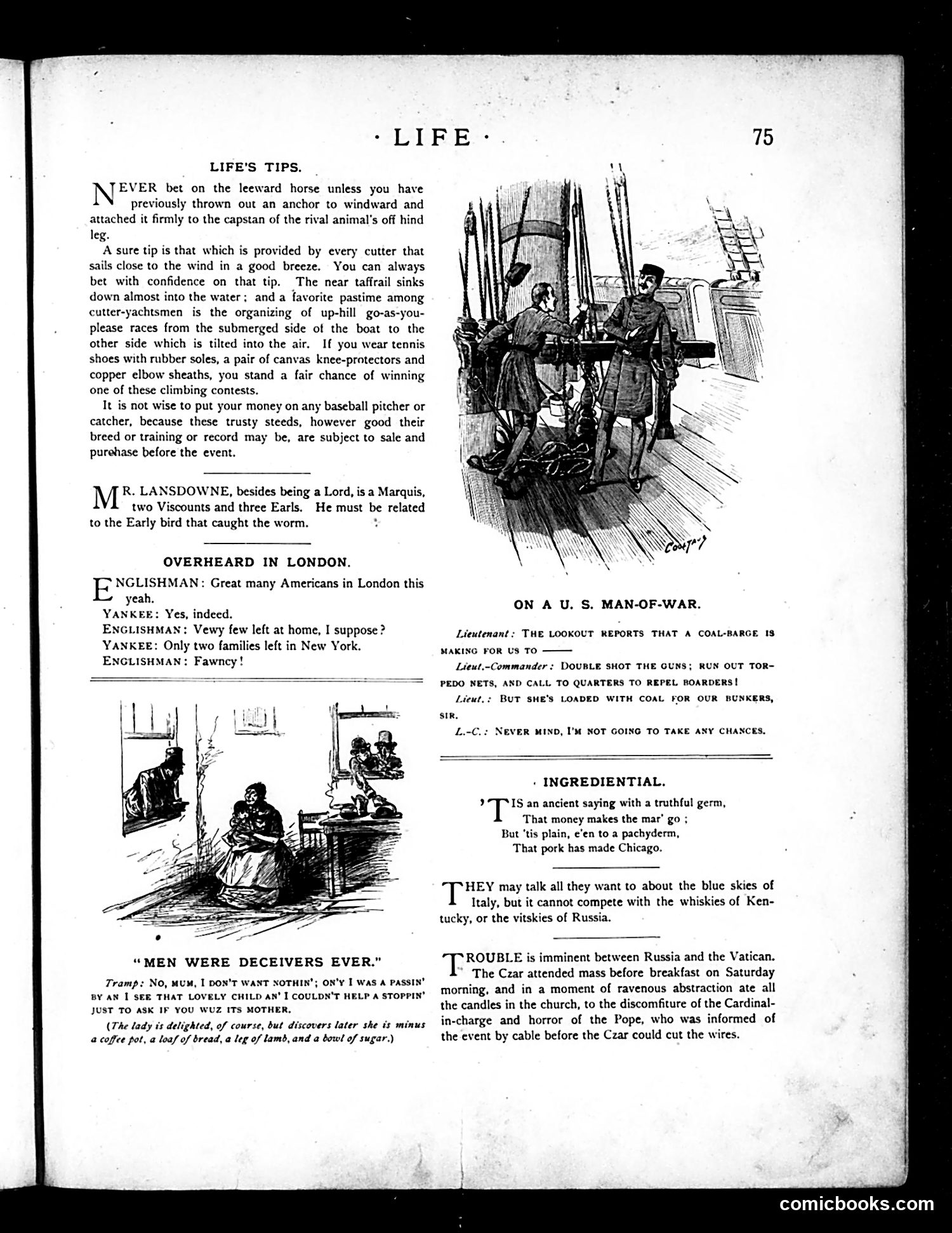
This page contains several satirical pieces typical of early 20th-century Life magazine humor: **"Life's Tips"** mocks upper-class sporting culture with absurd betting advice about horse racing and yachting competitions, poking fun at wealthy leisure activities. **"Men Were Deceivers Ever"** is a comic dialogue where a tramp manipulates a sympathetic woman by invoking motherhood sentimentality to obtain food and money—satirizing both male deception and female gullibility. **"On a U.S. Man-of-War"** depicts naval military life through dialogue about a coal barge attack, showing soldiers' pragmatic responses to danger. **"Ingrediential"** and other sections contain humorous observations about regional American products (pork from Chicago, whiskey from Kentucky), using crude ethnic stereotypes common to the era's satire. The page reflects turn-of-the-century class commentary and American regional humor typical of Life's satirical mission.
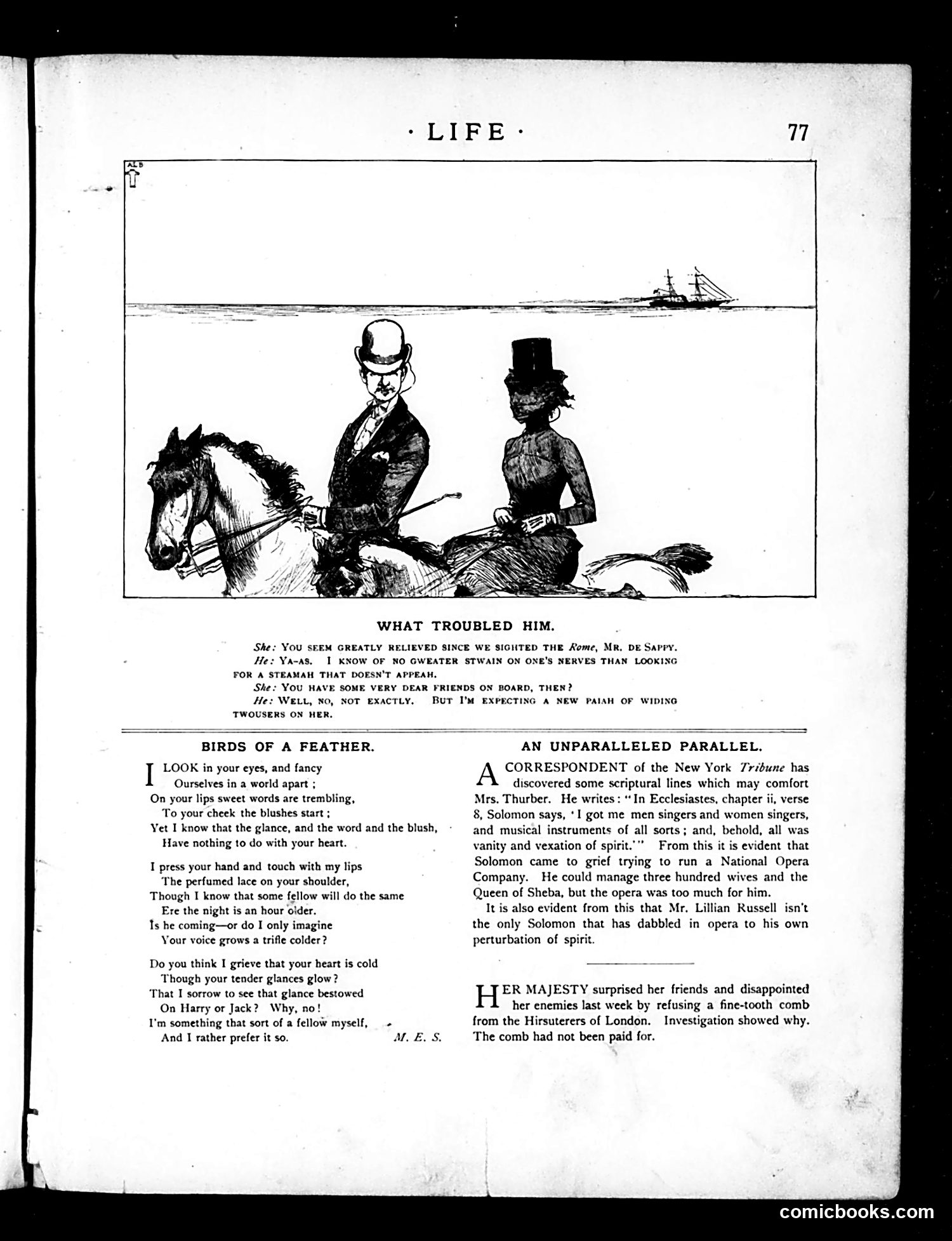
The cartoon depicts two elegantly dressed people on horseback, with a ship visible in the background. The dialogue reveals a social satire: a man expresses relief at spotting a ship (the "Rome"), while a woman notes he seems nervous about something. He admits he's expecting "a new paiah of winding trousers" to arrive on the vessel. The joke satirizes male vanity and fashion anxiety in high society. Despite his composed aristocratic appearance, the gentleman is genuinely worried about receiving new fashionable trousers—suggesting that even wealthy, well-dressed men are secretly preoccupied with trivial sartorial concerns. This mocks the pretense of masculine indifference to fashion while highlighting the era's obsession with proper dress codes among the elite.
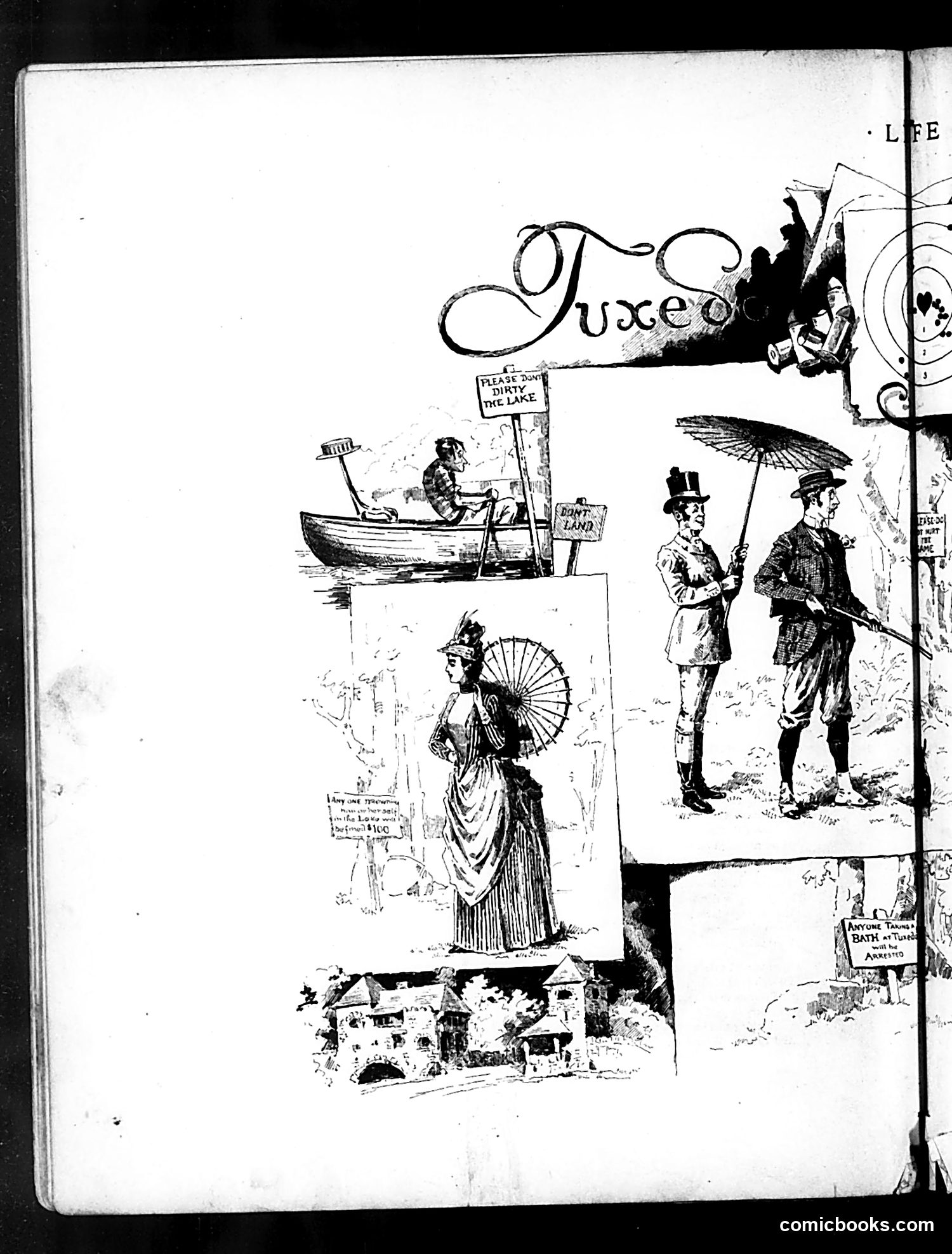
This page appears to be a table of contents or section header for "Juxedo" (likely "Tuxedo"), a section of Life magazine featuring satirical illustrations. The cartoons depict Victorian-era figures in various scenarios: - A woman with a parasol near what appears to be a lakeside village - A man in a boat with warning signs about the lake - Two formally-dressed men with umbrellas (one appears to be an officer or military figure based on his uniform) The visible signs read "PLEASE KEEP OFF THE LAKE" and "DONT LAND," suggesting these are warnings or cautionary scenarios. Without clearer OCR text or additional context, the specific satirical targets remain unclear, though the scenes appear to mock social conventions or safety concerns of the period. The overall tone is light social satire typical of Life magazine's humor section.
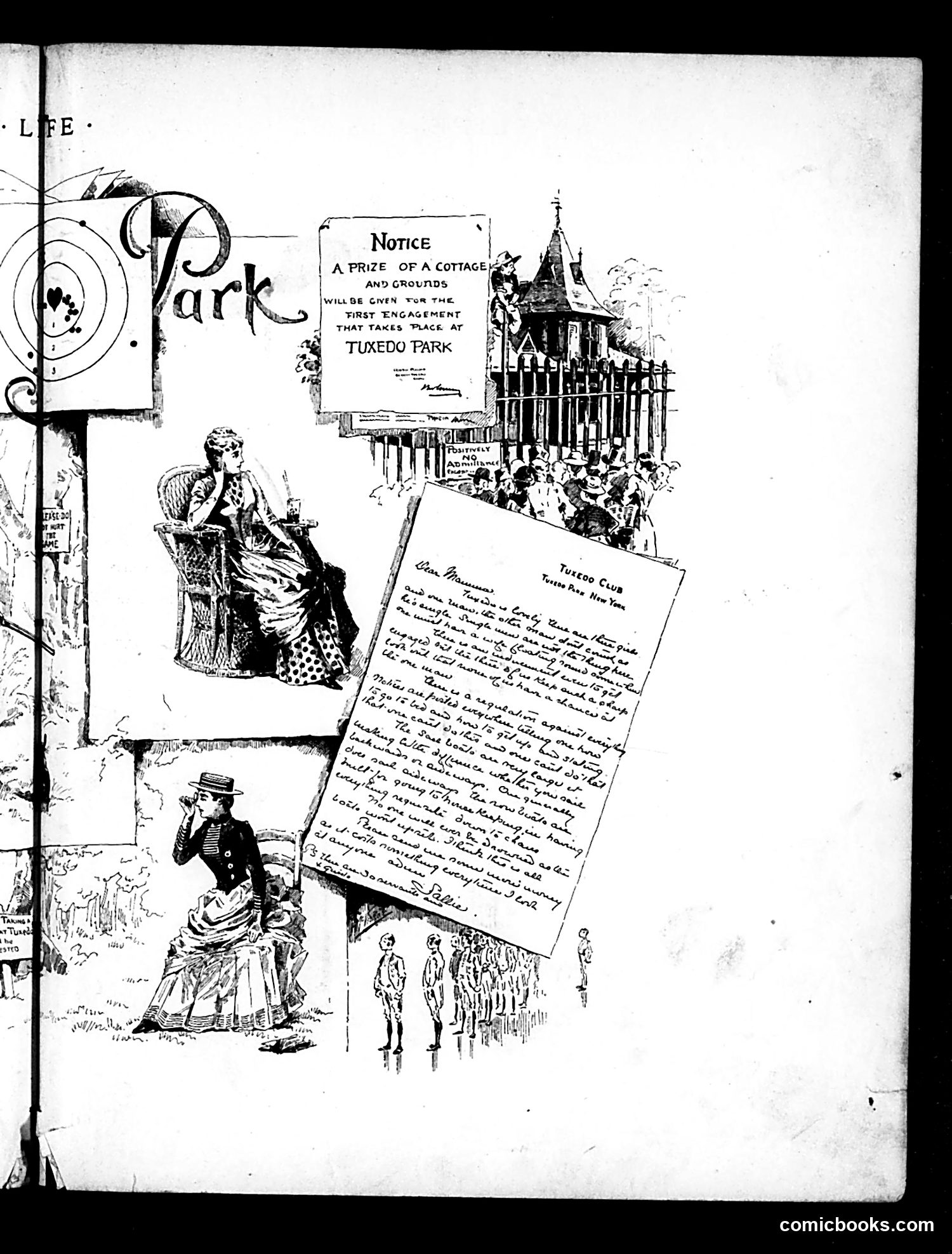
This page combines advertising with satirical social commentary about courtship and class. The "Park" heading and ornamental design frame the content elegantly. The central notice advertises "A Prize of a Cottage and Grounds" offered for "the first engagement that takes place at Tuxedo Park"—referring to an exclusive wealthy enclave in New York. The accompanying letter and illustrations satirize how such elite communities commodify romance, turning engagements into competitive spectacles with material prizes. The sketched figures—a well-dressed woman, a fashionably attired gentleman, and what appears to be a maid or servant—represent different social classes. The satire mocks the idea that wealthy communities would literally incentivize courtships among their residents, reducing romance to a promotional gimmick for exclusive real estate.
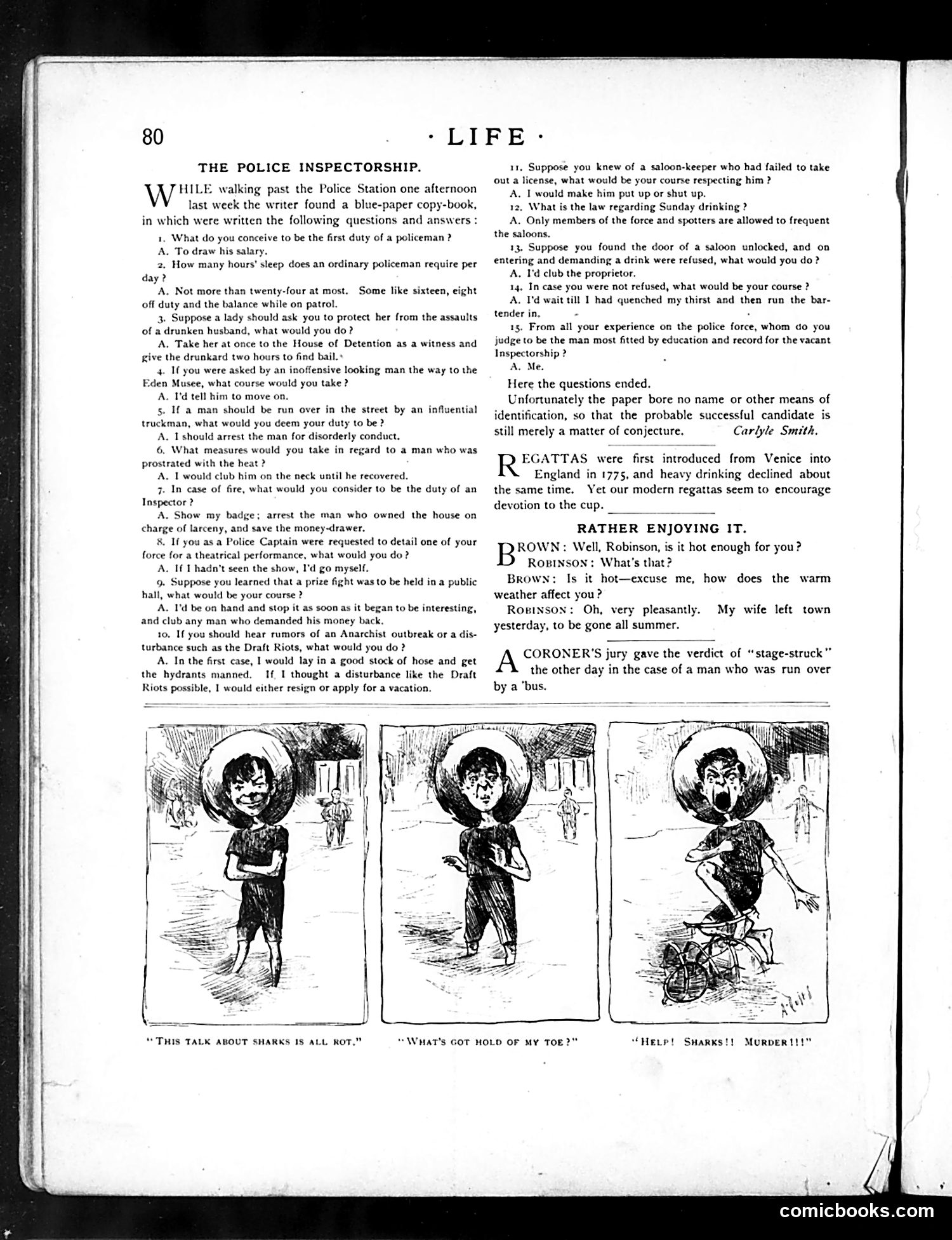
This page contains a satirical Q&A section called "The Police Inspectorship," presenting hypothetical scenarios to test candidates for a police inspector position. The questions cover proper conduct in various situations: protecting assault victims, handling drunk individuals, dealing with disorderly conduct, and responding to public disturbances. Below this section are three humorous cartoon panels depicting a child with an oversized head experiencing increasingly dramatic reactions—from calm ("This talk about sharks is all rot") to distressed ("What's got hold of my toe?") to panicked ("Help! Sharks!! Murder!!!"). The joke satirizes how people's rational skepticism collapses when faced with actual danger, contrasting with the inspector interview's focus on proper professional conduct above.
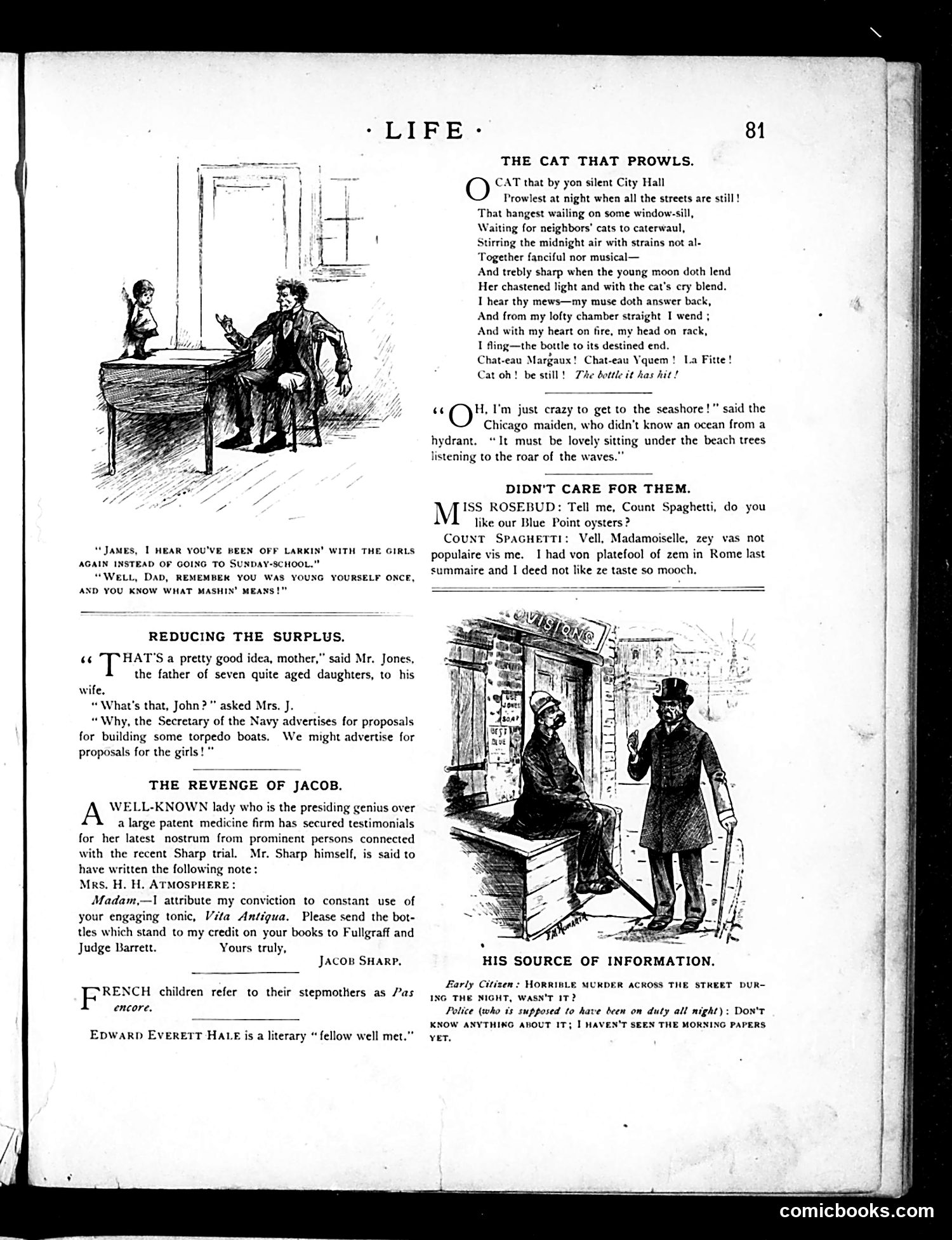
This page from *Life* contains several humorous vignettes mocking contemporary social issues: **"Reducing the Surplus"** jokes about Mr. Jones's seven unmarried daughters as a "surplus" problem—he quips they should be advertised like Navy torpedo boats, satirizing both the burden of supporting unmarried women and government waste. **"The Revenge of Jacob"** references the Sharp trial (a real scandal involving corrupt NYC politician Jacob Sharp). The joke ridicules patent medicine testimonials by imagining Sharp writing from prison, crediting his conviction to a fake tonic called "Vita Antigua"—mocking both fraudulent medical advertising and Sharp's notoriety. **"The Cat That Prowls"** parodies romantic poetry by depicting nocturnal cat fights, with the frustrated narrator throwing wine bottles at them—absurdist humor contrasting high literary language with mundane urban annoyance. **Other sketches** mock Chicago tourists' ignorance, foreign aristocrats' pretentiousness, and police negligence—standard *Life* targets of gentle ridicule aimed at middle-class readers.
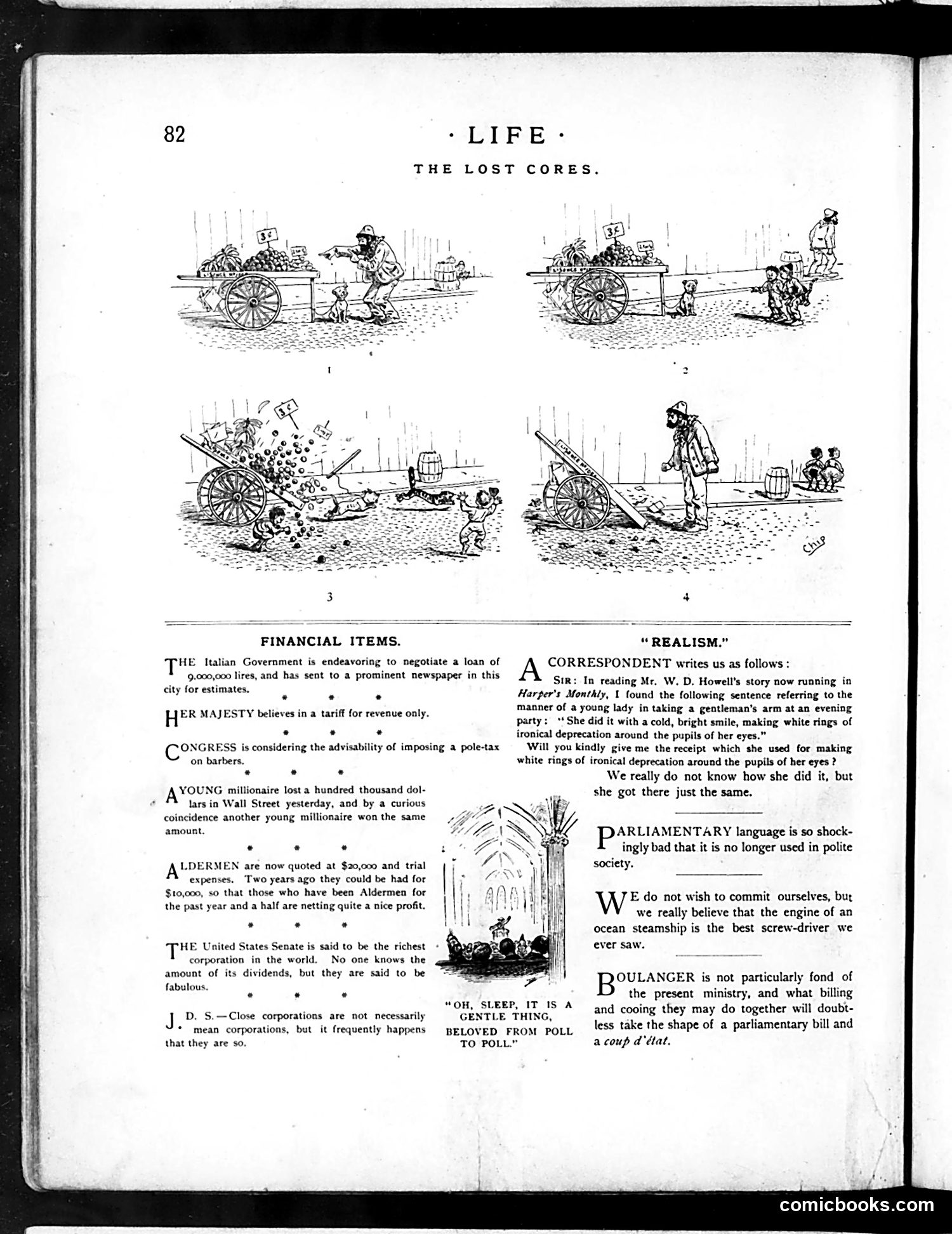
This page combines four sequential cartoon panels (depicting a cart losing its load) with satirical "Financial Items" and reader correspondence mocking contemporary politics and literature. **The cartoons** appear to illustrate financial or political losses—likely referencing government mismanagement or corruption, though specifics aren't explicit. **The satire targets:** - **Government incompetence**: Italian loan negotiations, Senate wealth, Congressional barber taxes - **Wall Street corruption**: A millionaire's loss equals another's gain—suggesting rigged markets - **Literary realism**: A correspondent sarcastically asks how author W.D. Howells' character creates "white rings of ironical deprecation" around her eyes—mocking overwrought, implausible realistic fiction - **Political figures**: "Boulanger" (likely French General Boulanger) criticized for political theatrics disguised as legislative action The humor relies on readers recognizing current events, literary controversies, and political figures of the era. The "lost cores" title suggests both literal cart contents and figurative loss of political/moral substance.
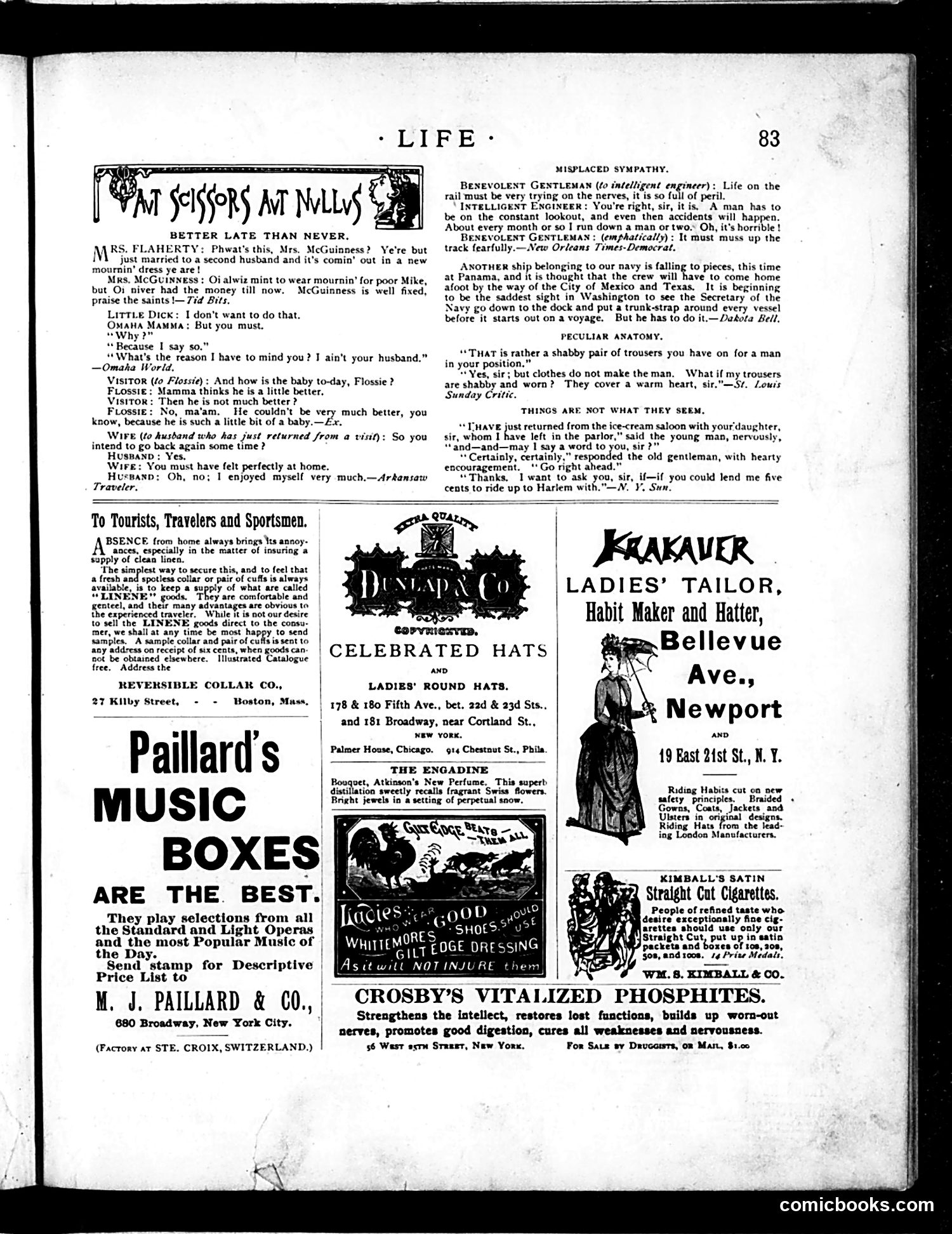
This page contains humorous short anecdotes and advertisements typical of *Life* magazine's satirical format. ## The Cartoons/Jokes: The sketches mock social pretenses and irony: - **"Better Late Than Never"**: Irish immigrant humor about a widow who finally has money to mourn her late husband properly—a dig at poverty and social conventions around mourning dress. - **"Misplaced Sympathy"**: A wealthy gentleman expresses concern for a railroad engineer's dangerous job, but the engineer reveals he's killed multiple workers monthly. The gentleman's only worry is damage to the *track*—satirizing bourgeois indifference to working-class suffering. - **"Things Are Not What They Seem"**: A young suitor asks to borrow five cents after returning from an ice-cream outing—he's financially dependent despite his romantic pretenses. The humor relies on class dynamics, Irish-American stereotypes, and exposing gaps between appearance and reality—typical *Life* magazine satire of the era. The rest is advertising for linens, hats, music boxes, and patent medicines.
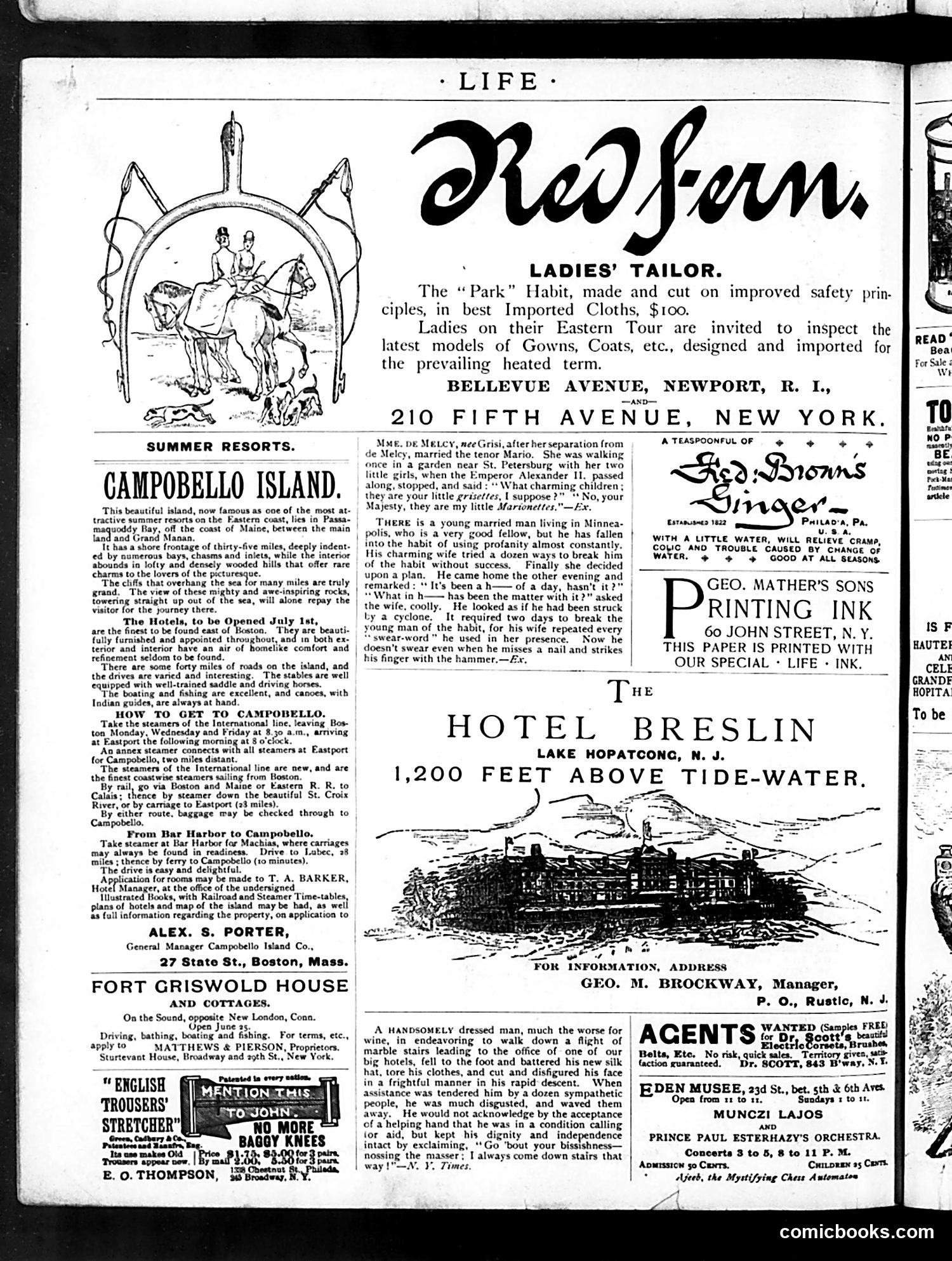
This is primarily an **advertising page** from *Life* magazine, featuring luxury resort and fashion advertisements rather than satirical cartoons. The main content includes ads for: - **Red Fern** (ladies' tailor on Fifth Avenue) - **Campobello Island** (Maine summer resort) - **Hotel Breslin** (Lake Hopatcong, New Jersey) - **Fort Griswold House** (Connecticut) There are two brief **anecdotes**: 1. A story about a woman (appears to be a singer named de Melcy) whose children are called "little Marionettes" by Tsar Alexander II 2. An incomplete story about a Minneapolis man and wine The page's "satire" is minimal—primarily gentle social humor about aristocratic life. The decorative illustrations (a ship's wheel, a hotel building) are ornamental rather than political commentary. This appears to be a typical *Life* magazine page from the Gilded Age, blending light humor with luxury tourism advertising.
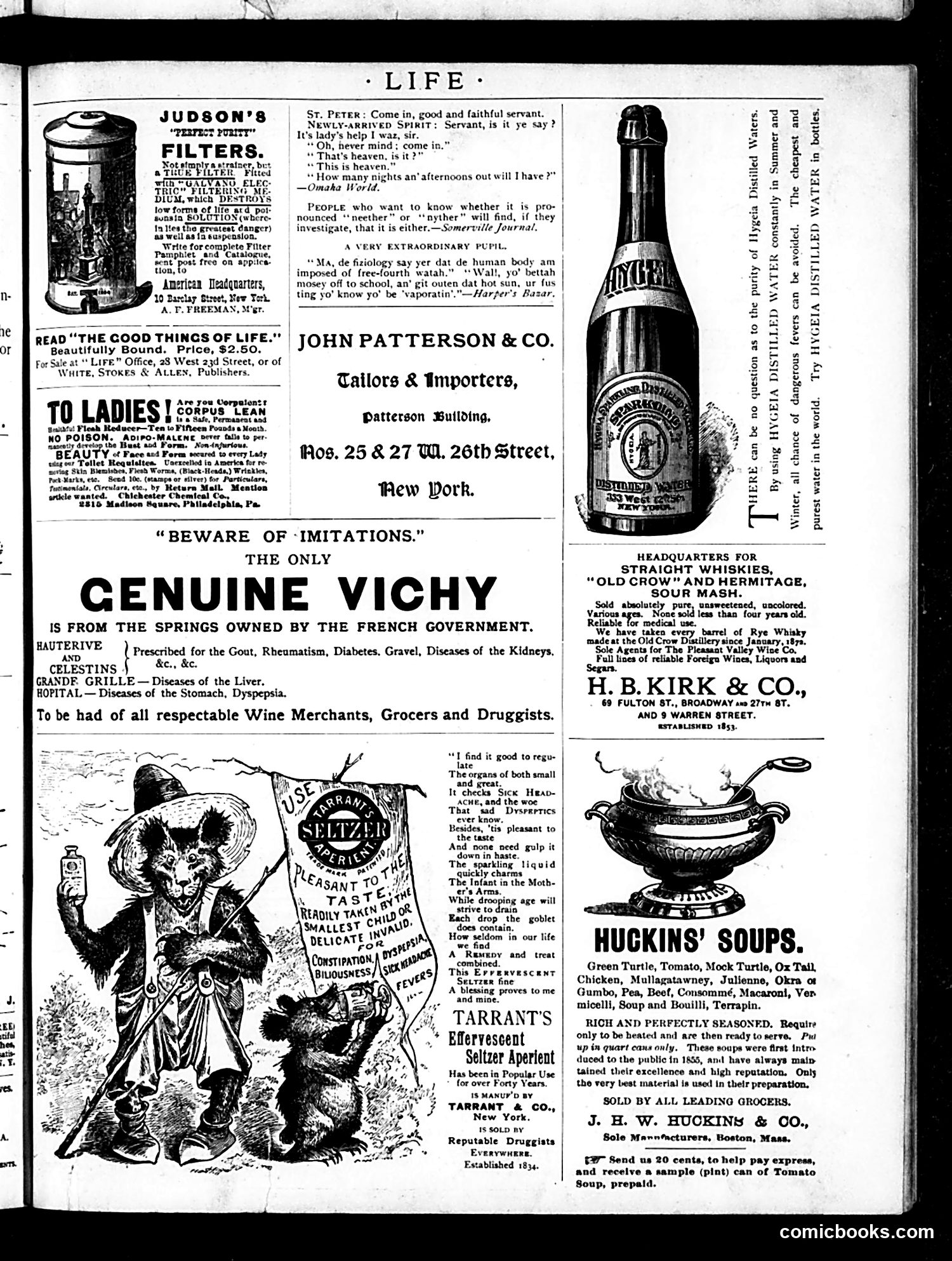
This page is primarily **advertising**, typical of late 19th-century publications. The main content includes: **Central Cartoon**: A skeletal Death figure dressed as a well-dressed gentleman holds a bottle labeled "Tarrant's Effervescent Seltzer Aperient." This is **satirical advertising**—the joke presents Death itself endorsing the product, ironically claiming it cures constipation, dyspepsia, and various ailments. The macabre humor suggests the product is so effective it could even appeal to Death. **Context**: This reflects Victorian-era medicine show advertising culture, where patent medicines claimed near-miraculous cures. The skeleton imagery was common in 19th-century advertising satire, playing on anxieties about health and mortality while promoting dubious remedies. **Other Content**: Surrounding advertisements for medical products (Vichy water, Seltzer, soups, filters, beauty treatments) and humor pieces typical of *Life* magazine's satirical format. The jokes about Irish dialect and servant wages reflect period ethnic stereotyping common to the era.
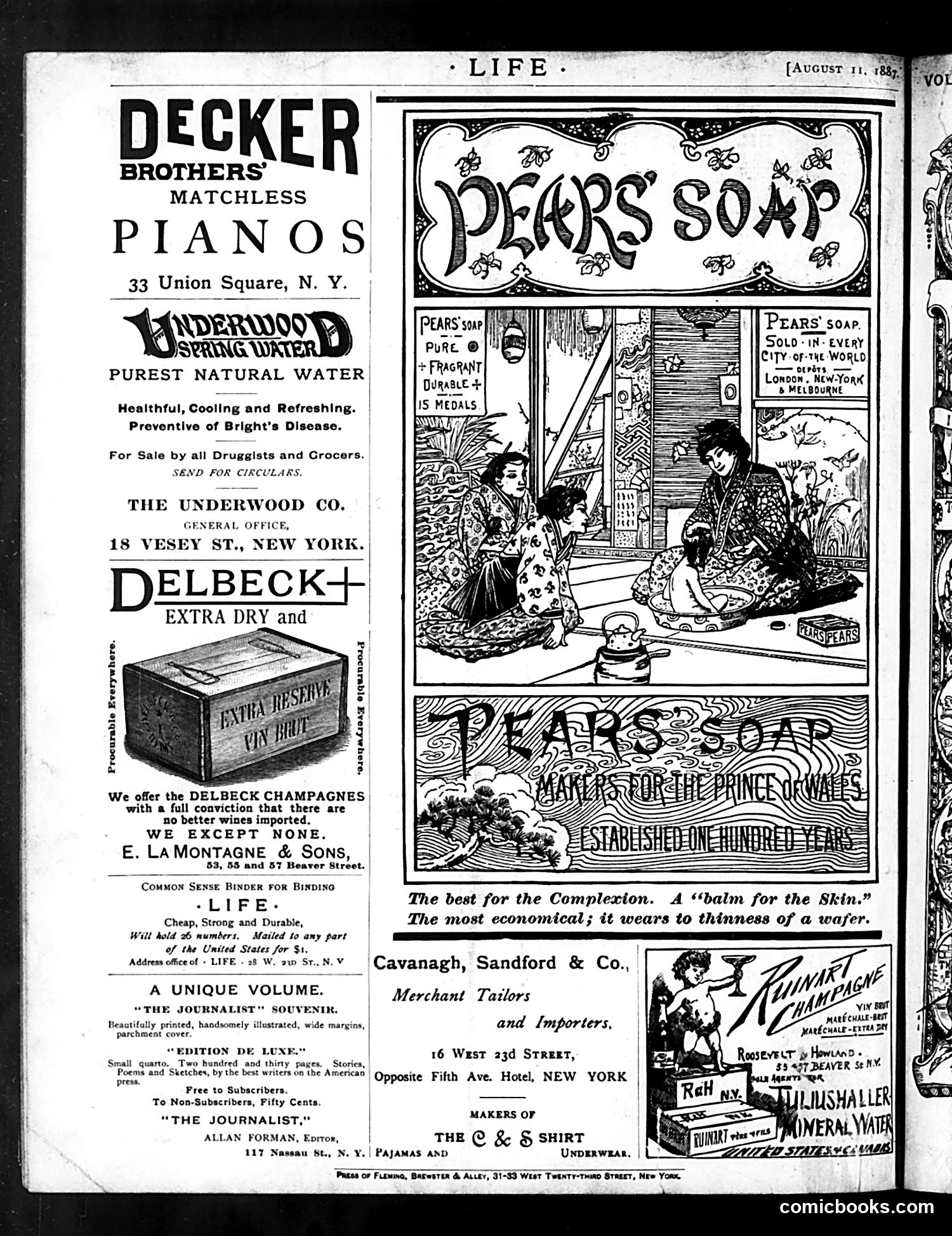
This page is **primarily advertising**, not editorial content or political satire. The dominant feature is a large Pears' Soap advertisement showing Victorian-era figures in an ornate illustrated frame. The ad copy emphasizes the soap's appeal to complexion and economy ("wears to thinness of a wafer"). Surrounding this central ad are typical late-19th-century product advertisements: Decker pianos, Underwood spring water, Delbeck champagne, and clothing from merchant tailors. A smaller ad promotes Roosevelt's Runkart Champagne mineral water. The left column includes notices for Life magazine's own products—a "Journalist" souvenir volume and a subscription binder. **No political or social satire is visible.** This appears to be a standard advertising revenue page from Life's early period, before it became known for political cartooning. The imagery reflects Victorian consumer culture and product marketing conventions of the 1880s.