
Life, 1887-08-11 · page 6 of 16
Life — August 11, 1887 — page 6: what you’re looking at
A restored page from Life, 1887-08-11. Page through the whole issue in the reader above.
📄 Transcribed text from this page (OCR, searchable)
Machine-transcribed from the original scan — historical spelling and the odd misread are preserved.
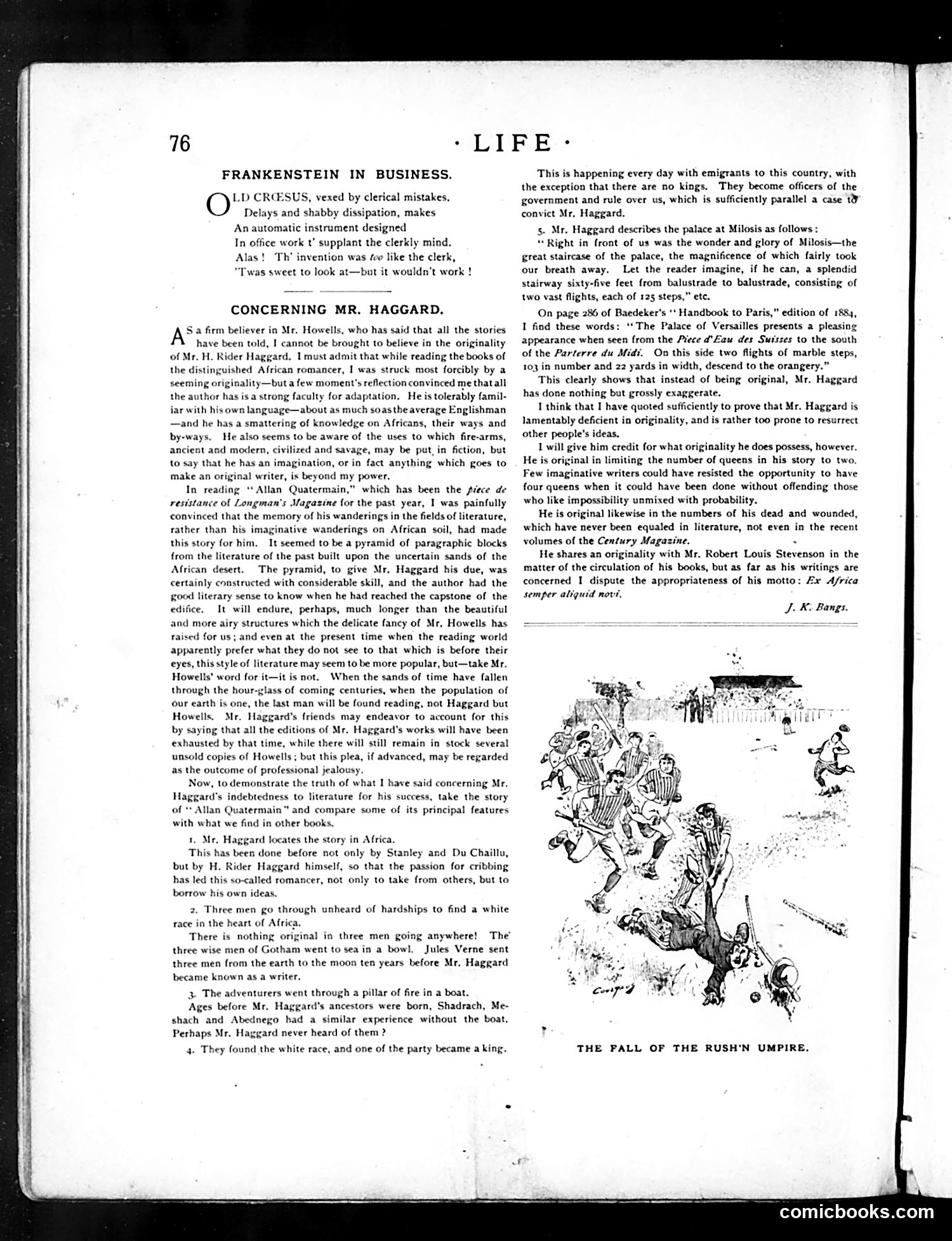
76 FRANKENSTEIN IN BUSINESS. LD CREESUS, vexed by clerical mistakes. Delays and shabby dissipation, makes An automatic instrument designed In office work t’ supplant the clerkly mind. Alas! Th’ invention was fo like the clerk, "Twas sweet to look at—but it wouldn't work ! CONCERNING MR. HAGGARD. Sa firm believer in Mr. Howells, who has said that all the stories have been told, I cannot be brought to believe in the originality of Mr. H. Rider Haggard. I must admit that while reading the books of the distinguished African romancer, I was struck most forcibly by a seeming originality—but a few moment's reflection convinced me that all the author has isa strong faculty for adaptation. He is tolerably famil- iar with his own language—about as much soasthe average Englishman —and he has a smattering of knowledge on Africans, their ways and by-ways. He also seems to be aware of the uses to which fire-arms, ancient and modern, civilized and savage, may be put, in fiction, but to say that he has an imagination, or in fact anything which goes to make an original writer, is beyond my power. In reading ‘Allan Quatermain,” which has been the piece de resistance of Longman's Magazine {or the past year, 1 was painfully convinced that the memory of his wanderings in the fields of literature, rather than his imaginative wanderings on African soil, had made this story for him, It seemed to be a pyramid of paragraphic blocks from the literature of the past built upon the uncertain sands of the African desert. The pyramid, to give Mr. Haggard his due, was certainly constructed with considerable skill, and the author had the good literary sense to know when he had reached the capstone of the edifice. It will endure, perhaps, much longer than the beautiful and more airy structures which the delicate fancy of Mr, Howells has raised for us; and even at the present time when the reading world apparently prefer what they do not see to that which is before their eyes, this style of literature may seem to be more popular, but—take Mr. Howells' word for it—it is not, When the sands of time have fallen through the hour-glass of coming centuries, when the population of our earth is one, the last man will be found reading, not Haggard but Howells, Mr. Haggard’s friends may endeavor to account for this by saying that all the editions of Mr. Haggard’s works will have been exhausted by that time, while there will still remain in stock several unsold copies of Howells ; but this plea, if advanced, may be regarded as the outcome of professional jealousy. Now, to demonstrate the truth of what I have said concerning Mr. Haggard’s indebtedness to literature for his success, take the story of * Allan Quatermain” and compare some of its principal features with what we find in other books. 1, Mr, Haggard locates the story in Africa. This has been done before not only by Stanley and Du Chaillu, but by H. Rider Haggard himself, so that the passion for cribbing has led this so-called romancer, not only to take from others, but to borrow his own ideas. 2. Three men go through unheard of hardships to find a white race in the heart of Afr There is nothing original in three men going anywhere! The three wise men of Gotham went to sea in a bowl. Jules Verne sent three men from the earth to the moon ten years before Mr. Haggard became known as a writer. 3. The adventurers went through a pillar of fire in a boat. ‘Ages before Mr. Haggard’s ancestors were born, Shadrach, Me- shach and Abednego had a similar experience without the boat. Perhaps Mr. Haggard never heard of them ? 4. They found the white race, and one of the party became a king. - LIFE: ‘This is happening every day with emigrants to this country, with the exception that there are no kings. They become officers of the government and rule over us, which is sufficiently parallel a case t8 convict Mr, Haggard. 5. Mr. Haggard describes the palace at Milosis as follow: “Right in front of us was the wonder and glory of Milosis—the great staircase of the palace, the magnificence of which fairly took our breath away. Let the reader imagine, if he can, a splendid stairway sixty-five feet from balustrade to balustrade, consisting of two vast flights, each of 125 steps,” etc. On page 286 of Baedeker’s * Handbook to Paris,” edition of 1884, I find these words: ‘The Palace of Versailles presents a pleasing appearance when seen from the Piece d'Eau des Suisses to the south of the Parterre du Midi. On this side two flights of marble steps, 103 in number and 22 yards in width, descend to the orangery.” This clearly shows that instead of being original, Mr. Haggard has done nothing but grossly exaggerate. I think that I have quoted sufficiently to prove that Mr. Haggard is lamentably deficient in originality, and is rather too prone to resurrect other people's ideas. I will give him credit for what originality he does possess, however. He is original in limiting the number of queens in his story to two. Few imaginative writers could have resisted the opportunity to have four queens when it could have been done without offending those who like impossibility unmixed with probability. He is original likewise in the numbers of his dead and wounded, which have never been equaled in literature, not even in the recent volumes of the Century Magazine, : He shares an originality with Mr. Robert Louis Stevenson in the matter of the circulation of his books, but as far as his writings are concerned I dispute the appropriateness of his motto: Ex Africa semper aliquid novi, J. K. Bangs. , cond THE PALL OF THE RUSH'N UMPIRE. comicbooks.com