
Life, 1887-08-11 · page 2 of 16
Life — August 11, 1887 — page 2: what you’re looking at
What you’re looking at
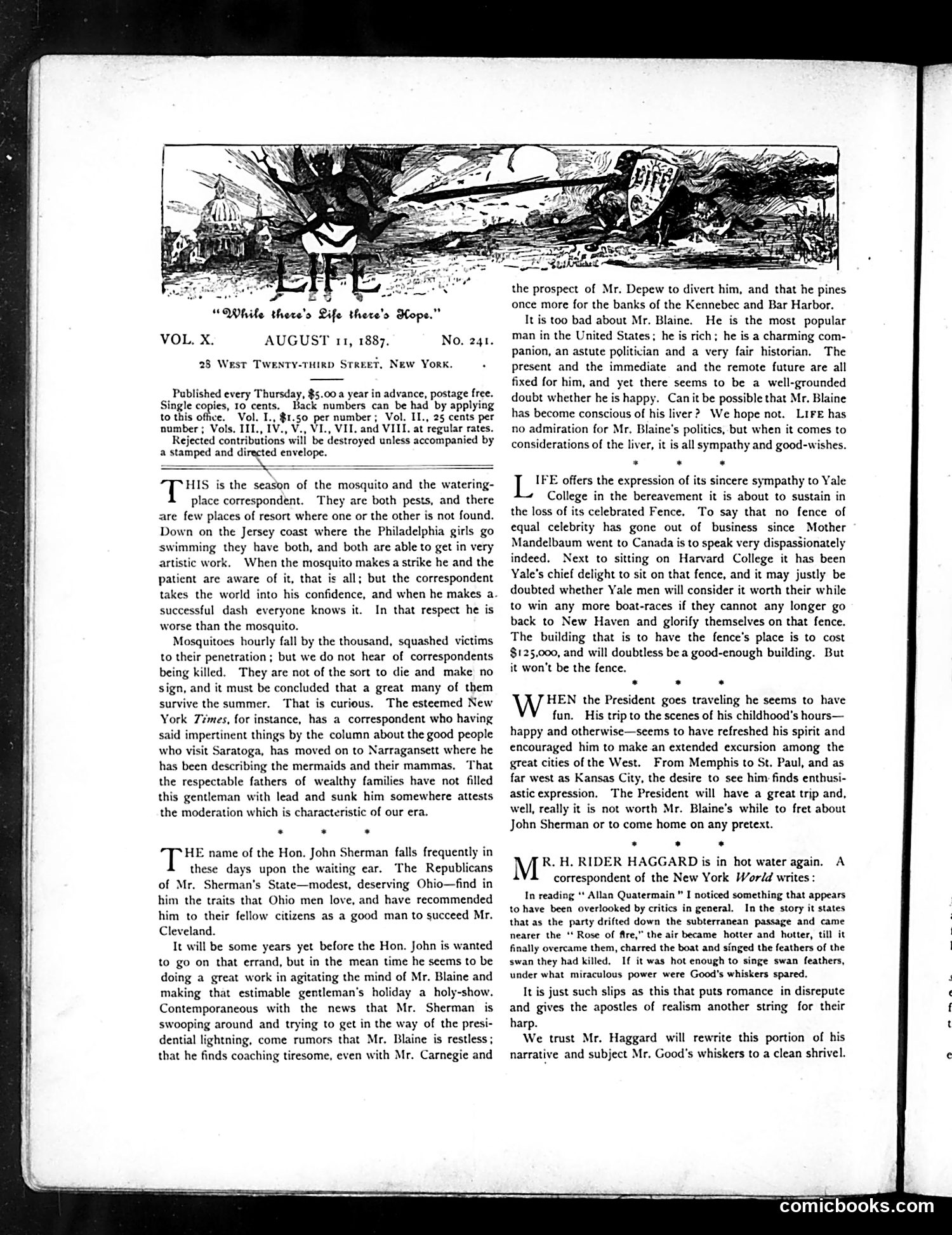
The masthead cartoon depicts a gnarled tree with the caption "While there's Life there's Hope"—a visual pun on the magazine's title. The text discusses contemporary figures and social commentary rather than displaying political cartoons. It references: - **Mr. Blaine**: Described as "the most popular man in the United States," wealthy, charming, and a politician. The writer expresses sympathy for him while questioning his happiness—a veiled critique wrapped in politeness. - **Yale College's lost Fence**: Apparently a celebrated structure whose demolition is lamented. - **President's travels**: Commentary on the president's western tour, praised as refreshing. - **Mr. Haggard's narrative**: A criticism of H. Rider Haggard's novel "Allan Quatermain," claiming it romanticizes violence unrealistically. The page is primarily satirical commentary on personalities and literature rather than visual political satire.
📄 Transcribed text from this page (OCR, searchable)
Machine-transcribed from the original scan — historical spelling and the odd misread are preserved.
VOL. X. AUGUST 11, 1887. 28 West Twenty-THirp Street, New York. . No. 241. Published every Thursday, $5.00. year in advance, postage free. Single copies, 10 cents. Back numbers can be had by applying to this office. Vol. I., $1.50 per number ; Vol. II., 25 cents per number ; Vols. IIL., IV., V., VI., VII. and VIII. at regular rates. Rejected contributions will be destroyed unless accompanied by a stamped and directed envelope. HIS is the season of the mosquito and the watering- place correspondent. They are both pests, and there are few places of resort where one or the other is not found. Down on the Jersey coast where the Philadelphia girls go swimming they have both, and both are able to get in very artistic work. When the mosquito makes a strike he and the patient are aware of it, that is all; but the correspondent takes the world into his confidence, and when he makes a. successful dash everyone knows it. In that respect he is worse than the mosquito. Mosquitoes hourly fall by the thousand, squashed victims to their penetration ; but we do not hear of correspondents being killed. They are not of the sort to die and make no sign, and it must be concluded that a great many of them survive the summer. That is curious. The esteemed New York 7imes, for instance, has a correspondent who having said impertinent things by the column about the good people who visit Saratoga, has moved on to Narragansett where he has been describing the mermaids and their mammas, That the respectable fathers of wealthy families have not filled this gentleman with lead and sunk him somewhere attests the moderation which is characteristic of our era. HE name of the Hon. John Sherman falls frequently in these days upon the waiting ear. The Republicans of Mr. Sherman's State—modest, deserving Ohio—find in him the traits that Ohio men love, and have recommended him to their fellow citizens as a good man to succeed Mr. Cleveland. It will be some years yet before the Hon. John is wanted to go on that errand, but in the mean time he seems to be doing a great work in agitating the mind of Mr. Blaine and making that estimable gentleman's holiday a holy-show. Contemporaneous with the news that Mr. Sherman is swooping around and trying to get in the way of the presi- dential lightning, come rumors that Mr. Blaine is restless; that he finds coaching tiresome, even with Mr. Carnegie and the prospect of Mr. Depew to divert him, and that he pines once more for the banks of the Kennebec and Bar Harbor. It is too bad about Mr. Blaine. He is the most popular man in the United States; he is rich; he is a charming com- panion, an astute politician and a very fair historian. The present and the immediate and the remote future are all fixed for him, and yet there seems to be a well-grounded doubt whether he is happy. Can it be possible that Mr. Blaine has become conscious of his liver? We hope not. LIFE has no admiration for Mr. Blaine’s politics, but when it comes to considerations of the liver, it is all sympathy and good-wishes. * . . IFE offers the expression of its sincere sympathy to Yale College in the bereavement it is about to sustain in the loss of its celebrated Fence. To say that no fence of equal celebrity has gone out of business since Mother Mandelbaum went to Canada is to speak very dispassionately indeed. Next to sitting on Harvard College it has been Yale's chief delight to sit on that fence, and it may justly be doubted whether Yale men will consider it worth their while to win any more boat-races if they cannot any longer go back to New Haven and glorify themselves on that fence. The building that is to have the fence's place is to cost $125,000, and will doubtless be a good-enough building. But it won't be the fence. . . . HEN the President goes traveling he seems to have fun. His trip to the scenes of his childhood’s hours— happy and otherwise—seems to have refreshed his spirit and encouraged him to make an extended excursion among the great cities of the West. From Memphis to St. Paul, and as far west as Kansas City, the desire to see him finds enthusi- astic expression. The President will have a great trip and, well, really it is not worth Mr. Blaine’s while to fret about John Sherman or to come home on any pretext. . . . R. H. RIDER HAGGARD is in hot water again. A correspondent of the New York World writes : In reading “ Allan Quatermain” I noticed something that appears to have been overlooked by critics in general. In the story it states that as the party drifted down the subterranean passage and came nearer the ‘ Rose of fire,” the air became hotter and hotter, till it finally overcame them, charred the boat and singed the feathers of the swan they had killed. If it was hot enough to singe swan feathers, under what miraculous power were Good's whiskers spared. It is just such slips as this that puts romance in disrepute and gives the apostles of realism another string for their harp. We trust Mr. Haggard will rewrite this portion of his narrative and subject Mr. Good's whiskers to a clean shrivel. ‘Comicbooks.com