
A complete issue · 14 pages · 1887
Life — August 4, 1887
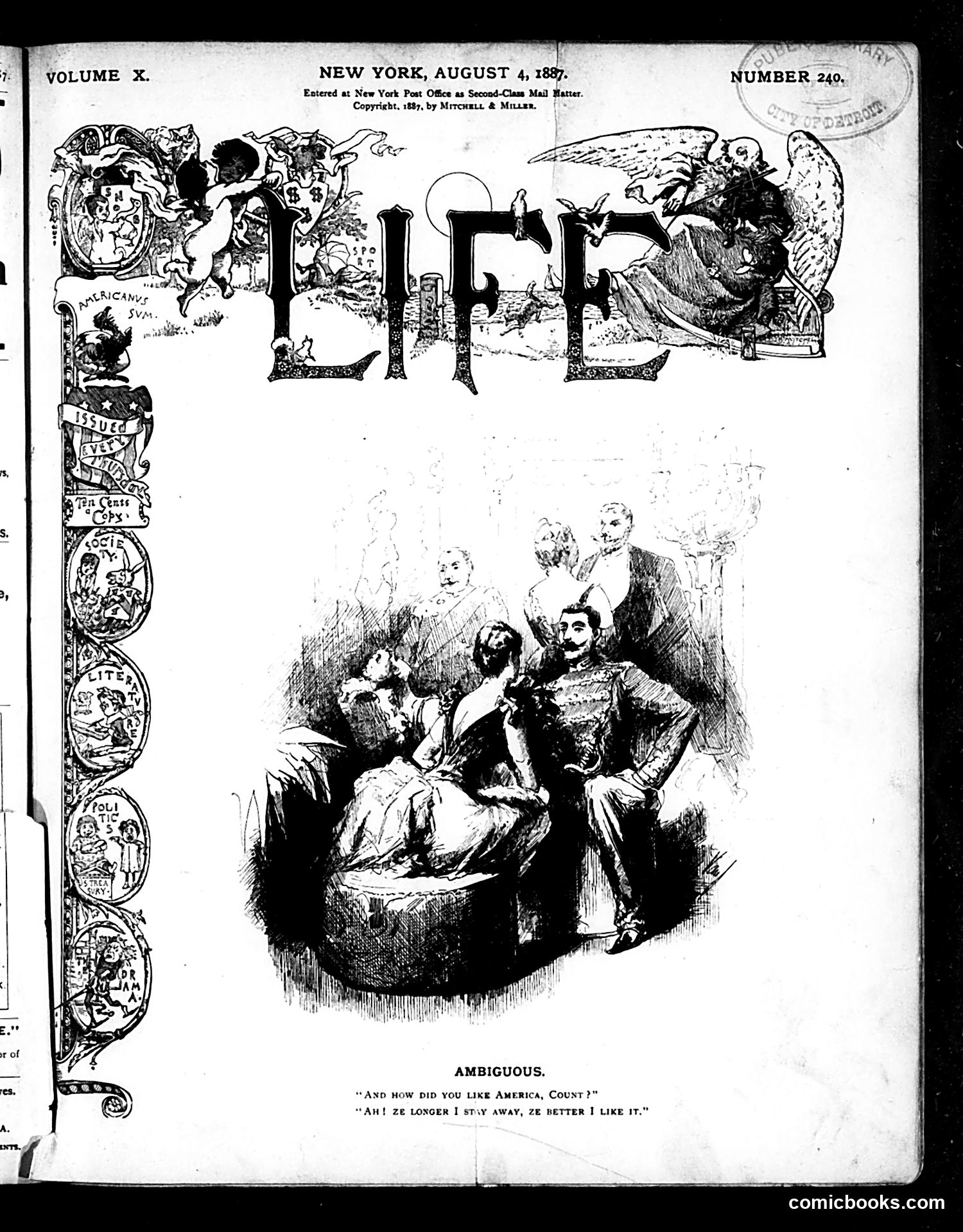
This cartoon satirizes a European nobleman's ambivalent response to America. The caption reads: "And how did you like America, Count?" / "Ah! ze longer I stay away, ze better I like it." The joke is a play on words—the Count claims to appreciate America more the *further* he is from it, meaning he didn't actually enjoy visiting. It's a backhanded compliment mocking both the Count's snobbish European pretensions and, implicitly, suggesting America has undesirable qualities that make distance preferable. The elaborate decorative border features various allegorical figures typical of Life's Victorian aesthetic. The cartoon reflects 1880s American attitudes toward European aristocracy and their perceived disdain for American society.
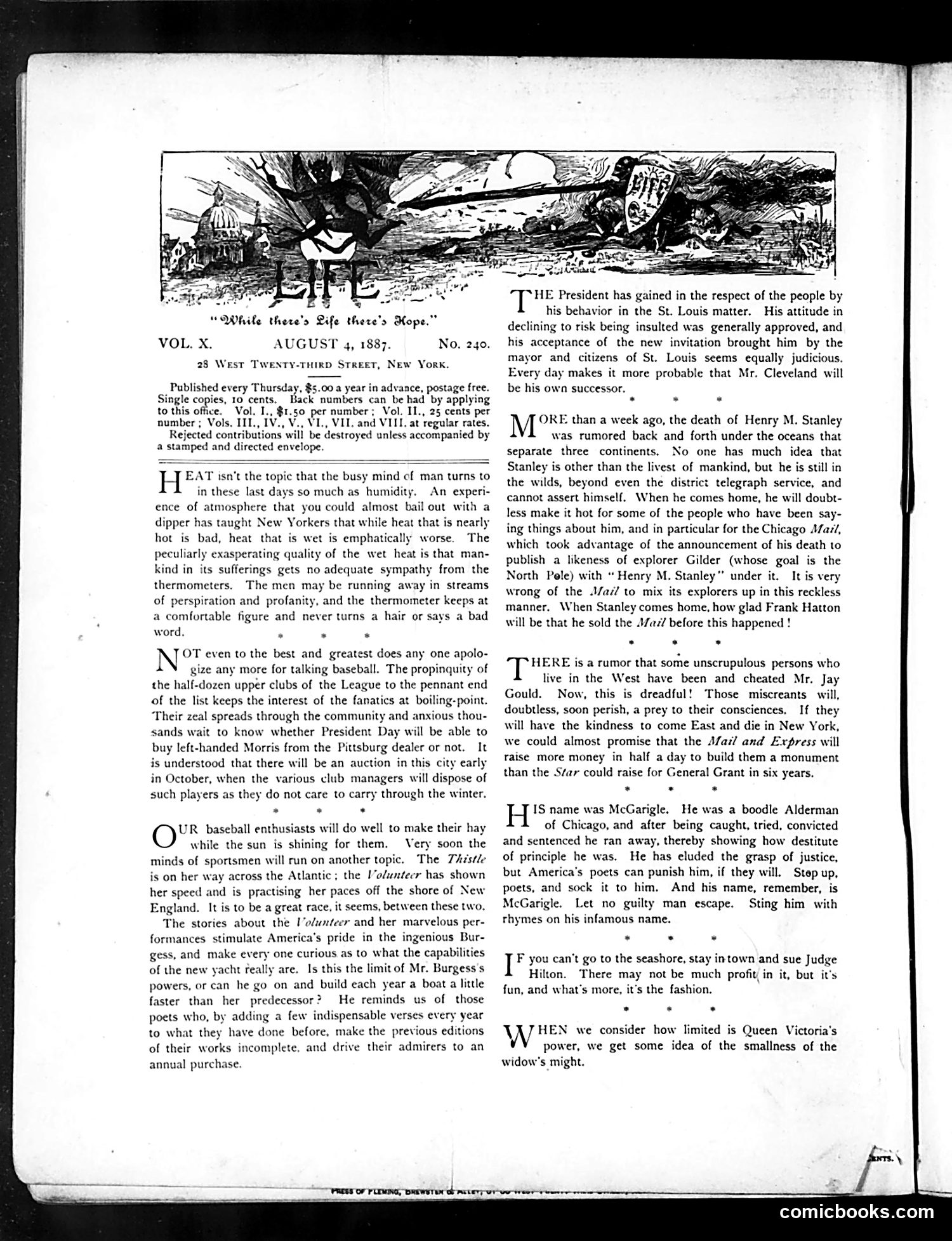
The masthead cartoon titled "While there's Life there's Hope" depicts a grim reaper figure looming over a landscape with a setting sun. The accompanying text discusses President Cleveland's improved standing following the St. Louis matter, suggesting his political fortunes are brightening. The page's satirical content addresses several topics: baseball's popularity and player auctions; the rumored death of explorer Henry M. Stanley in Africa (later proven false); criticism of the Chicago *Mail* newspaper for sensationalism; and a jab at a criminal named McGarigle who escaped justice. The piece concludes with a quip about Queen Victoria's limited political power. The overall tone is typical of *Life*'s editorial commentary blending political observation with social commentary and humor.
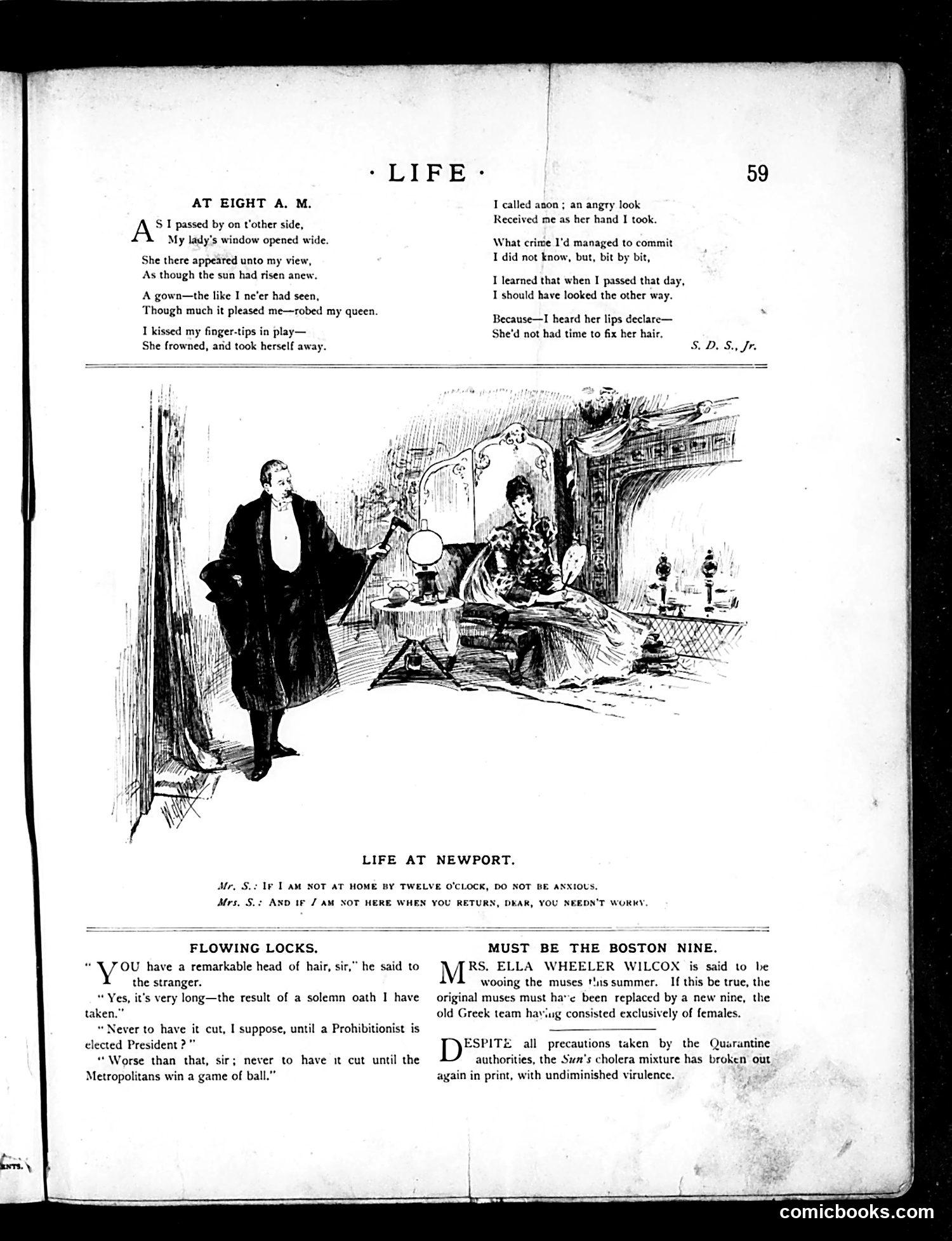
**"Life at Eight A.M."** (top poem): A domestic scene showing a man entering while his wife sits by a window. The poem describes his attempt at affection—kissing her fingertips—rejected with a frown. The satire targets morning marital coldness and miscommunication: he didn't realize he'd offended her the previous day by not looking her way. **"Life at Newport"** (illustration): Depicts wealthy leisure society. The dialogue mocks upper-class anxieties about punctuality and social expectations, with Mrs. S. reassuring Mr. S. about late arrivals. **"Flowing Locks" and "Must Be the Boston Nine"** (bottom sections): Brief satirical pieces—one about hair length and Prohibition, another regarding Mrs. Ella Wheeler Wilcox and Boston's baseball team. The page satirizes American social conventions across class levels.
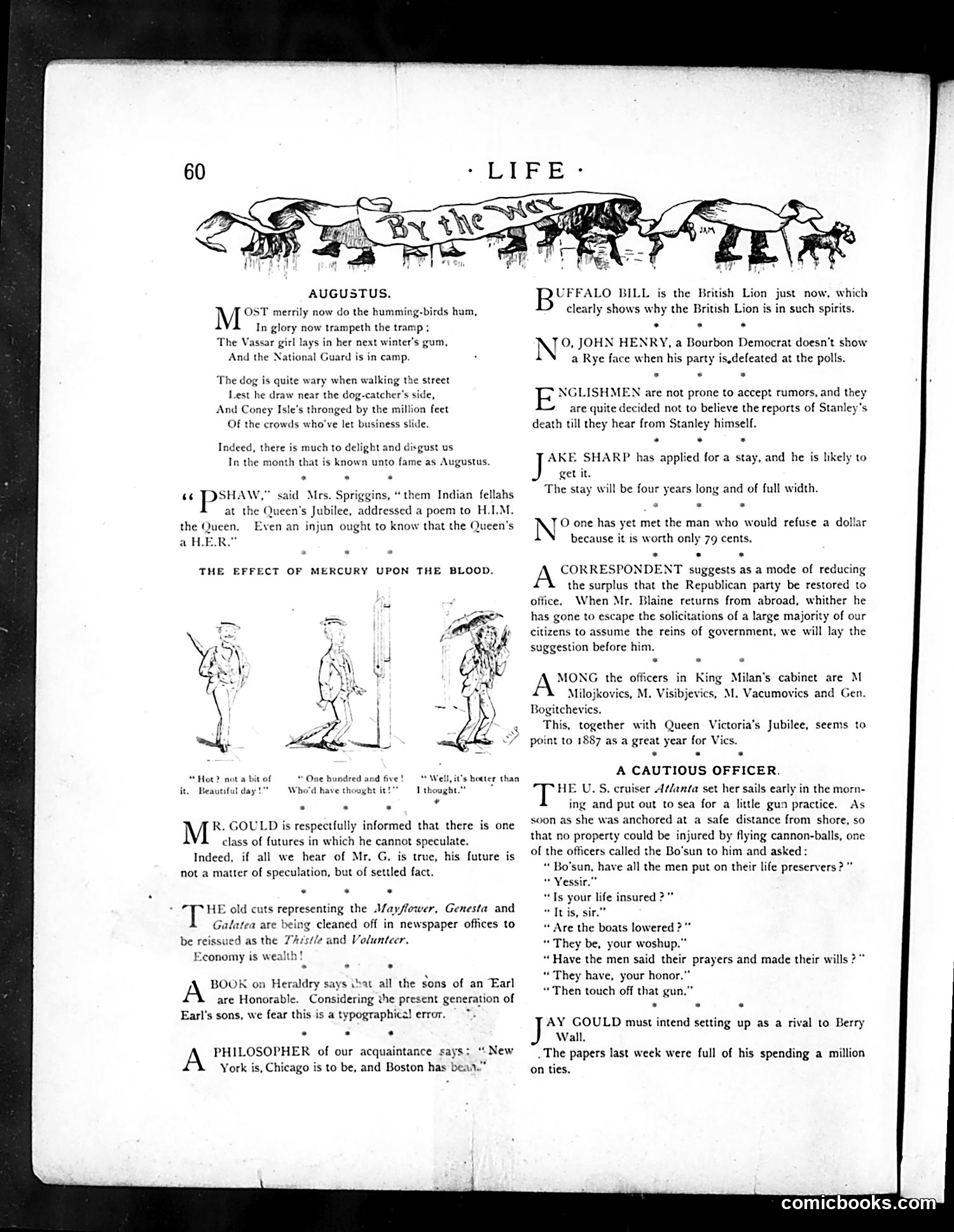
This cartoon depicts three figures in progressive states of physical deterioration, illustrating the medical effects of mercury treatment—the standard therapy for syphilis in the late 19th century. The captions suggest the treatment's severe side effects: "He's not a bit of it. Beautiful day!" / "One hundred and five? Who'd have thought it!" / "Well, it's better than I thought." The dark humor satirizes how mercury poisoning from syphilis treatment was considered preferable to the disease itself, yet caused dramatic weight loss and physical decline. The cartoon critiques both the disease and the brutal "cure," reflecting contemporary anxieties about venereal disease and medical treatment limitations during this era.
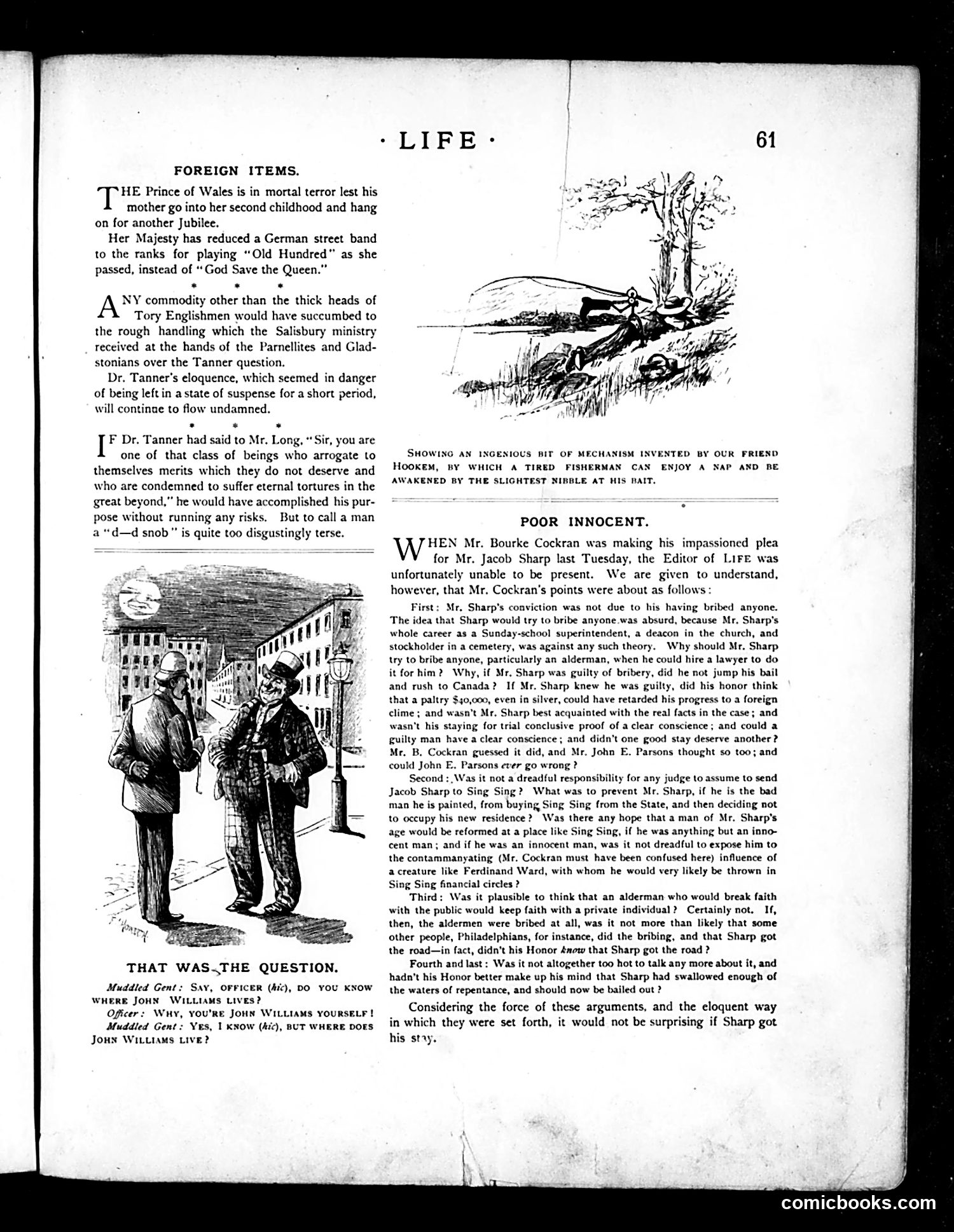
This page contains two distinct sections: **"That Was the Question"** (bottom left): A brief satirical dialogue between a "Muddled Gent" and an Officer about locating "John Williams." The joke plays on the officer's literal response—that Williams lives wherever he currently is—mocking the absurdity of the question itself. This appears to be a simple wordplay gag rather than political satire. **"Poor Innocent"** (main article): Discusses the Jacob Sharp bribery case, defending Sharp against charges of corruption. The text presents counterarguments that Sharp wouldn't logically resort to bribery given his position and wealth. This appears to be defending a controversial political figure through satirical argument, though the specific historical context of Sharp's alleged crimes isn't detailed here. The page's top includes brief foreign items and an illustration of a fisherman.
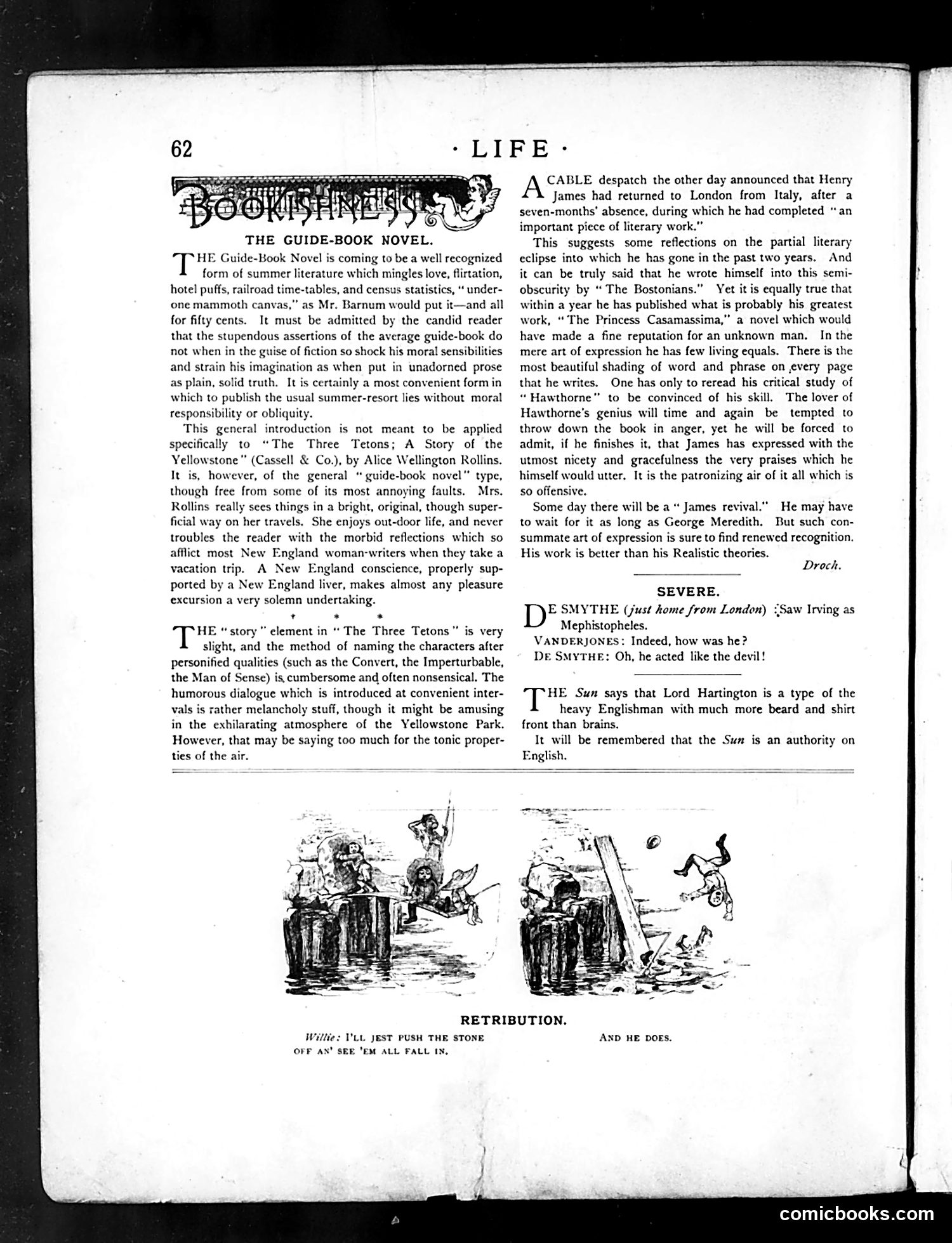
This page contains **book reviews** rather than political cartoons. The main content discusses "The Guide-Book Novel" as an emerging literary form, and reviews of works by Henry James and others. The only cartoon present is titled **"RETRIBUTION,"** showing two panels of a figure (labeled "Willie") pushing a stone off a wall, then falling as it tumbles down. The caption reads: "I'll jest push the stone off an' see i'm all fall in" / "And he does." This is a **simple moral cautionary tale**—a joke about comeuppance where Willie's mischievous action (pushing the stone) backfires literally when the stone falls on him. It's slapstick humor rather than political satire, illustrating consequences of one's actions.
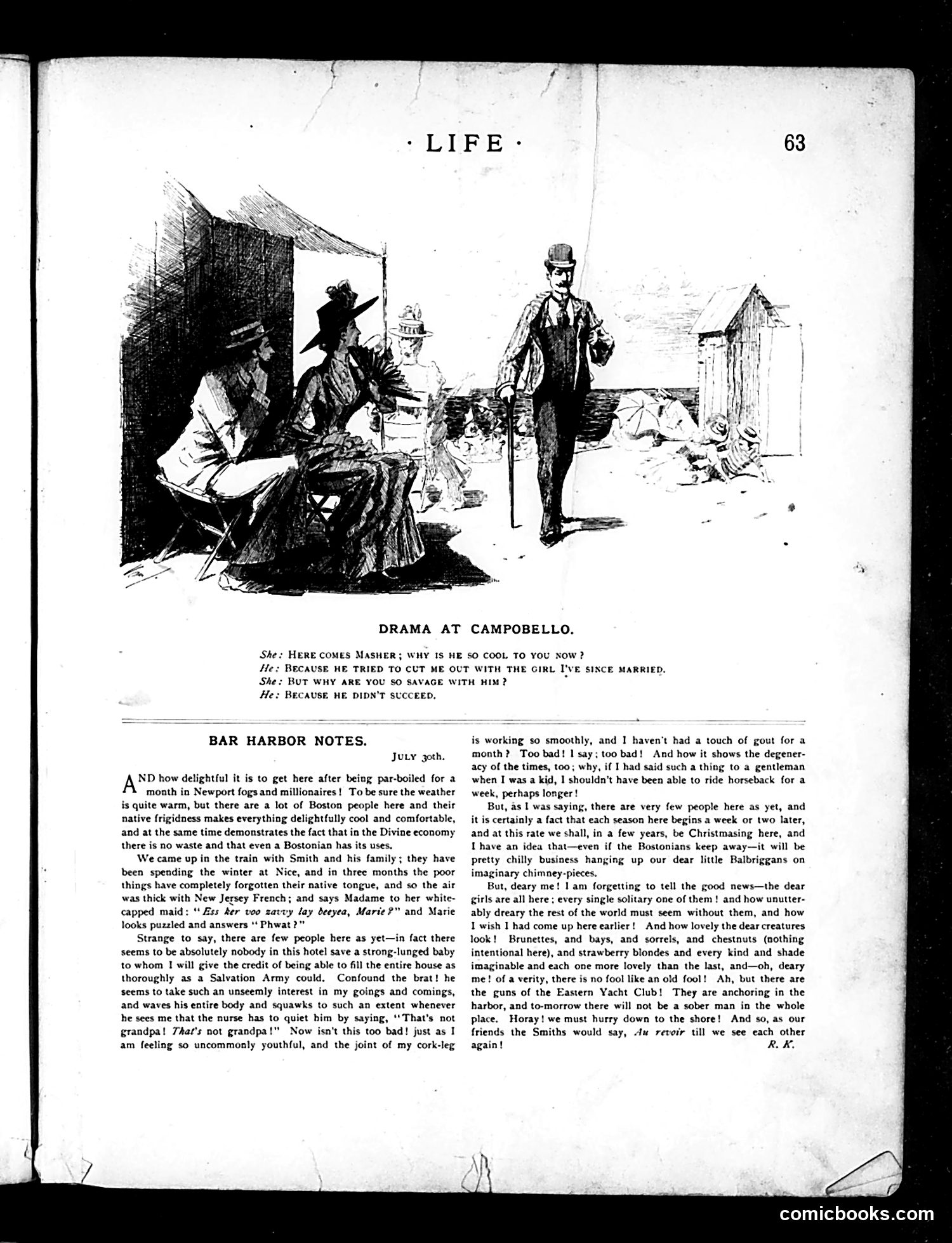
This cartoon depicts a domestic dispute at Campobello (likely a vacation resort). The caption shows a wife questioning why her husband is suddenly cold toward her, and he responds that he's cutting her out because he married her for money—implying she's failed to deliver financial support. The satire appears to target wealthy or upper-class marriages based on mercenary motives rather than genuine affection. The husband's admission that "he didn't succeed" suggests his fortune-hunting strategy backfired, making him resentful toward his wife. Below is "Bar Harbor Notes," a gossipy social column discussing the wealthy summer community at Bar Harbor, Maine—another exclusive vacation destination. The column's tone reflects turn-of-the-century satirical commentary on the leisure class and their social dramas.
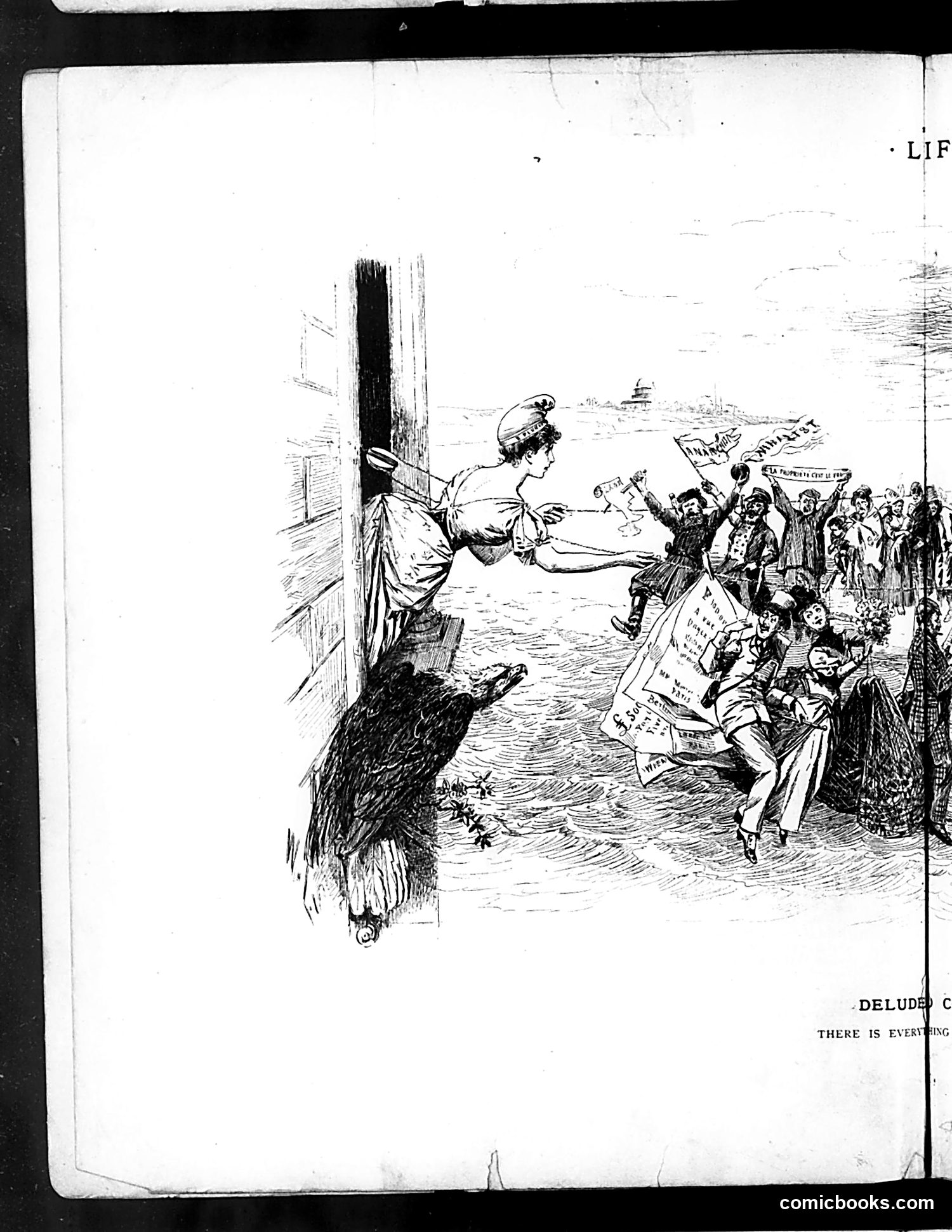
This satirical illustration depicts a woman in classical dress (representing Liberty or America) leaning from a pedestal or building, extending her hand toward a crowd of immigrants or common people below. The crowd carries banners and flags, appearing to celebrate or seek her approval. The cartoon likely critiques American immigration policy or attitudes toward immigrants during the early 20th century. The juxtaposition of the idealized Liberty figure with the depicted masses suggests tension between America's democratic ideals and actual treatment of newcomers. The partial text "DELUDED" and "THERE IS EVERYTHING" (visible at bottom) further suggests satirical commentary on false promises or contradictions between American rhetoric and reality regarding opportunity and welcome. The style and Life magazine context indicate this addresses contemporary immigration debates.
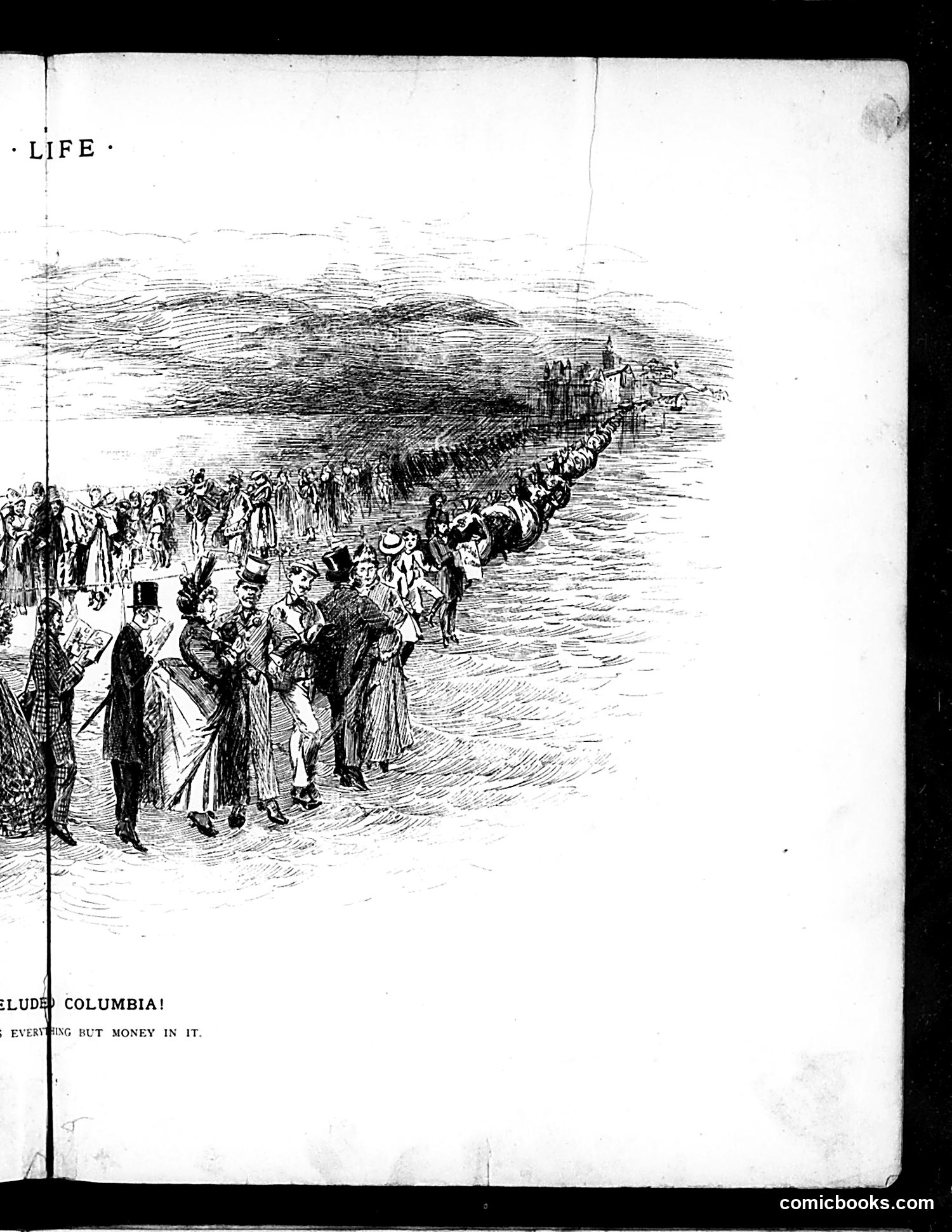
This satirical illustration depicts a long procession of people stretching toward a distant cityscape, likely representing America ("Columbia" referenced in the partial caption below). The figures in the foreground—wearing formal attire and top hats—appear to be wealthy or politically prominent individuals, while masses follow behind. The partially visible caption "LUDED COLUMBIA!" and "G EVERYTHING BUT MONEY IN IT" suggests social criticism regarding wealth inequality or greed in American society. The composition implies commentary on economic disparity: the elite few are positioned prominently while countless ordinary citizens form a long queue behind them, possibly satirizing resource distribution or opportunity access in America during this period (appears to be late 19th or early 20th century based on artistic style).
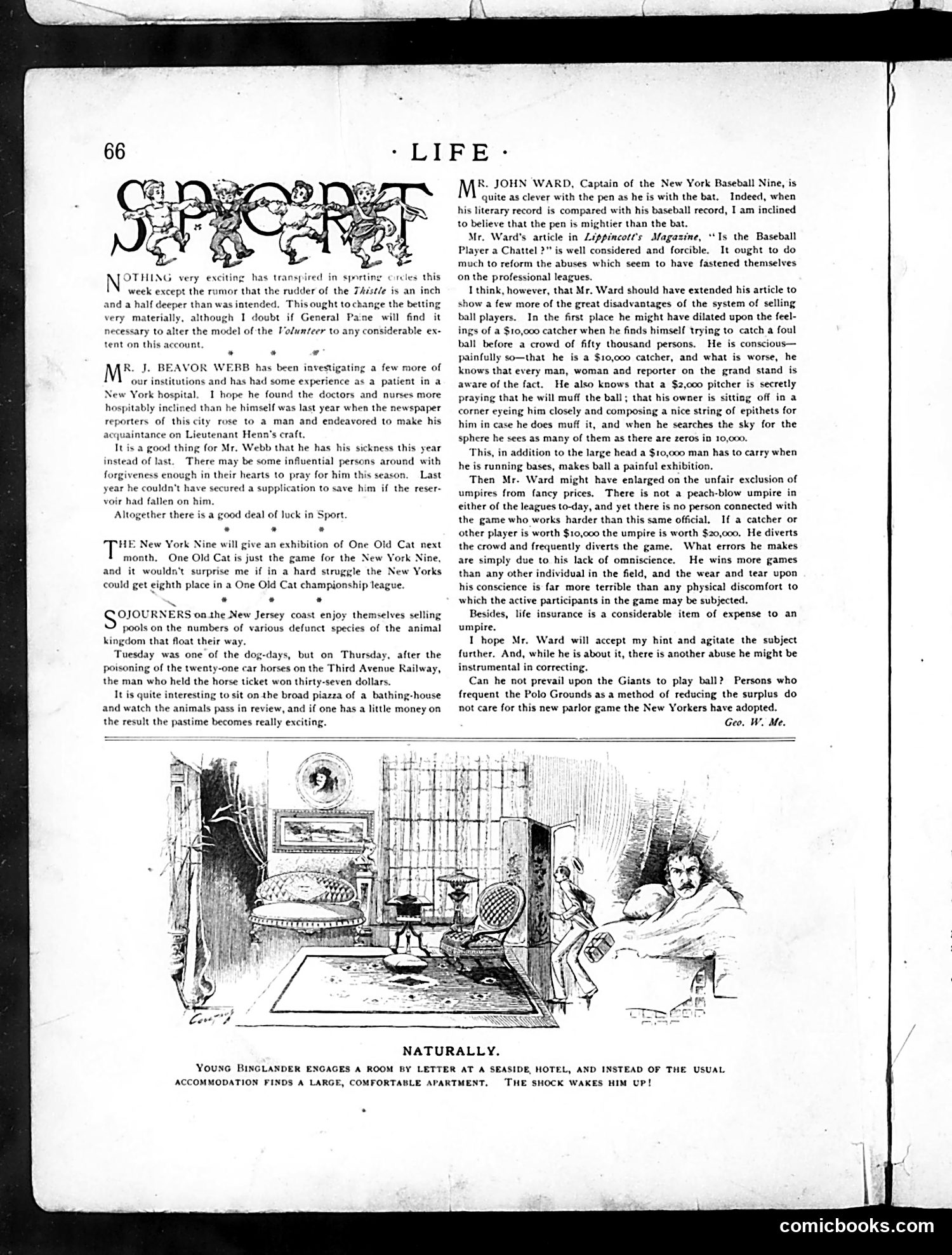
This cartoon satirizes a young Englishman who, while staying at a seaside hotel, requests a room by letter rather than accepting standard accommodation. The joke's punchline—"The shock wakes him up!"—suggests his elaborate request produced an absurdly luxurious or comically oversized room that startles him upon arrival. The satire targets pretentious British manners and overcomplicated formality. By writing a letter to secure lodging instead of simply booking in person, the Englishman exemplifies the stuffy, bureaucratic approach Life associated with the British upper class. His shock at receiving exactly what he demanded ridicules the gap between affected expectations and reality—a common theme in Life's humor about social affectation.
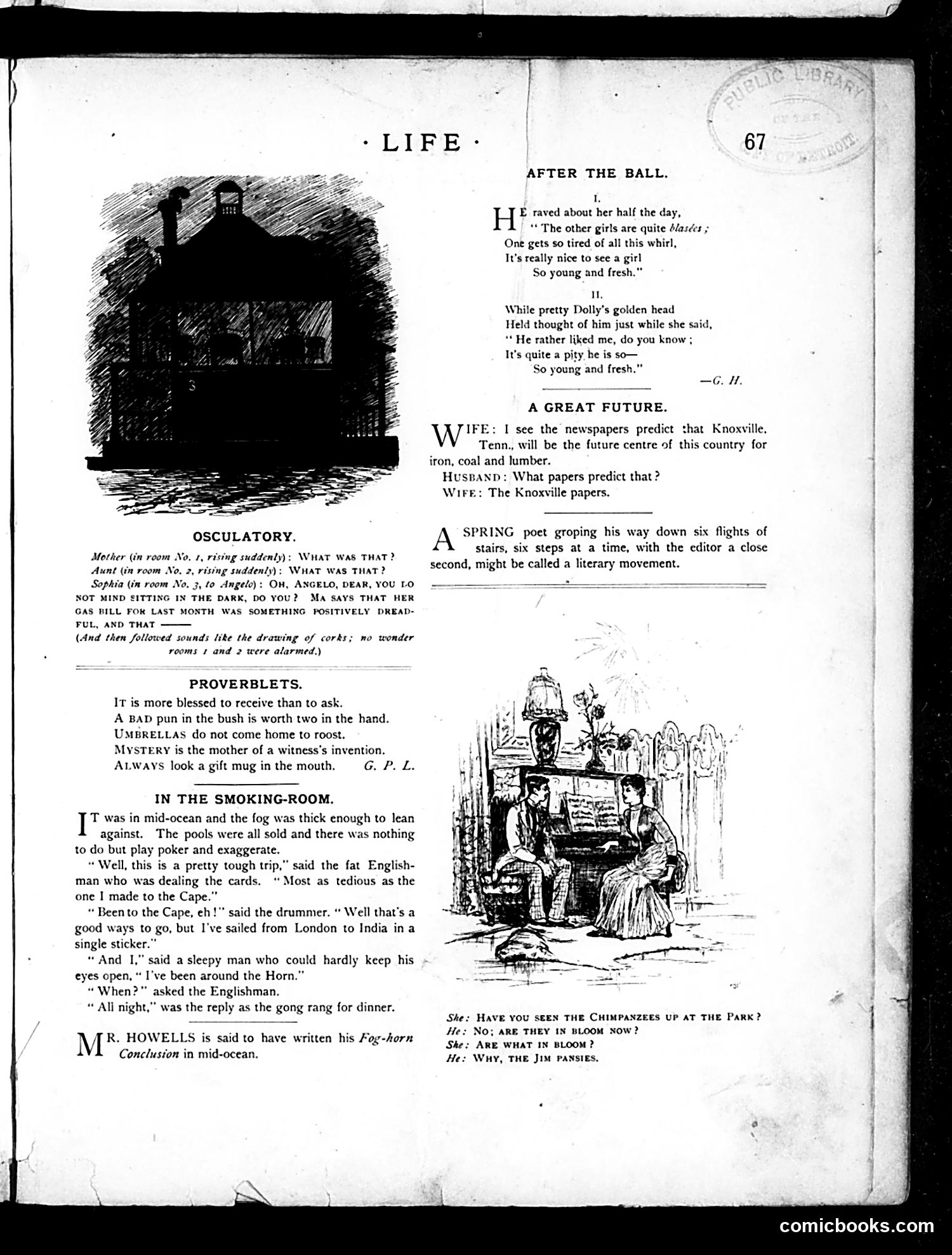
This page contains several short satirical pieces typical of early Life magazine's humor: **"Osculatory"** jokes about a young couple (Angelo and Sophia) kissing in darkened rooms while the aunt and mother in adjacent rooms hear suspicious sounds—"like the drawing of corks"—alarming them. The satire targets both propriety violations and the era's high gas bills that made darkness economical. **"In the Smoking-Room"** mocks exaggeration in travel stories, with men boasting increasingly outlandish sea voyages (Cape, London-to-India, around Cape Horn) in a competitive one-upmanship typical of period male braggadocio. **"A Great Future"** satirizes provincial self-promotion: a wife claims Knoxville newspapers predict the town's industrial dominance—circular reasoning that exposes local boosterism. **"A Literary Movement"** puns on a poet running downstairs from an angry editor as a "literary movement." The final exchange plays on "Jim pansies" (jimson weeds) sounding like "chimpanzees," targeting obtuse wordplay humor common to the era.
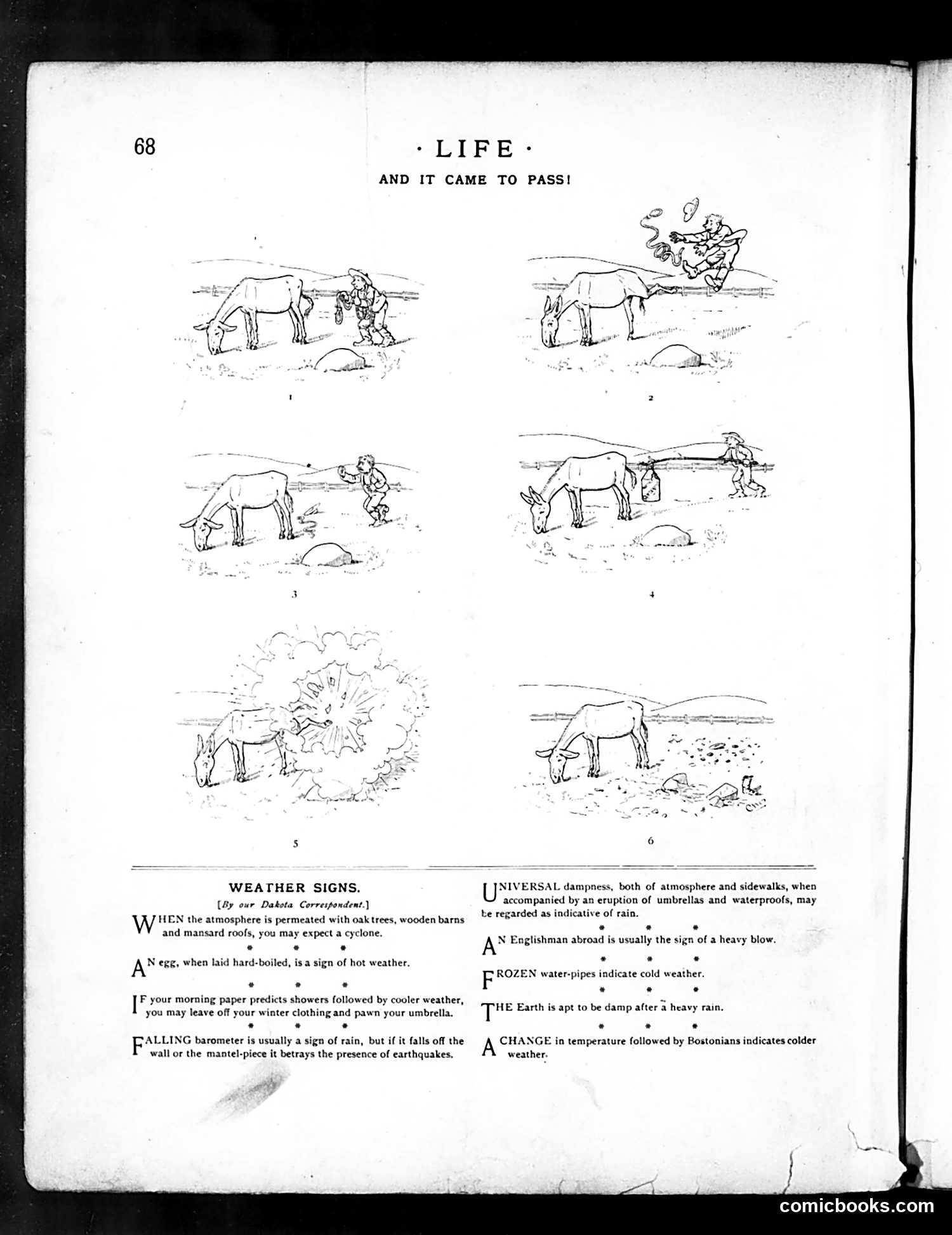
This page from *Life* magazine presents a humorous illustrated guide to weather prediction. The six numbered panels show a man attempting to use a donkey as a weather forecasting tool—pulling its tail, holding it, riding it—each supposedly demonstrating different meteorological outcomes. Below, the "Weather Signs" section offers deliberately absurd pseudo-scientific observations, mixing legitimate (falling barometer indicates rain) with ridiculous (an Englishman abroad signals "a heavy blow," frozen pipes mean cold weather). The final joke about "Bostonians" indicating cold weather appears to mock Boston's reputation. The satire targets people's tendency to find patterns and meaning in random occurrences, and pokes fun at folk meteorology. The donkey serves as the central absurd device—treating an animal's behavior as predictive, mirroring how people desperately seek weather certainty before modern forecasting.
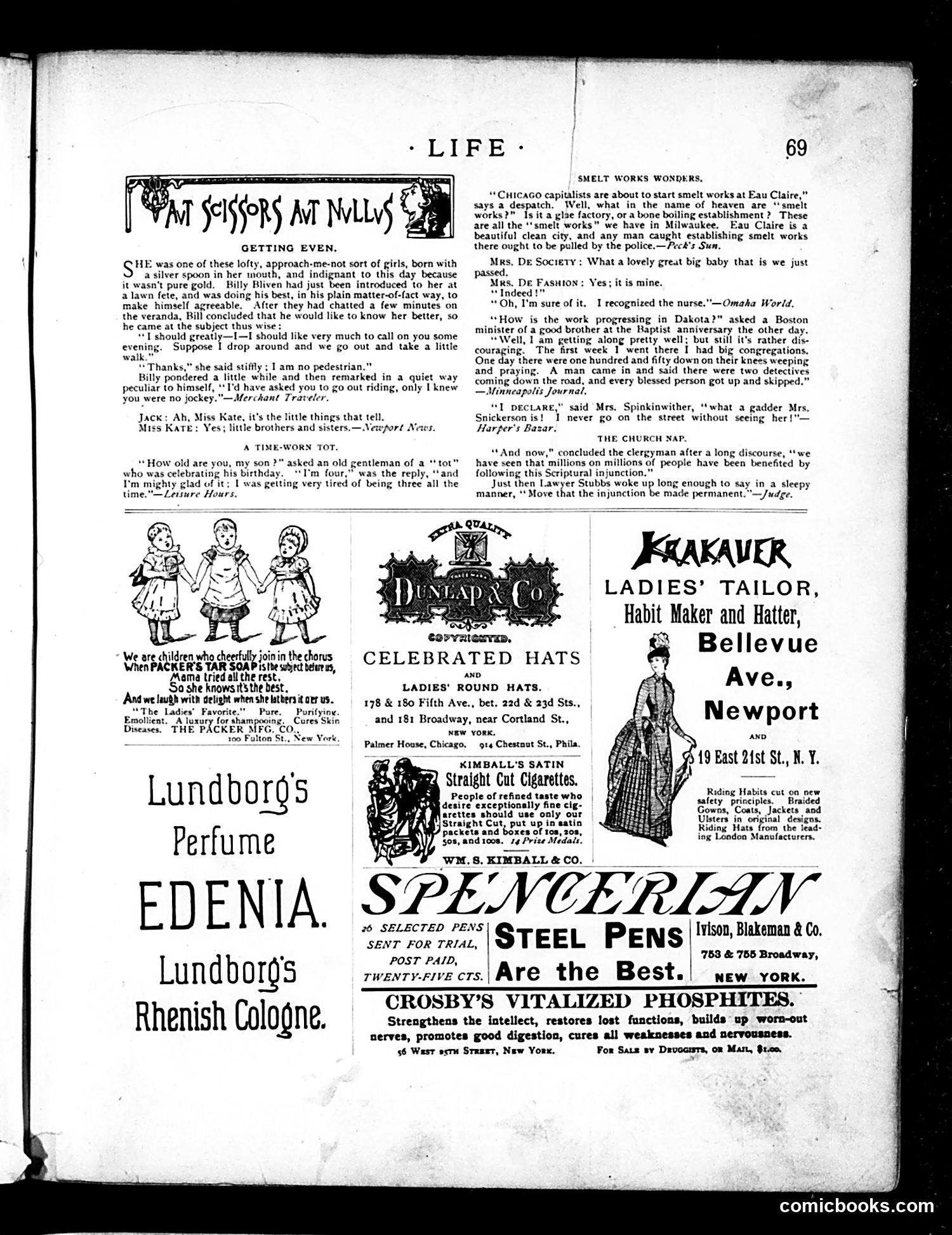
This page contains short humorous anecdotes rather than political cartoons. The main jokes rely on wordplay and social satire typical of late 19th-century American humor magazines. "Scissors at Nulls" features interconnected stories mocking upper-class pretension. Billy Bliven attempts to court a snobbish woman who claims she's "no pedestrian" (won't walk); he retorts she's "no jockey" either—satirizing her pompous refusal of ordinary activities. Other brief jokes target similar targets: a woman's vanity, social climbing, and hypocrisy. The "Smelt Works Wonders" item is a newspaper excerpt joking about a misunderstood business term—readers presumably confused the industrial term "smelt works" with something else, creating unintended comedy. The page is otherwise dominated by period advertisements for perfume, hats, pens, and patent medicines—typical commercial content filling magazine space.
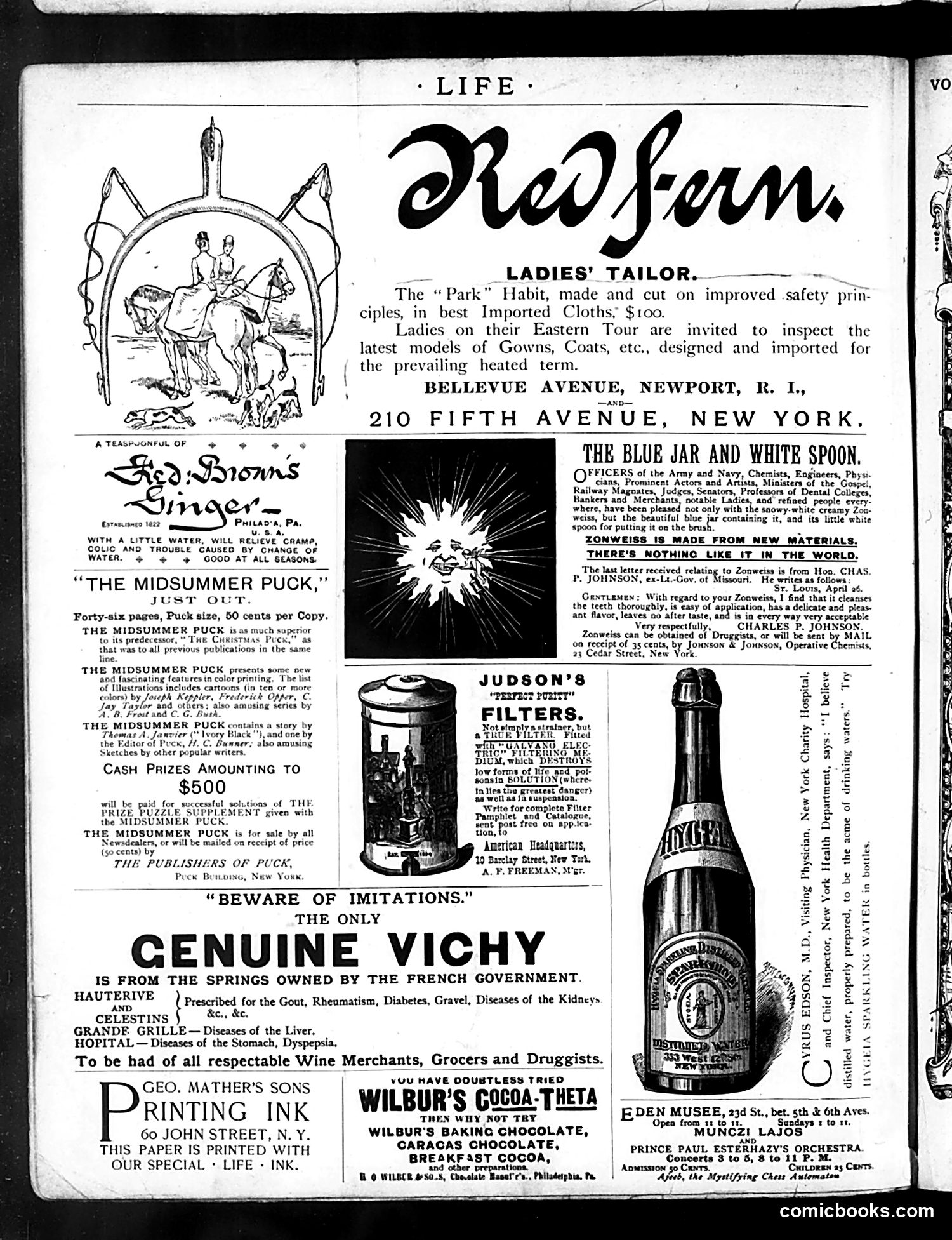
This is primarily an **advertising page** from Life magazine, not a political cartoon. The page contains multiple product advertisements typical of late 19th-century American periodicals. Notable content includes: - **Red Fern Ladies' Tailor**: High-end clothing advertiser (Newport and Fifth Avenue locations) - **The Midsummer Puck**: Advertisement for a rival satirical magazine featuring color cartoons and fiction - **Zonweiss**: Tooth-cleaning product endorsed by notable figures including an ex-Lieutenant Governor - **Judson's Filters**: Water filtration system - **Genuine Vichy Water**: French mineral water marketed for medicinal purposes (gout, rheumatism, kidney disease) - **Wilbur's Cocoa and Chocolate**: Food products The advertisements reflect Gilded Age consumer culture, emphasizing imported luxury goods, medical tonics, and refined domestic products for affluent readers. The endorsements by politicians and professionals were common advertising strategies of the era.