
Life, 1887-08-04 · page 6 of 14
Life — August 4, 1887 — page 6: what you’re looking at
What you’re looking at
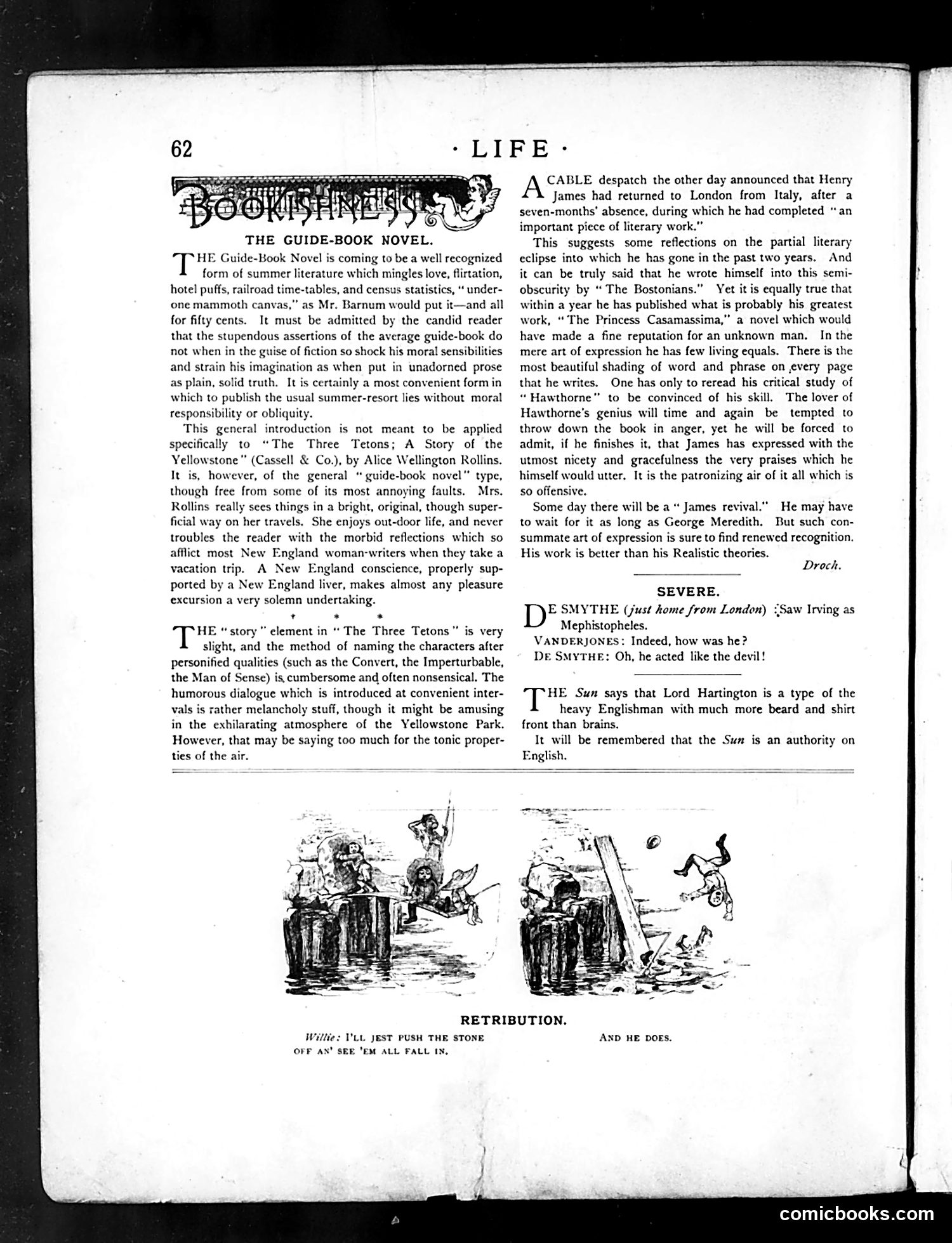
This page contains **book reviews** rather than political cartoons. The main content discusses "The Guide-Book Novel" as an emerging literary form, and reviews of works by Henry James and others. The only cartoon present is titled **"RETRIBUTION,"** showing two panels of a figure (labeled "Willie") pushing a stone off a wall, then falling as it tumbles down. The caption reads: "I'll jest push the stone off an' see i'm all fall in" / "And he does." This is a **simple moral cautionary tale**—a joke about comeuppance where Willie's mischievous action (pushing the stone) backfires literally when the stone falls on him. It's slapstick humor rather than political satire, illustrating consequences of one's actions.
📄 Transcribed text from this page (OCR, searchable)
Machine-transcribed from the original scan — historical spelling and the odd misread are preserved.
-LIFE- HE Guide-Book Novel is coming to be a well recognized form of summer literature which mingles love, flirtation, hotel puffs, railroad time-tables, and census statisti under- one mammoth canvas,” as Mr. Barnum would put it—and all for fifty cents. It must be admitted by the candid reader that the stupendous assertions of the average guide-book do not when in the guise of fiction so shock his moral sensibilities and strain his imagination as when put in unadorned prose as plain, solid truth. It is certainly a most convenient form in which to publish the usual summer-resort lies without moral responsibility or obliquity. This general introduction is not meant to be applied specifically to “The Three Tetons; A Story of the Yellowstone” (Cassell & Co.), by Alice Wellington Rollins. It is, however, of the general “ guide-book novel” type, though free from some of its most annoying faults. Mrs. Rollins really sees things in a bright, original, though super- ficial way on her travels. She enjoys out-door life, and never troubles the reader with the morbid reflections which so afflict most New England woman-writers when they take a vacation trip. A New England conscience, properly sup- ported by a New England liver, makes almost any pleasure excursion a very solemn undertaking. t . . HE “story” element in “ The Three Tetons" is very ight, and the method of naming the characters after personified qualities (such as the Convert, the Imperturbable, the Man of Sense) is cumbersome and often nonsensical. The humorous dialogue which is introduced at convenient inter- vals is rather melancholy stuff, though it might be amusing in the exhilarating atmosphere of the Yellowstone Park. However, that may be saying too much for the tonic proper- ties of the air. CABLE despatch the other day announced that Henry James had returned to London from Italy, after a seven-months’ absence, during which he had completed “an important piece of literary work.” This suggests some reflections on the partial literary eclipse into which he has gone in the past two years. And it can be truly said that he wrote himself into this semi- obscurity by “ The Bostonians.” Yet it is equally true that within a year he has published what is probably his greatest work, “The Princess Casamassima,” a novel which would have made a fine reputation for an unknown man, In the mere art of expression he has few living equals. There is the most beautiful shading of word and phrase on ,every page that he writes. One has only to reread his critical study of “Hawthorne” to be convinced of his skill. The lover of Hawthorne's genius will time and again be tempted to throw down the book in anger, yet he will be forced to admit, if he finishes it, that James has expressed with the utmost nicety and gracefulness the very praises which he himself would utter, It is the patronizing air of it all which is so offensive. Some day there will be a “ James revival." He may have to wait for it as long as George Meredith. But such con- summate art of expression is sure to find renewed recognition. His work is better than his Realistic theories. Droch. SEVERE, E SMYTHE (just home from London) Saw Irving as Mephistopheles. VANDERJON: Indeed, how was he? De SMYTHE: Oh, he acted like the devil! HE Sun says that Lord Hartington is a type of the heavy Englishman with much more beard and shirt front than brains. It will be remembered that the Sua is an authority on English. RETRIBUTION. Willie: VL JEST PUSH THE STONE OFF AN’ SEE ‘EM ALL FALL IN, AND HE DOES. comicbooks.com