
Life, 1887-08-04 · page 5 of 14
Life — August 4, 1887 — page 5: what you’re looking at
What you’re looking at
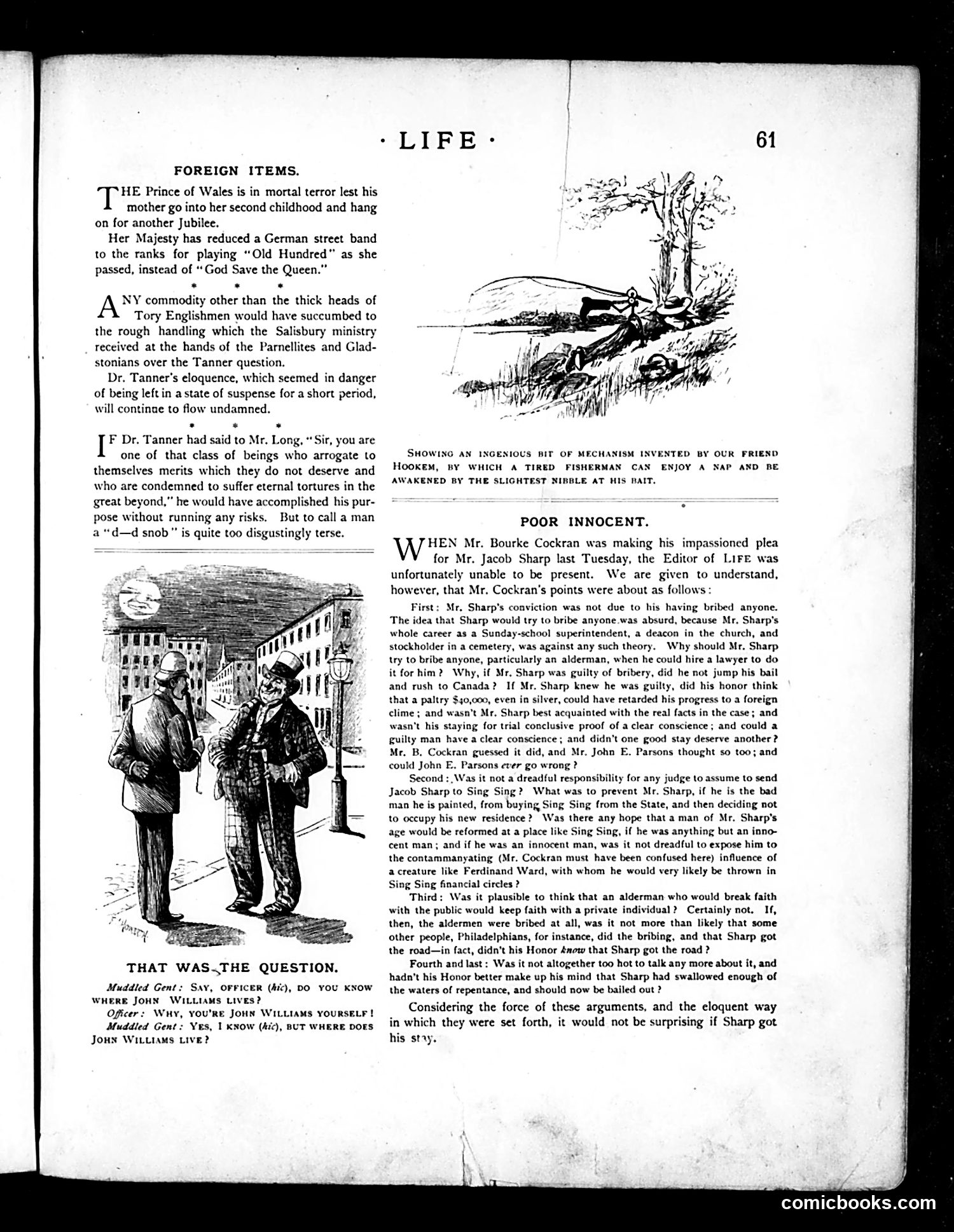
This page contains two distinct sections: **"That Was the Question"** (bottom left): A brief satirical dialogue between a "Muddled Gent" and an Officer about locating "John Williams." The joke plays on the officer's literal response—that Williams lives wherever he currently is—mocking the absurdity of the question itself. This appears to be a simple wordplay gag rather than political satire. **"Poor Innocent"** (main article): Discusses the Jacob Sharp bribery case, defending Sharp against charges of corruption. The text presents counterarguments that Sharp wouldn't logically resort to bribery given his position and wealth. This appears to be defending a controversial political figure through satirical argument, though the specific historical context of Sharp's alleged crimes isn't detailed here. The page's top includes brief foreign items and an illustration of a fisherman.
📄 Transcribed text from this page (OCR, searchable)
Machine-transcribed from the original scan — historical spelling and the odd misread are preserved.
FOREIGN ITEMS. HE Prince of Wales is in mortal terror lest his mother go into her second childhood and hang on for another Jubilee. Her Majesty has reduced a German street band to the ranks for playing “Old Hundred” as she passed, instead of “God Save the Queen.” . . . NY commodity other than the thick heads of Tory Englishmen would have succumbed to the rough handling which the Salisbury ministry received at the hands of the Parnellites and Glad- stonians over the Tanner question. Dr. Tanner's eloquence, which seemed in danger of being left in a state of suspense for a short period, will continae to flow undamned. . . . F Dr. Tanner had said to Mr. Long, “Sir, you are one of that class of beings who arrogate to themselves merits which they do not deserve and who are condemned to suffer eternal tortures in the great beyond,” he would have accomplished his pur- pose without running any risks. But to call a man a “d—d snob" is quite too disgustingly terse. THAT WAS.~THE QUESTION. Muddled Gent; SAY, OFFICER (hic), DO YoU KNOW WHERE JOHN WILLIAMS Lives? Oficer: Wuv, You're JOHN WILLIAMS YOURSELF ! Muddled Gent: Yes, 1 KNOW (hid), BUT WHERE DOES Joun WILLIAMS Live? SHOWING AN INGENIOUS BIT OF MECHANISM INVENTED BY OUR FRIEND HOOKEM, BY WHICH A TIRED FISHERMAN CAN ENJOY A NAP AND BE AWAKENED BY THE SLIGHTEST NIBBLE AT HI: POOR INNOCENT. HEN Mr. Bourke Cockran was making his impassioned plea for Mr. Jacob Sharp last Tuesday, the Editor of LIFE was unfortunately unable to be present. We are given to understand, however, that Mr. Cockran’s points were about as follows : First: Mr, Sharp's conviction was not due to his having bribed anyone. The idea that Sharp would try to bribe anyone.was absurd, because Mr, Sharp's whole career as a Sunday-school superintendent, a deacon in the church, and stockholder in a cemetery, was against any such theory. Why should Mr. Sharp try to bribe anyone, particularly an alderman, when he could hire a lawyer to do it for him? Why, if Mr, Sharp was guilty of bribery, did he not jump his bai and rush to Canada? If Mr. Sharp knew he was guilty, did his honor think that a paltry $40,000, even in silver, could have retarded his progress to a foreign clime ; and wasn’t Mr. Sharp best acquainted with the real facts in the case; and wasn't his staying for trial conclusive proof of a clear conscience ; and could a guilty man have a clear conscience; and didn’t one good stay deserve another? Mr. B, Cockran guessed it did, and Mr. John E. Parsons thought so too; and could John E. Parsons ever go wrong ? Second : Was it not a dreadful responsibility for any judge to assume to send Jacob Sharp to Sing Sing? What was to prevent Mr. Sharp, if he is the bad man he is painted, from buying Sing Sing from the State, and then deciding not to occupy his new residence? Was there any hope that a man of Mr, Sharp's age would be reformed at a place like Sing Sing, if he was anything but an inno- cent man; and if he was an innocent man, was it not dreadful to expose him to the contammanyating (Mr. Cockran must have been confused here) influence of acreature like Ferdinand Ward, with whom he would very likely be thrown in Sing Sing financial circles ? Third: Was it plausible to think that an alderman who would break faith with the public would keep faith with a private individual? Certainly not. If, then, the aldermen were bribed at all, was it not more than likely that some other people, Philadelphians, for instance, did the bribing, and that Sharp got the road—in fact, didn’t his Honor 4now that Sharp got the road ? Fourth and last : Was it not altogether too hot to talk any more about it, and hadn't his Honor better make up his mind that Sharp had swallowed enough of the waters of repentance, and should now be bailed out ? Considering the force of these arguments, and the eloquent way in which they were set forth, it would not be surprising if Sharp got his stay. comicbooks.com