
A complete issue · 16 pages · 1887
Life — July 21, 1887
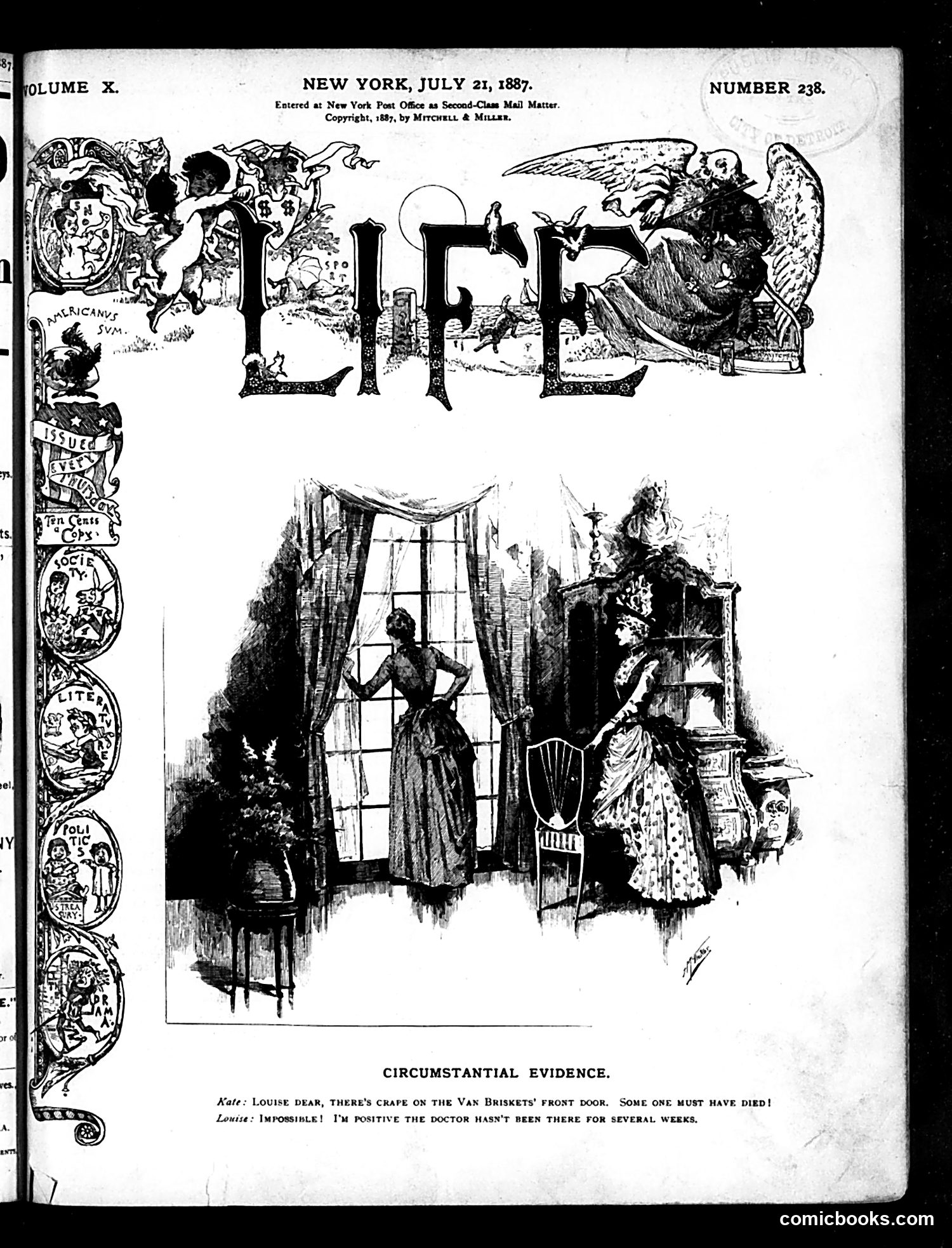
This 1887 *Life* magazine page contains a satirical cartoon titled "CIRCUMSTANTIAL EVIDENCE." The sketch depicts an interior domestic scene where two women discover something troubling—the caption references "crape on the Van Briskets' front door," suggesting a death in the household. The joke hinges on dark humor: Kate observes the mourning decoration and assumes someone has died, but Louise responds that it's "impossible" because "the doctor hasn't been there for several weeks." The satire mocks medical incompetence or suggests the doctor's absence caused the death—a commentary on the quality or necessity of medical care in that era. The elaborate decorative borders typical of *Life* magazine frame the artwork, showcasing the publication's visual sophistication.
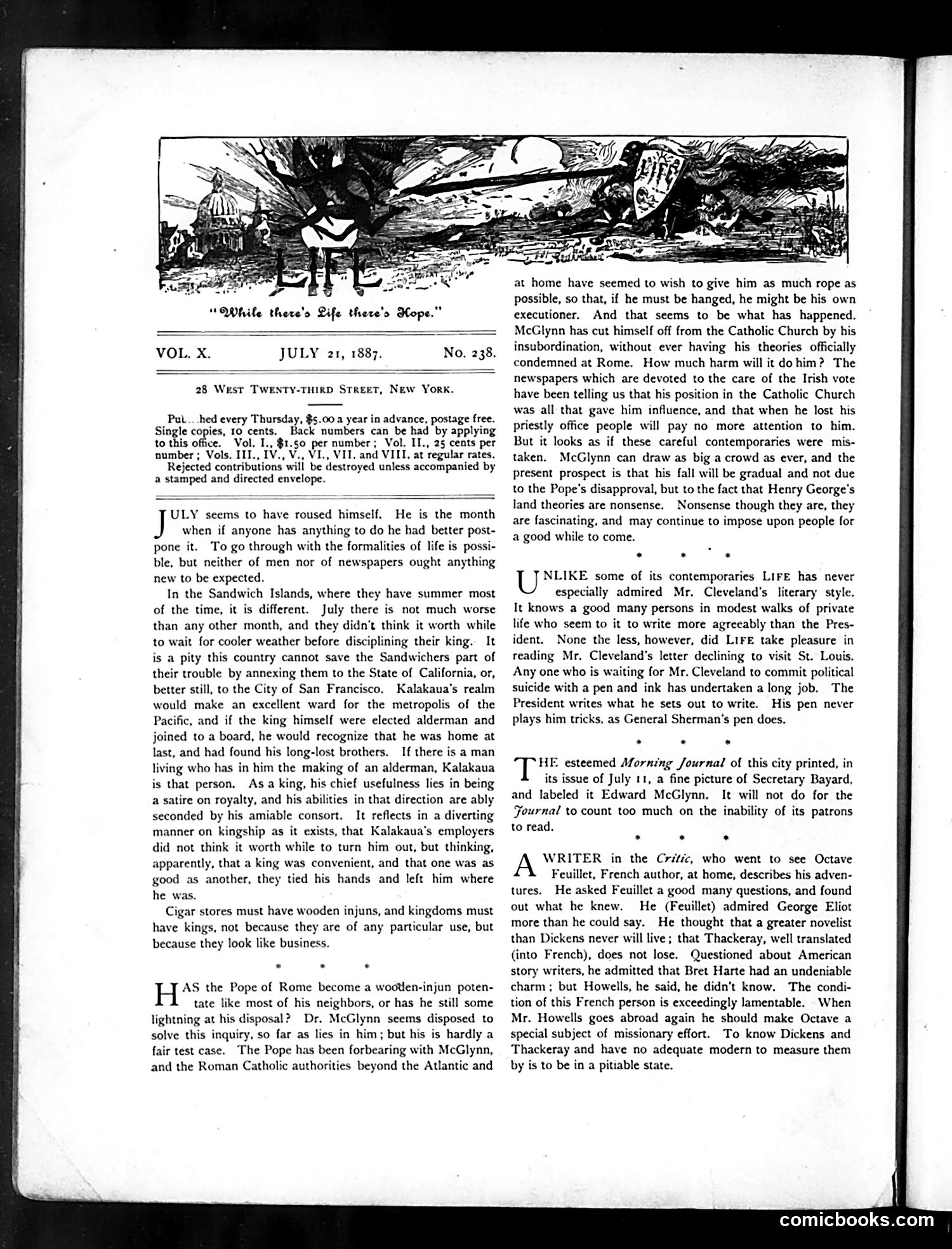
The top cartoon, titled "While there's Life there's Hope," depicts a skeletal Death figure looming over a landscape. The image appears to satirize mortality or societal decline, though the specific reference is unclear without additional context. The text discusses Dr. McGlynn, a Catholic priest who has broken with Church authority. The article notes his fall from influence will be "gradual," suggesting ecclesiastical punishment. The piece also critiques President Cleveland's literary style and mentions a visit to Octave Feuillet, a French author. The overall page reflects *Life*'s typical 1880s approach: combining visual satire with political and cultural commentary on contemporary figures and institutional conflicts.
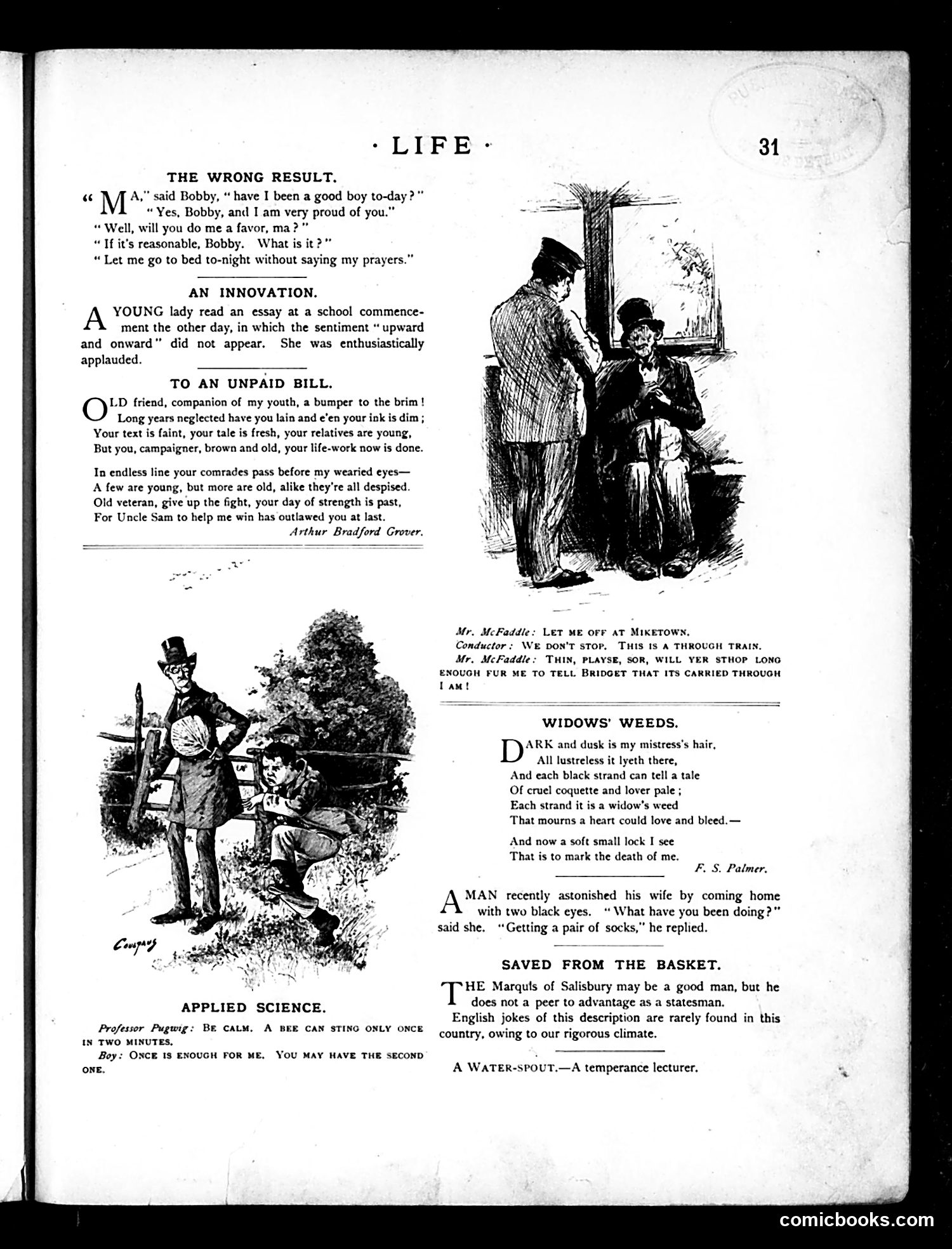
This page contains several short humorous items typical of early Life magazine's satirical format: **"The Wrong Result"** jokes about a boy seeking parental approval through good behavior, only to be asked to skip prayers—inverting expected outcomes. **"An Innovation"** mocks a schoolgirl's essay that omits the conventional phrase "upward and onward," suggesting satire of formulaic student writing. **"To an Unpaid Bill"** is a poem addressing an old debtor, using mock-heroic language to plead for payment. The illustrations show working-class or immigrant figures in period dress. **"Applied Science"** contains a brief joke about bees and stinging. Most items target everyday social situations—debt, parenting, education—rather than specific political figures or events. The overall tone is genteel mockery of middle-class life and human nature.
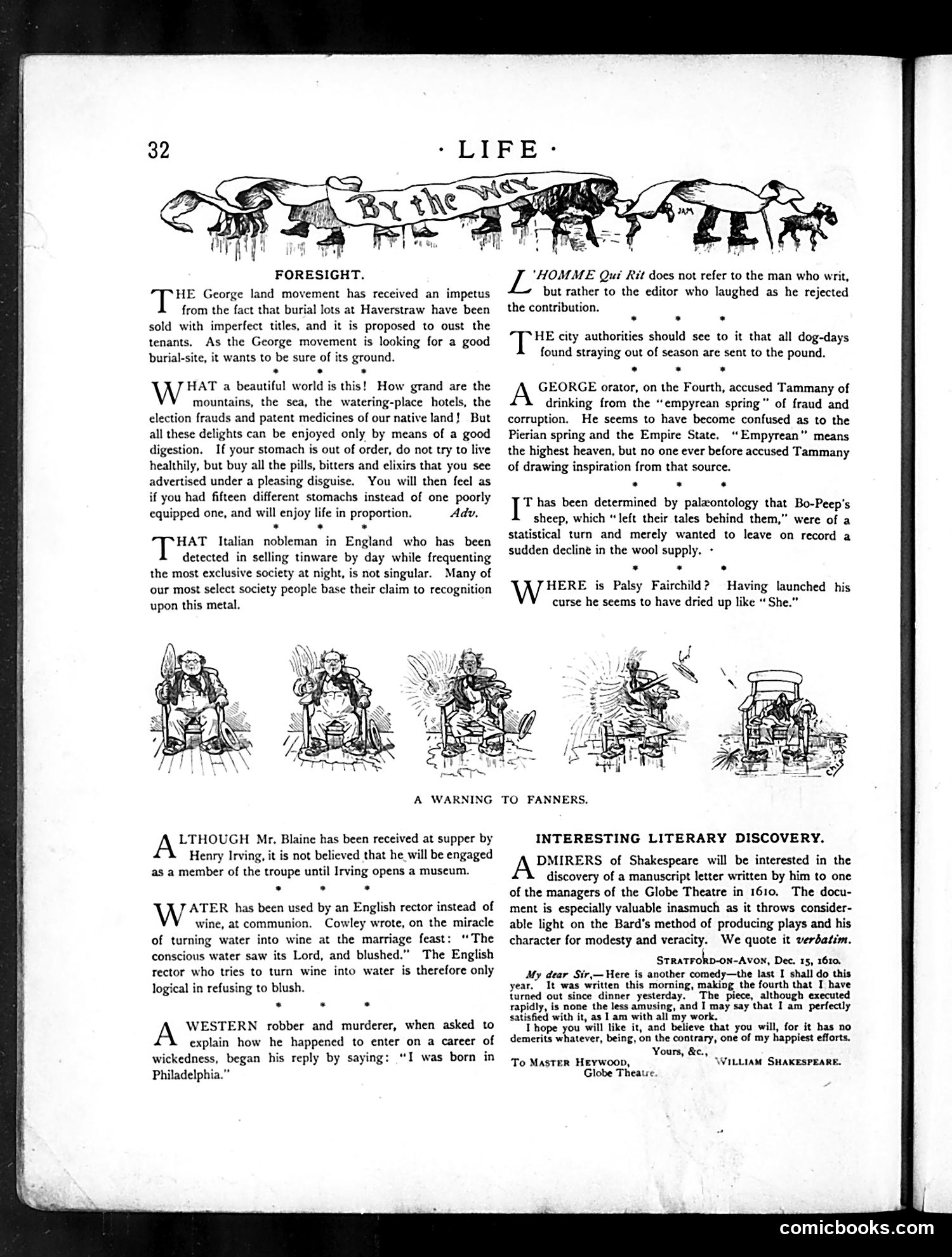
This page contains several satirical commentary items rather than a unified political cartoon: 1. **"A Warning to Fanners"** - The five-panel sequence depicts a man in a chair experiencing increasingly violent reactions, likely satirizing exaggerated responses to some contemporary issue (unclear which specific event without more context). 2. **Various short satirical items** mock: - George movement's land proposals (burial lots at Haversham) - An Italian nobleman selling tinware by night while claiming social status - Mr. Blaine's activities - An English rector substituting water for communion wine 3. **"Interesting Literary Discovery"** - Features a Shakespeare letter to the Globe Theatre, apparently satirizing theatrical practices or claims about Shakespeare's methods. The page is typical Life magazine fare: brief, topical satire on contemporary social pretensions and political figures, requiring knowledge of 1880s-90s American events for full understanding.
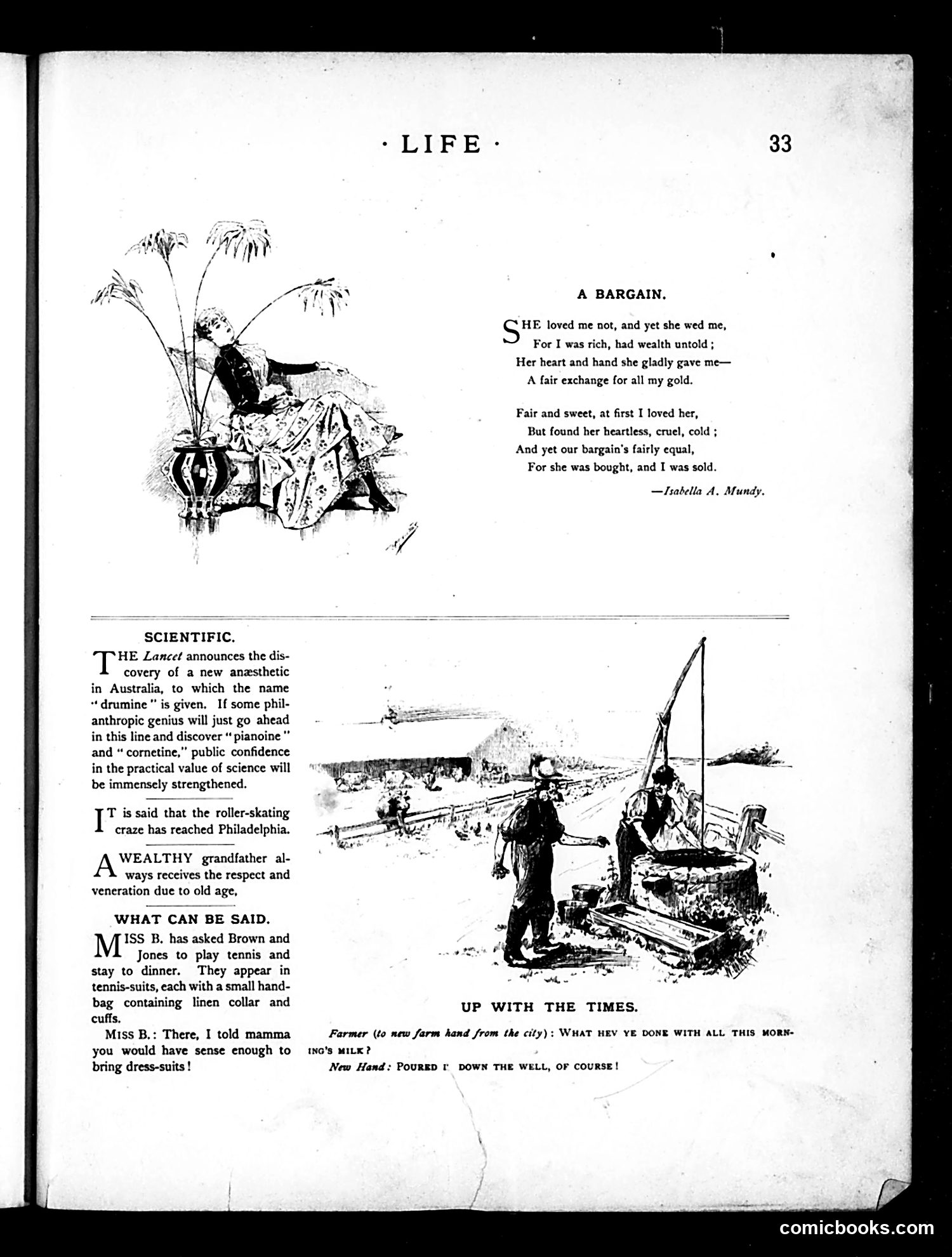
This page contains three distinct sections: 1. **"A Bargain"** — A poem by Isabella A. Mundy about a woman who married a wealthy man for his money rather than love, presenting a cynical view of matrimonial exchange. 2. **"Scientific"** — A brief news item about a new Australian anesthetic called "drumme," humorously suggesting philanthropists might discover similar drugs like "pianoine" and "cornetine." 3. **"Up with the Times"** — A cartoon depicting a farmer and presumably a city visitor at a well. The joke hinges on the city visitor asking about modernization ("What have ye done with all this morning's milk?"), to which the farmer responds he's "poured it down the well" — satirizing rural resistance to modern progress and urban confusion about country life. The humor reflects early 20th-century tensions between rural and urban American cultures.
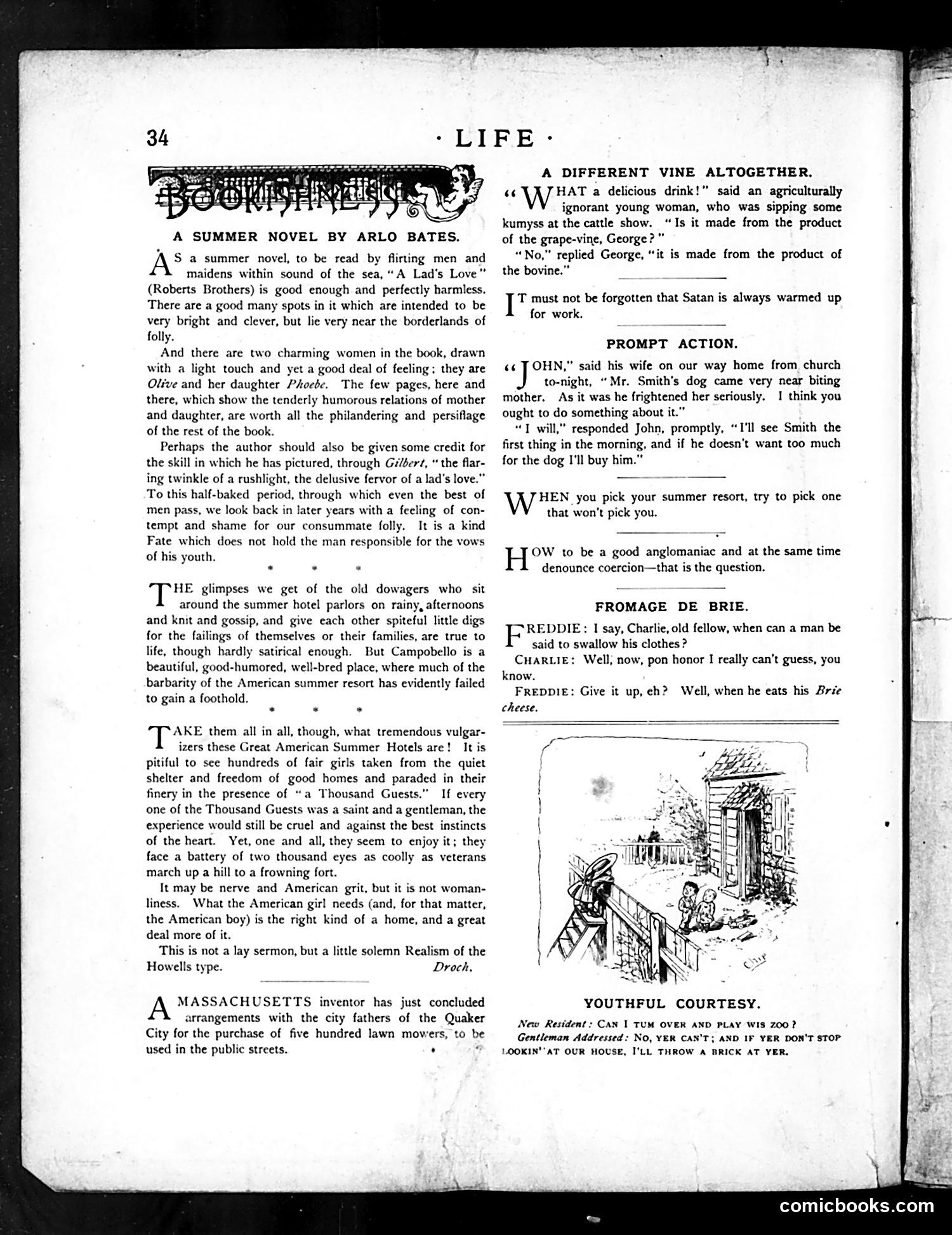
This page contains literary and humorous content rather than political cartoons. The main piece is a book review of "A Lad's Love" by Arlo Bates, a summer novel praised for its light romantic tone and two well-drawn female characters. The page includes several brief humorous sketches: "A Different Vine Altogether" jokes about wine production, "Prompt Action" humorously depicts marital dynamics, and "Fromage de Brie" features wordplay about eating clothes and French cheese. A small illustration shows a domestic scene. The final item, "Youthful Courtesy," presents a exchange between a new resident and gentleman about playing near the house—likely satirizing neighborhood etiquette and child discipline expectations of the era. The content reflects genteel, middle-class American humor of the period.
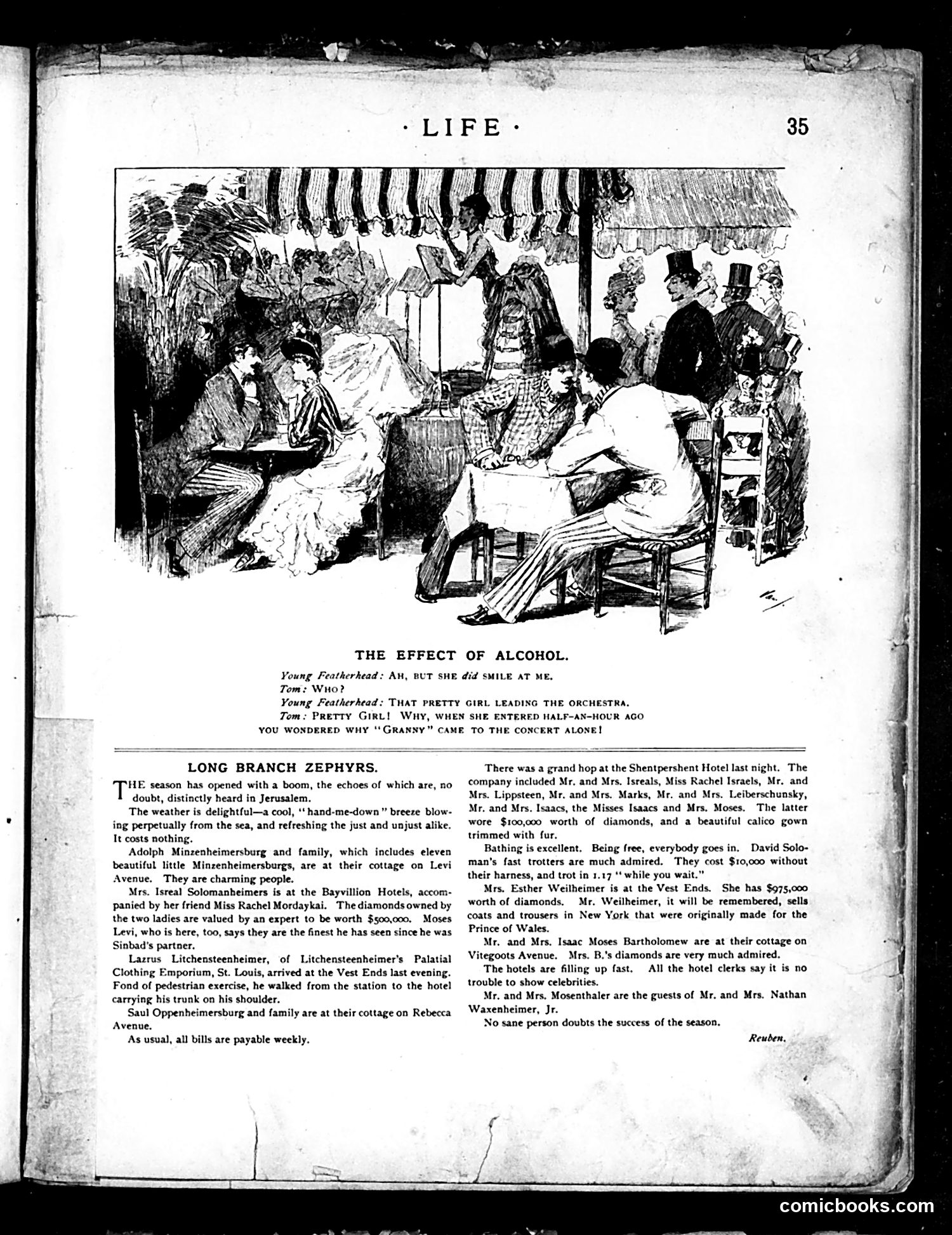
This cartoon satirizes upper-class social hypocrisy regarding alcohol consumption. The sketch depicts a fancy outdoor concert or garden party where elegantly dressed guests are gathered. The dialogue reveals the satire: a young man remarks that a "pretty girl leading the orchestra" smiled at him, and another asks why "Granny" came to the concert alone—implying alcohol's disinhibiting effects on proper behavior. The cartoon mocks the contradiction between Victorian propriety (formal dress, refined venues) and actual conduct when drinking occurs. The humor targets how alcohol loosens social restraint among the wealthy, making them behave contrary to their dignified appearances. It's social commentary on class and morality, suggesting respectability masks less virtuous reality.
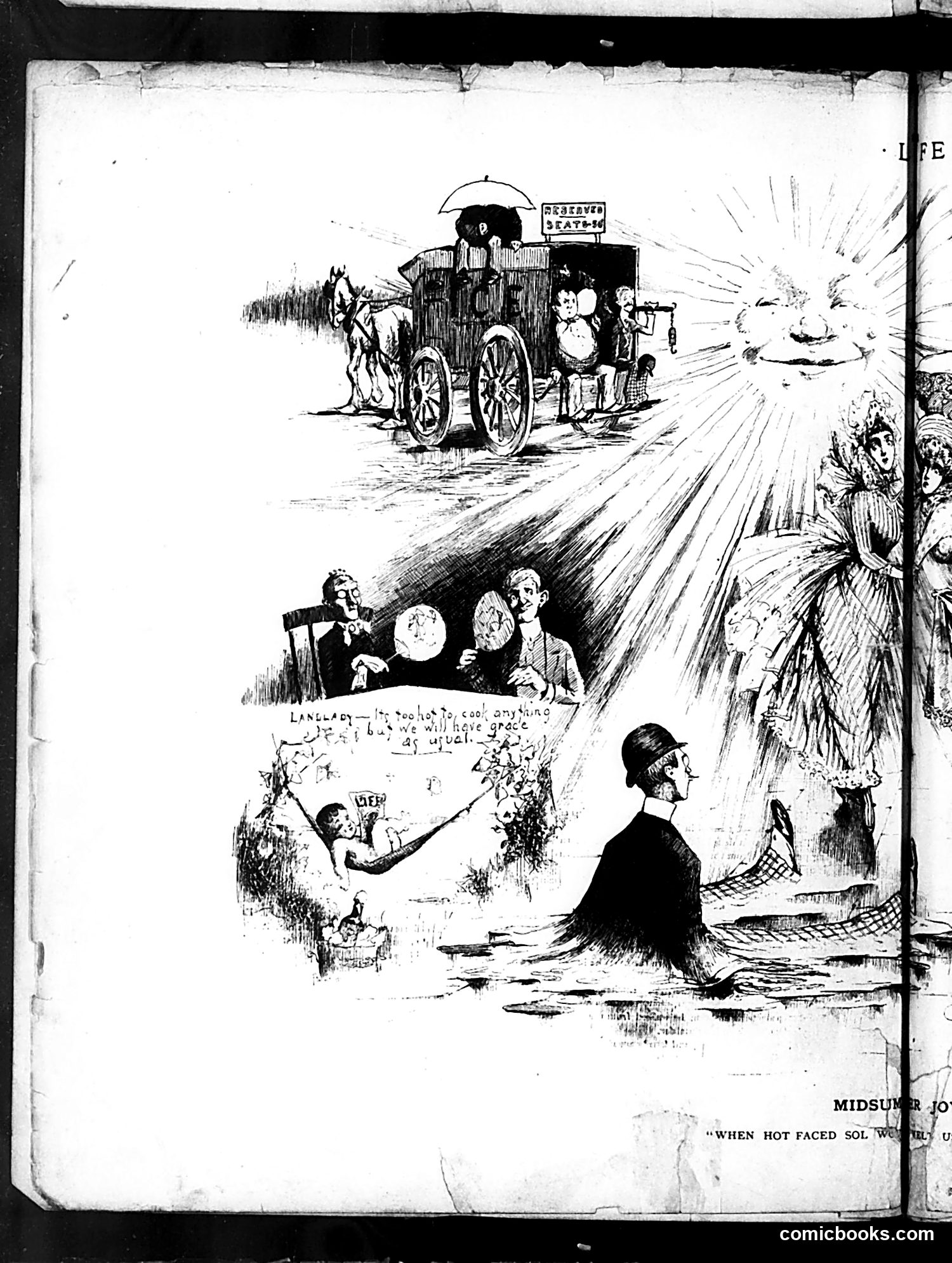
This appears to be a satirical illustration commentary on social class and transportation. The image shows contrasting scenes: upper-class figures in a horse-drawn carriage labeled "RESERVED SEATS" traveling on a road, while working-class figures are relegated to a ditch below. A well-dressed man in a bowler hat observes from the roadside. The caption references being "hot faced" and appears to address class inequality in public transportation or social access. The visual metaphor—literally placing poor people in a lower, dirtier position while the wealthy occupy "reserved seats"—critiques the hierarchical nature of society. The text in the ditch is partially legible but appears to comment on hardship or injustice. This reflects early 20th-century American satire about class divisions and social mobility.
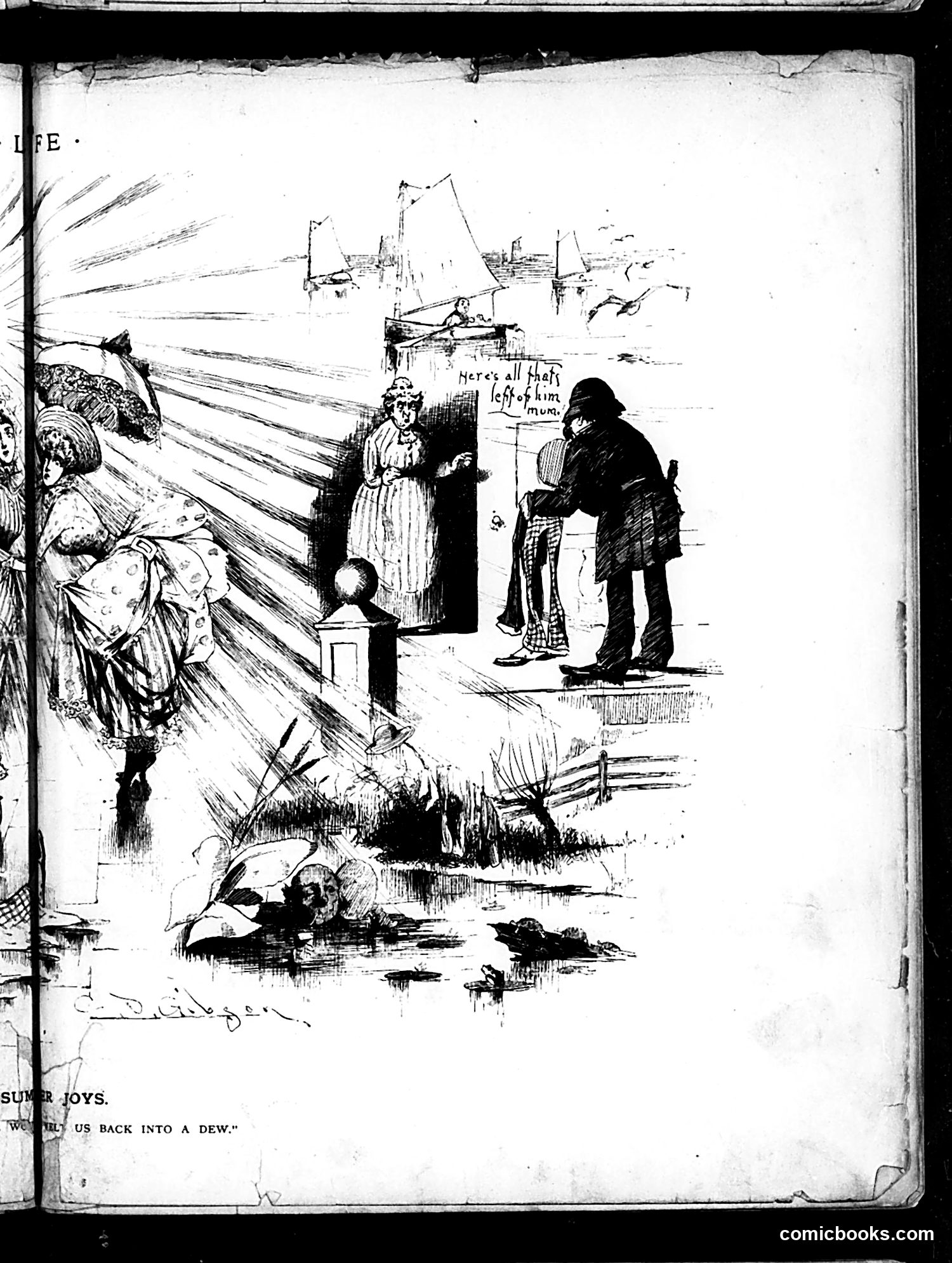
This appears to be a satirical illustration titled "Summer Joys" with the caption "We'll Us Back Into a Dew." The sketch depicts a waterside scene with figures in period dress (likely late 19th/early 20th century). On the left, women in elaborate clothing observe the scene. In the center, figures interact near what appears to be a dock or waterfront, with sailboats visible in the background. The handwritten note "Here's all that's left of him mum" suggests dark humor about someone's fate. The satire likely comments on social conventions of seaside leisure or courtship among the upper classes, with the morbid punchline implying an unfortunate outcome—possibly drowning or romantic disaster. The formal dress and maritime setting reference fashionable resort culture of the era.
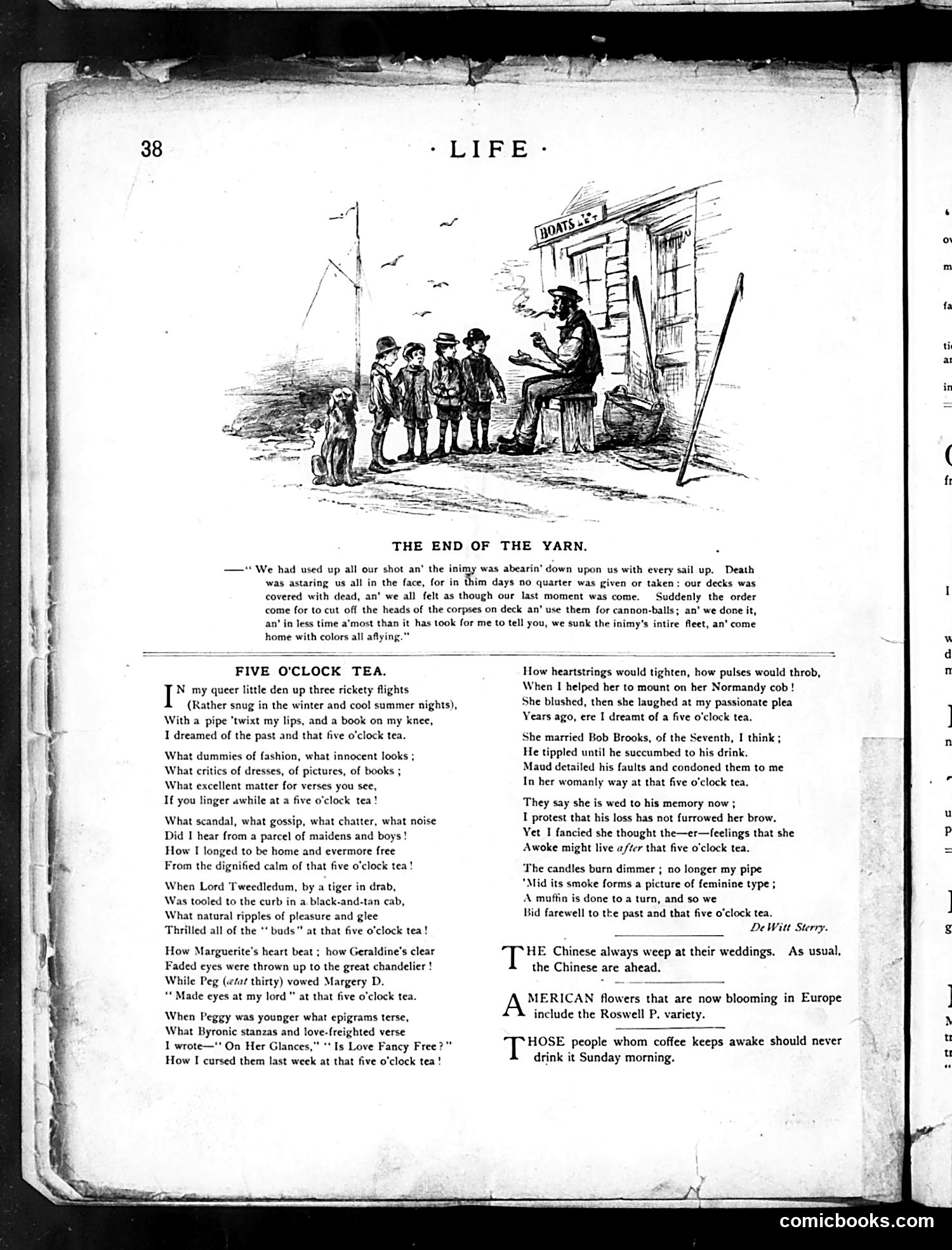
The illustration depicts a storyteller seated outside a boathouse, entertaining a group of children and a dog. Based on the title "The End of the Yarn," this appears to be satirizing someone telling tall tales or exaggerated nautical stories to an credulous audience. The quoted passage above describes a ship battle with dramatic, embellished language ("Death was staring us all in the face"), typical of adventure fiction. The cartoon mocks both the storyteller's grandiose narrative style and the children's rapt attention to obviously fictional accounts. This reflects a broader 19th-century satirical tradition mocking excessive romanticism in literature and the gullibility of audiences who accepted implausible adventure narratives as entertainment.
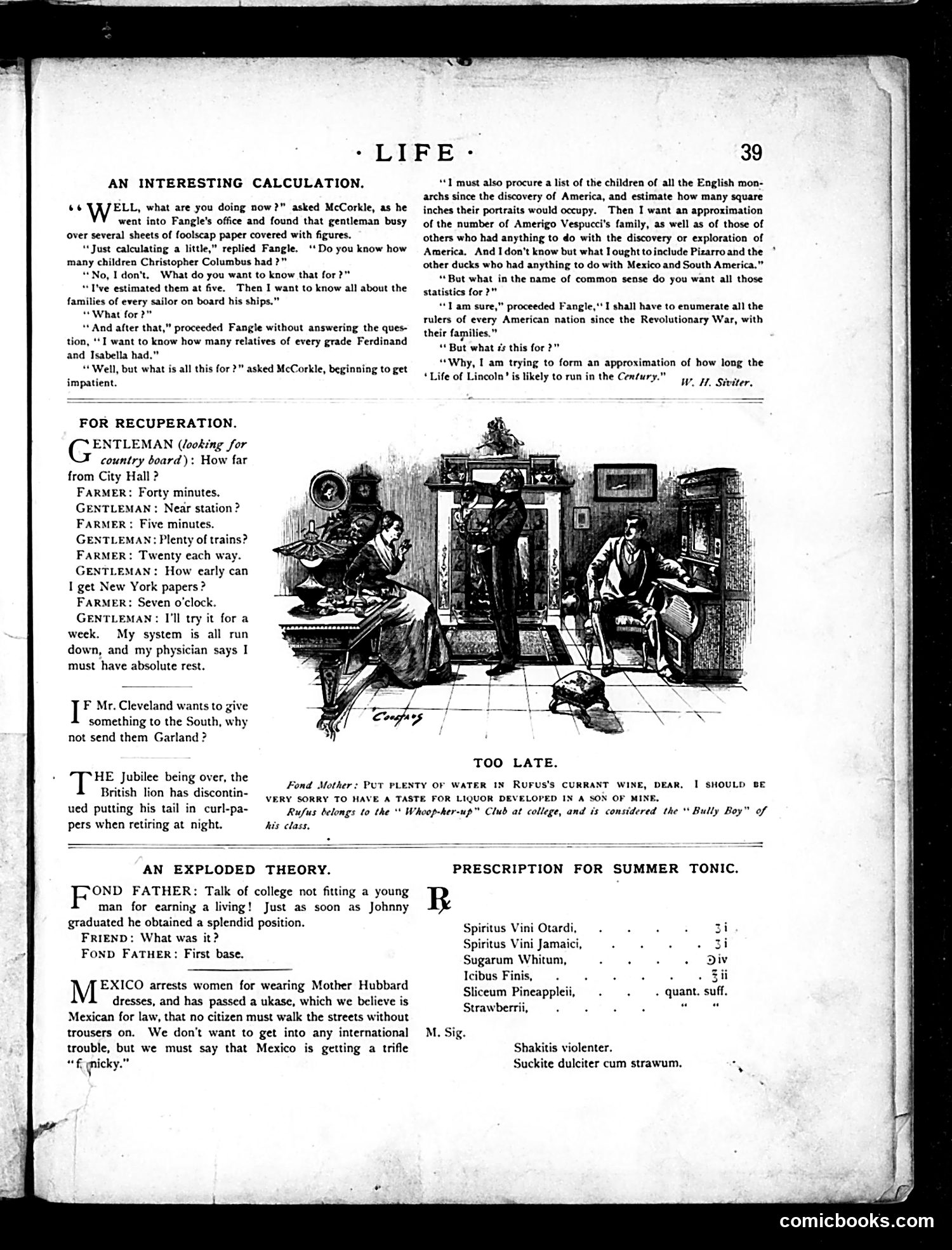
This page from *Life* magazine contains several brief satirical sketches typical of the publication's humor: **"An Interesting Calculation"**: Mocks obsessive genealogical research. Fangle compiles pointless family statistics about Columbus, Ferdinand and Isabella, and Amerigo Vespucci—apparently to estimate how long a serialized biography of Lincoln might run in *Century* magazine. The joke: absurd, elaborate calculations to answer a trivial question. **"For Recuperation"**: A gentleman seeking rest discovers his "country board" location is actually closer to the city than he thought—newspapers arrive at 7 a.m., trains run frequently. The irony: he cannot escape urban life despite traveling for recuperation. **"Too Late"**: A fond mother laments her son developed a taste for liquor at college, where he's known as the "Bully Boy" of his fraternity club. **"An Exploded Theory"**: Challenges the notion that college doesn't prepare men for work—a graduate obtained "a splendid position" as... a baseball first baseman (an absurd "job"). The humor relies on irony, misdirection, and contemporary references to college culture and leisure.
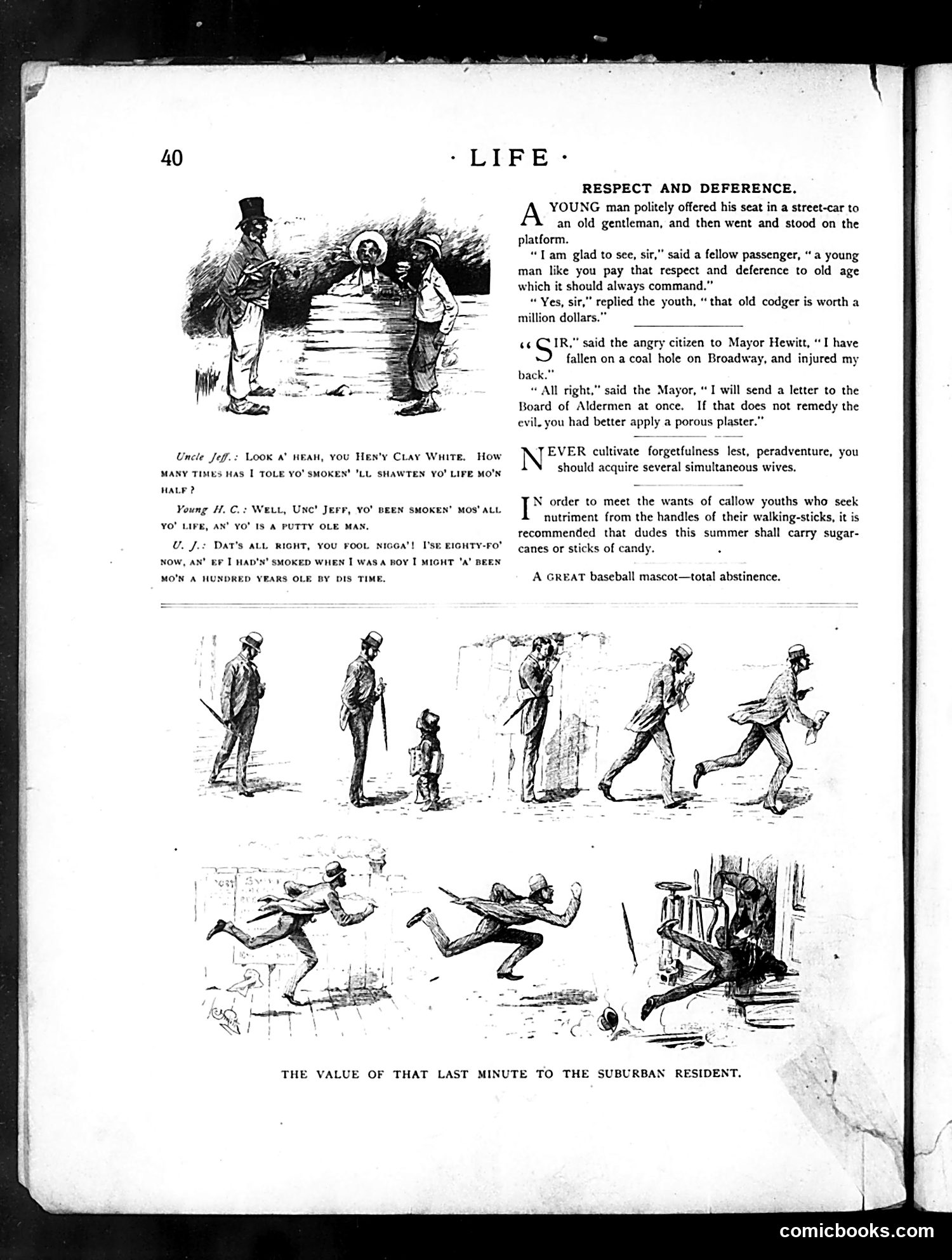
This page from *Life* magazine contains multiple brief satirical pieces mocking 1890s American society: **"Respect and Deference"**: A young man yields his streetcar seat to an elderly gentleman—appearing virtuous until revealed his motive is purely mercenary (the old man is wealthy). The satire critiques superficial courtesy masking materialistic values. **Coal Hole Complaint**: A citizen injured by an uncovered coal hole on Broadway appeals to Mayor Hewitt, who dismissively offers bureaucratic theater ("send a letter") rather than actual remedies. This mocks municipal incompetence and indifference to public safety hazards. **Dialect Dialogue** ("Uncle Jeff"): Uses offensive period racial stereotypes in a conversation about smoking's life-shortening effects—likely intended as crude humor. **Minor Items**: Brief jokes about forgetfulness, dudes (fashionable young men) eating sugar-canes as walking sticks, and baseball mascots. The bottom series of sketches illustrates "the value of that last minute to the suburban resident"—presumably showing frantic commuter behavior catching trains. The overall tone is cynical, targeting greed, bureaucratic failure, and social pretense.
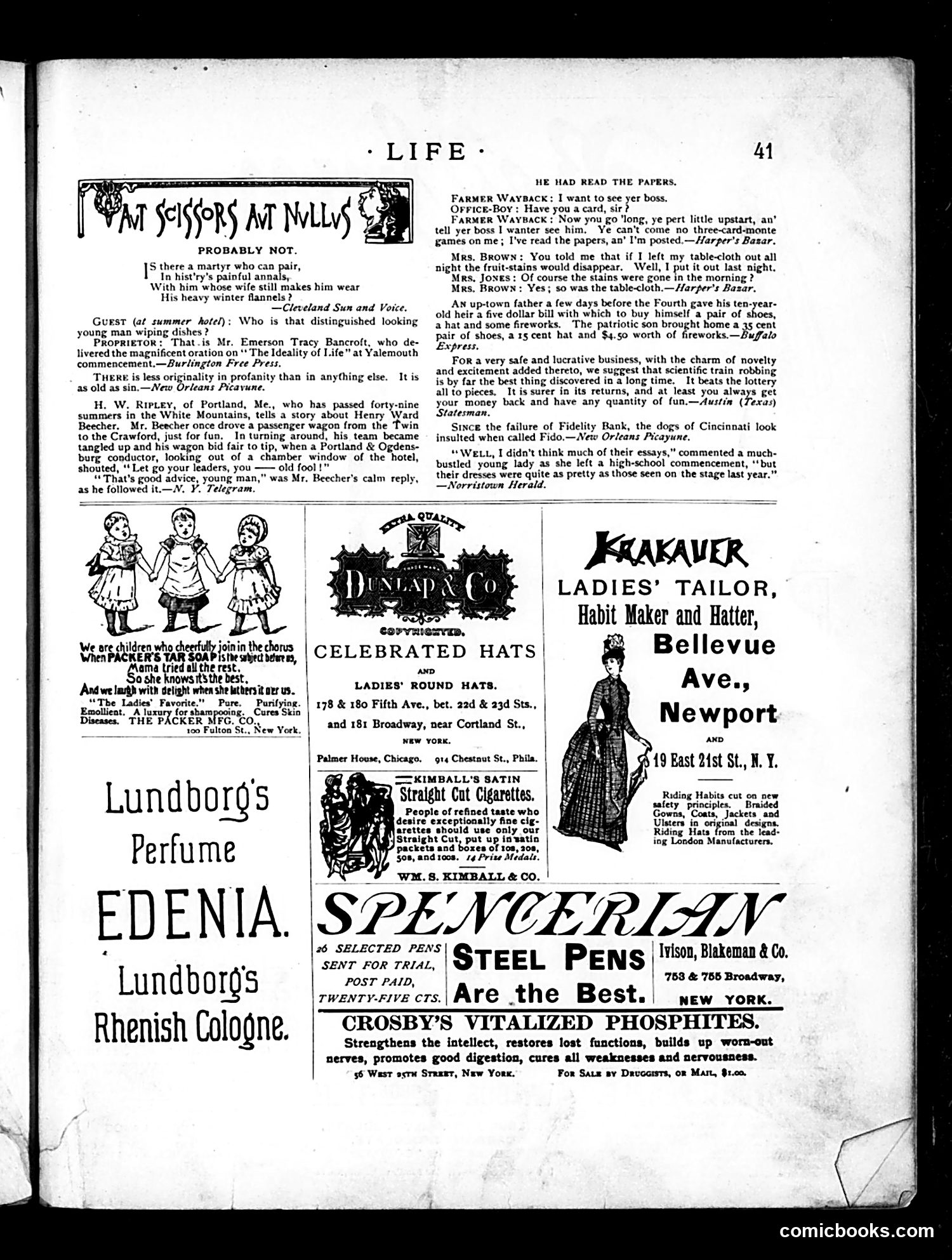
This page from *Life* magazine consists primarily of **short humorous anecdotes** rather than political cartoons. The jokes target social pretension and rural naïveté: 1. **"He Had Read the Papers"**: A farmer, claiming newspaper literacy has made him street-smart, demands to see his boss rather than provide a calling card—ironically proving his ignorance of business etiquette. 2. **Table-cloth theft**: A woman complains that stains disappeared overnight; her friend reveals the stains vanished *because the tablecloth was stolen*. 3. **The patriotic son**: A father gives his boy money for shoes, hat, and fireworks before Independence Day; the boy spends most on fireworks, exemplifying youthful priorities. 4. **Henry Ward Beecher anecdote**: Famous preacher accepts crude advice from a conductor with equanimity, satirizing either his humility or obliviousness. The page is largely **advertisements** (perfume, hats, cigars, pens). The humor reflects 1880s-90s concerns: social climbing, rural-urban cultural gaps, and consumer behavior.
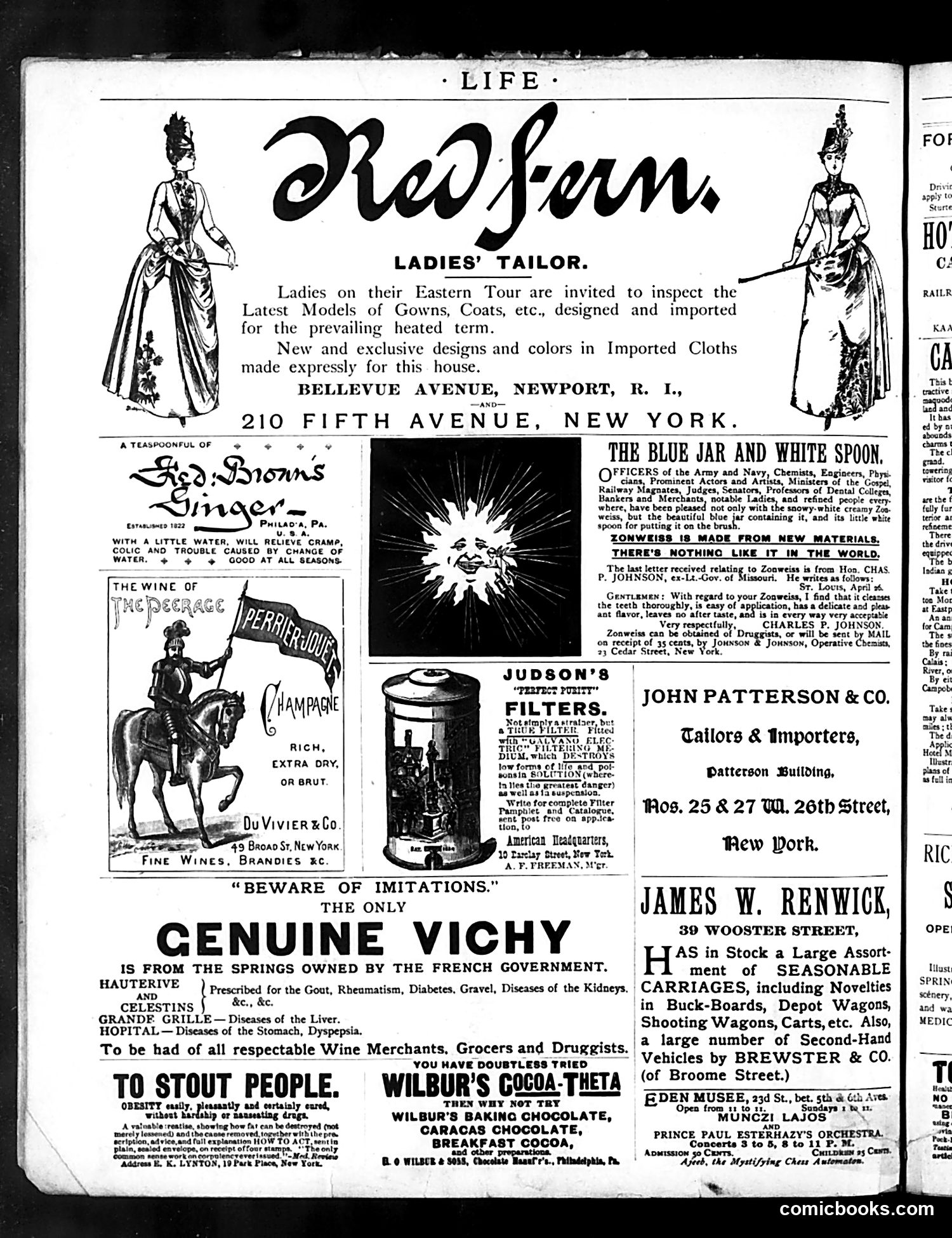
This is primarily an **advertising page** with no political cartoons or satirical content. It consists entirely of period commercial advertisements from what appears to be the late 19th or early 20th century. **Notable ads include:** - **Red Faun Ladies' Tailor** (Newport/NYC fashion): Targets wealthy women tourists with imported clothing - **Zonweiss** (dental product): Features a testimonial from Charles P. Johnson, ex-Lt. Governor of Missouri, promoting teeth-cleaning paste - **Vichy Water**: French mineral water marketed for medical conditions (gout, rheumatism, kidney disease) - **Wilbur's Cocoa**: Chocolate products - **Judson's Filters**: Cigarette/tobacco filters - **Carriage dealer, tailor services, orchestra concerts, museum admission** The page reflects **Gilded Age consumer culture** targeting affluent readers—featuring luxury imports, health tonics (common in this era before FDA regulation), and social venues. No satire or political commentary is present; this is straightforward period advertising.
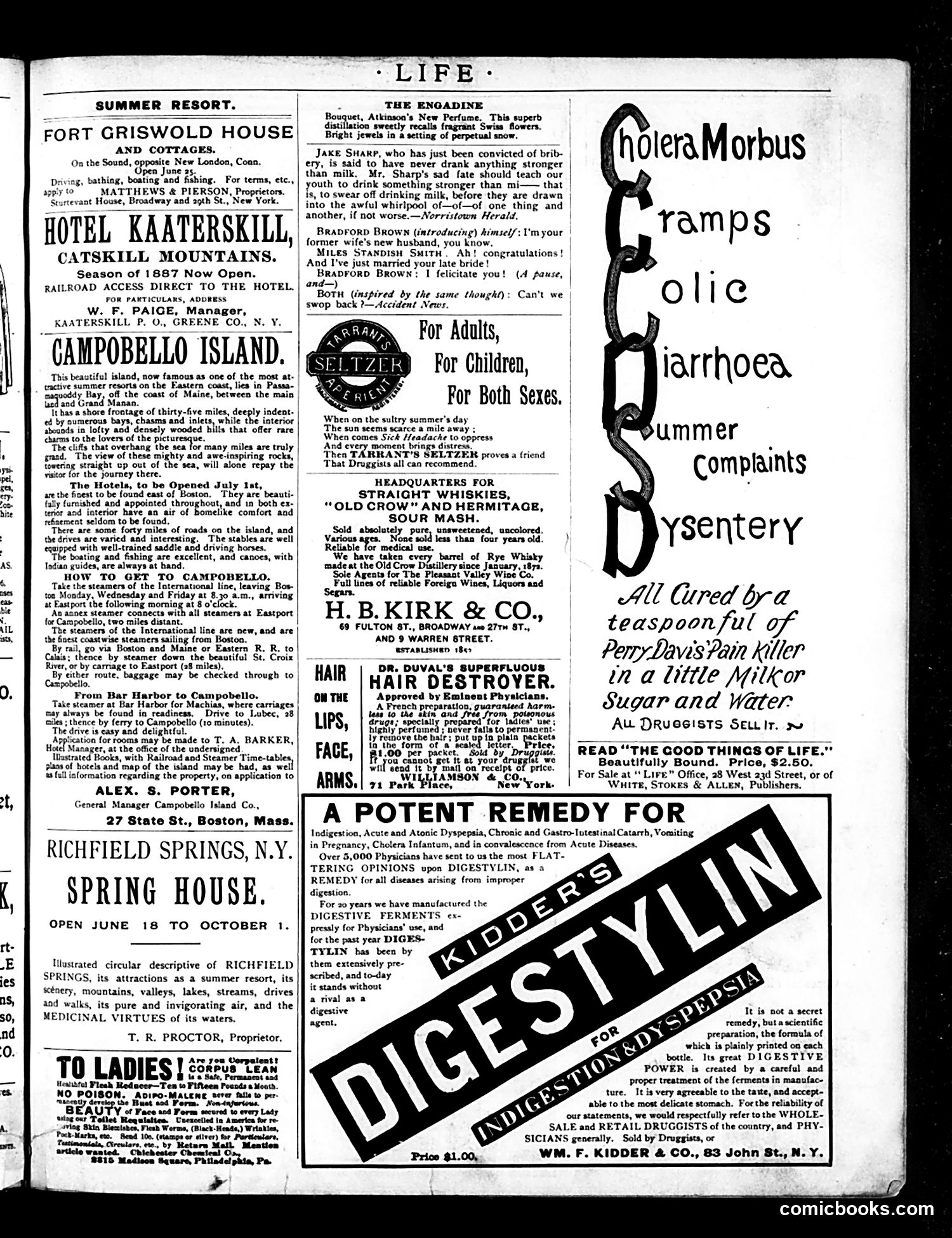
This page is primarily **advertisements for summer resorts and patent medicines**—typical of 1880s Life magazine, which relied heavily on advertising revenue. The only satirical content is a brief **editorial quip about Jane Sharp**, a convicted bribery defendant. The joke plays on irony: Sharp allegedly never drank alcohol (only milk), yet the writer sarcastically suggests young people should drink "something stronger than milk" to avoid corruption. The humor is crude moralism—implying that teetotalers are somehow more susceptible to criminal behavior, or that avoiding temptation entirely makes one vulnerable to worse vices. This reflects 1880s anxieties about Prohibition and moral reform. The remainder consists of resort advertisements (Fort Griswold, Hotel Kaaterskill, Campobello Island) and medical nostrums (hair destroyers, digestive ferments, weight-loss remedies), representing typical commercial content of the era with dubious health claims.
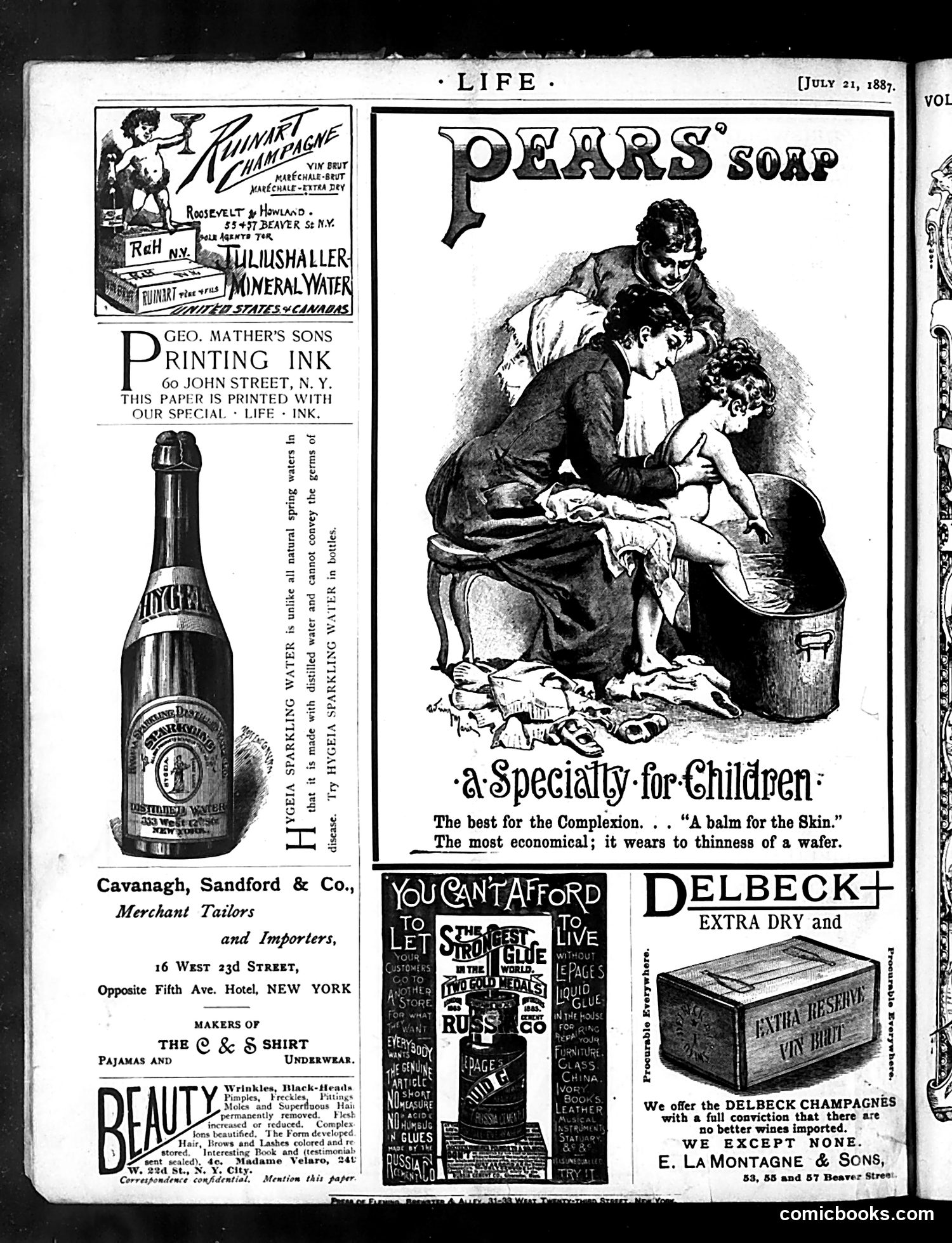
This page is primarily **advertising**, not political satire. The main content consists of period product advertisements from the 1880s. The largest advertisement features **Pears' Soap**, marketed as "a Specialty for Children." The accompanying illustration shows a Victorian-era caretaker bathing a young child—a sentimental domestic scene typical of late-19th-century advertising. The tagline emphasizes the soap's mildness for skin and economy ("wears to thinness of a wafer"). Other advertisements include champagne (Delbeck brand), printing ink, mineral water, men's clothing (C & S Shirt, pajamas), and a beauty treatment promising to reduce wrinkles and blemishes. The page also carries a notice that Life magazine itself is printed with "special Life-ink." There is **no political cartoon** on this page—it's a commercial goods advertisement section typical of magazines from this era, when publications relied heavily on advertising revenue.