
Life, 1887-07-21 · page 2 of 16
Life — July 21, 1887 — page 2: what you’re looking at
What you’re looking at
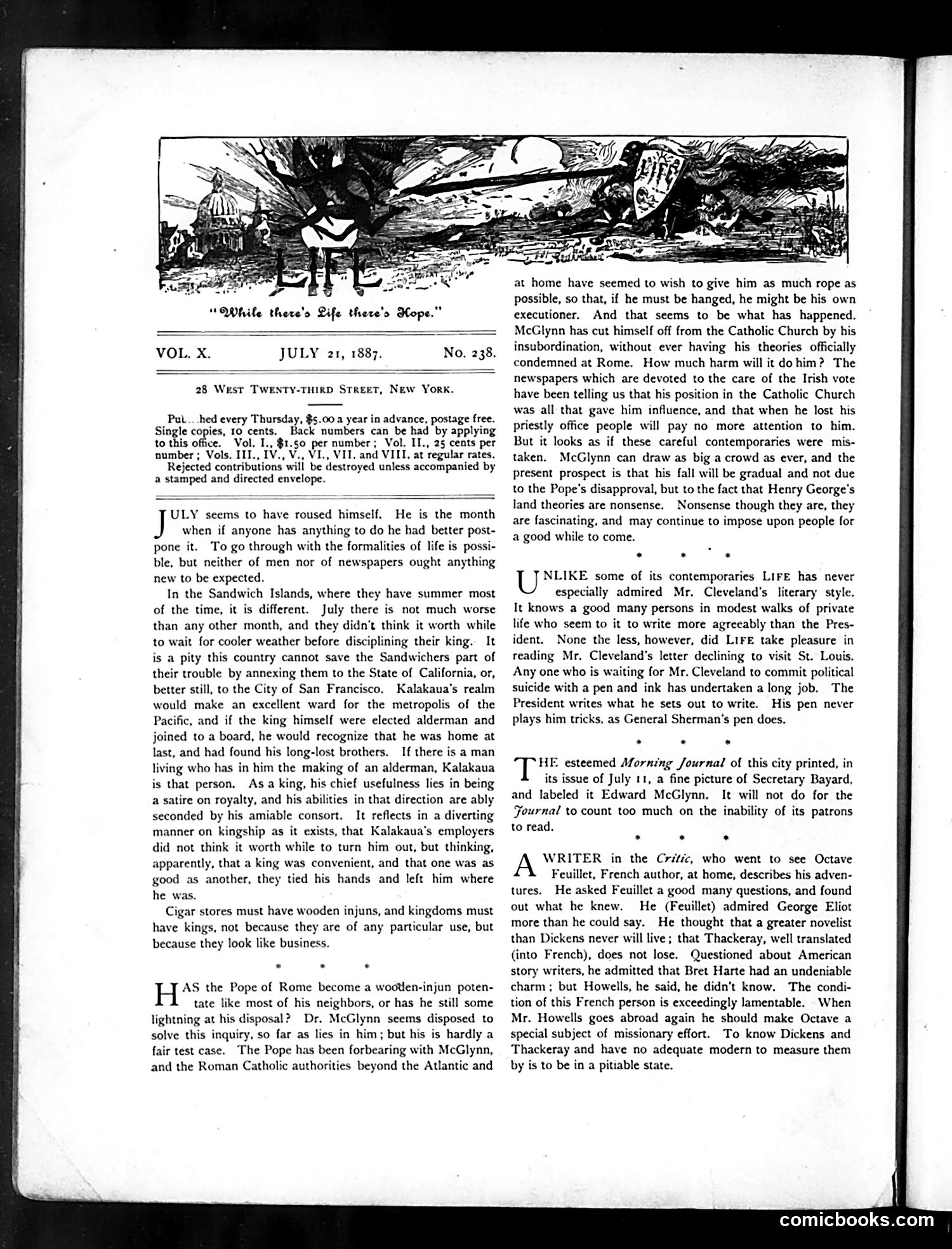
The top cartoon, titled "While there's Life there's Hope," depicts a skeletal Death figure looming over a landscape. The image appears to satirize mortality or societal decline, though the specific reference is unclear without additional context. The text discusses Dr. McGlynn, a Catholic priest who has broken with Church authority. The article notes his fall from influence will be "gradual," suggesting ecclesiastical punishment. The piece also critiques President Cleveland's literary style and mentions a visit to Octave Feuillet, a French author. The overall page reflects *Life*'s typical 1880s approach: combining visual satire with political and cultural commentary on contemporary figures and institutional conflicts.
📄 Transcribed text from this page (OCR, searchable)
Machine-transcribed from the original scan — historical spelling and the odd misread are preserved.
“WMhile there's Life there's Hope.” No. 238. VOL. X. JULY 21, 1887. 28 West TWENTY-THIRD STREET, New York. Put. hed every Thursday, $5.00 a year in advance, postage free. Single copies, 10 cents, Back numbers can be had by applying to this office. Vol. I., $1.50 per number; Vol. II., 25 cents per . $ number ; Vols. IIT., IV., V., VI., VII. and VIII. at regular rates. Rejected contributions will be destroyed unless accompanied by a stamped and directed envelope. ULY seems to have roused himself. He is the month when if anyone has anything to do he had better post- pone it. To go through with the formalities of life is possi- ble, but neither of men nor of newspapers ought anything new to be expected. In the Sandwich Islands, where they have summer most of the time, it is different. July there is not much worse than any other month, and they didn’t think it worth while to wait for cooler weather before disciplining their king. It is a pity this country cannot save the Sandwichers part of their trouble by annexing them to the State of California, or, better still, to the City of San Francisco. Kalakaua's realm would make an excellent ward for the metropolis of the Pacific, and if the king himself were elected alderman and joined to a board, he would recognize that he was home at last, and had found his long-lost brothers. If there is a man living who has in him the making of an alderman, Kalakaua is that person. As a king, his chief usefulness lies in being a satire on royalty, and his abilities in that direction are ably seconded by his amiable consort. It reflects in a diverting manner on kingship as it exists, that Kalakaua’s employers did not think it worth while to turn him out, but thinking, apparently, that a king was convenient, and that one was as good as another, they tied his hands and left him where he was. Cigar stores must have wooden injuns, and kingdoms must have kings, not because they are of any particular use, but because they look like business. H AS the Pope of Rome become a wootlen-injun poten- tate like most of his neighbors, or has he still some lightning at his disposal? Dr. McGlynn seems disposed to solve this inquiry, so far as lies in him; but his is hardly a fair test case. The Pope has been forbearing with McGlynn, and the Roman Catholic authorities beyond the Atlantic and at home have seemed to wish to give him as much rope as possible, so that, if he must be hanged, he might be his own executioner. And that seems to be what has happened. McGlynn has cut himself off from the Catholic Church by his insubordination, without ever having his theories officially condemned at Rome. How much harm will it do him? The newspapers which are devoted to the care of the Irish vote have been telling us that his position in the Catholic Church was all that gave him influence, and that when he lost his priestly office people will pay no more attention to him. But it looks as if these careful contemporaries were mis- taken. McGlynn can draw as big a crowd as ever, and the present prospect is that his fall will be gradual and not due to the Pope’s disapproval, but to the fact that Henry George's land theories are nonsense. Nonsense though they are, they are fascinating, and may continue to impose upon people for a good while to come. . * " NLIKE some of its contemporaries LIFE has never especially admired Mr. Cleveland's literary style. It knows a good many persons in modest walks of private life who seem to it to write more agreeably than the Pres- ident. None the less, however, did Lire take pleasure in reading Mr. Cleveland's letter declining to visit St. Louis. Any one who is waiting for Mr. Cleveland to commit political suicide with a pen and ink has undertaken a long job. The President writes what he sets out to write. His pen never plays him tricks, as General Sherman's pen does. HE esteemed Morning Journal of this city printed, in its issue of July 11, a fine picture of Secretary Bayard, and labeled it Edward McGlynn. It will not do for the Journal to count too much on the inability of its patrons to read. * . . WRITER in the Critic, who went to see Octave Feuillet, French author, at home, describes his adven- He asked Feuillet a good many questions, and found out what he knew. He (Feuillet) admired George Eliot more than he could say. He thought that a greater novelist than Dickens never will live; that Thackeray, well translated (into French), does not lose. Questioned about American story writers, he admitted that Bret Harte had an undeniable charm ; but Howells, he said, he didn't know. The condi- tion of this French person is exceedingly lamentable. When Mr. Howells goes abroad again he should make Octave a special subject of missionary effort. To know Dickens and Thackeray and have no adequate modern to measure them by is to be in a pitiable state. tures. comicbooks.com