
A complete issue · 21 pages · 1887
Life — June 30, 1887
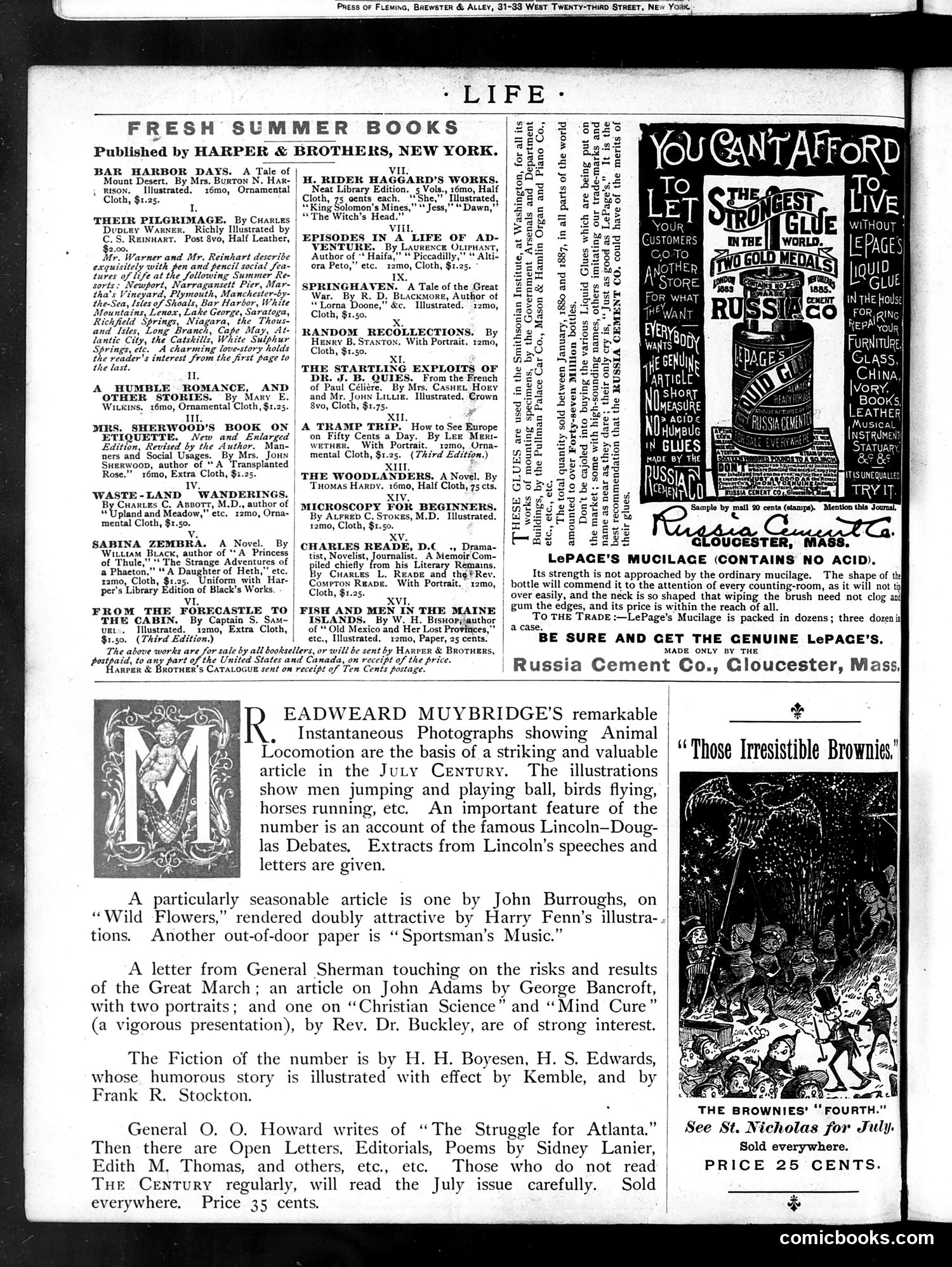
This page is primarily **advertising and literary promotion** for Harper & Brothers publishers' summer book releases and other products. The main cartoon—titled "Those Irresistible Brownies: Fourth" and labeled "See St. Nicholas for July"—depicts small, mischievous fairy-like creatures in a nighttime forest scene. This references the popular **"Brownie" character series**, likely by Palmer Cox, which appeared in *St. Nicholas* children's magazine. The brownies were friendly household sprites from folklore, repurposed as whimsical characters for young audiences in the 1890s. The image is promotional material advertising the July issue of *St. Nicholas* magazine (price 25 cents). The page itself contains book listings and a separate advertisement for LePage's Mucilage adhesive, emphasizing this is a commercial publication page rather than editorial content.
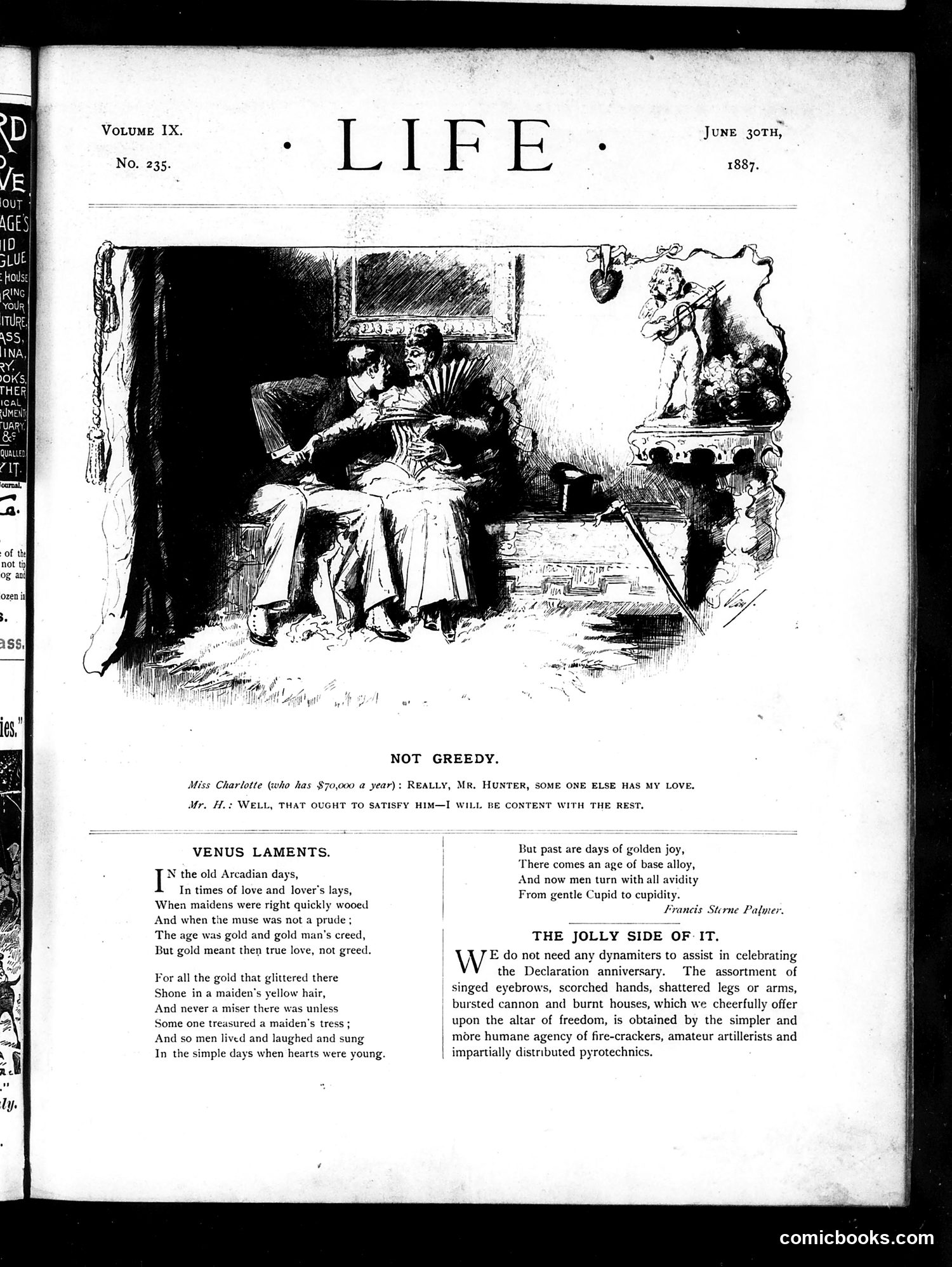
The cartoon depicts a romantic scene where a man (Mr. Hunter) sits with a woman (Miss Charlotte) who receives $70,000 yearly. The caption presents their exchange: she claims to have his love, he responds that "some one else has my love" but promises he'll "be content with the rest." The satire mocks wealthy marriages of convenience, where suitors pursue rich women while maintaining romantic interests elsewhere. The title "Not Greedy" is ironic—the man is portrayed as willing to accept a wealthy woman's money and companionship despite loving someone else, suggesting mercenary motivations masked by false modesty. This reflects Gilded Age anxieties about marriage, wealth, and male fortune-hunting among the upper classes.
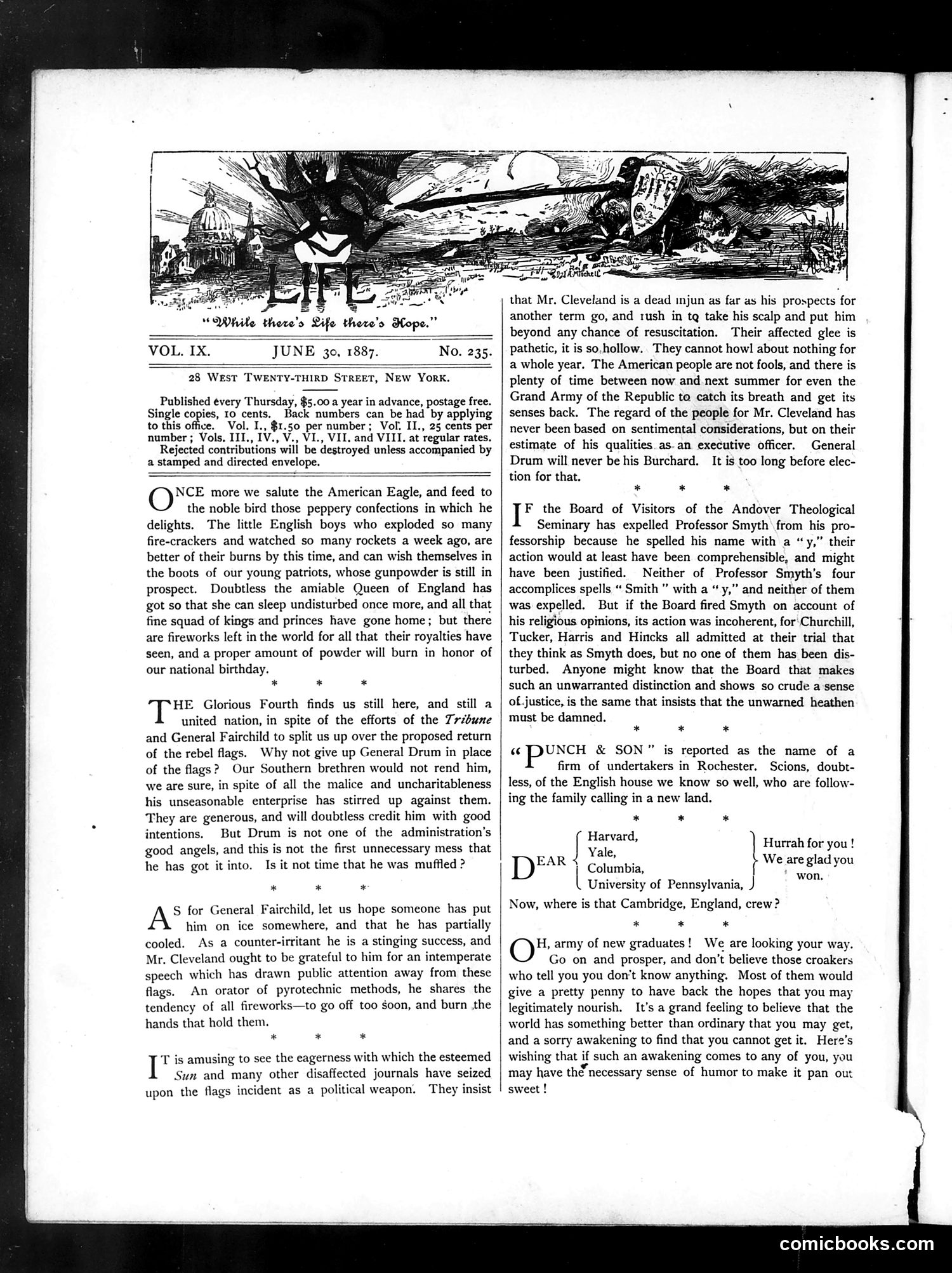
The masthead cartoon depicts a figure in Uncle Sam attire riding a rocket or firework, captioned "While there's Life there's Hope." The text discusses American celebration of Independence Day fireworks and references General Fairchild and rebel flags. One section criticizes General Fairchild for returning Confederate flags to the South, suggesting this was unnecessary and created political discord. The author sarcastically proposes someone "put him on ice" (remove him from office). Another section mocks the Board of Visitors at Andover Theological Seminary for expelling Professor Smyth over a spelling disagreement regarding his name, calling the action "incoherent" regarding his religious opinions. The page ends with congratulatory notes to Harvard, Yale, Columbia, and the University of Pennsylvania graduates, encouraging them to prosper and maintain hope for their futures.
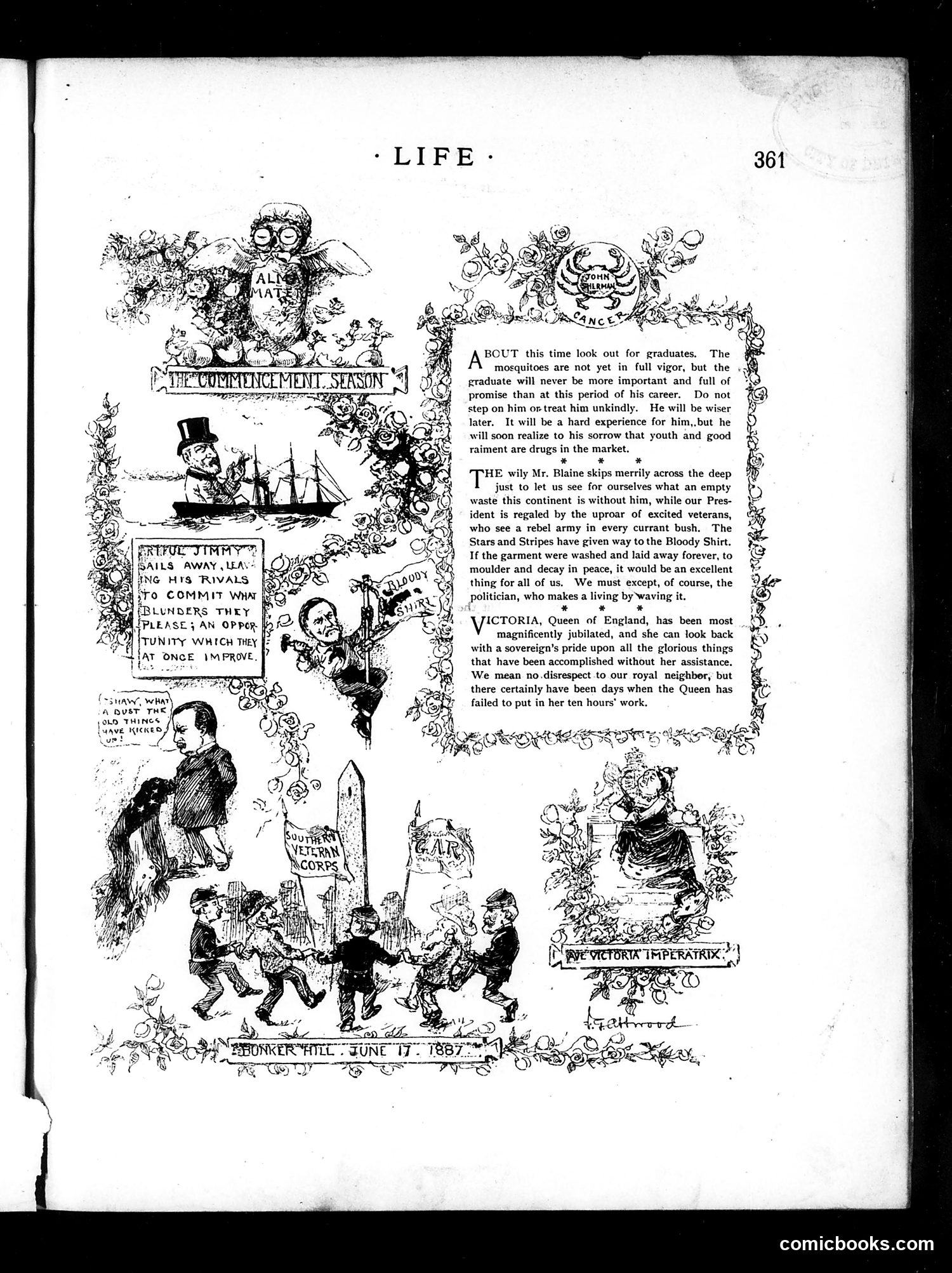
This satirical page mocks recent graduates entering the job market during what appears to be an economic downturn. The top cartoon warns graduates not to "step on" established professionals, as they face fierce competition from "excited veterans." The central section references the Bloody Shirt—a post-Civil War political tactic where Republicans invoked war memories to gain votes. The satire suggests this divisive strategy should be "washed and laid away forever." A paragraph praises Queen Victoria's jubilee while gently mocking her legendary work ethic ("ten hours' work"). The bottom cartoon depicts Bunker Hill monument with small figures, likely representing political or social upheaval. The overall page blends economic anxiety about job competition with commentary on outdated political rhetoric still dominating 1887 discourse.
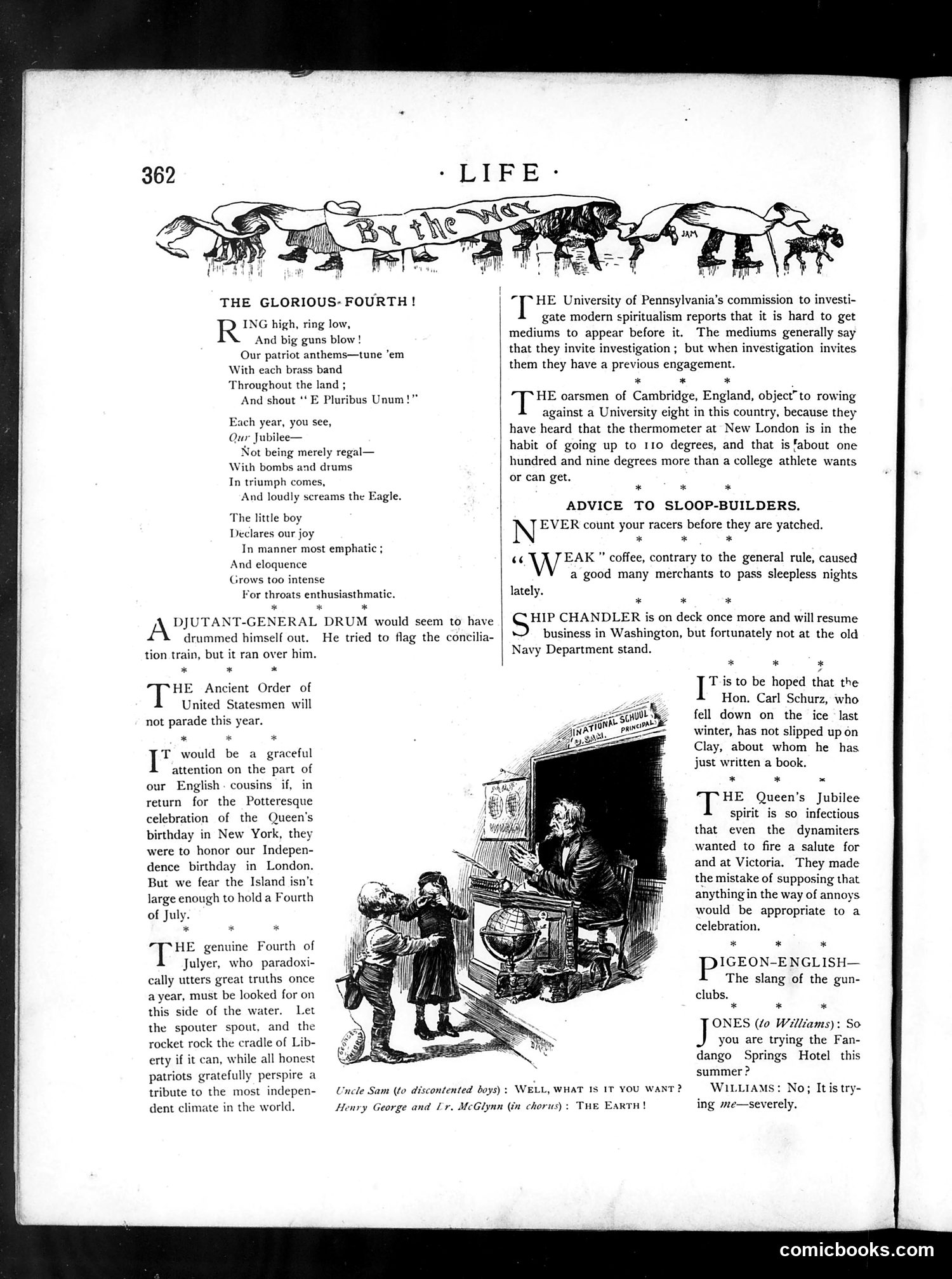
This page contains miscellaneous satirical commentary rather than a unified cartoon. The main illustrated piece shows an Uncle Sam figure in a ship's cabin speaking with two visitors, captioned with dialogue about "what is it you want?" The text items are brief social observations typical of Life's format: - A poem celebrating American Fourth of July patriotism - A note about University of Pennsylvania investigating spiritualism mediums - Cambridge oarsmen complaining about England's cold weather - Brief items about "weak coffee," a ship chandler, and author Carl Schurz - Commentary on Queen Victoria's Jubilee celebration - A slang notation ("pigeon-English") - A humorous exchange about the Fandango Springs Hotel The page satirizes contemporary American life, British society, and institutional pretensions through short jokes rather than developed political commentary.
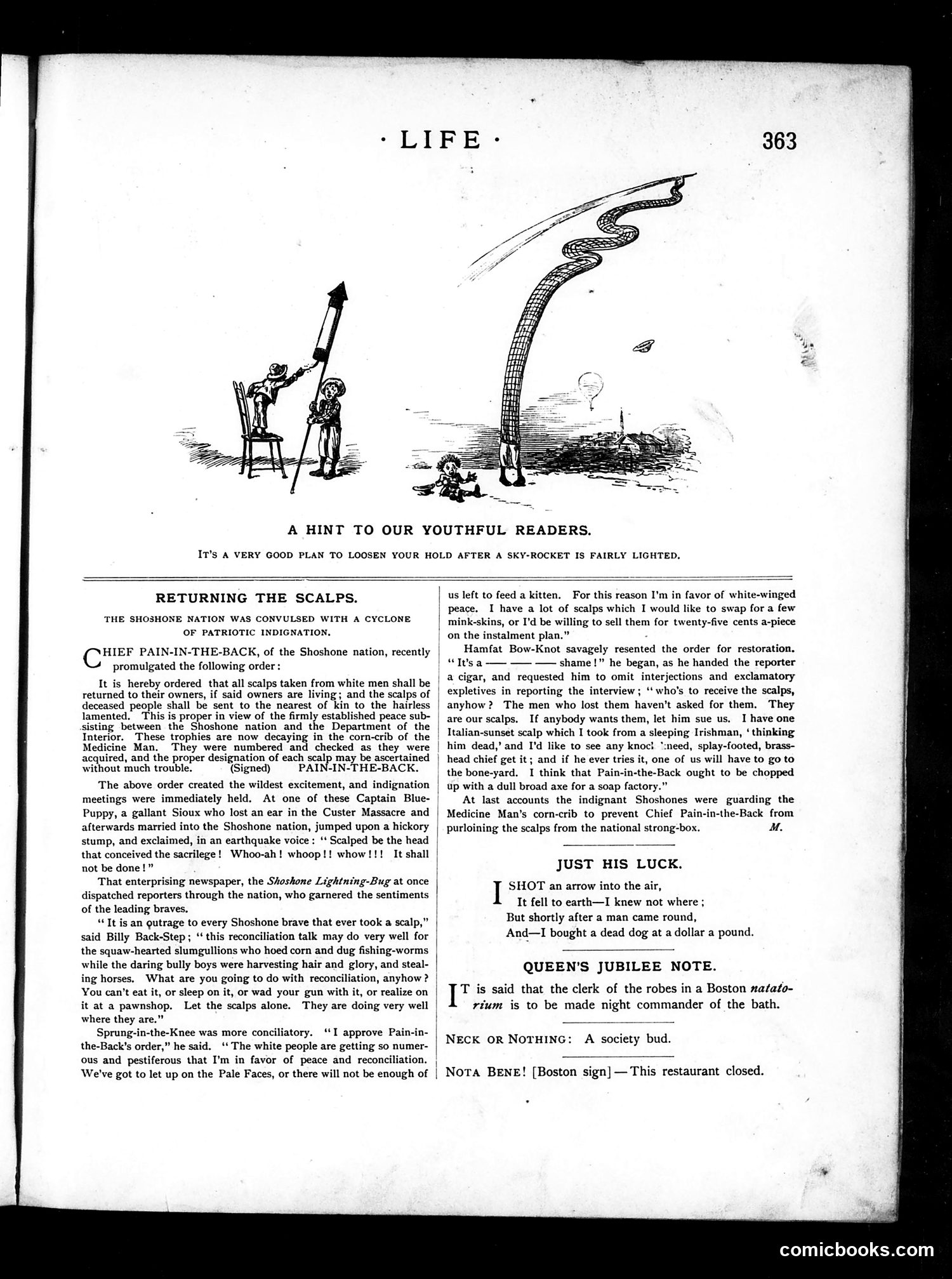
The top cartoon, "A Hint to Our Youthful Readers," satirizes the danger of early experimental rockets. It shows children launching a sky-rocket (left) while another child operates what appears to be a dangerous, uncontrolled rocket that's coiled like a snake (right). The caption warns: "It's a very good plan to loosen your hold after a sky-rocket is fairly lighted." The humor operates on two levels: literal safety advice for children experimenting with fireworks, and likely social commentary about recklessness or loss of control in pursuing dangerous ventures. The remaining page contains unrelated short satirical pieces including "Just His Luck" (a humorous anecdote), "Queen's Jubilee Note" (brief society commentary), and classified-style notes mocking Boston establishments.
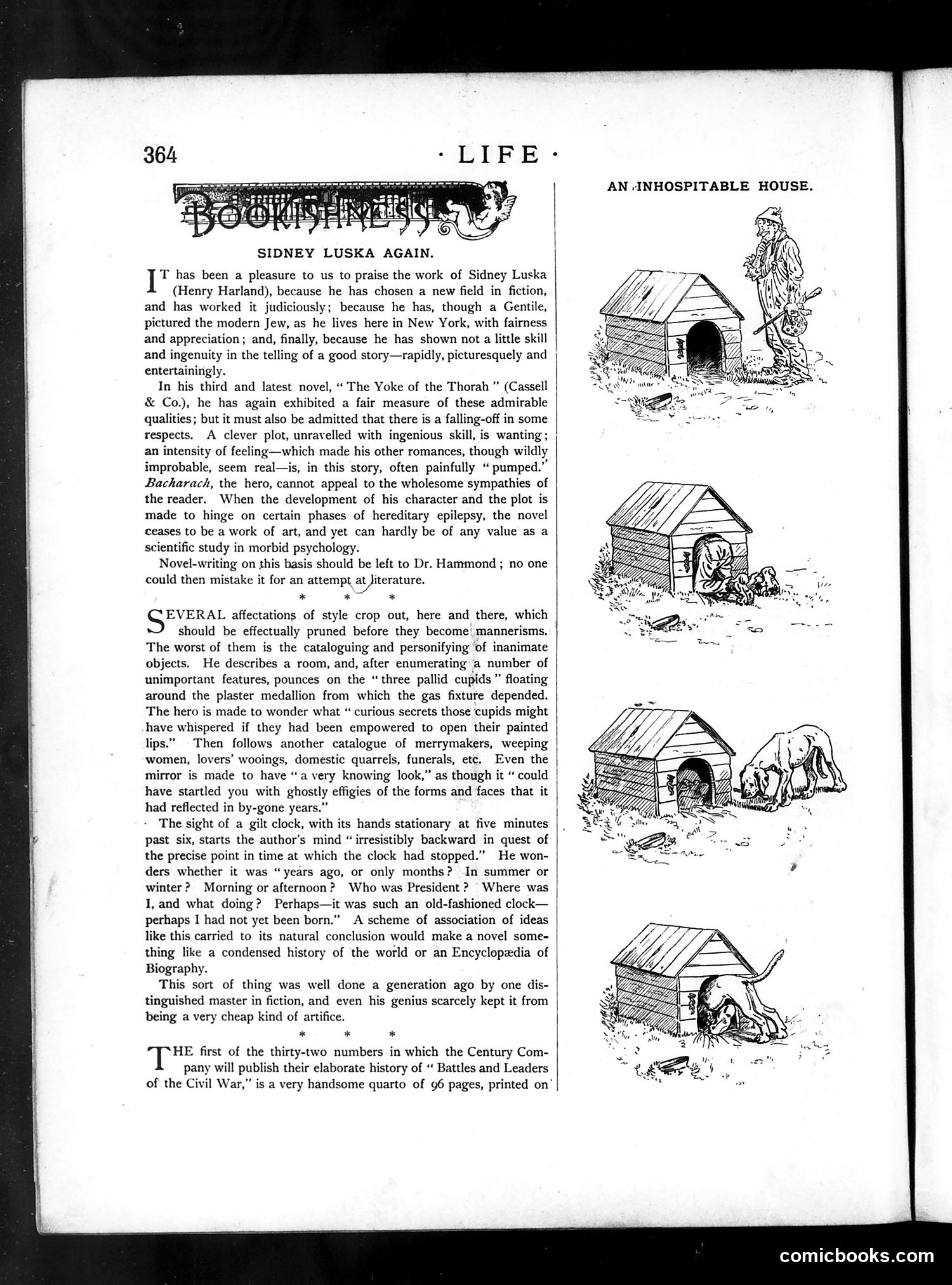
This page contains a literary review of Sidney Luska's novel "The Yoke of the Thorah" (published by Cassell & Co.). The reviewer praises Luska's (Henry Harland's) earlier work but criticizes this latest novel for lacking emotional intensity and containing problematic depictions of hereditary epilepsy that undermine its artistic value. The right side features four illustrations titled "An Inhospitable House"—sequential drawings showing a person attempting to enter a dog house while a dog defends it, escalating from peaceful coexistence to active conflict. This appears to be a humorous comic strip about unwelcome intrusion rather than political satire. The page is primarily literary criticism rather than political commentary.
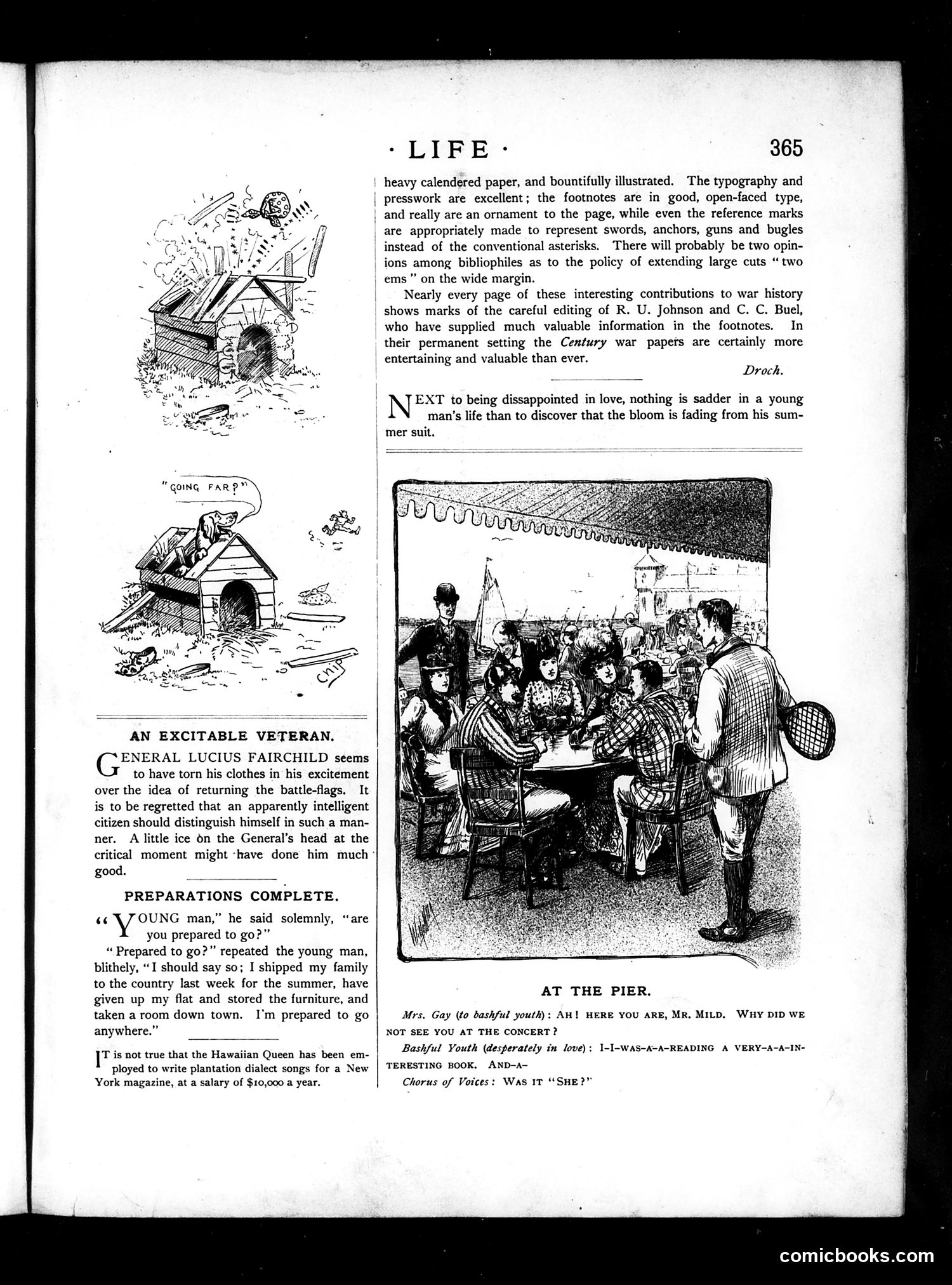
This page contains three distinct pieces: **Top cartoons**: Two humorous sketches about military life—one showing a soldier in a doghouse asking "Going Far?" (satirizing military discipline), and another titled "An Excitable Veteran" mocking General Lucius Fairchild's eccentric behavior regarding battle-flag displays. **Center section**: An article praising war history contributions to *Century* magazine, with editors R.U. Johnson and C.C. Buel credited for valuable footnotes and editing. **Bottom illustration & caption**: "At the Pier" depicts a social scene where Mrs. Gay confronts a bashful young man about missing a concert, with a chorus of onlookers commenting. This appears to be romantic/social satire about courtship expectations and embarrassment. The page mixes military satire with social humor typical of *Life* magazine's editorial approach during this period.
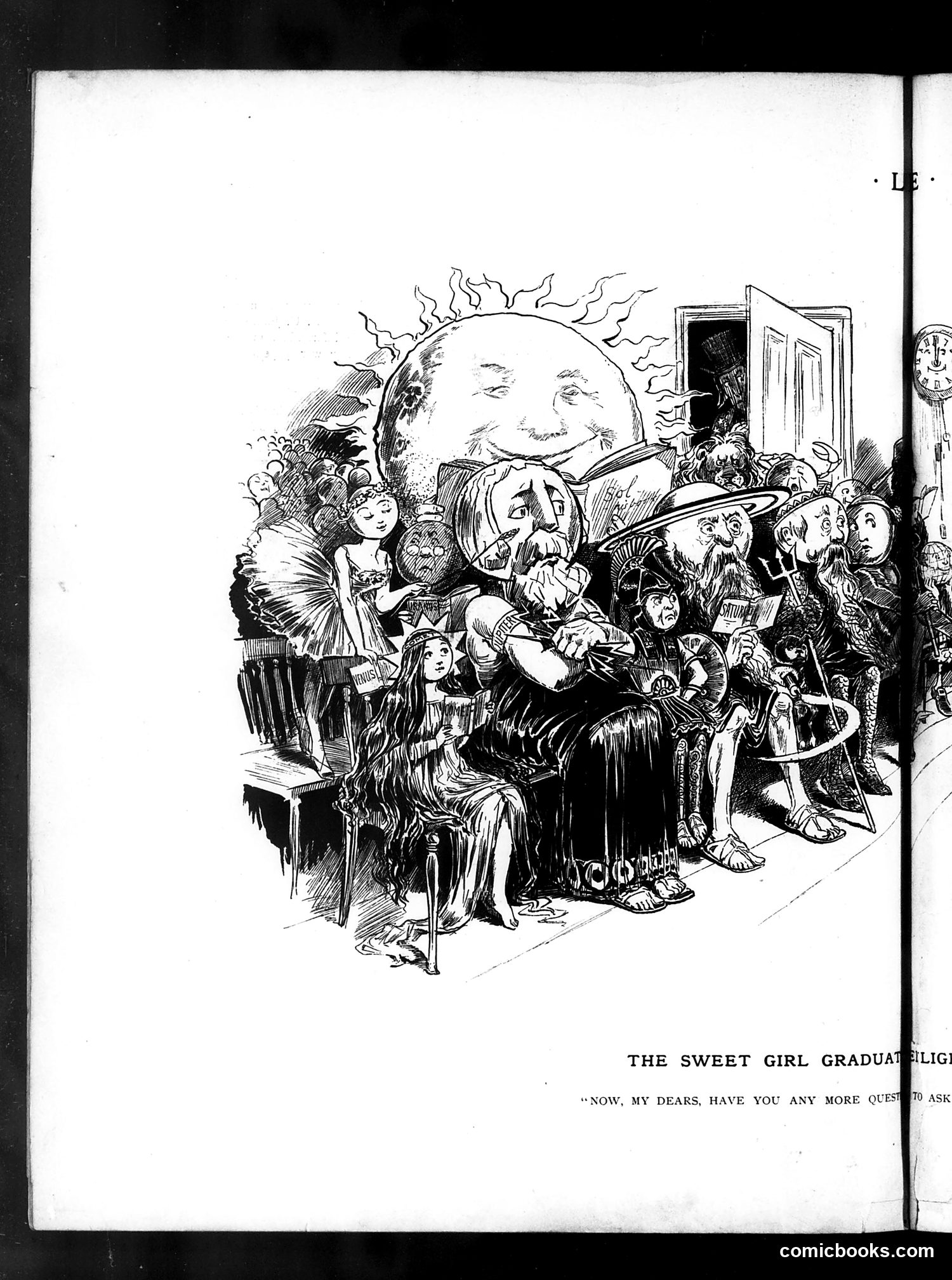
This satirical illustration depicts a young woman graduate surrounded by male suitors and admirers—wizards, bearded men, creatures, and various fantastical figures crowding around her. The caption reads: "NOW, MY DEARS, HAVE YOU ANY MORE QUESTIONS TO ASK?" The satire appears to target late-19th or early-20th century anxieties about educated women. The "sweet girl graduate" has become the object of intense male attention and curiosity, suggesting she's treated as a novelty or oddity rather than a serious scholar. The absurd crowd of admirers—including magical and monstrous figures—mocks both the sensationalism surrounding female education and the idea that an educated woman becomes a spectacle. The joke critiques how society views educated women as curiosities rather than individuals.
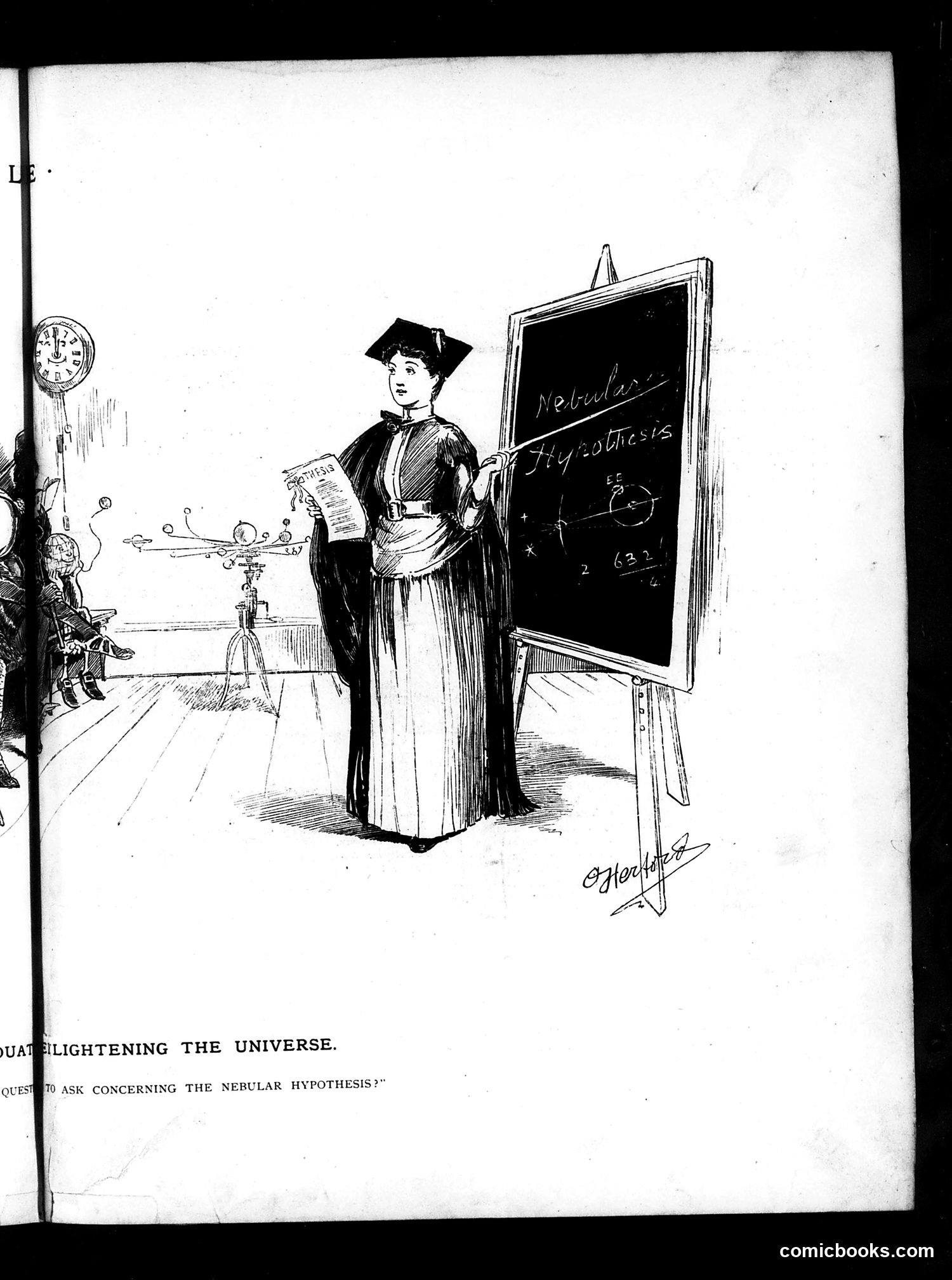
This cartoon satirizes the "New Woman" of the early 20th century—specifically, women entering higher education and professional fields. The illustration shows a female figure in academic robes and mortarboard standing before a blackboard with scientific equations ("Nebular Hypothesis"), holding what appears to be educational materials. The title's pun ("Enlightening") mocks the notion that women were advancing scientific knowledge. The caption—asking about the nebular hypothesis (a cosmological theory)—suggests she's presenting complex astronomical science. The satire likely critiques contemporary anxieties about women's intellectual ambitions and education. The various scientific instruments visible in the background emphasize the "serious" subject matter, making the joke about female competence or authority in male-dominated scientific fields. This reflects period debates over women's suffrage and professional opportunities.
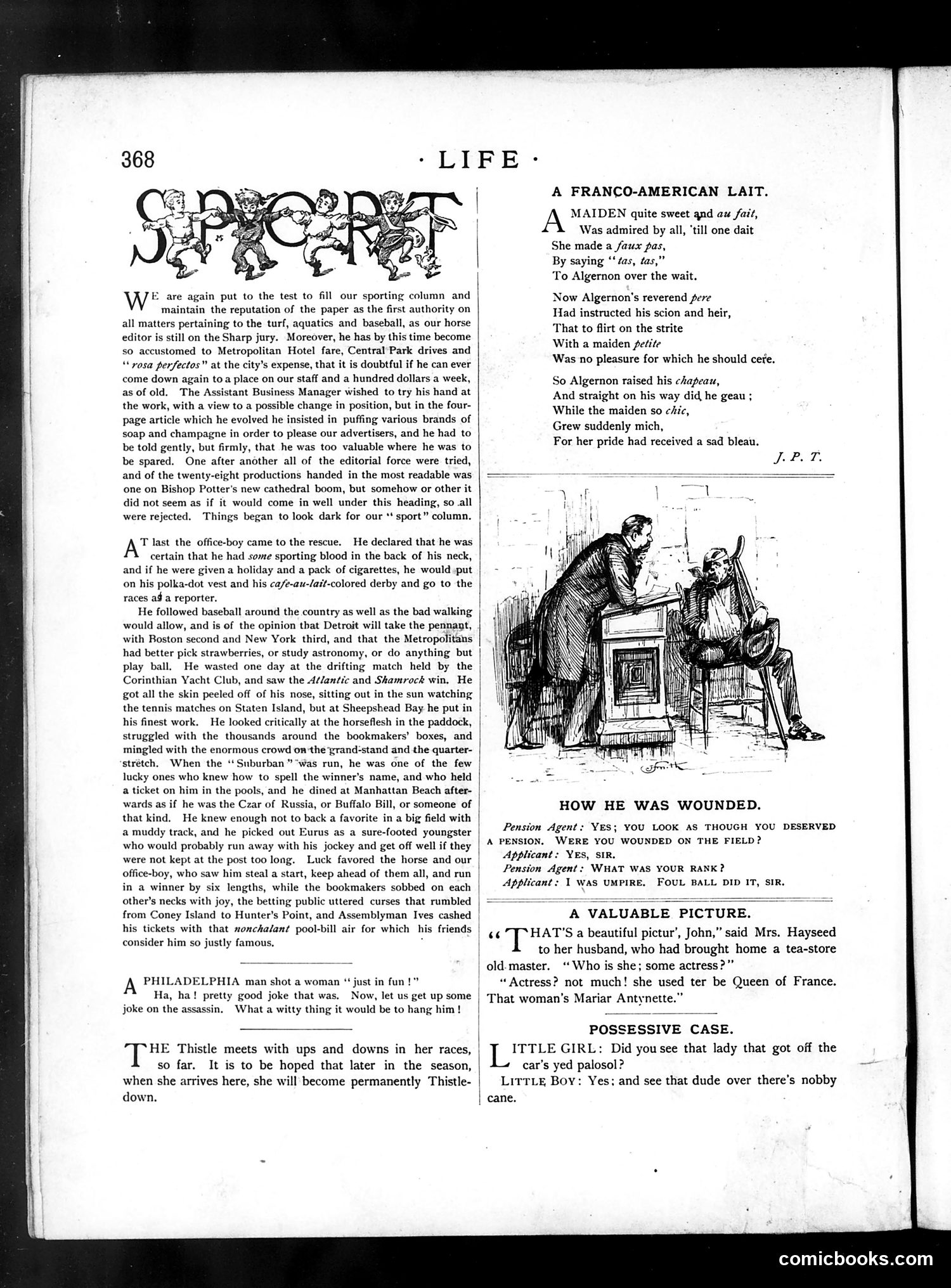
This page satirizes Life magazine's own struggling sports column. The text humorously describes the editorial scramble to fill the sports section after the regular editor abandons his duties (he's become too accustomed to expensive perks like Metropolitan Hotel meals and cigars paid by the publication to return to regular staff wages). The magazine mockingly chronicles failed attempts by various staff members before an office boy volunteers, equipped only with a polka-dot vest, café-au-lait derby, and cigarettes. The joke culminates in his surprising success at the Sheepshead Bay races, where he correctly identifies the winning horse "Eurus" and profits handsomely—while bookmakers and the betting public lose money. The satire targets both the magazine's own operational chaos and the contemporary obsession with horse racing. Brief humorous anecdotes below (about a Philadelphia shooting, yacht racing, and a poem) fill remaining space typical of Life's miscellaneous humor format.
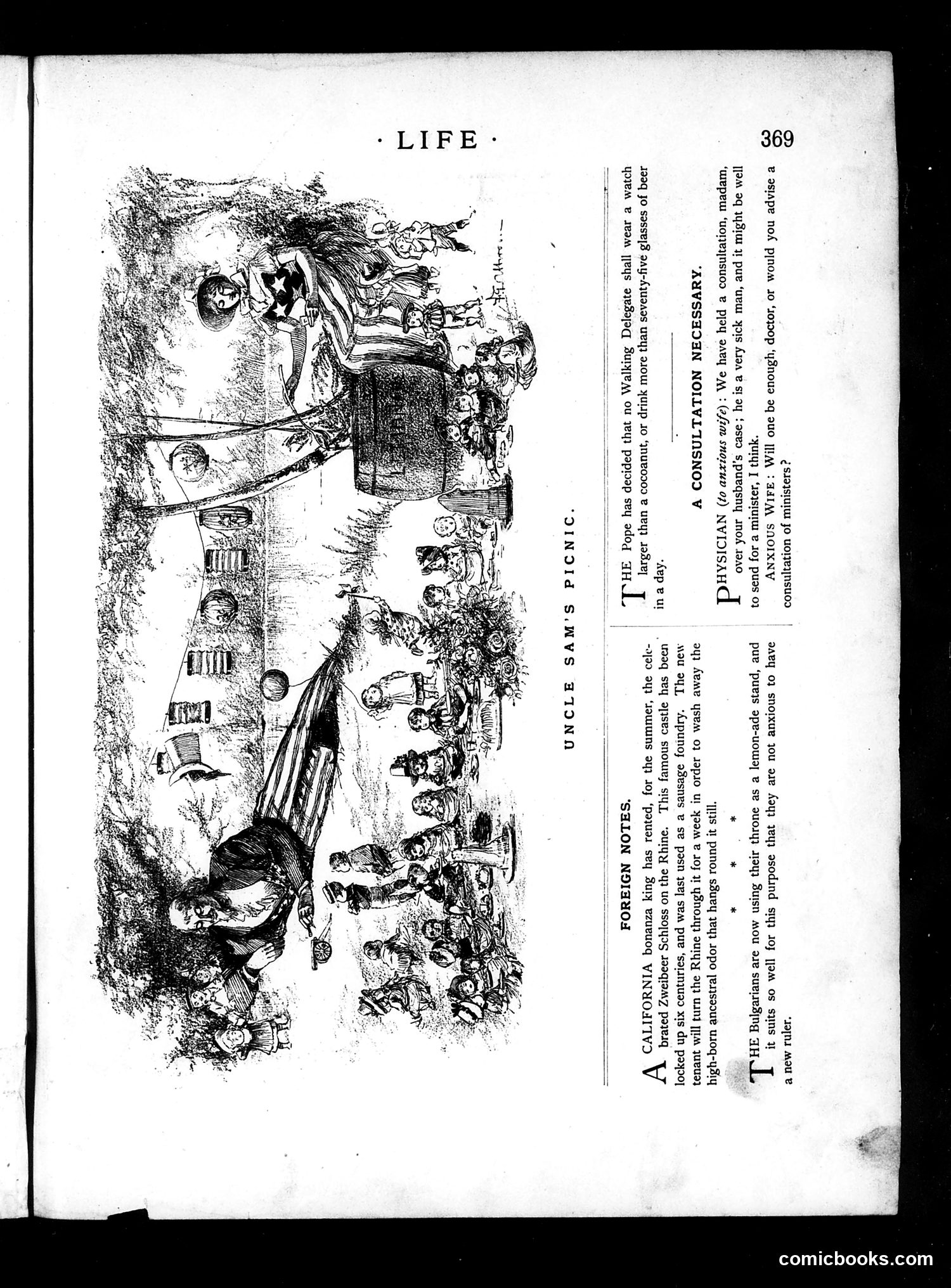
This page contains **"Uncle Sam's Picnic,"** a political cartoon satirizing American foreign policy and international relations. The OCR text is heavily corrupted, making precise identification difficult, but the cartoon itself is readable. The illustration depicts **Uncle Sam** (the bearded American figure in the center wearing his characteristic top hat and stars-and-stripes outfit) surrounded by various international figures and caricatures at what appears to be a picnic or gathering. The composition suggests commentary on American diplomatic entanglements or complicated international relationships of the era. Based on the title and Uncle Sam's prominent role, this likely satirizes American involvement in foreign affairs—possibly criticizing either excessive American intervention abroad or the complications arising from America's global commitments. The "picnic" metaphor suggests these international dealings are chaotic or uncomfortable social situations. Without clearer OCR text or a visible publication date, the specific historical context remains uncertain, though the cartooning style suggests early-to-mid 20th century.
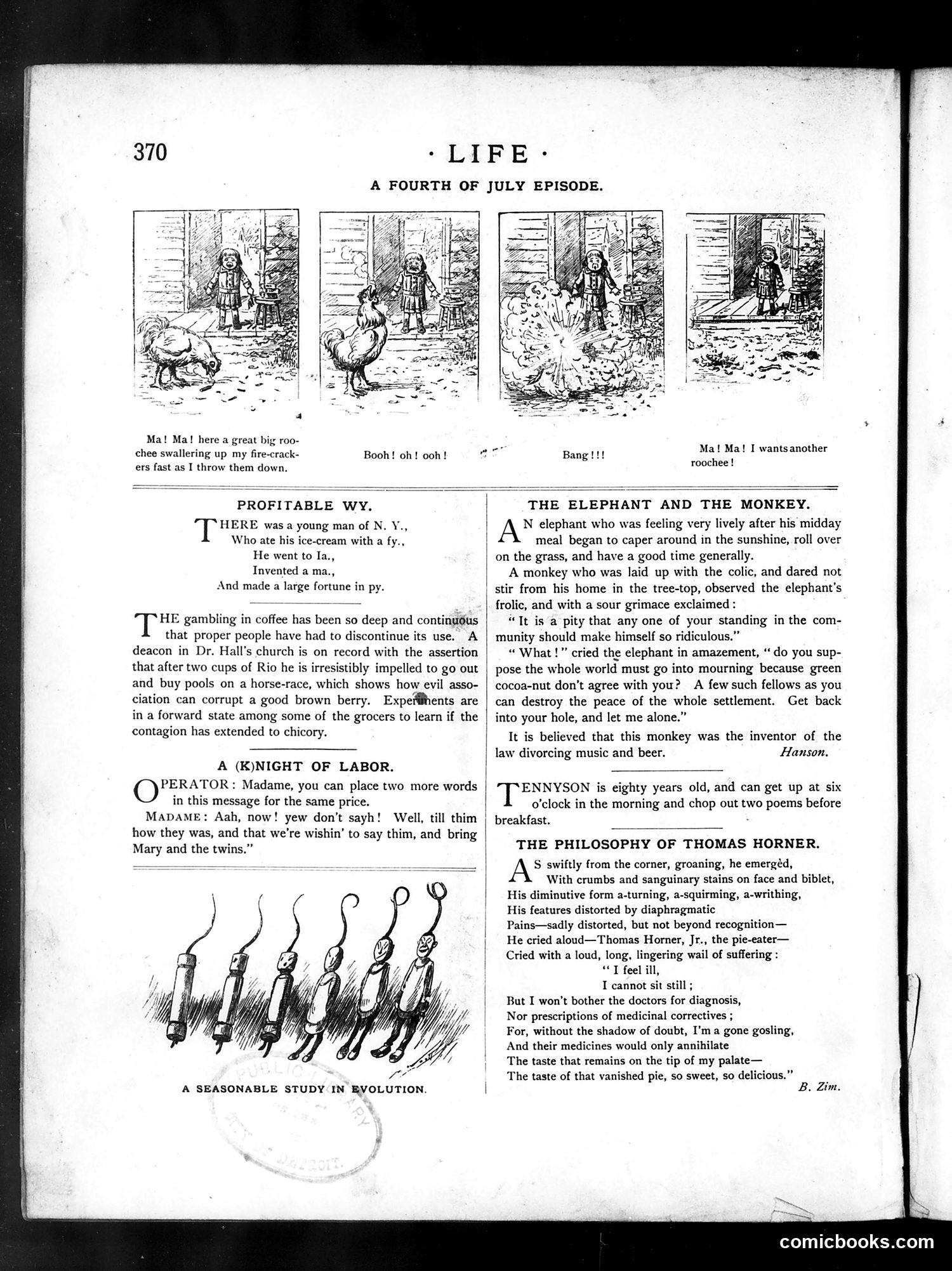
The top cartoon shows a child throwing firecrackers at a rooster ("roochee"), delighting in the bird's panicked reaction—a simple slapstick joke about Fourth of July mischief. Below are various satirical pieces typical of *Life* magazine's humor: **"Profitable Wy"** mocks a con artist who profited from an invention (details unclear from text alone). **"A Knight of Labor"** satirizes telegraph operators overcharging customers while helping wealthy clients send longer messages for the same price—critiquing labor exploitation and class favoritism. **"The Elephant and the Monkey"** is a moral fable: the sick, complaining monkey criticizes the healthy elephant's joy, suggesting that miserable people resent others' happiness and spread negativity. **"The Philosophy of Thomas Horner"** humorously depicts a boy sick from overeating pie, refusing medical help because he doesn't want to lose the lingering taste—absurdist humor about prioritizing pleasure over health. The page demonstrates *Life*'s mix of visual gags, social commentary, and whimsical verse typical of late 19th-century American satire.
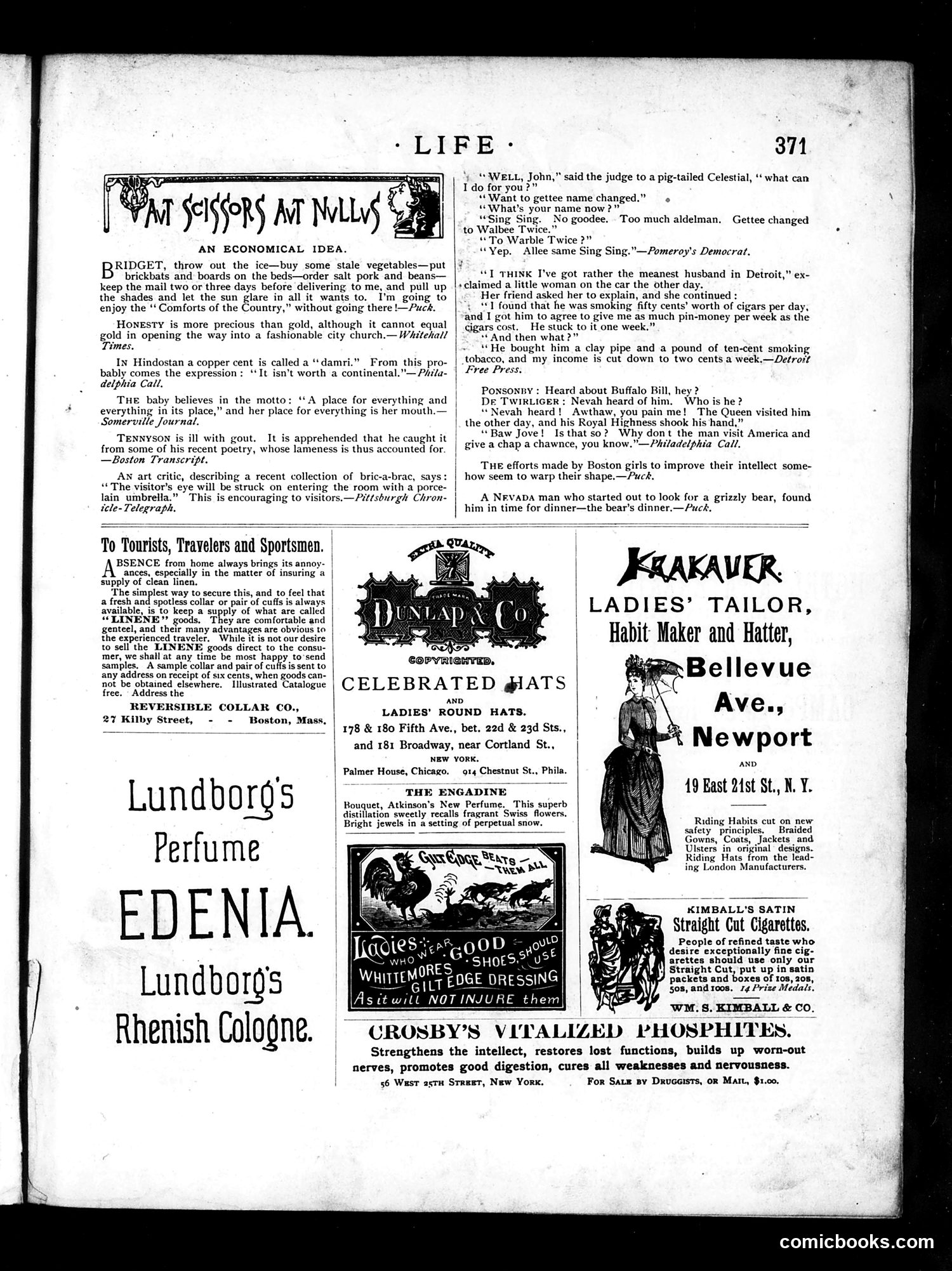
This page from *Life* magazine contains several brief satirical jokes typical of late 19th-century American humor: **"An Economical Idea"** mocks someone trying to recreate country living on a budget by keeping the house deliberately uncomfortable and neglected—a critique of false economy or pretentious frugality. **The pig-tailed Chinese immigrant** joke plays on stereotypical "pidgin English" and ethnic caricature. A man named "Sing Sing" (the New York prison) seeks a name change, showing how Chinese immigrants faced mockery. The punchline relies on racist dialect humor common to the era. **The Detroit wife's complaint** about her husband's cigar spending reflects class anxieties and marital dynamics—her attempt to control household finances by limiting his smoking backfires when he switches to cheaper tobacco, reducing her allowance. **The Buffalo Bill reference** is a brief joke about the famous Wild West showman's celebrity and British fascination with American frontier culture. Most content is **advertisements** for perfume, hats, and other goods. The page is primarily commercial rather than substantively satirical.
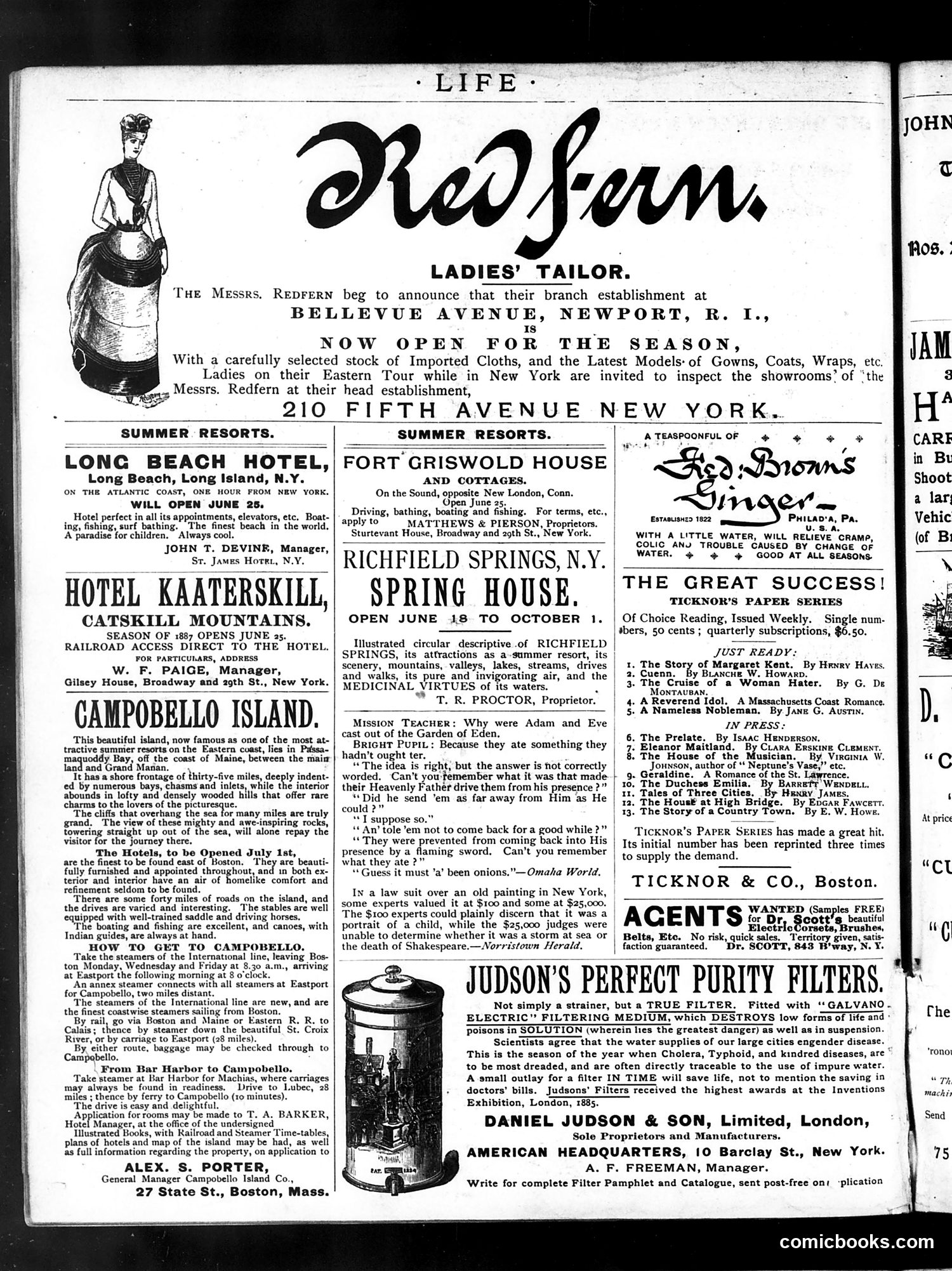
This is primarily an **advertising page**, not a satirical cartoon page. The content consists almost entirely of advertisements for: - **Red Fern Ladies' Tailor** (Newport and Fifth Avenue locations) - Multiple **summer resort hotels and destinations** (Long Beach, Catskill Mountains, Campobello Island, Fort Griswold House, Richfield Springs) - **Ticknor's Paper Series** (weekly reading material) - **Judson's Perfect Purity Filters** (water filtration systems) - **Agents wanted** for various products The single illustrated element is a fashion sketch of a woman in 1880s attire, accompanying the Red Fern advertisement. The page reflects **Gilded Age leisure culture**—marketing upscale summer retreats and fashionable clothing to wealthy clientele. The extensive resort advertisements indicate this issue targeted affluent readers seeking seasonal destinations. There is **no political satire or social commentary** visible on this page.
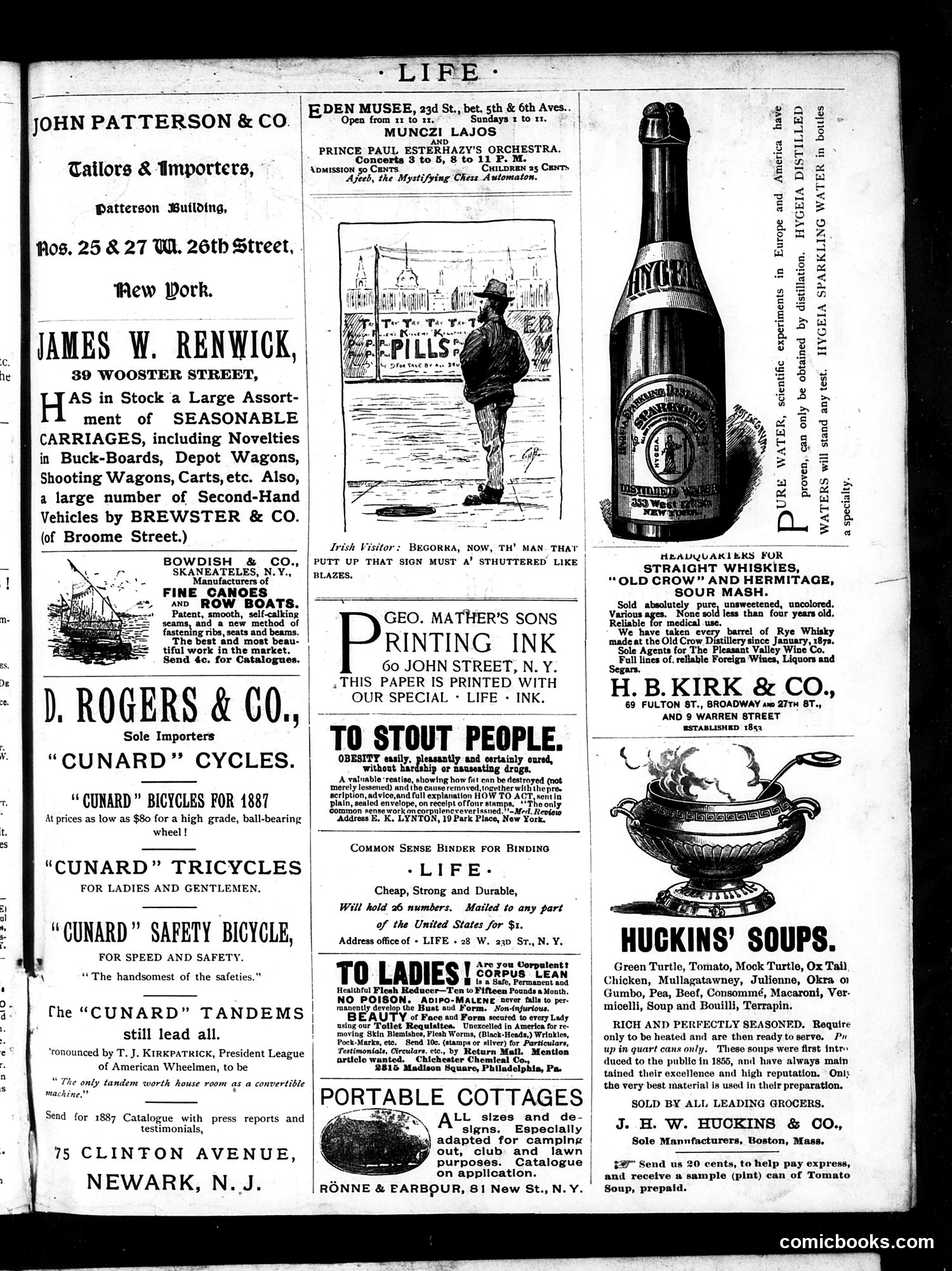
This page is primarily **advertising**, with one small cartoon. The single illustrated joke depicts an Irish visitor observing someone painting a sign, commenting that "the man that putt up that sign must a' shuttered like blazes"—a play on words exploiting the Irish brogue stereotype. The humor relies on mispronouncing "shutter" (as in paint application) as a speech impediment, mocking Irish immigrants' accents common in 1880s American satire. The page otherwise contains notices for late-19th-century luxury goods: Cunard bicycles and tricycles, carriages, fine canoes, printing ink, distilled water, whiskey, beauty treatments promising bust enhancement and weight loss, portable cottages, and Huckins' soups. The advertisements target middle and upper-class consumers. No significant political content appears; this represents typical Life magazine advertising and minor ethnic humor from the period.
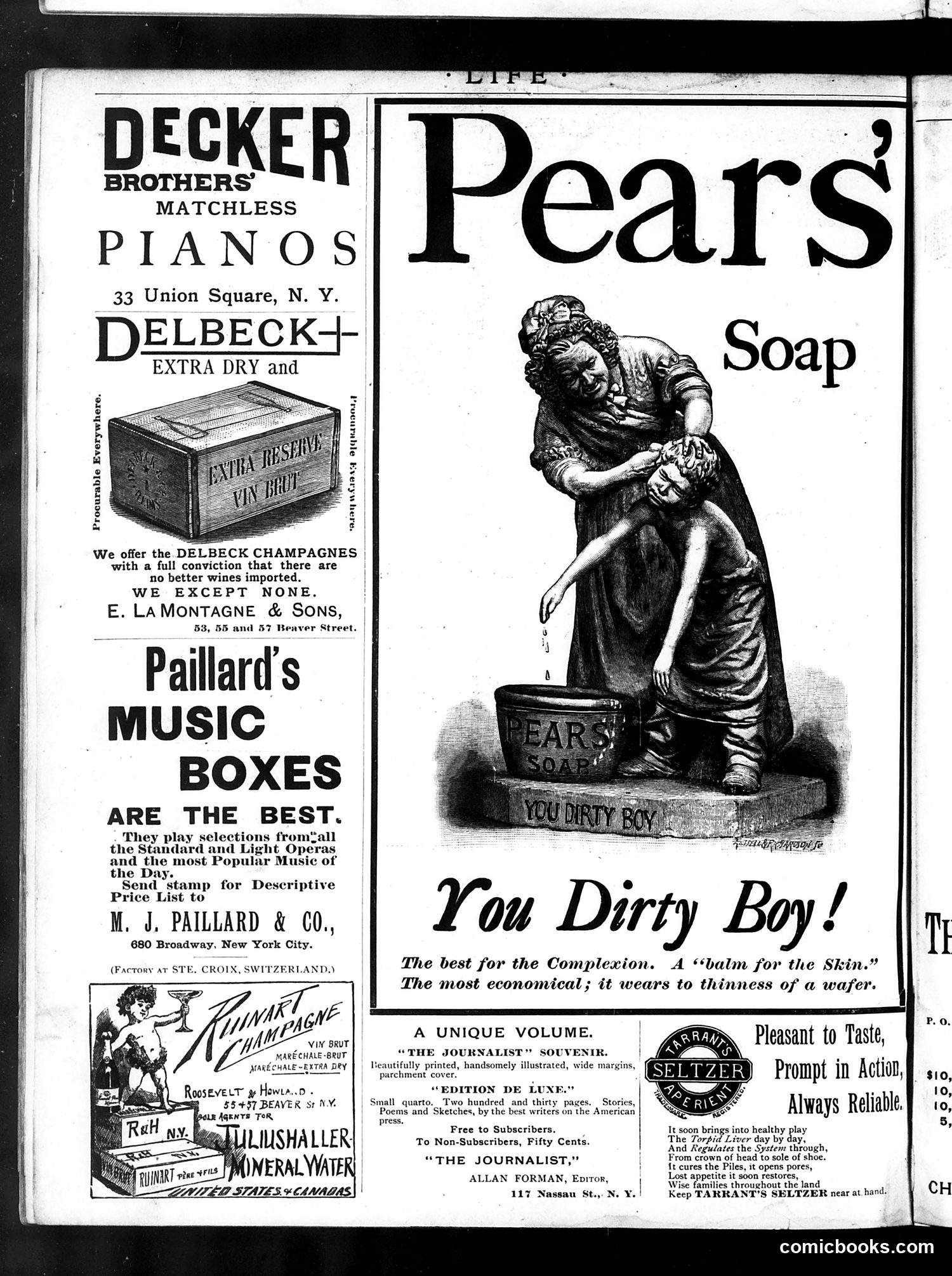
This is primarily an **advertising page** from Life magazine, not a political cartoon. The dominant image is a **Pears' Soap advertisement** featuring a caricatured child—labeled "You Dirty Boy!"—washing at a basin. The figure appears to use racist imagery common to Victorian-era advertising. The ad's humor relies on the child's exaggerated dirtiness and the product's promise of cleanliness. The caption "A 'balm for the Skin'" and claims of economy ("wears to thinness of a wafer") pitch the soap's practical benefits. Surrounding this are traditional advertisements for pianos, champagne, music boxes, mineral water, and Tarrant's Seltzer—typical Life magazine fare of the period. The page reflects late 19th-century consumer culture and advertising aesthetics rather than political satire. Modern readers would find the caricature style and stereotyping jarring and offensive.
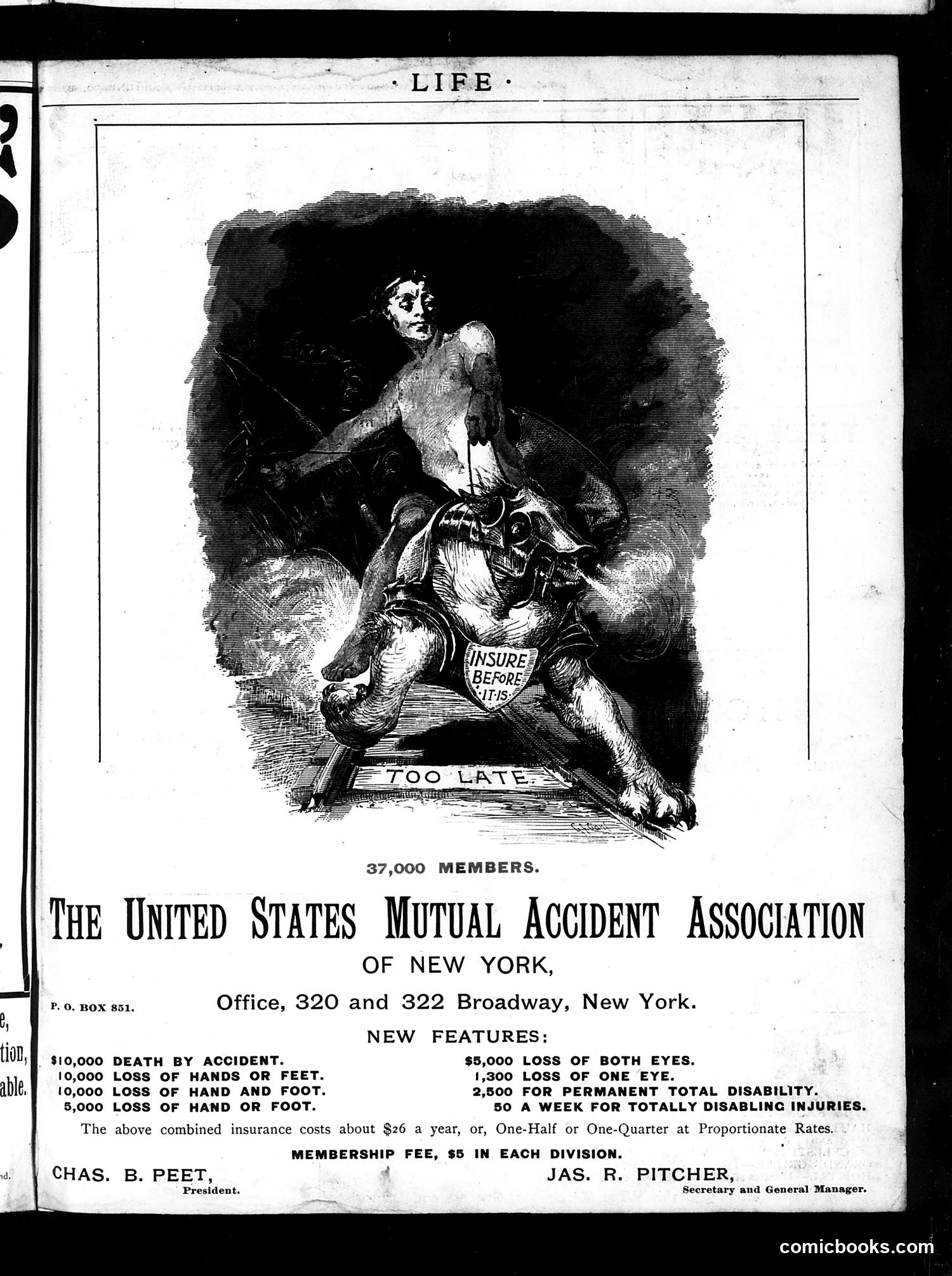
This is primarily an **insurance advertisement** for the United States Mutual Accident Association of New York. The accompanying satirical illustration depicts a skeleton or death figure perched atop a man's shoulders, holding a banner reading "INSURE BEFORE SITS" with "TOO LATE" written below. **The satire's point:** The grim reaper imagery mocks the desperation of accident insurance marketing—suggesting that without their coverage, death waits inevitably. The skeleton looming over an ordinary person embodies the sales tactic of fear-mongering: buy protection now or face catastrophe. **Historical context:** This reflects early 20th-century mutual insurance promotion, when accident/disability coverage was relatively novel and companies relied on stark mortality imagery to spur membership. The prominent display of "37,000 MEMBERS" suggests competitive marketing in a growing industry. The crude woodcut-style illustration typical of period *Life* magazine advertising uses dark humor to sell financial security—a classic example of fear-based marketing tactics.
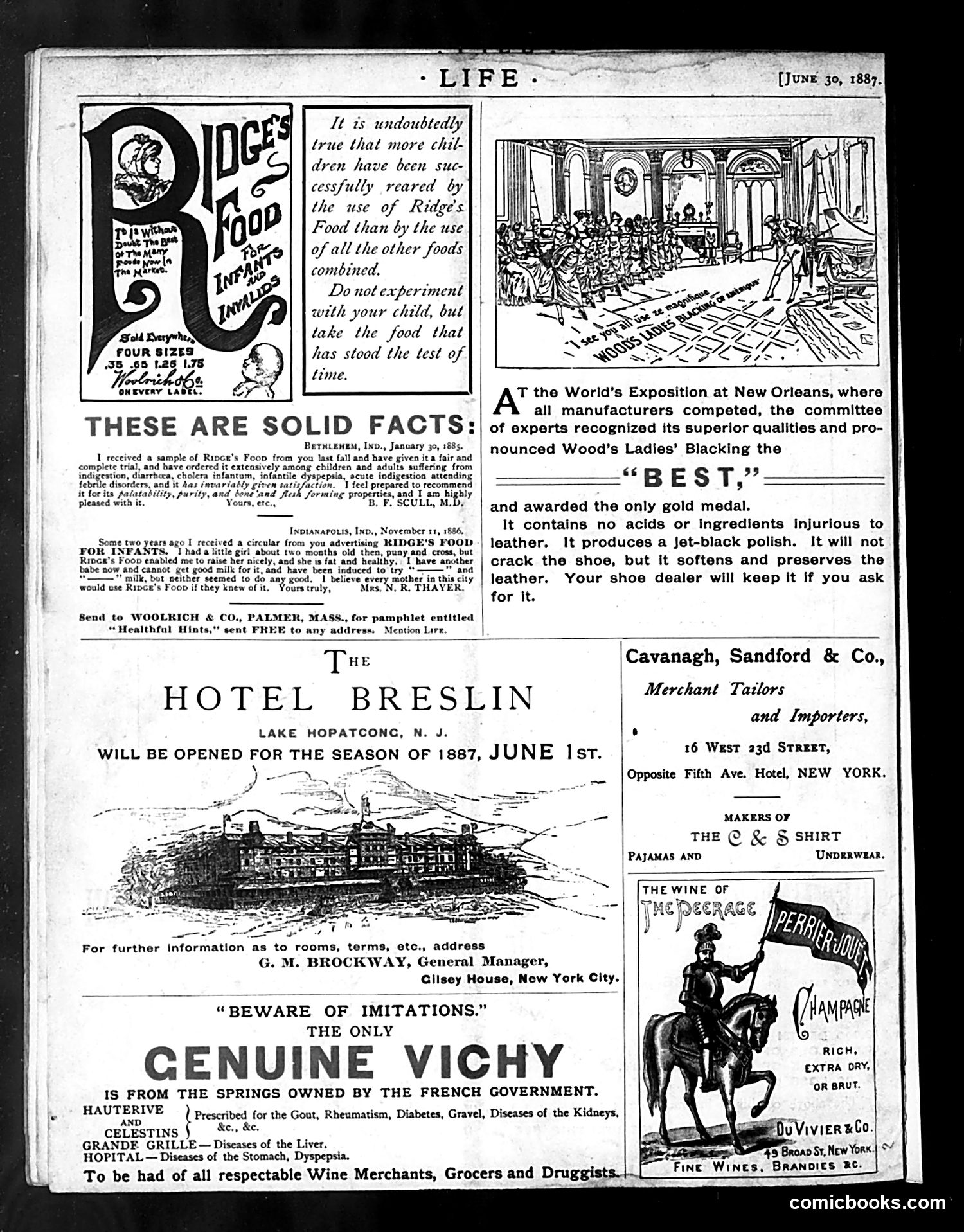
This is primarily an **advertising page** with no political cartoons or satire—just commercial notices typical of 1880s American magazines. The page features endorsements for **Ridge's Food for Infants**, presented as testimonials from doctors and mothers claiming it successfully raised healthier children than competitors. The ads use medical authority and consumer testimonials as marketing tactics. Other advertisements promote **Wood's Ladies' Blacking** (shoe polish, awarded a gold medal at the New Orleans World's Exposition), the **Hotel Breslin** resort opening in New Jersey, merchant tailors, champagne, and **genuine Vichy water**—a French mineral water marketed for treating gout, rheumatism, and digestive ailments. The only notable element is the "Beware of Imitations" warning for Vichy water, reflecting 19th-century concerns about product counterfeiting. This page reflects how American publications mixed editorial content with patent medicines, infant foods, and luxury goods marketed to middle-class consumers.

I can see this is a page from Life magazine, but the image is almost entirely black with only minimal visible details—a white margin on the left side and the comicbooks.com watermark at the bottom. The OCR text provides no substantive content beyond the website attribution. Without visible cartoon illustrations, readable text, or discernible figures, I cannot identify specific political figures, social references, or satirical points. The page appears to be either a blank/mostly black page, severely degraded, or improperly scanned. To provide historical analysis of the cartoons and their meaning, I would need a clearer image showing the actual content.