
Life, 1887-06-30 · page 8 of 21
Life — June 30, 1887 — page 8: what you’re looking at
What you’re looking at
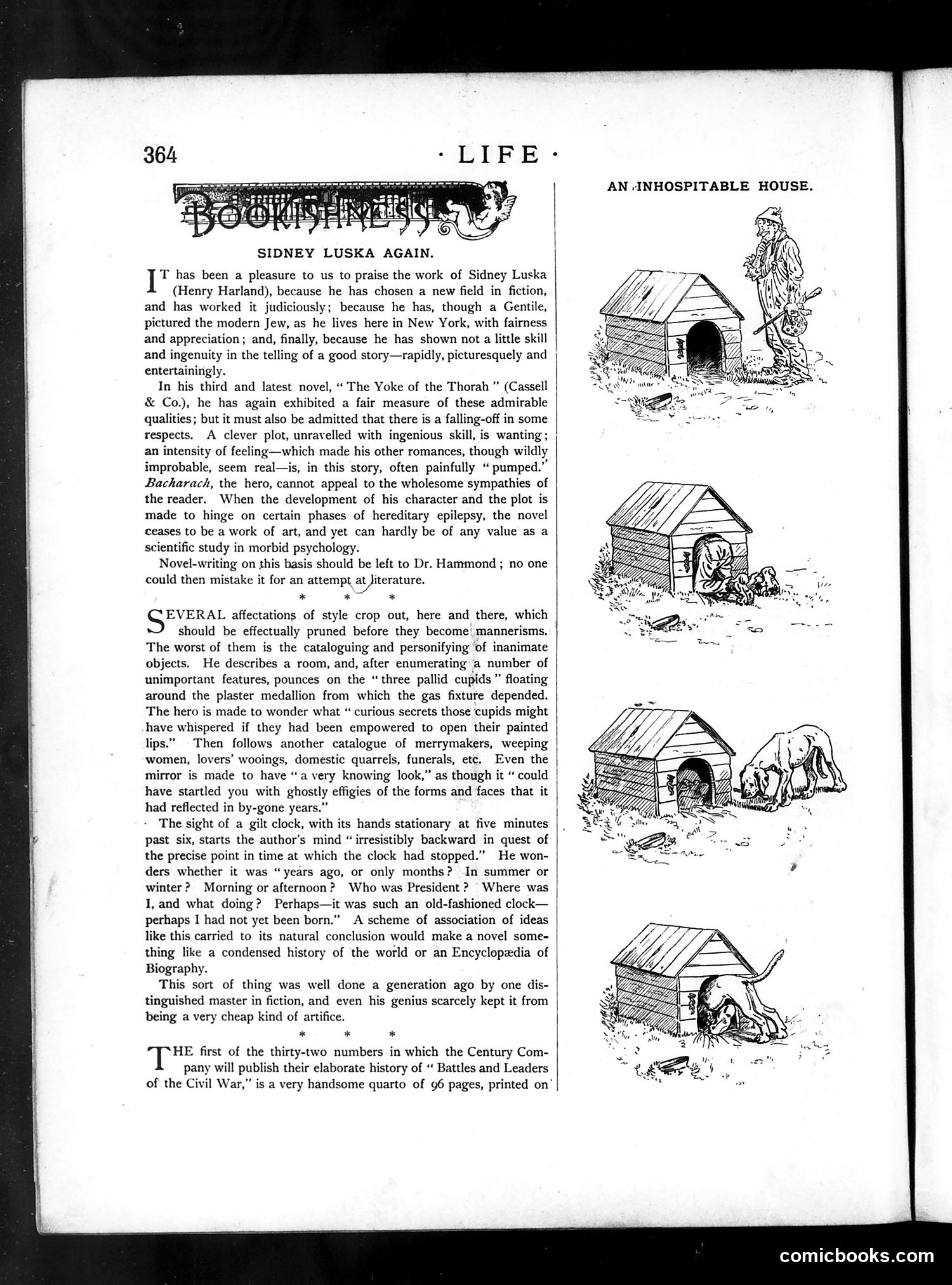
This page contains a literary review of Sidney Luska's novel "The Yoke of the Thorah" (published by Cassell & Co.). The reviewer praises Luska's (Henry Harland's) earlier work but criticizes this latest novel for lacking emotional intensity and containing problematic depictions of hereditary epilepsy that undermine its artistic value. The right side features four illustrations titled "An Inhospitable House"—sequential drawings showing a person attempting to enter a dog house while a dog defends it, escalating from peaceful coexistence to active conflict. This appears to be a humorous comic strip about unwelcome intrusion rather than political satire. The page is primarily literary criticism rather than political commentary.
📄 Transcribed text from this page (OCR, searchable)
Machine-transcribed from the original scan — historical spelling and the odd misread are preserved.
SIDNEY LUSKA AGAIN. T has been a pleasure to us to praise the work of Sidney Luska (Henry Harland), because he has chosen a new field in fiction, and has worked it judiciously; because he has, though a Gentile, pictured the modern Jew, as he lives here in New York, with fairness and appreciation ; and, finally, because he has shown not a little skill and ingenuity in the telling of a good story—rapidly, picturesquely and entertainingly. In his third and latest novel, ‘“‘ The Yoke of the Thorah ” (Cassell & Co.), he has again exhibited a fair measure of these admirable qualities; but it must also be admitted that there is a falling-off in some respects. A clever plot, unravelled with ingenious skill, is wanting ; an intensity of feeling—which made his other romances, though wildly improbable, seem real—is, in this story, often painfully “ pumped.” Bacharach, the hero, cannot appeal to the wholesome sympathies of the reader. When the development of his character and the plot is made to hinge on certain phases of hereditary epilepsy, the novel ceases to be a work of art, and yet can hardly be of any value as a scientific study in morbid psychology. Novel-writing on this basis should be left to Dr. Hammond ; no one could then mistake it for an attempt at Jiterature. * * * EVERAL affectations of style crop out, here and there, which should be effectually pruned before they become: mannerisms. The worst of them is the cataloguing and personifying ‘of inanimate objects. He describes a room, and, after enumerating a number of unimportant features, pounces on the “three pallid cupids” floating around the plaster medallion from which the gas fixture depended. The hero is made to wonder what “ curious secrets those cupids might have whispered if they had been empowered to open their painted lips.” Then follows another catalogue of merrymakers, weeping women, lovers’ wooings, domestic quarrels, funerals, etc. Even the mirror is made to have “a very knowing look,” as though it “ could have startled you with ghostly effigies of the forms and faces that it had reflected in by-gone years.” The sight of a gilt clock, with its hands stationary at five minutes past six, starts the author’s mind “ irresistibly backward in quest of the precise point in time at which the clock had stopped.” He won- ders whether it was “years ago, or only months? In summer or winter? Morning or afternoon? Who was President ? Where was I, and what doing? Perhaps—it was such an old-fashioned clock— perhaps I had not yet been born.” A scheme of association of ideas like this carried to its natural conclusion would make a novel some- thing like a condensed history of the world or an Encyclopedia of Biography. This sort of thing was well done a generation ago by one dis- | tinguished master in fiction, and even his genius scarcely kept it from | being a very cheap kind of artifice. * * * HE first of the thirty-two numbers in which the Century Com- pany will publish their elaborate history of ‘‘ Battles and Leaders of the Civil War,” is a very handsome quarto of 96 pages, printed on’ AN INHOSPITABLE HOUSE. comicbooks.com