
A complete issue · 16 pages · 1887
Life — June 9, 1887
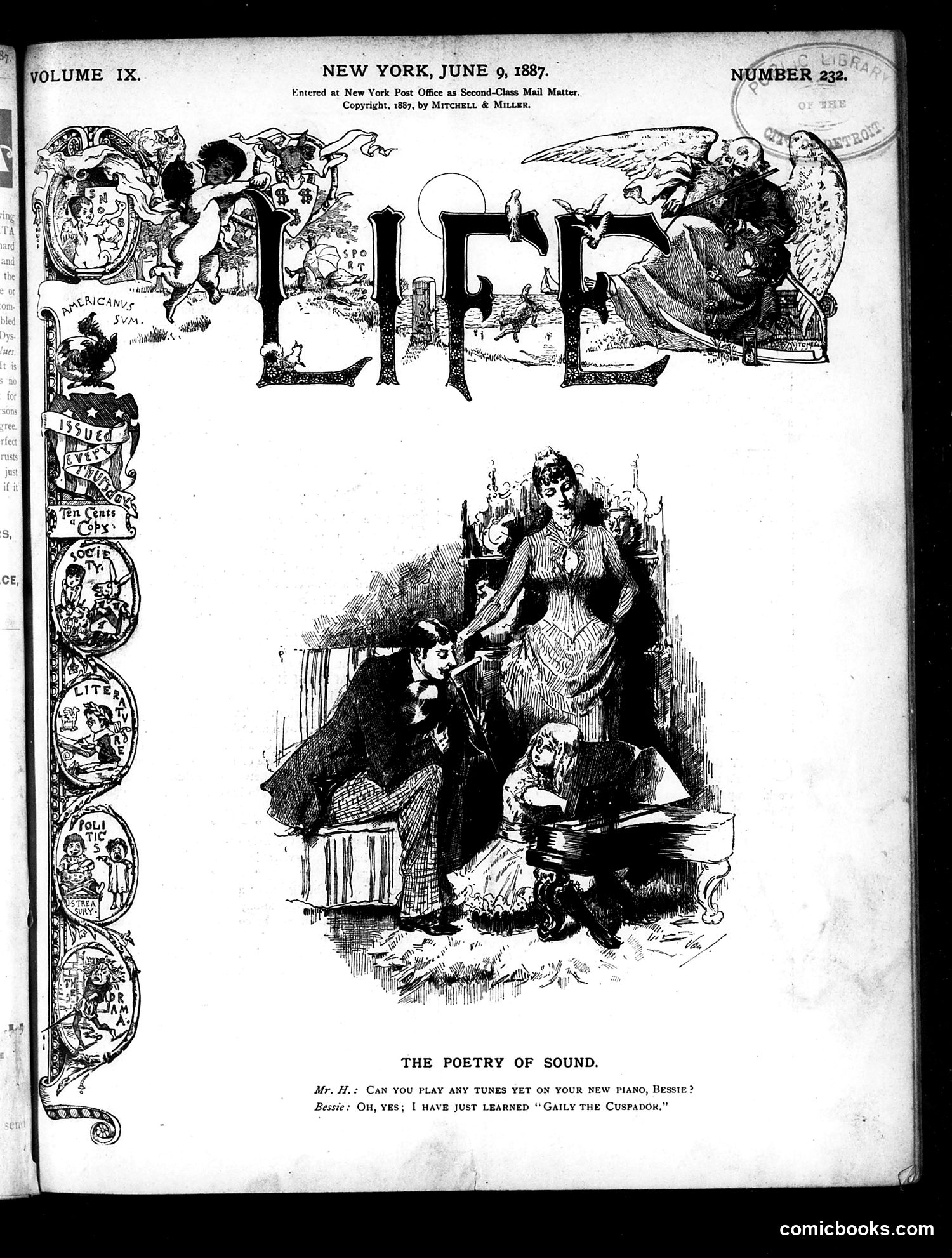
This page contains a single humorous cartoon titled "The Poetry of Sound," depicting a domestic scene where a woman stands at a piano while two men react with apparent distress or shock. The caption reads: **Mr. H.: "Can you play any tunes yet on your new piano, Bessie?"** **Bessie: "Oh yes; I have just learned 'Gaily the Crusadoe.'"** The joke satirizes amateur piano playing—a common Victorian-era domestic accomplishment for women. The men's exaggerated reactions suggest Bessie plays poorly despite her confidence, making her enthusiastic claim humorous. The title "Poetry of Sound" ironically contrasts with what appears to be unpleasant noise, a typical period joke about untrained musicians. No specific political or social commentary is evident; this is simply genteel domestic satire.
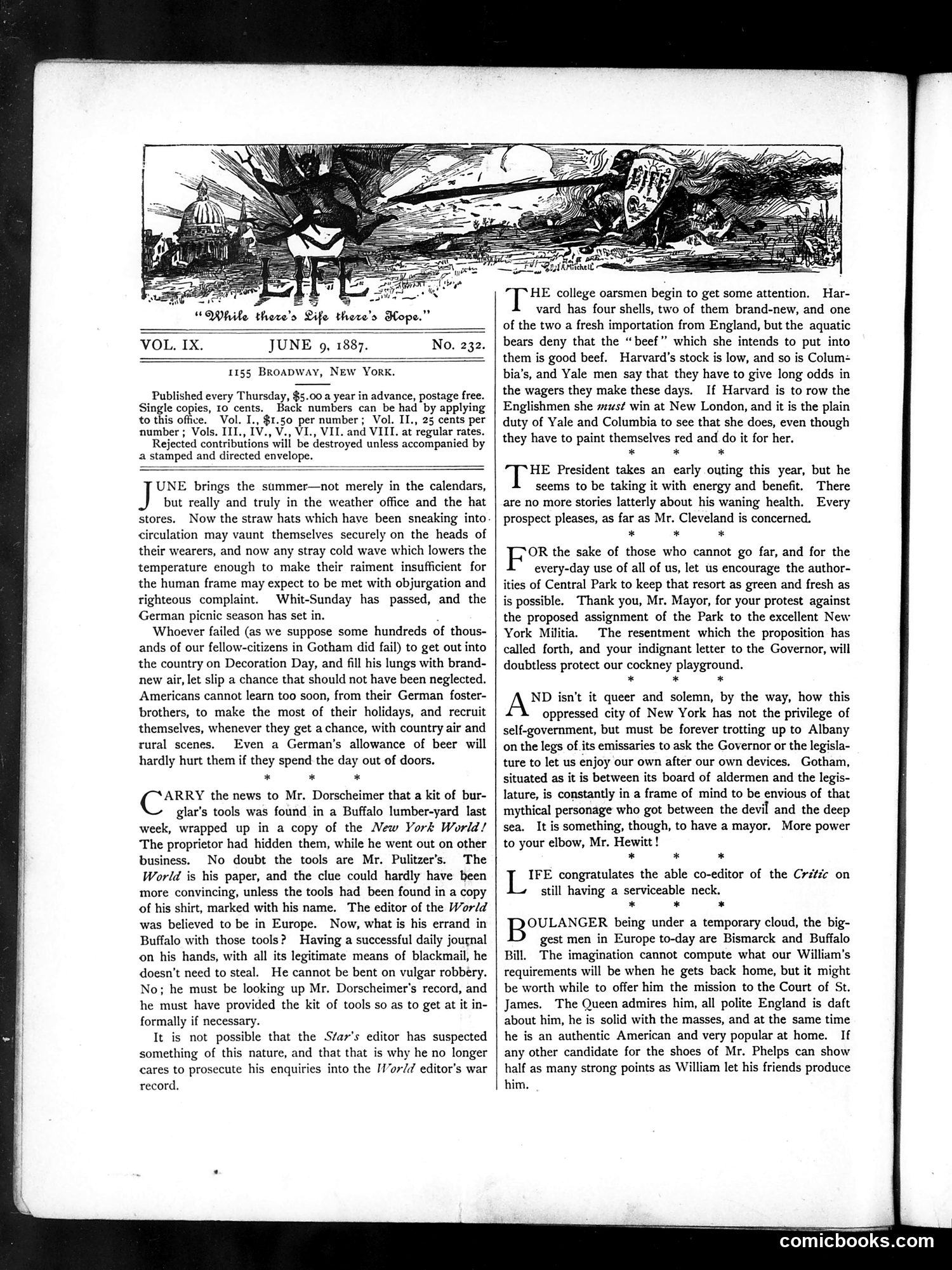
The masthead cartoon depicts a chaotic scene labeled "While there's Life there's Hope," showing figures in turmoil with what appears to be a crashing airship or dirigible. The text below addresses several contemporary issues: 1. **Harvard rowing competition** - Harvard oarsmen are competing; the text mentions their "beef" (physical conditioning) and notes Yale and Columbia must work hard to compete. 2. **Park controversy** - References a dispute over assigning Central Park to the "New York Militia," with the editor supporting the Governor's intervention against this proposal. 3. **Gotham governance** - Criticizes New York City's loss of self-governance, suggesting it's controlled by Albany rather than having true local autonomy. 4. **Buffalo Bill candidacy** - Discusses William F. Cody as a potential diplomatic envoy to the Court of St. James, suggesting he's popular and authentic American enough for the role.
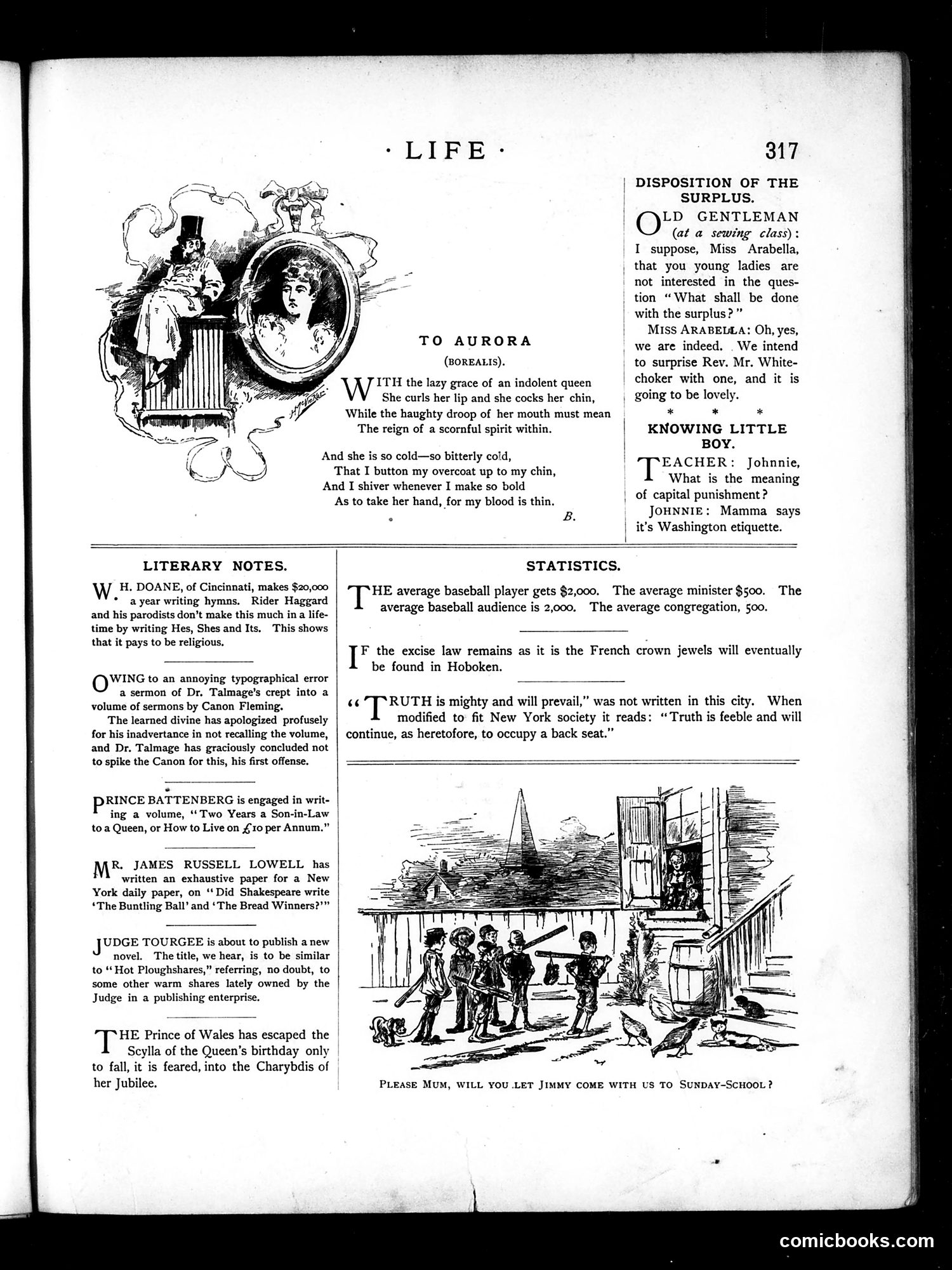
The page contains several sections: **"To Aurora" Poem**: A satirical poem mocking an indolent, cold queen named Aurora who refuses physical affection (won't let the speaker take her hand because "my blood is thin"). This appears to be literary satire on a specific person or type, though the identity isn't explicit here. **Literary Notes & Statistics**: Brief gossip items about writers and ministers, including one noting baseball players earn more than ministers—social commentary on American values. **Bottom Illustration**: Shows children at play near a waterfront building, with the caption "Please Mum, will you let Jimmy come with us to Sunday-School?" This is gentle domestic humor about childhood persuasion. The page reflects Life's typical mix of poetry, literary gossip, and wholesome/sentimental humor aimed at upper-class readers.
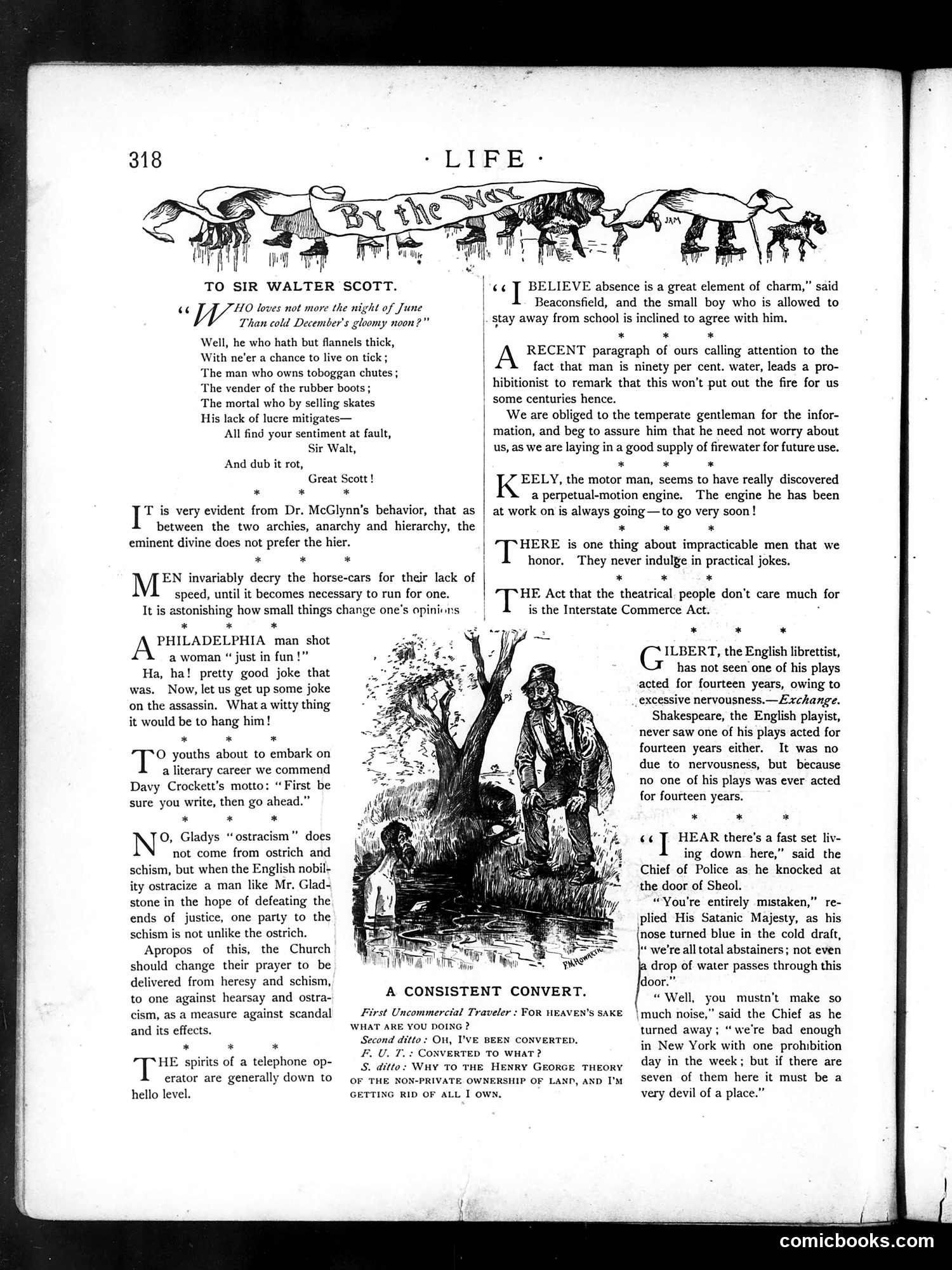
The main illustration depicts "A Consistent Convert"—a dialogue between a "First Uncommercial Trader" and a "Second Sitte" (possibly "Second Site"). The cartoon satirizes ideological inconsistency: someone who claims conversion to a cause while maintaining self-serving motives. The trader boasts of conversion, but when asked "to what?", reveals he's merely adopted Henry George's land-ownership theory to "get rid of all I own"—suggesting he's using radical ideology as cover for avoiding financial responsibility rather than genuine belief. The surrounding text snippets are typical Life magazine commentary on contemporary matters: observations about absence, water supply, motor mechanics, theatrical tastes, and nervous actors. This reflects Progressive Era debates about economic reform and whether converts to movements acted from principle or convenience.
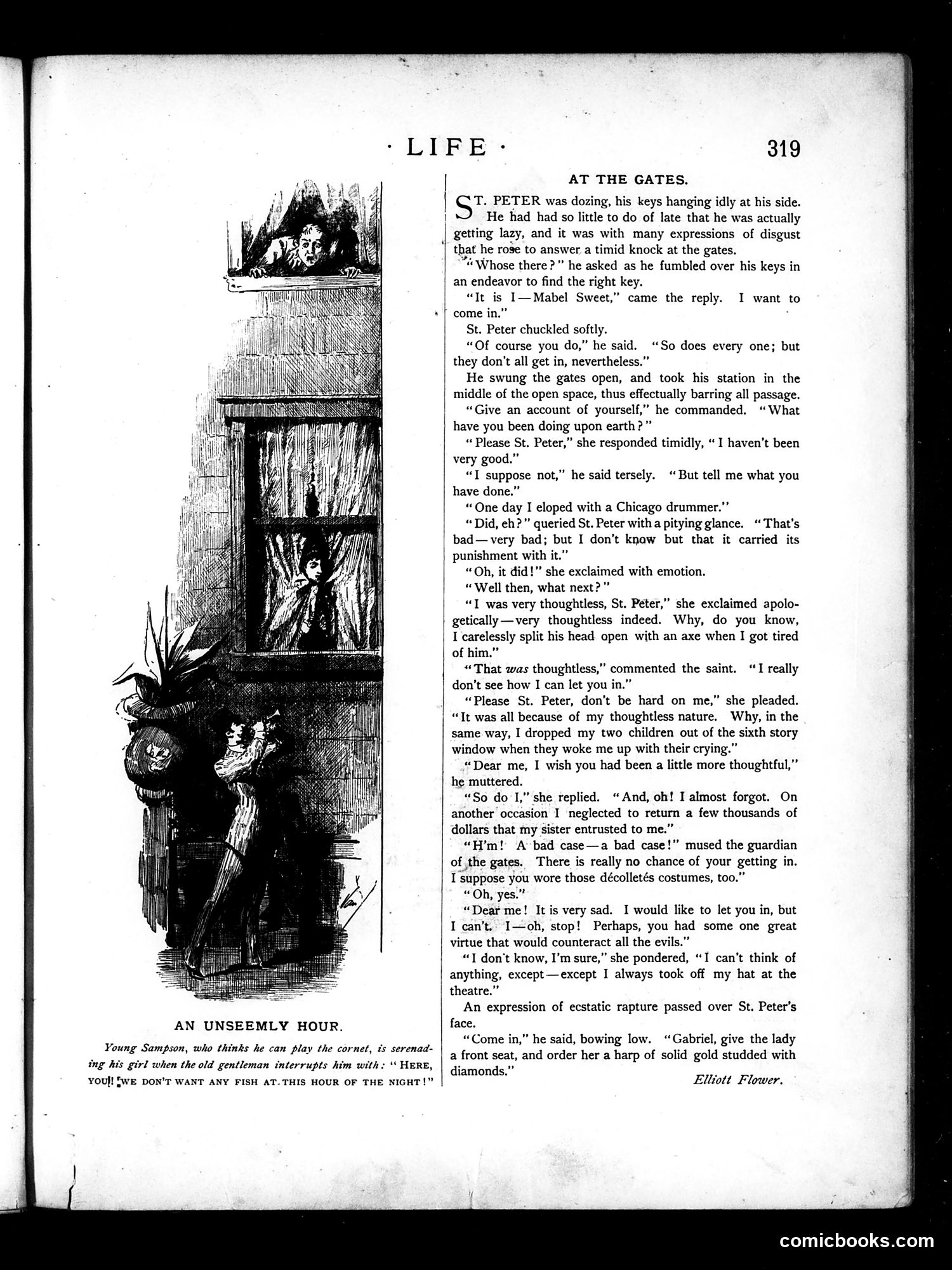
This page contains a short story titled "At the Gates" by Elliott Flower, not a political cartoon. The narrative depicts St. Peter at heaven's gates interviewing an applicant—Mabel Sweet—who admits to various moral failings: eloping with a Chicago drummer, carelessly killing her husband, and negligently dropping her two children from a window. The accompanying illustration shows St. Peter in his gatehouse with the applicant below. The satire is moral/religious rather than political: it mocks the applicant's casual attitude toward serious sins and St. Peter's bemused response. The humor derives from the contrast between the gravity of her transgressions and her flippant tone—a commentary on contemporary moral laxness and hypocrisy.
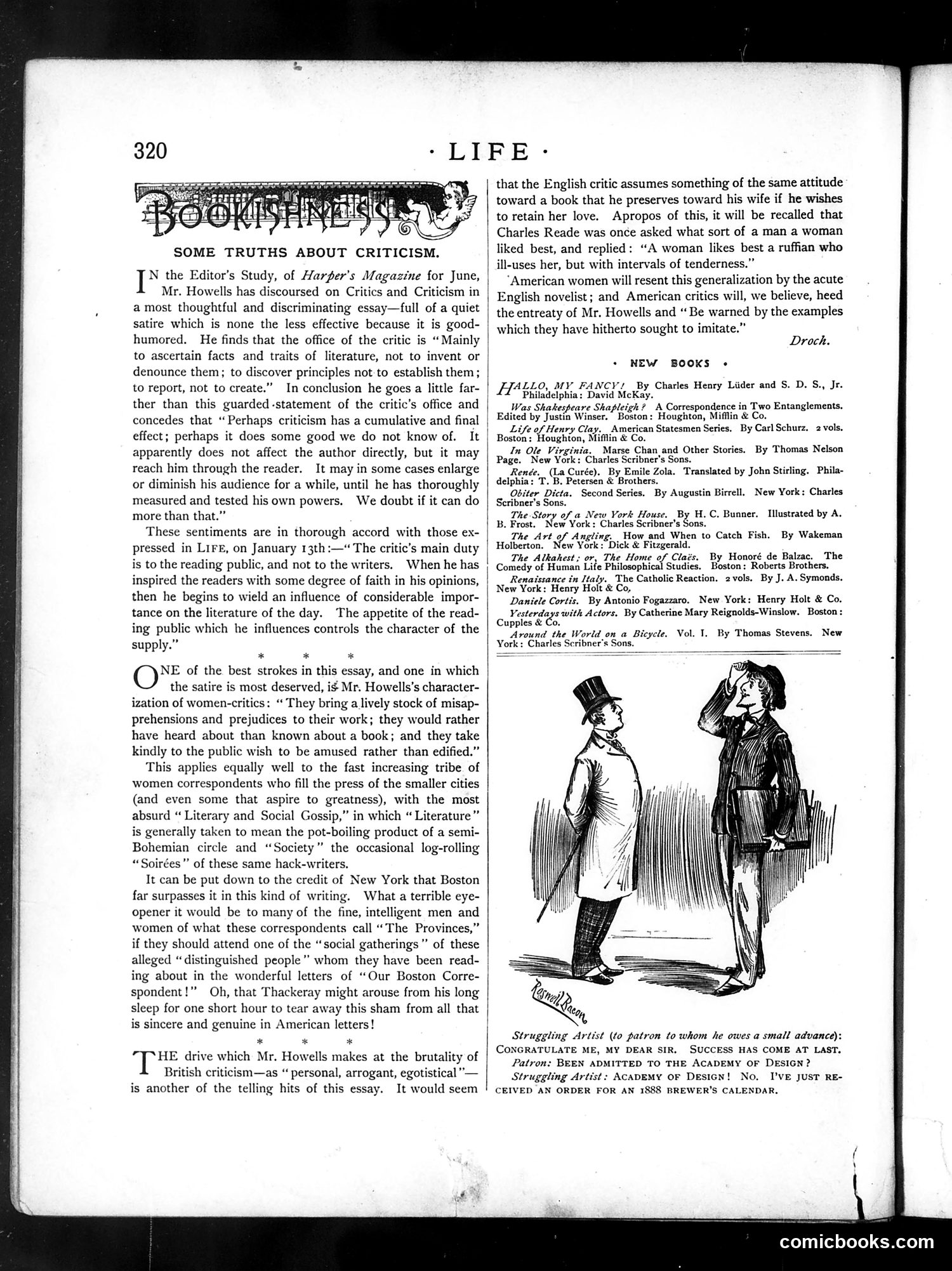
The main cartoon depicts a "Struggling Artist" seeking patronage from a wealthy patron. The artist appears humble and hopeful while the well-dressed patron (wearing a top hat) listens. The caption's joke relies on the artist's desperation: he congratulates the patron on finally being "admitted to the Academy of Design" and mentions receiving "an order for an 1888 brewer's calendar"—suggesting the struggling artist ironically celebrates getting such modest, commercial work rather than prestigious fine art commissions. This satirizes the difficult economic realities for artists of the era, who often had to accept commercial illustration work (like brewery advertisements) rather than pursue fine art. The cartoon mocks both artistic pretension and the patron-artist power dynamic of late 19th-century American society.
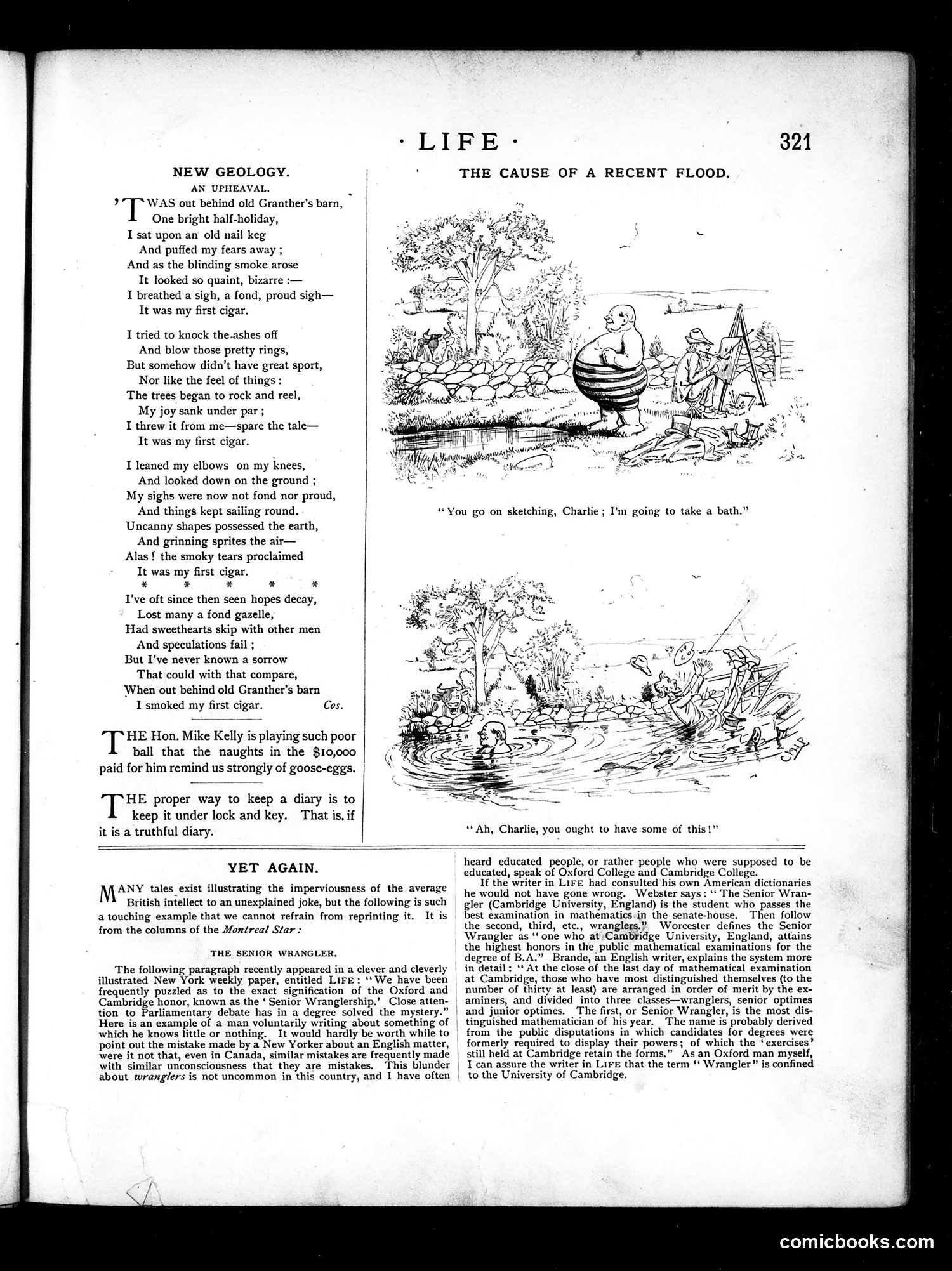
This page contains two unrelated items: 1. **"New Geology: An Upheaval"** — A poem about smoking one's first cigar behind a barn, with the speaker's embarrassing failed attempts at appearing sophisticated. It's gentle humor about youthful pretension. 2. **"The Cause of a Recent Flood"** — Two cartoon panels showing a man (Charlie) at a riverbank. In the first, he tells a companion he's going sketching while the other takes a bath. The second shows the bathing man causing a flood by displacing water. The humor is slapstick: the bather's bulk creates comical flooding. The caption "Ah, Charlie, you ought to have some of this!" suggests teasing about the bather's size. Below is an unrelated note about Mike Kelly and diary-keeping. The page is primarily lighthearted domestic humor.
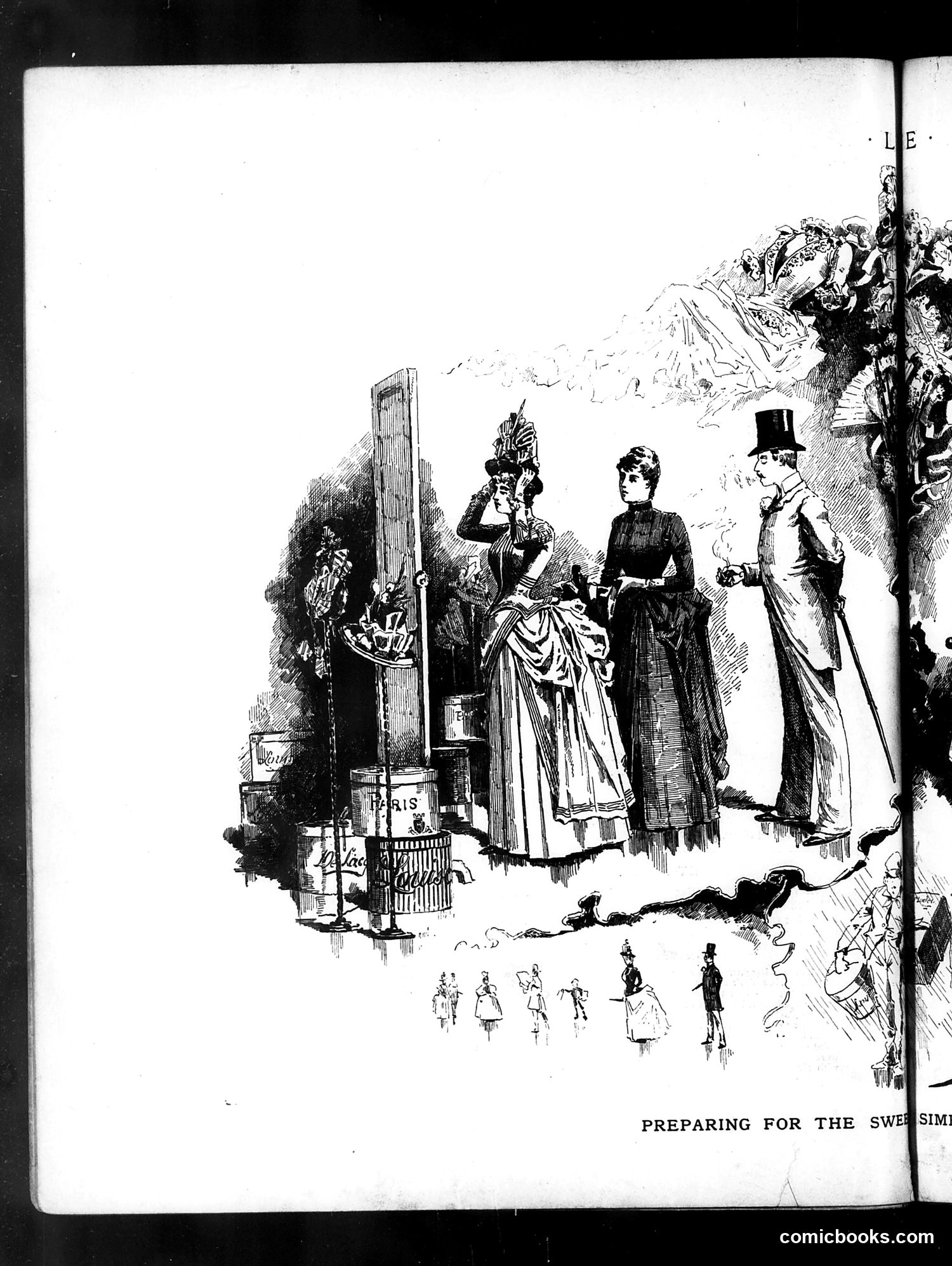
This appears to be a satirical illustration titled "Preparing for the Swe[et] Simi[...]" (text is cut off). The image shows four elegantly dressed Victorian-era figures standing near what appears to be a large structure or monument, with smaller figures sketched below them. The satire likely concerns wealthy society preparing for some fashionable event or season. The elaborate dress of the main figures—including top hats and formal gowns—suggests commentary on upper-class pretension. The contrast between the large, detailed main figures and the tiny sketched figures below may mock the distance between the wealthy and common people, or illustrate how the elite view ordinary citizens. Without the complete title and more context, the specific event being satirized remains unclear, but this represents typical Life magazine social satire of the Gilded Age or Progressive Era.
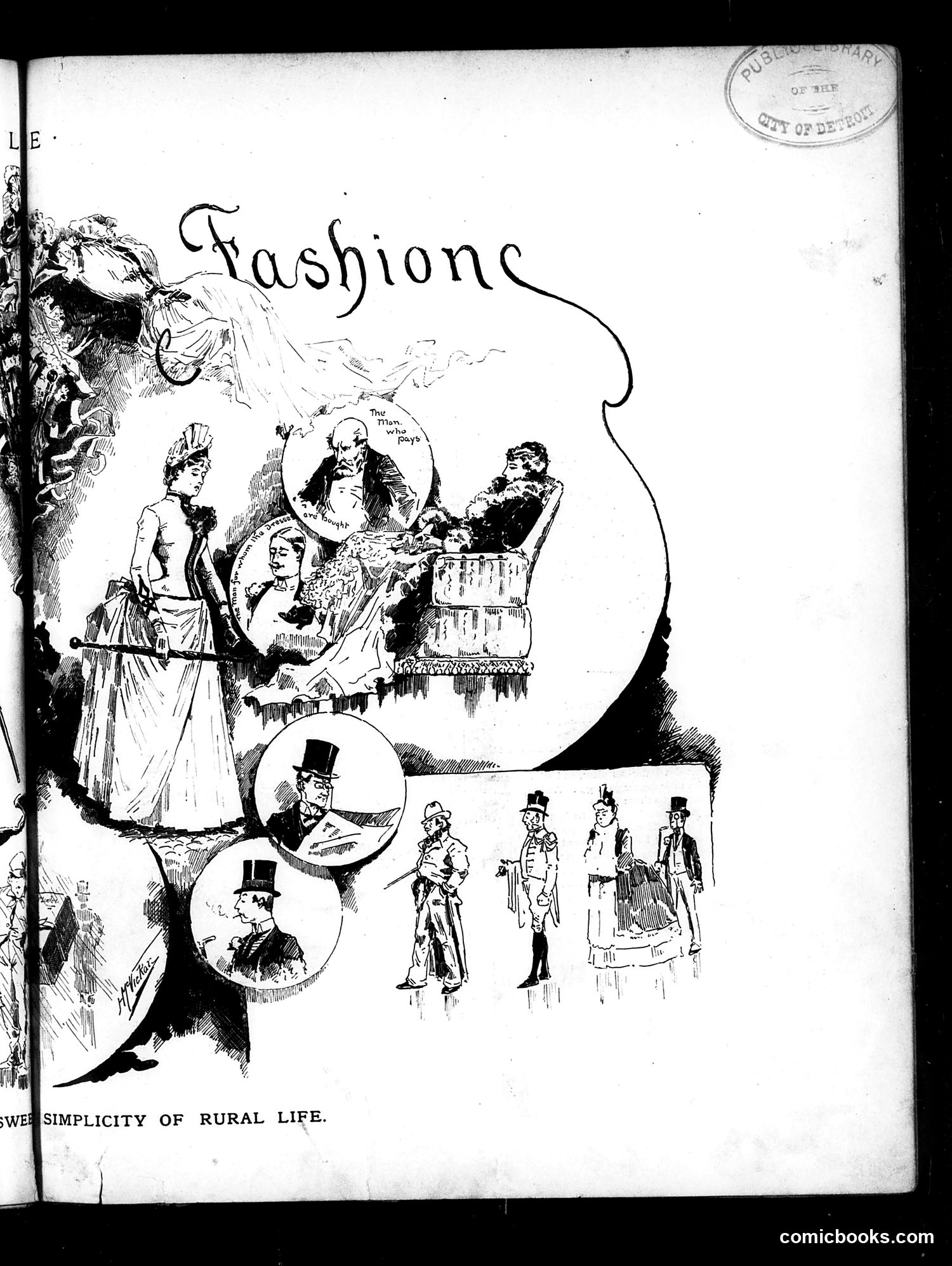
This satirical page contrasts fancy urban fashion with rural simplicity. The upper illustration shows elegantly dressed society figures in an ornate interior setting, with a woman in an elaborate gown standing prominently on the left. Below are two circular vignettes featuring men in top hats—likely representing wealthy or fashionable urbanites—and a series of four rural figures in simpler attire on the right. The caption "Simplicity of Rural Life" appears ironic: the page suggests that despite claims of rural simplicity, even country folk adopt fashionable dress and mannerisms. The contrast satirizes how fashion and social pretension permeate all levels of society, including those supposedly removed from urban vanity.
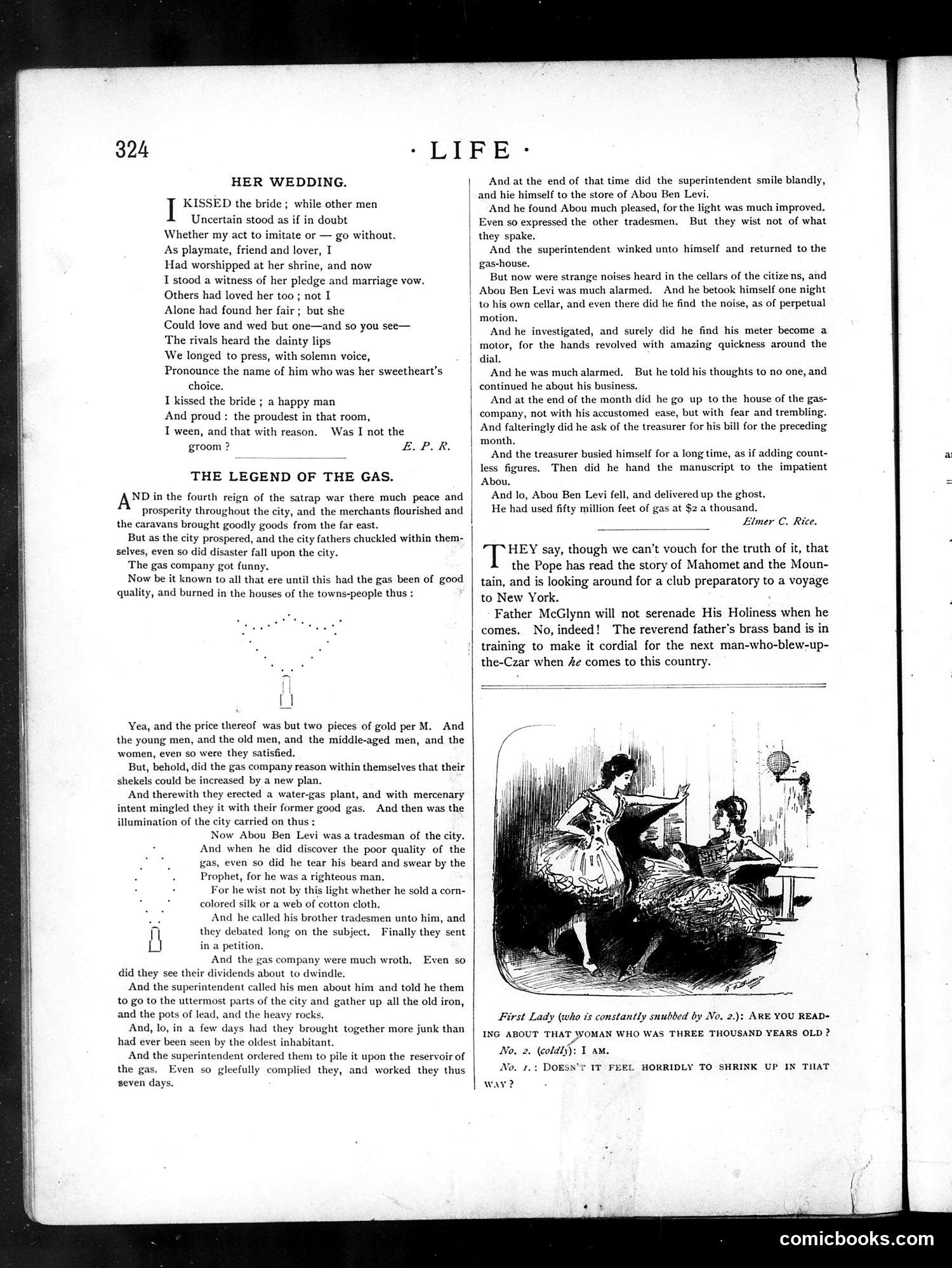
This page contains two distinct pieces: **"Her Wedding"** (poem by E.P.R.): A conventional love poem about witnessing a bride's marriage vow. **"The Legend of the Gas"** (story by Elmer C. Rice): A satirical narrative about a gas company's monopoly practices in a city. The story mocks how the company discovered poor gas quality, faced complaints, and responded by establishing a water-gas plant. When a worker named Abou Ben Levi exposed the fraud through investigation, the company retaliated by firing him—illustrating corporate malfeasance and worker exploitation during the industrial era. The accompanying illustration shows two women in what appears to be a drawing room, with a caption about a three-thousand-year-old woman, likely a humorous aside unrelated to the main stories. The satire targets late 19th/early 20th-century utility monopolies and corporate dishonesty.
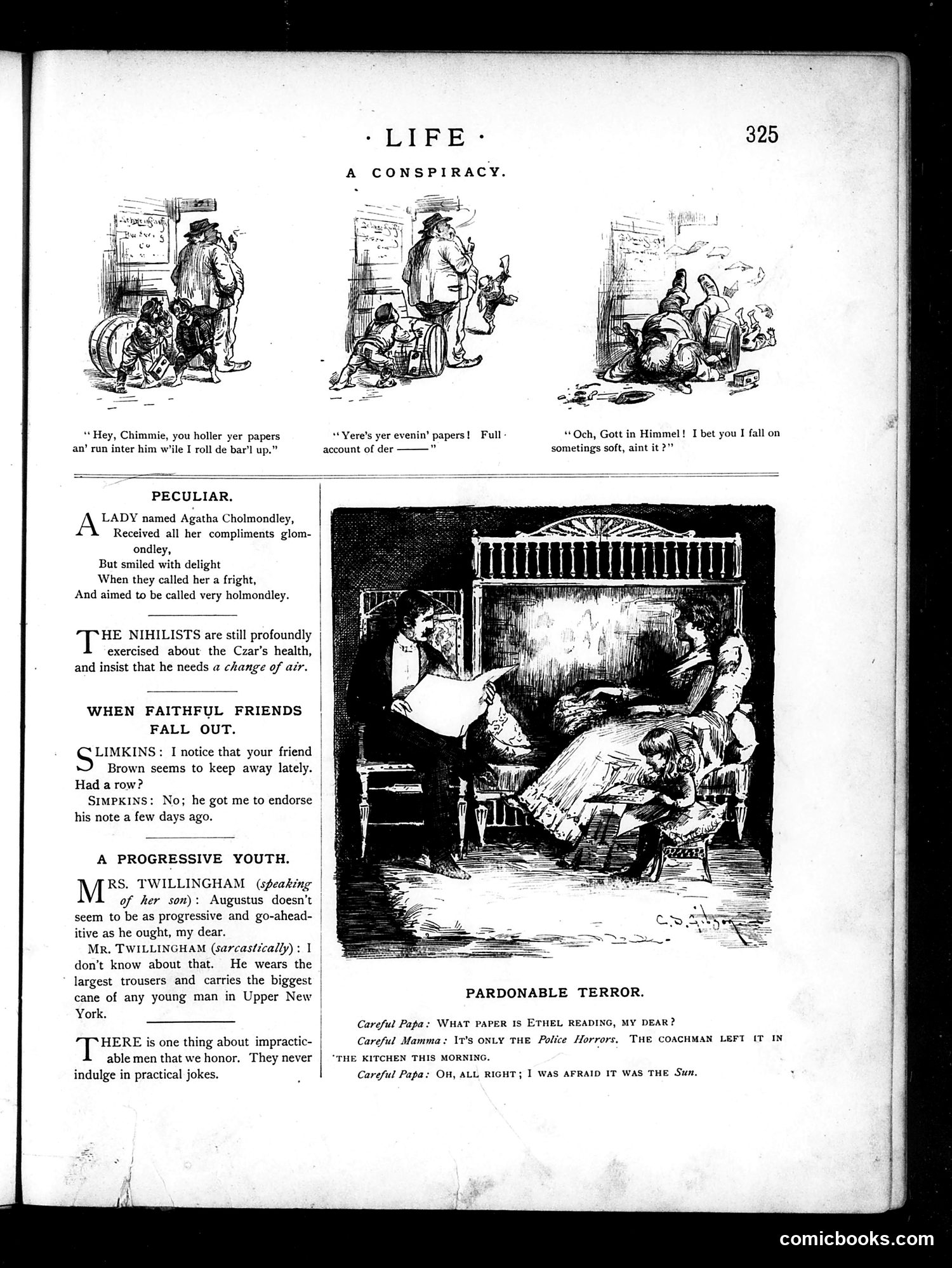
This page contains multiple satirical pieces typical of early 20th-century American humor: **"A Conspiracy"** (top cartoon): Three panels showing street vendors and a man with a barrel in what appears to be immigrant-dialect humor. The "conspiracy" depicts petty street hustlers—one distracting a mark while another rolls a barrel to trip him. The heavy dialect ("Chimmie," "w'ile") reflects period stereotyping of working-class immigrants. **Various short jokes**: These target specific social types—a vain lady (Agatha Cholmondley), nihilists concerned about the Russian Czar's health (likely referencing contemporary Russian political instability), a young man whose fashion sense outpaces his ambition, and impractical men. **"Pardonable Terror"** (bottom): Parents worry their daughter reads the *Police Horrors* section of the newspaper, but are relieved it's not the *Sun*—suggesting the *Sun* was considered more scandalous or sensational. This reflects period anxiety about newspaper content's influence on youth. The page exemplifies Life's mix of social satire, class humor, and topical references accessible to educated readers of the era.
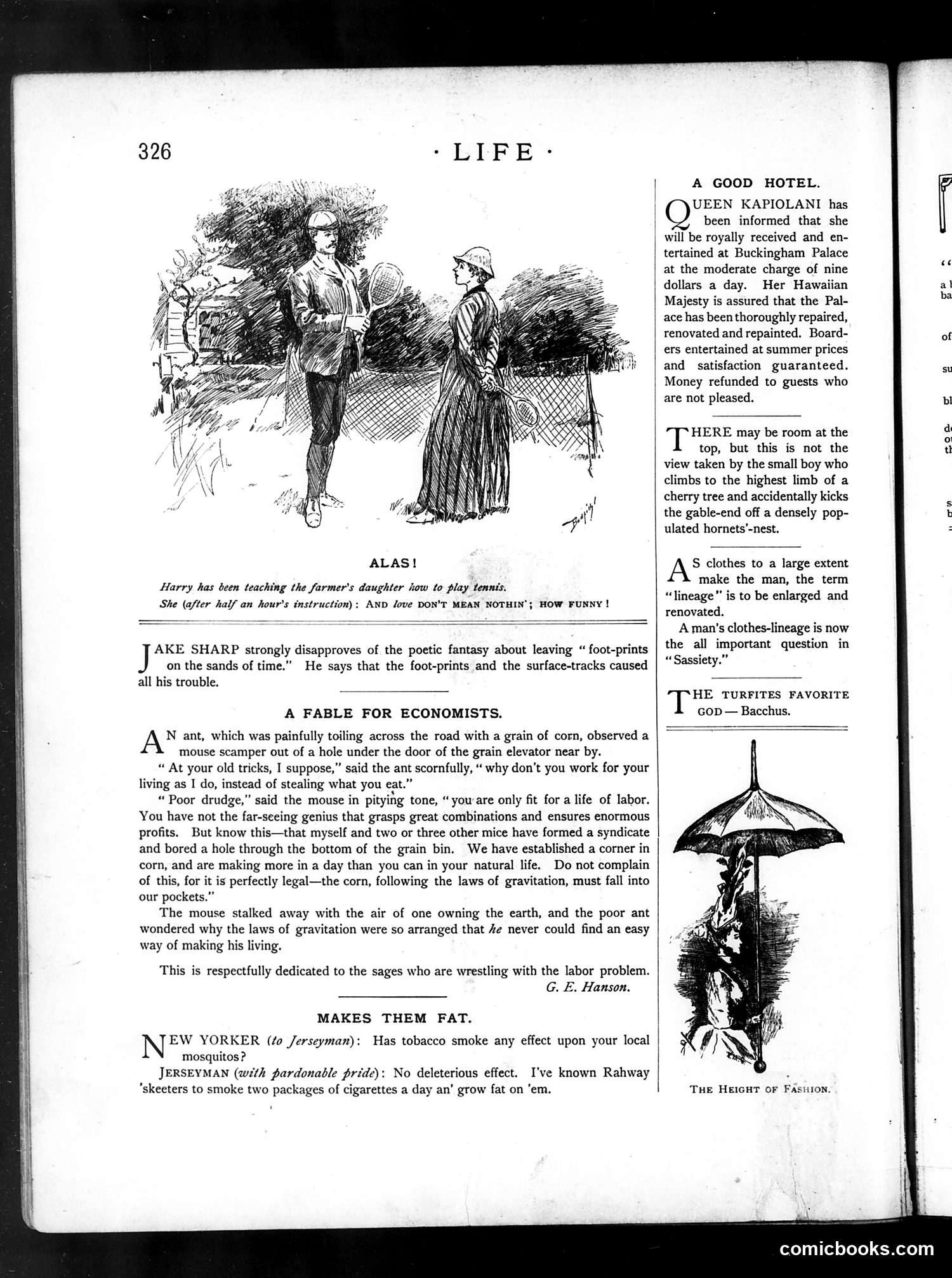
**Main Cartoon ("Alas!")**: Shows a man instructing a woman in tennis. Her naive comment—"love don't mean nothin'"—is funny because she's misunderstanding tennis terminology ("love" = zero score) as romantic sentiment, suggesting innocent misinterpretation of courtship signals. **"A Fable for Economists"**: A sophisticated political satire mocking labor economics and monopolies. An ant works honestly; a mouse brags about forming a "syndicate" to corner the grain market through a hole in the bin, making profits through manipulation rather than labor. The satire attacks wealthy industrialists and "trusts" (monopolies) that were controversial political issues in this era, suggesting their schemes are legally permissible but morally questionable—the mouse profits while the honest worker struggles. **Other Items**: Brief humorous snippets about tobacco, fashion, and social pretension typical of Life's satirical style. The page reflects early-20th-century American anxieties about labor, wealth inequality, and corporate power.
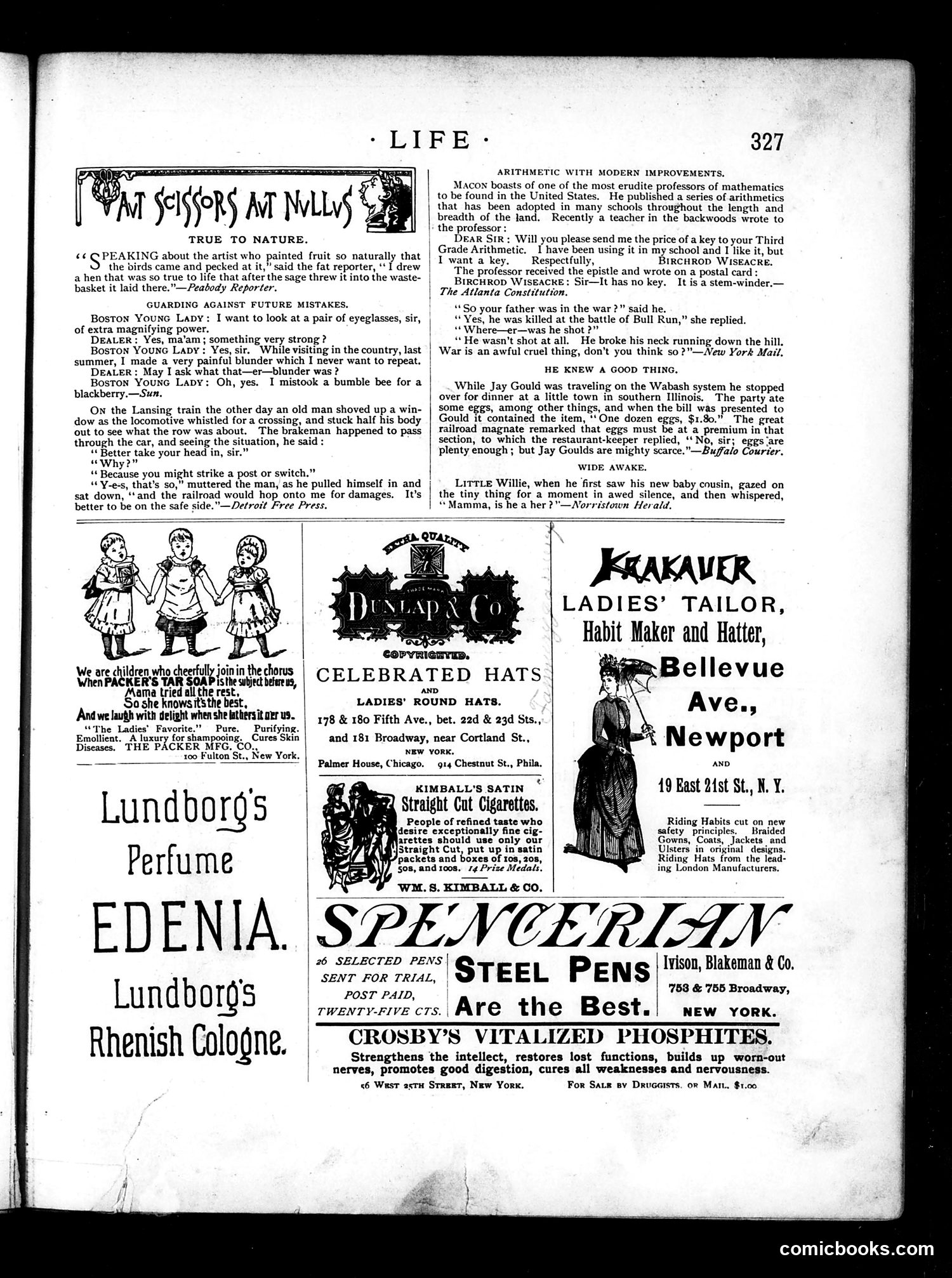
This page is primarily a collection of short humorous anecdotes and advertisements typical of *Life* magazine's satirical format. The cartoons/jokes include: 1. **"Scissors Art Nulls"** — A reporter claims an artist painted fruit so realistically that birds pecked at it. The joke's punchline: the reporter drew a hen so lifelike that after someone discarded it, the hen "laid" an egg—a absurdist play on the artist's claim. 2. **Eyeglasses joke** — A woman wants powerful magnifying glasses because she once mistook a bumble bee for a blackberry while visiting the country. 3. **Train window anecdote** — An old man sticks his head out a train window; when warned he might hit a post, he worries the railroad will sue *him* for damages—satirizing liability concerns. 4. **Math textbook key** — A backwoods teacher requests an answer key for an arithmetic textbook; the famous mathematics professor replies it has "no key. It is a stem-winder"—a mechanical pun. 5. **Jay Gould egg prices** — Railroad magnate Jay Gould questions inflated egg prices; the restaurateur replies eggs are cheap, but "Jay Goulds are mighty scarce"—poking fun at Gould's legendary stinginess. The remaining content is period advertising.
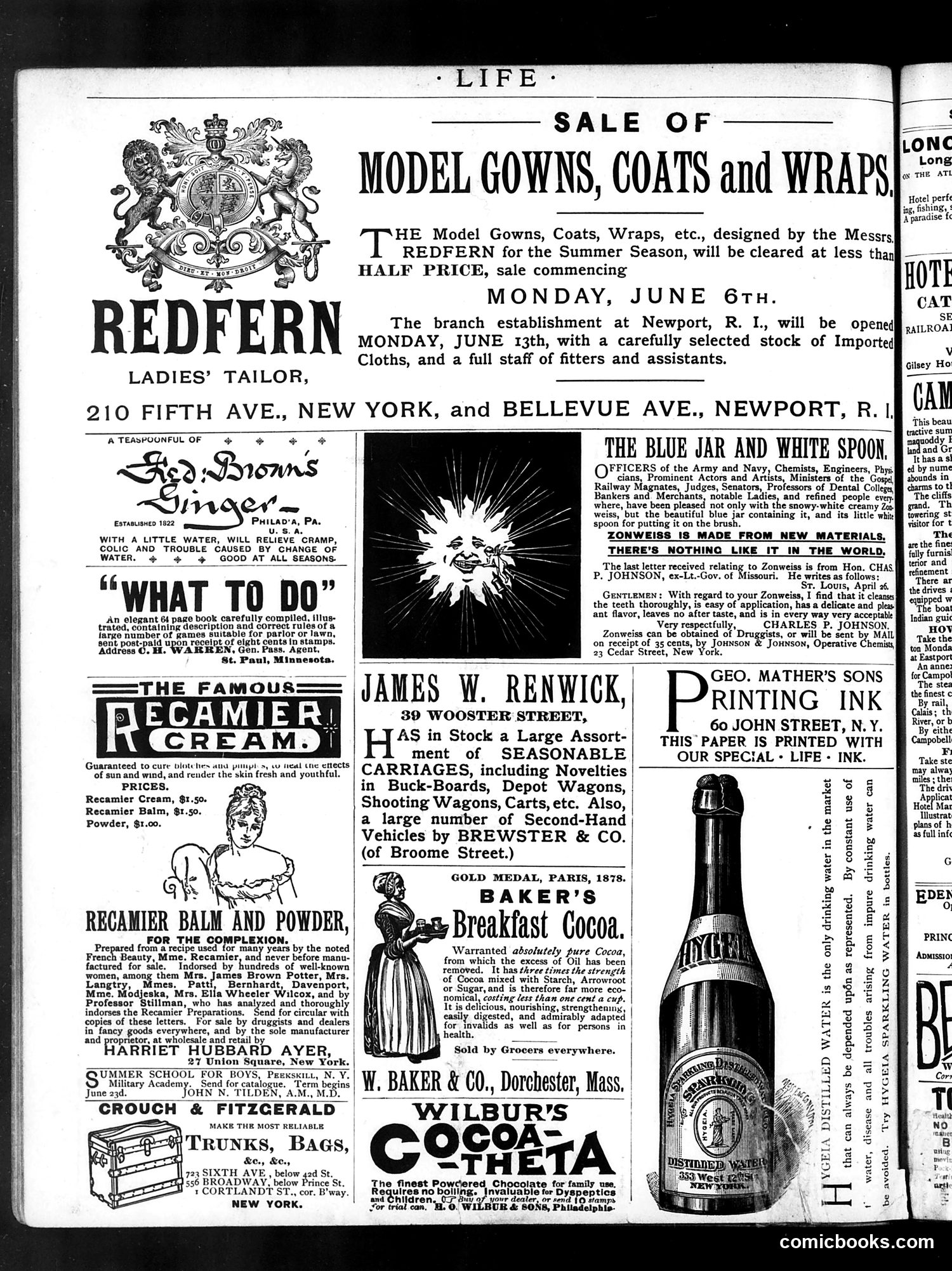
This is primarily an **advertising page** from Life magazine, not a satirical cartoon section. The page consists almost entirely of commercial advertisements from the late 19th century. The main advertisements include: - **Redfern Ladies' Tailor** (top): A high-end fashion house advertising clearance sales of model gowns, coats, and wraps for summer, with locations in New York and Newport, Rhode Island. - **Zonweiss toothpaste**: Features a testimonial from Charles P. Johnson (identified as ex-Lieutenant Governor of Missouri) endorsing the product's cleaning properties and pleasant flavor. - **Recamier Balm and Powder**: A cosmetic product endorsed by celebrities of the era (Lillie Langtry, Adelina Patti, Sarah Bernhardt) and a chemistry professor. - **Baker's Breakfast Cocoa** and **Wilbur's Cocoa-Theta**: Competing chocolate drink products. - Various other products: printing ink, carriages, trunks, and singer sewing machines. There is **no political satire** visible on this page—it represents typical advertising from Life's commercial sections.
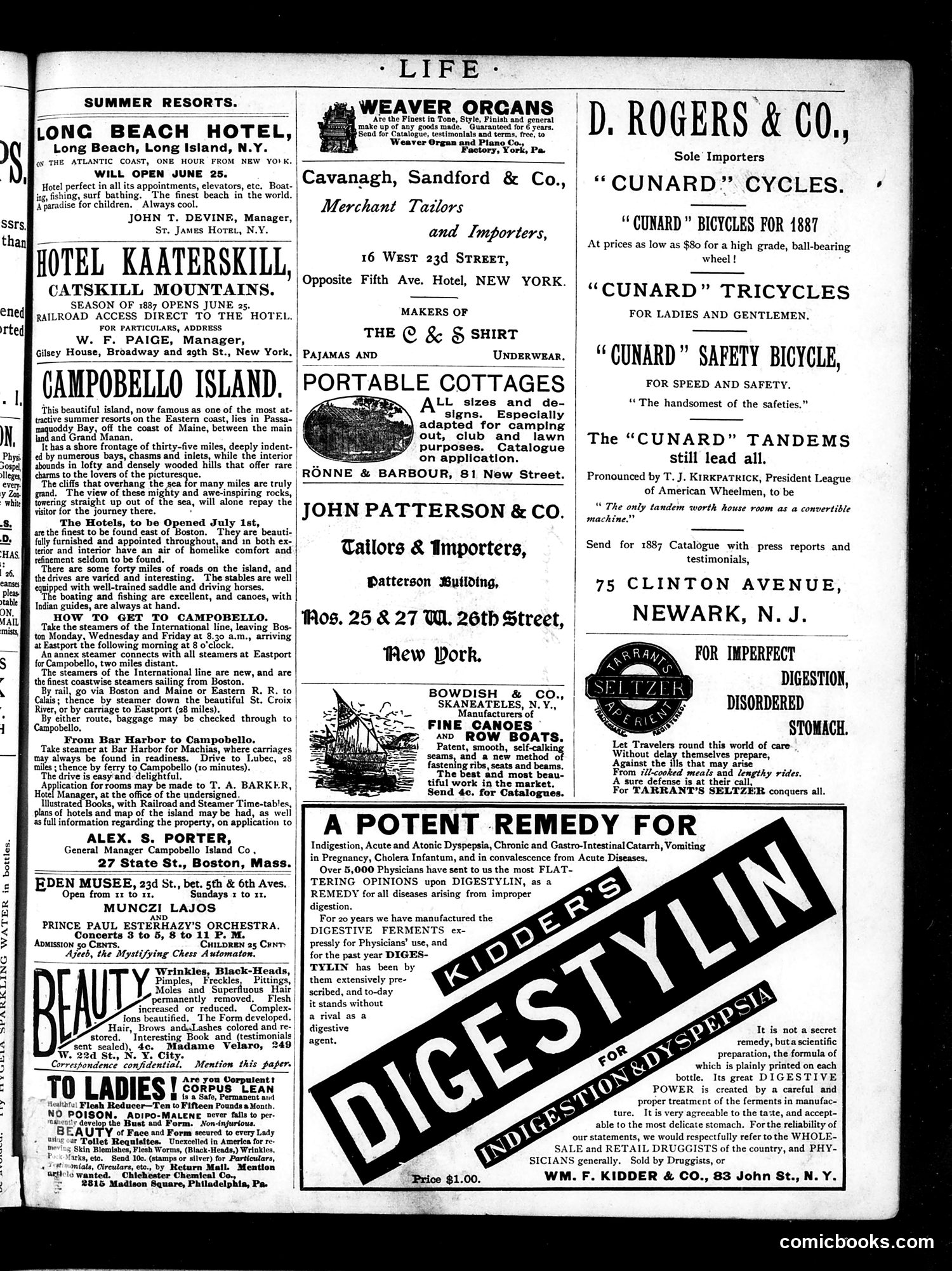
This is primarily an **advertising page** from Life magazine, circa 1887. The dominant content consists of resort hotel ads (Long Beach Hotel, Hotel Kaaterskill, Campobello Island) and commercial advertisements for bicycles, tailors, and patent medicines. The largest visual element is an advertisement for **"Kidder's Digestin"**—a patent medicine claiming to cure indigestion, dyspepsia, and stomach disorders. The dramatic diagonal text overlay and bold typography emphasize the product's supposed universal remedy status. This reflects the era's widespread marketing of dubious medicinal tonics to the general public. The bicycle advertisements ("Cunard" cycles, tandems, safety bicycles) indicate this was a period of cycling's explosive popularity as transportation and recreation. The page contains **no political cartoons or satire**—it's straightforward commercial advertising typical of late-19th-century American magazines, which derived revenue primarily from such ads rather than subscription fees.
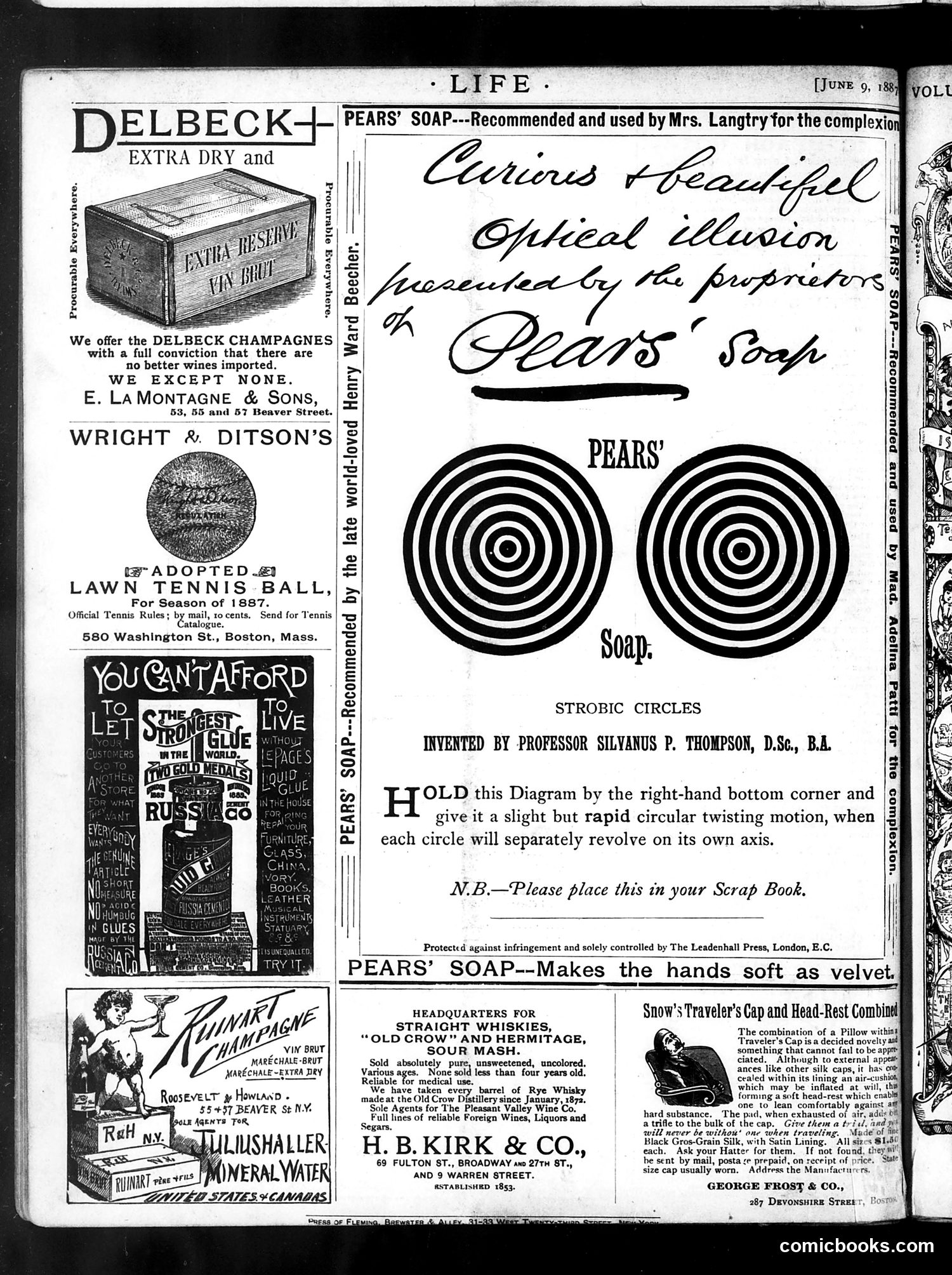
This page is primarily **advertising**, not editorial content or political satire. It features multiple commercial advertisements typical of late 19th-century magazines. The main items advertised include: - **Pears' Soap**: promoted with celebrity endorsement (Mrs. Langtry, a famous actress of the era) and an optical illusion diagram ("Strobic Circles") readers could cut out for their scrapbooks—a common interactive marketing technique - **Delbeck Champagnes** and other wines - **Wright & Ditson's lawn tennis balls** (1887 season) - **Straight whiskey** ("Old Crow" and Hermitage brands) - **Snow's Traveler's Cap and Head-Rest Combine**: a novelty travel pillow-hat hybrid The page also includes a **Mustachers Glue advertisement** with dense rhetorical copy typical of the period. There is **no political cartoon or satirical content** visible—this represents pure product advertising, which filled magazine pages to subsidize publication costs. The "Life" branding indicates this was the humor magazine, but this particular page emphasizes commerce over comedy.