
A complete issue · 18 pages · 1887
Life — May 26, 1887
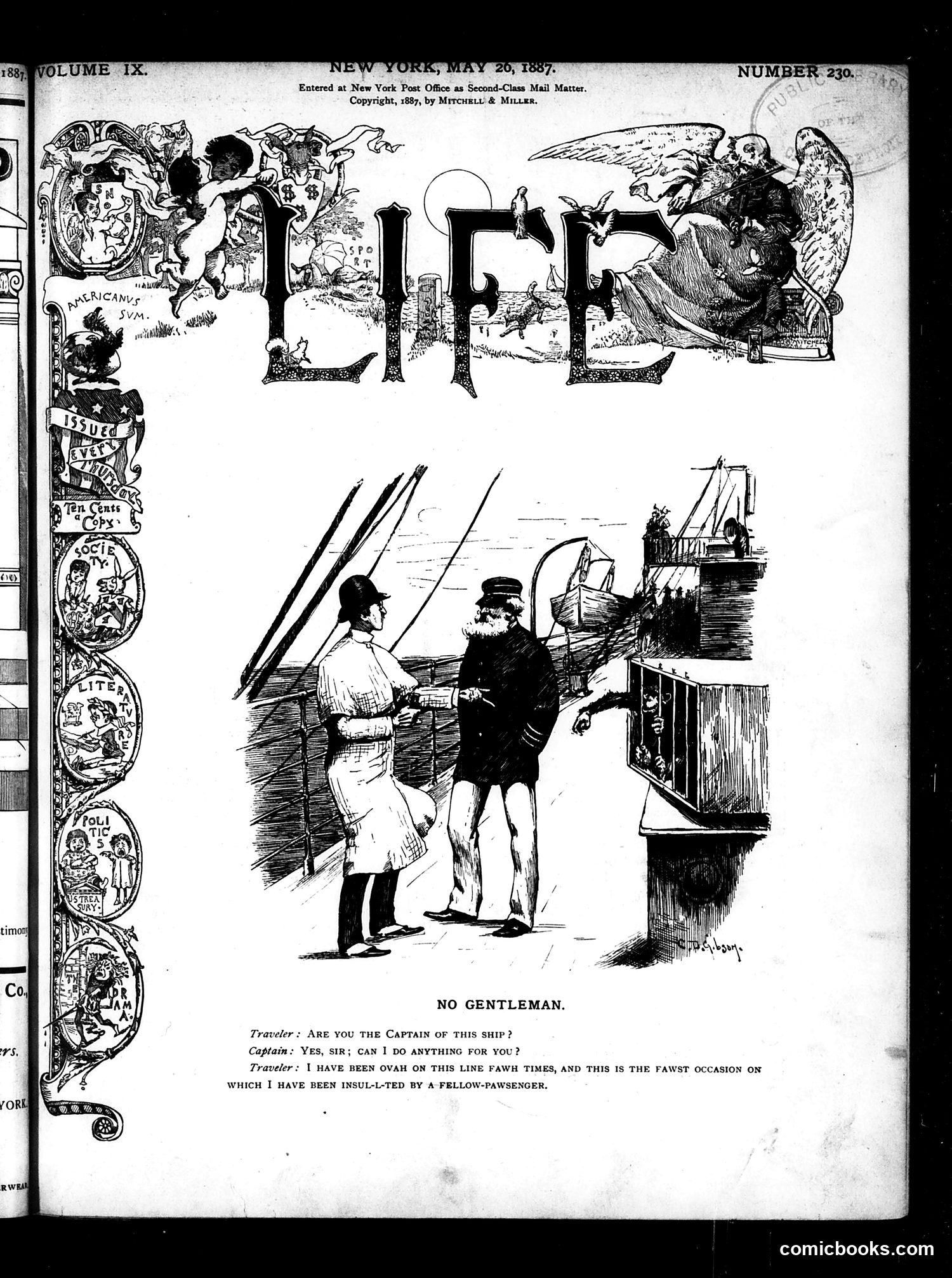
This cartoon satirizes maritime etiquette and class pretension. A well-dressed traveler aboard a ship addresses the captain, complaining that he's been a passenger on this line many times and this is "the fawst occasion" (fastest occasion) on which he's been "insulted by a fellow-passenger." The joke hinges on the captain's response: "Yes, sir; can I do anything for you?" The traveler considers the captain's polite offer itself an insult—the implication being that only a captain would dare address him, and that being served by anyone of lower social standing constitutes an affront to his gentlemanly dignity. The satire mocks Victorian-era class consciousness and the absurd sensitivities of the wealthy about their social standing.
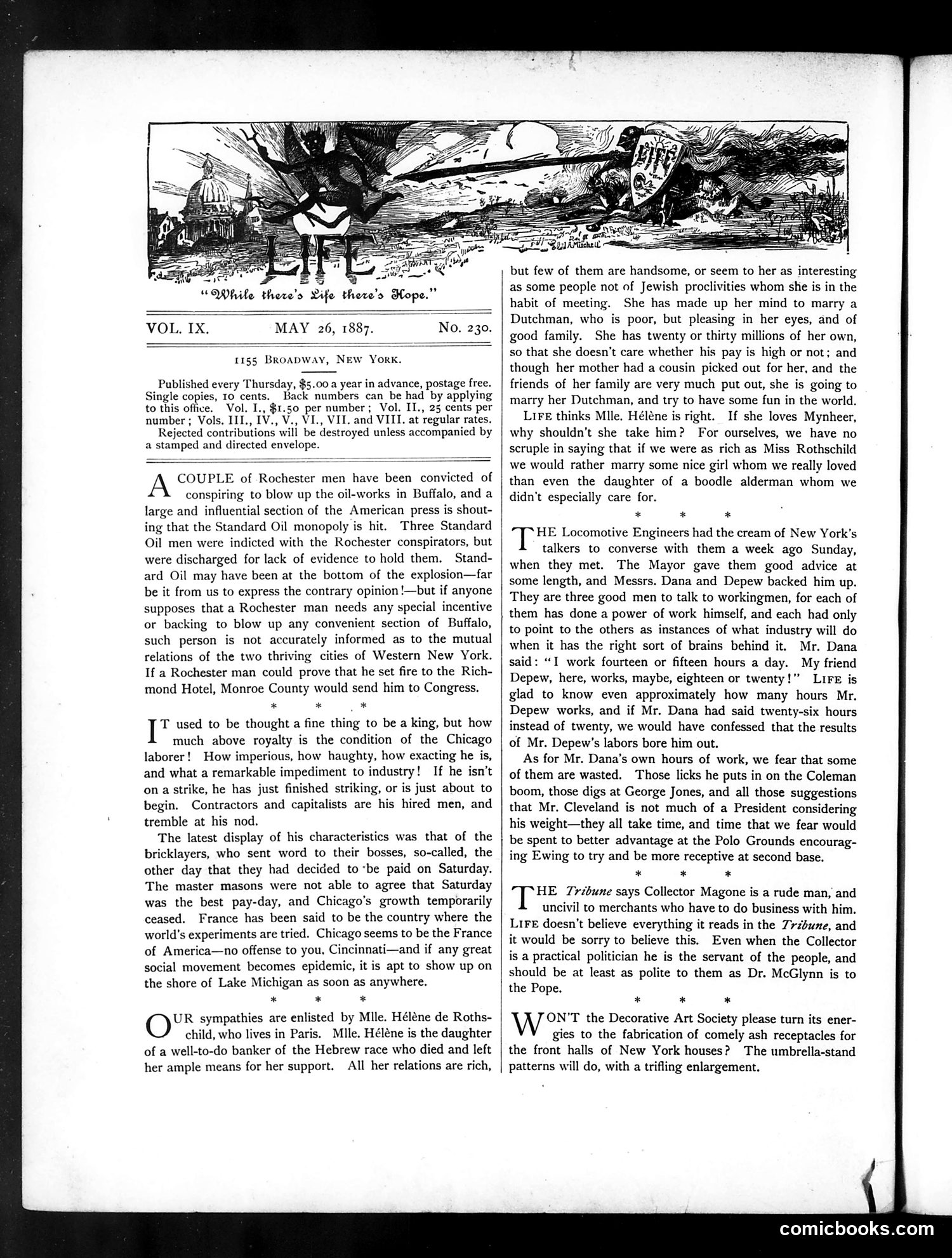
The masthead cartoon depicts a gnarled tree beside a full moon with the caption "While there's Life there's Hope." This appears to be Life magazine's standard decorative header rather than political commentary. The page contains several brief satirical editorial comments on current events. One section mocks Rochester men involved in an oil monopoly conspiracy; another critiques Chicago laborers' entitlement during strikes. There's commentary on the Locomotive Engineers union discussing working hours with New York's Mayor. Most notably, Life satirizes the *Tribune's* Collector Mayence as rude to merchants, suggesting he should emulate Pope Leo XIII's civility toward the public. The content reflects 1880s urban labor disputes, monopoly concerns, and local New York politics rather than a cohesive narrative cartoon.
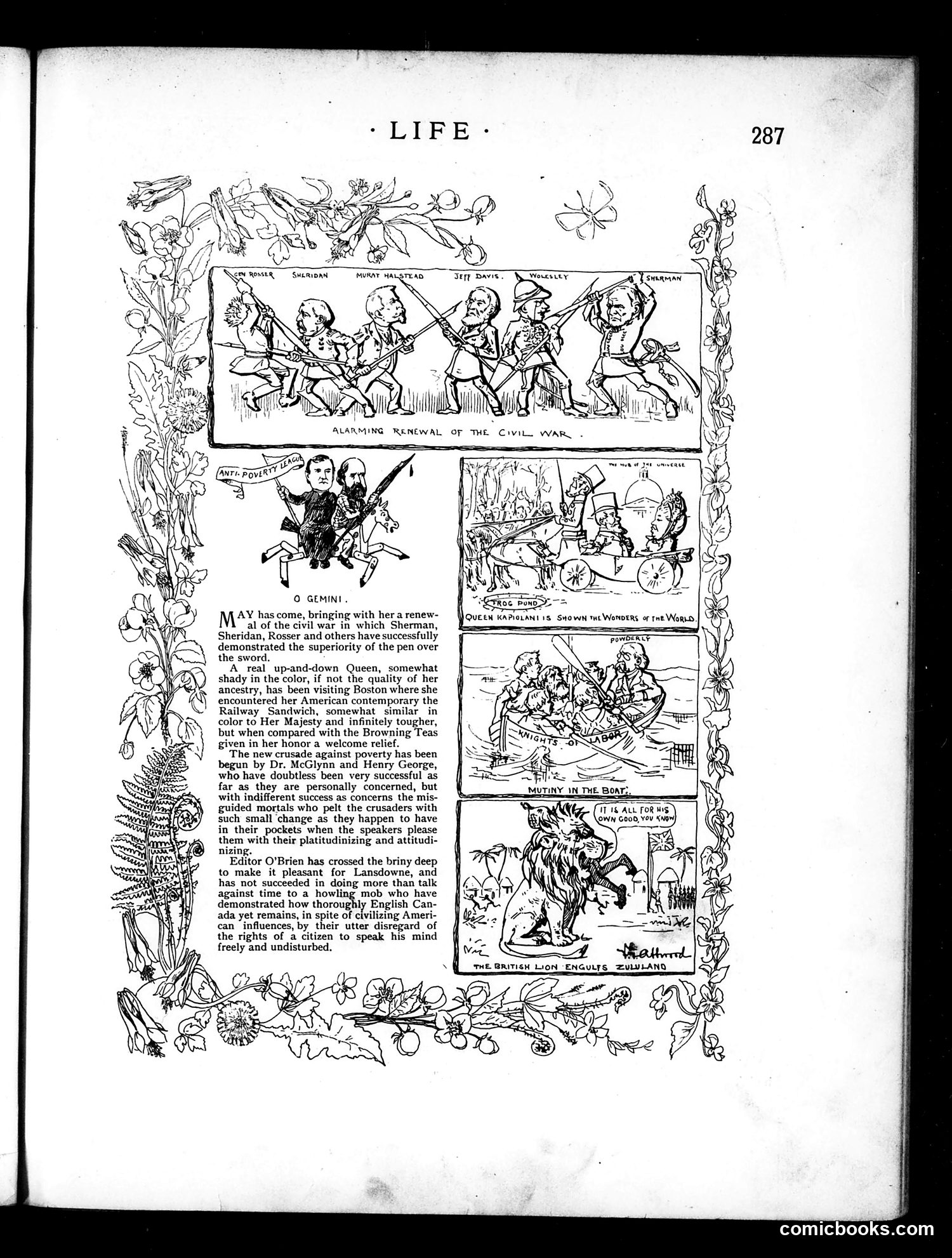
This page satirizes the American Civil War era through multiple cartoons. The top panel, "Alarming Renewal of the Civil War," depicts caricatured political figures (labeled names appear to include Sherman, Sheridan, and others) engaged in mock combat with weapons, suggesting renewed political conflict. The text references Dr. McGlynn and Henry George's land reform movement, comparing it unfavorably to Civil War violence. It critiques what appears to be heated political debate over economic policy, suggesting the disputes mirror actual warfare in their intensity. The remaining cartoons mock British reactions to American affairs, including one titled "The British Lion Engulfs England's" and another about "Mutiny in the Boat," using animal caricatures to satirize international commentary on American domestic turmoil. The overall theme: American political divisions remain as divisive as the Civil War itself.
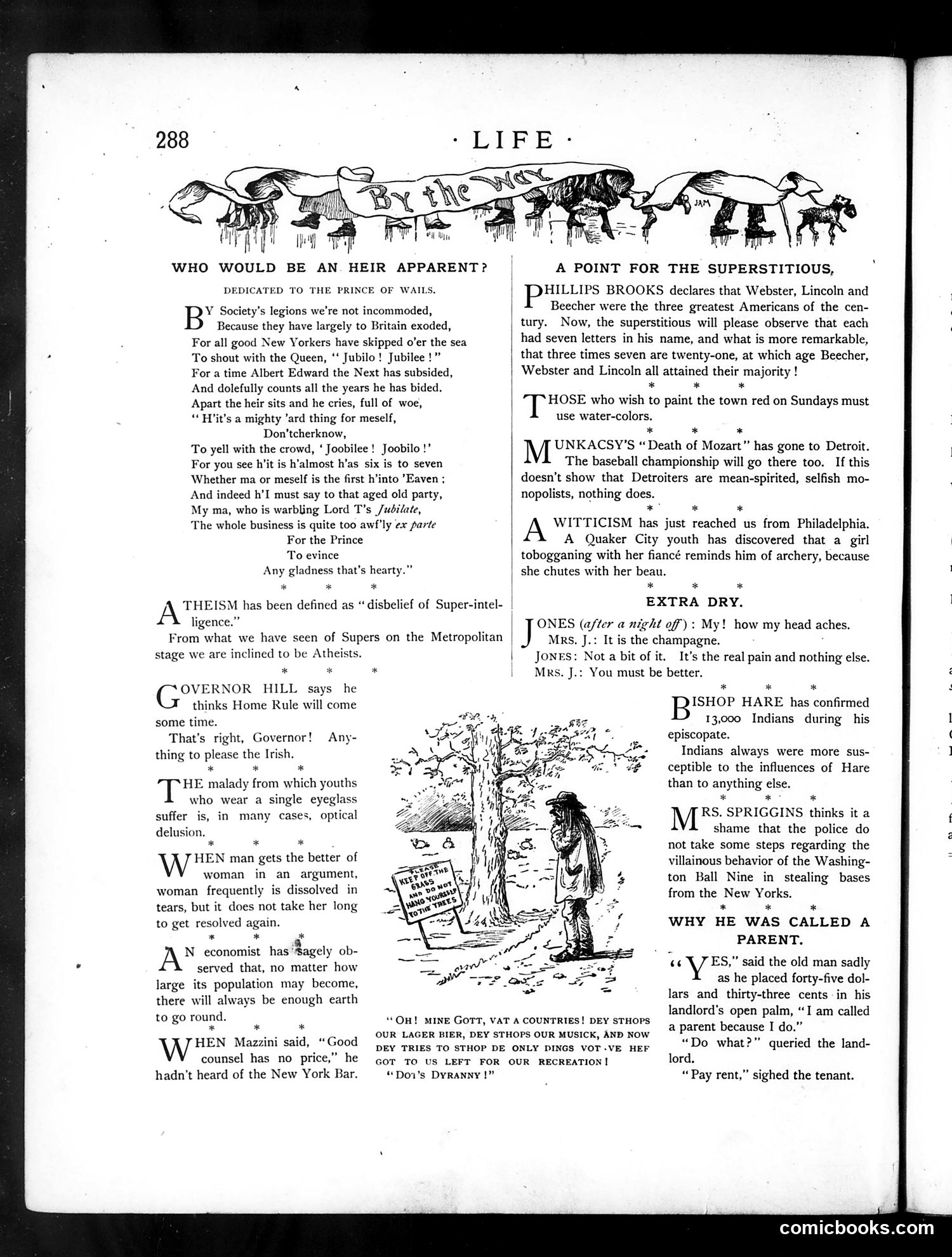
This page contains miscellaneous satirical commentary rather than a unified cartoon. Key items include: **"Who Would Be an Heir Apparent?"** - A poem mocking Irish immigration to America, suggesting New Yorkers were "skipped o'er the sea" to avoid British rule. It references Prince Albert Edward (later Edward VII) and appears to satirize both Irish-American identity and royal pretension. **Various brief satirical notes** comment on contemporary topics: atheism on Broadway stages, Home Rule for Ireland, optical problems from age, and women in arguments. **"Why He Was Called a Parent"** - A humorous anecdote about a tenant paying rent, playing on the double meaning of "parent" and "pay rent." The page reflects Life's editorial voice critiquing immigration, Irish politics, theater culture, and social foibles of the Gilded Age era.
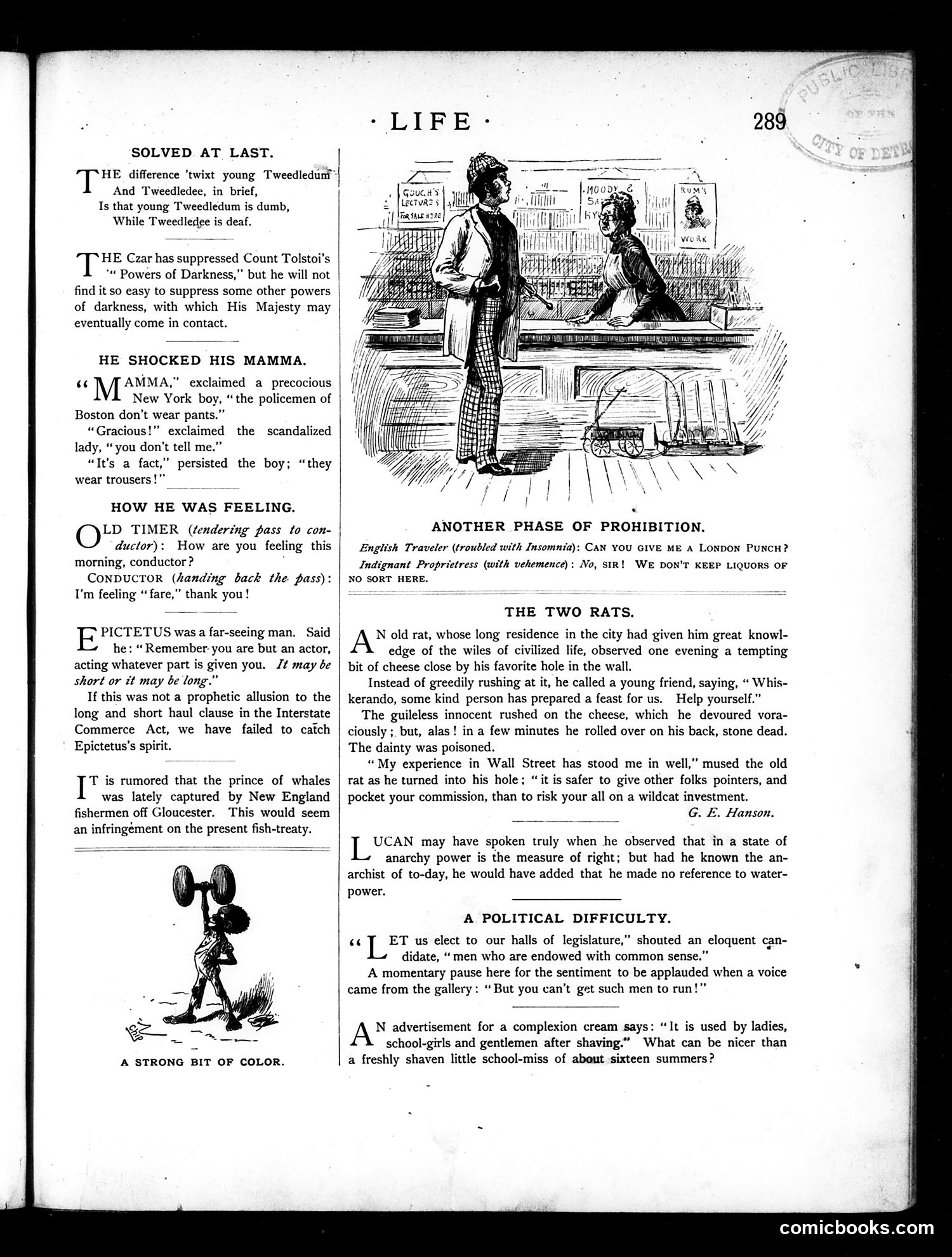
This page contains several brief satirical pieces rather than a single cartoon. **"Solved at Last"** jokes about the difference between Tweedledum and Tweedledee (characters representing two similar political figures), with the punchline that one is dumb while the other is deaf—implying both are equally useless. **"The Czar has suppressed Count Tolstoi's 'Powers of Darkness'"** references Russian censorship of the famous author's work, satirizing governmental suppression of literature. The remaining items are short humorous anecdotes about American life—a Boston woman wearing trousers (scandalous for the era), a conductor's response to passenger complaints, and observations about prohibition and political candidates. The cartoon **"A Strong Bit of Color"** depicts weightlifting, likely commenting on strength or athletic prowess. The overall tone mocks censorship, social pretension, and political incompetence.
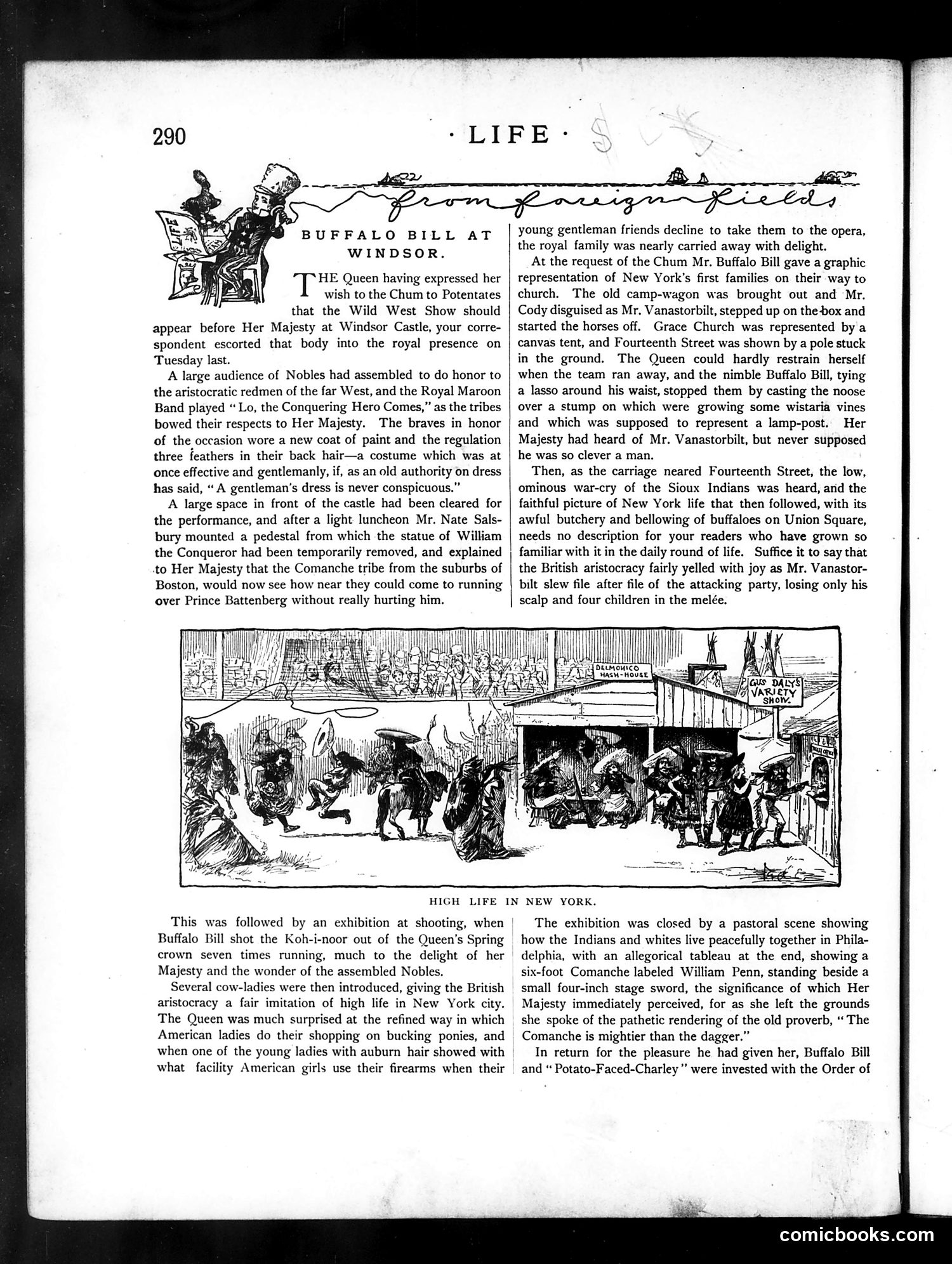
This page satirizes Buffalo Bill's Wild West Show exhibition at Windsor Castle for Queen Victoria. The text describes how the Queen requested the famous showman display his act before the Royal Court. The cartoon depicts the chaotic scene when Buffalo Bill's performance—featuring Sioux Indians, horses, and frontier stunts—descended into disorder at Fourteenth Street in New York. The satire mocks both the incongruity of frontier roughness invading aristocratic spaces and British nobility's fascination with American "Wild West" spectacle. The piece ridicules how refined English society gawked at what was essentially a traveling circus, while commenting on American girls' behavior and frontier violence. The overall joke: authentic Western barbarism meets European pretension, with absurd results.
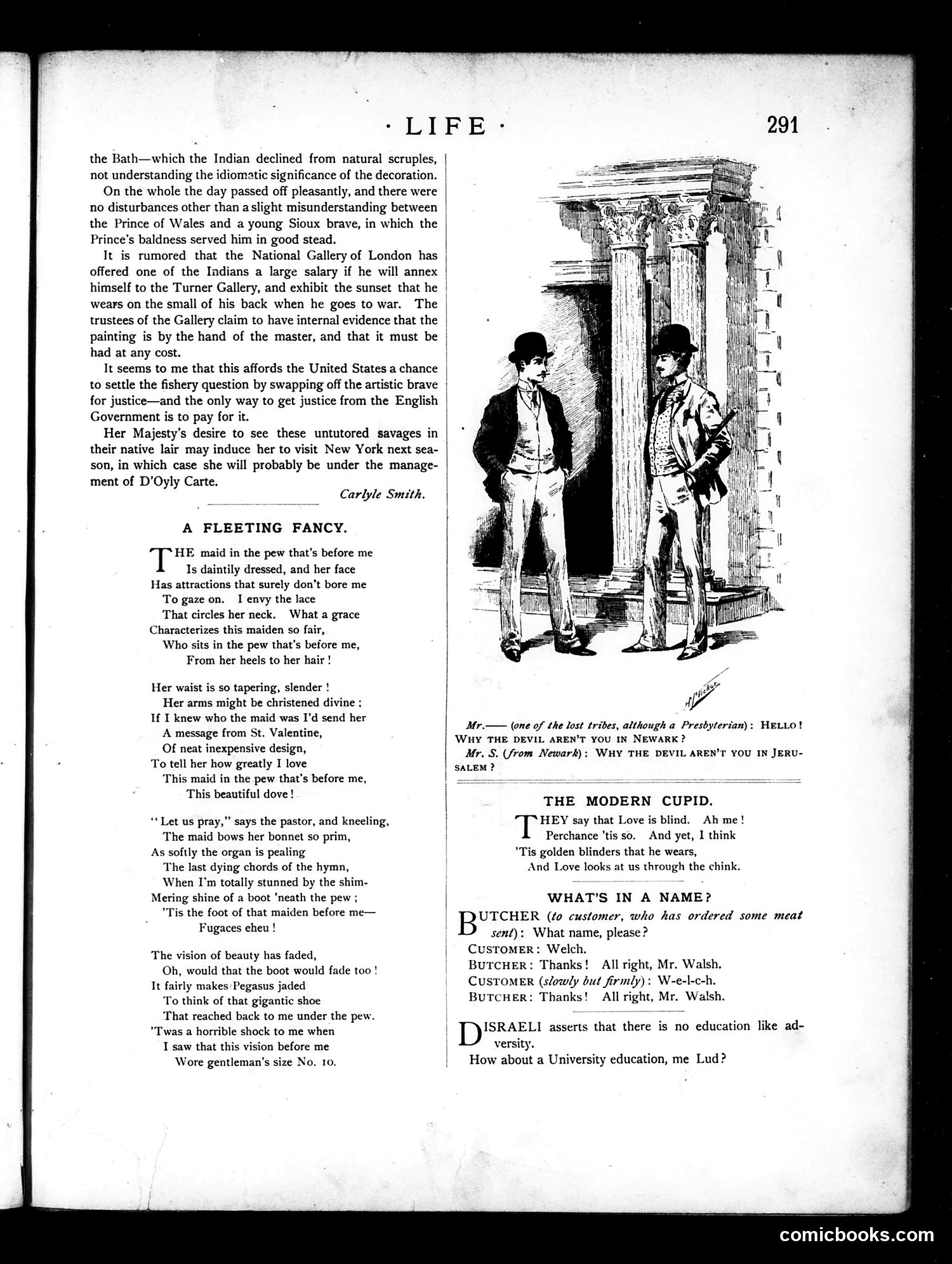
This page contains literary and humorous content rather than political cartoons. The main features are: **"A Fleeting Fancy"** — a poem by Carlyle Smith about admiring a young woman in church, with romantic but somewhat self-aware humor about the speaker's fleeting infatuation. **The illustration** shows two men conversing near classical columns, with a caption referencing "lost tribes" and asking "Why the devil aren't you in Newark?" and "Why the devil aren't you in Jerusalem?" — appearing to be ethnic or religious humor typical of early 20th-century American satire. **"The Modern Cupid"** and **"What's in a Name?"** are brief comic dialogues playing on wordplay and romantic themes. The page demonstrates Life magazine's mix of sentimental poetry, visual humor, and conversational comedy rather than sharp political satire.
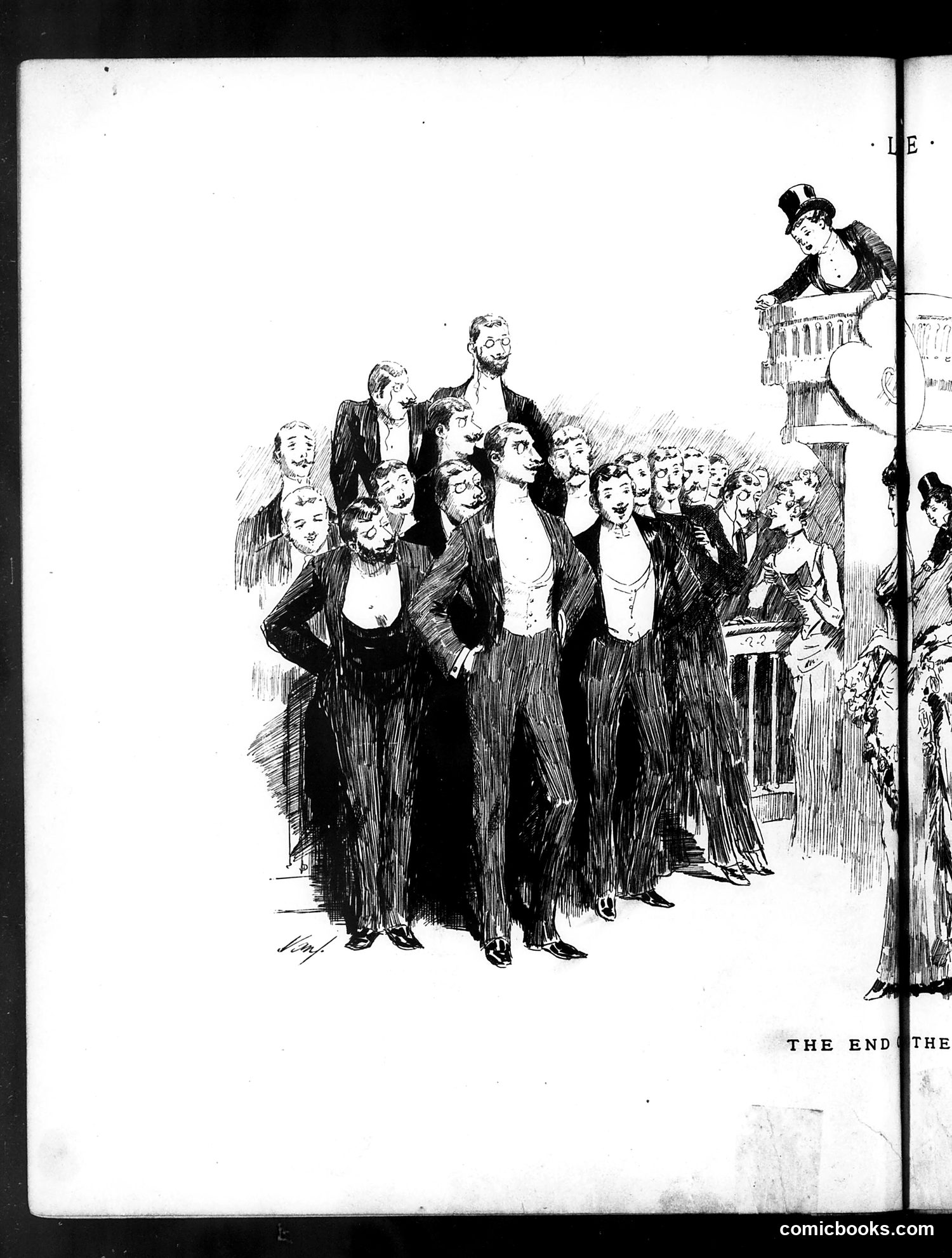
This illustration depicts a formal social gathering, likely at an upscale venue—note the woman observing from an elevated position (possibly a balcony or mezzanine) on the right side. The group below consists of well-dressed men in formal attire (tuxedos) gathered together, with additional figures visible in the background. The caption reads "THE END THE" (text appears cut off), suggesting this is the conclusion of a narrative or social situation being satirized. Without the complete caption or additional context from the surrounding page, the specific subject of satire is unclear. The formal dress and crowded gathering suggest commentary on high-society events, possibly critiquing social hierarchies, exclusivity, or the behavior of the wealthy elite—common targets of *Life* magazine's satire. However, the precise political or social reference remains uncertain without fuller text.
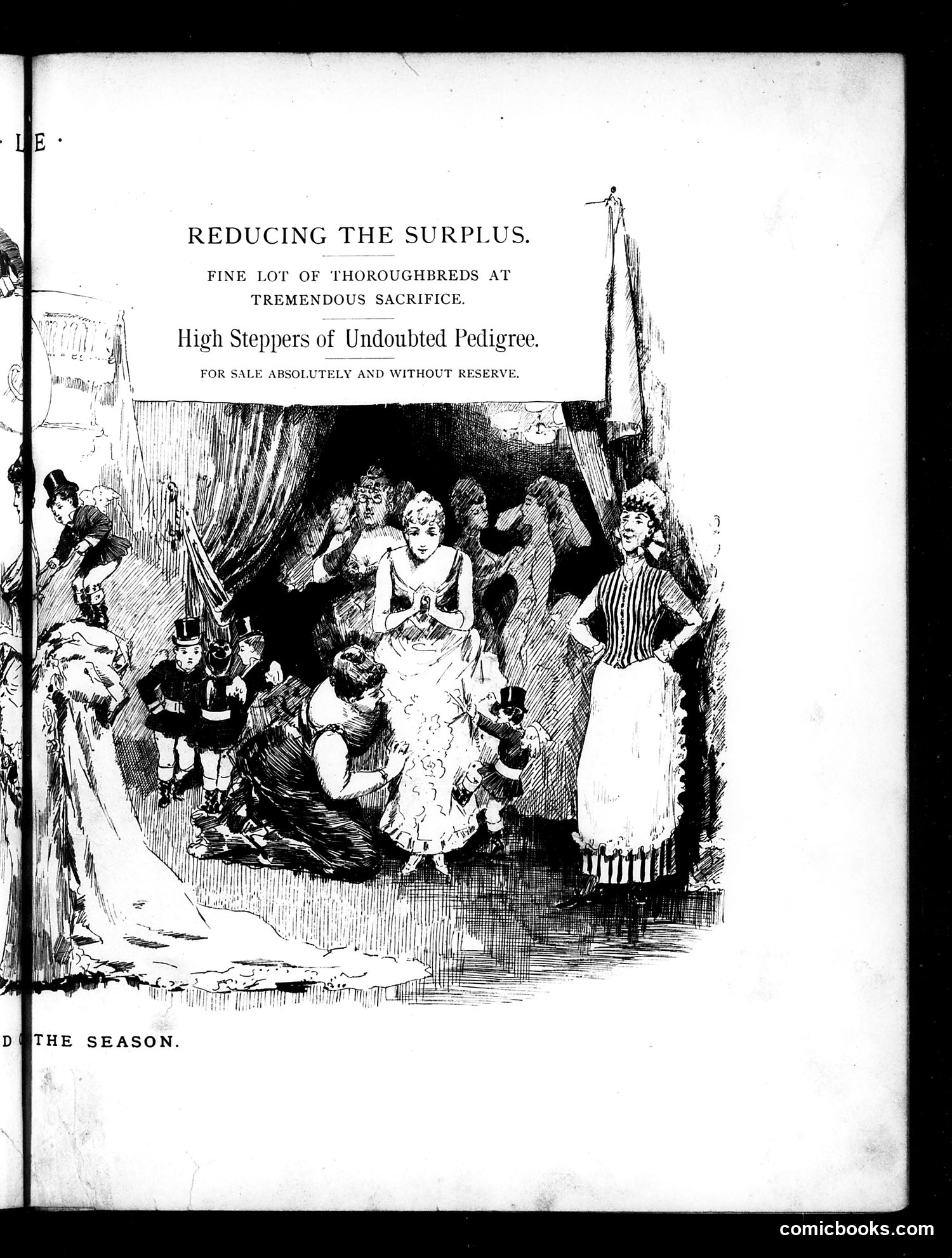
This satirical cartoon depicts a livestock auction scene, with the headline treating high-bred horses as if they were surplus animals being sold off at "tremendous sacrifice." The joke appears to be social commentary on wealthy aristocratic families—the well-dressed women and formally-attired figures in the tent represent the upper class, while the horses (labeled "High Steppers of Undoubted Pedigree") serve as a metaphor for eligible young women from prestigious families. The satire suggests that excess unmarried women from prominent families are being "auctioned off" in the marriage market, humorously comparing the marriage season to livestock reduction. This would resonate with contemporary concerns about marriage prospects and the social pressures on affluent women to find suitable husbands.
This page contains dramatic criticism and theater reviews rather than political cartoons. The main content discusses the Broadway theatrical season's conclusion, reviewing several productions: **"The End of the Season"** section critiques the Wallack company's performance decline and praises Miss Russell's comedic talents in *Marguerite* and *Mabel*. **Authors' Matinees** section celebrates George Parsons Lathrop and Harry Edwards' play *Elaine*, featuring actress Annie Russell. **"The Pyramid"** opera receives mixed review—praised for musicianship but criticized as lacking originality, despite being advertised as America's "first comic opera." The page concludes noting Lawrence Barrett's performance in *Kienzi* at a provincial theater. This is primarily theater criticism for an educated urban audience, not political satire.
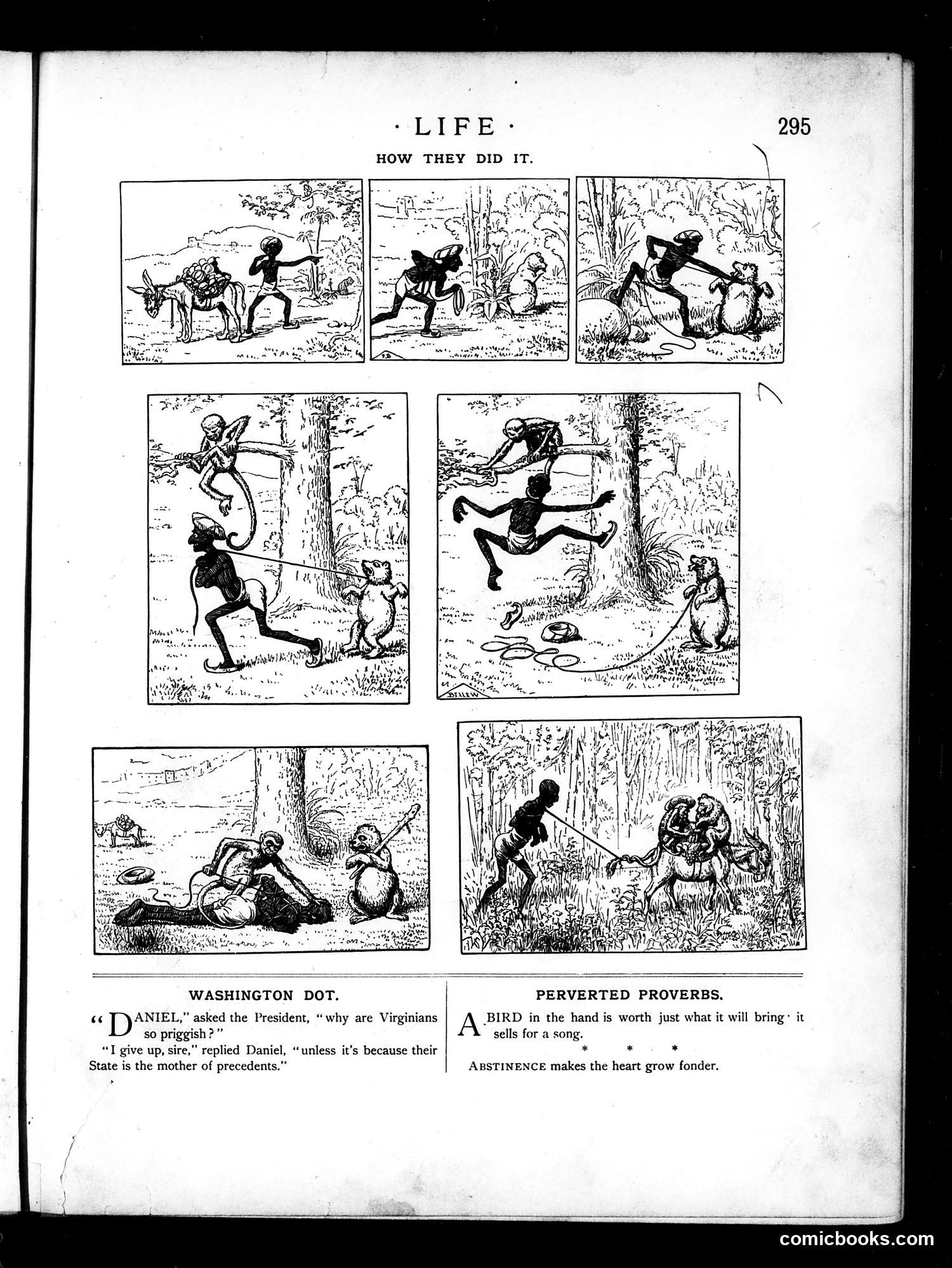
This comic strip depicts **monkeys or apes progressively learning human behavior**, showing a satirical take on evolution or civilization's development. The sequential panels show the creatures advancing from basic tool use with a donkey, to standing upright, to using implements, to increasingly human-like activities culminating in what appears to be hunting or violence. The "Washington Dot" joke mocks **Virginians as self-righteous**, with a President asking "Daniel" (likely a reference to a historical or contemporary figure) why Virginians are "priggish." The punchline claims Virginia's self-importance stems from being "the mother of precedents"—a sarcastic dig at Virginia's historical prominence in American founding. The "Perverted Proverbs" section inverts common sayings for ironic effect: a bird in hand merely sells cheaply, and abstinence (rather than absence) makes hearts fonder—cynical reversals of conventional wisdom typical of satirical magazines' humor.
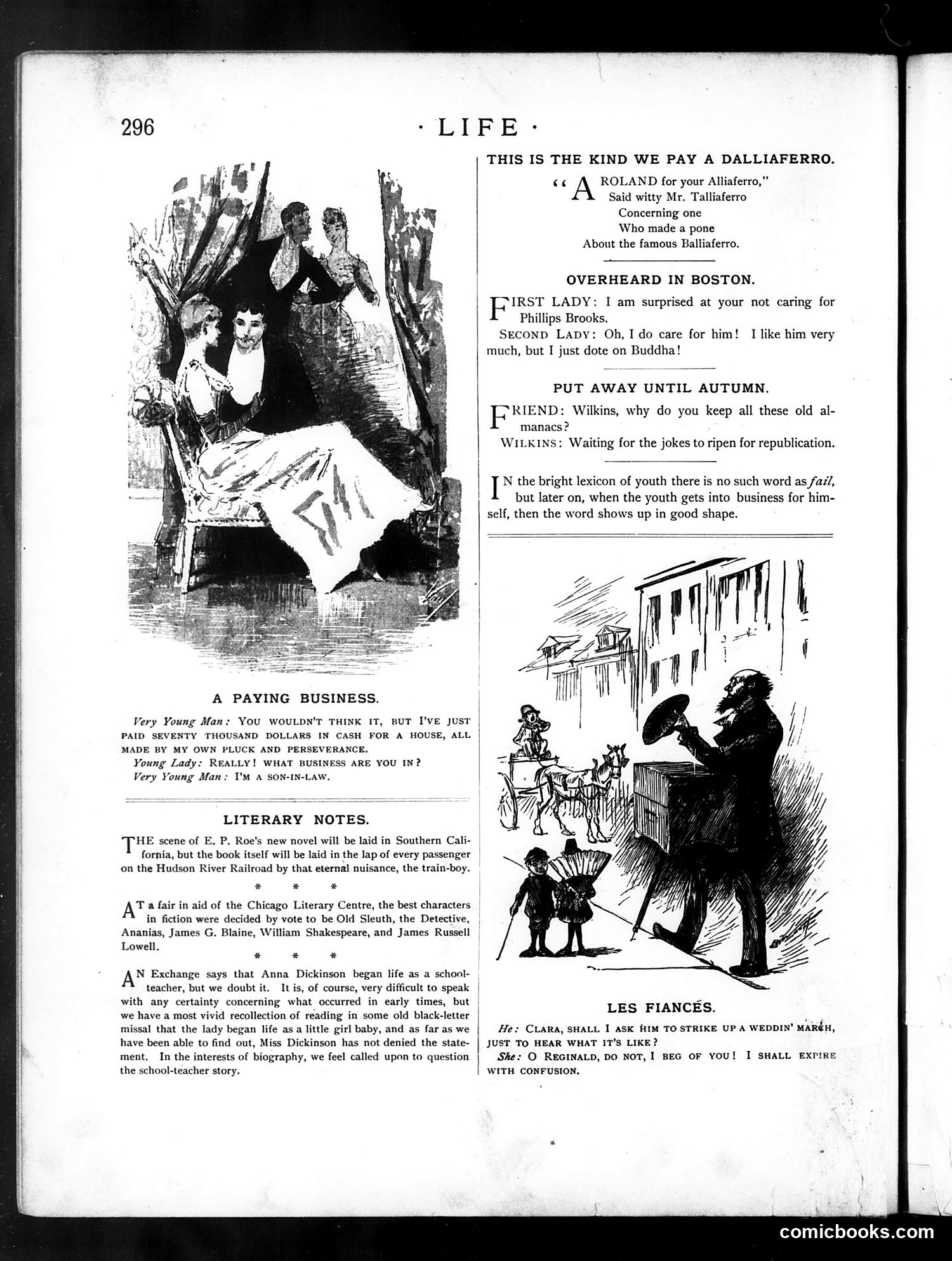
This page contains several brief satirical jokes typical of 19th-century American humor: **"A Paying Business"** mocks a young man's boasting about purchasing a house through "pluck and perseverance"—he reveals he's actually a "son-in-law," implying he married into money rather than earning it himself. **"Overheard in Boston"** satirizes Boston's intellectual pretensions: a society lady claims indifference to Phillips Brooks (a renowned Boston preacher) but obsesses over Buddhism, suggesting fashionable religiosity over genuine conviction. **"Put Away Until Autumn"** jokes that almanac jokes are so stale they need time to "ripen" before reuse—mocking recycled humor. The **Literary Notes** section contains editorial barbs, including skepticism about Anna Dickinson's claimed background as a schoolteacher, and sarcasm about which fictional characters voters deemed greatest (grouping the detective "Old Sleuth" with Shakespeare). **"Les Fiancés"** depicts an engaged couple where the groom wants to hear a wedding march to preview it; his fiancée begs him not to, fearing she'll "expire with confusion"—gentle humor about wedding anxiety.
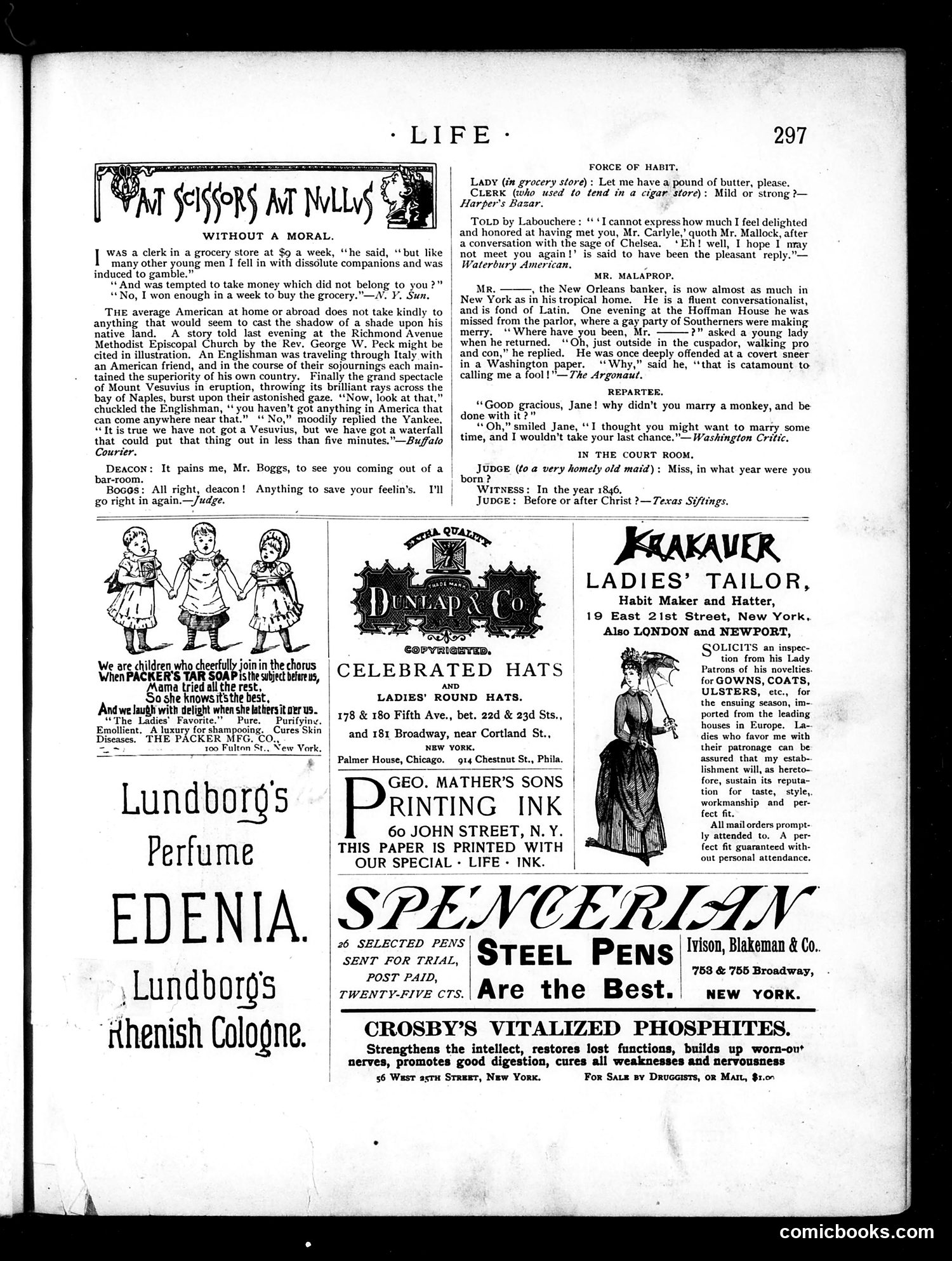
This page collects brief humorous anecdotes mocking American pretension and everyday absurdities. The cartoons and jokes share a theme: deflating human vanity through ironic situations. The main cartoon (top left) features three children endorsing Packer's Tar Soap—a typical advertising jingle, but the satire is implicit in Life's juxtaposition with stories about self-deception. The anecdotes mock: - A young man's self-justifying story about gambling winnings - American nationalism (a Yankee boasting of waterfalls versus Vesuvius) - A clergyman's hypocrisy (sneaking from bars) - Malapropisms and pretension (a banker confusing "cuspador" with outdoor spaces; "catamount" for "amounts to") - A woman's barbed wit about marriage The page's title—"Without a Moral"—suggests these are mere observations of human folly without didactic purpose, typical of *Life*'s satirical approach to social commentary. The remainder consists primarily of period advertisements for perfumes, hats, and printing services.
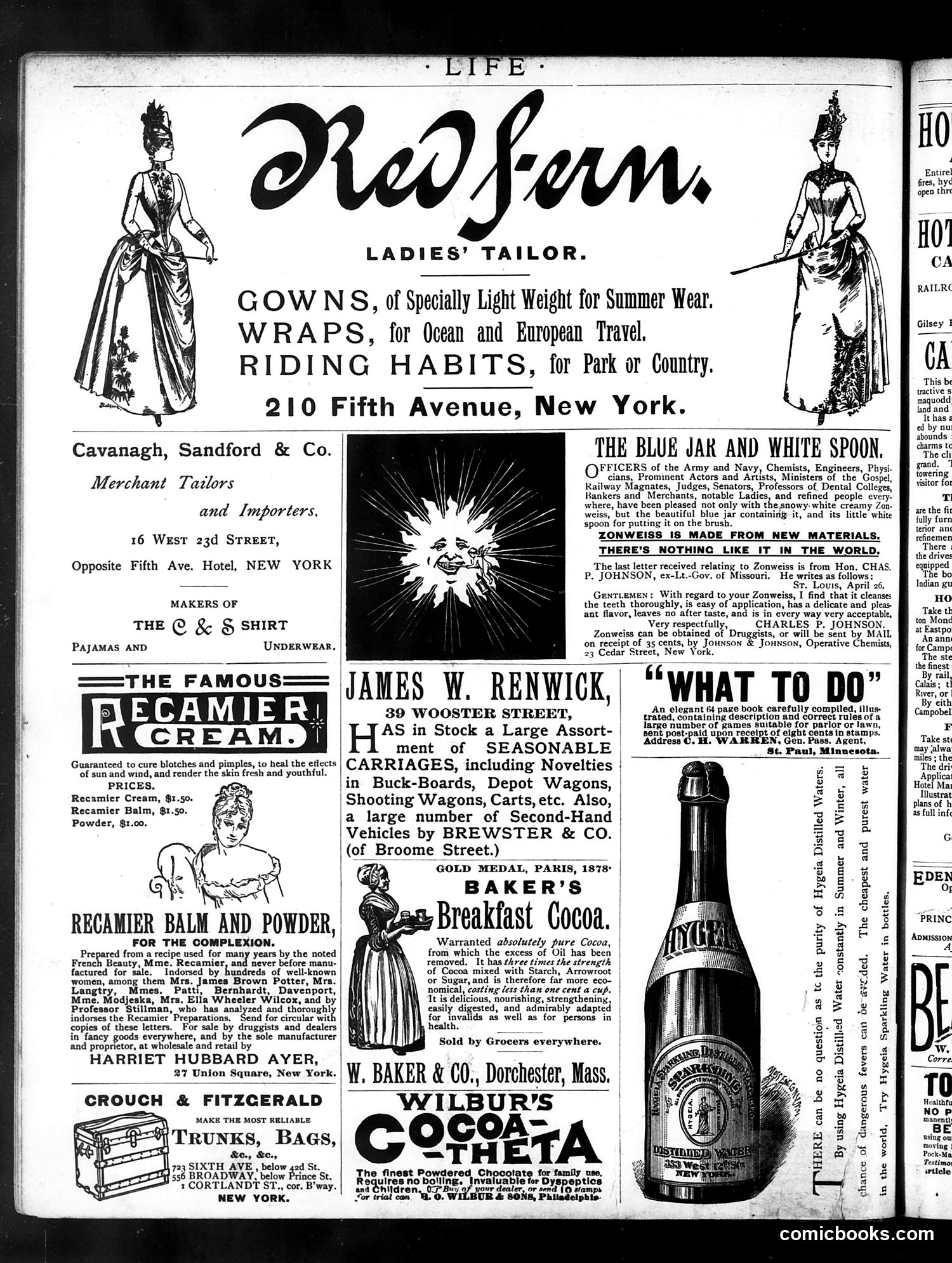
This page is primarily **advertising** from a late 19th-century Life magazine. The central featured item is a testimonial advertisement for "Zonweiss," a tooth-cleaning product marketed with endorsements from prominent figures. The key claim appears in the text: an endorsement letter from **Charles P. Johnson, ex-Lieutenant Governor of Missouri**, praising Zonweiss's effectiveness and pleasant taste. This represents a common Victorian advertising practice—using notable public figures' names to build credibility for consumer products. The "blue jar and white spoon" referenced in the title refers to Zonweiss's packaging, which apparently was distinctive enough to warrant emphasis. The advertisement emphasizes that the product appeals to "Officers of the Army and Navy, Chemists, Engineers...notable Ladies, and refined people"—targeting upper-class consumers. The surrounding advertisements (Recamier Cream, Breakfast Cocoa, tailoring services) reflect typical luxury goods marketed in Life magazine during this era, suggesting this was a publication aimed at affluent readers. **This page contains no political satire**—it is straightforward commercial advertising typical of the period.
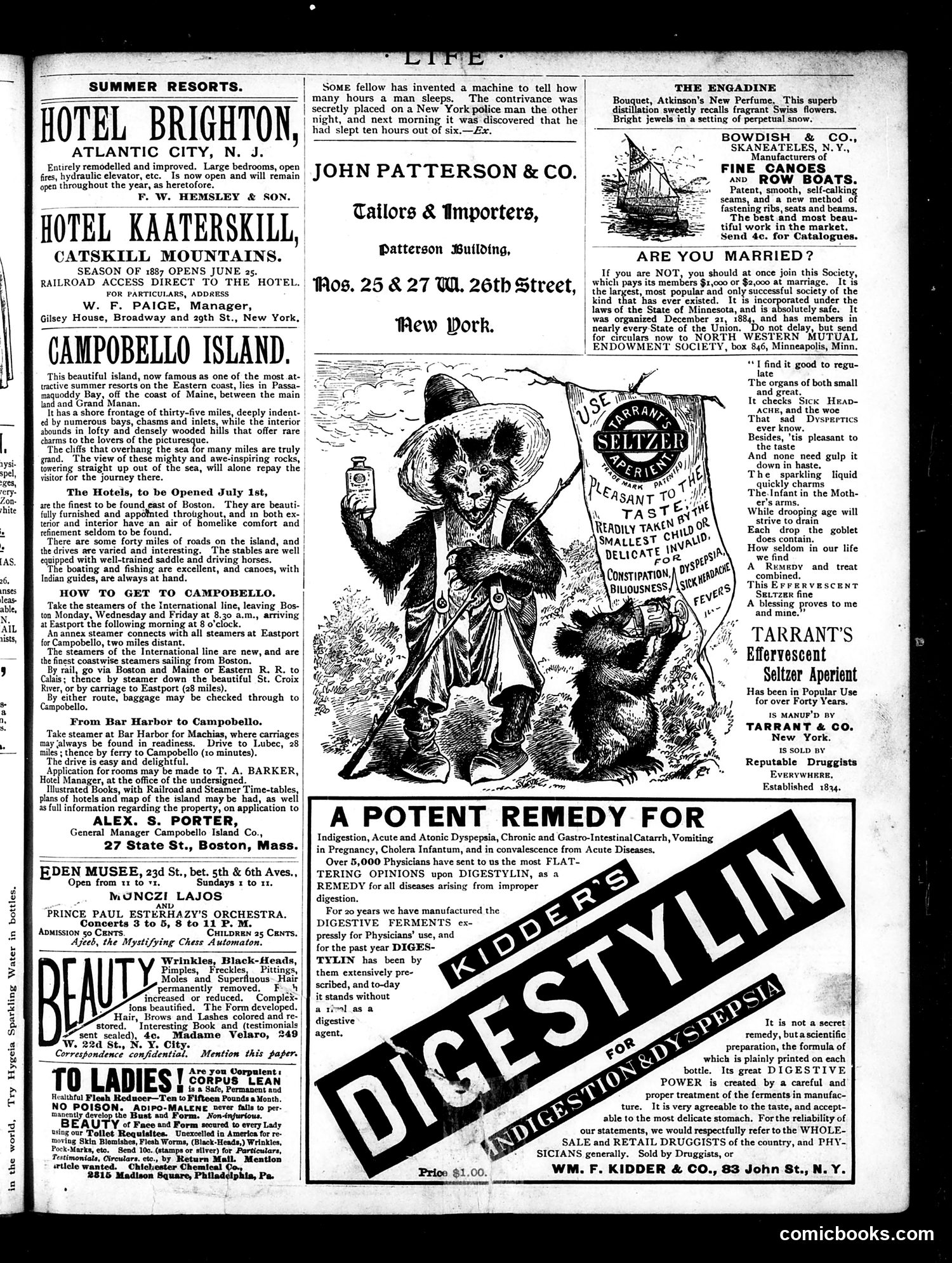
This page is primarily **advertising and commercial content** from an 1887 issue of Life magazine. The central visual feature—a large cartoon skeleton figure labeled "KIDDERYS DIGESTYLIN"—is a patent medicine advertisement, not political satire. The skeleton hawking digestive elixir represents a common Victorian advertising trope: using grotesque or dramatic imagery to promote cure-all tonics. The text claims the product treats indigestion, dyspepsia, and various ailments affecting "over 8,000 physicians." The surrounding advertisements showcase typical late-19th-century offerings: summer resort hotels, beauty treatments (hair removal, complexion improvement), and theatrical attractions. **No political satire is present.** This reflects Life's evolution from pure satire magazine toward a publication mixing humor, news, and commercial advertising—a business model shift that occurred during this era.
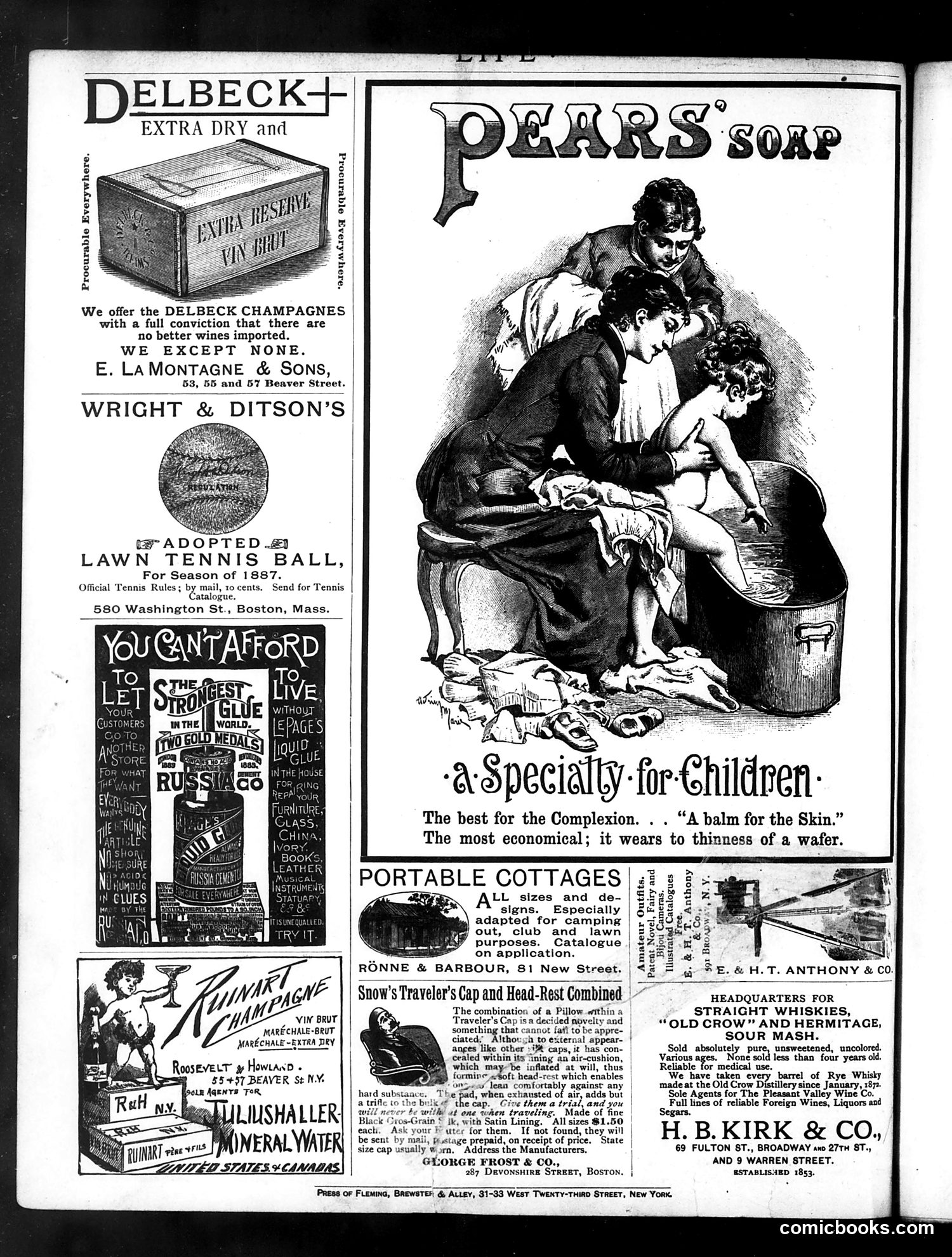
This is primarily an **advertising page** rather than a satirical cartoon page. The dominant content is a Pears' Soap advertisement featuring an engraving of a well-dressed man bathing a young child, with the tagline "a Specialty for Children." The surrounding advertisements promote various late-19th-century luxury goods: champagne (Delbeck), tennis balls, lawn cottages, portable camping equipment, whiskey, and a novelty inflatable travel pillow. The page reflects the magazine's role as a venue for upscale product marketing to wealthy readers. The only hint of satire appears in the smaller advertisements' hyperbolic language ("You Can't Afford to Let..."), typical of period advertising copy. The Pears' Soap image itself uses sentimental Victorian imagery to market hygiene—associating the product with childcare and gentility rather than functional cleaning. This represents Life's mixed model: satirical editorial content paired with fashionable commercial promotion.
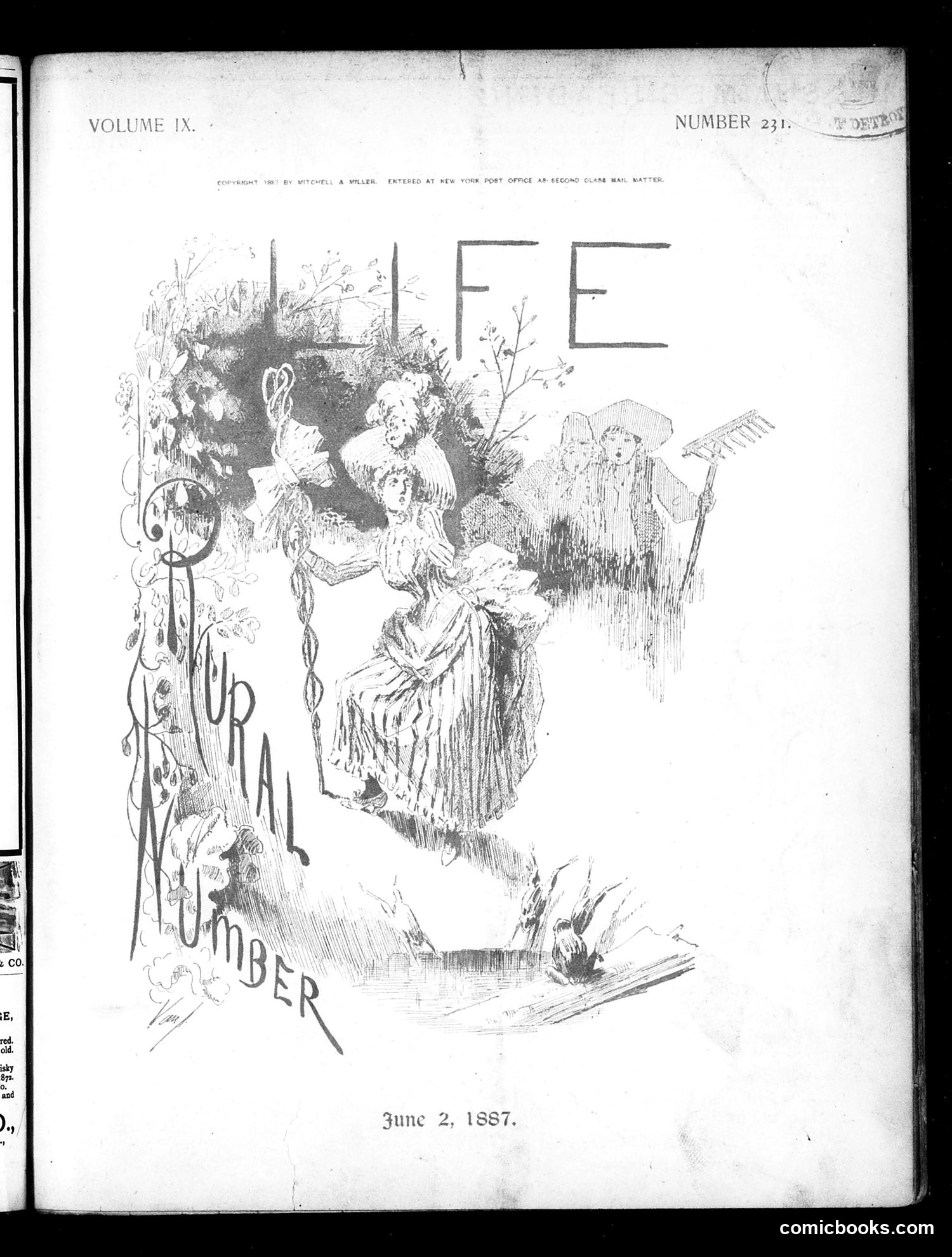
This is the cover of Life magazine (Volume IX, Number 231). The illustration depicts an allegorical female figure—likely representing "Life" or spring—surrounded by cherubs and floral elements. The phrase "UP AND LUMBER" appears vertically on the left side, suggesting a pun or seasonal reference. The artistic style is typical of 1880s satirical illustration, rendered in ink with detailed cross-hatching. Without additional interior content visible, the specific satirical target remains unclear, though the "lumber" reference may allude to the timber industry or possibly political/economic activity of the period. The overall tone appears whimsical rather than sharply critical.
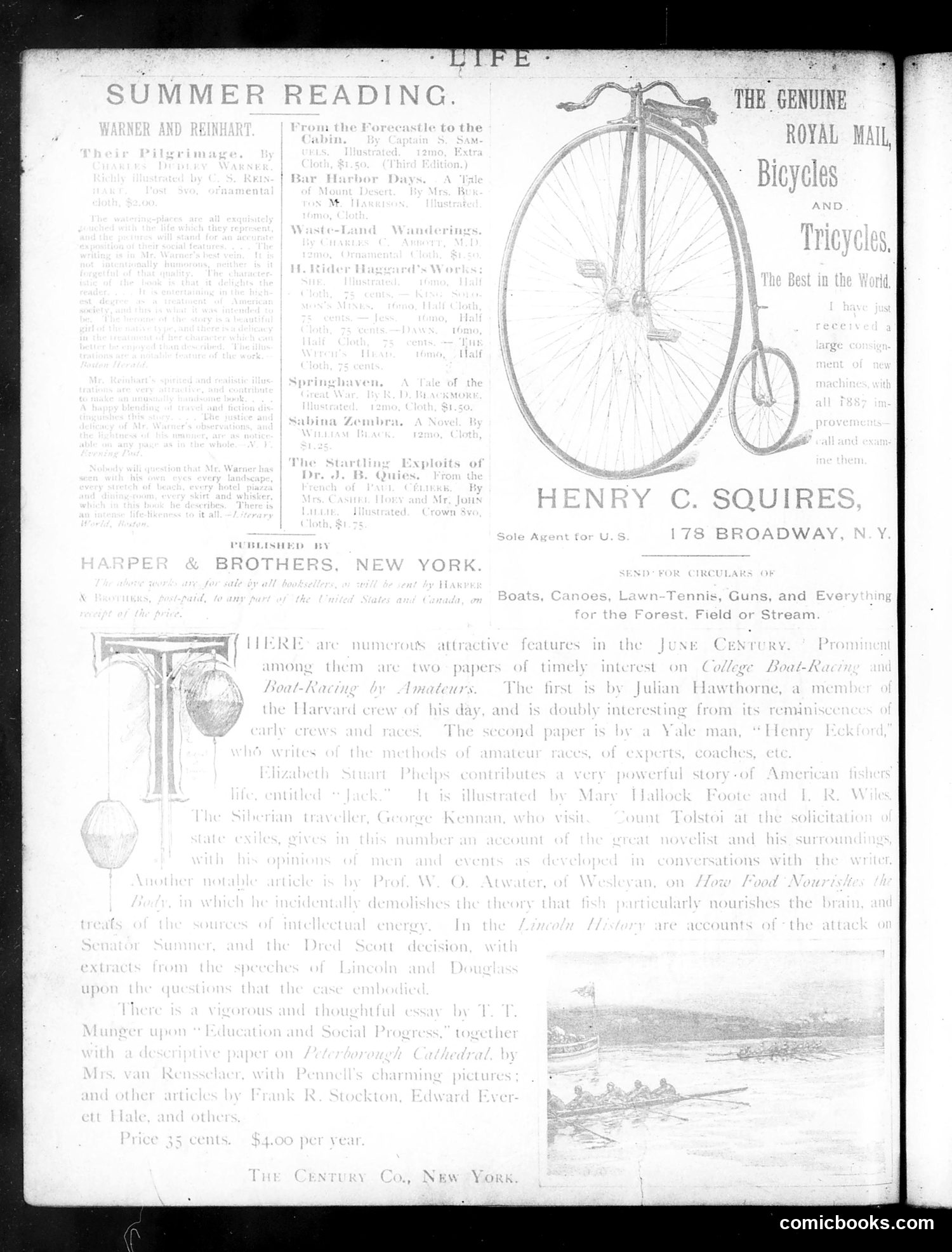
This page is primarily **advertising and editorial content**, not political satire or comics. The left side features "Summer Reading" book advertisements from Harper & Brothers, listing titles like "Their Pilgrimage" by Warner and Reinhardt and "Sabina Zembla" by William Black. The right side displays a prominent advertisement for **Royal Mail Bicycles and Tricycles** by Henry C. Squires (178 Broadway, NY), featuring a detailed illustration of a penny-farthing bicycle. The ad emphasizes these are "The Best in the World" and mentions recent improvements. Below is editorial text about the **June Century magazine**, discussing articles on boat-racing, Count Tolstoi, and food science—typical serious literary content for the era. There are no political cartoons, caricatures, or satirical commentary visible on this page. It represents standard late-19th-century magazine advertising and editorial matter.